check engine TOYOTA LAND CRUISER 2011 J200 Owner's Manual
[x] Cancel search | Manufacturer: TOYOTA, Model Year: 2011, Model line: LAND CRUISER, Model: TOYOTA LAND CRUISER 2011 J200Pages: 608, PDF Size: 8.29 MB
Page 423 of 608
Maintenance and care4
423
L/C200_U (OM60F74U)
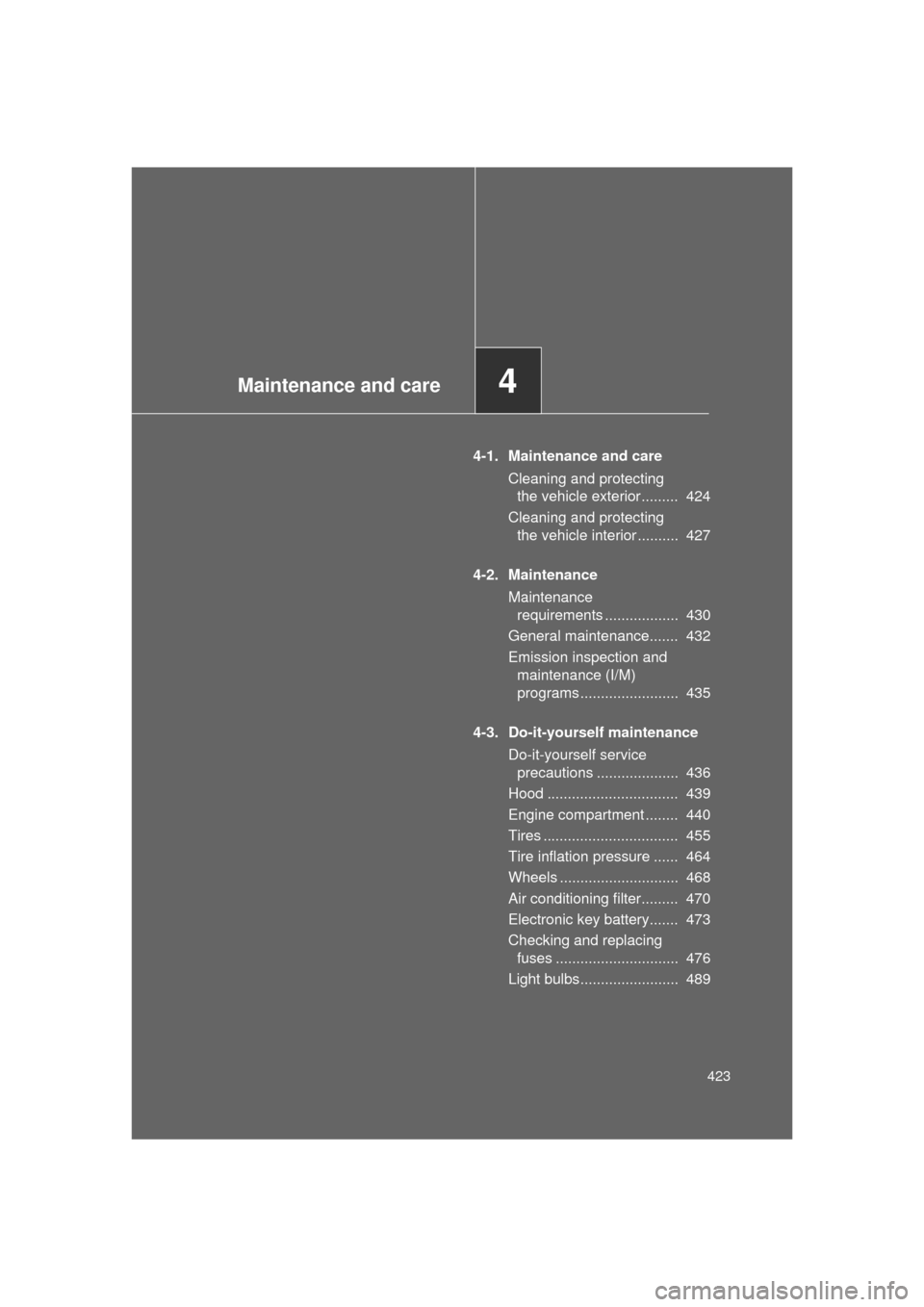
4-1. Maintenance and careCleaning and protecting the vehicle exterior ......... 424
Cleaning and protecting the vehicle interior .......... 427
4-2. Maintenance Maintenance requirements .................. 430
General maintenance....... 432
Emission inspection and maintenance (I/M)
programs ........................ 435
4-3. Do-it-yourself maintenance Do-it-yourself service precautions .................... 436
Hood ................................ 439
Engine compartment ........ 440
Tires ................................. 455
Tire inflation pressure ...... 464
Wheels ............................. 468
Air conditioning filter......... 470
Electronic key battery....... 473
Checking and replacing fuses .............................. 476
Light bulbs........................ 489
Page 432 of 608
432
4-2. Maintenance
L/C200_U (OM60F74U)
General maintenance
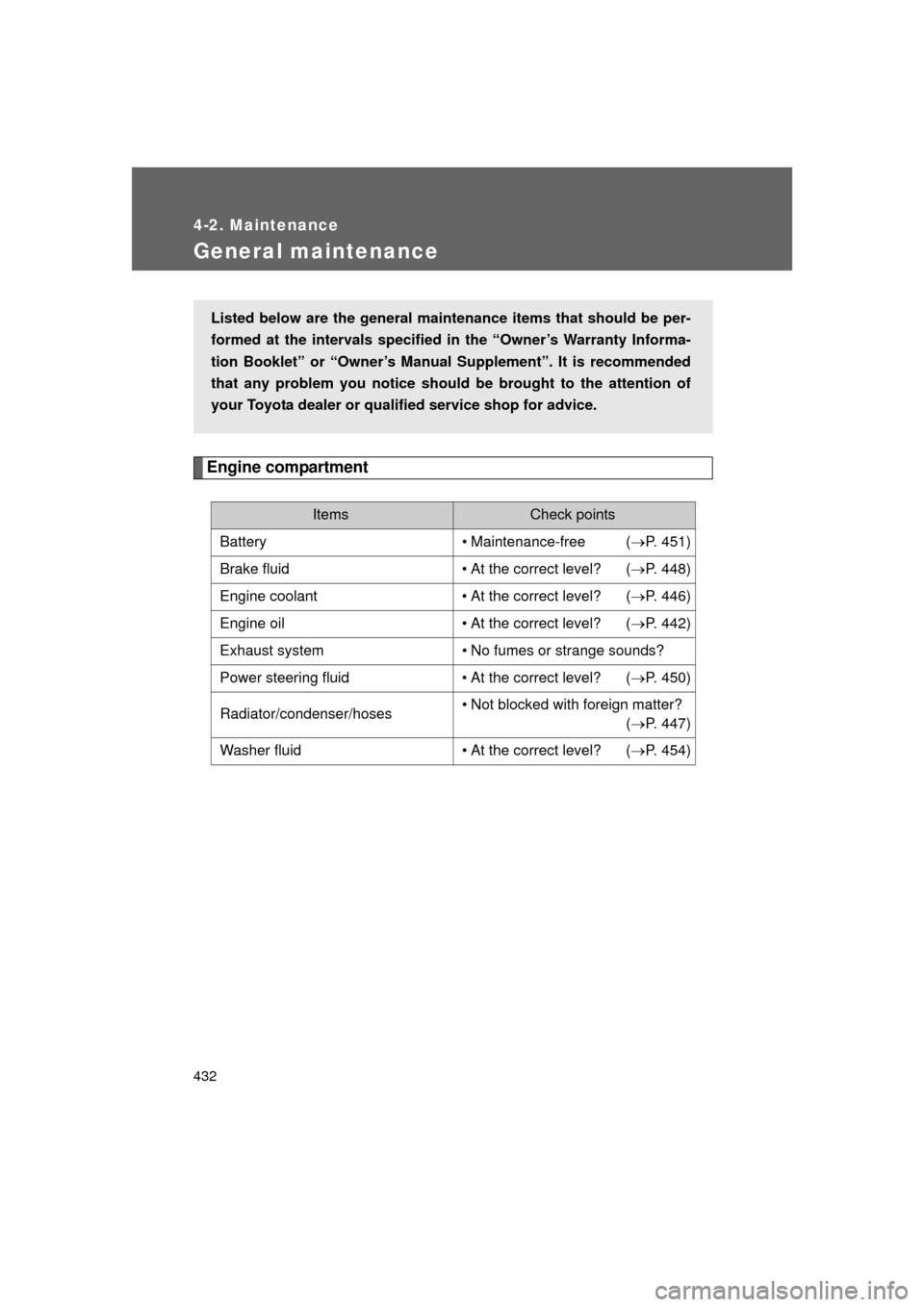
Engine compartment
ItemsCheck points
Battery • Maintenance-free ( P. 451)
Brake fluid • At the correct level? ( P. 448)
Engine coolant • At the correct level? ( P. 446)
Engine oil • At the correct level? ( P. 442)
Exhaust system • No fumes or strange sounds?
Power steering fluid • At the correct level? ( P. 450)
Radiator/condenser/hoses • Not blocked with foreign matter?
(P. 447)
Washer fluid • At the correct level? ( P. 454)
Listed below are the general maintenance items that should be per-
formed at the intervals specified in the “Owner’s Warranty Informa-
tion Booklet” or “Owner’s Manual Supplement”. It is recommended
that any problem you notice should be brought to the attention of
your Toyota dealer or qualified service shop for advice.
Page 434 of 608
434 4-2. Maintenance
L/C200_U (OM60F74U)
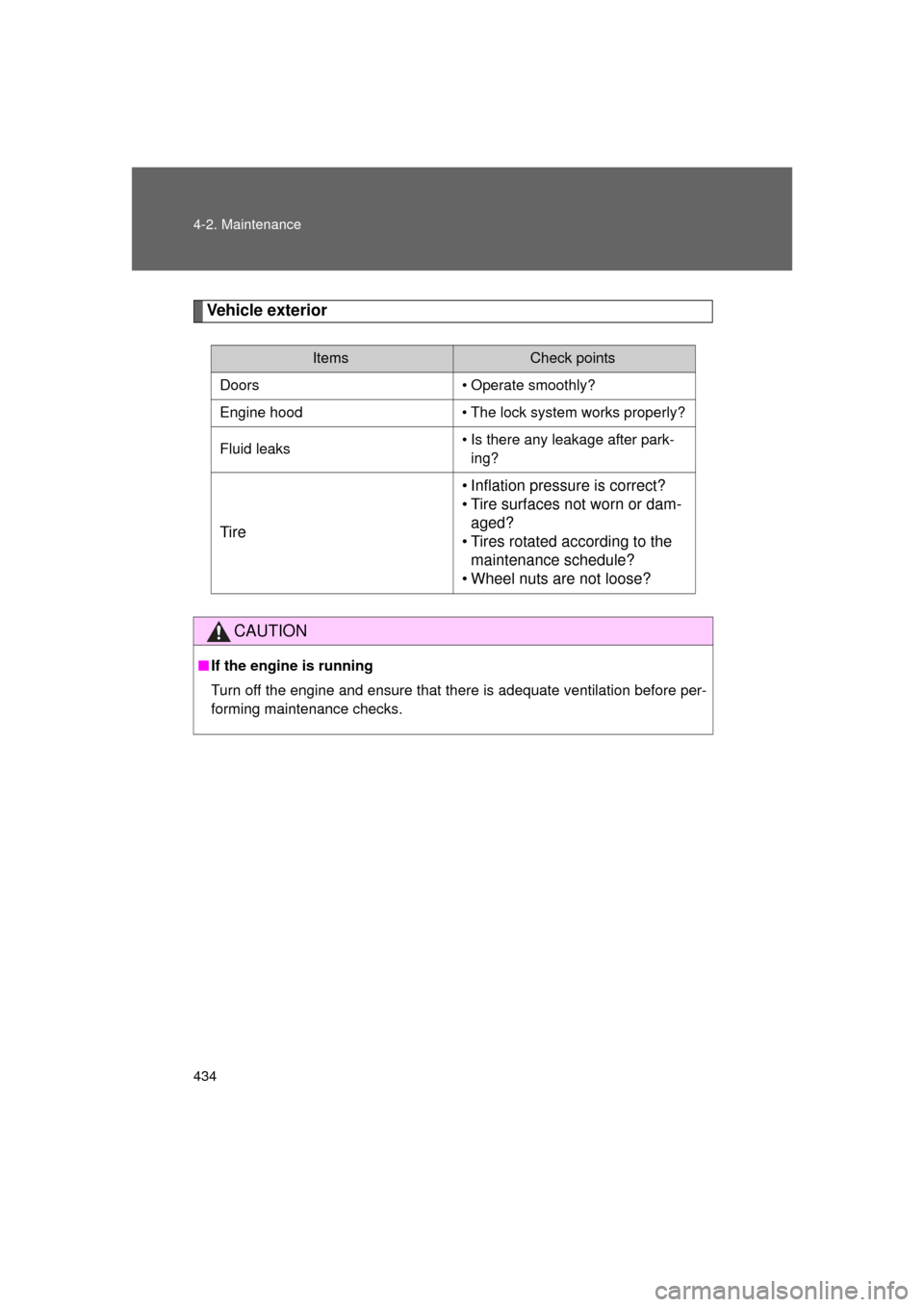
Vehicle exterior
ItemsCheck points
Doors • Operate smoothly?
Engine hood • The lock system works properly?
Fluid leaks • Is there any leakage after park-
ing?
Tire • Inflation pressure is correct?
• Tire surfaces not worn or dam-
aged?
• Tires rotated according to the maintenance schedule?
• Wheel nuts are not loose?
CAUTION
■ If the engine is running
Turn off the engine and ensure that there is adequate ventilation before per-
forming maintenance checks.
Page 442 of 608
442 4-3. Do-it-yourself maintenance
L/C200_U (OM60F74U)
Engine oilWith the engine at operating temperature and turned off, check the oil
level on the dipstick.
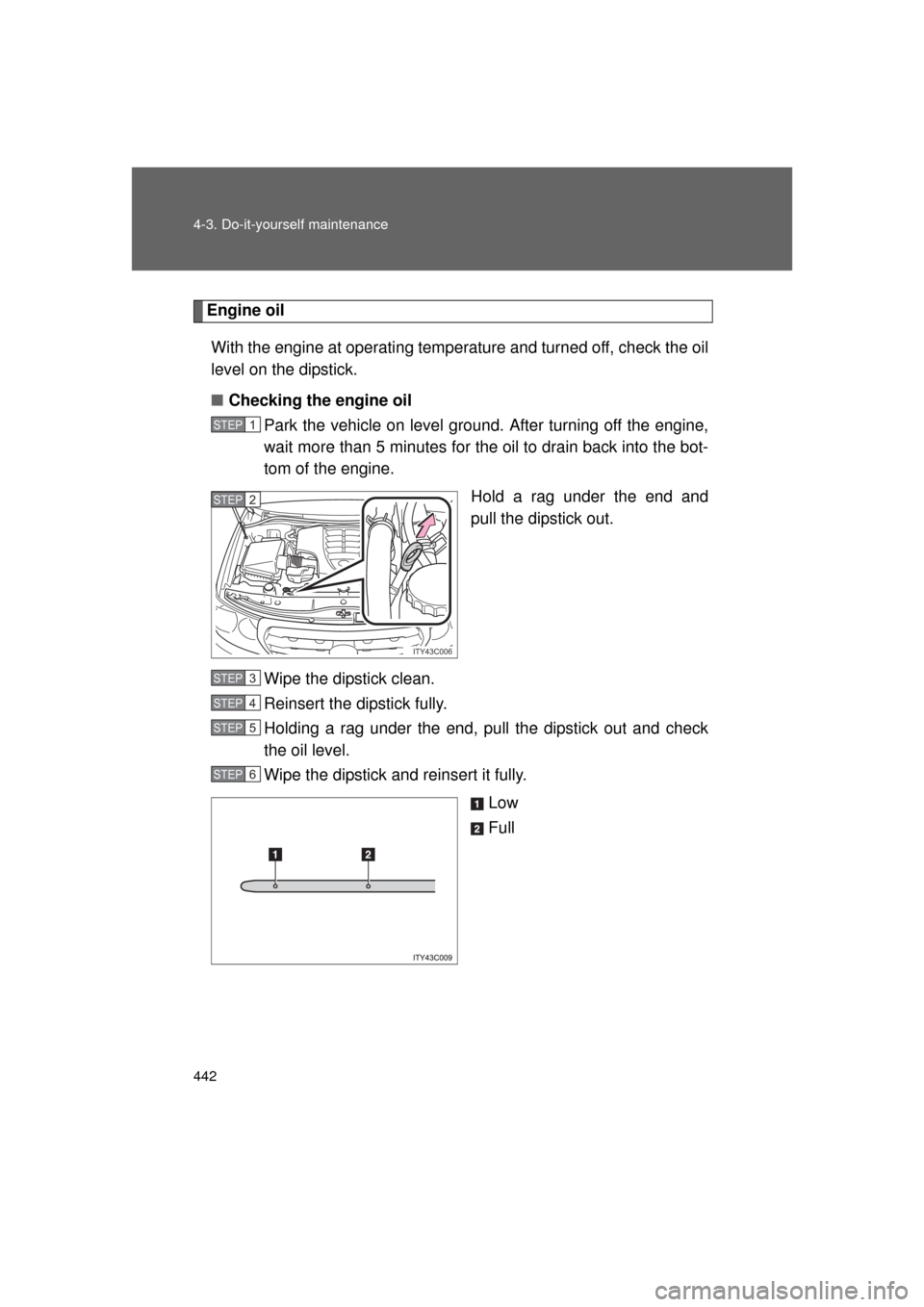
■ Checking the engine oil
Park the vehicle on level gro und. After turning off the engine,
wait more than 5 minutes for the oil to drain back into the bot-
tom of the engine.
Hold a rag under the end and
pull the dipstick out.
Wipe the dipstick clean.
Reinsert the dipstick fully.
Holding a rag under the end, pull the dipstick out and check
the oil level.
Wipe the dipstick and reinsert it fully. Low
Full
STEP1
ITY43C006
STEP2
STEP3
STEP4
STEP5
STEP6
Page 443 of 608
443
4-3. Do-it-yourself maintenance
4
Maintenance and care
L/C200_U (OM60F74U)
■
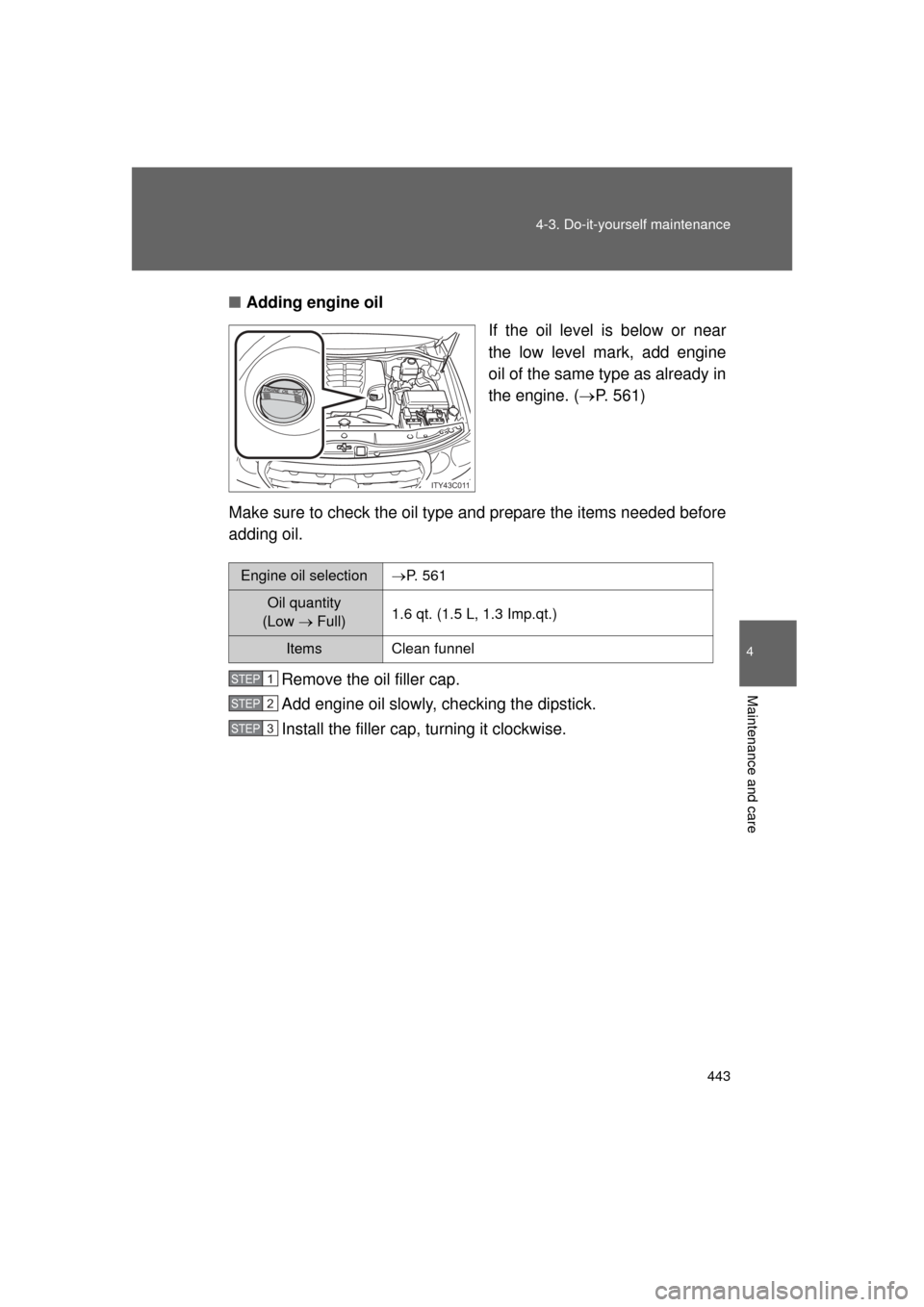
Adding engine oil
If the oil level is below or near
the low level mark, add engine
oil of the same type as already in
the engine. (P. 561)
Make sure to check the oil type and prepare the items needed before
adding oil.
Remove the oil filler cap.
Add engine oil slowly, checking the dipstick.
Install the filler cap, turning it clockwise.
ITY43C011
Engine oil selectionP. 561
Oil quantity
(Low Full)1.6 qt. (1.5 L, 1.3 Imp.qt.)
ItemsClean funnel
STEP1
STEP2
STEP3
Page 445 of 608
445
4-3. Do-it-yourself maintenance
4
Maintenance and care
L/C200_U (OM60F74U)
CAUTION
■
Used engine oil
● Used engine oil contains potentially harmful contaminants which may
cause skin disorders such as inflammation or skin cancer, so care should
be taken to avoid prolonged and repeated contact. To remove used engine
oil from your skin, wash thoroughly with soap and water.
● Dispose of used oil and filters only in a safe and acceptable manner. Do
not dispose of used oil and filters in household trash, in sewers or onto the
ground.
Call your Toyota dealer, service station or auto parts store for information
concerning recycling or disposal.
● Do not leave used engine oil within the reach of children.
NOTICE
■To prevent serious engine damage
Check the oil level on regular basis.
■ When replacing the engine oil
● Be careful not to spill engine oil on the vehicle components.
● Avoid overfilling, or the engine could be damaged.
● Check the oil level on the dipstick every time you refill the vehicle.
● Be sure the engine oil filler cap is properly retightened.
Page 446 of 608
446 4-3. Do-it-yourself maintenance
L/C200_U (OM60F74U)
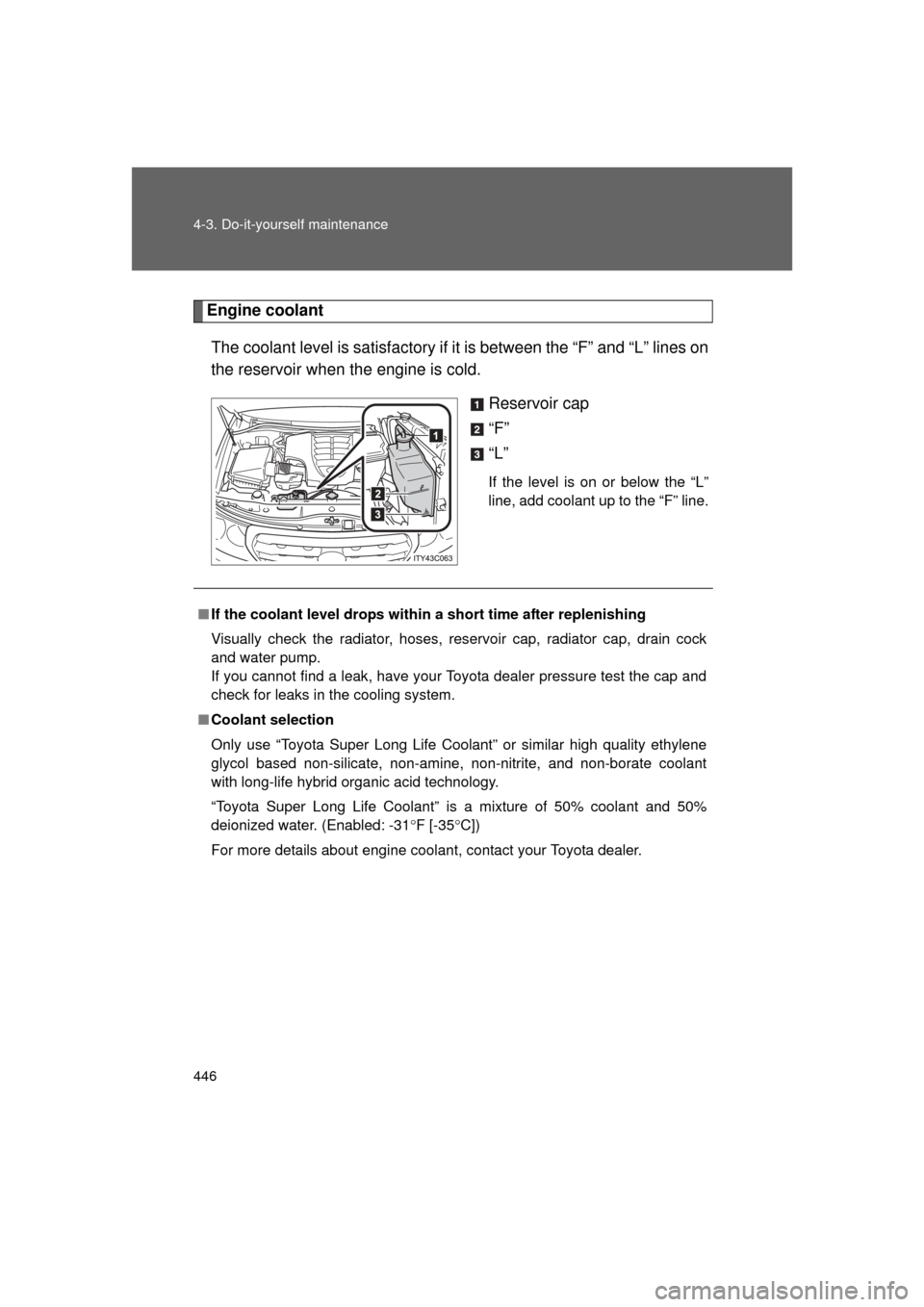
Engine coolantThe coolant level is sati sfactory if it is between the “F” and “L” lines on
the reservoir when the engine is cold.
Reservoir cap
“F”
“L”
If the level is on or below the “L”
line, add coolant up to the “F” line.
■If the coolant level drops within a short time after replenishing
Visually check the radiator, hoses, reservoir cap, radiator cap, drain cock
and water pump.
If you cannot find a leak, have your Toyota dealer pressure test the cap and
check for leaks in the cooling system.
■ Coolant selection
Only use “Toyota Super Long Life Coolant” or similar high quality ethylene
glycol based non-silicate, non-amine, non-nitrite, and non-borate coolant
with long-life hybrid organic acid technology.
“Toyota Super Long Life Coolant” is a mixture of 50% coolant and 50%
deionized water. (Enabled: -31 F [-35 C])
For more details about engine coolant, contact your Toyota dealer.
Page 447 of 608
447
4-3. Do-it-yourself maintenance
4
Maintenance and care
L/C200_U (OM60F74U)
Radiator and condenser
Check the radiator and condenser and clear any foreign objects.
If either of the above parts are extremely dirty or you are not sure of
their condition, have your vehicl e checked by your Toyota dealer.
CAUTION
■When the engine is hot
Do not remove the radiator cap.
The cooling system may be under pressure and may spray hot coolant if the
cap is removed, causing burns or other injuries.
NOTICE
■When adding the engine coolant
Coolant is neither plain water nor stra ight antifreeze. The correct mixture of
water and antifreeze must be used to provide proper lubrication, corrosion
protection and cooling. Be sure to read the antifreeze or coolant label.
■ If you spill coolant
Be sure to wash it off with water to prevent it damage to parts or paint.
CAUTION
■When the engine is hot
Do not touch the radiator or condenser as they may be hot and you may be
burned.
Page 448 of 608
448 4-3. Do-it-yourself maintenance
L/C200_U (OM60F74U)
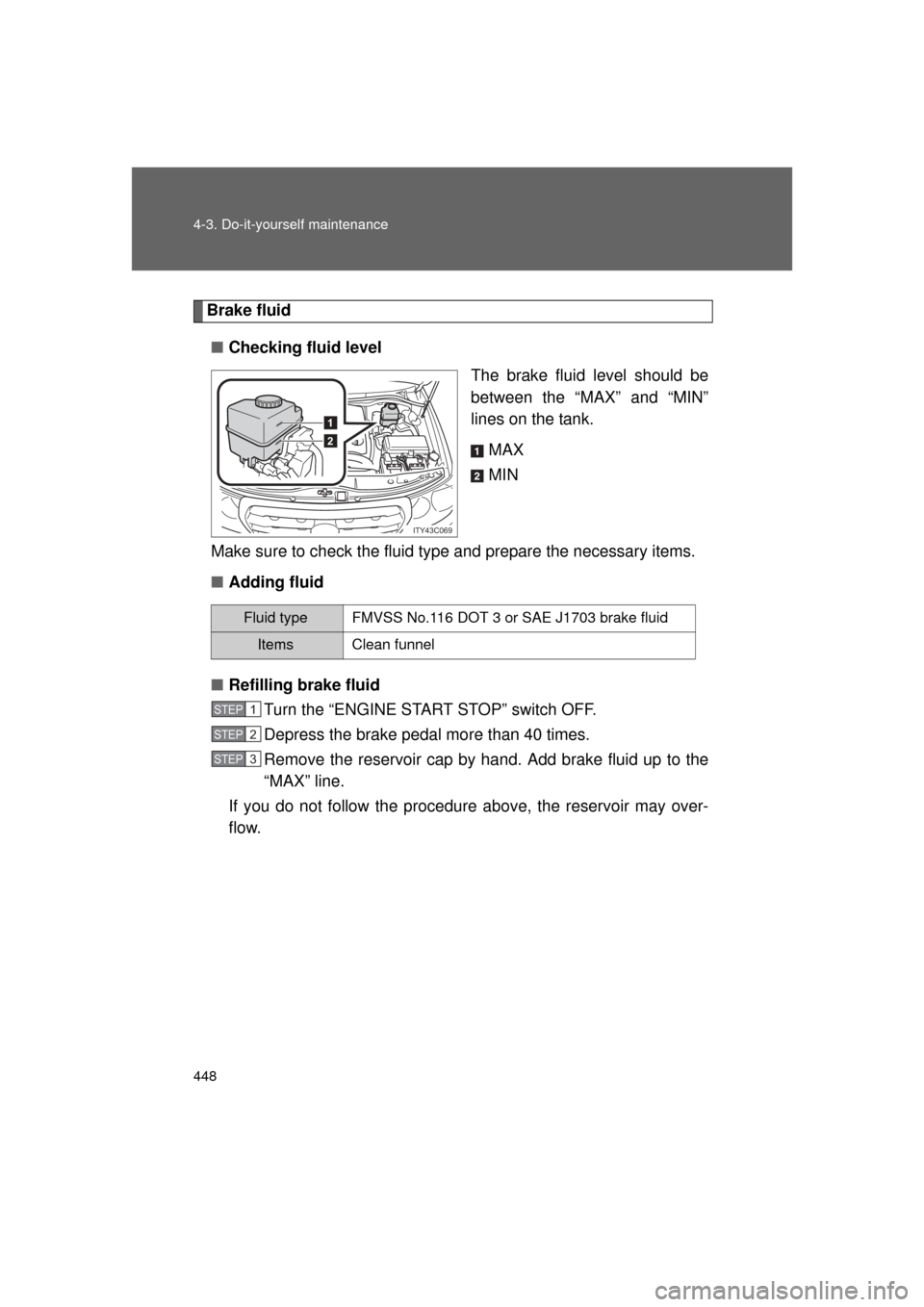
Brake fluid■ Checking fluid level
The brake fluid level should be
between the “MAX” and “MIN”
lines on the tank.
MAX
MIN
Make sure to check the fluid type and prepare the necessary items.
■ Adding fluid
■ Refilling brake fluid
Turn the “ENGINE START STOP” switch OFF.
Depress the brake pedal more than 40 times.
Remove the reservoir cap by ha nd. Add brake fluid up to the
“MAX” line.
If you do not follow the procedure above, the reservoir may over-
flow.
1
2
ITY43C069
Fluid typeFMVSS No.116 DOT 3 or SAE J1703 brake fluid
ItemsClean funnel
STEP1
STEP2
STEP3
Page 450 of 608
450 4-3. Do-it-yourself maintenance
L/C200_U (OM60F74U)
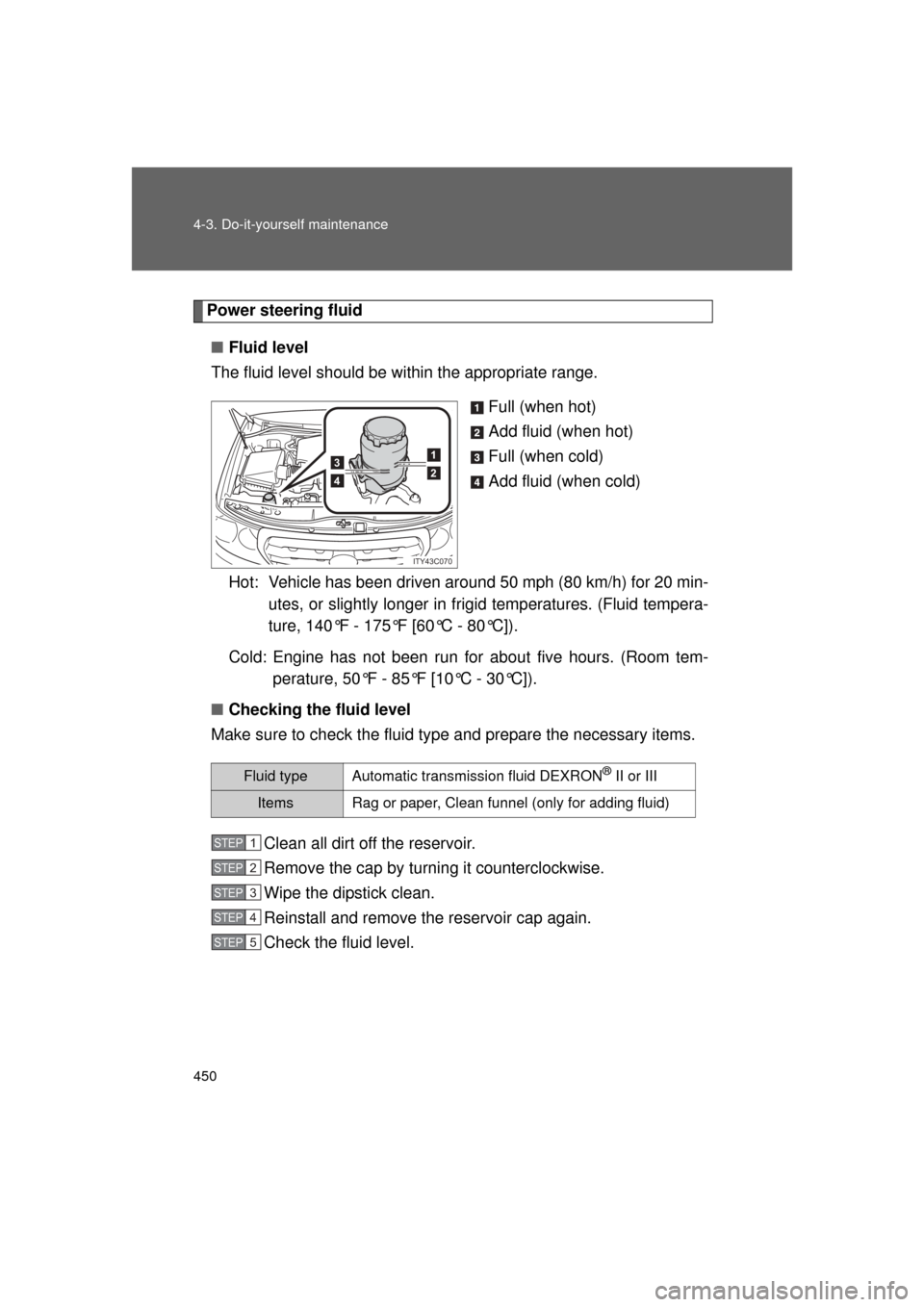
Power steering fluid■ Fluid level
The fluid level should be within the appropriate range.
Full (when hot)
Add fluid (when hot)
Full (when cold)
Add fluid (when cold)
Hot: Vehicle has been driven around 50 mph (80 km/h) for 20 min- utes, or slightly longer in frig id temperatures. (Fluid tempera-
ture, 140°F - 175°F [60°C - 80°C]).
Cold: Engine has not been run for about five hours. (Room tem- perature, 50°F - 85°F [10°C - 30°C]).
■ Checking the fluid level
Make sure to check the fluid type and prepare the necessary items.
Clean all dirt off the reservoir.
Remove the cap by turning it counterclockwise.
Wipe the dipstick clean.
Reinstall and remove the reservoir cap again.
Check the fluid level.
1
23
4
ITY43C070
Fluid typeAutomatic transmission fluid DEXRON® II or III
ItemsRag or paper, Clean funnel (only for adding fluid)
STEP1
STEP2
STEP3
STEP4
STEP5