parking TOYOTA LAND CRUISER 2012 User Guide
[x] Cancel search | Manufacturer: TOYOTA, Model Year: 2012, Model line: LAND CRUISER, Model: TOYOTA LAND CRUISER 2012Pages: 692, PDF Size: 29.3 MB
Page 178 of 692
178
L/C200_EE (OM60G38E)
2-1. Driving procedures
Driving the vehicle
The following procedures should be observed to ensure safe driv-
ing.
Starting the engine (P. 190)
Driving
With the brake pedal depressed, shift the shift lever to “D”.
(P. 194)
Release the parking brake. (P. 201)
Gradually release the brake pedal and gently push the
accelerator pedal to accelerate the vehicle.
Stopping
With the shift lever in “D”, push the brake pedal.
If necessary, set the parking brake.
When the vehicle is stopped for an extended period of time, shift
the shift lever to “P” or “N”. (P. 194)
Parking the vehicle
With the shift lever in “D”, push the brake pedal.
Set the parking brake. (P. 201)
Shift the shift lever to “P”. (P. 194)
When parking on a hill, if necessary, block the wheels.
Press the “ENGINE START STOP” switch to stop the
engine.
Lock the door, making sure that you have the electronic key
on your person.
STEP1
STEP2
STEP3
STEP1
STEP2
STEP1
STEP2
STEP3
STEP4
STEP5
Page 179 of 692
179 2-1. Driving procedures
2
When driving
L/C200_EE (OM60G38E)
Starting on a steep uphill
Firmly set the parking brake and shift the shift lever to “D”.
Gently depress the accelerator pedal.
Release the parking brake.
Driving in the rain
Drive carefully when it is raining, because visibility will be reduced, the
windows may become fogged-up, and the road will be slippery.
Drive carefully when it starts to rain, because the road surface will be
especially slippery.
Refrain from high speeds when driving on an expressway in the rain,
because there may be a layer of water between the tires and the road
surface, preventing the steering and brakes from operating properly.
Engine speed while driving
In the following conditions, the engine speed may become high while driving.
This is due to automatic up-shifting control or down-shifting implementation
to meet driving conditions. It does not indicate sudden acceleration.
The vehicle is judged to be driving uphill or downhill
When the accelerator pedal is released
Breaking in your new Toyota
To extend the life of the vehicle, the following precautions are recommended
to observe:
For the first 300 km (200 miles):
Avoid sudden stops.
For the first 800 km (500 miles):
Do not tow a trailer.
For the first 1000 km (600 miles):
• Do not drive at extremely high speeds.
• Avoid sudden acceleration.
• Do not drive continuously in the low gears.
• Do not drive at a constant speed for extended periods.
STEP1
STEP2
STEP3
Page 180 of 692
180 2-1. Driving procedures
L/C200_EE (OM60G38E)
Drum-in-disc type parking brake system
Your vehicle has a drum-in-disc type parking brake system.
This type of brake system needs bedding-down of the brake shoes periodi-
cally or whenever the parking brake shoes and/or drums are replaced.
Have any authorized Toyota dealer or repairer, or another duly qualified and
equipped professional, perform the bedding-down.
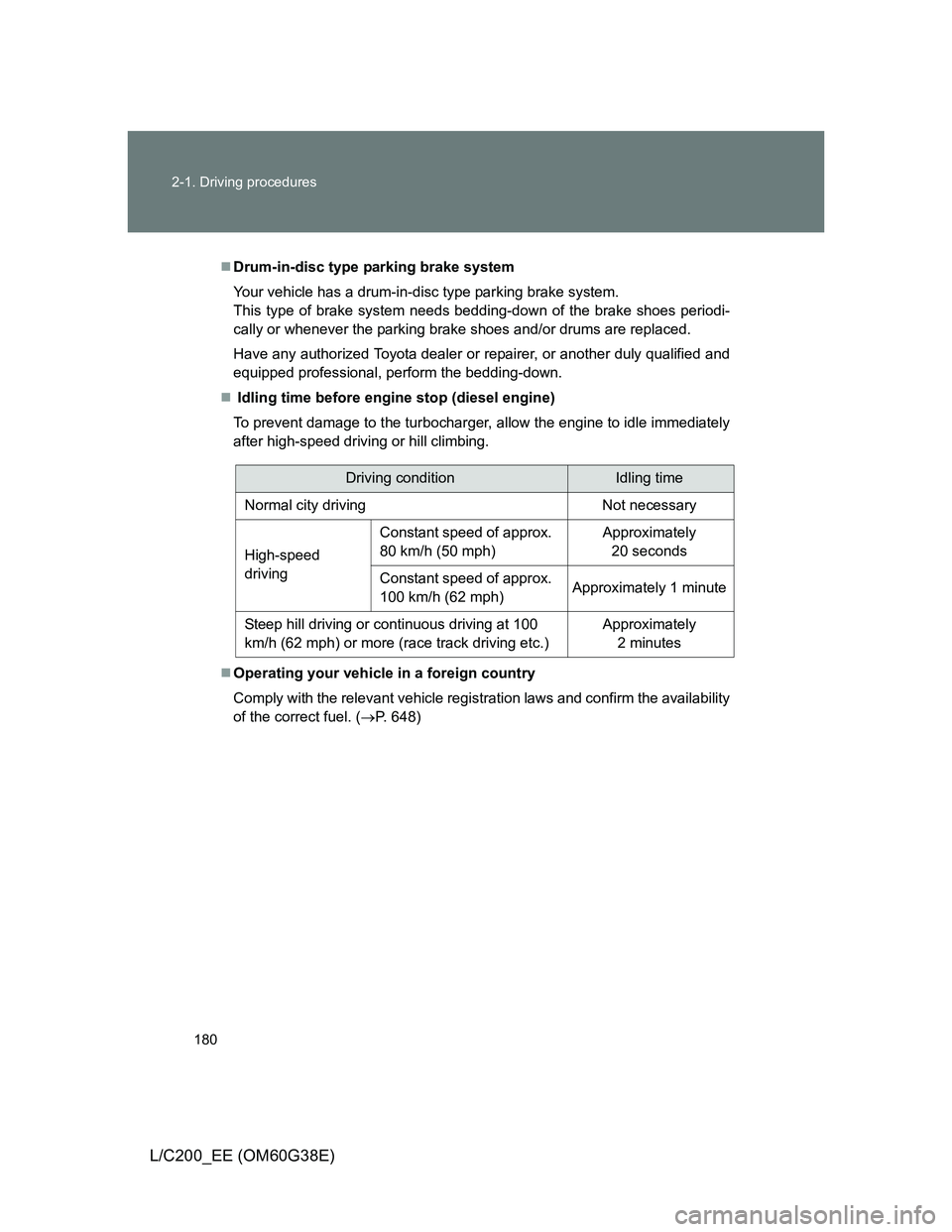
Idling time before engine stop (diesel engine)
To prevent damage to the turbocharger, allow the engine to idle immediately
after high-speed driving or hill climbing.
Operating your vehicle in a foreign country
Comply with the relevant vehicle registration laws and confirm the availability
of the correct fuel. (P. 648)
Driving conditionIdling time
Normal city driving Not necessary
High-speed
drivingConstant speed of approx.
80 km/h (50 mph)Approximately
20 seconds
Constant speed of approx.
100 km/h (62 mph)Approximately 1 minute
Steep hill driving or continuous driving at 100
km/h (62 mph) or more (race track driving etc.)Approximately
2 minutes
Page 184 of 692
184 2-1. Driving procedures
L/C200_EE (OM60G38E)
CAUTION
When stopped on an inclined surface, use the brake pedal and parking
brake to prevent the vehicle from rolling backward or forward and causing
an accident.
Do not adjust the position of the steering wheel, the seat, or the inside or
outside rear view mirrors while driving.
Doing so may result in a loss of vehicle control that can cause accidents
that may result in death or serious injury.
Always check that all passengers’ arms, heads or other parts of their bod-
ies are not outside the vehicle, as this may result in death or serious injury.
Vehicles with the 4-Wheel AHC & AVS: When crossing rivers, turn off
height control after putting the vehicle height in high mode, and drive at
30 km/h (18 mph) or less. Otherwise the vehicle height may change due to
the automatic leveling function, resulting in an accident. (P. 248)
When driving on slippery road surfaces
Sudden braking, acceleration and steering may cause tire slippage and
reduce your ability to control the vehicle, resulting in an accident.
Sudden acceleration, engine braking due to shift changing, or changes in
engine speed could cause the vehicle to skid, resulting in an accident
After driving through a puddle, lightly depress the brake pedal to make
sure that the brakes are functioning properly. Wet brake pads may prevent
the brakes from functioning properly. If the brakes on only one side are wet
and not functioning properly, steering control may be affected, resulting in
an accident.
When shifting the shift lever
Be careful not to shift the shift lever with the accelerator pedal depressed.
This may lead to unexpected rapid acceleration of the vehicle that may
cause an accident and result in death or serious injury.
If you hear a squealing or scraping noise (brake pad wear indicators)
Have your Toyota dealer check and replace the brake pads as soon as pos-
sible.
Rotor damage may result if the pads are not replaced when needed.
It is dangerous to drive the vehicle when the wear limits of the brake pads
and/or those of the rotors are exceeded.
Page 185 of 692
185 2-1. Driving procedures
2
When driving
L/C200_EE (OM60G38E)
CAUTION
When the vehicle is stopped
Do not race the engine.
If the vehicle is in any gear other than “P” or “N”, the vehicle may acceler-
ate suddenly and unexpectedly, and may cause an accident.
Do not leave the vehicle with the engine running for a long time.
If such a situation cannot be avoided, park the vehicle in an open space
and check that exhaust fumes do not enter the vehicle interior.
In order to prevent accidents due to the vehicle rolling away, always keep
depressing the brake pedal while the engine is running, and apply the
parking brake as necessary.
If the vehicle is stopped on an incline, in order to prevent accidents caused
by the vehicle rolling forward or backward, always depress the brake pedal
and securely apply the parking brake as needed.
Avoid revving or racing the engine.
Running the engine at high speed while the vehicle is stopped may cause
the exhaust system to overheat, which could result in a fire if combustible
material is nearby.
When the vehicle is parked
Do not leave glasses, cigarette lighters, spray cans, or soft drink cans in
the vehicle when it is in the sun.
Failure to do so may result in the following:
• Gas may leak from a cigarette lighter or spray can, and may lead to a
fire.
• The temperature inside the vehicle may cause the plastic lenses and
plastic material of eye glasses to deform or crack.
• Soft drink cans may fracture, causing the contents to spray over the
interior of the vehicle, and may also cause a short circuit in the vehi-
cle’s electrical components.
Always apply the parking brake, shift the shift lever to “P”, stop the engine
and lock the vehicle.
Do not leave the vehicle unattended while the engine is running.
Page 187 of 692
187 2-1. Driving procedures
2
When driving
L/C200_EE (OM60G38E)
CAUTION
When taking a nap in the vehicle
Always turn the engine off. Otherwise, you may accidentally move the shift
lever or depress the accelerator pedal, which could cause an accident or fire
due to engine overheating. Additionally, if the vehicle is parked in a poorly
ventilated area, exhaust gases may collect and may enter the vehicle, lead-
ing to death or a serious health hazard.
When braking the vehicle
When the brakes are wet, drive more cautiously.
Braking distance increases when the brakes are wet, and may cause one
side of the vehicle to brake differently than the other side. Also the parking
brake may not securely hold the vehicle.
If the power brake assist function does not operate, do not follow other
vehicles closely and avoid downhills or sharp turns that require braking.
In this case, braking is still possible, but it will require more force on the
pedal than usual. Braking distance may also increase.
Do not pump the brake pedal if the engine stalls.
Each push on the brake pedal uses up the reserve for the power-assisted
brakes.
The brake system consists of 2 individual hydraulic systems: If one of the
systems fails, the other will still operate. In this case, the brake pedal
should be depressed more firmly than usual and braking distance
becomes longer.
Do not drive your vehicle with only a single brake system. Have your
brakes fixed immediately.
Page 188 of 692
188 2-1. Driving procedures
L/C200_EE (OM60G38E)
NOTICE
When driving the vehicle
Do not depress the accelerator and brake pedals at the same time during
driving. If the brake pedal is depressed while driving with the accelerator
pedal depressed, driving torque may be restrained.
Do not use the accelerator pedal or depress accelerator and brake pedals
together to hold the vehicle on a hill.
When parking the vehicle
Always put the shift lever in “P”. Failure to do so may cause the vehicle to
move or the vehicle may accelerate suddenly if the accelerator pedal is acci-
dentally depressed.
Avoiding damage to vehicle parts
Do not turn the steering wheel fully in either direction and hold it there for a
long time.
Doing so may damage the power steering pump.
When driving over bumps in the road, drive as slowly as possible to avoid
damaging the wheels, underside of the vehicle, etc.
Diesel engine only: Make sure to idle the engine immediately after high-
speed driving or hill climbing. Stop the engine only after the turbocharger
has cooled down.
Failure to do so may cause damage to the turbocharger.
Page 190 of 692
190
2-1. Driving procedures
L/C200_EE (OM60G38E)
Engine (ignition) switch
Performing the following operations when carrying the electronic
key on your person starts the engine or changes “ENGINE START
STOP” switch modes.
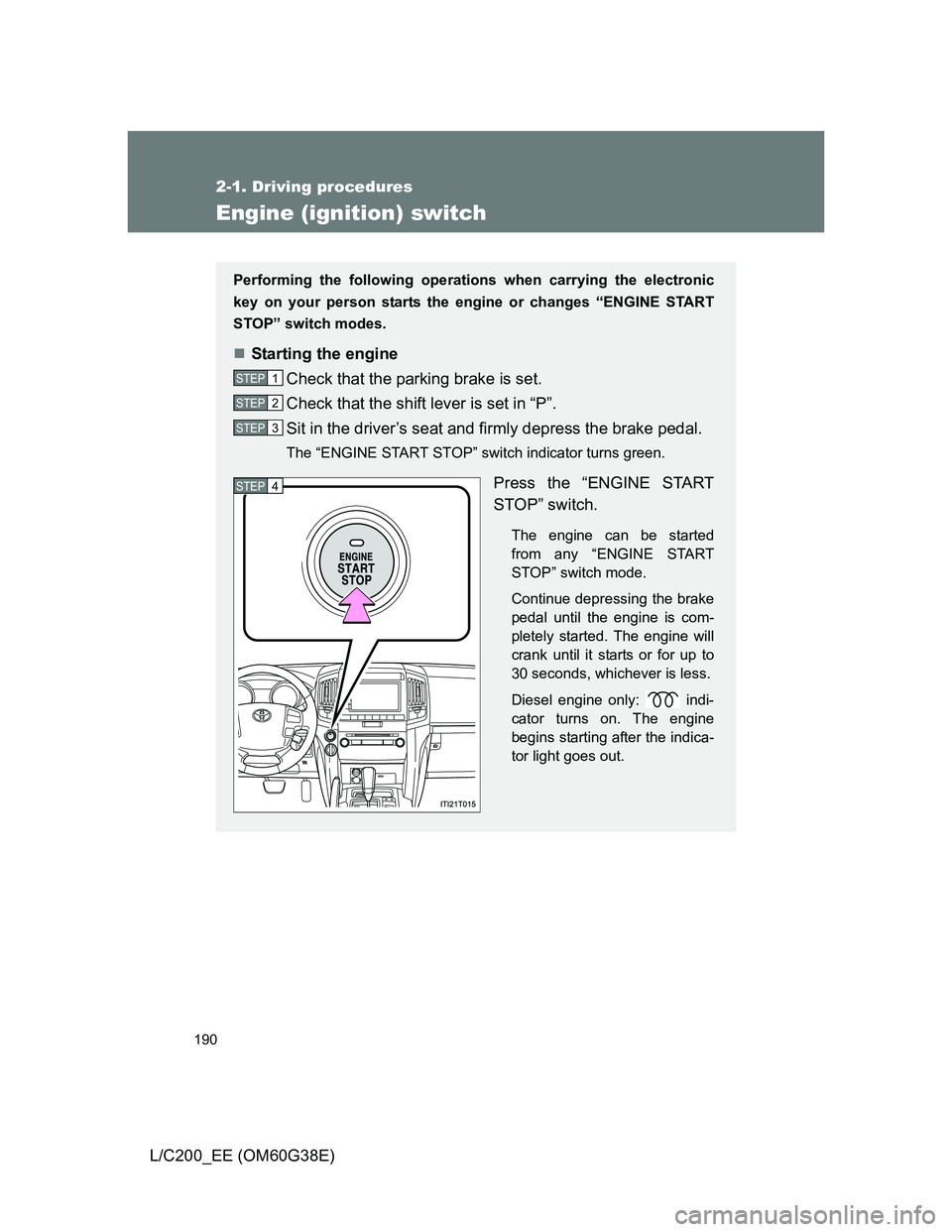
Starting the engine
Check that the parking brake is set.
Check that the shift lever is set in “P”.
Sit in the driver’s seat and firmly depress the brake pedal.
The “ENGINE START STOP” switch indicator turns green.
Press the “ENGINE START
STOP” switch.
The engine can be started
from any “ENGINE START
STOP” switch mode.
Continue depressing the brake
pedal until the engine is com-
pletely started. The engine will
crank until it starts or for up to
30 seconds, whichever is less.
Diesel engine only: indi-
cator turns on. The engine
begins starting after the indica-
tor light goes out.
STEP1
STEP2
STEP3
STEP4
Page 195 of 692
195 2-1. Driving procedures
2
When driving
L/C200_EE (OM60G38E)
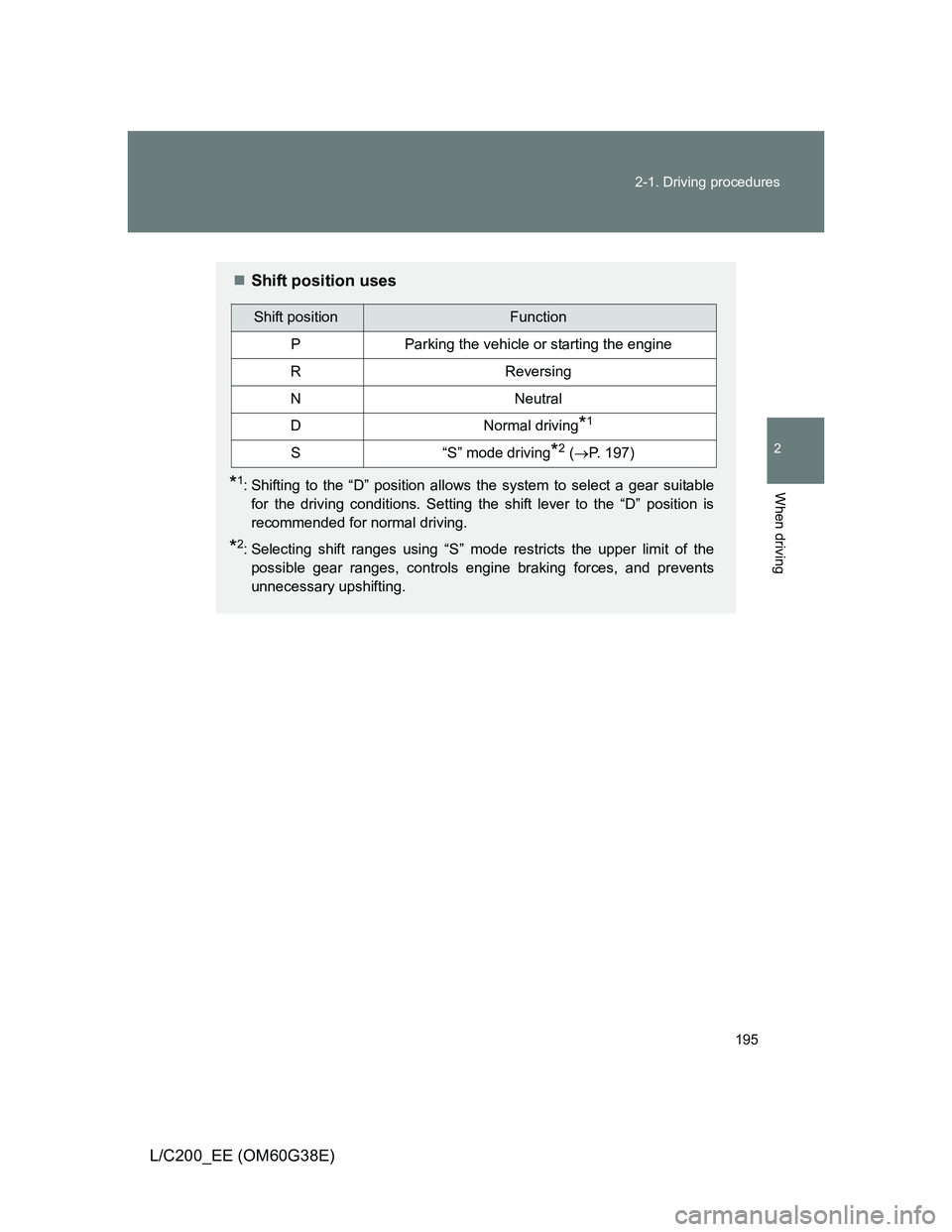
Shift position uses
*1: Shifting to the “D” position allows the system to select a gear suitable
for the driving conditions. Setting the shift lever to the “D” position is
recommended for normal driving.
*2: Selecting shift ranges using “S” mode restricts the upper limit of the
possible gear ranges, controls engine braking forces, and prevents
unnecessary upshifting.
Shift positionFunction
PParking the vehicle or starting the engine
RReversing
NNeutral
DNormal driving*1
S“S” mode driving*2 (P. 197)
Page 201 of 692
201
2-1. Driving procedures
2
When driving
L/C200_EE (OM60G38E)
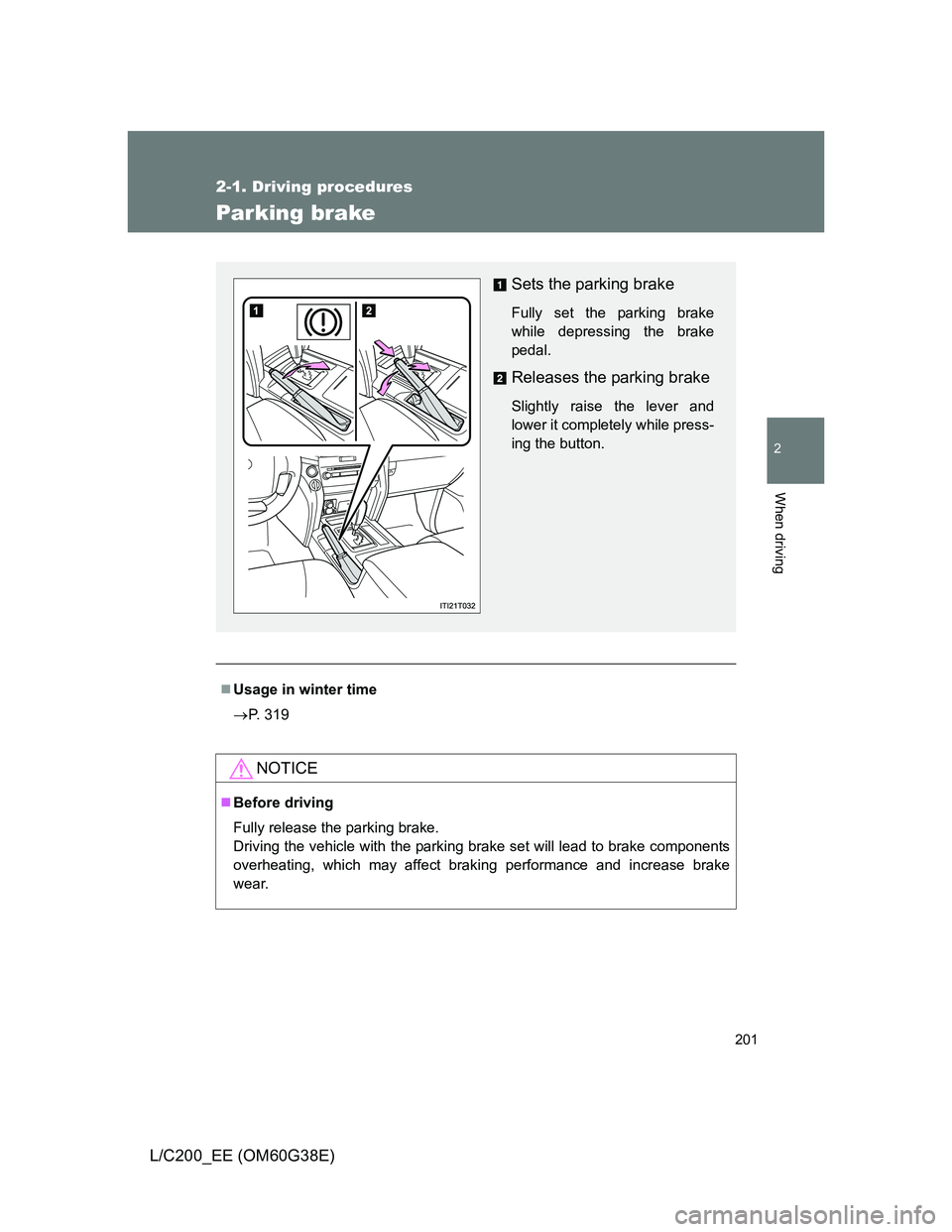
Parking brake
Usage in winter time
P. 319
NOTICE
Before driving
Fully release the parking brake.
Driving the vehicle with the parking brake set will lead to brake components
overheating, which may affect braking performance and increase brake
wear.
Sets the parking brake
Fully set the parking brake
while depressing the brake
pedal.
Releases the parking brake
Slightly raise the lever and
lower it completely while press-
ing the button.