brake fluid TOYOTA LAND CRUISER 2012 Owners Manual
[x] Cancel search | Manufacturer: TOYOTA, Model Year: 2012, Model line: LAND CRUISER, Model: TOYOTA LAND CRUISER 2012Pages: 692, PDF Size: 29.3 MB
Page 189 of 692
189 2-1. Driving procedures
2
When driving
L/C200_EE (OM60G38E)
NOTICE
If you get a flat tire while driving
A flat or damaged tire may cause the following situations. Hold the steering
wheel firmly and gradually press the brake pedal to slow down the vehicle.
It may be difficult to control your vehicle.
The vehicle will make abnormal sounds.
The vehicle will behave abnormally.
Replace a flat tire with a new one. (P. 601)
When encountering flooded roads
Do not drive on a road that has flooded after heavy rain etc. Doing so may
cause the following serious damage to the vehicle.
Engine stalling
Short in electrical components
Engine damage caused by water immersion
In the event that you drive on a flooded road and the vehicle is flooded, be
sure to have any authorized Toyota dealer or repairer, or another duly quali-
fied and equipped professional check the following.
Brake function
Changes in quantity and quality of oil and fluid used for the engine, trans-
mission, transfer, differentials, etc.
Lubricant condition for the propeller shaft, bearings and suspension joints
(where possible) and the function of all joints, bearings, etc.
Page 254 of 692
254 2-4. Using other driving systems
L/C200_EE (OM60G38E)
In the following cases the 4-Wheel AHC will not operate
The brake pedal has been depressed for a few seconds or longer while
the vehicle is stopped.
Vehicle height control has not been frequently used.
The suspension fluid temperature is lower than -30°C (-22°F).
There is ice on the suspension.
Driving on bumpy roads which may cause the suspension to fully elon-
gate.
If the steering wheel is abruptly turned more than 3/4 of a revolution with
the center differential lock system activated.
Cold weather operation
It may take longer for the vehicle height to change if the suspension fluid
temperature drops below -15°C (5°F).
The 4-Wheel AHC does not operate when the suspension fluid temperature
drops below -30°C (-22°F).
In this case, even if the height select switch is pressed, the vehicle height
will not change. Once the vehicle has been driven for a short time and
the suspension fluid has been warmed to within normal operating limits,
the 4-Wheel AHC will begin operating and the vehicle height will auto-
matically change to the selected mode.
When the suspension fluid is around -30°C (-22°F), the vehicle height
may not be able to be raised, even if the 4-Wheel AHC is operating. In
this case, push “ ” then “ ” on the height select switch after driving for
a short time longer to select the desired vehicle height.
Parking and stopping tips
If you immediately stop the engine after off-road driving, the vehicle
height may gradually lower. When parking, make sure there is nothing
under the vehicle that may come in contact with the underbody. The vehi-
cle will return to the set height when the engine is started.
The vehicle height may change as the temperature changes when the
engine is stopped. The vehicle will return to the set height when the
engine is started.
Page 495 of 692
495 4-2. Maintenance
4
Maintenance and care
L/C200_EE (OM60G38E)
Where to go for service?
In order to maintain your vehicle in the highest possible condition, Toyota
recommends that all repairs and service operations be carried out by autho-
rized Toyota dealers or repairers or other duly qualified and equipped profes-
sionals. For repairs and services covered by your warranty, please visit an
authorized Toyota dealer or repairer, who will use genuine Toyota parts in
repairing any difficulties you may encounter. There can also be advantages
in utilizing authorized Toyota dealers or repairers for non-warranty repairs
and services, as members of the Toyota network will be able to expertly
assist you with any difficulties you may encounter.
Your Toyota dealer or repairer, or another duly qualified and equipped pro-
fessional service department will perform all of the scheduled maintenance
on your vehicle-reliably and economically due to their experience with
Toyota vehicles.
Does your vehicle need repair?
Be on the alert for changes in performance and sounds, and visual tip-offs
that indicate service is needed. Some important clues are:
Engine missing, stumbling, or pinging
Appreciable loss of power
Strange engine noises
A fluid leak under the vehicle (However, water dripping from the air condi-
tioning after use is normal.)
Change in exhaust sound (This may indicate a dangerous carbon mon-
oxide leak. Drive with the windows open and have the exhaust system
checked immediately.)
Flat-looking tires, excessive tire squeal when cornering, uneven tire wear
Vehicle pulls to one side when driving straight on a level road
Strange noises related to suspension movement
Loss of brake effectiveness, spongy feeling brake pedal, pedal almost
touches the floor, vehicle pulls to one side when braking
Engine coolant temperature continually higher than normal
Engine continually runs hot, oil pressure gauge stays low
Page 499 of 692
499 4-3. Do-it-yourself maintenance
4
Maintenance and care
L/C200_EE (OM60G38E)
CAUTION
The engine compartment contains many mechanisms and fluids that may
move suddenly, become hot, or become electrically energized. To avoid death
or serious injury observe the following precautions.
When working on the engine compartment
Keep hands, clothing, and tools away from the moving fan and engine
drive belt.
Be careful not to touch the engine, radiator, exhaust manifold, etc. right
after driving as they may be hot. Oil and other fluids may also be hot.
Do not leave anything that may burn easily, such as paper or rags, in the
engine compartment.
Do not smoke, cause sparks or expose an open flame to fuel or the bat-
tery. Fuel and battery fumes are flammable.
Be extremely cautious when working on the battery. It contains poisonous
and corrosive sulfuric acid.
Take care because brake fluid can harm your hands or eyes and damage
painted surfaces.
If fluid gets on your hands or in your eyes, flush the affected area with
clean water immediately.
If you still experience discomfort, see a doctor.
When working near the electric cooling fan or radiator grille
Be sure the “ENGINE START STOP” switch is off.
With the “ENGINE START STOP” switch in IGNITION ON mode, the electric
cooling fan may automatically start to run if the air conditioning is on and/or
the coolant temperature is high. (P. 511)
When working on or under the vehicle
Do not get under the vehicle with just the jack supporting it.
Always use automotive jack stands or other solid supports.
Use eye protection to prevent flying or falling material, fluid spray, etc. from
getting in your eyes.
Page 500 of 692
500 4-3. Do-it-yourself maintenance
L/C200_EE (OM60G38E)
NOTICE
If you remove the air cleaner filter
Driving with the air cleaner removed may cause excessive engine wear due
to dirt in the air. Also a backfire could cause a fire in the engine compart-
ment.
If the fluid level is low or high
It is normal for the brake fluid level to go down slightly as the brake pads
wear or when the fluid level in the accumulator is high.
If the reservoir needs frequent refilling, it may indicate a serious problem.
Page 571 of 692
5
571
5-1. Essential information
When trouble arises
L/C200_EE (OM60G38E)
If you think something is wrong
If you notice any of the following symptoms, your vehicle probably
needs adjustment or repair. Contact any authorized Toyota dealer or
repairer, or another duly qualified and equipped professional, as
soon as possible.
Visible symptoms
Fluid leaks under the vehicle
(Water dripping from the air conditioning after use is normal.)
Flat-looking tires or uneven tire wear
Engine coolant temperature gauge needle continually points
higher than normal
Engine oil pressure gauge continually points lower than nor-
mal.
Voltmeter continually points higher or lower than normal.
Audible symptoms
Changes in exhaust sound
Excessive tire squeal when cornering
Strange noises related to the suspension system
Pinging or other noises related to the engine
Operational symptoms
Engine missing, stumbling or running rough
Appreciable loss of power
Vehicle pulls heavily to one side when braking
Vehicle pulls heavily to one side when driving on a level road
Loss of brake effectiveness, spongy feeling, pedal almost
touches the floor
Page 573 of 692
5
573
When trouble arises
L/C200_EE (OM60G38E)
5-2. Steps to take in an emergency
If a war ning light tur ns on or a war ning buzzer sounds...
Stop the vehicle immediately. Continuing to drive the vehicle
may be dangerous.
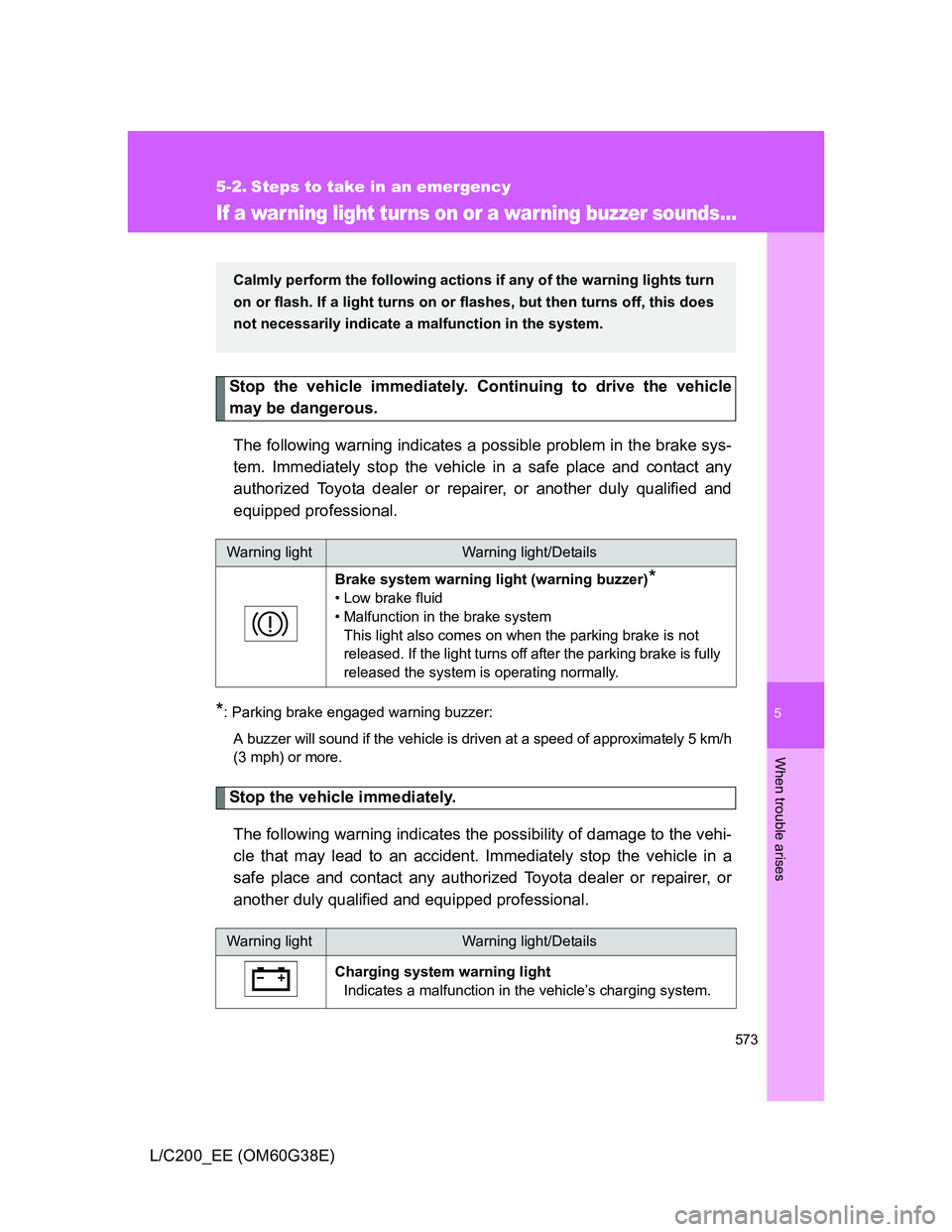
The following warning indicates a possible problem in the brake sys-
tem. Immediately stop the vehicle in a safe place and contact any
authorized Toyota dealer or repairer, or another duly qualified and
equipped professional.
*: Parking brake engaged warning buzzer:
A buzzer will sound if the vehicle is driven at a speed of approximately 5 km/h
(3 mph) or more.
Stop the vehicle immediately.
The following warning indicates the possibility of damage to the vehi-
cle that may lead to an accident. Immediately stop the vehicle in a
safe place and contact any authorized Toyota dealer or repairer, or
another duly qualified and equipped professional.
Warning lightWarning light/Details
Brake system warning light (warning buzzer)
*
• Low brake fluid
• Malfunction in the brake system
This light also comes on when the parking brake is not
released. If the light turns off after the parking brake is fully
released the system is operating normally.
Warning lightWarning light/Details
Charging system warning light
Indicates a malfunction in the vehicle’s charging system.
Calmly perform the following actions if any of the warning lights turn
on or flash. If a light turns on or flashes, but then turns off, this does
not necessarily indicate a malfunction in the system.
Page 585 of 692
5
585 5-2. Steps to take in an emergency
When trouble arises
L/C200_EE (OM60G38E)
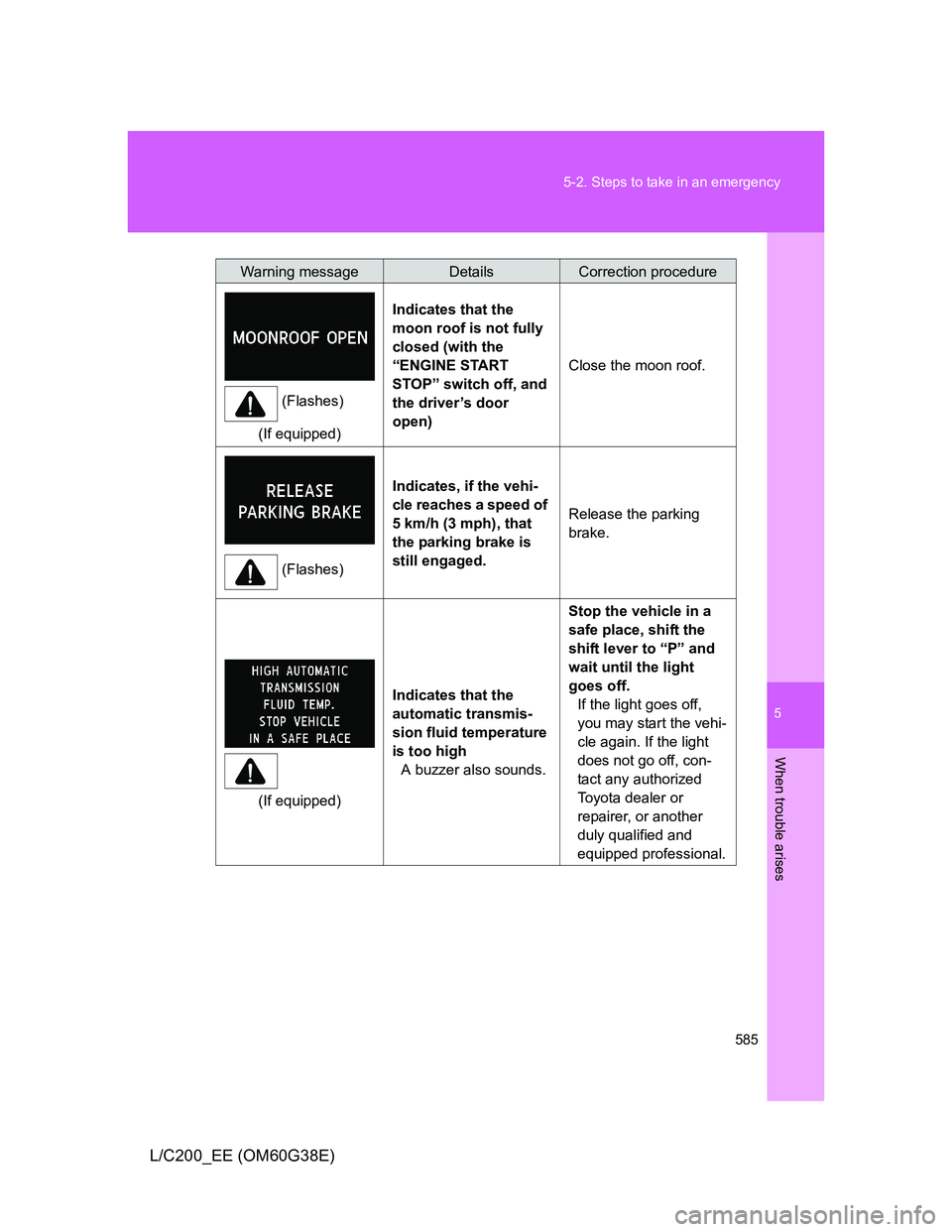
(Flashes)
(If equipped)Indicates that the
moon roof is not fully
closed (with the
“ENGINE START
STOP” switch off, and
the driver’s door
open)Close the moon roof.
(Flashes)Indicates, if the vehi-
cle reaches a speed of
5 km/h (3 mph), that
the parking brake is
still engaged.Release the parking
brake.
(If equipped)Indicates that the
automatic transmis-
sion fluid temperature
is too high
A buzzer also sounds.Stop the vehicle in a
safe place, shift the
shift lever to “P” and
wait until the light
goes off.
If the light goes off,
you may start the vehi-
cle again. If the light
does not go off, con-
tact any authorized
Toyota dealer or
repairer, or another
duly qualified and
equipped professional.
Warning messageDetailsCorrection procedure
Page 657 of 692
657 6-1. Specifications
6
Vehicle specifications
L/C200_EE (OM60G38E)
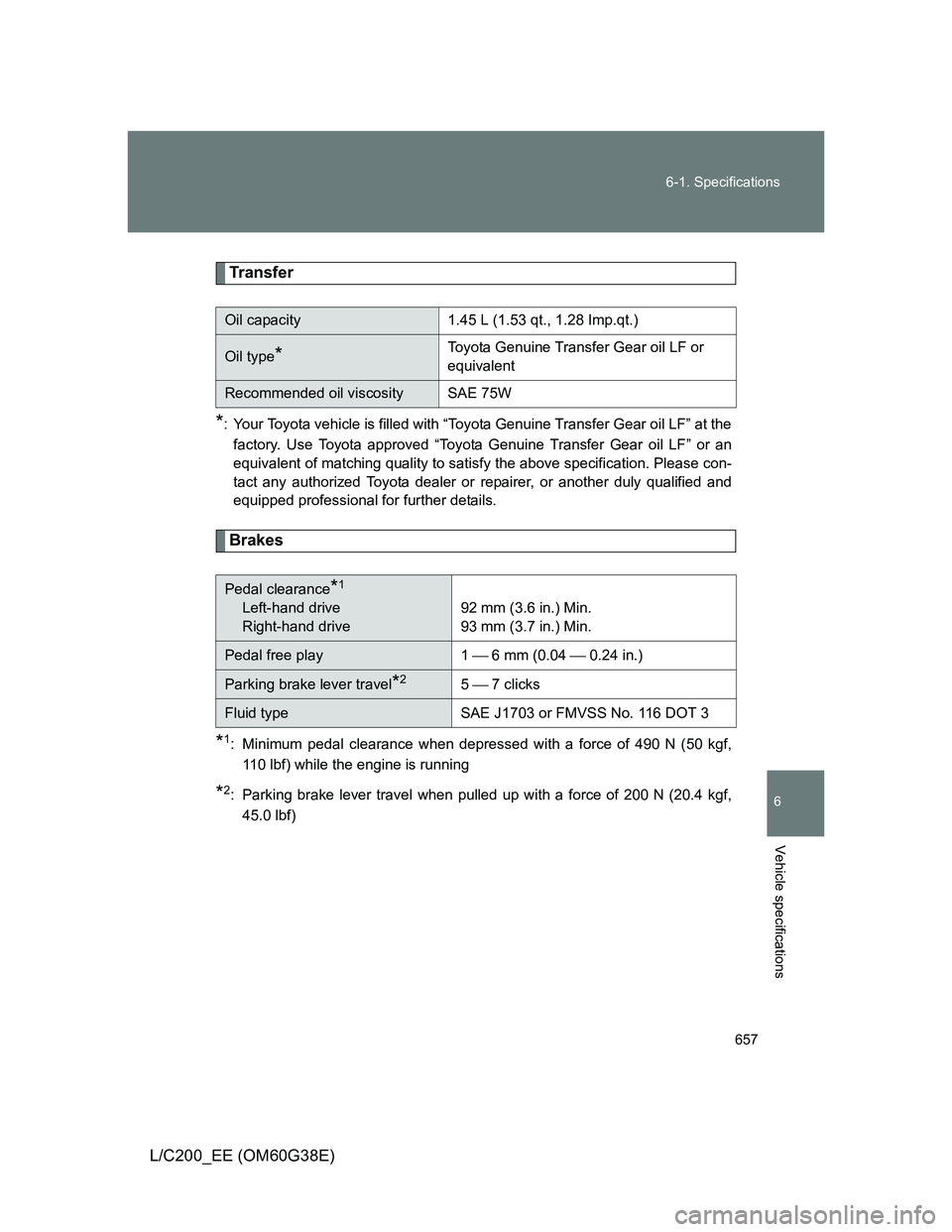
Transfer
*: Your Toyota vehicle is filled with “Toyota Genuine Transfer Gear oil LF” at the
factory. Use Toyota approved “Toyota Genuine Transfer Gear oil LF” or an
equivalent of matching quality to satisfy the above specification. Please con-
tact any authorized Toyota dealer or repairer, or another duly qualified and
equipped professional for further details.
Brakes
*1: Minimum pedal clearance when depressed with a force of 490 N (50 kgf,
110 lbf) while the engine is running
*2: Parking brake lever travel when pulled up with a force of 200 N (20.4 kgf,
45.0 lbf)
Oil capacity1.45 L (1.53 qt., 1.28 Imp.qt.)
Oil type*Toyota Genuine Transfer Gear oil LF or
equivalent
Recommended oil viscositySAE 75W
Pedal clearance*1
Left-hand drive
Right-hand drive92 mm (3.6 in.) Min.
93 mm (3.7 in.) Min.
Pedal free play 1 6 mm (0.04 0.24 in.)
Parking brake lever travel*25 7 clicks
Fluid type SAE J1703 or FMVSS No. 116 DOT 3
Page 679 of 692
679 Alphabetical index
L/C200_EE (OM60G38E)
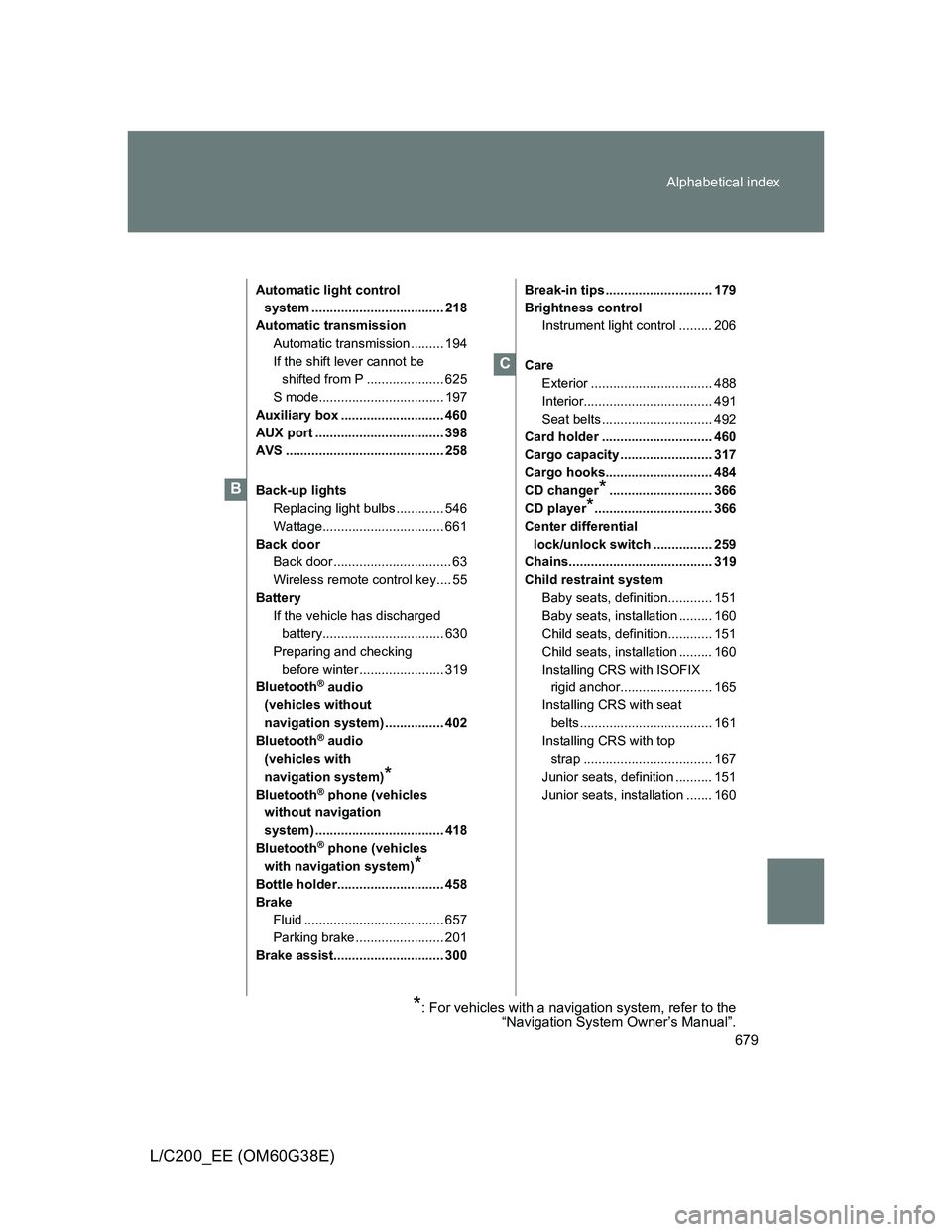
Automatic light control
system .................................... 218
Automatic transmission
Automatic transmission ......... 194
If the shift lever cannot be
shifted from P ..................... 625
S mode.................................. 197
Auxiliary box ............................ 460
AUX port ................................... 398
AVS ........................................... 258
Back-up lights
Replacing light bulbs ............. 546
Wattage................................. 661
Back door
Back door ................................ 63
Wireless remote control key.... 55
Battery
If the vehicle has discharged
battery................................. 630
Preparing and checking
before winter ....................... 319
Bluetooth
® audio
(vehicles without
navigation system) ................ 402
Bluetooth
® audio
(vehicles with
navigation system)
*
Bluetooth® phone (vehicles
without navigation
system) ................................... 418
Bluetooth
® phone (vehicles
with navigation system)
*
Bottle holder............................. 458
Brake
Fluid ...................................... 657
Parking brake ........................ 201
Brake assist.............................. 300Break-in tips ............................. 179
Brightness control
Instrument light control ......... 206
Care
Exterior ................................. 488
Interior................................... 491
Seat belts .............................. 492
Card holder .............................. 460
Cargo capacity ......................... 317
Cargo hooks............................. 484
CD changer
*............................ 366
CD player
*................................ 366
Center differential
lock/unlock switch ................ 259
Chains....................................... 319
Child restraint system
Baby seats, definition............ 151
Baby seats, installation ......... 160
Child seats, definition............ 151
Child seats, installation ......... 160
Installing CRS with ISOFIX
rigid anchor......................... 165
Installing CRS with seat
belts .................................... 161
Installing CRS with top
strap ................................... 167
Junior seats, definition .......... 151
Junior seats, installation ....... 160
B
C
*: For vehicles with a navigation system, refer to the
“Navigation System Owner’s Manual”.