engine overheat TOYOTA LAND CRUISER 2012 Owners Manual
[x] Cancel search | Manufacturer: TOYOTA, Model Year: 2012, Model line: LAND CRUISER, Model: TOYOTA LAND CRUISER 2012Pages: 692, PDF Size: 29.3 MB
Page 6 of 692
TABLE OF CONTENTSIndex
6
L/C200_EE (OM60G38E)
5-1. Essential information
Emergency flashers ............ 564
If your vehicle needs
to be towed ....................... 565
If you think something
is wrong ............................ 571
Fuel pump shut off
system (gasoline engine
only) .................................. 572
5-2. Steps to take in an emergency
If a warning light turns on
or a warning buzzer
sounds... ........................... 573
If a warning message is
displayed .......................... 579
If you have a flat tire
(vehicles with a standard
spare tire) ......................... 596
If you have a flat tire
(vehicles with
an emergency tire
puncture repair kit)............ 610
If the engine
will not start....................... 623
If the shift lever cannot
be shifted from P .............. 625
If you lose your keys ........... 626
If the electronic key
does not operate
properly............................. 627If the battery is
discharged ....................... 630
If your vehicle
overheats ......................... 634
If you run out of fuel and
the engine stalls
(diesel engine only) .......... 637
If the vehicle becomes
stuck................................. 638
If your vehicle
has to be stopped
in an emergency .............. 640
6-1. Specifications
Maintenance data
(fuel, oil level, etc.) ........... 644
Fuel information ................. 662
6-2. Customization
Customizable features ....... 665
6-3. Initialization
Items to initialize................. 674
5When trouble arises
6Vehicle specifications
Page 183 of 692
183 2-1. Driving procedures
2
When driving
L/C200_EE (OM60G38E)
CAUTION
Do not shift the shift lever to “P” while the vehicle is moving.
Doing so can damage the transmission and may result in a loss of vehicle
control.
Do not shift the shift lever to “R” while the vehicle is moving forward.
Doing so can damage the transmission and may result in a loss of vehicle
control.
Do not shift the shift lever to “D” while the vehicle is moving backward.
Doing so can damage the transmission and may result in a loss of vehicle
control.
Moving the shift lever to “N” while the vehicle is moving will disengage the
engine from the transmission. Engine braking is not available when “N” is
selected.
During normal driving, do not turn off the engine. Turning the engine off
while driving will not cause loss of steering or braking control, but the
power assist to these systems will be lost. This will make it more difficult to
steer and brake, so you should pull over and stop the vehicle as soon as it
is safe to do so.
However, in the event of an emergency, such as if it becomes impossible
to stop the vehicle in the normal way: P. 640
Use engine braking (downshift) to maintain a safe speed when driving
down a steep hill.
Using the brakes continuously may cause the brakes to overheat and lose
effectiveness. (P. 195)
Page 185 of 692
185 2-1. Driving procedures
2
When driving
L/C200_EE (OM60G38E)
CAUTION
When the vehicle is stopped
Do not race the engine.
If the vehicle is in any gear other than “P” or “N”, the vehicle may acceler-
ate suddenly and unexpectedly, and may cause an accident.
Do not leave the vehicle with the engine running for a long time.
If such a situation cannot be avoided, park the vehicle in an open space
and check that exhaust fumes do not enter the vehicle interior.
In order to prevent accidents due to the vehicle rolling away, always keep
depressing the brake pedal while the engine is running, and apply the
parking brake as necessary.
If the vehicle is stopped on an incline, in order to prevent accidents caused
by the vehicle rolling forward or backward, always depress the brake pedal
and securely apply the parking brake as needed.
Avoid revving or racing the engine.
Running the engine at high speed while the vehicle is stopped may cause
the exhaust system to overheat, which could result in a fire if combustible
material is nearby.
When the vehicle is parked
Do not leave glasses, cigarette lighters, spray cans, or soft drink cans in
the vehicle when it is in the sun.
Failure to do so may result in the following:
• Gas may leak from a cigarette lighter or spray can, and may lead to a
fire.
• The temperature inside the vehicle may cause the plastic lenses and
plastic material of eye glasses to deform or crack.
• Soft drink cans may fracture, causing the contents to spray over the
interior of the vehicle, and may also cause a short circuit in the vehi-
cle’s electrical components.
Always apply the parking brake, shift the shift lever to “P”, stop the engine
and lock the vehicle.
Do not leave the vehicle unattended while the engine is running.
Page 187 of 692
187 2-1. Driving procedures
2
When driving
L/C200_EE (OM60G38E)
CAUTION
When taking a nap in the vehicle
Always turn the engine off. Otherwise, you may accidentally move the shift
lever or depress the accelerator pedal, which could cause an accident or fire
due to engine overheating. Additionally, if the vehicle is parked in a poorly
ventilated area, exhaust gases may collect and may enter the vehicle, lead-
ing to death or a serious health hazard.
When braking the vehicle
When the brakes are wet, drive more cautiously.
Braking distance increases when the brakes are wet, and may cause one
side of the vehicle to brake differently than the other side. Also the parking
brake may not securely hold the vehicle.
If the power brake assist function does not operate, do not follow other
vehicles closely and avoid downhills or sharp turns that require braking.
In this case, braking is still possible, but it will require more force on the
pedal than usual. Braking distance may also increase.
Do not pump the brake pedal if the engine stalls.
Each push on the brake pedal uses up the reserve for the power-assisted
brakes.
The brake system consists of 2 individual hydraulic systems: If one of the
systems fails, the other will still operate. In this case, the brake pedal
should be depressed more firmly than usual and braking distance
becomes longer.
Do not drive your vehicle with only a single brake system. Have your
brakes fixed immediately.
Page 206 of 692
206 2-2. Instrument cluster
L/C200_EE (OM60G38E)
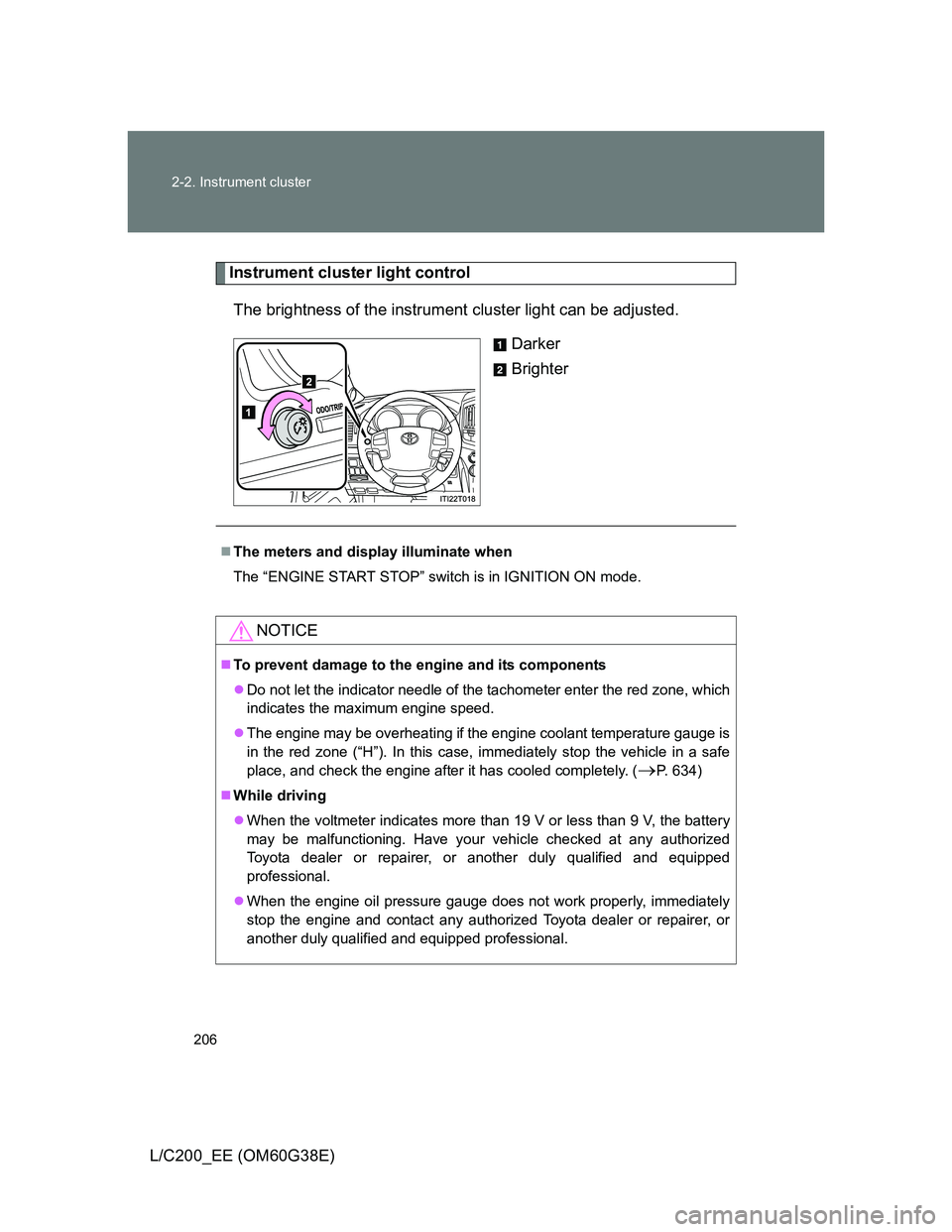
Instrument cluster light control
The brightness of the instrument cluster light can be adjusted.
Darker
Brighter
The meters and display illuminate when
The “ENGINE START STOP” switch is in IGNITION ON mode.
NOTICE
To prevent damage to the engine and its components
Do not let the indicator needle of the tachometer enter the red zone, which
indicates the maximum engine speed.
The engine may be overheating if the engine coolant temperature gauge is
in the red zone (“H”). In this case, immediately stop the vehicle in a safe
place, and check the engine after it has cooled completely. (
P. 634)
While driving
When the voltmeter indicates more than 19 V or less than 9 V, the battery
may be malfunctioning. Have your vehicle checked at any authorized
Toyota dealer or repairer, or another duly qualified and equipped
professional.
When the engine oil pressure gauge does not work properly, immediately
stop the engine and contact any authorized Toyota dealer or repairer, or
another duly qualified and equipped professional.
Page 232 of 692
232
2-3. Operating the lights and wipers
L/C200_EE (OM60G38E)
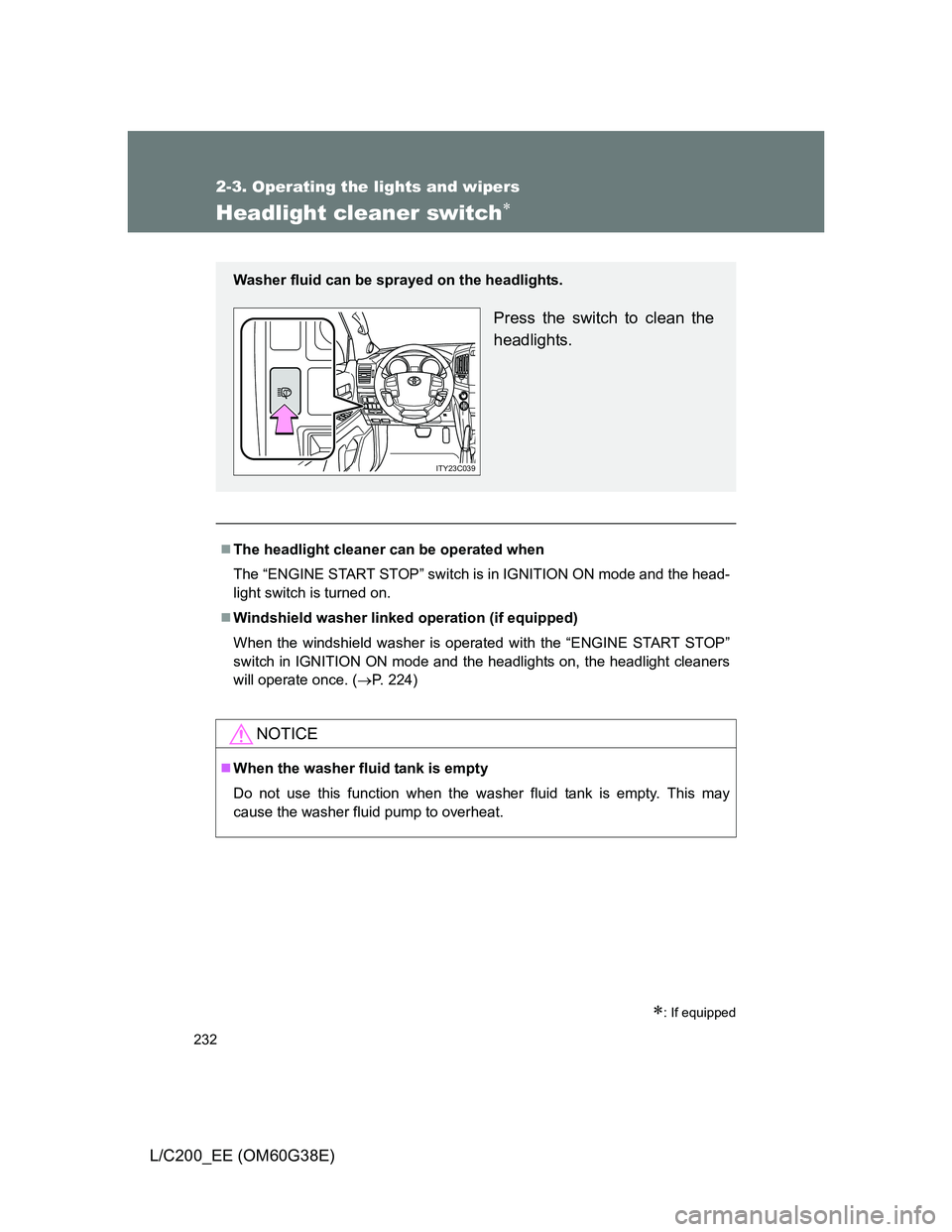
Headlight cleaner switch
: If equipped
The headlight cleaner can be operated when
The “ENGINE START STOP” switch is in IGNITION ON mode and the head-
light switch is turned on.
Windshield washer linked operation (if equipped)
When the windshield washer is operated with the “ENGINE START STOP”
switch in IGNITION ON mode and the headlights on, the headlight cleaners
will operate once. (P. 224)
NOTICE
When the washer fluid tank is empty
Do not use this function when the washer fluid tank is empty. This may
cause the washer fluid pump to overheat.
Washer fluid can be sprayed on the headlights.
Press the switch to clean the
headlights.
ITY23C039
Page 268 of 692
268 2-4. Using other driving systems
L/C200_EE (OM60G38E)
Function limitations
Crawl Control
In the following situations, brake control can be used to drive downhill at
a constant speed. However, engine control is not available when driving
uphill at a constant speed.
• When switched to second start mode.
In the following situation, engine control and brake control will stop tem-
porarily. In this event, the Crawl Control indicator will flash.
• When the vehicle speed exceeds approximately 25 km/h (15 mph).
Turn Assist function
In the following situations, the Turn Assist function will stop temporarily. In
this event, the Turn Assist indicator will flash.
When the vehicle speed exceeds approximately 10km/h (6 mph).
When the shift lever is moved to “R”.
When the Crawl Control system is operated continuously
If Crawl Control is used continuously for a long time, the buzzer will
sound, a malfunction notification will be displayed on the multi-informa-
tion display, the Crawl Control indicator will go off, and Crawl Control will
be temporarily inoperable as a result of the brake system overheating. In
this event, stop the vehicle immediately in a safe place, and allow the
brake system to cool down sufficiently until the “TRC OFF” on the multi-
information display go off. (In the meantime, normal driving is possible.)
If Crawl Control is used continuously for a long time, the buzzer will
sound, the system will be temporarily canceled, and a malfunction notifi-
cation will be displayed on the multi-information display as a result of the
automatic transmission system overheating. Stop the vehicle in a safe
place until the display goes off.
Page 303 of 692
303 2-4. Using other driving systems
2
When driving
L/C200_EE (OM60G38E)
Automatic reactivation of Active TRC and VSC
Turning the “ENGINE START STOP” switch off after turning off the Active
TRC and VSC systems will automatically re-enable them.
Automatic Active TRC reactivation
If only the Active TRC system is turned off, the Active TRC system will turn
on when vehicle speed increases.
Automatic Active TRC and VSC reactivation
If the Active TRC and VSC systems are turned off, the systems will not turn
on even when vehicle speed increases.
If the brake system overheats
The brake system may overheat. In this case, a buzzer will sound, and the
“TRC OFF” will be displayed on the multi-information display, and Active
TRC and hill-start assist control will be temporarily inoperable. In this event,
stop the vehicle immediately in a safe place, and allow the brake system to
cool down sufficiently until the “TRC OFF” on the multi-information display
go off. (There is no problem with continuing normal driving.)
Sounds and vibrations caused by the Multi Terrain ABS, brake assist,
Active TRC, VSC, hill-start assist control and VGRS
A sound may be heard from the engine compartment when the engine is
started or just after the vehicle begins to move. This sound does not indi-
cate that a malfunction has occurred in any of these systems.
Any of the following conditions may occur when the above systems are
operating. None of these indicates that a malfunction has occurred.
• Vibrations may be felt through the vehicle body and steering.
• A motor sound may be heard after the vehicle comes to a stop.
• The brake pedal may pulsate slightly after the Multi Terrain ABS is acti-
vated.
• The brake pedal may move down slightly after the Multi Terrain ABS is
activated.
Page 332 of 692
332 2-5. Driving information
L/C200_EE (OM60G38E)Transmission information
To maintain engine braking efficiency, when using engine braking,
do not put the transmission in “D”.
Transmission shift range position must be in “5” in the “S” mode.
If the engine overheats...
Towing a loaded trailer up a long steep incline in temperatures
exceeding 30C (85F) may result in the engine overheating. If the
engine coolant temperature gauge indicates that the engine is
overheating, turn the air conditioning off immediately, leave the
road and stop the vehicle in a safe place. (P. 634)
When parking the vehicle
Always place wheel chocks under the wheels of both the vehicle
and trailer. Firmly set the parking brake and shift the shift lever to
“P”.
CAUTION
Follow all the precautions described in this section. Failure to do so could
cause an accident resulting in death or serious injury.
Trailer towing precautions
When towing, make sure that none of the weight limits are exceeded.
(P. 324)
Vehicle speed in towing
Observe the legal maximum speeds for trailer towing.
Before descending hills or long declines
Reduce speed and downshift. However, never downshift suddenly while
descending steep or long downhill grades.
Operation of the brake
Do not hold the brake pedal depressed often or for long periods.
Doing so may result in the brake overheating or reduce braking effects.
Page 470 of 692
470
3-7. Other interior features
L/C200_EE (OM60G38E)
Cigarette lighter
The cigarette lighter can be used when
The “ENGINE START STOP” switch is in ACCESSORY or IGNITION ON
mode.
CAUTION
To avoid burns or fires
Do not touch the metal parts of the cigarette lighter.
Do not hold the cigarette lighter down. It could overheat and cause a fire.
Do not insert anything other than the cigarette lighter into the outlet.
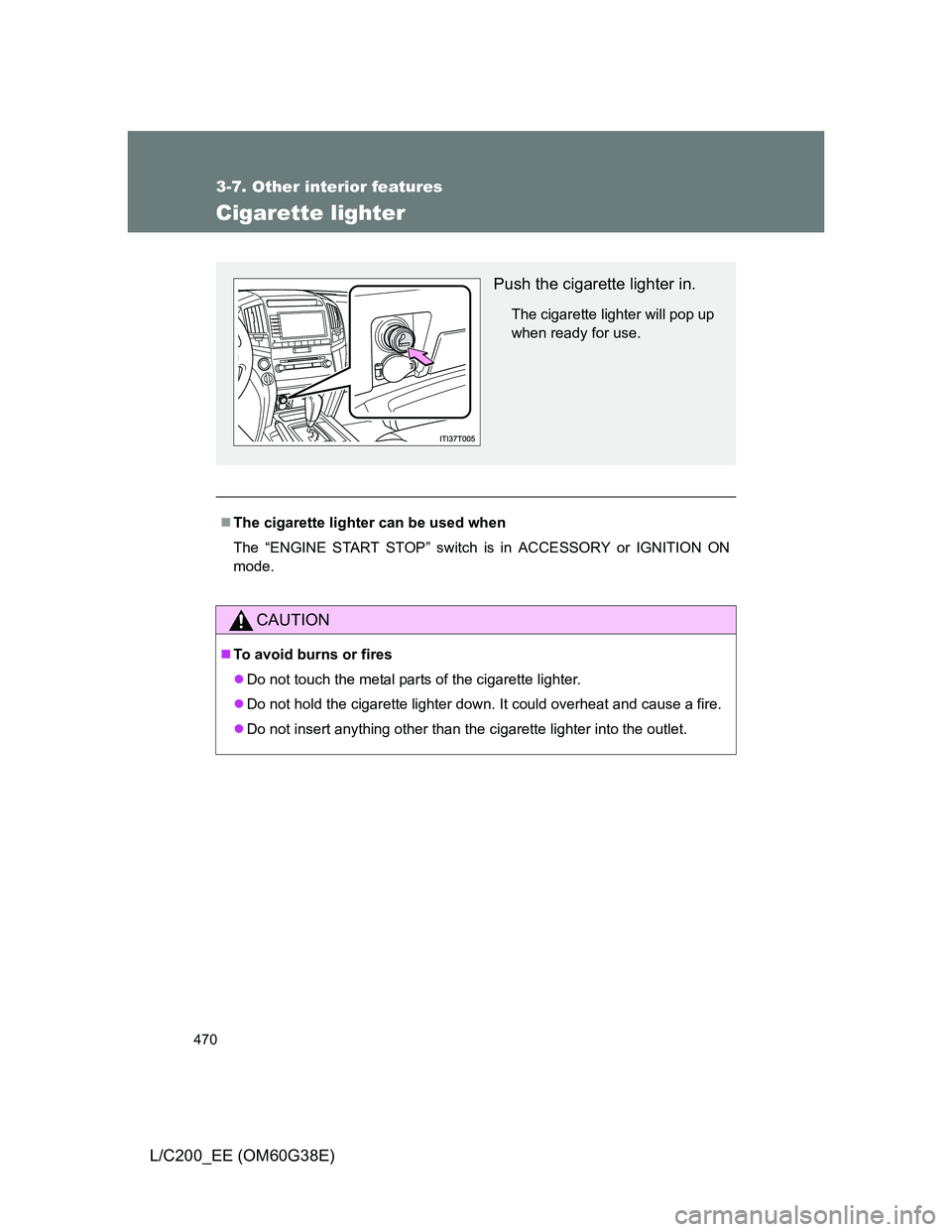
Push the cigarette lighter in.
The cigarette lighter will pop up
when ready for use.