suspension TOYOTA LAND CRUISER 2012 Owners Manual
[x] Cancel search | Manufacturer: TOYOTA, Model Year: 2012, Model line: LAND CRUISER, Model: TOYOTA LAND CRUISER 2012Pages: 692, PDF Size: 29.3 MB
Page 3 of 692
1
2
3
4
5
6
3
L/C200_EE (OM60G38E)
2-1. Driving procedures
Driving the vehicle .............. 178
Engine (ignition) switch ....... 190
Automatic transmission....... 194
Turn signal lever ................. 200
Parking brake...................... 201
Horn .................................... 202
2-2. Instrument cluster
Gauges and meters ............ 203
Indicators and
warning lights.................... 207
Multi-information display ..... 212
2-3. Operating the lights and
wipers
Headlight switch.................. 218
Fog light switch ................... 222
Windshield wipers and
washer .............................. 224
Rear window wiper and
washer .............................. 231
Headlight cleaner switch ..... 2322-4. Using other driving systems
Cruise control ..................... 233
Toyota parking
assist-sensor .................... 237
4-Wheel AHC
(Active Height Control
Suspension) ..................... 248
AVS (Adaptive Variable
Suspension system)......... 258
Four-wheel drive system .... 259
Crawl Control (with Turn
Assist function)................. 264
Multi-terrain Select ............. 270
Multi-terrain Monitor ........... 276
Driving assist systems........ 300
PCS (Pre-Crash Safety) ..... 307
DPF (Diesel Particulate
Filter) system ................... 308
2-5. Driving information
Off-road precautions .......... 313
Cargo and luggage............. 317
Winter driving tips............... 319
Trailer towing...................... 323
2When driving
Page 149 of 692
149 1-7. Safety information
1
Before driving
L/C200_EE (OM60G38E)
CAUTION
Modification and disposal of SRS airbag system components
Do not dispose of your vehicle or perform any of the following modifications
without consulting any authorized Toyota dealer or repairer, or another duly
qualified and equipped professional.
The SRS airbags may malfunction or deploy (inflate) accidentally, causing
death or serious injury.
Installation, removal, disassembly and repair of the SRS airbags
Repairs, modifications, removal or replacement of the steering wheel,
instrument panel, dashboard, seats or seat upholstery, front, side and rear
pillars or roof side rail
Repairs or modifications of the front fender, front bumper, or side of the
occupant compartment
Installation of snow plows, winches, etc. to the front grille (bull bars, kan-
garoo bar etc.)
Modifications to the vehicle’s suspension system
Installation of electronic devices such as an RF-transmitter or CD players
Modifications to your vehicle for a person with a physical disability
Page 177 of 692
2When driving
177
L/C200_EE (OM60G38E)
2-1. Driving procedures
Driving the vehicle ............ 178
Engine (ignition) switch..... 190
Automatic transmission .... 194
Turn signal lever ............... 200
Parking brake ................... 201
Horn .................................. 202
2-2. Instrument cluster
Gauges and meters .......... 203
Indicators and
warning lights.................. 207
Multi-information
display ............................ 212
2-3. Operating the lights and
wipers
Headlight switch ............... 218
Fog light switch ................. 222
Windshield wipers and
washer ............................ 224
Rear window wiper and
washer ............................ 231
Headlight cleaner
switch ............................. 2322-4. Using other driving systems
Cruise control.................... 233
Toyota parking
assist-sensor .................. 237
4-Wheel AHC
(Active Height Control
Suspension).................... 248
AVS (Adaptive Variable
Suspension system) ....... 258
Four-wheel drive
system ............................ 259
Crawl Control (with Turn
Assist function) ............... 264
Multi-terrain Select ............ 270
Multi-terrain Monitor .......... 276
Driving assist systems ...... 300
PCS
(Pre-Crash Safety).......... 307
DPF (Diesel Particulate
Filter) system .................. 308
2-5. Driving information
Off-road precautions ......... 313
Cargo and luggage ........... 317
Winter driving tips ............. 319
Trailer towing .................... 323
Page 189 of 692
189 2-1. Driving procedures
2
When driving
L/C200_EE (OM60G38E)
NOTICE
If you get a flat tire while driving
A flat or damaged tire may cause the following situations. Hold the steering
wheel firmly and gradually press the brake pedal to slow down the vehicle.
It may be difficult to control your vehicle.
The vehicle will make abnormal sounds.
The vehicle will behave abnormally.
Replace a flat tire with a new one. (P. 601)
When encountering flooded roads
Do not drive on a road that has flooded after heavy rain etc. Doing so may
cause the following serious damage to the vehicle.
Engine stalling
Short in electrical components
Engine damage caused by water immersion
In the event that you drive on a flooded road and the vehicle is flooded, be
sure to have any authorized Toyota dealer or repairer, or another duly quali-
fied and equipped professional check the following.
Brake function
Changes in quantity and quality of oil and fluid used for the engine, trans-
mission, transfer, differentials, etc.
Lubricant condition for the propeller shaft, bearings and suspension joints
(where possible) and the function of all joints, bearings, etc.
Page 245 of 692
245 2-4. Using other driving systems
2
When driving
L/C200_EE (OM60G38E)
Sensor detection information
The sensor’s detection areas are limited to the areas around the vehi-
cle’s front corner and rear bumpers.
Certain vehicle conditions and the surrounding environment may affect
the ability of the sensor to correctly detect obstacles. Particular instances
where this may occur are listed below.
• There is dirt, snow or ice on the sensor. (Wiping the sensors will
resolve this problem.)
• The sensor is frozen. (Thawing the area will resolve this problem.)
In especially cold weather, if a sensor is frozen the screen may show
an abnormal display, or obstacles may not be detected.
• The sensor is covered in any way.
• The vehicle is leaning considerably to one side.
• On an extremely bumpy road, on an incline, on gravel, or on grass
• The vicinity of the vehicle is noisy due to vehicle horns, motorcycle
engines, air brakes of large vehicles, or other loud noises producing
ultrasonic waves.
• There is another vehicle equipped with parking assist sensors in the
vicinity.
• The sensor is coated with a sheet of spray or heavy rain.
• The vehicle is equipped with a fender pole or wireless antenna.
• Towing eyelets are installed.
• The bumper or sensor receives a strong impact.
• The vehicle is approaching a tall or curved curb.
• In harsh sunlight or intense cold weather
• The area directly under the bumpers is not detected.
• If obstacles draw too close to the sensor.
• A non-genuine Toyota suspension (lowered suspension etc.) is
installed.
• People may not be detected if they are wearing certain types of cloth-
ing.
In addition to the examples above, there are instances in which, because
of their shape, signs and other objects may be judged by the sensor to be
closer than they are.
Page 248 of 692
248
2-4. Using other driving systems
L/C200_EE (OM60G38E)
4-Wheel AHC (Active Height Control Suspension)
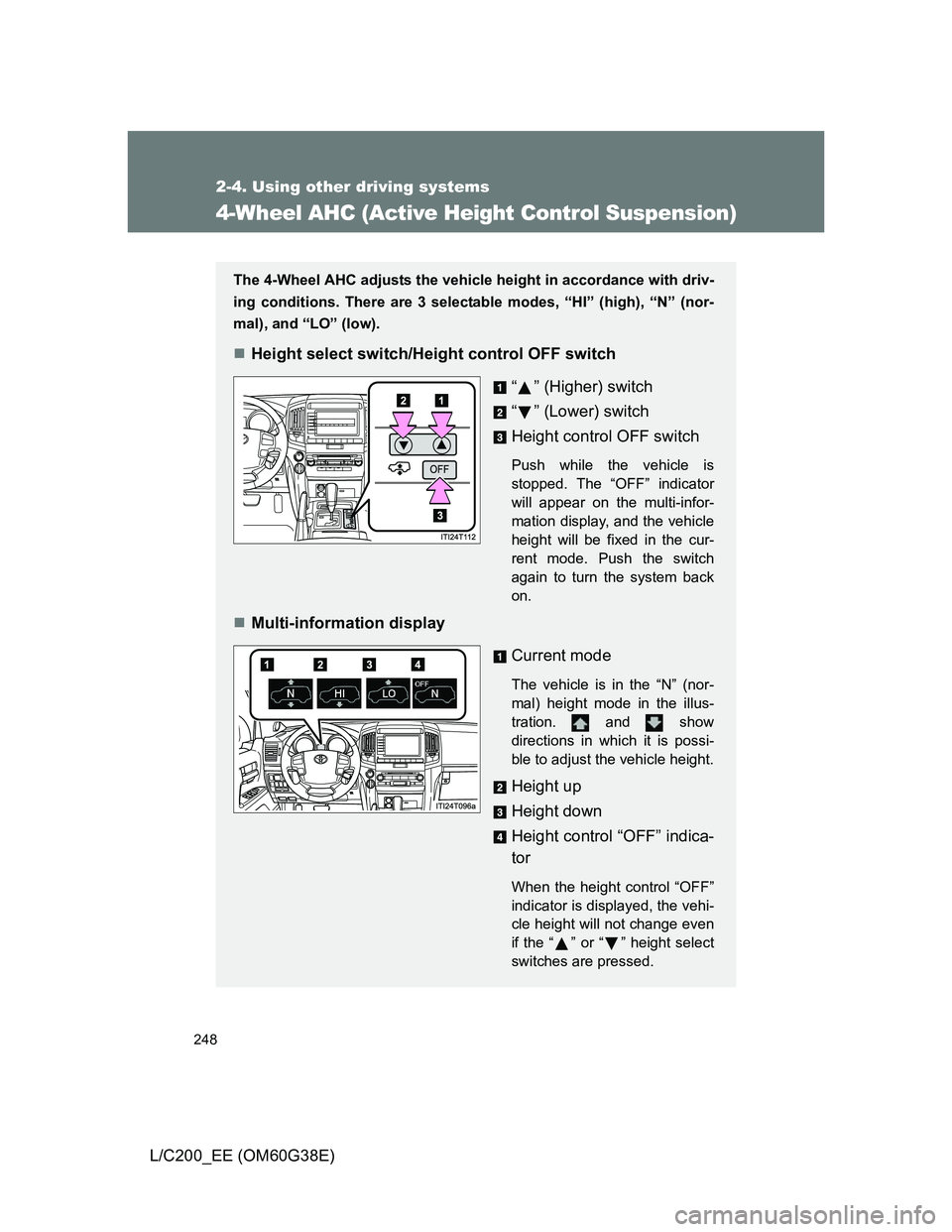
The 4-Wheel AHC adjusts the vehicle height in accordance with driv-
ing conditions. There are 3 selectable modes, “HI” (high), “N” (nor-
mal), and “LO” (low).
Height select switch/Height control OFF switch
“ ” (Higher) switch
“” (Lower) switch
Height control OFF switch
Push while the vehicle is
stopped. The “OFF” indicator
will appear on the multi-infor-
mation display, and the vehicle
height will be fixed in the cur-
rent mode. Push the switch
again to turn the system back
on.
Multi-information display
Current mode
The vehicle is in the “N” (nor-
mal) height mode in the illus-
tration. and show
directions in which it is possi-
ble to adjust the vehicle height.
Height up
Height down
Height control “OFF” indica-
tor
When the height control “OFF”
indicator is displayed, the vehi-
cle height will not change even
if the “ ” or “ ” height select
switches are pressed.
Page 254 of 692
254 2-4. Using other driving systems
L/C200_EE (OM60G38E)
In the following cases the 4-Wheel AHC will not operate
The brake pedal has been depressed for a few seconds or longer while
the vehicle is stopped.
Vehicle height control has not been frequently used.
The suspension fluid temperature is lower than -30°C (-22°F).
There is ice on the suspension.
Driving on bumpy roads which may cause the suspension to fully elon-
gate.
If the steering wheel is abruptly turned more than 3/4 of a revolution with
the center differential lock system activated.
Cold weather operation
It may take longer for the vehicle height to change if the suspension fluid
temperature drops below -15°C (5°F).
The 4-Wheel AHC does not operate when the suspension fluid temperature
drops below -30°C (-22°F).
In this case, even if the height select switch is pressed, the vehicle height
will not change. Once the vehicle has been driven for a short time and
the suspension fluid has been warmed to within normal operating limits,
the 4-Wheel AHC will begin operating and the vehicle height will auto-
matically change to the selected mode.
When the suspension fluid is around -30°C (-22°F), the vehicle height
may not be able to be raised, even if the 4-Wheel AHC is operating. In
this case, push “ ” then “ ” on the height select switch after driving for
a short time longer to select the desired vehicle height.
Parking and stopping tips
If you immediately stop the engine after off-road driving, the vehicle
height may gradually lower. When parking, make sure there is nothing
under the vehicle that may come in contact with the underbody. The vehi-
cle will return to the set height when the engine is started.
The vehicle height may change as the temperature changes when the
engine is stopped. The vehicle will return to the set height when the
engine is started.
Page 258 of 692
258
2-4. Using other driving systems
L/C200_EE (OM60G38E)
AVS (Adaptive Variable Suspension system)
: If equipped
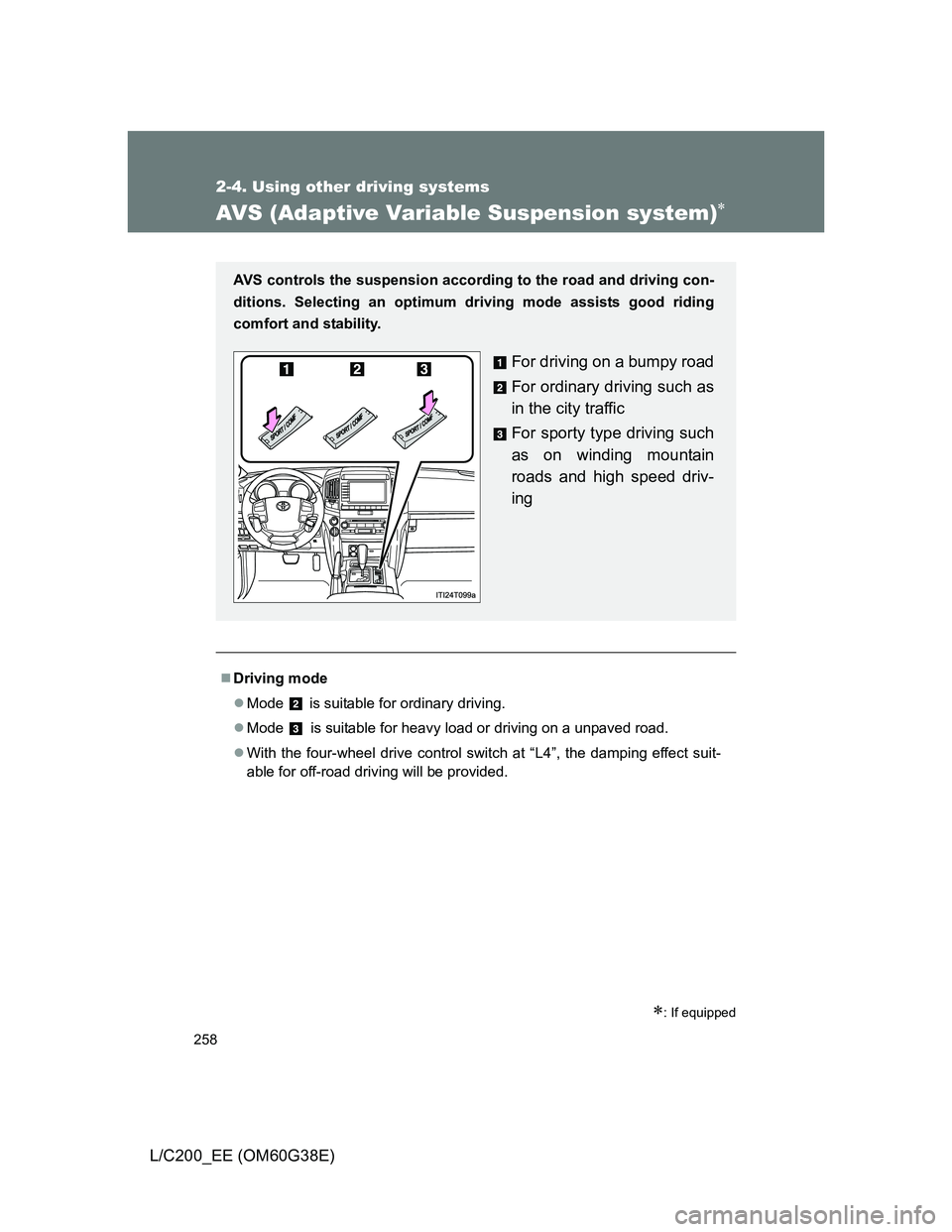
Driving mode
Mode is suitable for ordinary driving.
Mode
is suitable for heavy load or driving on a unpaved road.
With the four-wheel drive control switch at “L4”, the damping effect suit-
able for off-road driving will be provided.
AVS controls the suspension according to the road and driving con-
ditions. Selecting an optimum driving mode assists good riding
comfort and stability.
For driving on a bumpy road
For ordinary driving such as
in the city traffic
For sporty type driving such
as on winding mountain
roads and high speed driv-
ing
Page 300 of 692
300
2-4. Using other driving systems
L/C200_EE (OM60G38E)
Driving assist systems
To help enhance driving safety and performance, the following sys-
tems operate automatically in response to various driving situations.
Be aware, however, that these systems are supplementary and
should not be relied upon too heavily when operating the vehicle.
Multi Terrain ABS (Anti-lock Brake System)
Helps to prevent wheel lock when the brakes are applied suddenly, or if
the brakes are applied while driving on a slippery road surface, or in off-
road conditions (such as rough roads, sand and mud).
Brake assist
Generates an increased level of braking force after the brake pedal is
depressed, when the system detects a panic stop situation.
VSC (Vehicle Stability Control)
Helps the driver to control skidding when swerving suddenly or turning
on slippery road surfaces.
Active TRC (Traction Control)
Helps to maintain drive power and prevent the 4 wheels from spinning
when starting the vehicle or accelerating on slippery roads.
Hill-start assist control
Helps prevent the vehicle from rolling backwards when starting on an
incline or slippery slope.
KDSS (Kinetic Dynamic Suspension System) (if equipped)
KDSS helps to ensure ride comfort and handling response by using a
hydraulic control system to control the suspension stabilizer bars in
response to road surface and driving conditions during cornering or off-
road driving.
VGRS (Variable Gear Ratio Steering) (if equipped)
Helps to adjust the wheel turning angle in accordance with the vehicle
speed and steering wheel movement.
Pre-Crash Safety (if equipped)
P. 307
Page 305 of 692
305 2-4. Using other driving systems
2
When driving
L/C200_EE (OM60G38E)
CAUTION
Active TRC may not operate effectively when
Directional control and power may not be achievable while driving on slip-
pery road surfaces, even if the Active TRC is operating.
Do not drive the vehicle in conditions where stability and power may be lost.
If the hill-start assist control does not operate effectively
Do not overly rely on the hill-start assist control. The hill-start assist control
may not operate effectively on steep inclines and roads covered in ice.
When Active TRC and VSC are off
Be especially careful and drive at a speed appropriate to the road condi-
tions. As there are systems to help to ensure vehicle stability and driving
force, do not turn off Active TRC and VSC unless necessary.
When the VSC is activated
The slip indicator light flashes. Always drive carefully.
Reckless driving may cause an accident. Exercise particular care when the
indicator light flashes.
Replacing tires
Make sure that all tires are of the same size, brand, tread pattern and total
load capacity. In addition, make sure that the tires are inflated to the speci-
fied tire pressure level.
The Multi Terrain ABS and VSC will not function correctly if different tires are
fitted on the vehicle.
Contact any authorized Toyota dealer or repairer, or another duly qualified
and equipped professional for further information when replacing tires or
wheels.
Handling of tires and suspension
Using tires with any kind of problem or modifying the suspension will affect
the driving assist systems, and may cause the system to malfunction.