trailer TOYOTA LAND CRUISER 2012 Owners Manual
[x] Cancel search | Manufacturer: TOYOTA, Model Year: 2012, Model line: LAND CRUISER, Model: TOYOTA LAND CRUISER 2012Pages: 692, PDF Size: 29.3 MB
Page 3 of 692
1
2
3
4
5
6
3
L/C200_EE (OM60G38E)
2-1. Driving procedures
Driving the vehicle .............. 178
Engine (ignition) switch ....... 190
Automatic transmission....... 194
Turn signal lever ................. 200
Parking brake...................... 201
Horn .................................... 202
2-2. Instrument cluster
Gauges and meters ............ 203
Indicators and
warning lights.................... 207
Multi-information display ..... 212
2-3. Operating the lights and
wipers
Headlight switch.................. 218
Fog light switch ................... 222
Windshield wipers and
washer .............................. 224
Rear window wiper and
washer .............................. 231
Headlight cleaner switch ..... 2322-4. Using other driving systems
Cruise control ..................... 233
Toyota parking
assist-sensor .................... 237
4-Wheel AHC
(Active Height Control
Suspension) ..................... 248
AVS (Adaptive Variable
Suspension system)......... 258
Four-wheel drive system .... 259
Crawl Control (with Turn
Assist function)................. 264
Multi-terrain Select ............. 270
Multi-terrain Monitor ........... 276
Driving assist systems........ 300
PCS (Pre-Crash Safety) ..... 307
DPF (Diesel Particulate
Filter) system ................... 308
2-5. Driving information
Off-road precautions .......... 313
Cargo and luggage............. 317
Winter driving tips............... 319
Trailer towing...................... 323
2When driving
Page 133 of 692
133 1-6. Theft deterrent system
1
Before driving
L/C200_EE (OM60G38E)
The vehicle is inside an automatic or high-pressure car wash.
The vehicle experiences impacts, such as hail, lightning strikes, and
other kinds of repeated impacts or vibrations.
Tilt sensor detection considerations
The sensor may trigger the alarm in the following situations:
The vehicle is transported by a ferry, trailer, train, etc.
The vehicle is parked in a parking garage.
The vehicle is inside a car wash that moves the vehicle.
Any of the tires loses air pressure.
The vehicle is jacked up.
An earthquake occurs or the road caves in.
Cargo is loaded onto or unloaded from the roof luggage carrier.
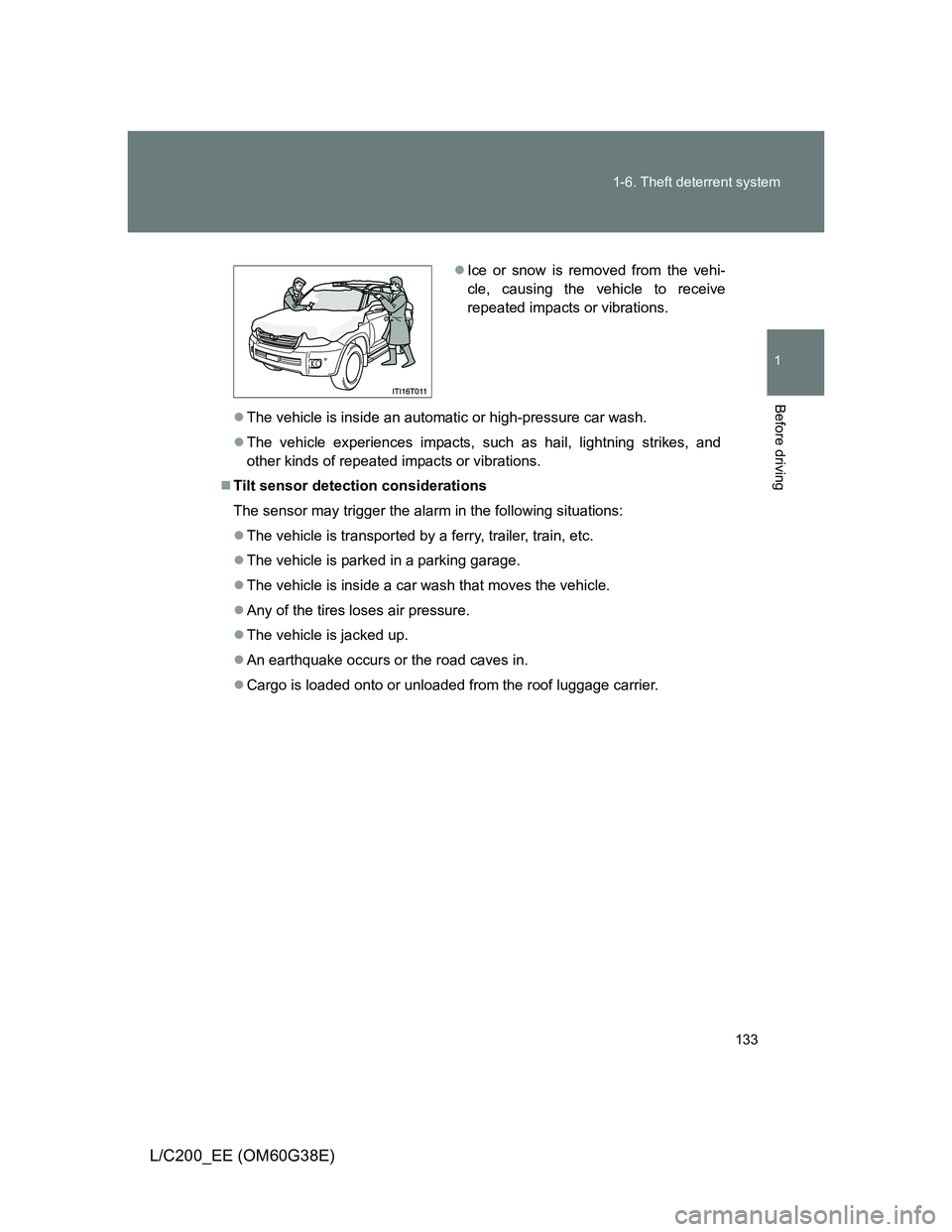
Ice or snow is removed from the vehi-
cle, causing the vehicle to receive
repeated impacts or vibrations.
Page 177 of 692
2When driving
177
L/C200_EE (OM60G38E)
2-1. Driving procedures
Driving the vehicle ............ 178
Engine (ignition) switch..... 190
Automatic transmission .... 194
Turn signal lever ............... 200
Parking brake ................... 201
Horn .................................. 202
2-2. Instrument cluster
Gauges and meters .......... 203
Indicators and
warning lights.................. 207
Multi-information
display ............................ 212
2-3. Operating the lights and
wipers
Headlight switch ............... 218
Fog light switch ................. 222
Windshield wipers and
washer ............................ 224
Rear window wiper and
washer ............................ 231
Headlight cleaner
switch ............................. 2322-4. Using other driving systems
Cruise control.................... 233
Toyota parking
assist-sensor .................. 237
4-Wheel AHC
(Active Height Control
Suspension).................... 248
AVS (Adaptive Variable
Suspension system) ....... 258
Four-wheel drive
system ............................ 259
Crawl Control (with Turn
Assist function) ............... 264
Multi-terrain Select ............ 270
Multi-terrain Monitor .......... 276
Driving assist systems ...... 300
PCS
(Pre-Crash Safety).......... 307
DPF (Diesel Particulate
Filter) system .................. 308
2-5. Driving information
Off-road precautions ......... 313
Cargo and luggage ........... 317
Winter driving tips ............. 319
Trailer towing .................... 323
Page 179 of 692
179 2-1. Driving procedures
2
When driving
L/C200_EE (OM60G38E)
Starting on a steep uphill
Firmly set the parking brake and shift the shift lever to “D”.
Gently depress the accelerator pedal.
Release the parking brake.
Driving in the rain
Drive carefully when it is raining, because visibility will be reduced, the
windows may become fogged-up, and the road will be slippery.
Drive carefully when it starts to rain, because the road surface will be
especially slippery.
Refrain from high speeds when driving on an expressway in the rain,
because there may be a layer of water between the tires and the road
surface, preventing the steering and brakes from operating properly.
Engine speed while driving
In the following conditions, the engine speed may become high while driving.
This is due to automatic up-shifting control or down-shifting implementation
to meet driving conditions. It does not indicate sudden acceleration.
The vehicle is judged to be driving uphill or downhill
When the accelerator pedal is released
Breaking in your new Toyota
To extend the life of the vehicle, the following precautions are recommended
to observe:
For the first 300 km (200 miles):
Avoid sudden stops.
For the first 800 km (500 miles):
Do not tow a trailer.
For the first 1000 km (600 miles):
• Do not drive at extremely high speeds.
• Avoid sudden acceleration.
• Do not drive continuously in the low gears.
• Do not drive at a constant speed for extended periods.
STEP1
STEP2
STEP3
Page 236 of 692
236 2-4. Using other driving systems
L/C200_EE (OM60G38E)
CAUTION
To avoid operating the cruise control by mistake
Switch the cruise control off using the “ON-OFF” button when not in use.
Situations unsuitable for cruise control
Do not use cruise control in any of the following situations.
Doing so may result in loss of control and could cause an accident resulting
in death or serious injury.
In heavy traffic
On roads with sharp bends
On winding roads
On slippery roads, such as those covered with rain, ice or snow
On steep hills
Vehicle speed may exceed the set speed when driving down a steep hill.
When your vehicle is towing a trailer or during emergency towing
Page 323 of 692
323
2-5. Driving information
2
When driving
L/C200_EE (OM60G38E)
Trailer towing
Your vehicle is designed primarily as a passenger carrying vehicle.
Towing a trailer will have an adverse effect on handling, perfor-
mance, braking, durability, and fuel consumption. Your safety and
satisfaction depend on the proper use of correct equipment and cau-
tious driving habits. For your safety and the safety of others, do not
overload the vehicle or trailer.
To tow a trailer safely, use extreme care and drive the vehicle in
accordance with the trailer’s characteristics and operating condi-
tions.
Toyota warranties do not apply to damage or malfunction caused by
towing a trailer for commercial purposes.
Ask your local authorized Toyota dealer or repairer, or another duly
qualified and equipped professional for further details before towing,
as there are additional legal requirements in some countries.
Weight limits
Check the allowable towing capacity, GVM (Gross Vehicle
Mass), MPAC (Maximum Permissible Axle Capacity), and per-
missible drawbar load before towing. (P. 644)
Towing hitch/bracket
Toyota recommends the use of the Toyota hitch/bracket for your
vehicle. Other products of a suitable nature and comparable
quality may also be used.
Page 324 of 692
324 2-5. Driving information
L/C200_EE (OM60G38E)
Important points regarding trailer loads
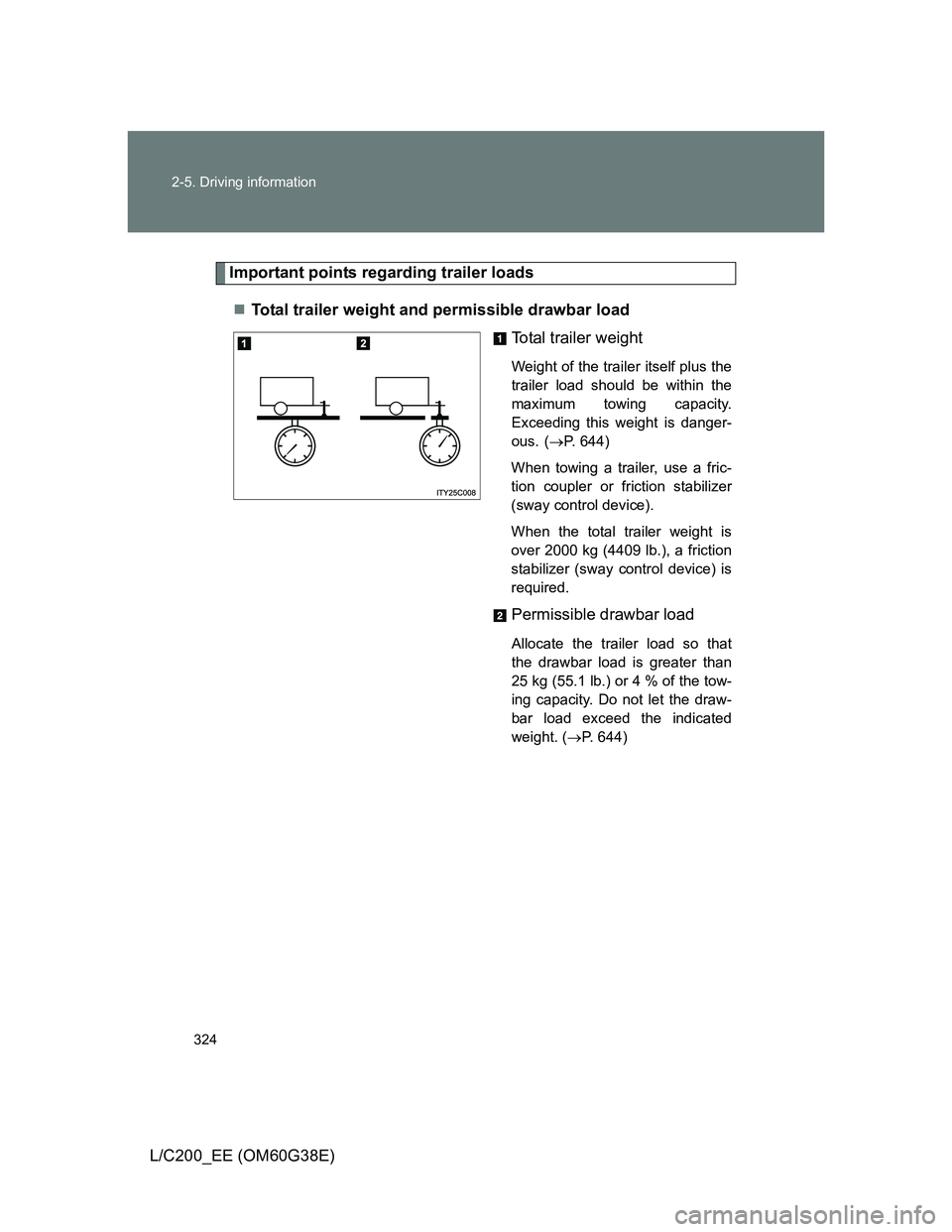
Total trailer weight and permissible drawbar load
Total trailer weight
Weight of the trailer itself plus the
trailer load should be within the
maximum towing capacity.
Exceeding this weight is danger-
ous.
(P. 644)
When towing a trailer, use a fric-
tion coupler or friction stabilizer
(sway control device).
When the total trailer weight is
over 2000 kg (4409 lb.), a friction
stabilizer (sway control device) is
required.
Permissible drawbar load
Allocate the trailer load so that
the drawbar load is greater than
25 kg (55.1 lb.) or 4 % of the tow-
ing capacity. Do not let the draw-
bar load exceed the indicated
weight. (P. 644)
Page 325 of 692
325 2-5. Driving information
2
When driving
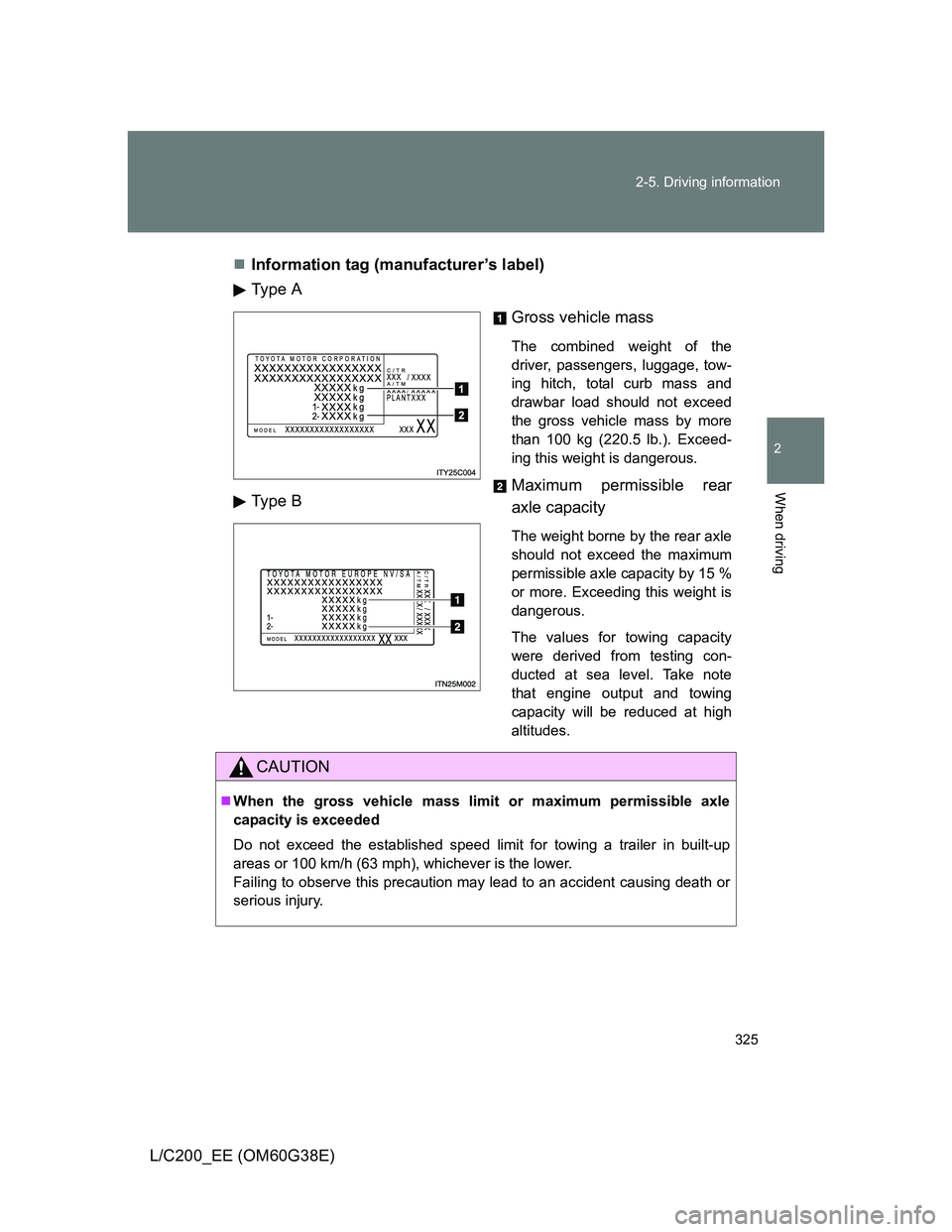
L/C200_EE (OM60G38E)Information tag (manufacturer’s label)
Type A
Gross vehicle mass
The combined weight of the
driver, passengers, luggage, tow-
ing hitch, total curb mass and
drawbar load should not exceed
the gross vehicle mass by more
than 100 kg (220.5 lb.). Exceed-
ing this weight is dangerous.
Maximum permissible rear
axle capacity
The weight borne by the rear axle
should not exceed the maximum
permissible axle capacity by 15 %
or more. Exceeding this weight is
dangerous.
The values for towing capacity
were derived from testing con-
ducted at sea level. Take note
that engine output and towing
capacity will be reduced at high
altitudes.
Type B
CAUTION
When the gross vehicle mass limit or maximum permissible axle
capacity is exceeded
Do not exceed the established speed limit for towing a trailer in built-up
areas or 100 km/h (63 mph), whichever is the lower.
Failing to observe this precaution may lead to an accident causing death or
serious injury.
Page 327 of 692
327 2-5. Driving information
2
When driving
L/C200_EE (OM60G38E)
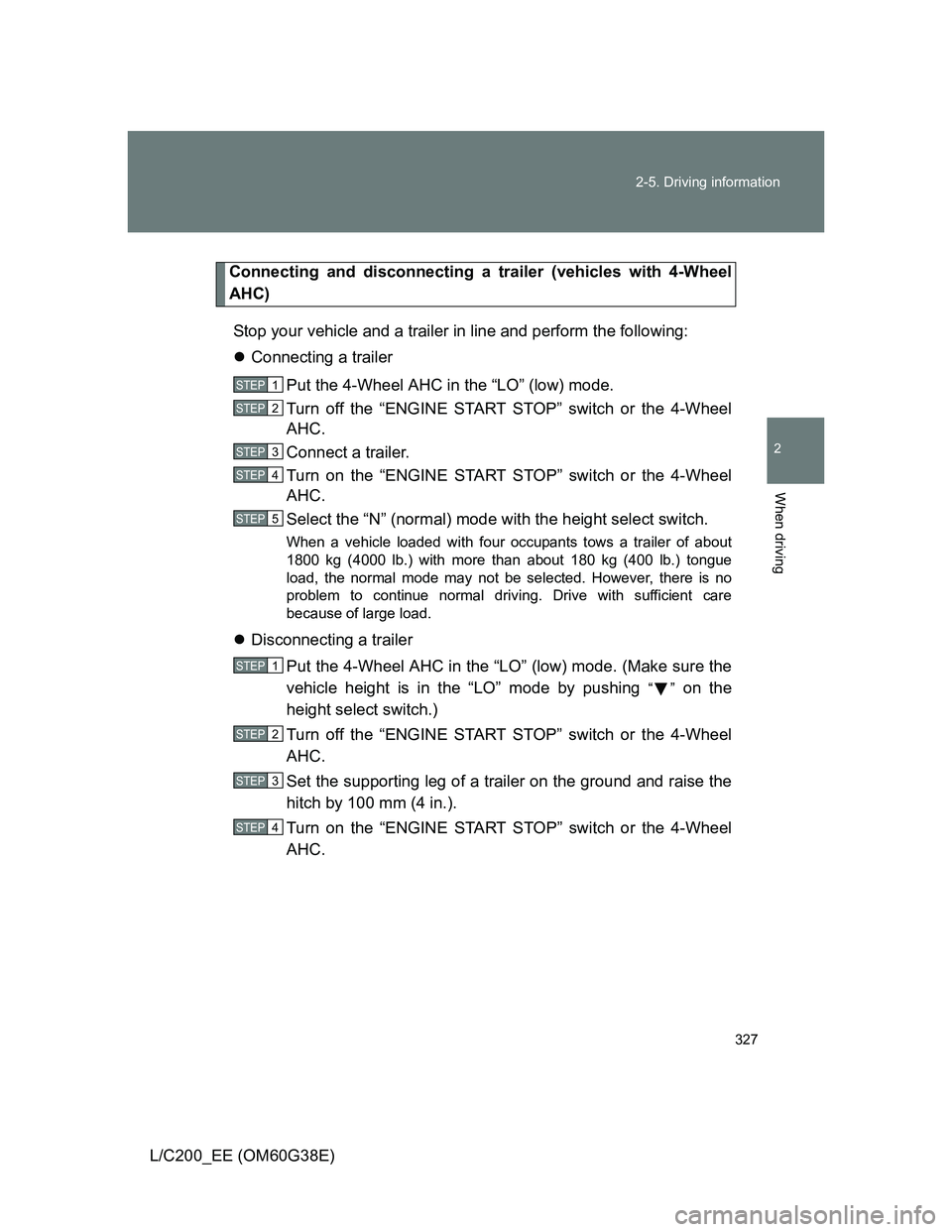
Connecting and disconnecting a trailer (vehicles with 4-Wheel
AHC)
Stop your vehicle and a trailer in line and perform the following:
Connecting a trailer
Put the 4-Wheel AHC in the “LO” (low) mode.
Turn off the “ENGINE START STOP” switch or the 4-Wheel
AHC.
Connect a trailer.
Turn on the “ENGINE START STOP” switch or the 4-Wheel
AHC.
Select the “N” (normal) mode with the height select switch.
When a vehicle loaded with four occupants tows a trailer of about
1800 kg (4000 lb.) with more than about 180 kg (400 lb.) tongue
load, the normal mode may not be selected. However, there is no
problem to continue normal driving. Drive with sufficient care
because of large load.
Disconnecting a trailer
Put the 4-Wheel AHC in the “LO” (low) mode. (Make sure the
vehicle height is in the “LO” mode by pushing
“” on the
height select switch.)
Turn off the “ENGINE START STOP” switch or the 4-Wheel
AHC.
Set the supporting leg of a trailer on the ground and raise the
hitch by 100 mm (4 in.).
Turn on the “ENGINE START STOP” switch or the 4-Wheel
AHC.
STEP1
STEP2
STEP3
STEP4
STEP5
STEP1
STEP2
STEP3
STEP4
Page 328 of 692
328 2-5. Driving information
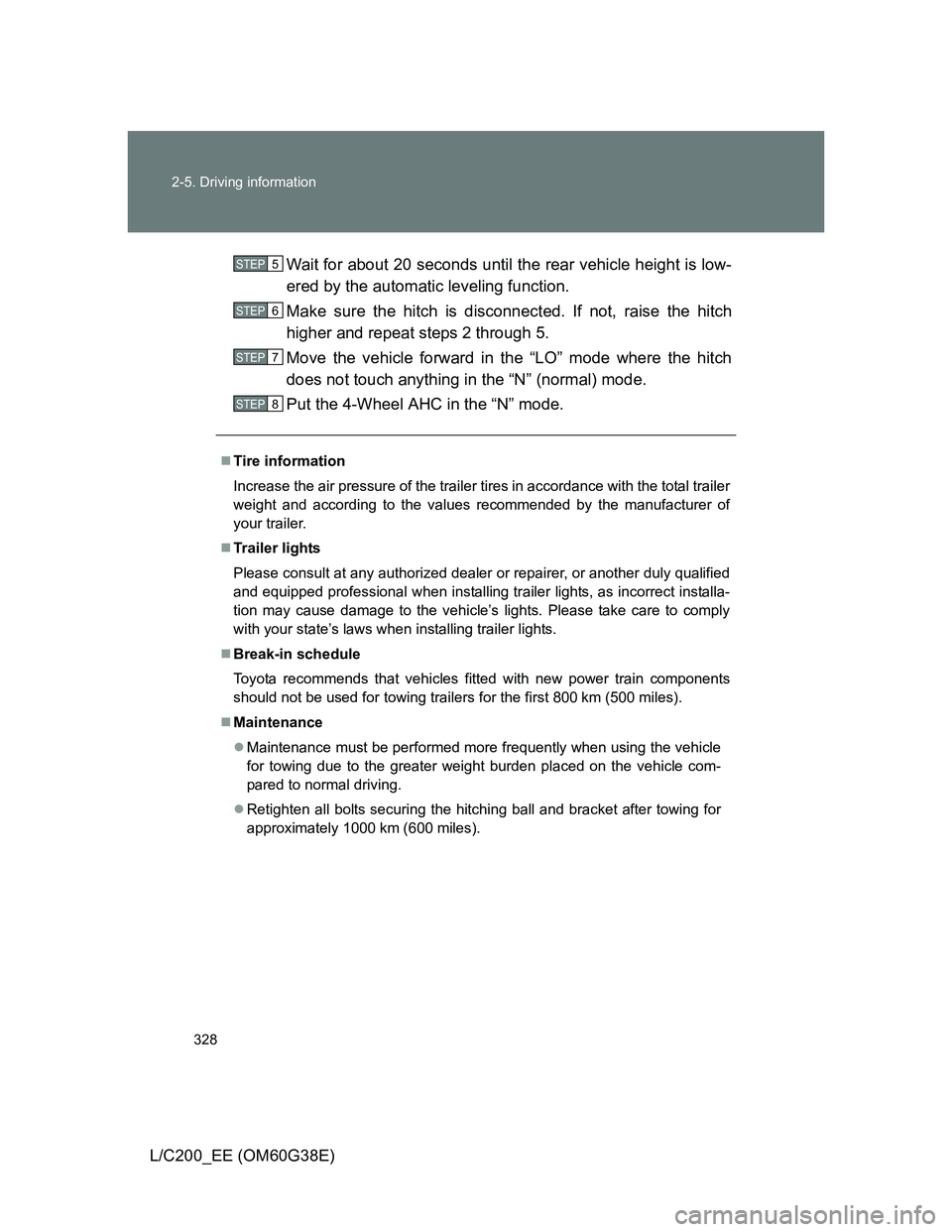
L/C200_EE (OM60G38E)Wait for about 20 seconds until the rear vehicle height is low-
ered by the automatic leveling function.
Make sure the hitch is disconnected. If not, raise the hitch
higher and repeat steps 2 through 5.
Move the vehicle forward in the “LO” mode where the hitch
does not touch anything in the “N” (normal) mode.
Put the 4-Wheel AHC in the “N” mode.
Tire information
Increase the air pressure of the trailer tires in accordance with the total trailer
weight and according to the values recommended by the manufacturer of
your trailer.
Trailer lights
Please consult at any authorized dealer or repairer, or another duly qualified
and equipped professional when installing trailer lights, as incorrect installa-
tion may cause damage to the vehicle’s lights. Please take care to comply
with your state’s laws when installing trailer lights.
Break-in schedule
Toyota recommends that vehicles fitted with new power train components
should not be used for towing trailers for the first 800 km (500 miles).
Maintenance
Maintenance must be performed more frequently when using the vehicle
for towing due to the greater weight burden placed on the vehicle com-
pared to normal driving.
Retighten all bolts securing the hitching ball and bracket after towing for
approximately 1000 km (600 miles).
STEP5
STEP6
STEP7
STEP8