lock TOYOTA LAND CRUISER 2013 J200 Quick Reference Guide
[x] Cancel search | Manufacturer: TOYOTA, Model Year: 2013, Model line: LAND CRUISER, Model: TOYOTA LAND CRUISER 2013 J200Pages: 36, PDF Size: 1.5 MB
Page 18 of 36
16
Window wipers & washers
FEATURES/OPERATIONS
Windows-Power
Up
Down
Driver side
Window lock
switch
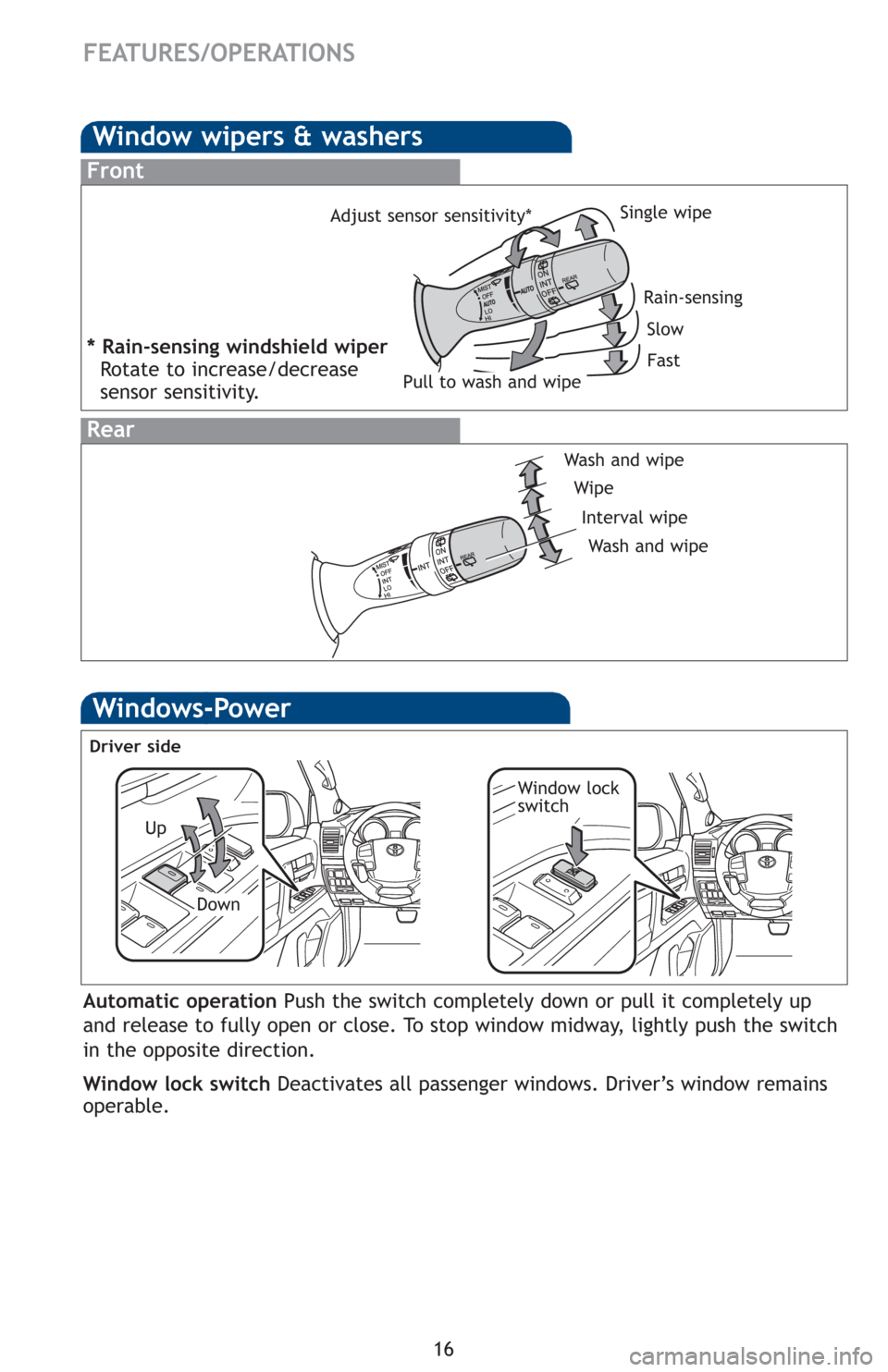
Automatic operation Push the switch completely down or pull it completely up
and release to fully open or close. To stop window midway, lightly push the switch
in the opposite direction.
Window lock switch Deactivates all passenger windows. Driver’s window remains
operable.
Front
Rear
Wash and wipe
Wipe
Interval wipe
Wash and wipe
* Rain-sensing windshield wiper
Rotate to increase/decrease
sensor sensitivity.
Rain-sensing
Slow
FastPull to wash and wipe
Single wipe
Adjust sensor sensitivity*
Page 19 of 36
OVERVIEW
FEATURES/OPERATIONS
SAFETY AND EMERGENCY FEATURES
17
Back door
Pull
Unlock
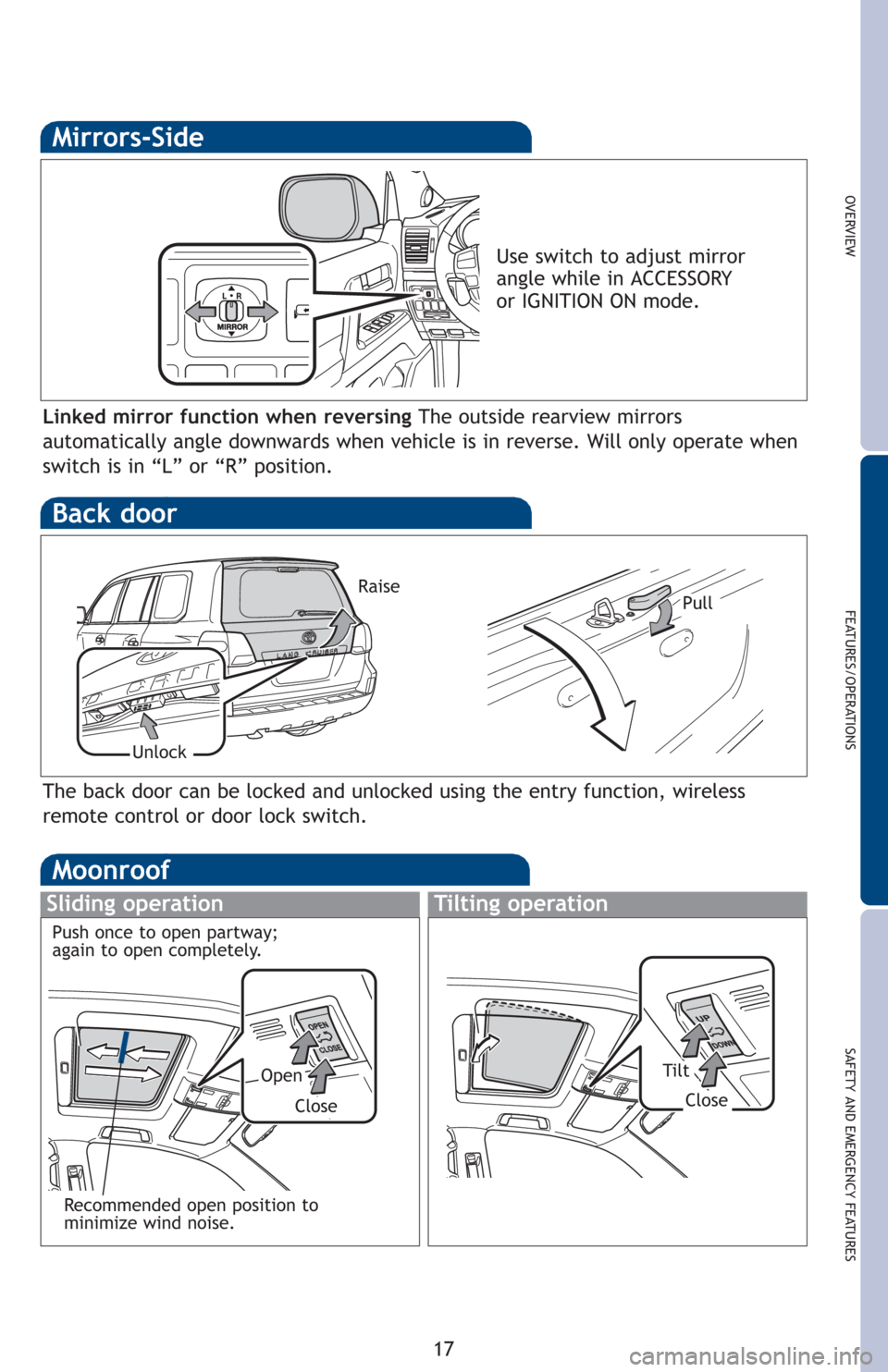
The back door can be locked and unlocked using the entry function, wireless
remote control or door lock switch.
Raise
Moonroof
Sliding operationTilting operation
OpenTilt
CloseClose
Recommended open position to
minimize wind noise. Push once to open partway;
again to open completely.
Mirrors-Side
Linked mirror function when reversingThe outside rearview mirrors
automatically angle downwards when vehicle is in reverse. Will only operate when
switch is in “L” or “R” position.Use switch to adjust mirror
angle while in ACCESSORY
or IGNITION ON mode.
Page 21 of 36

OVERVIEW
FEATURES/OPERATIONS
SAFETY AND EMERGENCY FEATURES
19
Rear Air Conditioning
Temperature selector (left side)
Temperature selector (right side)
Climate control OFF
Airflow vent
Fan speed
Automatic climate control ON
Seat heaters and ventilators
Front seats
Push knob to pop the controller out. Turn
clockwise for heater; counterclockwise
for airflow.
Push
Second seats
AUTO TEMP
OFFTEMP
HI
LO
OFF
HI
LO
OFF
HI
LO
OFF
HI
LOLeft
second seatRight
second seat
OFF
Blows air from the seat
Turns the seat heater on
Page 27 of 36
OVERVIEW
FEATURES/OPERATIONS
SAFETY AND EMERGENCY FEATURES
25
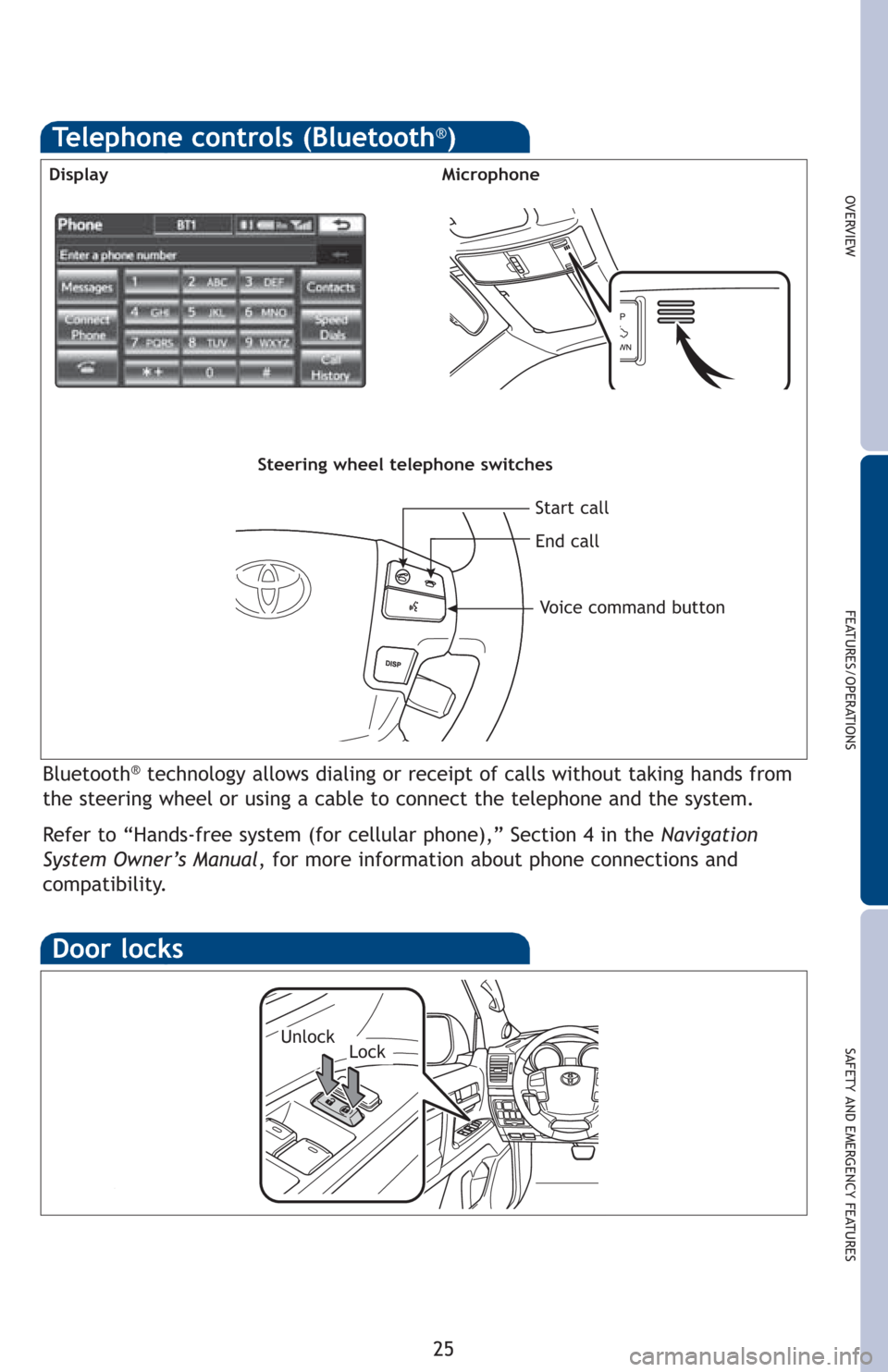
Bluetooth®technology allows dialing or receipt of calls without taking hands from
the steering wheel or using a cable to connect the telephone and the system.
Refer to “Hands-free system (for cellular phone),” Section 4 in the Navigation
System Owner’s Manual, for more information about phone connections and
compatibility.
MicrophoneDisplay
Steering wheel telephone switches
Start call
End call
Voice command button
Door locks
LockUnlock
Telephone controls (Bluetooth®)
Page 30 of 36
28
SAFETY AND EMERGENCY FEATURES
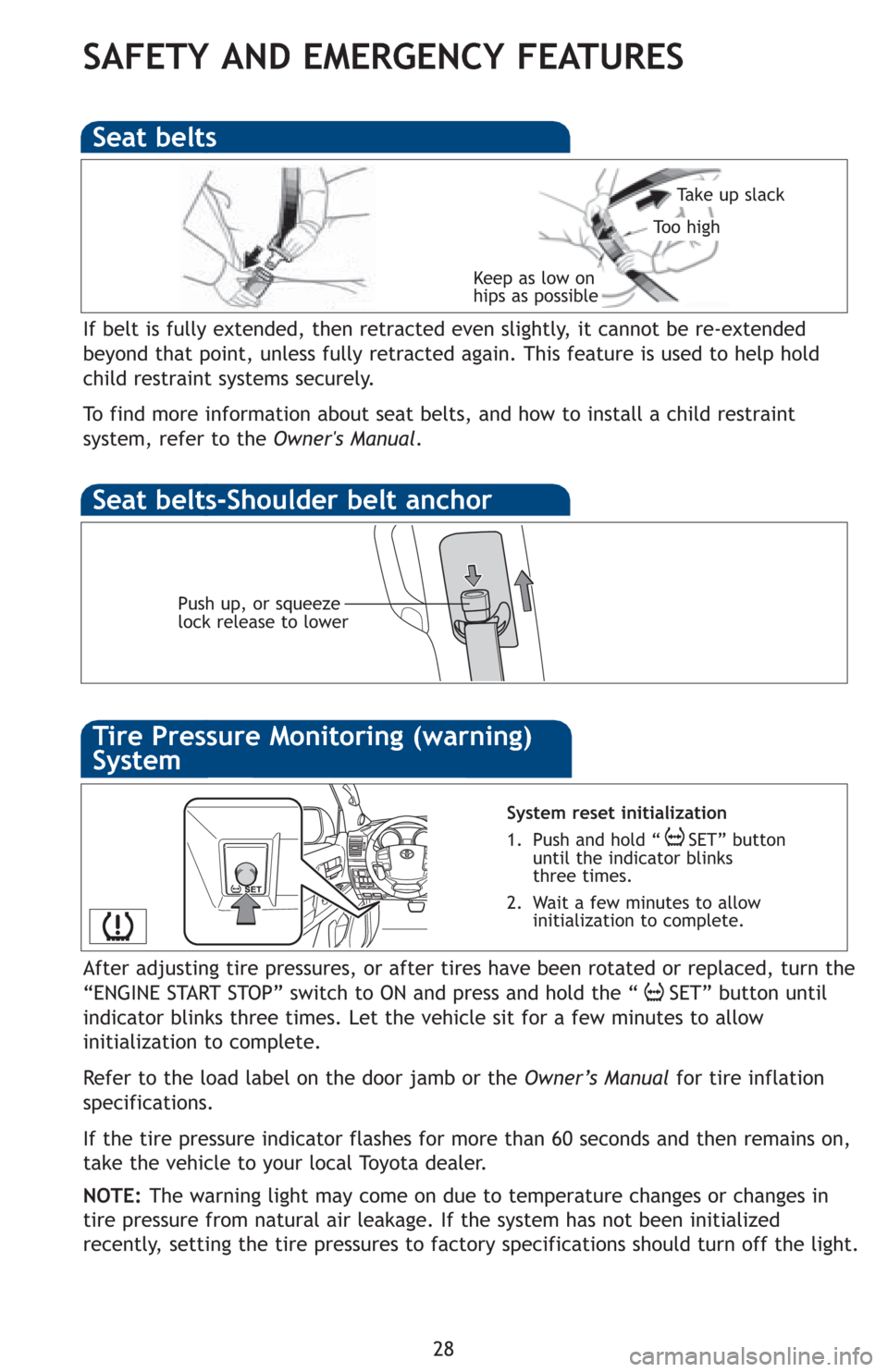
If belt is fully extended, then retracted even slightly, it cannot be re-extended
beyond that point, unless fully retracted again. This feature is used to help hold
child restraint systems securely.
To find more information about seat belts, and how to install a child restraint
system, refer to the Owner's Manual.
Keep as low on
hips as possible
Take up slack
Too high
Seat belts
Push up, or squeeze
lock release to lower
System reset initialization
1. Push and hold “ SET” button
until the indicator blinks
three times.
2. Wait a few minutes to allow
initialization to complete.
Seat belts-Shoulder belt anchor
After adjusting tire pressures, or after tires have been rotated or replaced, turn the
“ENGINE START STOP” switch to ON and press and hold the “ SET” button until
indicator blinks three times. Let the vehicle sit for a few minutes to allow
initialization to complete.
Refer to the load label on the door jamb or the Owner’s Manualfor tire inflation
specifications.
If the tire pressure indicator flashes for more than 60 seconds and then remains on,
take the vehicle to your local Toyota dealer.
NOTE:The warning light may come on due to temperature changes or changes in
tire pressure from natural air leakage. If the system has not been initialized
recently, setting the tire pressures to factory specifications should turn off the light.
Tire Pressure Monitoring (warning)
System
Page 31 of 36
OVERVIEW
FEATURES/OPERATIONS
SAFETY AND EMERGENCY FEATURES
29
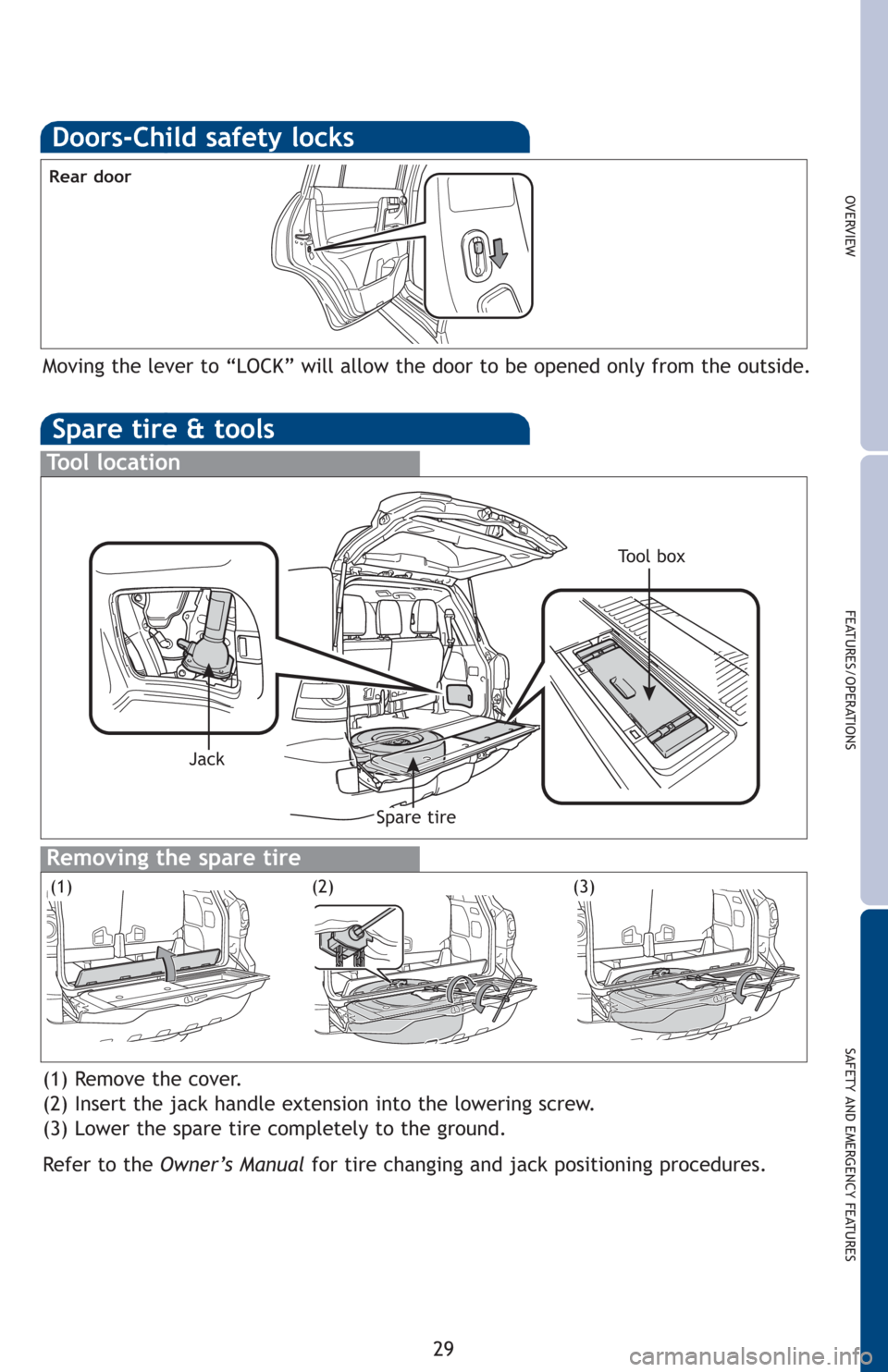
Spare tire & tools
Tool location
Removing the spare tire
(1) Remove the cover.
(2) Insert the jack handle extension into the lowering screw.
(3) Lower the spare tire completely to the ground.
Refer to the Owner’s Manualfor tire changing and jack positioning procedures.
Spare tire
Moving the lever to “LOCK” will allow the door to be opened only from the outside.
Rear door
JackTool box
Doors-Child safety locks
(1)(2)(3)
Page 32 of 36
Smart Stop Technology automatically reduces engine power when the accelerator
and brake pedals are pressed simultaneously under certain conditions.
SST engages when the accelerator is depressed first and the brakes are applied
firmly for longer than one-half second at speeds greater than five miles per hour.
SST doesn’t engage if the brake pedal is depressed before the accelerator pedal,
allowing vehicles to start on a steep hill and safely accelerate without rolling
backward.
Smart Stop Technology (SST)
SAFETY AND EMERGENCY FEATURES
Star Safety SystemTM
VSC helps prevent loss of traction during cornering by reducing engine power and
applying brake force to selected wheels.
Toyota’s VSC monitors steering angle and the direction your vehicle is traveling.
When it senses that the front or rear wheels begin to lose traction, VSC reduces
engine power and applies braking to selected wheels. This helps restore traction
and vehicle control.
Vehicle Stability Control (VSC)
Multi Terrain Anti-lock Brake System (ABS)
Brake Assist (BA)
Helps to prevent wheel lock when the brakes are applied suddenly, or if
the brakes are applied while driving on a slippery road surface, or in off-road
conditions (such as rough roads, sand and mud).
Brake Assist is designed to detect sudden or “panic” braking, and then add braking
pressure to decrease the vehicle’s stopping distance. When there’s only a split
second to react, Brake Assist can add additional brake pressure more quickly than
just the driver alone can. Helps to maintain drive power and prevent the 4 wheels from spinning
when starting the vehicle or accelerating on slippery roads.
Active Traction Control (A-TRAC)
Electronic Brake Force Distribution (EBD)
Toyota’s ABS technology has Electronic Brake-force Distribution (EBD) to help
maintain stability and balance when braking. Abrupt stops cause the vehicle to tilt
forward, reducing the braking power of the rear wheels. EBD responds to sudden
stops by redistributing brake force to maximize the braking effectiveness of all
four wheels. All new Toyota vehicles come standard with the Star Safety System
TM, which
combines Vehicle Stability Control (VSC), Traction Control (TRAC), Anti-lock Braking
System (ABS), Electronic Brake-force Distribution (EBD), Brake Assist (BA) and
Smart Stop Technology (SST).
30