child lock TOYOTA LAND CRUISER 2015 J200 Owners Manual
[x] Cancel search | Manufacturer: TOYOTA, Model Year: 2015, Model line: LAND CRUISER, Model: TOYOTA LAND CRUISER 2015 J200Pages: 728, PDF Size: 10.53 MB
Page 2 of 728
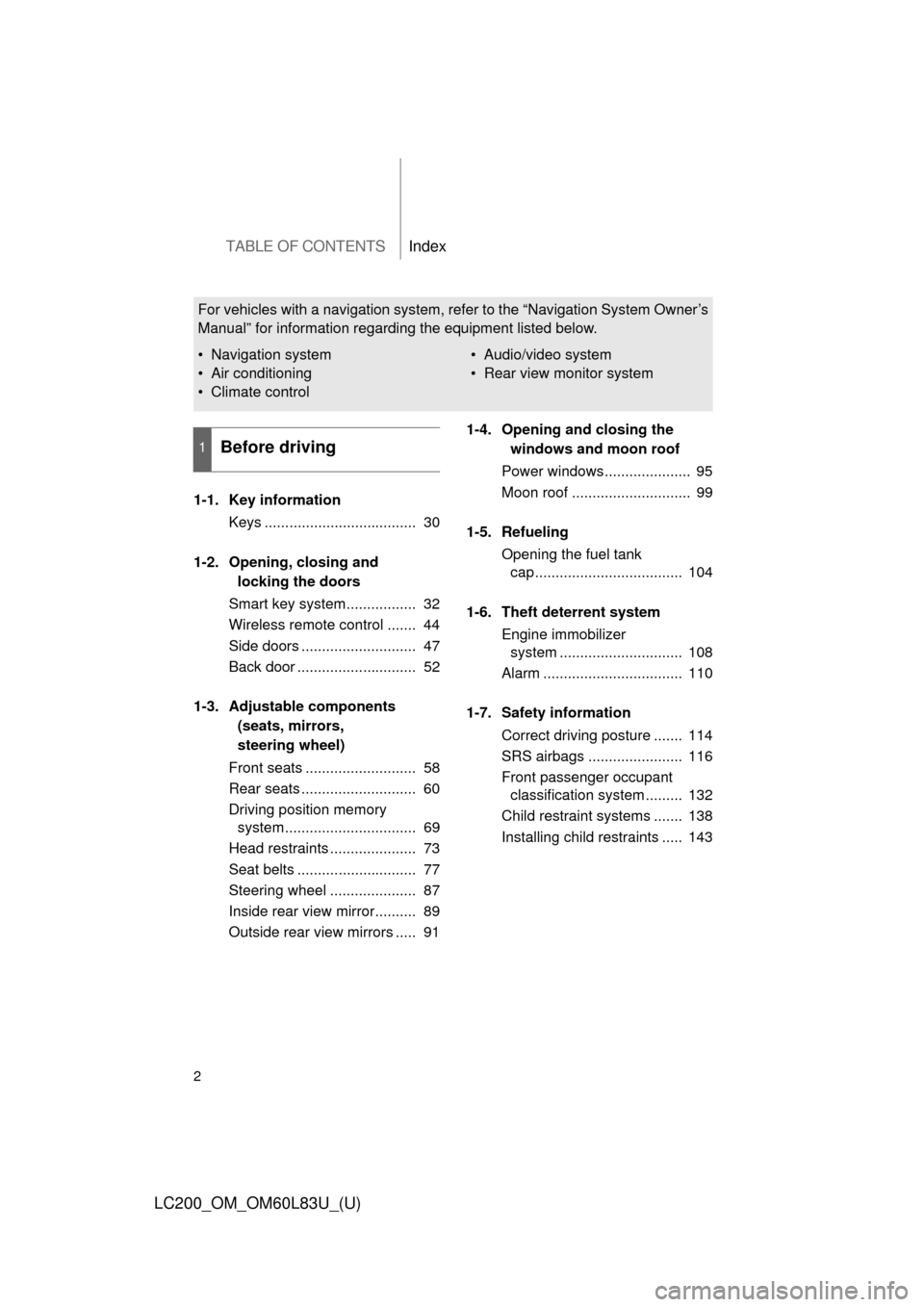
TABLE OF CONTENTSIndex
2
LC200_OM_OM60L83U_(U)
1-1. Key informationKeys ..................................... 30
1-2. Opening, closing and locking the doors
Smart key system................. 32
Wireless remote control ....... 44
Side doors ............................ 47
Back door ............................. 52
1-3. Adjustable components (seats, mirrors,
steering wheel)
Front seats ........................... 58
Rear seats ............................ 60
Driving position memory system ................................ 69
Head restraints ..................... 73
Seat belts ............................. 77
Steering wheel ..................... 87
Inside rear view mirror.......... 89
Outside rear view mirrors ..... 91 1-4. Opening and closing the
windows and moon roof
Power windows..................... 95
Moon roof ............................. 99
1-5. Refueling Opening the fuel tank cap .................................... 104
1-6. Theft deterrent system Engine immobilizer system .............................. 108
Alarm .................................. 110
1-7. Safety information Correct driving posture ....... 114
SRS airbags ....................... 116
Front passenger occupant classification system ......... 132
Child restraint systems ....... 138
Installing child restraints ..... 143
1Before driving
For vehicles with a navigation system, refer to the “Navigation System Owner’s
Manual” for information regarding the equipment listed below.
• Navigation system
• Air conditioning
• Climate control • Audio/video system
• Rear view monitor system
Page 29 of 728
Before driving1
29
LC200_OM_OM60L83U_(U)
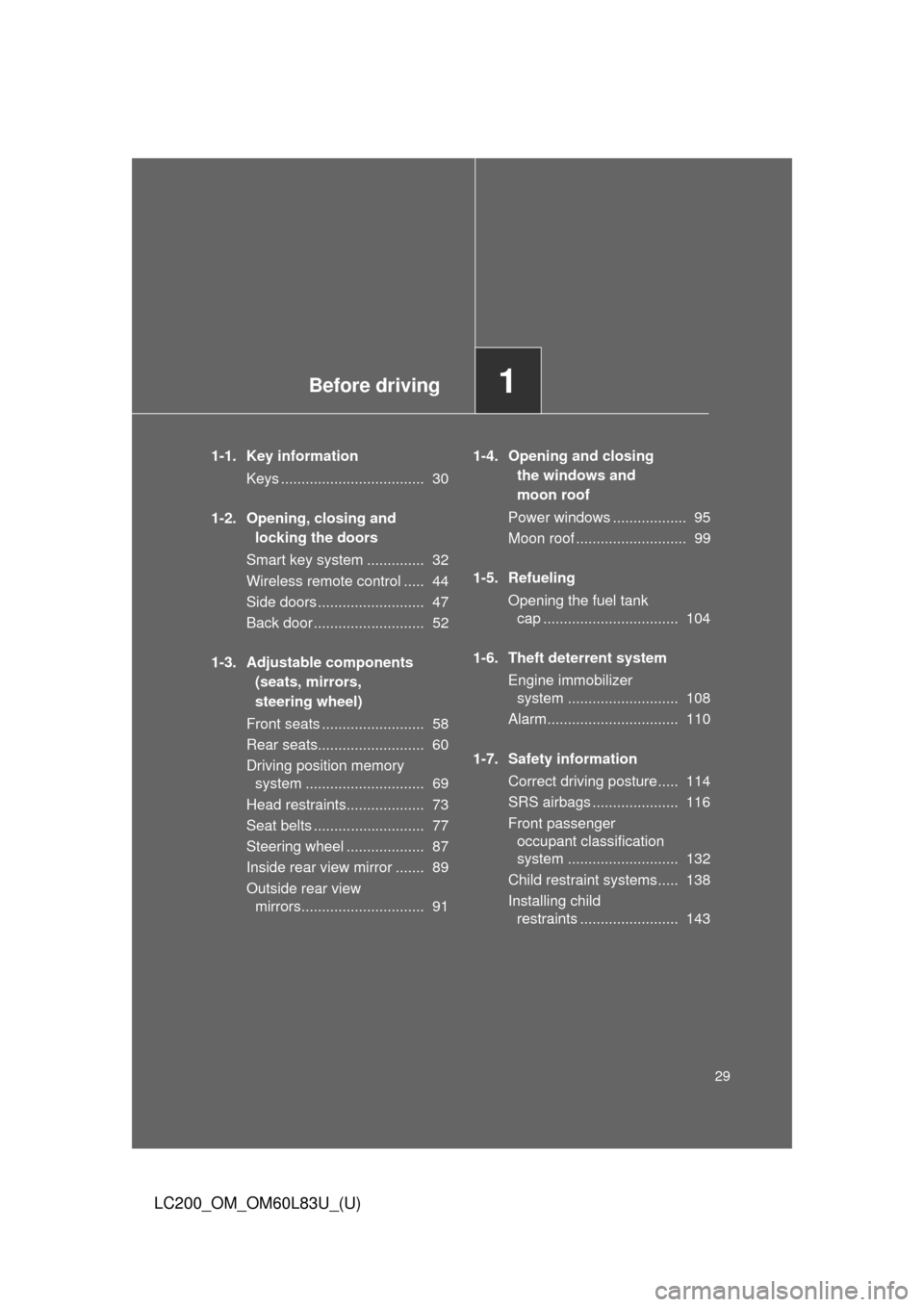
1-1. Key informationKeys ................................... 30
1-2. Opening, closing and locking the doors
Smart key system .............. 32
Wireless remote control ..... 44
Side doors .......................... 47
Back door ........................... 52
1-3. Adjustable components (seats, mirrors,
steering wheel)
Front seats ......................... 58
Rear seats.......................... 60
Driving position memory system ............................. 69
Head restraints................... 73
Seat belts ........................... 77
Steering wheel ................... 87
Inside rear view mirror ....... 89
Outside rear view mirrors.............................. 91 1-4. Opening and closing
the windows and
moon roof
Power windows .................. 95
Moon roof ........................... 99
1-5. Refueling Opening the fuel tank cap ................................. 104
1-6. Theft deterrent system Engine immobilizer system ........................... 108
Alarm................................ 110
1-7. Safety information Correct driving posture..... 114
SRS airbags ..................... 116
Front passenger occupant classification
system ........................... 132
Child restraint systems..... 138
Installing child restraints ........................ 143
Page 43 of 728

43
1-2. Opening, closing and locking the doors
1
Before driving
LC200_OM_OM60L83U_(U)
■
Certification for the smart key system
CAUTION
■Caution regarding interference with electronic devices
●People with implantable cardiac pacemakers, cardiac resynchronization
therapy-pacemakers or implantable cardioverter defibrillators should keep
away from the smart key system antennas. ( P. 34) The radio waves may
affect the operation of such devices. If necessary, the entry function can
be disabled. Ask your Toyota dealer for details, such as the frequency of
radio waves and timing of the emitted radio waves. Then, consult your
doctor to see if you should disable the entry function.
● Users of any electrical medical device other than implantable cardiac
pacemakers, cardiac resynchronizati on therapy-pacemakers or implant-
able cardioverter defibrillators should consult the manufacturer of the
device for information about its operation under the influence of radio
waves. Radio waves could have unexpected effects on the operation of
such medical devices.
Ask your Toyota dealer for details for disabling the smart key system.
■ When using the smart key system and operating the power windows
and moon roof
Operate the power window or moon roof after checking to make sure that
there is no possibility of any passenger having any of their body parts caught
in the window or moon roof. Also, do not allow children to operate the smart
key system. It is possible for children and other passengers to get caught in
power window and moon roof.
Page 46 of 728

46 1-2. Opening, closing and locking the doors
LC200_OM_OM60L83U_(U)
■Certification for wireless remote control
FCC ID: HYQ14AEM
FCC ID: HYQ13BZS
FCC ID: HYQ14ABK
*
FCC ID: HYQ13CZA*
*
: For U.S. mainland only
NOTE:
This device complies with part 15 of the FCC Rules. Operation is subject to
the following two conditions: (1) This device may not cause harmful interfer-
ence, and (2) this device must accept any interference received, including
interference that may cause undesired operation.
FCC WARNING:
Changes or modifications not expressly approved by the party responsible
for compliance could void the user’s authority to operate the equipment.
CAUTION
■ When using the wireless remote control and operating the power win-
dows and moon roof
Operate the power window or moon roof after checking to make sure that
there is no possibility of any passenger having any of their body parts caught
in the window or moon roof. Also, do not allow children to operate the wire-
less remote control. It is possible for children and other passengers to get
caught in power window and moon roof.
Page 48 of 728

48 1-2. Opening, closing and locking the doors
LC200_OM_OM60L83U_(U)
Locking the driver’s door from the outside without a keyMove the inside lock button to the lock position.
Close the door.
The door cannot be locked if the “ENGINE START STOP” switch is in
ACCESSORY or IGNITION ON mode, or the electronic key is left
inside the vehicle.
Depending on the position of the electronic key, the key may not be
detected correctly and the door may be locked.
Rear door child-protector lock
The door cannot be opened from
inside the vehicle when the locks
are set.Unlock
Lock
These locks can be set to prevent
children from opening the rear
doors. Press down rear door
switches to lock the rear doors.
STEP1
STEP2
Page 51 of 728

51
1-2. Opening, closing and locking the doors
1
Before driving
LC200_OM_OM60L83U_(U)
CAUTION
■
To prevent an accident
Observe the following precautions while driving the vehicle.
Failing to do so may result in a door opening and an occupant falling out,
resulting in death or serious injury.
●Always use a seat belt.
● Always lock all doors.
● Ensure that all doors are properly closed.
● Do not pull the inside handle of the doors while driving.
The doors may be opened and the passengers are thrown out of the vehi-
cle and it may result in serious injury or death.
Be especially careful of the front doors, as the doors may be opened even
if the inside lock buttons are in locked position.
● Set the rear door child-protector locks when children are seated in the rear
seat.
Page 55 of 728

55
1-2. Opening, closing and locking the doors
1
Before driving
LC200_OM_OM60L83U_(U)
CAUTION
■
While driving
●Keep the back door closed while driving.
If the back door is left open, it may hit near-by objects while driving or lug-
gage may be unexpectedly thrown out, causing an accident.
In addition, exhaust gases may enter the vehicle, causing death or a seri-
ous health hazard. Make sure to close the back door before driving.
● Before driving the vehicle, make sure that the back door is fully closed. If
the back door is not fully closed, it may open unexpectedly while driving,
causing an accident.
● Never let anyone sit in the luggage compartment. In the event of sudden
braking or an accident, they are susceptible to death or serious injury.
■ When children are in the vehicle
Observe the following precautions.
Failure to do so may result in death or serious injury.
●Do not allow children to play in the luggage compartment.
If a child is accidentally locked in the luggage compartment, they could
have heat exhaustion or other injuries.
● Do not allow a child to open or close the back door.
Doing so may cause the back door to move unexpectedly, or cause the
child’s hands, head, or neck to be caught by the closing back door.
Page 81 of 728
81
1-3. Adjustable components (s
eats, mirrors, steering wheel)
1
Before driving
LC200_OM_OM60L83U_(U)
Pre-collision seat belts (front seats of vehicles with pre-collision
system)
Brake-linked pre-collision system
If the system determines that emergency braking is being per-
formed or the vehicle is out of c ontrol, the front seat belts will
retract. ( P. 293)
Radar type pre- collision system
If the system determines that a collision is unavoidable, the front
seat belts will retract before the collision. (P. 293)
■Emergency locking retractor (ELR)
The retractor will lock the belt during a sudden stop or on impact. It may also
lock if you lean forward too quickly. A slow, easy motion will allow the belt to
extend, and you can move around fully.
■ Automatic locking retractor (ALR)
When a passenger’s shoulder belt is completely extended and then
retracted even slightly, the belt is locked in that position and cannot be
extended. This feature is used to hold the child restraint system (CRS) firmly.
To free the belt again, fully retract the belt and then pull the belt out once
more. ( P. 143)
Page 82 of 728
82 1-3. Adjustable components (seats, mirrors, steering wheel)
LC200_OM_OM60L83U_(U)
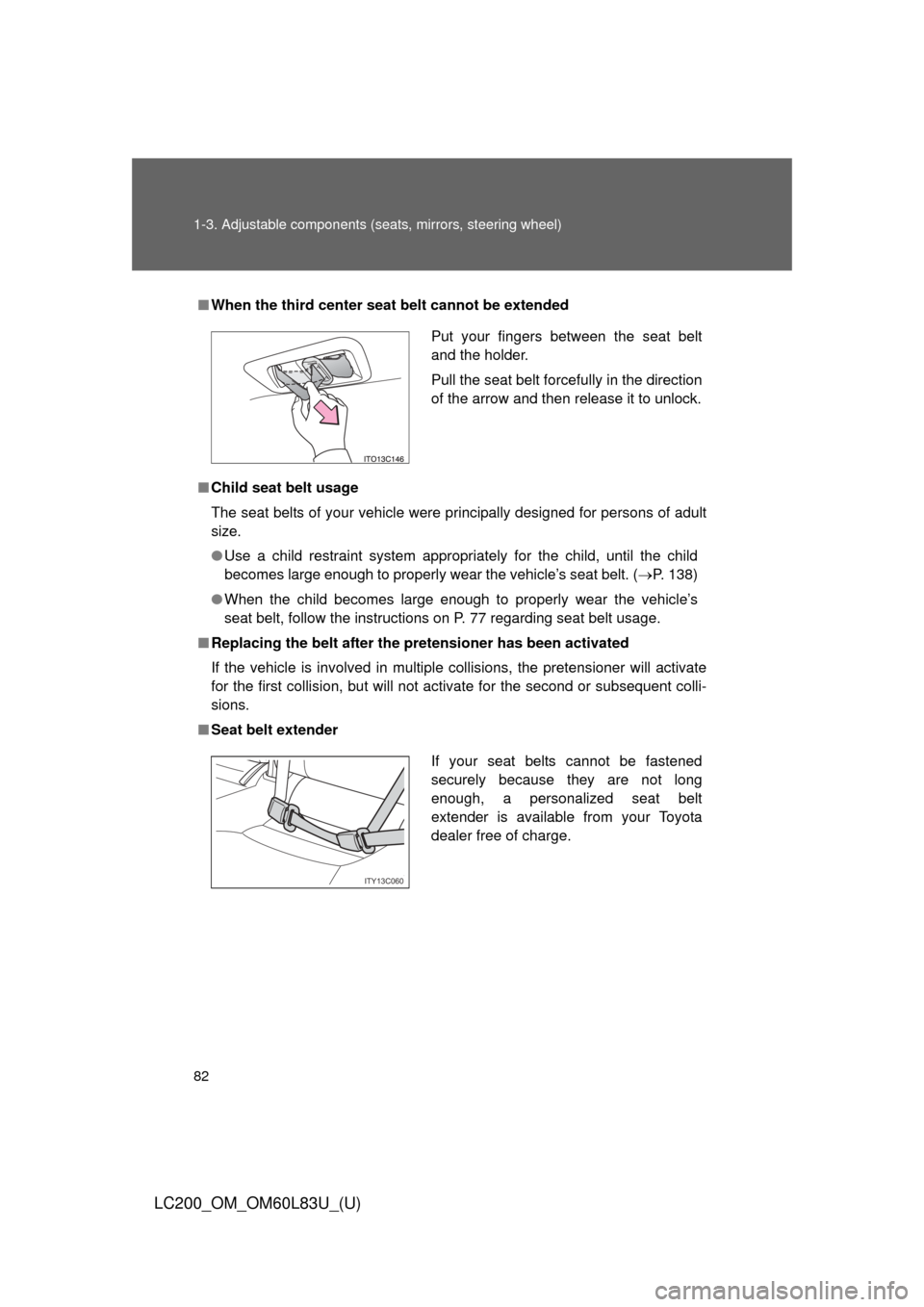
■When the third center seat belt cannot be extended
■ Child seat belt usage
The seat belts of your vehicle were principally designed for persons of adult
size.
●Use a child restraint system appropriately for the child, until the child
becomes large enough to properly wear the vehicle’s seat belt. ( P. 138)
● When the child becomes large enough to properly wear the vehicle’s
seat belt, follow the instructions on P. 77 regarding seat belt usage.
■ Replacing the belt after the pretensioner has been activated
If the vehicle is involved in multiple collisions, the pretensioner will activate
for the first collision, but will not activate for the second or subsequent colli-
sions.
■ Seat belt extender
Put your fingers between the seat belt
and the holder.
Pull the seat belt forcefully in the direction
of the arrow and then release it to unlock.
If your seat belts cannot be fastened
securely because they are not long
enough, a personalized seat belt
extender is available from your Toyota
dealer free of charge.
ITY13C060
Page 85 of 728

85
1-3. Adjustable components (s
eats, mirrors, steering wheel)
1
Before driving
LC200_OM_OM60L83U_(U)
CAUTION
■Seat belt damage and wear
●Do not damage the seat belts by allowing the belt, plate or buckle to be
jammed in the door.
● Inspect the seat belt system periodically. Check for cuts, fraying, and loose
parts. Do not use a damaged seat belt until it is replaced. Damaged seat
belts cannot protect an occupant from death or serious injury.
● Ensure that the belt and tab are locked and the belt is not twisted. If the
seat belt does not function correctly, immediately contact your Toyota
dealer.
● Replace the seat assembly, including the belts, if your vehicle has been
involved in a serious accident, even if there is no obvious damage.
● Do not attempt to install, remove, modify, disassemble or dispose of a seat
belt. Have any necessary repairs carried out by your Toyota dealer. Inap-
propriate handling of the pretensioner may cause it to activate or operate
improperly and may cause death or serious injury.
■ Using a seat belt extender
●Do not wear the seat belt extender, if you can fasten the seat belt without
the extender.
● Do not use the seat belt extender when installing a child restraint system,
because the belt will not securely hold the child restraint system, increas-
ing the risk of death or serious injury in the event of a sudden stop, sudden
swerve or accident.
● The personalized extender may not be safe on another vehicle, when
used by another person, or at a different seating position other than the
one originally intended.