fuel TOYOTA LAND CRUISER 2017 J200 Owner's Guide
[x] Cancel search | Manufacturer: TOYOTA, Model Year: 2017, Model line: LAND CRUISER, Model: TOYOTA LAND CRUISER 2017 J200Pages: 608, PDF Size: 15.88 MB
Page 512 of 608
5127-2. Steps to take in an emergency
LC200_OM_OM60P24U_(U)
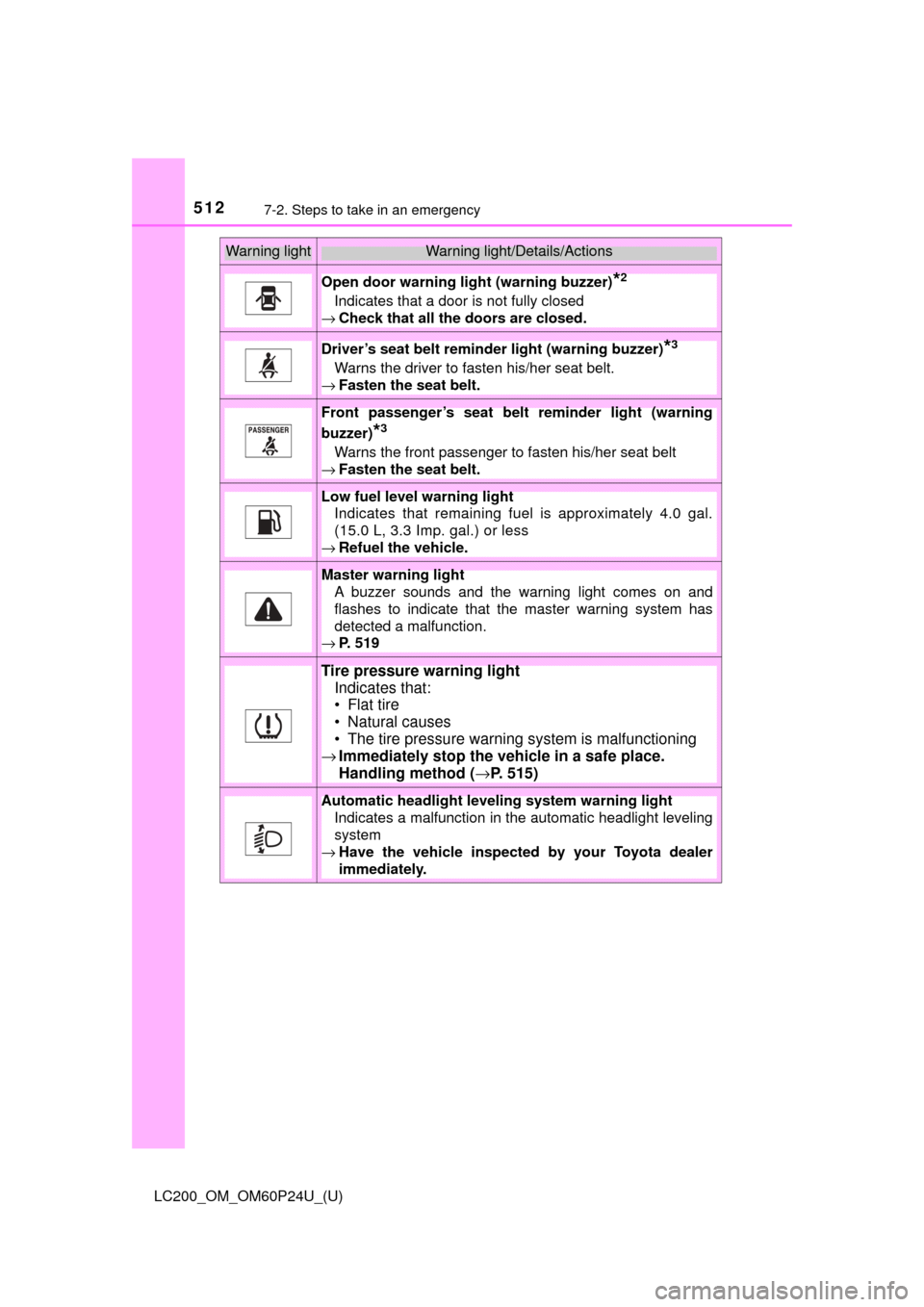
Open door warning light (warning buzzer)*2
Indicates that a door is not fully closed
→ Check that all the doors are closed.
Driver’s seat belt reminder light (warning buzzer)*3
Warns the driver to fasten his/her seat belt.
→ Fasten the seat belt.
Front passenger’s seat belt reminder light (warning
buzzer)
*3
Warns the front passenger to fasten his/her seat belt
→ Fasten the seat belt.
Low fuel level warning light
Indicates that remaining fuel is approximately 4.0 gal.
(15.0 L, 3.3 Imp. gal.) or less
→ Refuel the vehicle.
Master warning light
A buzzer sounds and the warning light comes on and
flashes to indicate that the master warning system has
detected a malfunction.
→ P. 519
Tire pressure warning light
Indicates that:
• Flat tire
• Natural causes
• The tire pressure warning system is malfunctioning
→ Immediately stop the vehicle in a safe place.
Handling method ( →P. 515)
Automatic headlight leveling system warning light
Indicates a malfunction in the automatic headlight leveling
system
→ Have the vehicle inspected by your Toyota dealer
immediately.
Warning lightWarning light/Details/Actions
Page 514 of 608
5147-2. Steps to take in an emergency
LC200_OM_OM60P24U_(U)
■SRS warning light
This warning light system monitors the airbag sensor assembly, front impact
sensors, side impact sensors (rear), side impact sensors (front door), safing
sensor (rear), driver’s seat belt buckle switch, driver’s seat position sensor,
front passenger’s seat belt buckle switch, airbags, interconnecting wiring and
power sources, front passenger occupant classification system, “AIR BAG
ON” and “AIR BAG OFF” indicator lights, seat belt pretensioners, “RSCA
OFF” indicator light. (→P. 38)
■ Front passenger detection sensor, seat belt reminder and warning
buzzer
● If luggage is placed on the front passenger seat, the front passenger de\
tec-
tion sensor may cause the warning light to flash and the warning buzzer to
sound even if a passenger is not sitting in the seat.
● If a cushion is placed on the seat, the sensor may not detect a passenger,
and the warning light may not operate properly.
■ If the malfunction indicator la mp comes on while driving
First check the following:
● Is the fuel tank empty?
If it is, fill the fuel tank immediately.
● Is the fuel tank cap loose?
If it is, tighten it securely.
The light will go off after several driving trips.
If the light does not go off even after several trips, contact your Toyota dealer
as soon as possible.
■ If the low speed four-wheel drive indi cator light or the center differential
lock indicator light blinks
Take the specified steps. ( →P. 283)
If the brake system warning light or the malfunction indicator light also comes
on, or the low speed four-wheel drive indicator light or the center differential
lock indicator light continues to blink after taking the specified steps, there
may be a malfunction in the engine, the brake system or the four-wheel drive
system. In this case, you may not be able to transfer between “H4” and “L4”
modes, and the center differential lock may not be able to be locked or
unlocked. Have the vehicle inspected by your Toyota dealer immediately.
Page 517 of 608
5177-2. Steps to take in an emergency
LC200_OM_OM60P24U_(U)
7
When trouble arises
WARNING
■Maintenance of the tires
Each tire, including the spare (if provided), should be checked monthly
when cold and inflated to the inflation pressure recommended by the
vehicle manufacturer on the vehicle placard or tire inflation pressure
label (tire and load information label). (If your vehicle has tires of a dif-
ferent size than the size indicated on the vehicle placard or tire inflation
pressure label [tire and load information label], you should determine
the proper tire inflation pressure for those tires.)
As an added safety feature, your vehicle has been equipped with a tire
pressure monitoring system (TPMS-ti re pressure warning system) that
illuminates a low tire pre ssure telltale (tire pressure warning light) when
one or more of your tires is significantly under-inflated. Accordingly,
when the low tire pressure telltale (tire pressure warning light) illumi-
nates, you should stop and check your tires as soon as possible, and
inflate them to the proper pressure. Driving on a significantly under-
inflated tire causes the tire to overheat and can lead to tire failure.
Under-inflation also reduces fuel effi ciency and tire tread life, and may
affect the vehicle’s handling and stopping ability.
Please note that the TPMS (tire pressure warning system) is not a sub-
stitute for proper ti re maintenance, and it is the driver’s responsibility to
maintain correct tire pressure, even if under-inflation has not reached
the level to trigger illumination of the TPMS low tire pressure telltale (tire
pressure warning light).
Your vehicle has also been equipped with a TPMS (tire pressure warn-
ing system) malfunction indicator to indicate when the system is not
operating properly. The TPMS (tire pressure warning system) malfunc-
tion indicator is combined with the lo w tire pressure telltale (tire pressure
warning light). When the system detects a malfunction, the telltale will
flash for approximately one minute and then remain continuously illumi-
nated. This sequence will continue upon subsequent vehicle start-ups as long as the malfunction exists. When the malfunction indicator is illu-
minated, the system may not be able to detect or signal low tire pres-
sure as intended.
TPMS (tire pressure warning system) malfunctions may occur for a vari-
ety of reasons, including the installation of replacement or alternate tires
or wheels on the vehicle that prevent the TPMS (tire pressure warning
system) from functioning properly. Always check the TPMS (tire pres-
sure warning system) malfunction te lltale after replacing one or more
tires or wheels on your vehicle to ensure that the replacement or alter-
nate tires and wheels allow the TPMS (tire pressure warning system) to
continue to function properly.
Page 538 of 608
538
LC200_OM_OM60P24U_(U)
7-2. Steps to take in an emergency
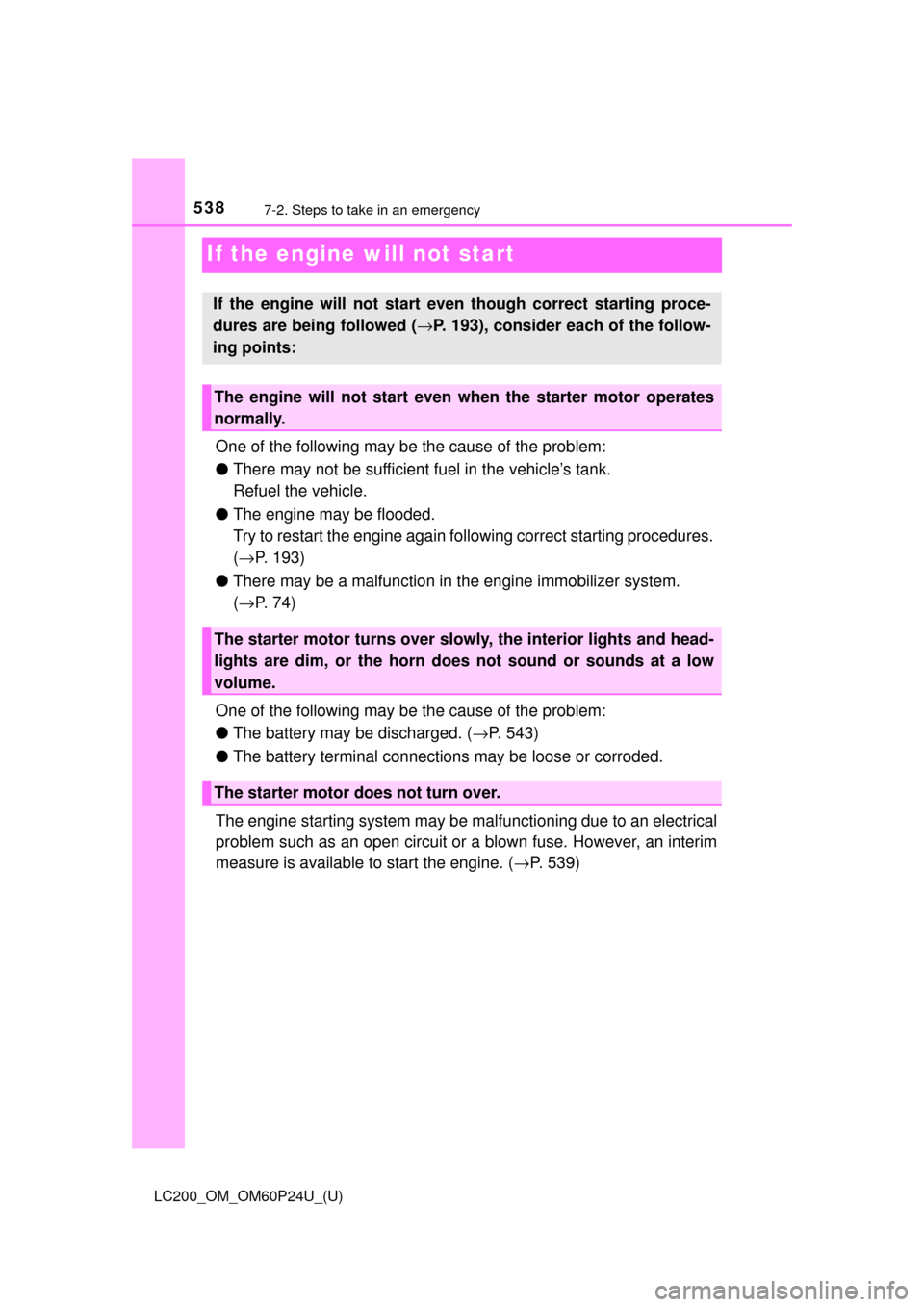
If the engine will not start
One of the following may be the cause of the problem:
●There may not be sufficient fuel in the vehicle’s tank.
Refuel the vehicle.
● The engine may be flooded.
Try to restart the engine again follo wing correct starting procedures.
( → P. 193)
● There may be a malfunction in the engine immobilizer system.
(→ P. 74)
One of the following may be the cause of the problem:
● The battery may be discharged. ( →P. 543)
● The battery terminal connections may be loose or corroded.
The engine starting system may be malfunctioning due to an electrical
problem such as an open circuit or a blown fuse. However, an interim
measure is available to start the engine. ( →P. 539)
If the engine will not start eve n though correct starting proce-
dures are being followed ( →P. 193), consider each of the follow-
ing points:
The engine will not start even when the starter motor operates
normally.
The starter motor turns over slowly, the interior lights and head-
lights are dim, or the horn does not sound or sounds at a low
volume.
The starter motor does not turn over.
Page 551 of 608
551
LC200_OM_OM60P24U_(U)
8Vehicle specifications
8-1. SpecificationsMaintenance data (fuel, oil level, etc.) .......... 552
Fuel information ................ 560
Tire information ................. 563
8-2. Customization Customizable features ...... 574
8-3. Initialization Items to initialize ............... 584
Page 552 of 608
552
LC200_OM_OM60P24U_(U)
8-1. Specifications
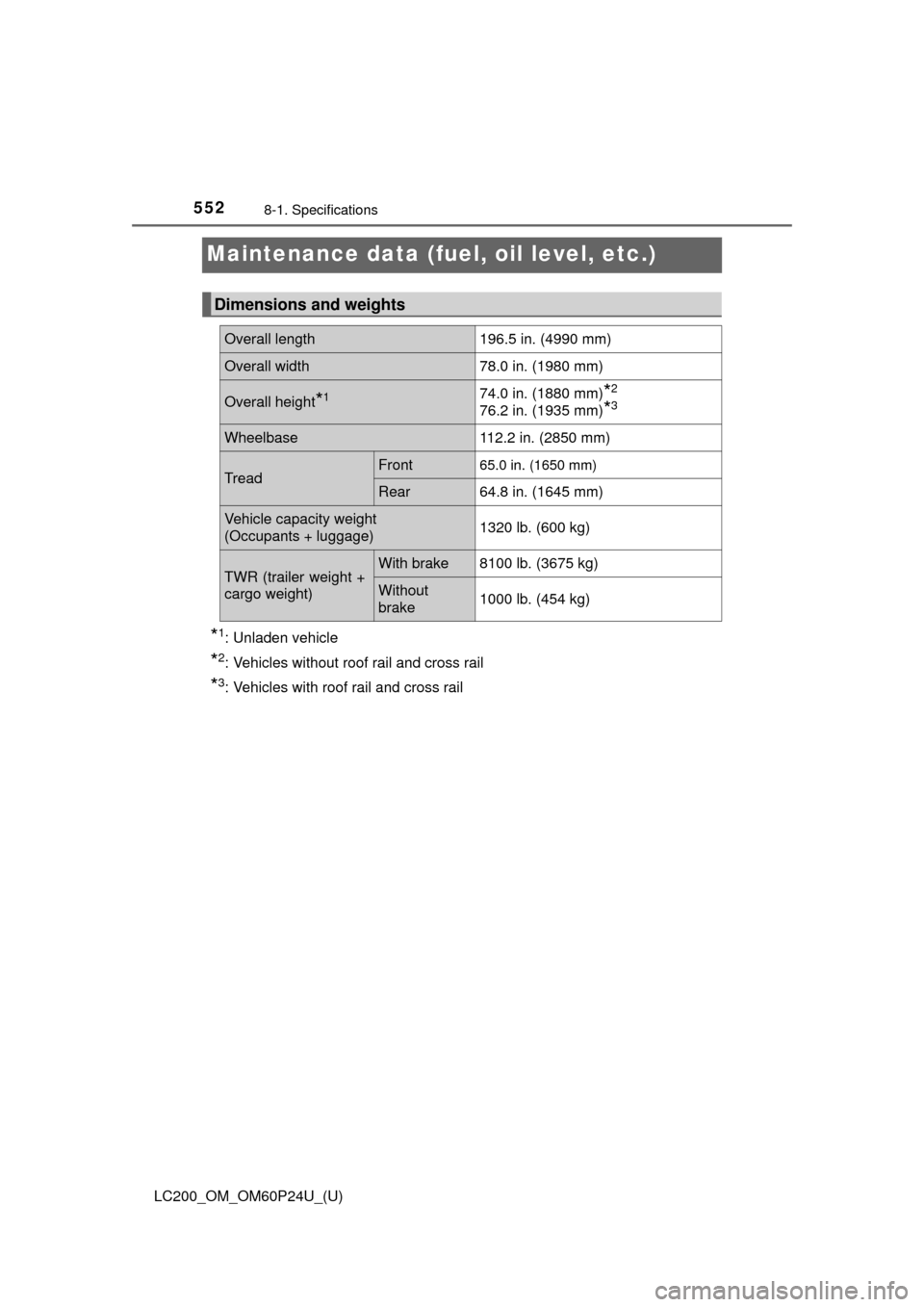
Maintenance data (fuel, oil level, etc.)
*1: Unladen vehicle
*2: Vehicles without roof rail and cross rail
*3: Vehicles with roof rail and cross rail
Dimensions and weights
Overall length196.5 in. (4990 mm)
Overall width78.0 in. (1980 mm)
Overall height*174.0 in. (1880 mm)*2
76.2 in. (1935 mm)*3
Wheelbase112.2 in. (2850 mm)
TreadFront65.0 in. (1650 mm)
Rear64.8 in. (1645 mm)
Vehicle capacity weight
(Occupants + luggage)1320 lb. (600 kg)
TWR (trailer weight +
cargo weight)With brake8100 lb. (3675 kg)
Without
brake1000 lb. (454 kg)
Page 554 of 608
554
LC200_OM_OM60P24U_(U)
8-1. Specifications
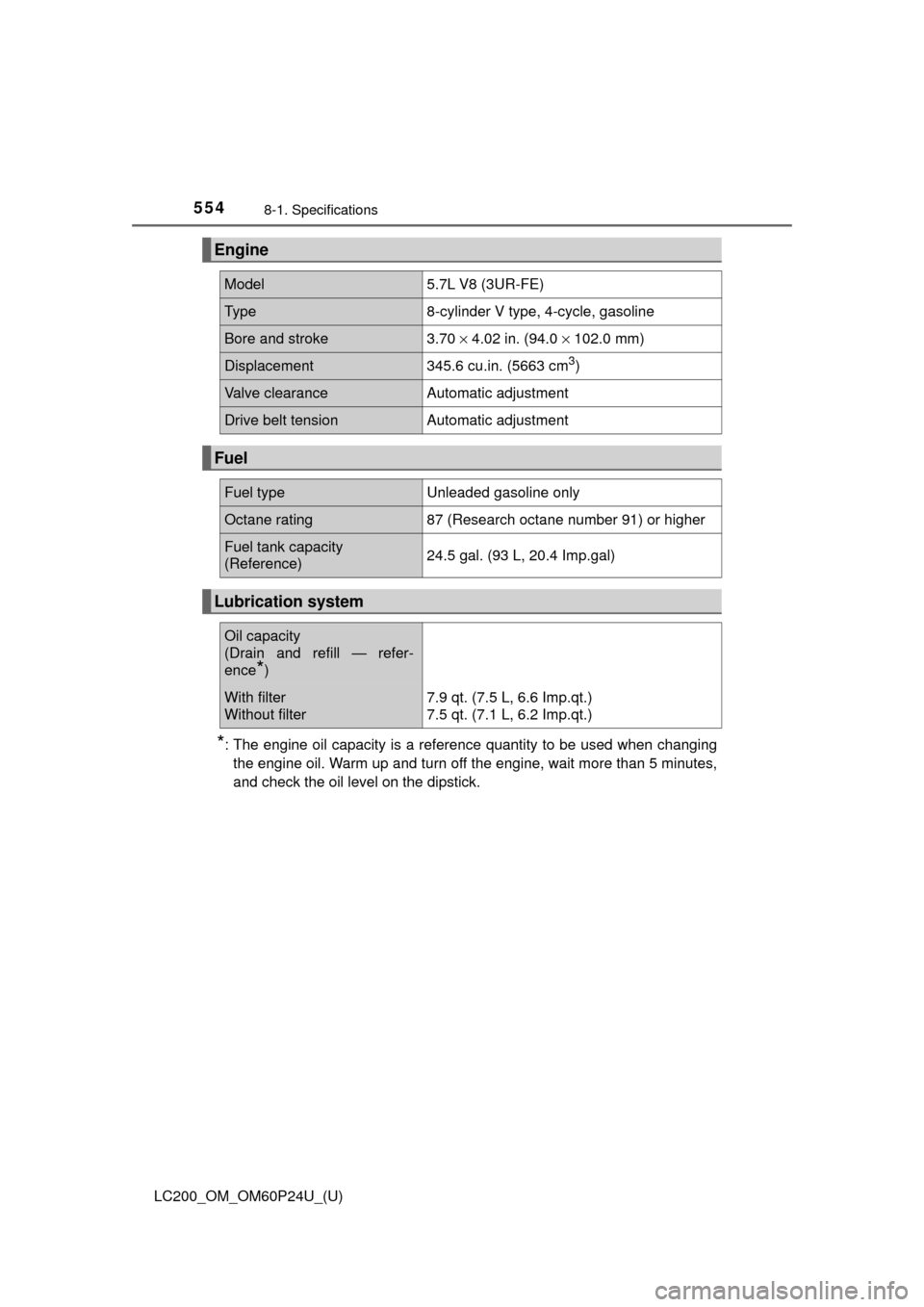
*: The engine oil capacity is a reference quantity to be used when changingthe engine oil. Warm up and turn off the engine, wait more than 5 minutes,
and check the oil level on the dipstick.
Engine
Model5.7L V8 (3UR-FE)
Ty p e8-cylinder V type, 4-cycle, gasoline
Bore and stroke3.70 × 4.02 in. (94.0 × 102.0 mm)
Displacement345.6 cu.in. (5663 cm3)
Valve clearanceAutomatic adjustment
Drive belt tensionAutomatic adjustment
Fuel
Fuel typeUnleaded gasoline only
Octane rating87 (Research octane number 91) or higher
Fuel tank capacity
(Reference)24.5 gal. (93 L, 20.4 Imp.gal)
Lubrication system
Oil capacity
(Drain and refill — refer-
ence
*)
With filter
Without filter7.9 qt. (7.5 L, 6.6 Imp.qt.)
7.5 qt. (7.1 L, 6.2 Imp.qt.)
Page 555 of 608
LC200_OM_OM60P24U_(U)
5558-1. Specifications
8
Vehicle specifications
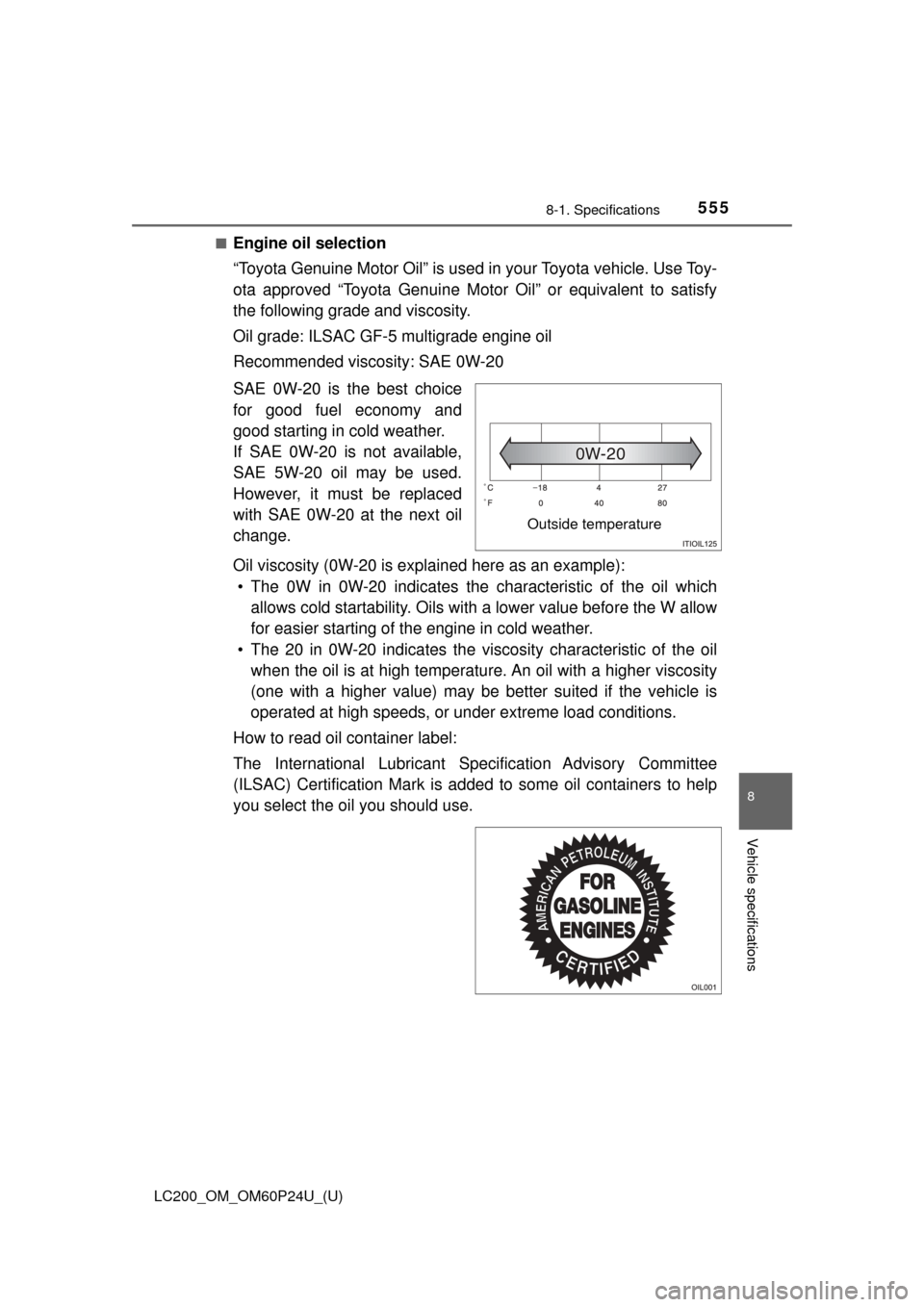
■Engine oil selection
“Toyota Genuine Motor Oil” is used in your Toyota vehicle. Use Toy-
ota approved “Toyota Genuine Motor Oil” or equivalent to satisfy
the following grade and viscosity.
Oil grade: ILSAC GF-5 multigrade engine oil
Recommended viscosity: SAE 0W-20
SAE 0W-20 is the best choice
for good fuel economy and
good starting in cold weather.
If SAE 0W-20 is not available,
SAE 5W-20 oil may be used.
However, it must be replaced
with SAE 0W-20 at the next oil
change.
Oil viscosity (0W-20 is explained here as an example): • The 0W in 0W-20 indicates the characteristic of the oil which
allows cold startability. Oils with a lower value before the W allow
for easier starting of the engine in cold weather.
• The 20 in 0W-20 indicates the viscosity characteristic of the oil when the oil is at high temperature. An oil with a higher viscosity
(one with a higher value) may be better suited if the vehicle is
operated at high speeds, or under extreme load conditions.
How to read oil container label:
The International Lubricant Sp ecification Advisory Committee
(ILSAC) Certification Mark is ad ded to some oil containers to help
you select the oi l you should use.
Outside temperature
Page 560 of 608
560
LC200_OM_OM60P24U_(U)
8-1. Specifications
Fuel information
■Gasoline quality
In very few cases, driveability problems may be caused by the brand of gaso-
line you are using. If driveability problems persist, try changing the brand of
gasoline. If this does not correct the problem, consult your Toyota dealer.
■ Gasoline quality standards
●Automotive manufacturers in the U.S.A., Europe and Japan have developed
a specification for fuel quality called the World-Wide Fuel Charter (WWFC),
which is expected to be applied worldwide.
● The WWFC consists of four categor ies that are based on required emission
levels. In the U.S., category 4 has been adopted.
● The WWFC improves air quality by lowering emissions in vehicle fleets, and
improves customer satisfaction through better performance.
■ Recommendation of the use of gaso line containing detergent additives
● Toyota recommends the use of gasoline that contains detergent additives to
avoid the build-up of engine deposits.
● All gasoline sold in the U.S.A. contains minimum detergent additives to
clean and/or keep clean intake systems, per EPA’s lowest additives concen-
tration program.
● Toyota strongly recommends the use of Top Tier Detergent Gasoline. For
more information on Top Tier Detergent Gasoline and a list of marketers,
please go to the official website www.toptiergas.com.
■ Recommendation of the use of low emissions gasoline
Gasolines containing oxygenates such as ethers and ethanol, as well as
reformulated gasolines, are available in some cities. These fuels are typically
acceptable for use, providing they meet other fuel requirements.
Toyota recommends these fuels, since the formulations allow for reduced
vehicle emissions.
You must only use unleaded gasoline.
Select octane rating 87 (Research Octane Number 91) or higher.
Use of unleaded gasoline with an octane rating lower than 87
may result in engine knocking. Persistent knocking can lead to
engine damage.
At minimum, the gasoline you use s hould meet the specifications of
ASTM D4814 in the U.S.A..
Page 561 of 608
LC200_OM_OM60P24U_(U)
5618-1. Specifications
8
Vehicle specifications
■Non-recommendation of the use of blended gasoline
●If you use gasohol in your vehicle, be sure that it has an octane rating no
lower than 87.
● Toyota does not recommend the use of gasoline containing methanol.
■ Non-recommendation of the use of gasoline containing MMT
Some gasoline contains an octane enhancing additive called MMT (Methylcy
clopentadienyl Manganese Tricarbonyl).
Toyota does not recommend the use of gasoline that contains MMT. If fuel
containing MMT is used, your emission control system may be adversely
affected.
The malfunction indicator lamp on the instrument cluster may come on. If this
happens, contact your Toyota dealer for service.
■ If your engine knocks
●Consult your Toyota dealer.
● You may occasionally notice light knocking for a short time while accelerat-
ing or driving uphill. This is normal and there is no need for concern.
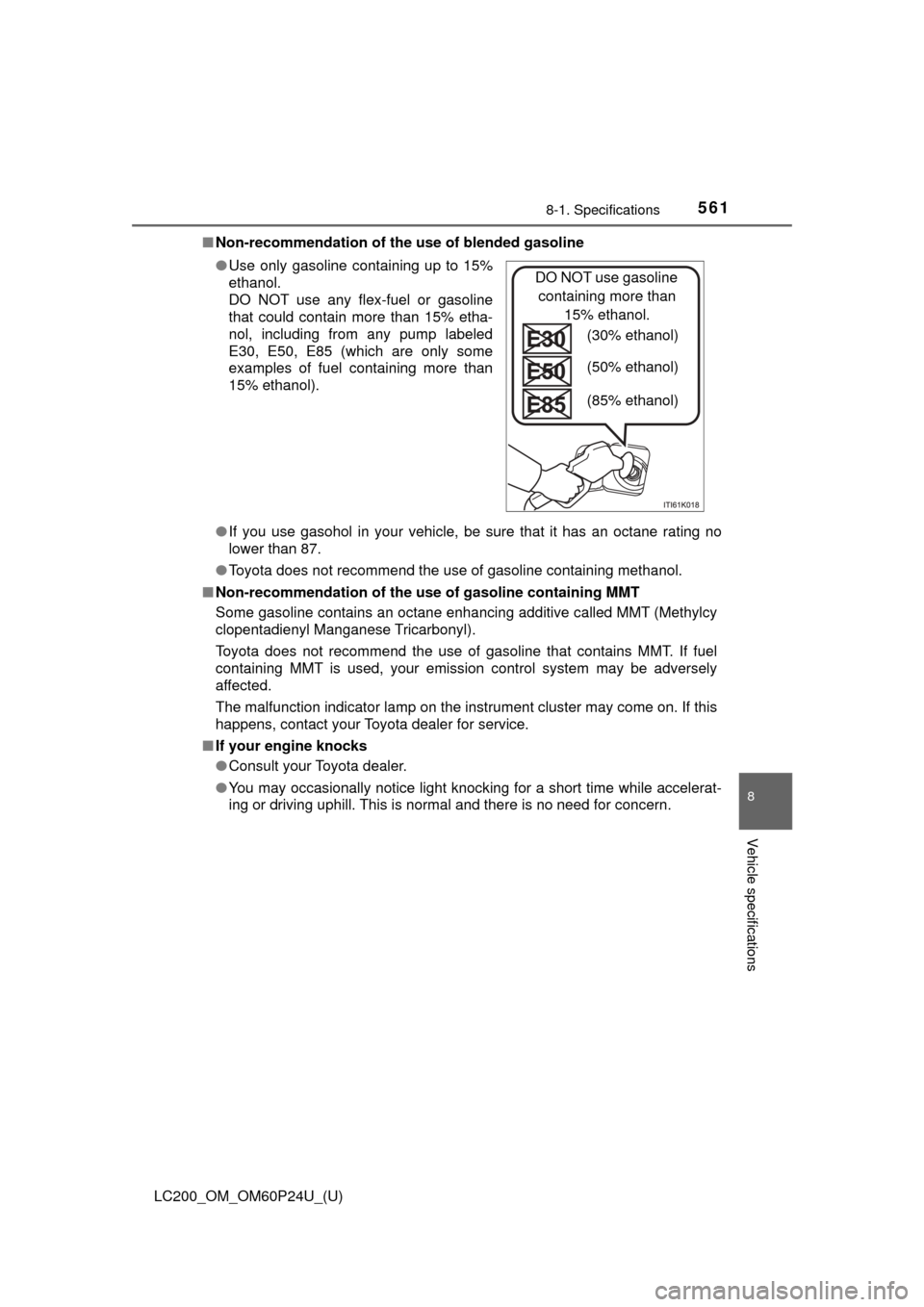
●
Use only gasoline containing up to 15%
ethanol.
DO NOT use any flex-fuel or gasoline
that could contain more than 15% etha-
nol, including from any pump labeled
E30, E50, E85 (which are only some
examples of fuel containing more than
15% ethanol).
DO NOT use gasoline
containing more than 15% ethanol.
(30% ethanol)
(50% ethanol)
(85% ethanol)