inflation pressure TOYOTA LAND CRUISER 2020 Warranties & Maintenance Guides (in English)
[x] Cancel search | Manufacturer: TOYOTA, Model Year: 2020, Model line: LAND CRUISER, Model: TOYOTA LAND CRUISER 2020Pages: 260, PDF Size: 8.54 MB
Page 158 of 260
NITTO TIRE
156
It is important to check your tires using an accurate tire
pressure gauge, which can be purchased at your tire dealer
or auto supply store.
Underinflation can overload tires. Check the inflation pressure every
month, including for the spare tire, to make sure it’s up to specification.
Check it again before long trips or when carrying extra weight.
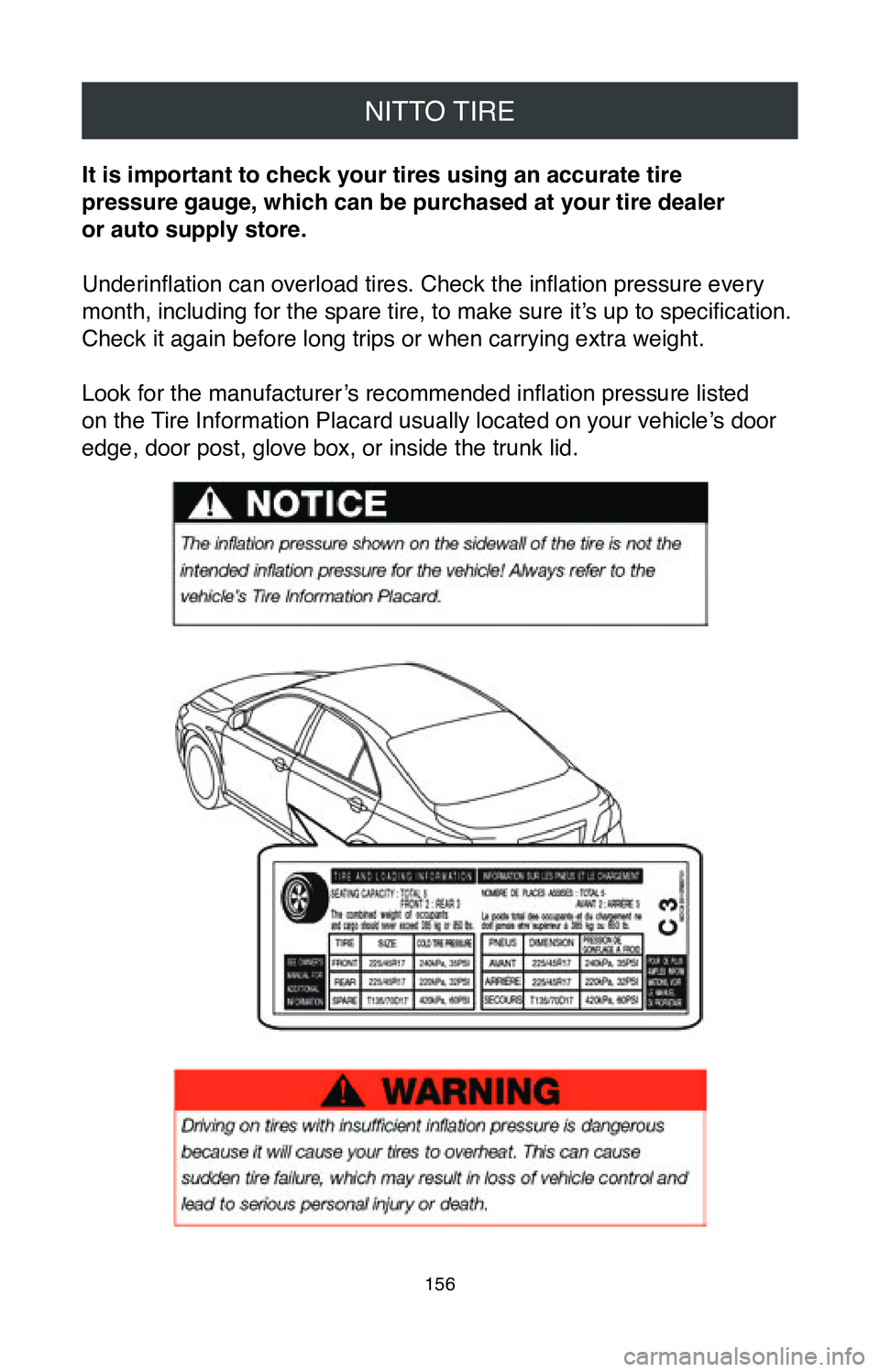
Look for the manufacturer’s recommended inflation pressure listed
on the Tire Information Placard usually located on your vehicle’s door
edge, door post, glove box, or inside the trunk lid.
Page 159 of 260
NITTO TIRE
157
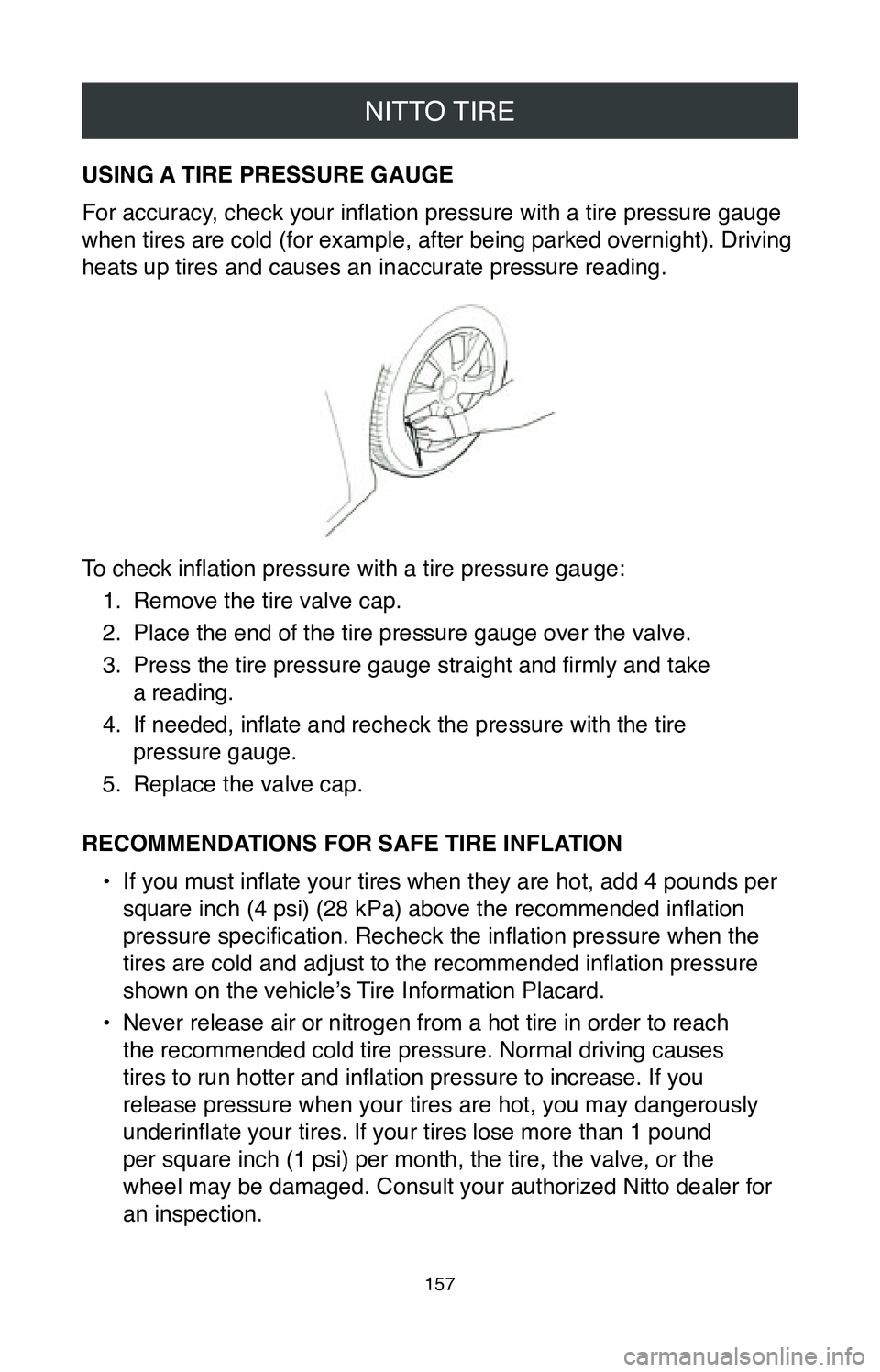
USING A TIRE PRESSURE GAUGE
For accuracy, check your inflation pressure with a tire pressure gauge
when tires are cold (for example, after being parked overnight). Driving
heats up tires and causes an inaccurate pressure reading.
To check inflation pressure with a tire pressure gauge:1.
Remove the tire valve cap.
2.
Place the end of the tire pressure gauge over the valve.
3.
Press the tire pressure gauge straight and firmly and take
a reading.
4.
If needed, inflate and recheck the pressure with the tire
pressure gauge.
5.
Replace the valve cap.
RECOMMENDATIONS FOR SAFE TIRE INFLATION •
If you must inflate your tires when they are hot, add 4 pounds per
square inch (4 psi) (28 kPa) above the recommended inflation
pressure specification. Recheck the inflation pressure when the
tires are cold and adjust to the recommended inflation pressure
shown on the vehicle’s Tire Information Placard.
•
Never release air or nitrogen from a hot tire in order to reach
the recommended cold tire pressure. Normal driving causes
tires to run hotter and inflation pressure to increase. If you
release pressure when your tires are hot, you may dangerously
underinflate your tires. If your tires lose more than 1 pound
per square inch (1 psi) per month, the tire, the valve, or the
wheel may be damaged. Consult your authorized Nitto dealer for
an inspection.
Page 160 of 260
NITTO TIRE
158
• Over-inflation can cause the tire to be more susceptible to
impact damage.
•
Over-inflation or underinflation may adversely affect vehicle
handling.
•
Remember to check your spare tire. Consult your vehicle Owner’s
Manual for the correct inflation pressure and use of a “temporary
use” spare tire. The inflation pressure specified for a spare tire is
typically different from that specified for your regular tires.
•
Use valve caps to keep valve cores clean and clear of debris and
to help guard against air leakage.
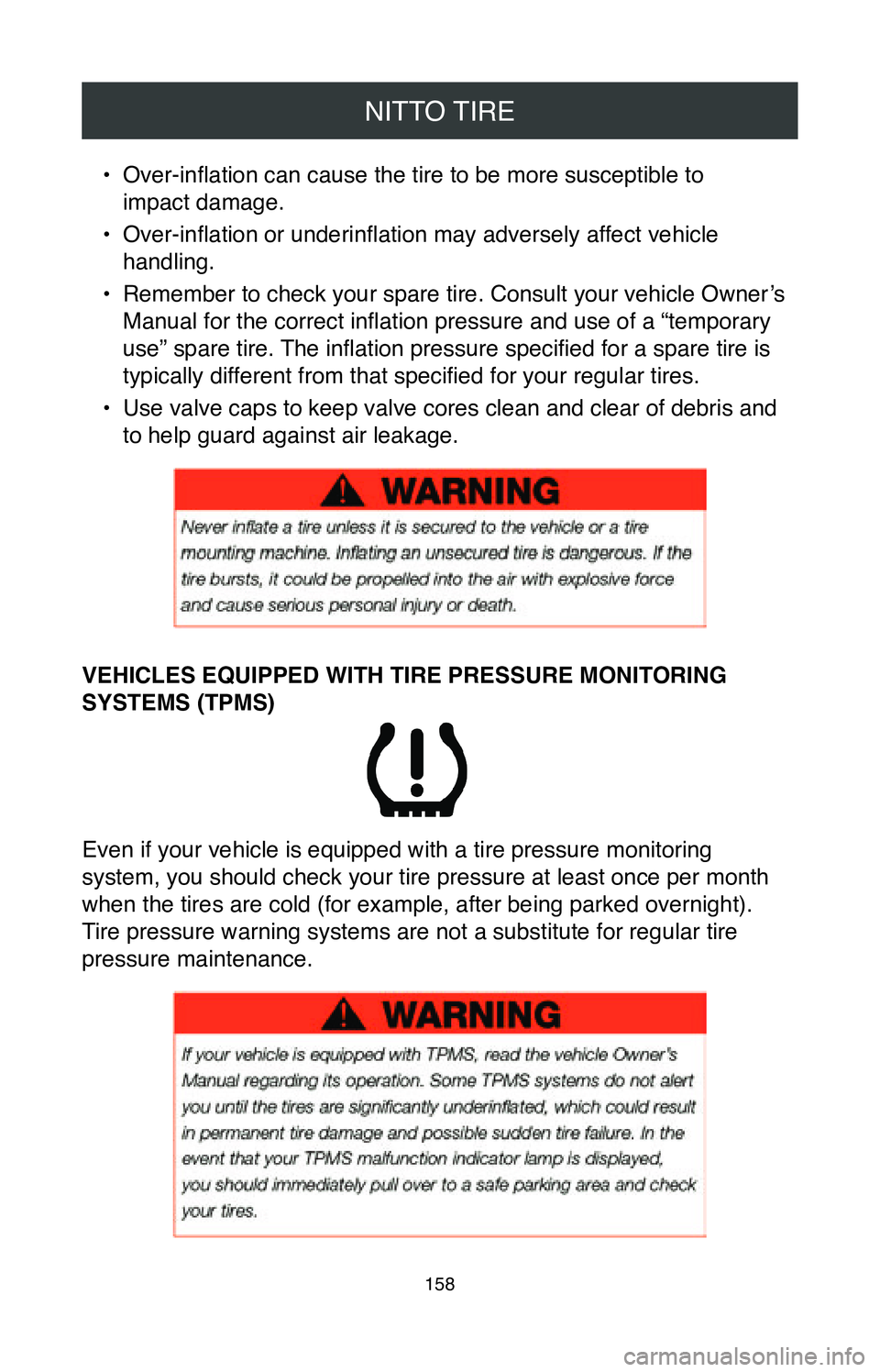
VEHICLES EQUIPPED WITH TIRE PRESSURE MONITORING
SYSTEMS (TPMS)
Even if your vehicle is equipped with a tire pressure monitoring
system, you should check your tire pressure at least once per month
when the tires are cold (for example, after being parked overnight).
Tire pressure warning systems are not a substitute for regular tire
pressure maintenance.
Page 165 of 260
NITTO TIRE
163
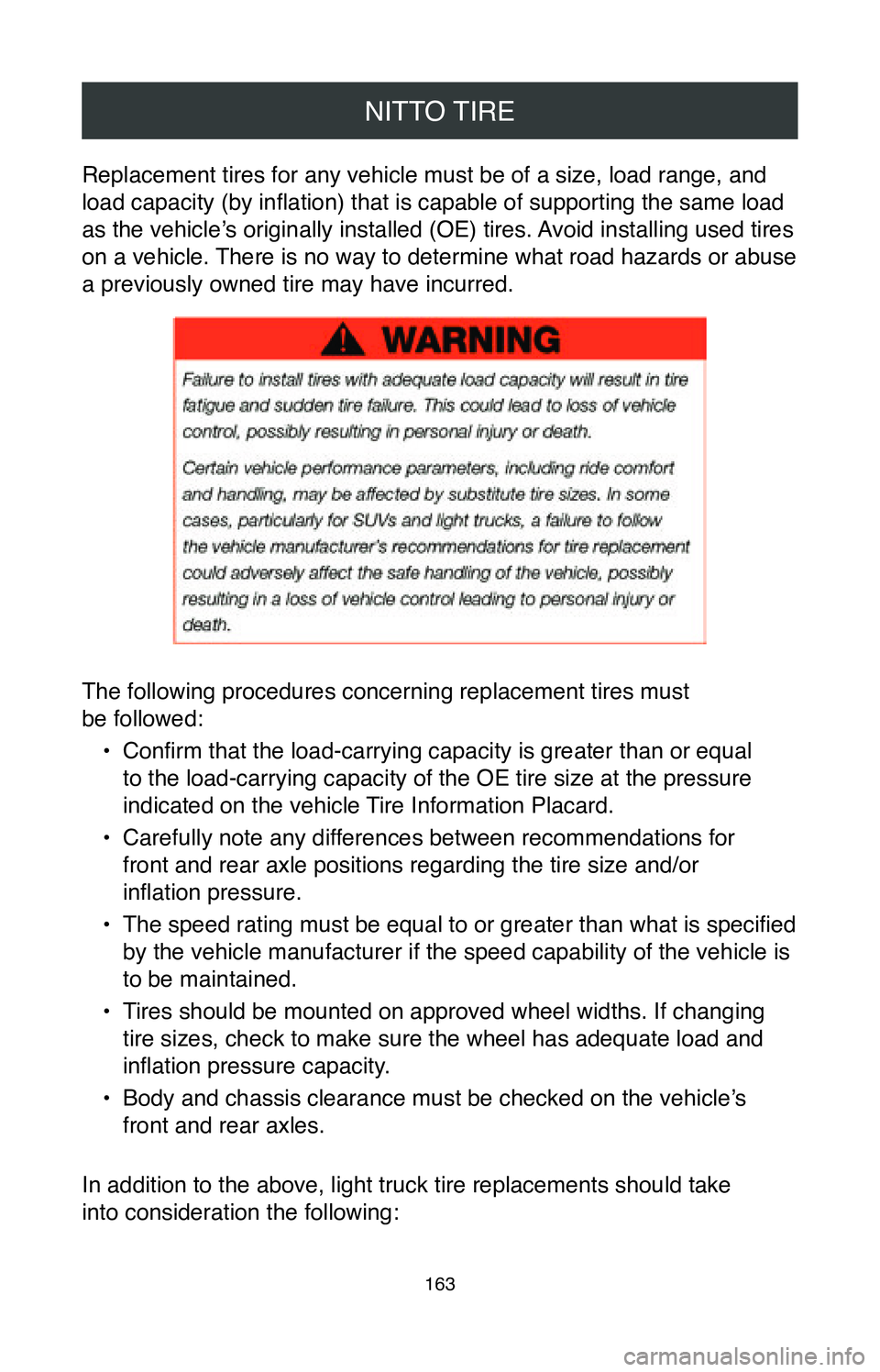
Replacement tires for any vehicle must be of a size, load range, and
load capacity (by inflation) that is capable of supporting the same load
as the vehicle’s originally installed (OE) tires. Avoid installing used tires
on a vehicle. There is no way to determine what road hazards or abuse
a previously owned tire may have incurred.
The following procedures concerning replacement tires must
be followed:•
Confirm that the load-carrying capacity is greater than or equal
to the load-carrying capacity of the OE tire size at the pressure
indicated on the vehicle Tire Information Placard.
•
Carefully note any differences between recommendations for
front and rear axle positions regarding the tire size and/or
inflation pressure.
•
The speed rating must be equal to or greater than what is specified
by the vehicle manufacturer if the speed capability of the vehicle is
to be maintained.
•
Tires should be mounted on approved wheel widths. If changing
tire sizes, check to make sure the wheel has adequate load and
inflation pressure capacity.
•
Body and chassis clearance must be checked on the vehicle’s
front and rear axles.
In addition to the above, light truck tire replacements should take
into consideration the following:
Page 173 of 260
NITTO TIRE
171
Full-size spare tires (not temporary spares) of the same size,
construction, and speed rating may be used in a five-tire
rotation pattern.
After rotation, check the inflation pressure of all the tires. The front
and rear tire pressures may vary according to the vehicle
manufacturer’s specifications.
Remember to follow your vehicle Owner’s Manual for tire rotation
intervals. Your Limited Warranty recommends Nitto brand tires to be
rotated as follows:
•
Every 3,500 miles or less for high performance (low profile) tires.
•
Every 7,500 miles or less for standard passenger and light
truck tires.
More frequent rotation or a thorough vehicle inspection may be
necessary if, upon inspection, irregular or erratic treadwear is
beginning to appear.
It is important to remember the following: •
These tire rotation recommendations do not take into account
different tire and construction types mixed on the vehicle.
•
Some tires cannot be rotated in the manner described. Such tires
include unidirectional tires. Unidirectional tread patterns must be
rotated front-to-rear only so that the direction of revolution does
not change.
•
Some vehicles are designed with different tire sizes on the front
and rear axles. Normally, such combinations will not allow rotation.
Prior to rotating, consult the vehicle Owner’s Manual.
•
For vehicles with dual rear wheels, see the vehicle Owner’s
Manual for the vehicle manufacturer’s procedures. If your vehicle
Owner’s Manual is not available, please contact the vehicle
manufacturer.
•
Some vehicles are equipped with wheels that limit the choice of
rotation pattern. Consult the vehicle Owner’s Manual.
•
Do not include temporary spare tires in the rotation pattern.
However, if your spare tire is the same size and type as a road tire
(for LT tires of the same size, type, and load rating), it should be
Page 174 of 260
NITTO TIRE
172
included in the tire rotation process. The proper procedure is to use
the vehicle manufacturer’s recommended tire rotation procedures,
or if not available, to use the appropriate rotation pattern shown,
inserting the spare in the right rear position. Place the tire that
would have gone to the right rear in the spare tire storage position
as the new spare.
•
Important! After rotation, adjust the pressure of the individual tires
to the vehicle manufacturer’s recommendation or the inflation
pressure recommended by Nitto for an optional fitment according
to the tire’s new location on the vehicle.
•
Do not mix speed-rated tires on the same axle. Higher speed-
rated tires must remain on the rear axle. Consult your authorized
Nitto dealer.
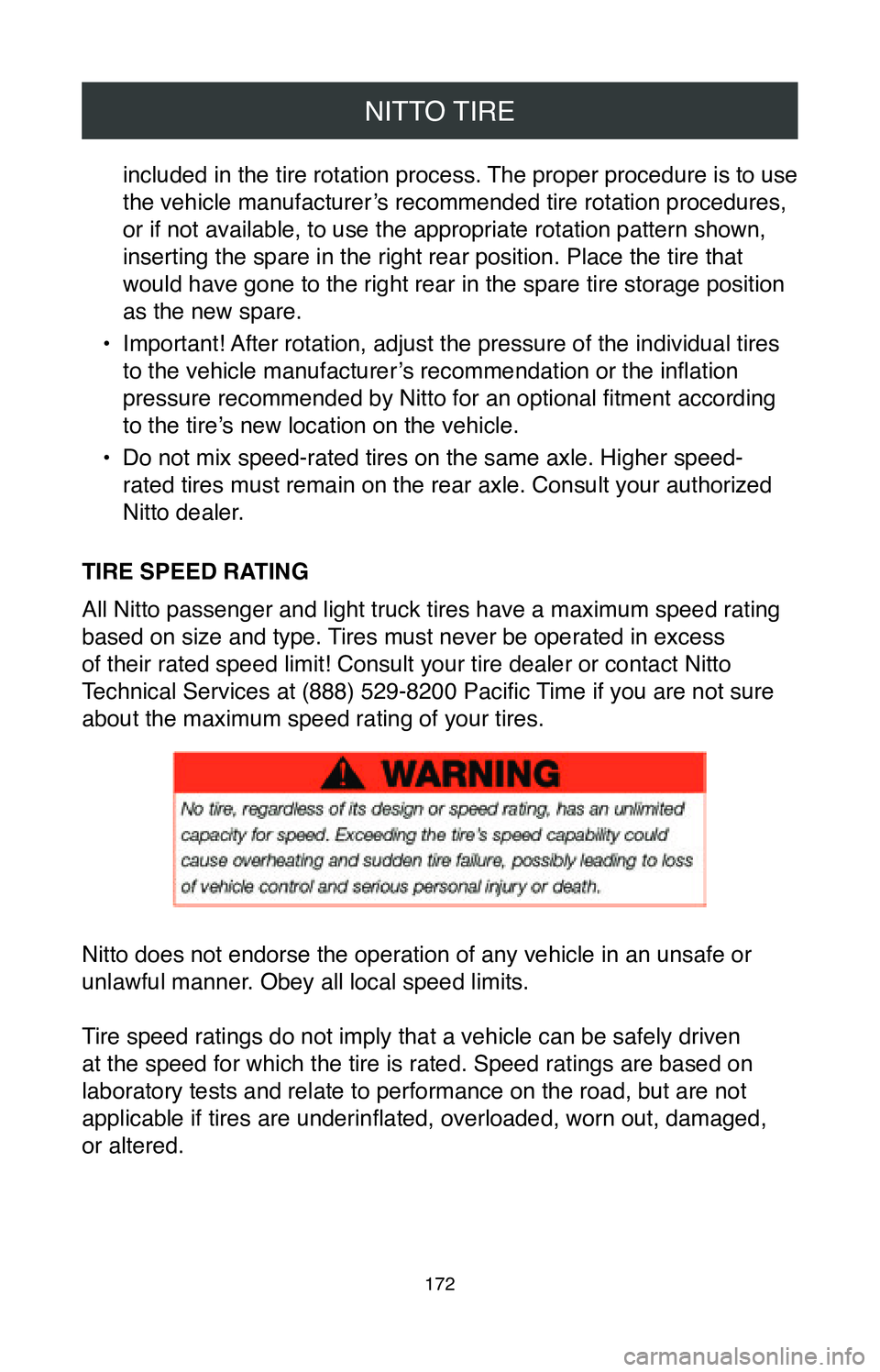
TIRE SPEED RATING
All Nitto passenger and light truck tires have a maximum speed rating
based on size and type. Tires must never be operated in excess
of their rated speed limit! Consult your tire dealer or contact Nitto
Technical Services at (888) 529-8200 Pacific Time if you are not sure
about the maximum speed rating of your tires.
Nitto does not endorse the operation of any vehicle in an unsafe or
unlawful manner. Obey all local speed limits.
Tire speed ratings do not imply that a vehicle can be safely driven
at the speed for which the tire is rated. Speed ratings are based on
laboratory tests and relate to performance on the road, but are not
applicable if tires are underinflated, overloaded, worn out, damaged,
or altered.
Page 182 of 260
NITTO TIRE
180
It is not recommended that any light truck be operated at speeds in
excess of legal limits. However, if it is anticipated that sustained driving
at speeds in excess of 65 mph may be required, then the following
adjustments or recommendations should be followed:•
At speeds from 66 mph through 75 mph, cold inflation pressure
must be increased 10 psi above the recommended pressures for
the load being carried.
•
Do not exceed the maximum inflation pressure of the wheel (all
wheels have maximum allowable inflation pressures).
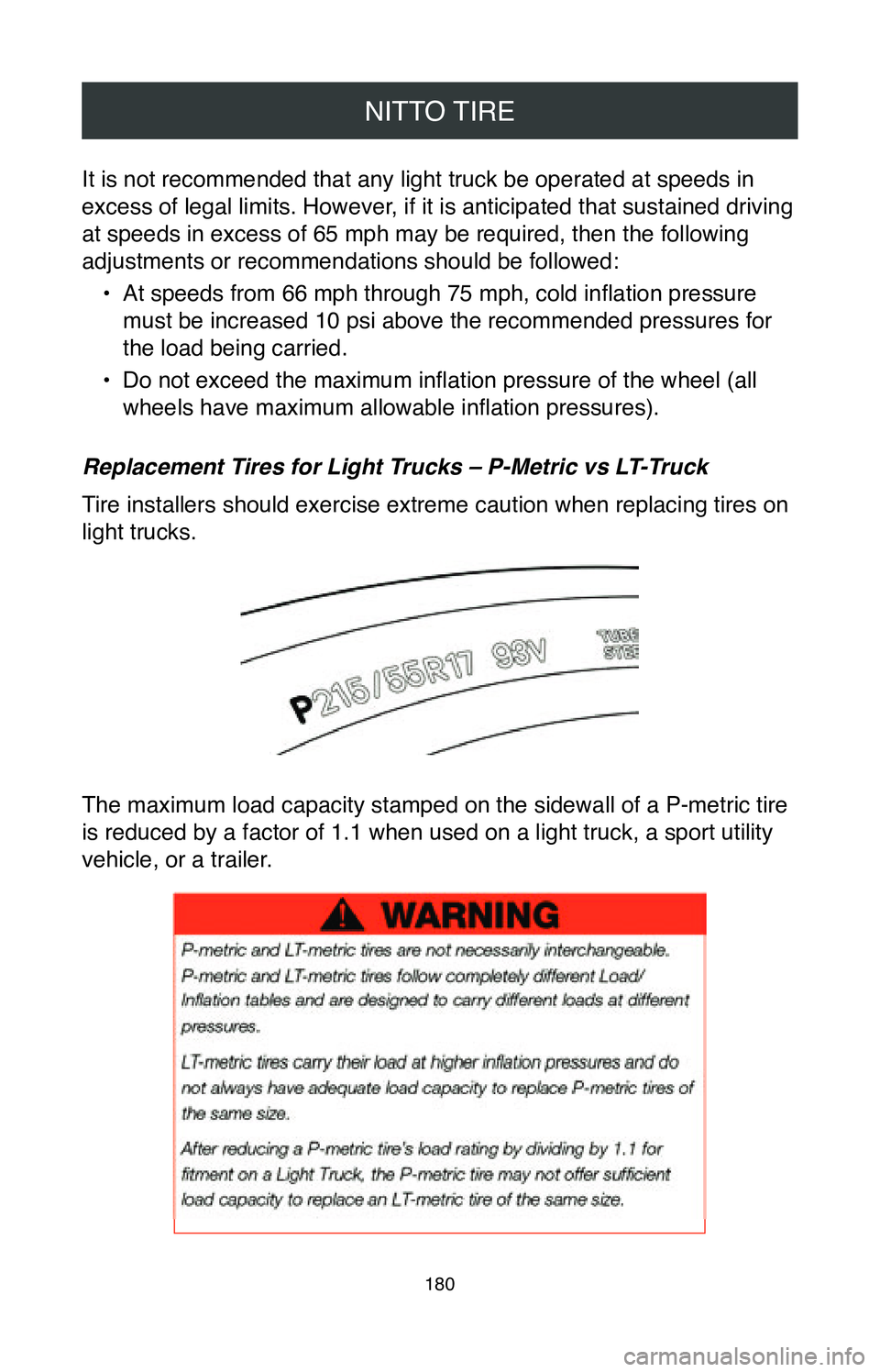
Replacement Tires for Light Trucks – P-Metric vs LT-Truck
Tire installers should exercise extreme caution when replacing tires on
light trucks.
The maximum load capacity stamped on the sidewall of a P-metric tire
is reduced by a factor of 1.1 when used on a light truck, a sport utilit\
y
vehicle, or a trailer.
Page 193 of 260
PIRELLI
191
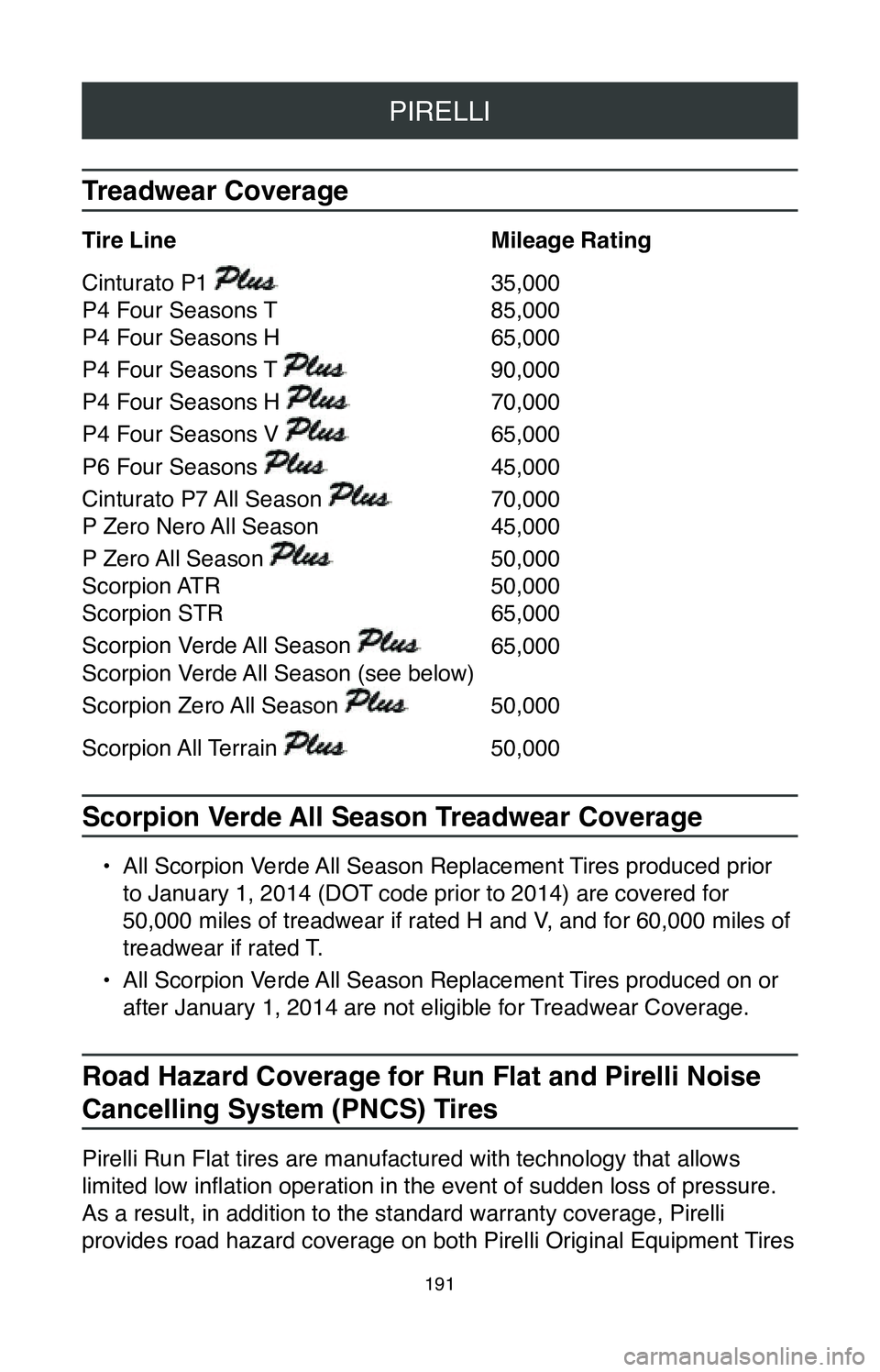
Treadwear Coverage
Tire Line Mileage Rating
Cinturato P1
35,000
P4 Four Seasons T
85,000
P4 Four Seasons H
65,000
P4 Four Seasons T
90,000
P4 Four Seasons H
70,000
P4 Four Seasons V
65,000
P6 Four Seasons
45,000
Cinturato P7 All Season
70,000
P Zero Nero All Season
45,000
P Zero All Season
50,000
Scorpion ATR
50,000
Scorpion STR
65,000
Scorpion Verde All Season
65,000
Scorpion Verde All Season (see below)
Scorpion Zero All Season 50,000
Scorpion All Terrain
50,000
Scorpion Verde All Season Treadwear Coverage
• All Scorpion Verde All Season Replacement Tires produced prior
to January 1, 2014 (DOT code prior to 2014) are covered for
50,000 miles of treadwear if rated H and V, and for 60,000 miles of
treadwear if rated T.
•
All Scorpion Verde All Season Replacement Tires produced on or
after January 1, 2014 are not eligible for Treadwear Coverage.
Road Hazard Coverage for Run Flat and Pirelli Noise
Cancelling System (PNCS) Tires
Pirelli Run Flat tires are manufactured with technology that allows
limited low inflation operation in the event of sudden loss of pressure.
As a result, in addition to the standard warranty coverage, Pirelli
provides road hazard coverage on both Pirelli Original Equipment Tires
Page 199 of 260
PIRELLI
197
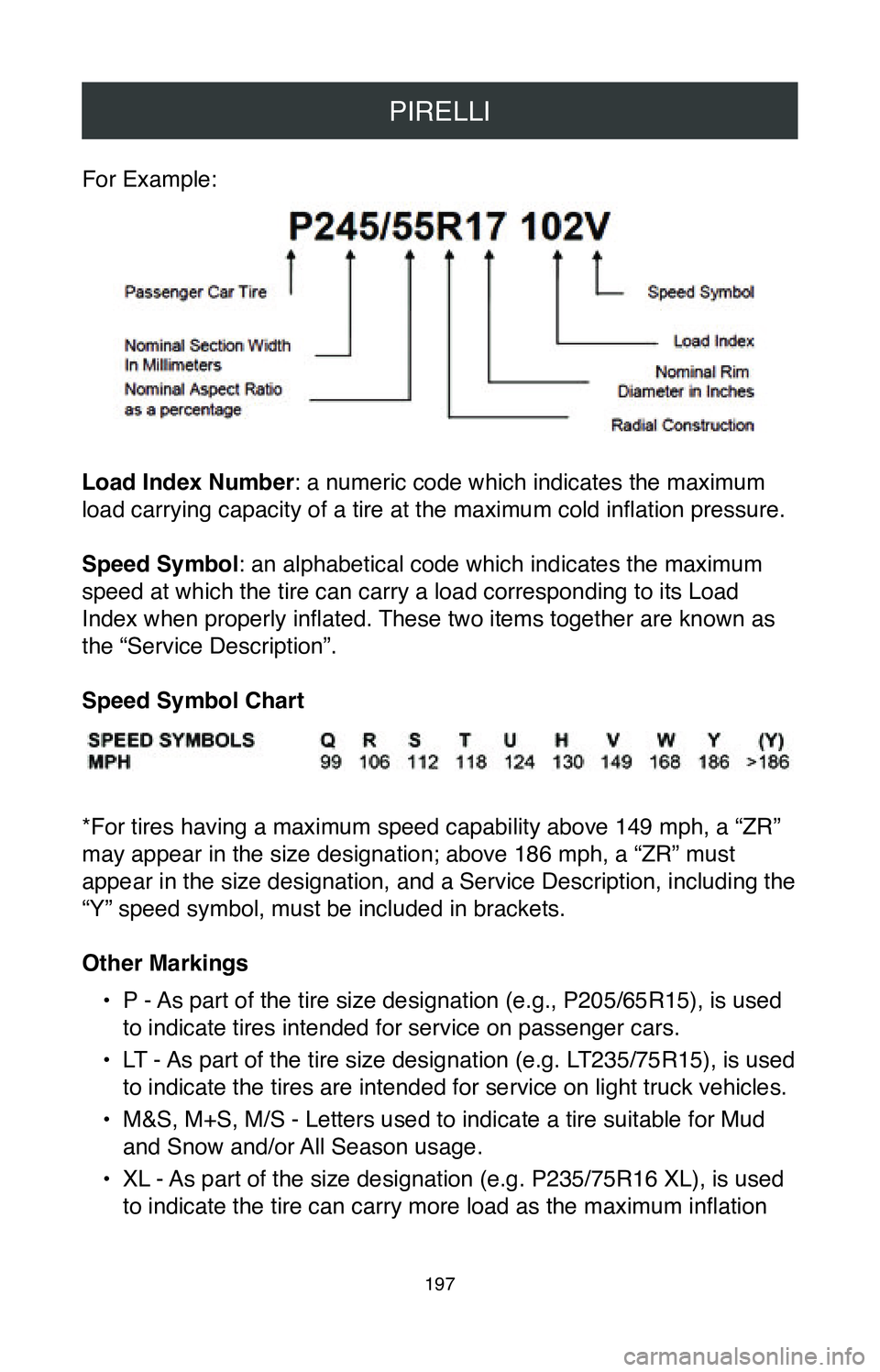
For Example:
Load Index Number: a numeric code which indicates the maximum
load carrying capacity of a tire at the maximum cold inflation pressure.
Speed Symbol: an alphabetical code which indicates the maximum
speed at which the tire can carry a load corresponding to its Load
Index when properly inflated. These two items together are known as
the “Service Description”.
Speed Symbol Chart
*For tires having a maximum speed capability above 149 mph, a “ZR”
may appear in the size designation; above 186 mph, a “ZR” must
appear in the size designation, and a Service Description, including the\
“Y” speed symbol, must be included in brackets.
Other Markings
•
P - As part of the tire size designation (e.g., P205/65R15), is used
to indicate tires intended for service on passenger cars.
•
LT - As part of the tire size designation (e.g. LT235/75R15), is used
to indicate the tires are intended for service on light truck vehicles.
•
M&S, M+S, M/S - Letters used to indicate a tire suitable for Mud
and Snow and/or All Season usage.
•
XL - As part of the size designation (e.g. P235/75R16 XL), is used
to indicate the tire can carry more load as the maximum inflation
Page 200 of 260
PIRELLI
198
pressure and load are greater than a standard load version. (Also
could be called REINFORCED).
•
: 3 peak mountain snowflake pictograph used to indicate a tire
suitable for use in severe snow conditions.
Tire Categories
ALL SEASON TIRES (All Weather Tires): Tires that are designed to
perform in a variety of road conditions in All Seasons of the year. An
All Season tire will carry “M+S”, “M&S”, or “M/S” desi\
gnation on the
sidewall. All Season tires may carry a treadwear warranty depending
on the product line.
SUMMER TIRES: Summer tires offer superior handling, grip and
cornering ability compared to standard tires under certain conditions.
Some lines may carry a treadwear warranty.
WINTER TIRES (Snow Tires): A winter tire is a tire with a tread design
and compound made specifically for snow and ice conditions and
is identified by M&S, M+S or M/S markings on the sidewalls. Tires
designed for use in severe snow conditions are further identified with a
pictograph of a mountain with a snowflake on the sidewalls and must
meet specific snow performance test requirements. Pirelli Winter tires
do not carry a treadwear warranty.
The information provided above is an overview of tire types. Tread
patterns and rubber compounds vary among the seasonal tire types
and provide varying performance characteristics and limitations.
Summer performance tires are different than winter and All Season
types. To determine which Pirelli lines carry a treadwear warranty,
please refer to the “Treadwear Coverage” sections in this document.
Pressure Recommendations
Recommended tire inflation pressures for your vehicle can be found
either on your vehicle’s tire placard or in your owner’s manual. Correct
pressures are related to load, speed and vehicle handling and are
vital for even braking, maximum traction and good tire life. Under no
circumstances should your tires’ cold inflation pressure be less than