suspension system TOYOTA LAND CRUISER 2020 Warranties & Maintenance Guides (in English)
[x] Cancel search | Manufacturer: TOYOTA, Model Year: 2020, Model line: LAND CRUISER, Model: TOYOTA LAND CRUISER 2020Pages: 260, PDF Size: 8.54 MB
Page 170 of 260
NITTO TIRE
168
REPLACING TWO TIRES•
When a pair of replacement tires is selected in the same size and
construction as those on the vehicle, the two newer tires must be
installed on the rear axle and must be of equal or higher speed
rating than the front tires. Generally, new tires with deeper tread
will provide better grip and evacuate water more effectively, which
is important as a driver approaches hydroplaning situations.
Placing greater traction on the rear axle on wet surfaces is
necessary to prevent a possible oversteer condition and loss of
vehicle stability.
•
When two new tires have been installed onto the rear axle
positions, they are to be kept on the rear but rotated from side
to side. This is recommended after installing two new tires to the
rear position, or if you discover significant tread depth differences
between the front and rear positions during rotation intervals.
REPLACING ONE TIRE •
Replacing a single tire on a vehicle can have an adverse effect on
suspension systems, gear ratios, transmission, and tire treadwear.
•
If single tire replacement is unavoidable, it is recommended that
the single new tire be paired with the tire that has the deepest
tread and both be placed on the rear axle. Placing greater traction
on the rear axle on wet surfaces is necessary to prevent a possible
oversteer condition and loss of vehicle stability.
WHEEL ALIGNMENT AND BALANCING •
Proper wheel alignment and balance are very important
considerations for safety and getting the maximum mileage from
your tires. You need to check how your tires are wearing at least
once a month.
•
Your vehicle may be out of alignment if your tires are wearing
unevenly, such as when the inside shoulder of the tire is wearing
faster than the rest of the tread. This condition not only shortens
the life of your tires, it adversely affects the handling characteristics
of your vehicle, which could be dangerous. If your tires show
irregular wear, have your vehicle’s alignment checked immediately.
Page 204 of 260
PIRELLI
202
On all wheel drive or four wheel drive vehicles the tires must always
be replaced in sets of four. When replacing tires, you should always
follow the vehicle manufacturer’s recommendations. Passenger and
light truck tires are not interchangeable, due to differences in their
pressures and load carrying capacity.
P-Metric and Euro-Metric Interchangeability: Euro-Metric (Example:
225/45R17) tires have a load index which is equal to or greater than
that of the same size P-Metric (Example: P225/45R17) tire. Therefore,
they have the same or higher load carrying capacity at the maximum
rated inflation pressure. Always check with your tire dealer or Pirelli
Tire Consumer Affairs to check interchangeability to maintain proper
vehicle dynamics.
Please be aware that it is important, before fitting the suggested tires,
to confirm that the fitment is allowed by the technical specifications of
the vehicle, the vehicle manufacturer and the relevant homologations.
Pirelli does not express any view as to the compatibility of the wheel/
tire combination with the technical specifications for the chassis
and vehicle.
TO MAINTAIN VEHICLE DYNAMICS AND LOAD CARRYING
CAPACITY, REPLACEMENT TIRES MUST ALWAYS HAVE A LOAD
INDEX AND SPEED SYMBOL EQUAL TO OR GREATER THAN
THOSE FITTED AS ORIGINAL EQUIPMENT.
When installing plus size fitments, you should consult with the dealer
regarding any suspension or braking system modifications which may
be recommended for the vehicle.
Tire Inspection
As a minimum, tires should be examined and air pressure checked
monthly and always prior to long trips. They should also be examined
if you strike any unusual object on the road. Tires showing bulges,
cracks, cuts, penetrations or uneven wear must be dismounted and
examined by an authorized Pirelli dealer and replaced if necessary.
Pirelli tires have treadwear indicators in the tread grooves, which
clearly show when the tread has worn to 2/32” remaining. At this point,
your tires must be replaced because they do not meet the federal
Page 229 of 260
TOYO TIRE
227
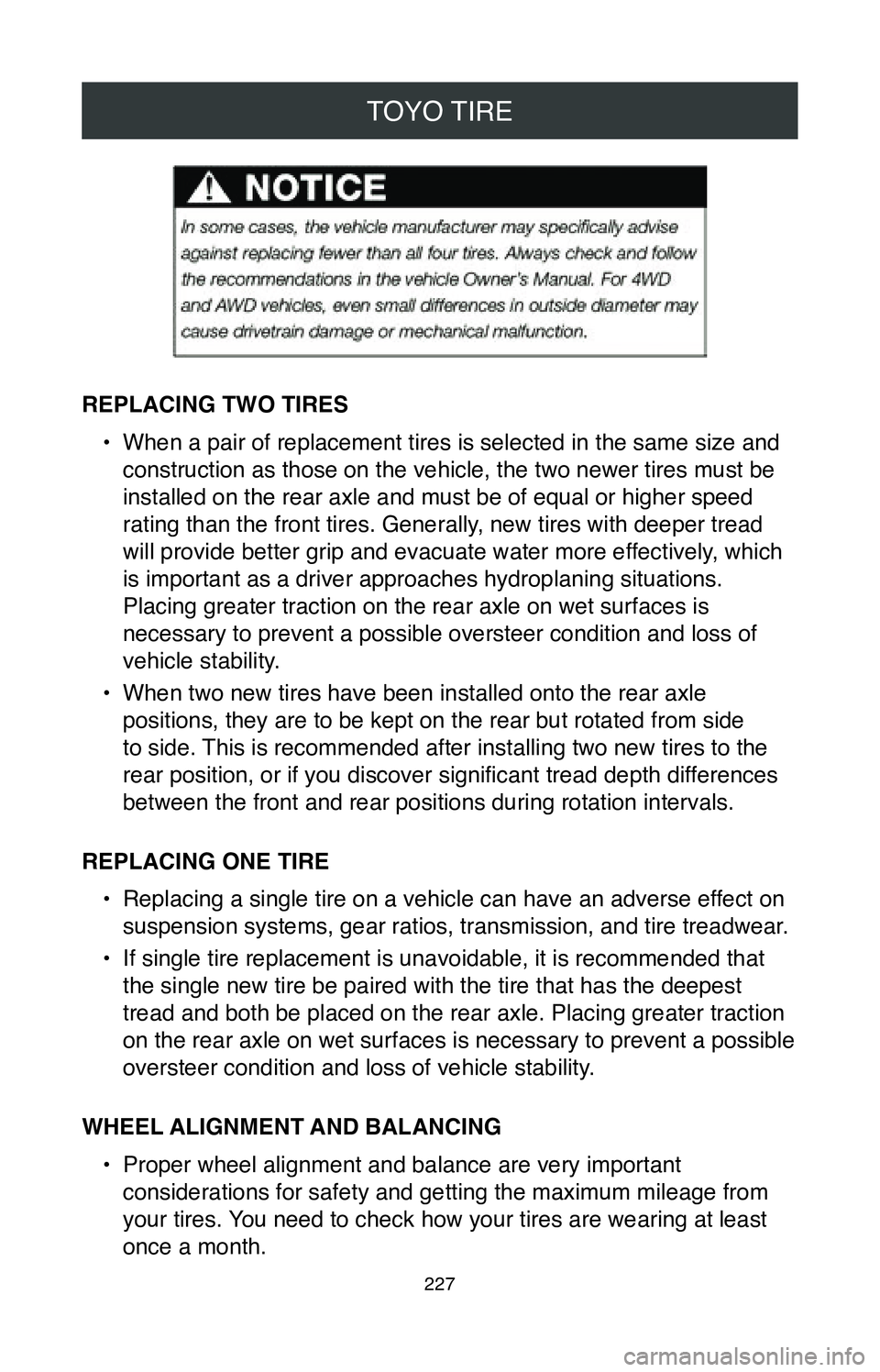
REPLACING TWO TIRES•
When a pair of replacement tires is selected in the same size and
construction as those on the vehicle, the two newer tires must be
installed on the rear axle and must be of equal or higher speed
rating than the front tires. Generally, new tires with deeper tread
will provide better grip and evacuate water more effectively, which
is important as a driver approaches hydroplaning situations.
Placing greater traction on the rear axle on wet surfaces is
necessary to prevent a possible oversteer condition and loss of
vehicle stability.
•
When two new tires have been installed onto the rear axle
positions, they are to be kept on the rear but rotated from side
to side. This is recommended after installing two new tires to the
rear position, or if you discover significant tread depth differences
between the front and rear positions during rotation intervals.
REPLACING ONE TIRE •
Replacing a single tire on a vehicle can have an adverse effect on
suspension systems, gear ratios, transmission, and tire treadwear.
•
If single tire replacement is unavoidable, it is recommended that
the single new tire be paired with the tire that has the deepest
tread and both be placed on the rear axle. Placing greater traction
on the rear axle on wet surfaces is necessary to prevent a possible
oversteer condition and loss of vehicle stability.
WHEEL ALIGNMENT AND BALANCING •
Proper wheel alignment and balance are very important
considerations for safety and getting the maximum mileage from
your tires. You need to check how your tires are wearing at least
once a month.