seat TOYOTA MATRIX 2009 E140 / 2.G Owner's Manual
[x] Cancel search | Manufacturer: TOYOTA, Model Year: 2009, Model line: MATRIX, Model: TOYOTA MATRIX 2009 E140 / 2.GPages: 440, PDF Size: 9.39 MB
Page 46 of 440
46
1-3. Adjustable components (seats, mirrors, steering wheel)
Steering wheel
CAUTION
■Caution while driving
Do not adjust the steering wheel while driving.
Doing so may cause the driver to mishandle the vehicle and cause an acci-
dent, resulting in death or serious injury.
■After adjusting the steering wheel
Make sure that the steering wheel is securely locked.
Otherwise, the steering wheel may move suddenly, possibly causing an
accident and resulting in death or serious injury.
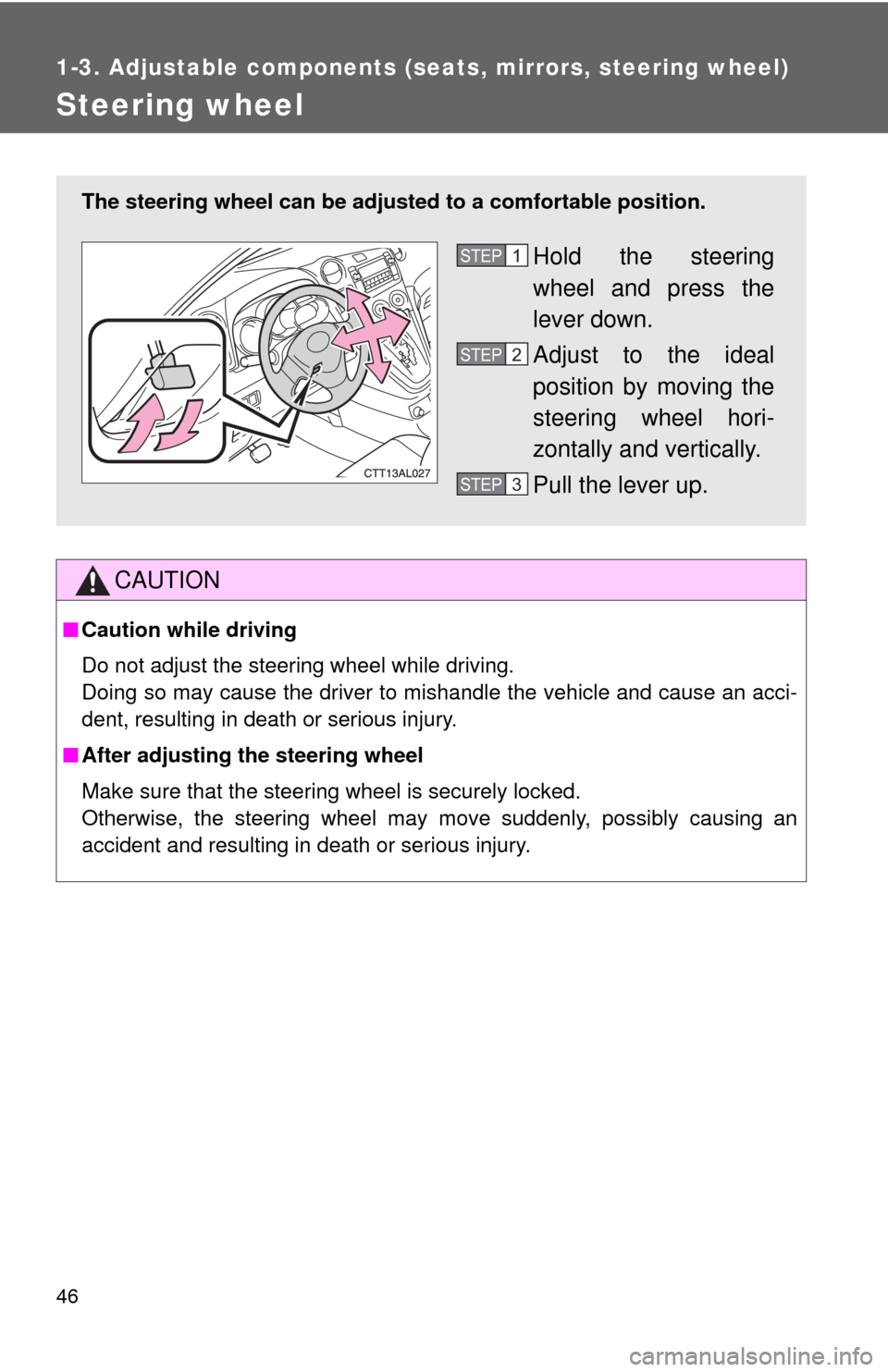
The steering wheel can be adjusted to a comfortable position.
Hold the steering
wheel and press the
lever down.
Adjust to the ideal
position by moving the
steering wheel hori-
zontally and vertically.
Pull the lever up.STEP1
STEP2
STEP3
Page 47 of 440
47
1
1-3. Adjustable components (seats, mirrors, steering wheel)
Before driving
Anti-glare inside rear view mirror
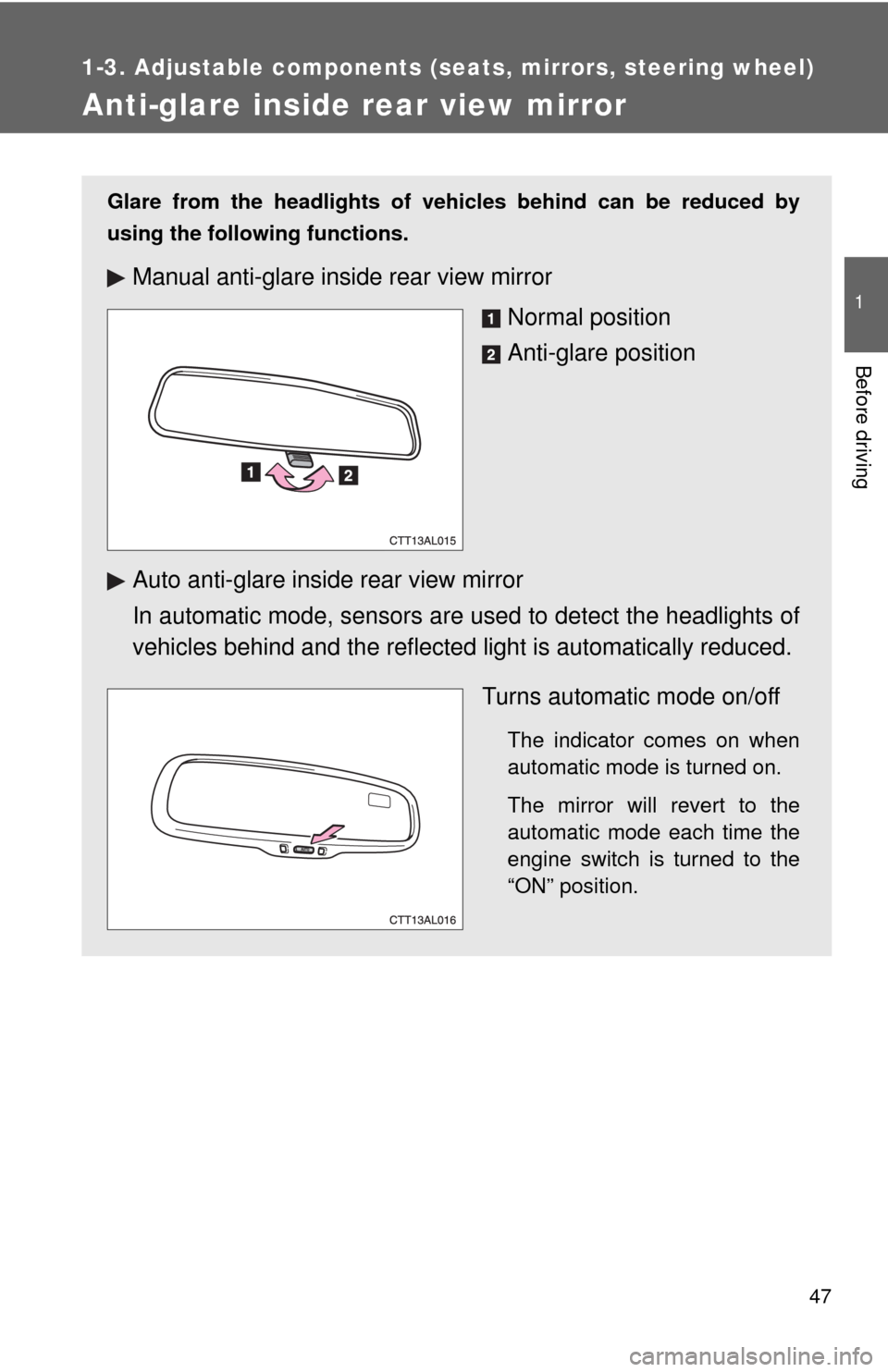
Glare from the headlights of vehicles behind can be reduced by
using the following functions.
Manual anti-glare inside rear view mirror
Normal position
Anti-glare position
Auto anti-glare inside rear view mirror
In automatic mode, sensors are used to detect the headlights of
vehicles behind and the reflected light is automatically reduced.
Turns automatic mode on/off
The indicator comes on when
automatic mode is turned on.
The mirror will revert to the
automatic mode each time the
engine switch is turned to the
“ON” position.
Page 48 of 440
48 1-3. Adjustable components (seats, mirrors, steering wheel)
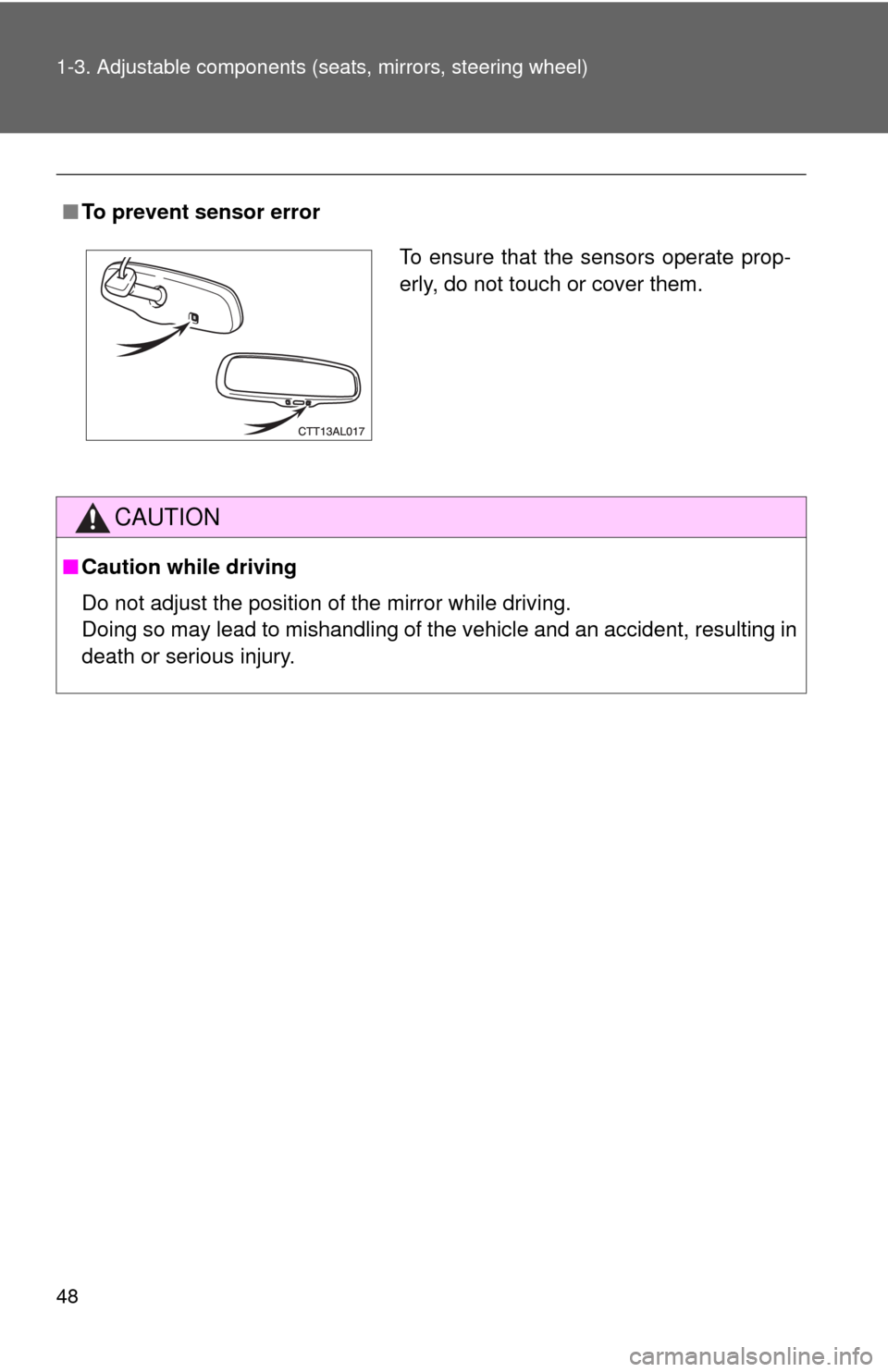
■To prevent sensor error
CAUTION
■Caution while driving
Do not adjust the position of the mirror while driving.
Doing so may lead to mishandling of the vehicle and an accident, resulting in
death or serious injury.
To ensure that the sensors operate prop-
erly, do not touch or cover them.
Page 49 of 440
49
1
1-3. Adjustable components (seats, mirrors, steering wheel)
Before driving
Outside rear view mirrors
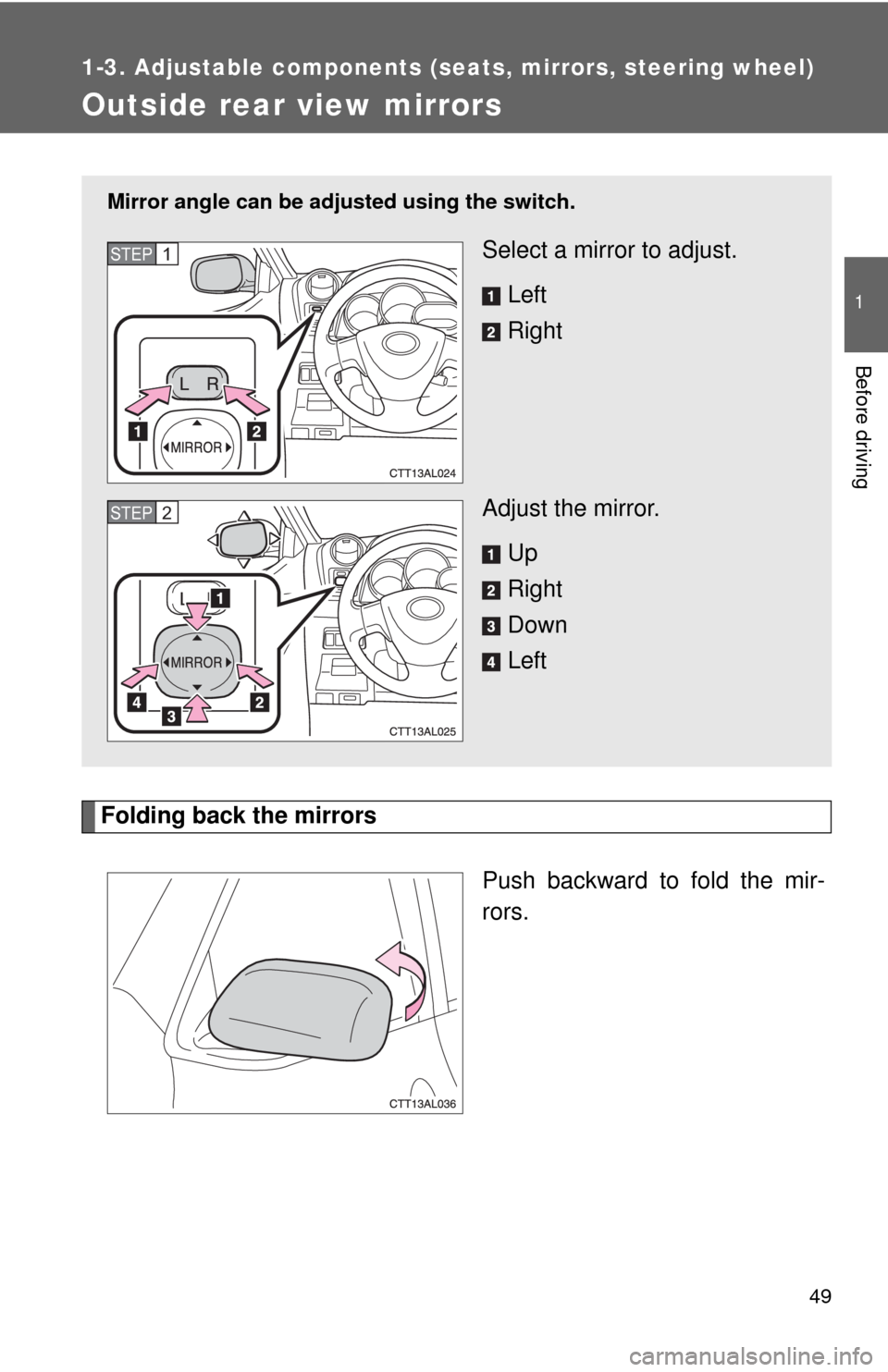
Folding back the mirrors
Push backward to fold the mir-
rors.
Mirror angle can be adjusted using the switch.
Select a mirror to adjust.
Left
Right
Adjust the mirror.
Up
Right
Down
LeftSTEP1
STEP2
Page 50 of 440

50 1-3. Adjustable components (seats, mirrors, steering wheel)
■Mirror angle can be adjusted when
The engine switch is in the “ACC” or “ON” position.
■When the mirrors are fogged up (vehicles with outside rear view mirror
defoggers)
Turn on the mirror defoggers to defog the mirrors. (→P. 168)
CAUTION
■When driving the vehicle
Observe the following precautions while driving.
Failing to do so may result in loss of control of the vehicle and cause an acci-
dent, resulting in death or serious injury.
●Do not adjust the mirrors while driving.
●Do not drive with the mirrors folded back.
●Both the driver and passenger side mirrors must be extended and properly
adjusted before driving.
■When the mirror defoggers are operating (vehicles with outside rear
view mirror defoggers)
Do not touch the surface of the mirror, as it may be hot.
Page 63 of 440
63
1
Before driving
1-7. Safety information
Correct driving posture
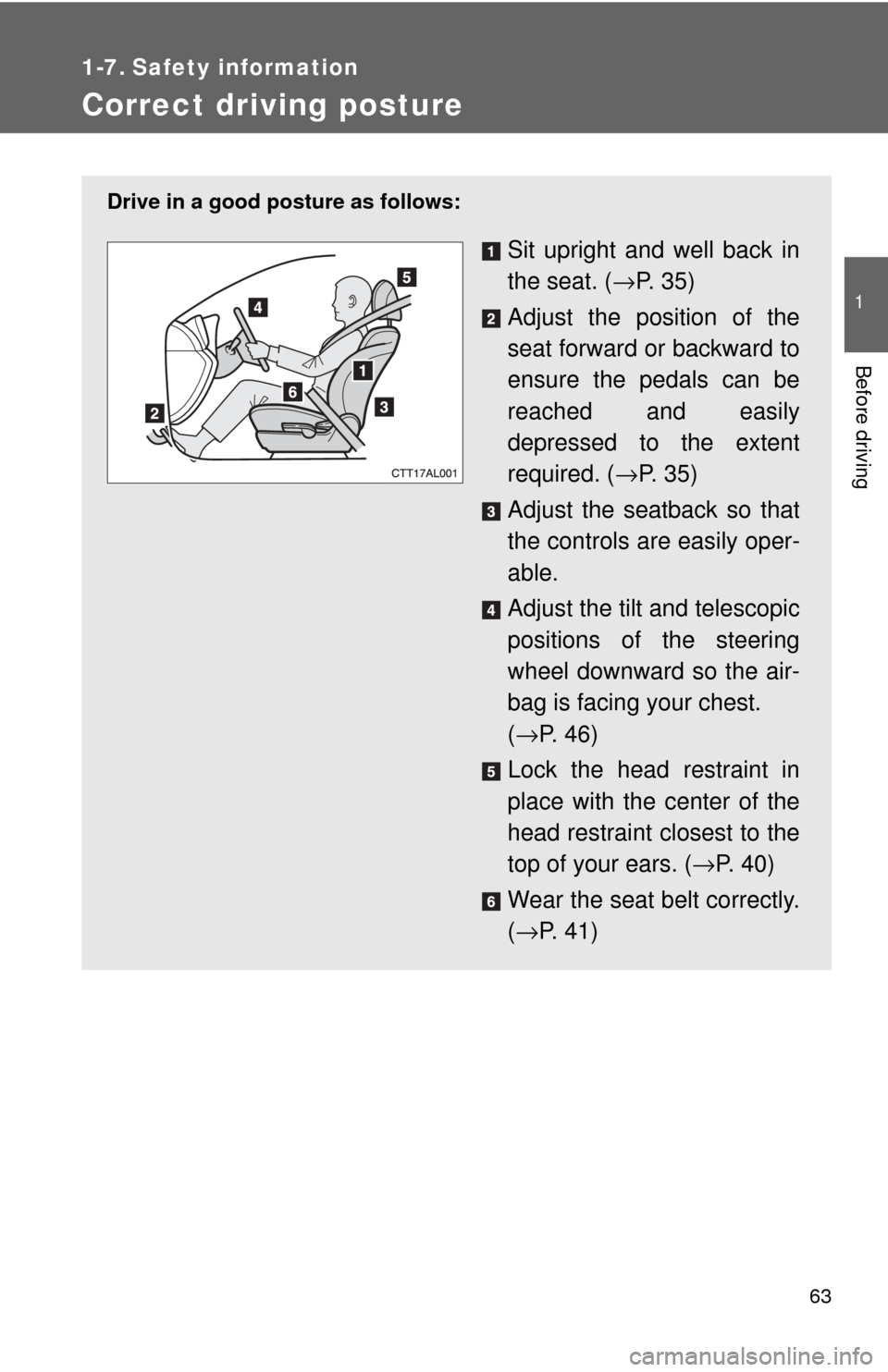
Drive in a good posture as follows:
Sit upright and well back in
the seat. (→P. 3 5 )
Adjust the position of the
seat forward or backward to
ensure the pedals can be
reached and easily
depressed to the extent
required. (→P. 35)
Adjust the seatback so that
the controls are easily oper-
able.
Adjust the tilt and telescopic
positions of the steering
wheel downward so the air-
bag is facing your chest.
(→P. 46)
Lock the head restraint in
place with the center of the
head restraint closest to the
top of your ears. (→P. 40)
Wear the seat belt correctly.
(→P. 41)
Page 64 of 440

64 1-7. Safety information
CAUTION
■While driving
●Do not adjust the position of the driver's seat while driving.
Doing so could cause the driver to lose control of the vehicle.
●Do not place a cushion between the driver or passenger and the seatback.
A cushion may prevent correct posture from being achieved, and reduce
the effectiveness of the seat belt and head restraint, increasing the risk of
death or serious injury to the driver or passenger.
●Do not place anything under the front seats.
Objects placed under the front seats may become jammed in the seat
tracks and stop the seat from locking in place. This may lead to an acci-
dent. The adjustment mechanism may also be damaged.
■Adjusting the seat position
●Take care when adjusting the seat position to ensure that other passen-
gers are not injured by the moving seat.
●Do not put your hands under the seat or near the moving parts to avoid
injury.
Fingers or hands may become jammed in the seat mechanism.
Page 65 of 440
65
1
1-7. Safety information
Before driving
SRS airbags
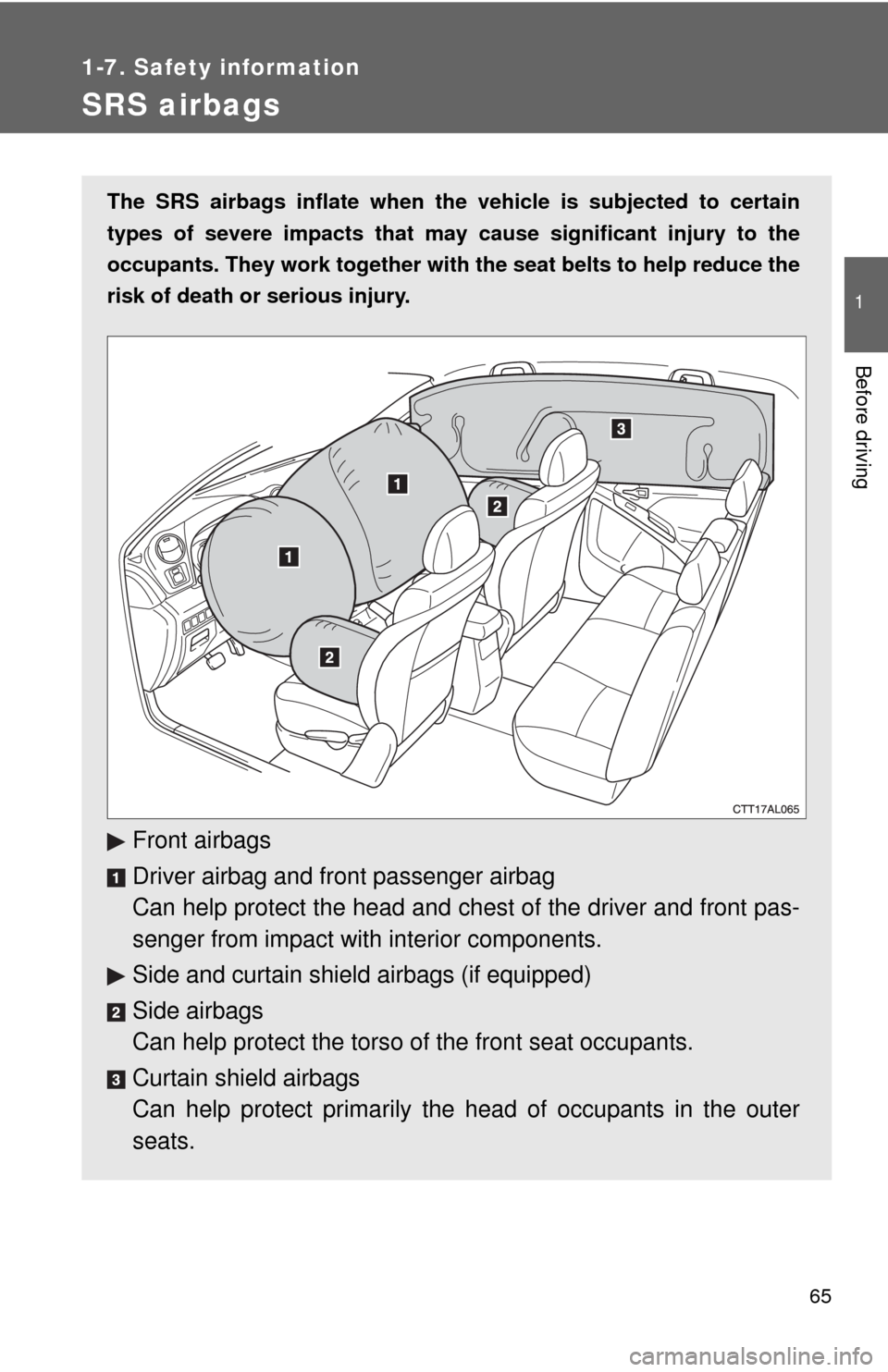
The SRS airbags inflate when the vehicle is subjected to certain
types of severe impacts that may cause significant injury to the
occupants. They work together with the seat belts to help reduce the
risk of death or serious injury.
Front airbags
Driver airbag and front passenger airbag
Can help protect the head and chest of the driver and front pas-
senger from impact with interior components.
Side and curtain shield airbags (if equipped)
Side airbags
Can help protect the torso of the front seat occupants.
Curtain shield airbags
Can help protect primarily the head of occupants in the outer
seats.
Page 66 of 440
66 1-7. Safety information
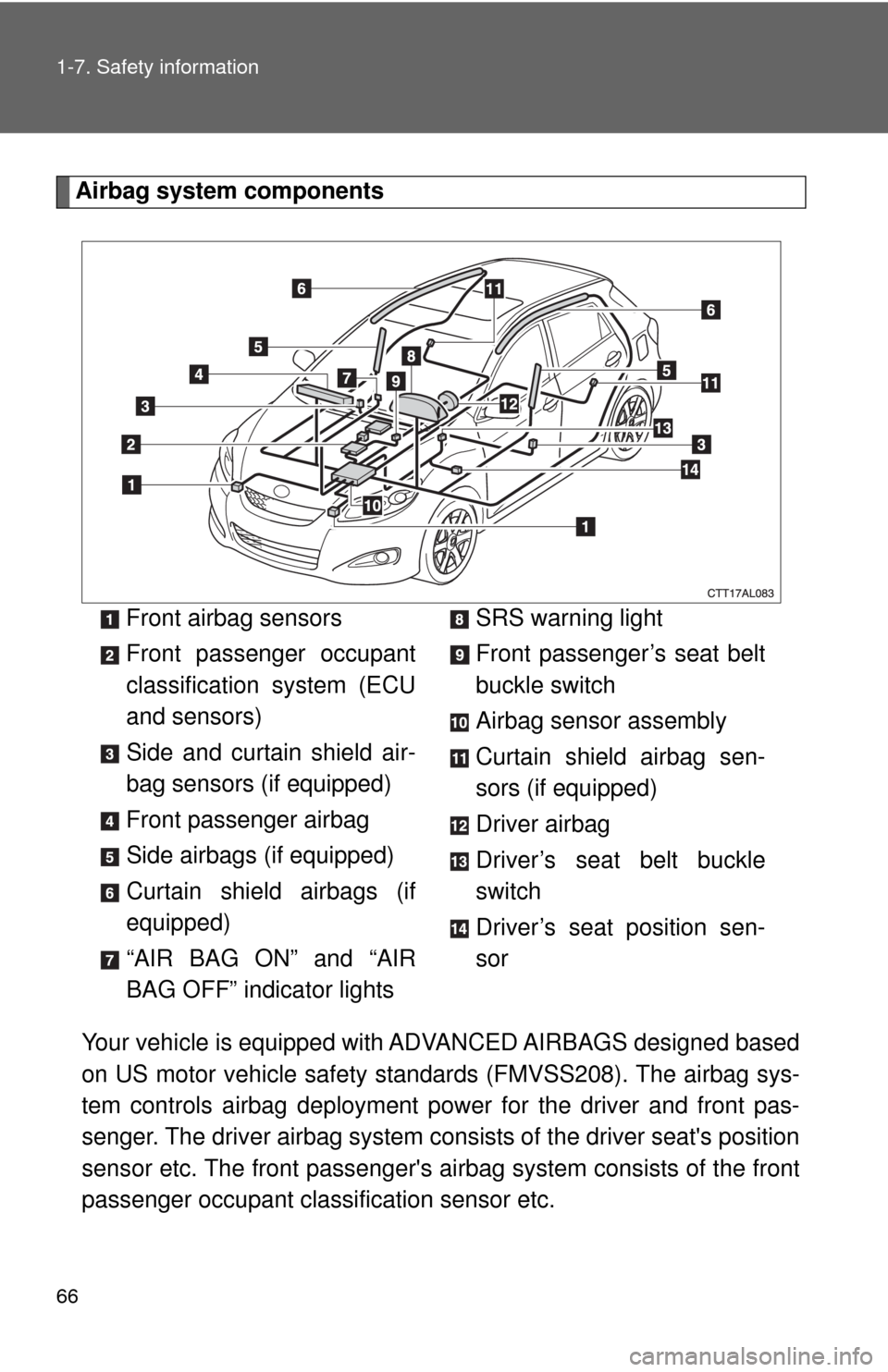
Airbag system components
Your vehicle is equipped with ADVANCED AIRBAGS designed based
on US motor vehicle safety standards (FMVSS208). The airbag sys-
tem controls airbag deployment power for the driver and front pas-
senger. The driver airbag system consists of the driver seat's position
sensor etc. The front passenger's airbag system consists of the front
passenger occupant classification sensor etc.Front airbag sensors
Front passenger occupant
classification system (ECU
and sensors)
Side and curtain shield air-
bag sensors (if equipped)
Front passenger airbag
Side airbags (if equipped)
Curtain shield airbags (if
equipped)
“AIR BAG ON” and “AIR
BAG OFF” indicator lightsSRS warning light
Front passenger’s seat belt
buckle switch
Airbag sensor assembly
Curtain shield airbag sen-
sors (if equipped)
Driver airbag
Driver’s seat belt buckle
switch
Driver’s seat position sen-
sor
Page 68 of 440

68 1-7. Safety information
■SRS warning light
This warning light system monitors the airbag sensor assembly, front airbag
sensors, side and curtain shield airbag sensors (if equipped), curtain shield
airbag sensors (if equipped), driver's seat position sensor, driver's seat belt
buckle switch, front passenger occupant classification system, “AIR BAG
ON” indicator light, “AIR BAG OFF” indicator light, front passenger's seat
belt buckle switch, seat belt pretensioner assemblies, inflators, interconnect-
ing wiring and power sources. (→P. 353)
■If the SRS airbags deploy (inflate)
●Bruising and slight abrasions may result from contact with a deploying
(inflating) SRS airbag.
●A loud noise and white powder will be emitted.
●Parts of the airbag module (steering wheel hub, airbag cover and inflator)
as well as the front seats, and parts of the front and rear pillars and roof
side rail, may be hot for several minutes. The airbag itself may also be
hot.
●The front windshield may crack.
■Operating conditions
Front airbags
●The SRS front airbags will deploy if the severity of the frontal impact is
above the designed threshold level, comparable to an approximate 15
mph (25 km/h) collision when the vehicle impacts straight into a fixed bar-
rier that does not move or deform.
However, this threshold velocity will be considerably higher if the vehicle
strikes an object, such as a parked vehicle or sign pole, which can move or
deform on impact, or if the vehicle is involved in an underride collision (e.g.
a collision in which the front of the vehicle “underrides”, or goes under, the
bed of a truck, etc.).
●It is possible that in some collisions where the forward deceleration of the
vehicle is very close to the designed threshold level, the SRS front air-
bags and the seat belt pretensioners may not activate together.
●The SRS front passenger airbag will not activate if there is no passenger
sitting in the front passenger seat. However, the front passenger airbag
may deploy if luggage is put in the seat, or the seat belt is fastened, even
if the seat is unoccupied. (→P. 77)