seat TOYOTA MATRIX 2009 E140 / 2.G Manual PDF
[x] Cancel search | Manufacturer: TOYOTA, Model Year: 2009, Model line: MATRIX, Model: TOYOTA MATRIX 2009 E140 / 2.GPages: 440, PDF Size: 9.39 MB
Page 357 of 440

5
When trouble arises
357 5-2. Steps to take in an emergency
■Front passenger detection sensor and passenger seat belt reminder
●If luggage is placed on the front passenger seat, the front passenger
detection sensor may cause the warning light to flash, even if a passen-
ger is not sitting in the seat.
●If a cushion is placed on the seat, the sensor may not detect a passen-
ger, and the warning light may not operate properly.
■Changing the engine oil (U.S.A. only)
Make sure to reset the oil change system. (→P. 293)
■
When the tire pressure warning light comes on
Check the tire inflation pressure and adjust to the appropriate level.
Pushing the tire pressure warning reset switch does not turn off the tire
pressure warning light.
■The tire pressure warning light may turn on due to natural causes
The tire pressure warning light may turn on due to natural causes such
as natural air leaks or tire inflation pressure changes caused by tem-
perature. In this case, adjusting the tire inflation pressure will turn off the
warning light (after a few minutes).
Page 359 of 440
5
When trouble arises
359 5-2. Steps to take in an emergency
■If the tire pressure warning light comes on after blinking for 1 min-
ute frequently
If the tire pressure warning light comes on after blinking for 1 minute fre-
quently when the engine switch is turned to the “ON” position, have it
checked by your Toyota dealer.
■Customization that can be configured at Toyota dealer
The vehicle speed linked seat belt reminder buzzer can be disabled.
(Customizable features →P. 420) However, Toyota recommends that the
seat belt reminder buzzer be operational to alert the driver and front passen-
ger that the seat belts are not fastened.
CAUTION
■If the tire pressure warning light comes on
Be sure to observe the following precautions. Failure to do so could
cause loss of vehicle control and result in death or serious injury.
●Stop your vehicle in a safe place as soon as possible. Adjust the tire
inflation pressure immediately.
●If the tire pressure warning light comes on even after tire inflation pres-
sure adjustment, it is probable that you have a flat tire. Check the tires.
If the tire is flat, change to the spare tire and have the flat tire repaired
by the nearest Toyota dealer.
●Avoid abrupt maneuvering and braking. If the vehicle tires deteriorate,
you could lose control of the steering wheel or the brakes.
■If a blowout or sudden air leakage should occur
The tire pressure warning system may not activate immediately.
Page 391 of 440
391 6-1. Specifications
6
Vehicle specifications
Vehicle identification
■Vehicle identification number
The vehicle identification number (VIN) is the legal identifier for your
vehicle. This is the primary identification number for your Toyota. It is
used in registering the ownership of your vehicle.
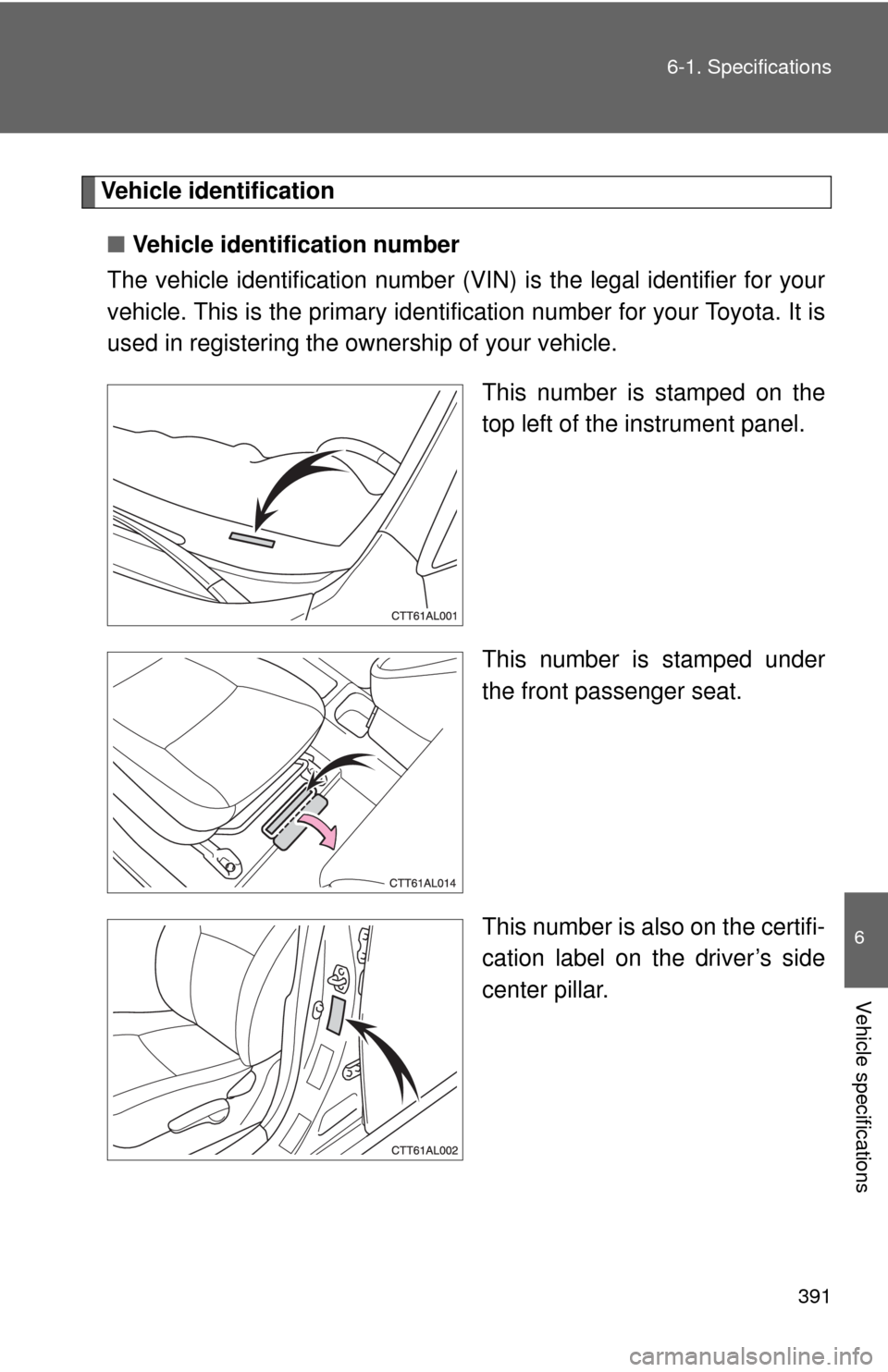
This number is stamped on the
top left of the instrument panel.
This number is stamped under
the front passenger seat.
This number is also on the certifi-
cation label on the driver’s side
center pillar.
Page 414 of 440

414 6-1. Specifications
Warning: The temperature grades for this tire are established for a
tire that is properly inflated and not overloaded.
Excessive speed, underinflation, or excessive loading, either sepa-
rately or in combination, can cause heat buildup and possible tire fail-
ure.
Glossary of tire terminology
Tire related termMeaning
Cold tire inflation pres-
sureTire pressure when the vehicle has been
parked for three hours or more, or has not
been driven more than 1 mile or 1.5 km under
that condition
Maximum inflation
pressureThe maximum cold inflated pressure to which a
tire may be inflated, shown on the sidewall of
the tire
Recommended infla-
tion pressureCold tire inflation pressure recommended by a
manufacturer
Accessory weightThe combined weight (in excess of those stan-
dard items which may be replaced) of auto-
matic transmission, power steering, power
brakes, power windows, power seats, radio
and heater, to the extent that these items are
available as factory-installed equipment
(whether installed or not)
Curb weightThe weight of a motor vehicle with standard
equipment, including the maximum capacity of
fuel, oil and coolant, and if so equipped, air
conditioning and additional weight optional
engine
Maximum loaded vehi-
cle weightThe sum of:
(a) Curb weight
(b) Accessory weight
(c) Vehicle capacity weight
(d) Production options weight
Page 415 of 440
415 6-1. Specifications
6
Vehicle specifications
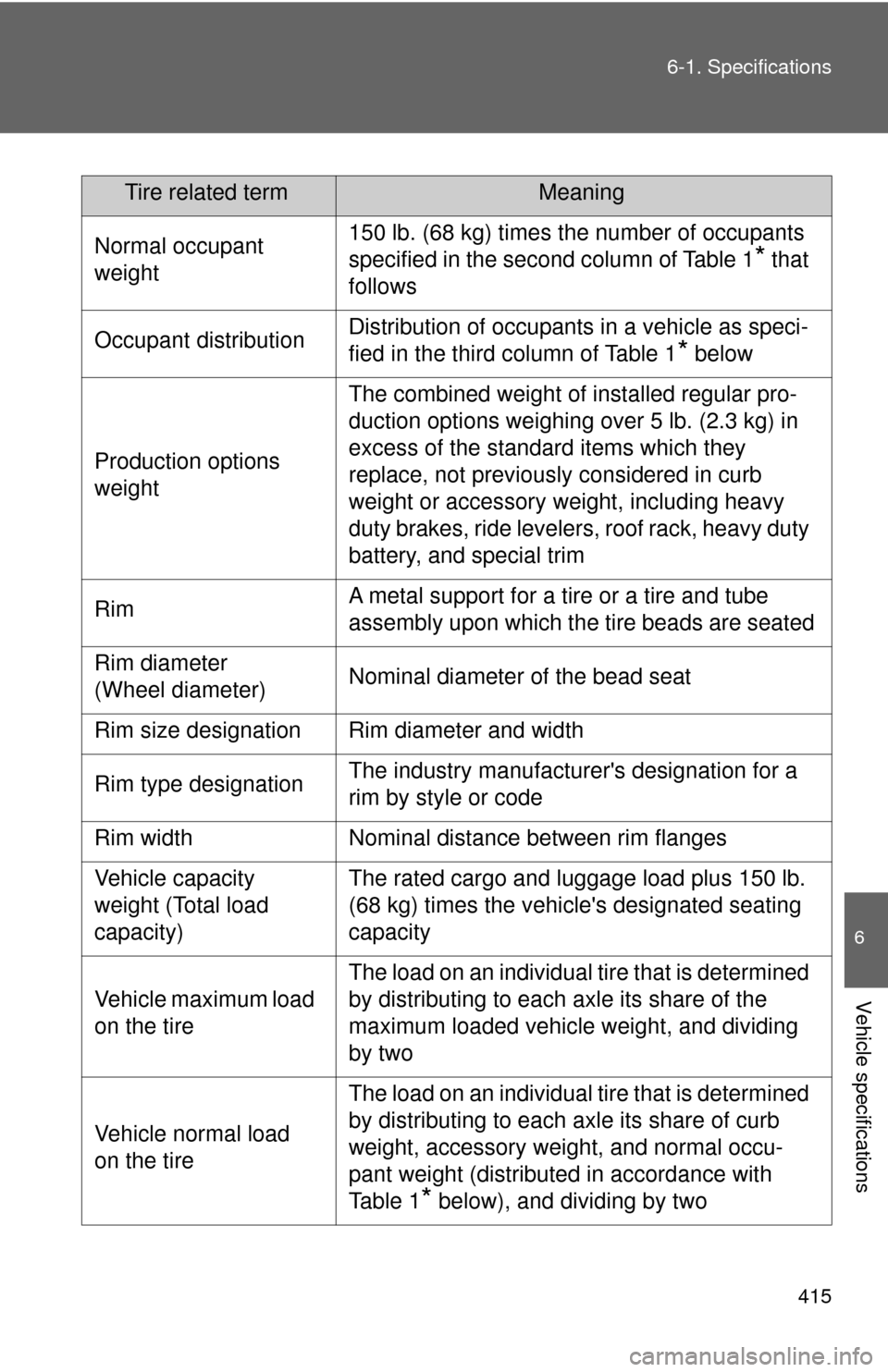
Tire related termMeaning
Normal occupant
weight150 lb. (68 kg) times the number of occupants
specified in the second column of Table 1
* that
follows
Occupant distributionDistribution of occupants in a vehicle as speci-
fied in the third column of Table 1
* below
Production options
weightThe combined weight of installed regular pro-
duction options weighing over 5 lb. (2.3 kg) in
excess of the standard items which they
replace, not previously considered in curb
weight or accessory weight, including heavy
duty brakes, ride levelers, roof rack, heavy duty
battery, and special trim
RimA metal support for a tire or a tire and tube
assembly upon which the tire beads are seated
Rim diameter
(Wheel diameter)Nominal diameter of the bead seat
Rim size designation Rim diameter and width
Rim type designationThe industry manufacturer's designation for a
rim by style or code
Rim width Nominal distance between rim flanges
Vehicle capacity
weight (Total load
capacity)The rated cargo and luggage load plus 150 lb.
(68 kg) times the vehicle's designated seating
capacity
Vehicle maximum load
on the tireThe load on an individual tire that is determined
by distributing to each axle its share of the
maximum loaded vehicle weight, and dividing
by two
Vehicle normal load
on the tireThe load on an individual tire that is determined
by distributing to each axle its share of curb
weight, accessory weight, and normal occu-
pant weight (distributed in accordance with
Ta b l e 1
* below), and dividing by two
Page 419 of 440
419 6-1. Specifications
6
Vehicle specifications
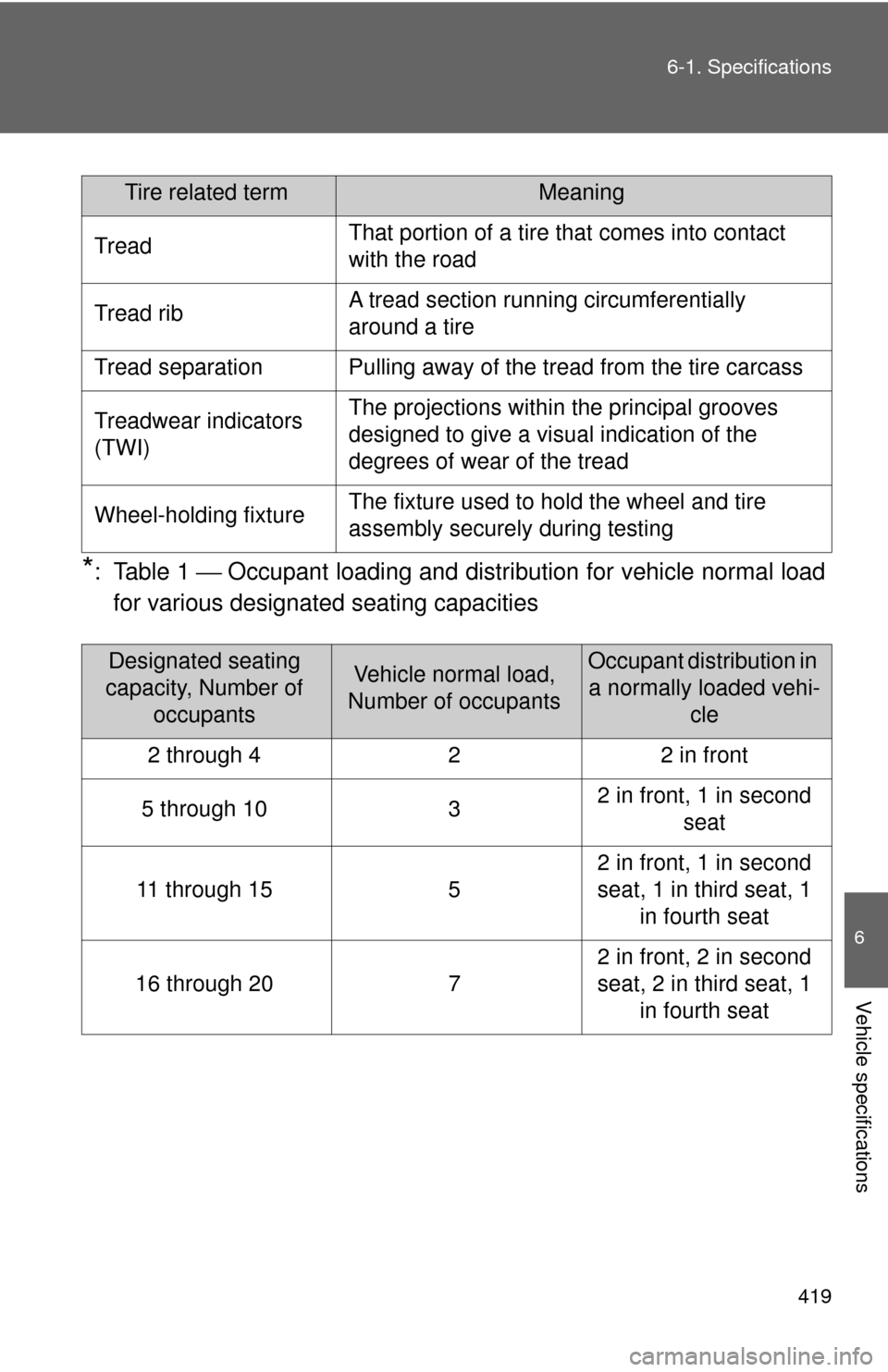
*: Table 1 ⎯ Occupant loading and distribution for vehicle normal load
for various designated seating capacities
Tire related termMeaning
TreadThat portion of a tire that comes into contact
with the road
Tread ribA tread section running circumferentially
around a tire
Tread separation Pulling away of the tread from the tire carcass
Treadwear indicators
(TWI)The projections within the principal grooves
designed to give a visual indication of the
degrees of wear of the tread
Wheel-holding fixtureThe fixture used to hold the wheel and tire
assembly securely during testing
Designated seating
capacity, Number of
occupantsVehicle normal load,
Number of occupantsOccupant distribution in
a normally loaded vehi-
cle
2 through 4 2 2 in front
5 through 10 32 in front, 1 in second
seat
11 through 15 52 in front, 1 in second
seat, 1 in third seat, 1
in fourth seat
16 through 20 72 in front, 2 in second
seat, 2 in third seat, 1
in fourth seat
Page 421 of 440
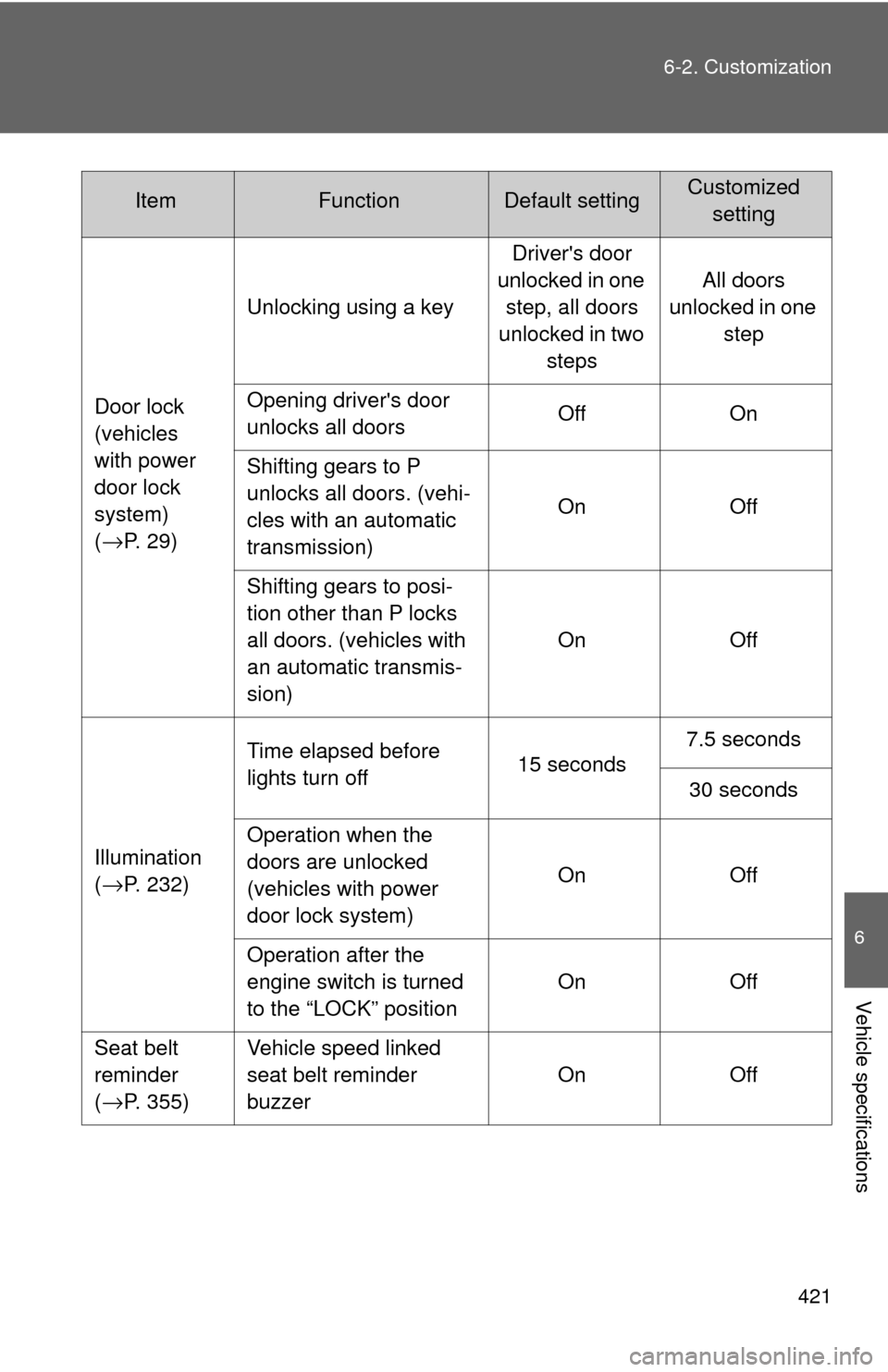
421 6-2. Customization
6
Vehicle specifications
Door lock
(vehicles
with power
door lock
system)
(
→P. 29)Unlocking using a keyDriver's door
unlocked in one
step, all doors
unlocked in two
stepsAll doors
unlocked in one
step
Opening driver's door
unlocks all doorsOff On
Shifting gears to P
unlocks all doors. (vehi-
cles with an automatic
transmission)On Off
Shifting gears to posi-
tion other than P locks
all doors. (vehicles with
an automatic transmis-
sion)On Off
Illumination
(
→P. 232)Time elapsed before
lights turn off15 seconds7.5 seconds
30 seconds
Operation when the
doors are unlocked
(vehicles with power
door lock system)On Off
Operation after the
engine switch is turned
to the “LOCK” positionOn Off
Seat belt
reminder
(
→P. 355)Vehicle speed linked
seat belt reminder
buzzerOn Off
ItemFunctionDefault settingCustomized
setting
Page 423 of 440
For owners7
423
Reporting safety defects
for U.S. owners .............. 424
Seat belt instructions for
Canadian owners
(in French) ..................... 425
Page 425 of 440
425
7
For owners
Seat belt instructions for Canadian owners (in French)
The following is a French explanation of seat belt instructions
extracted from the seat belt section in this manual.
See the seat belt section for more detailed seat belt instructions in
English.
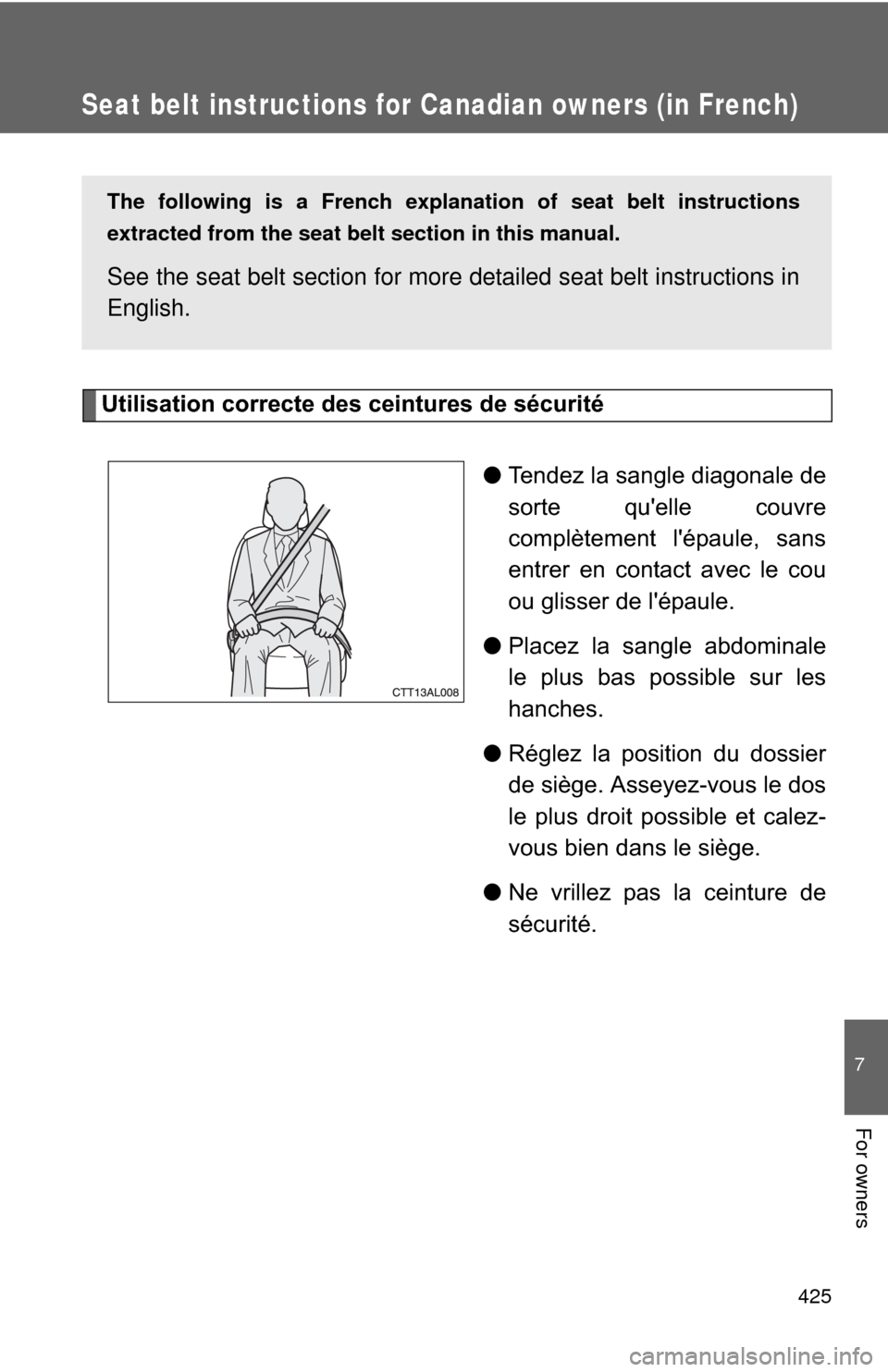
Utilisation correcte des ceintures de sécurité
●Tendez la sangle diagonale de
sorte qu'elle couvre
complètement l'épaule, sans
entrer en contact avec le cou
ou glisser de l'épaule.
●Placez la sangle abdominale
le plus bas possible sur les
hanches.
●Réglez la position du dossier
de siège. Asseyez-vous le dos
le plus droit possible et calez-
vous bien dans le siège.
●Ne vrillez pas la ceinture de
sécurité.
Page 430 of 440

430 Alphabetical index
Care
Exterior .................................. 268
Interior ................................... 270
Seat belts .............................. 271
Cargo capacity ......................... 140
Cargo hooks ............................. 255
CD changer ............................... 178
CD player .................................. 178
Chains ....................................... 144
Child restraint system
Booster seats, definition ..........82
Booster seats, installation .......86
Convertible seats,
definition ...............................82
Convertible seats,
installation .............................86
Front passenger occupant
classification system .............77
Infant seats, definition .............82
Infant seats, installation...........86
Installing CRS with lower
anchorages ...........................90
Installing CRS with
seat belts ..............................87
Installing CRS with top
straps ....................................92Child safety
Airbag precautions .................. 72
Battery precautions ....... 300, 383
Child restraint system ............. 82
Child-protectors....................... 30
How your child should wear
the seat belt .......................... 43
Installing child restraints.......... 86
Moon roof precautions ............ 55
Power window lock switch ...... 51
Power window precautions ..... 52
Removed key battery
precautions ......................... 321
Seat belt extender
precautions ........................... 45
Seat belt precautions .............. 44
Child-protectors ......................... 30
Cleaning
Exterior.................................. 268
Interior ................................... 270
Seat belts .............................. 271
Clock ......................................... 246
Compass................................... 262
Condenser ................................ 296
Console box ............................. 237
Cooling system
Engine overheating ............... 385
Cruise control .......................... 132
Cup holder ................................ 239
Curtain shield airbags ............... 65
Customizable features ............ 420C