automatic transmission TOYOTA MATRIX 2009 E140 / 2.G Owners Manual
[x] Cancel search | Manufacturer: TOYOTA, Model Year: 2009, Model line: MATRIX, Model: TOYOTA MATRIX 2009 E140 / 2.GPages: 440, PDF Size: 9.39 MB
Page 2 of 440

TABLE OF CONTENTSIndex
2
1-1. Key information .................. 24Keys ..................................... 24
1-2. Opening, closing
and
locking the
doors ............. 26
Wireless remote control ....... 26
Doors.................................... 29
Back door ............................. 33
1-3.
Adjustable components
(seats, mirrors,
steering wheel)
................. 35
Front seats ........................... 35
Rear seats ............................ 38
Head restraints ..................... 40
Seat belts ............................. 41
Steering wheel ..................... 46
Anti-glare inside rear view mirror .................................. 47
Outside rear view mirrors ..... 49
1-4. Opening a
nd closing the
window
s ............................ 51
Power windows .................... 51
Moon roof ............................. 53
1-5. Refueling ............................. 56 Opening the fuel tank cap .... 56
1-6. Theft deterrent system ...... 60 Engine immobilizer system ................................ 60
Theft prevention labels (for U.S.A.) ......................... 62 1-7. Safety information .............. 63
Correct driving posture ......... 63
SRS airbags ......................... 65
Front passenger occupant classification system ........... 77
Child restraint systems ......... 82
Installing child restraints ....... 86
2-1. Driving procedures............. 96 Driving the vehicle ................ 96
Engine (ignition) switch....... 106
Automatic transmission ...... 110
Manual transmission........... 115
Turn signal lever ................. 117
Parking brake ..................... 118
2-2. Instrument cluster ............ 119 Gauges and meters ............ 119
Indicators and warning lights ................................. 122
2-3. Operating the li
ghts and
wipers
.............................. 125
Headlight switch ................. 125
Fog light switch ................... 128
Windshield wipers and washer .............................. 129
Rear window wiper and washer .............................. 131
2-4. Using other driving systems ........................... 132
Cruise control ..................... 132
Driving assist systems ........ 135
1Before driving
2When driving
Page 3 of 440

1
2
3
4
5
6
7
3
2-5. Driving information ........... 140
Cargo and luggage ............. 140
Vehicle load limits ............... 143
Winter driving tips ............... 144
Trailer towing ...................... 148
Dinghy towing
(automatic
transmission) .................... 156
Dinghy towing
(manual transmission) ...... 157
3-1. Using the air conditioning
system and defogger...... 162
Air conditioning system ....... 162
Rear window and outside
rear view mirror
defoggers .......................... 168
3-2. Using the audio system.... 169
Audio system types ............. 169
Using the radio .................... 172
Using the CD player ............ 178
Playing MP3 and
WMA discs ........................ 185
Optimal use of the audio
system .............................. 193
Using the AUX adapter ....... 196
Using the steering wheel
audio switches .................. 197
3-3. Using the hands-free
phone system
(for cellular phone) ......... 200Hands-free phone system
(for cellular phone)
features ............................ 200
Using the hands-free
phone system
(for cellular phone) ........... 203
Making a phone call ........... 212
Setting a cellular phone ...... 216
Security and system
setup ................................ 221
Using the phone book ........ 225
3-4. Using the interior lights ... 232
Interior lights list ................. 232
• Interior light ...................... 233
• Personal/interior lights...... 234
• Personal lights.................. 235
3-5. Using the storage
features ........................... 236
List of storage features ....... 236
• Glove box ......................... 237
• Console box ..................... 237
• Cup holders ...................... 239
• Bottle holders ................... 241
• Auxiliary boxes ................. 242
3-6. Other interior features ..... 244
Sun visors........................... 244
Vanity mirrors ..................... 245
Clock .................................. 246
Ashtrays ............................. 247
Cigarette lighter .................. 248
Power outlet ....................... 249
Grocery bag hook ............... 251
Seatback table.................... 253
Floor mat ............................ 254
Luggage compartment
feature .............................. 255
3Interior features
Page 4 of 440

TABLE OF CONTENTSIndex
4
Compass ............................ 262
4-1. Maintenance and care...... 268
Cleaning and protecting the
vehicle exterior ................. 268
Cleaning and protecting the
vehicle interior .................. 270
4-2. Maintenance ..................... 273
Maintenance
requirements .................... 273
General maintenance ......... 275
Emission inspection and
maintenance (I/M)
programs .......................... 278
4-3. Do-it-yourself
maintenance ................... 279
Do-it-yourself service
precautions ...................... 279
Hood................................... 283
Positioning a floor jack ....... 285
Engine compartment .......... 288
Tires ................................... 303
Tire inflation pressure......... 312
Wheels ............................... 316
Air conditioning filter ........... 318
Key battery (vehicles with
wireless remote control) ... 320
Checking and replacing
fuses ................................ 323
Light bulbs .......................... 3325-1. Essential information ....... 342
If your vehicle needs to
be towed ........................... 342
If you think something
is wrong ............................ 348
Fuel pump shut off
system .............................. 349
Event data recorder ............ 350
5-2. Steps to take in an
emergency ...................... 352
If a warning light turns on
or a warning buzzer
sounds... .......................... 352
If you have a flat tire ........... 362
If the engine will not start .... 376
If the shift lever cannot be
shifted from P (automatic
transmission) .................... 377
If you lose your keys ........... 378
If the battery is
discharged ........................ 379
If your vehicle overheats..... 385
If the vehicle becomes
stuck ................................. 388
4Maintenance and care
5When trouble arises
Page 30 of 440
30 1-2. Opening, closing and locking the doors
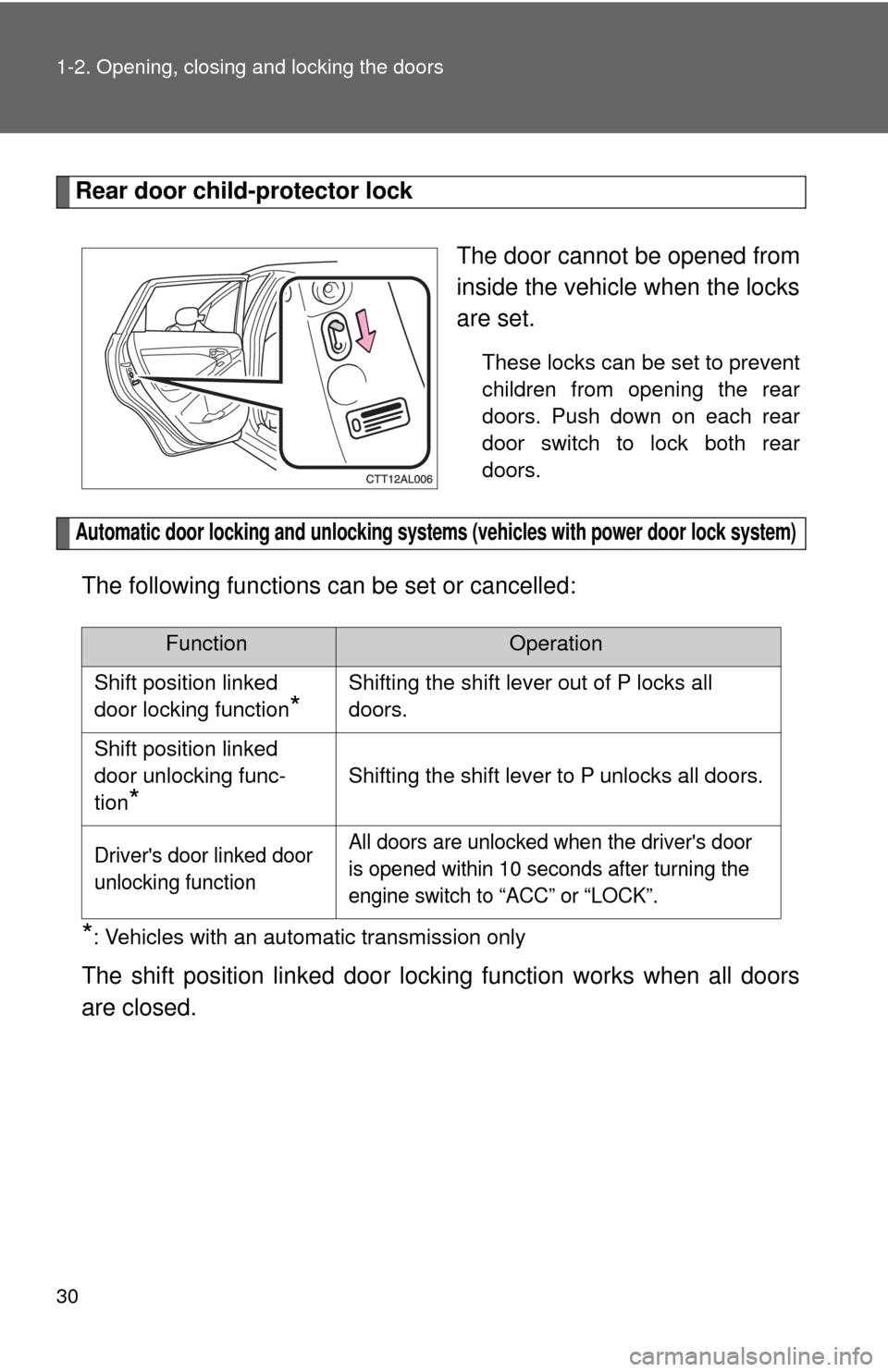
Rear door child-protector lock
The door cannot be opened from
inside the vehicle when the locks
are set.
These locks can be set to prevent
children from opening the rear
doors. Push down on each rear
door switch to lock both rear
doors.
Automatic door locking and unlocking systems (vehicles with power door lock system)
The following functions can be set or cancelled:
*: Vehicles with an automatic transmission only
The shift position linked door locking function works when all doors
are closed.
FunctionOperation
Shift position linked
door locking function
*
Shifting the shift lever out of P locks all
doors.
Shift position linked
door unlocking func-
tion
*
Shifting the shift lever to P unlocks all doors.
Driver's door linked door
unlocking functionAll doors are unlocked when the driver's door
is opened within 10 seconds after turning the
engine switch to “ACC” or “LOCK”.
Page 31 of 440
31 1-2. Opening, closing and locking the doors
1
Before driving
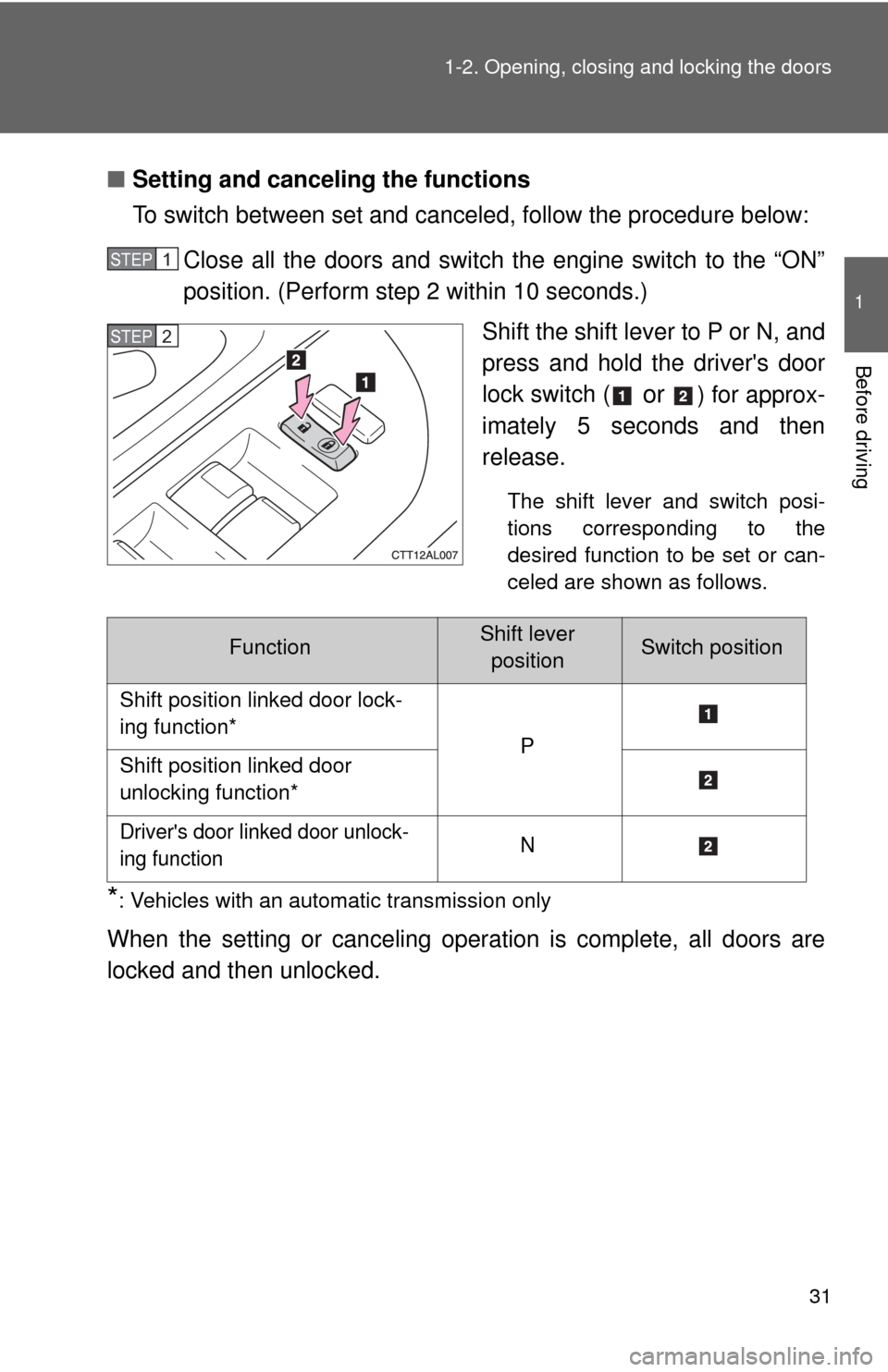
■Setting and canceling the functions
To switch between set and canceled, follow the procedure below:
Close all the doors and switch the engine switch to the “ON”
position. (Perform step 2 within 10 seconds.)
Shift the shift lever to P or N, and
press and hold the driver's door
lock switch (
or ) for approx-
imately 5 seconds and then
release.
The shift lever and switch posi-
tions corresponding to the
desired function to be set or can-
celed are shown as follows.
*: Vehicles with an automatic transmission only
When the setting or canceling operation is complete, all doors are
locked and then unlocked.
STEP1
STEP2
FunctionShift lever
positionSwitch position
Shift position linked door lock-
ing function*
P
Shift position linked door
unlocking function*
Driver's door linked door unlock-
ing functionN
Page 95 of 440
When driving2
95
2-1. Driving procedures .......... 96
Driving the vehicle.............. 96
Engine (ignition) switch .... 106
Automatic transmission .... 110
Manual transmission ........ 115
Turn signal lever .............. 117
Parking brake ................... 118
2-2. Instrument cluster.......... 119
Gauges and meters............. 119
Indicators and warning
lights .............................. 122
2-3. Operating the lights and
wipers ........................... 125
Headlight switch ............... 125
Fog light switch ................ 128
Windshield wipers and
washer ........................... 129
Rear window wiper and
washer ........................... 131
2-4. Using other driving
systems ........................ 132
Cruise control ................... 132
Driving assist systems ..... 1352-5. Driving information ........ 140
Cargo and luggage .......... 140
Vehicle load limits ............ 143
Winter driving tips ............ 144
Trailer towing ................... 148
Dinghy towing
(automatic
transmission) ................. 156
Dinghy towing
(manual transmission) ... 157
Page 96 of 440
96
2-1. Driving procedures
Driving the vehicle
The following procedures should be observed to ensure safe driv-
ing.
■Starting the engine
→P. 106
■Driving
Automatic transmission
With the brake pedal depressed, shift the shift lever to D.
(→P. 1 1 0 )
Release the parking brake. (→P. 1 1 8 )
Gradually release the brake pedal and gently depress the
accelerator pedal to accelerate the vehicle.
Manual transmission
With the clutch pedal fully depressed, shift the shift lever to
1. (→P. 1 1 5 )
Release the parking brake. (→P. 1 1 8 )
Gradually release the clutch pedal. At the same time, gently
depress the accelerator pedal to accelerate the vehicle.
■Stopping
Automatic transmission
With the shift lever in D, depress the brake pedal.
If necessary, set the parking brake.
When the vehicle is stopped for an extended period of time, shift
the shift lever to P or N. (→P. 110)
Manual transmission
With the clutch pedal fully depressed, depress the brake
pedal.
If necessary, set the parking brake.
When the vehicle is stopped for an extended period of time, shift
the shift lever to N. (→P. 115)
STEP1
STEP2
STEP3
STEP1
STEP2
STEP3
STEP1
STEP2
STEP1
STEP2
Page 97 of 440
97 2-1. Driving procedures
2
When driving
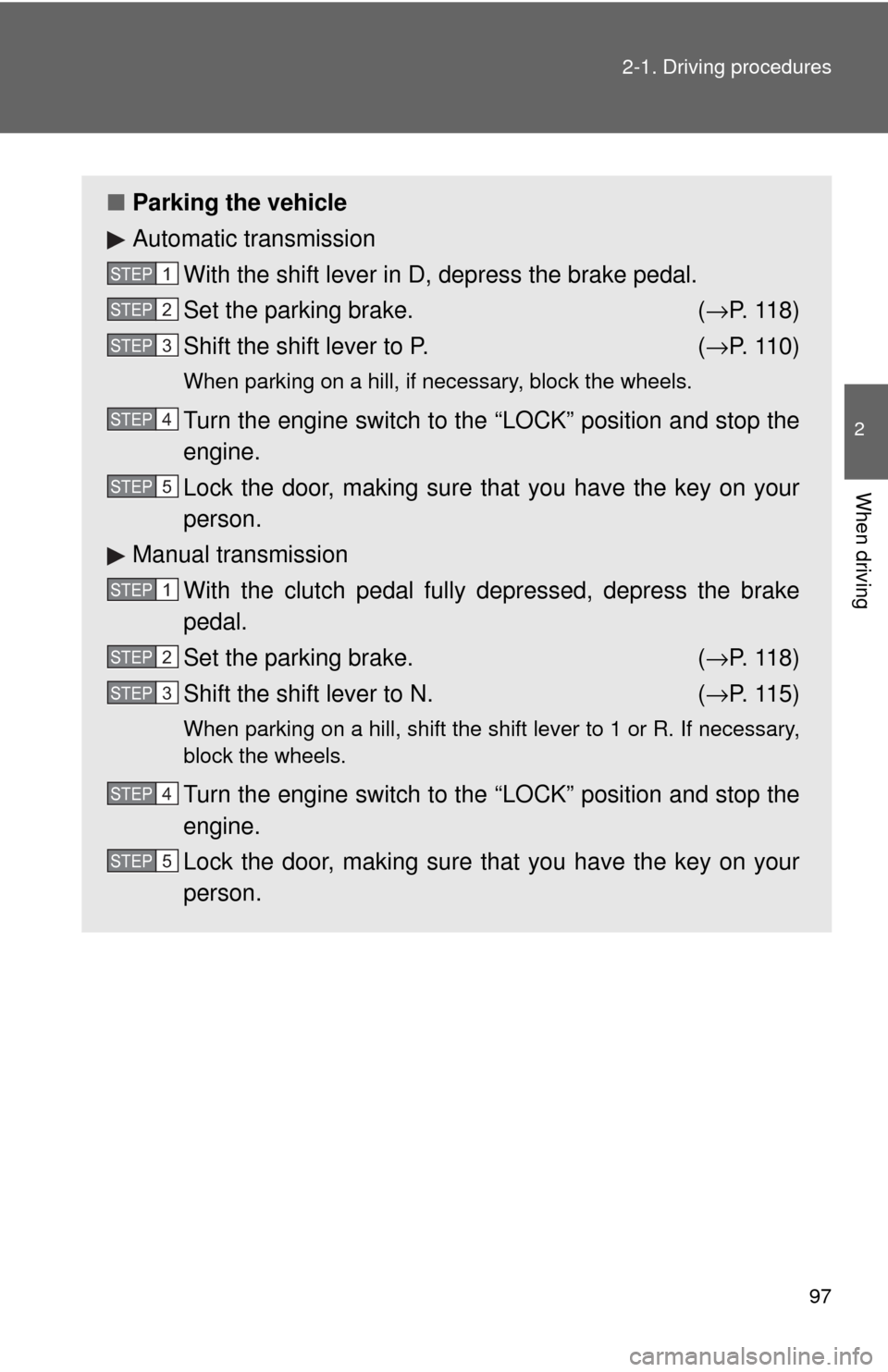
■Parking the vehicle
Automatic transmission
With the shift lever in D, depress the brake pedal.
Set the parking brake. (→P. 1 1 8 )
Shift the shift lever to P. (→P. 1 1 0 )
When parking on a hill, if necessary, block the wheels.
Turn the engine switch to the “LOCK” position and stop the
engine.
Lock the door, making sure that you have the key on your
person.
Manual transmission
With the clutch pedal fully depressed, depress the brake
pedal.
Set the parking brake. (→P. 1 1 8 )
Shift the shift lever to N. (→P. 1 1 5 )
When parking on a hill, shift the shift lever to 1 or R. If necessary,
block the wheels.
Turn the engine switch to the “LOCK” position and stop the
engine.
Lock the door, making sure that you have the key on your
person.
STEP1
STEP2
STEP3
STEP4
STEP5
STEP1
STEP2
STEP3
STEP4
STEP5
Page 98 of 440
98 2-1. Driving procedures
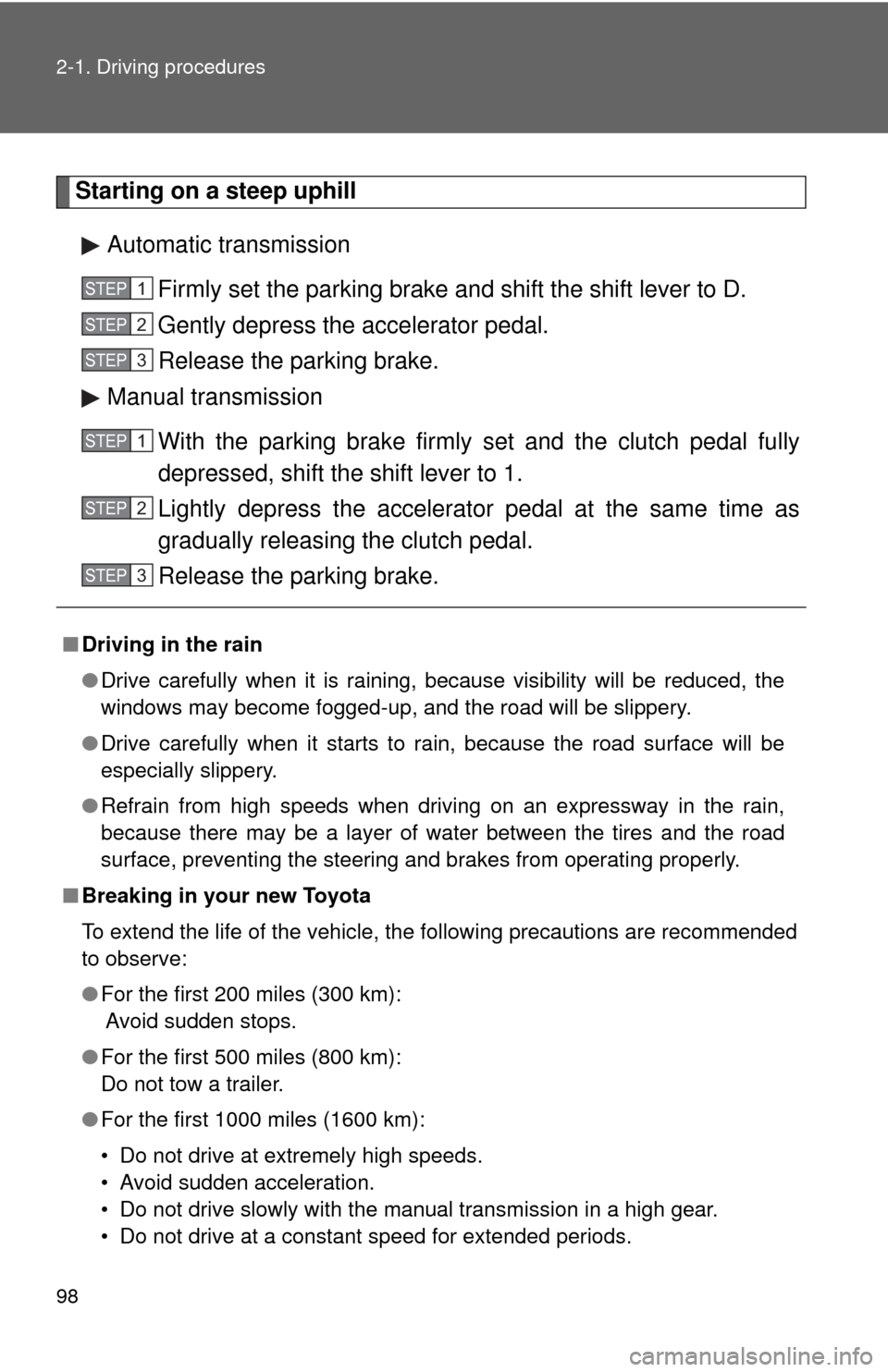
Starting on a steep uphill
Automatic transmission
Firmly set the parking brake and shift the shift lever to D.
Gently depress the accelerator pedal.
Release the parking brake.
Manual transmission
With the parking brake firmly set and the clutch pedal fully
depressed, shift the shift lever to 1.
Lightly depress the accelerator pedal at the same time as
gradually releasing the clutch pedal.
Release the parking brake.
■Driving in the rain
●Drive carefully when it is raining, because visibility will be reduced, the
windows may become fogged-up, and the road will be slippery.
●Drive carefully when it starts to rain, because the road surface will be
especially slippery.
●Refrain from high speeds when driving on an expressway in the rain,
because there may be a layer of water between the tires and the road
surface, preventing the steering and brakes from operating properly.
■Breaking in your new Toyota
To extend the life of the vehicle, the following precautions are recommended
to observe:
●For the first 200 miles (300 km):
Avoid sudden stops.
●For the first 500 miles (800 km):
Do not tow a trailer.
●For the first 1000 miles (1600 km):
• Do not drive at extremely high speeds.
• Avoid sudden acceleration.
• Do not drive slowly with the manual transmission in a high gear.
• Do not drive at a constant speed for extended periods.
STEP1
STEP2
STEP3
STEP1
STEP2
STEP3
Page 99 of 440

99 2-1. Driving procedures
2
When driving
■Drum-in-disc type parking brake system (if equipped)
Your vehicle has a drum-in-disc type parking brake system. This type of
brake system needs bedding-down of the brake shoes periodically or when-
ever the parking brake shoes and/or drum are replaced. Have your Toyota
dealer perform the bedding down.
■Operating your vehicle in a foreign country
Comply with the relevant vehicle registration laws and confirm the availability
of the correct fuel. (→P. 394)
■Normal characteristics after turning off the engine
Approximately five hours after the engine is turned off, you may hear sound
coming from under the vehicle for several minutes. This is because the fuel
evaporation leakage check is performed. It does not indicate a malfunction.
CAUTION
■When starting the vehicle (vehicles with an automatic transmission)
Always keep your foot on the brake pedal while stopped with the engine run-
ning. This prevents the vehicle from creeping.
■When driving the vehicle
●Do not drive if you are unfamiliar with the location of the brake and accel-
erator pedals to avoid depressing the wrong pedal.
• Accidentally depressing the accelerator pedal instead of the brake
pedal will result in sudden acceleration that may lead to an accident
that could result in death or serious injury.
• When backing up, you may twist your body around, leading to a diffi-
culty in operating the pedals. Make sure to operate the pedals properly.
• Make sure to keep a correct driving posture even when moving the
vehicle only slightly, allowing you to depress the brake and accelerator
pedals properly.
• Depress the brake pedal using your right foot. Depressing the brake
pedal using your left foot may delay response in an emergency, result-
ing in an accident.