instrument cluster TOYOTA MATRIX 2009 E140 / 2.G Owners Manual
[x] Cancel search | Manufacturer: TOYOTA, Model Year: 2009, Model line: MATRIX, Model: TOYOTA MATRIX 2009 E140 / 2.GPages: 440, PDF Size: 9.39 MB
Page 2 of 440

TABLE OF CONTENTSIndex
2
1-1. Key information .................. 24Keys ..................................... 24
1-2. Opening, closing
and
locking the
doors ............. 26
Wireless remote control ....... 26
Doors.................................... 29
Back door ............................. 33
1-3.
Adjustable components
(seats, mirrors,
steering wheel)
................. 35
Front seats ........................... 35
Rear seats ............................ 38
Head restraints ..................... 40
Seat belts ............................. 41
Steering wheel ..................... 46
Anti-glare inside rear view mirror .................................. 47
Outside rear view mirrors ..... 49
1-4. Opening a
nd closing the
window
s ............................ 51
Power windows .................... 51
Moon roof ............................. 53
1-5. Refueling ............................. 56 Opening the fuel tank cap .... 56
1-6. Theft deterrent system ...... 60 Engine immobilizer system ................................ 60
Theft prevention labels (for U.S.A.) ......................... 62 1-7. Safety information .............. 63
Correct driving posture ......... 63
SRS airbags ......................... 65
Front passenger occupant classification system ........... 77
Child restraint systems ......... 82
Installing child restraints ....... 86
2-1. Driving procedures............. 96 Driving the vehicle ................ 96
Engine (ignition) switch....... 106
Automatic transmission ...... 110
Manual transmission........... 115
Turn signal lever ................. 117
Parking brake ..................... 118
2-2. Instrument cluster ............ 119 Gauges and meters ............ 119
Indicators and warning lights ................................. 122
2-3. Operating the li
ghts and
wipers
.............................. 125
Headlight switch ................. 125
Fog light switch ................... 128
Windshield wipers and washer .............................. 129
Rear window wiper and washer .............................. 131
2-4. Using other driving systems ........................... 132
Cruise control ..................... 132
Driving assist systems ........ 135
1Before driving
2When driving
Page 95 of 440
When driving2
95
2-1. Driving procedures .......... 96
Driving the vehicle.............. 96
Engine (ignition) switch .... 106
Automatic transmission .... 110
Manual transmission ........ 115
Turn signal lever .............. 117
Parking brake ................... 118
2-2. Instrument cluster.......... 119
Gauges and meters............. 119
Indicators and warning
lights .............................. 122
2-3. Operating the lights and
wipers ........................... 125
Headlight switch ............... 125
Fog light switch ................ 128
Windshield wipers and
washer ........................... 129
Rear window wiper and
washer ........................... 131
2-4. Using other driving
systems ........................ 132
Cruise control ................... 132
Driving assist systems ..... 1352-5. Driving information ........ 140
Cargo and luggage .......... 140
Vehicle load limits ............ 143
Winter driving tips ............ 144
Trailer towing ................... 148
Dinghy towing
(automatic
transmission) ................. 156
Dinghy towing
(manual transmission) ... 157
Page 119 of 440
119
2
When driving
2-2. Instrument cluster
Gauges and meters
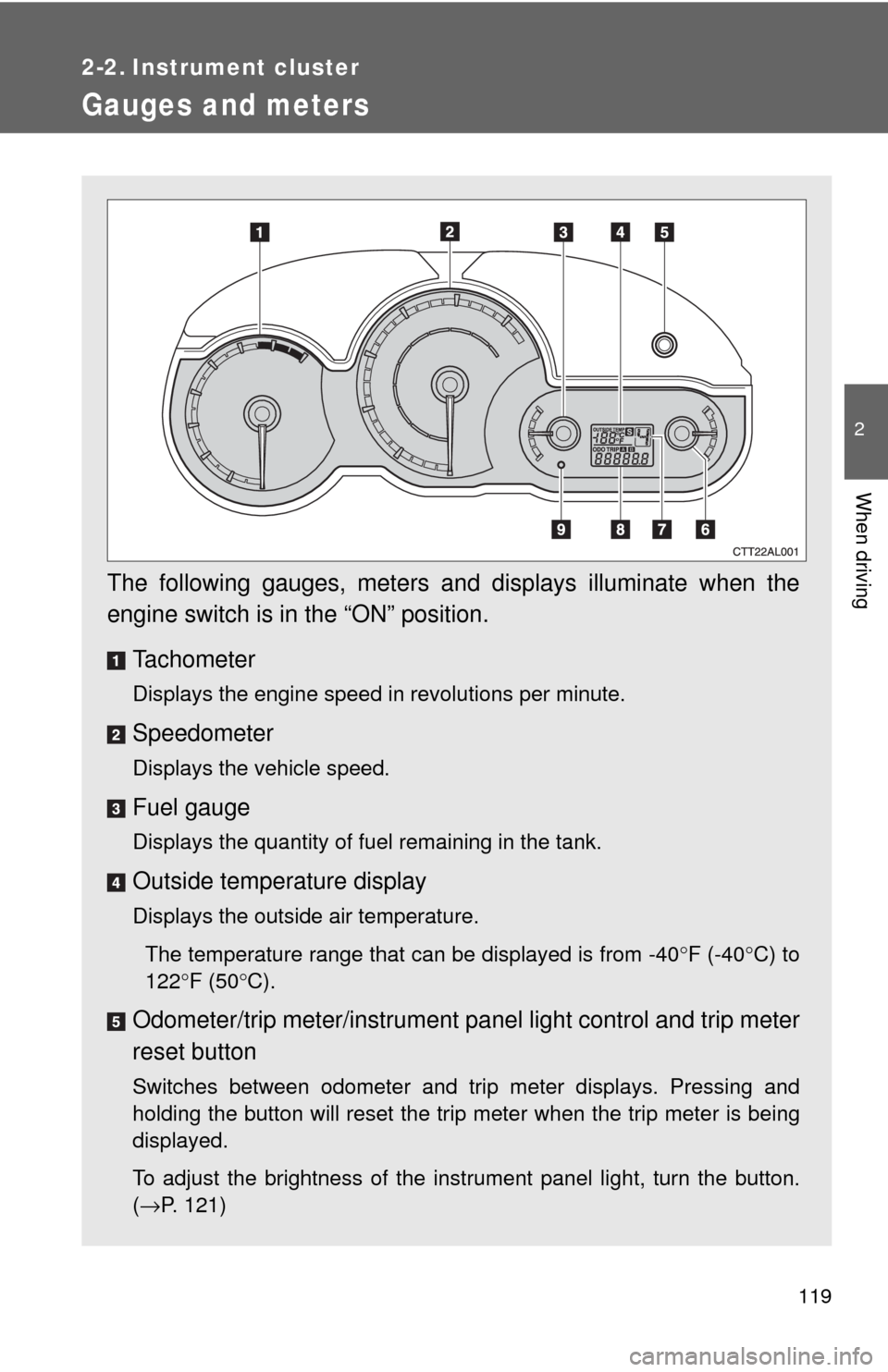
The following gauges, meters and displays illuminate when the
engine switch is in the “ON” position.
Tachometer
Displays the engine speed in revolutions per minute.
Speedometer
Displays the vehicle speed.
Fuel gauge
Displays the quantity of fuel remaining in the tank.
Outside temperature display
Displays the outside air temperature.
The temperature range that can be displayed is from -40°F (-40°C) to
122°F (50°C).
Odometer/trip meter/instrument panel light control and trip meter
reset button
Switches between odometer and trip meter displays. Pressing and
holding the button will reset the trip meter when the trip meter is being
displayed.
To adjust the brightness of the instrument panel light, turn the button.
(→P. 1 2 1 )
Page 120 of 440
120 2-2. Instrument cluster
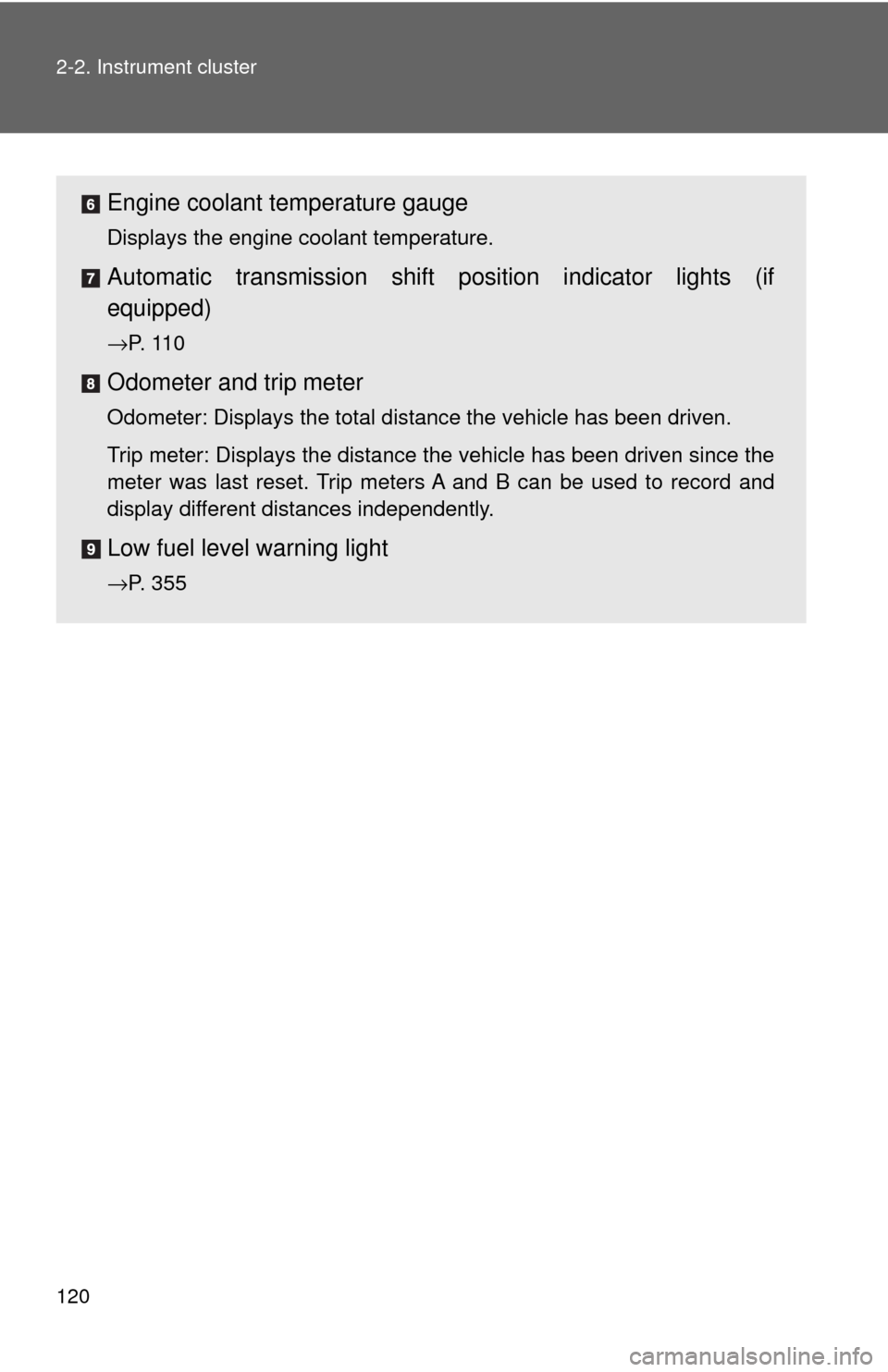
Engine coolant temperature gauge
Displays the engine coolant temperature.
Automatic transmission shift position indicator lights (if
equipped)
→P. 1 1 0
Odometer and trip meter
Odometer: Displays the total distance the vehicle has been driven.
Trip meter: Displays the distance the vehicle has been driven since the
meter was last reset. Trip meters A and B can be used to record and
display different distances independently.
Low fuel level warning light
→P. 355
Page 121 of 440
121 2-2. Instrument cluster
2
When driving
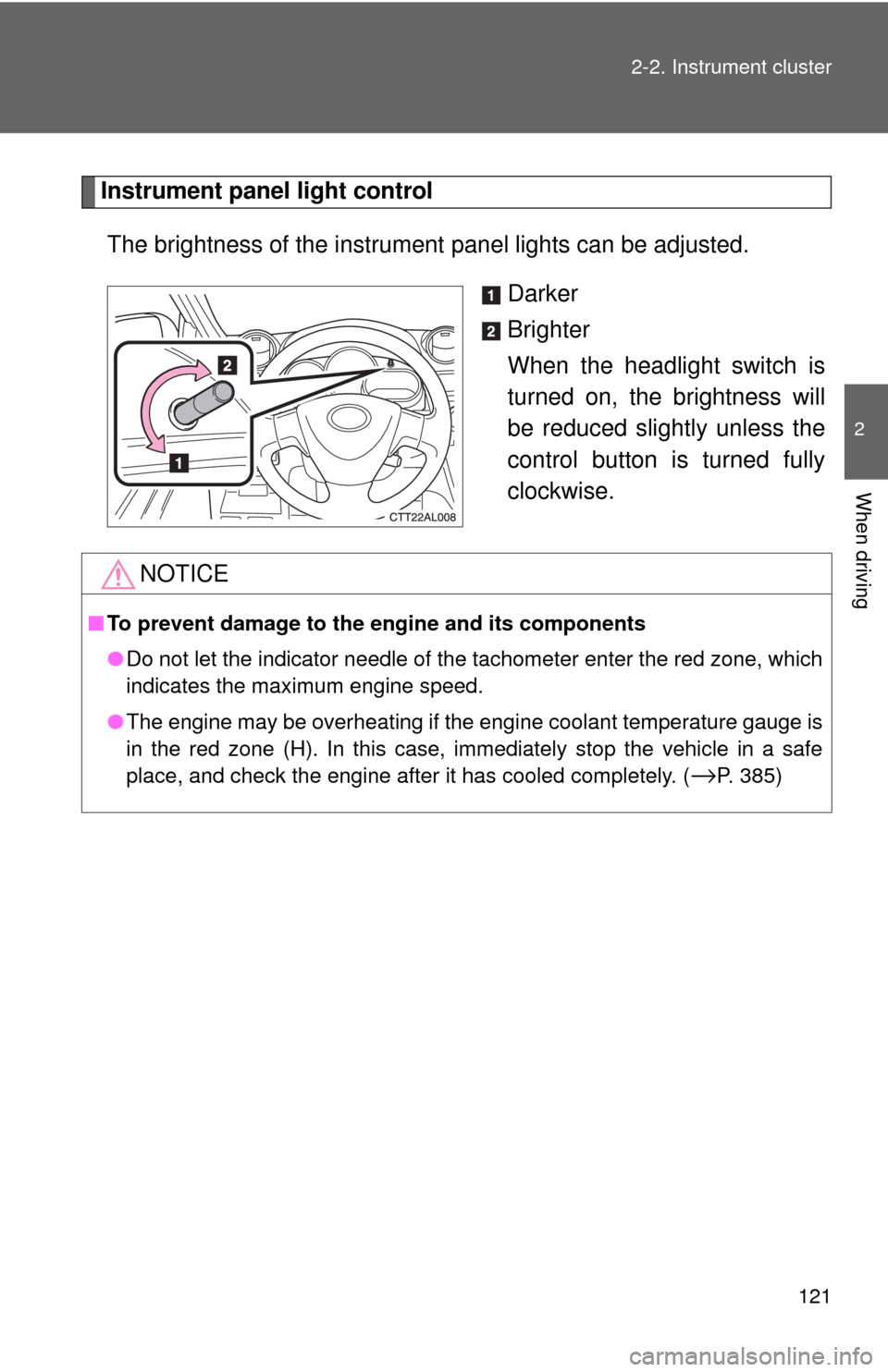
Instrument panel light control
The brightness of the instrument panel lights can be adjusted.
Darker
Brighter
When the headlight switch is
turned on, the brightness will
be reduced slightly unless the
control button is turned fully
clockwise.
NOTICE
■To prevent damage to the engine and its components
●Do not let the indicator needle of the tachometer enter the red zone, which
indicates the maximum engine speed.
●The engine may be overheating if the engine coolant temperature gauge is
in the red zone (H). In this case, immediately stop the vehicle in a safe
place, and check the engine after it has cooled completely. (
→P. 385)
Page 122 of 440
122
2-2. Instrument cluster
Indicators and warning lights
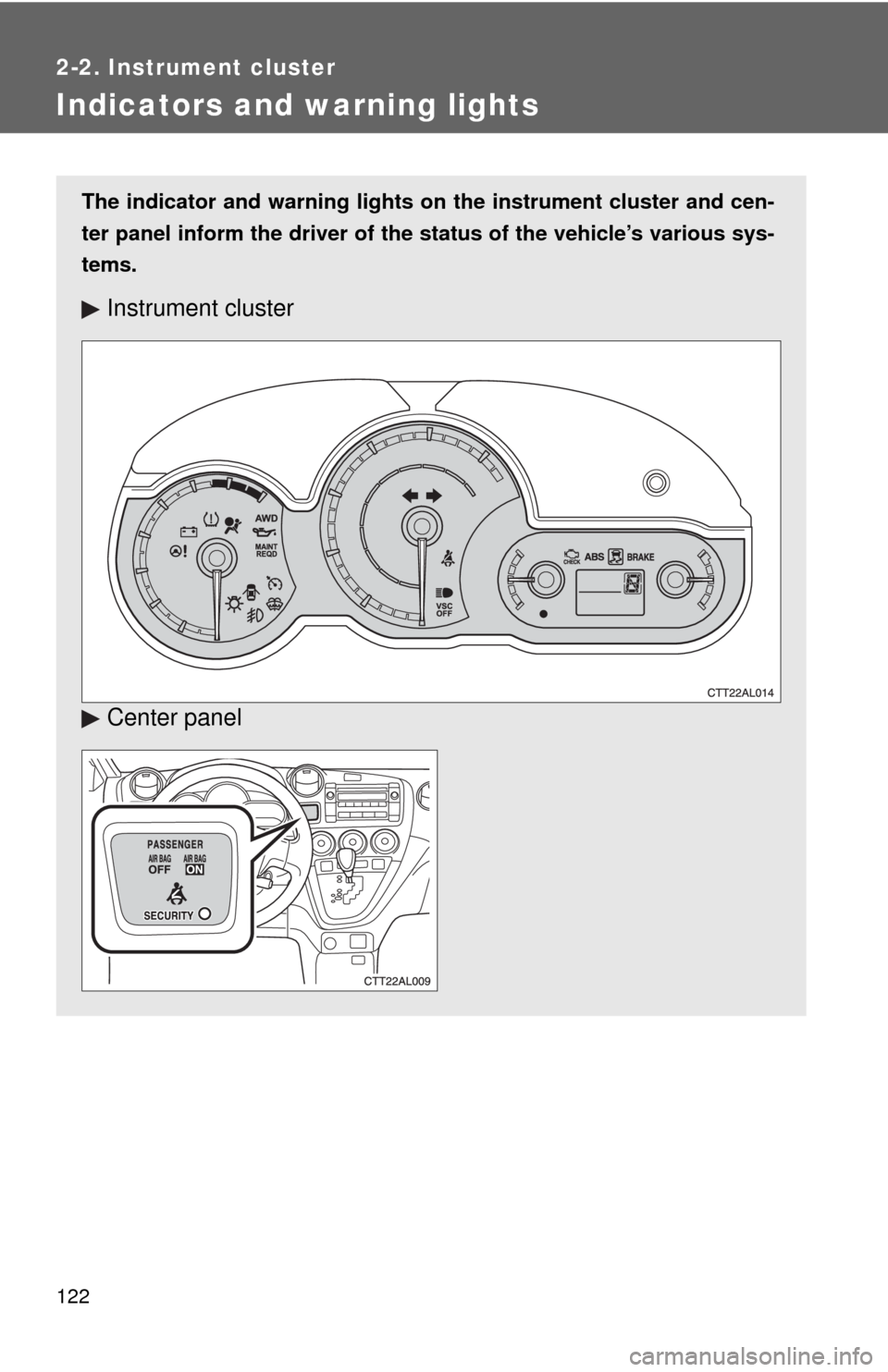
The indicator and warning lights on the instrument cluster and cen-
ter panel inform the driver of the status of the vehicle’s various sys-
tems.
Instrument cluster
Center panel
Page 123 of 440
123 2-2. Instrument cluster
2
When driving
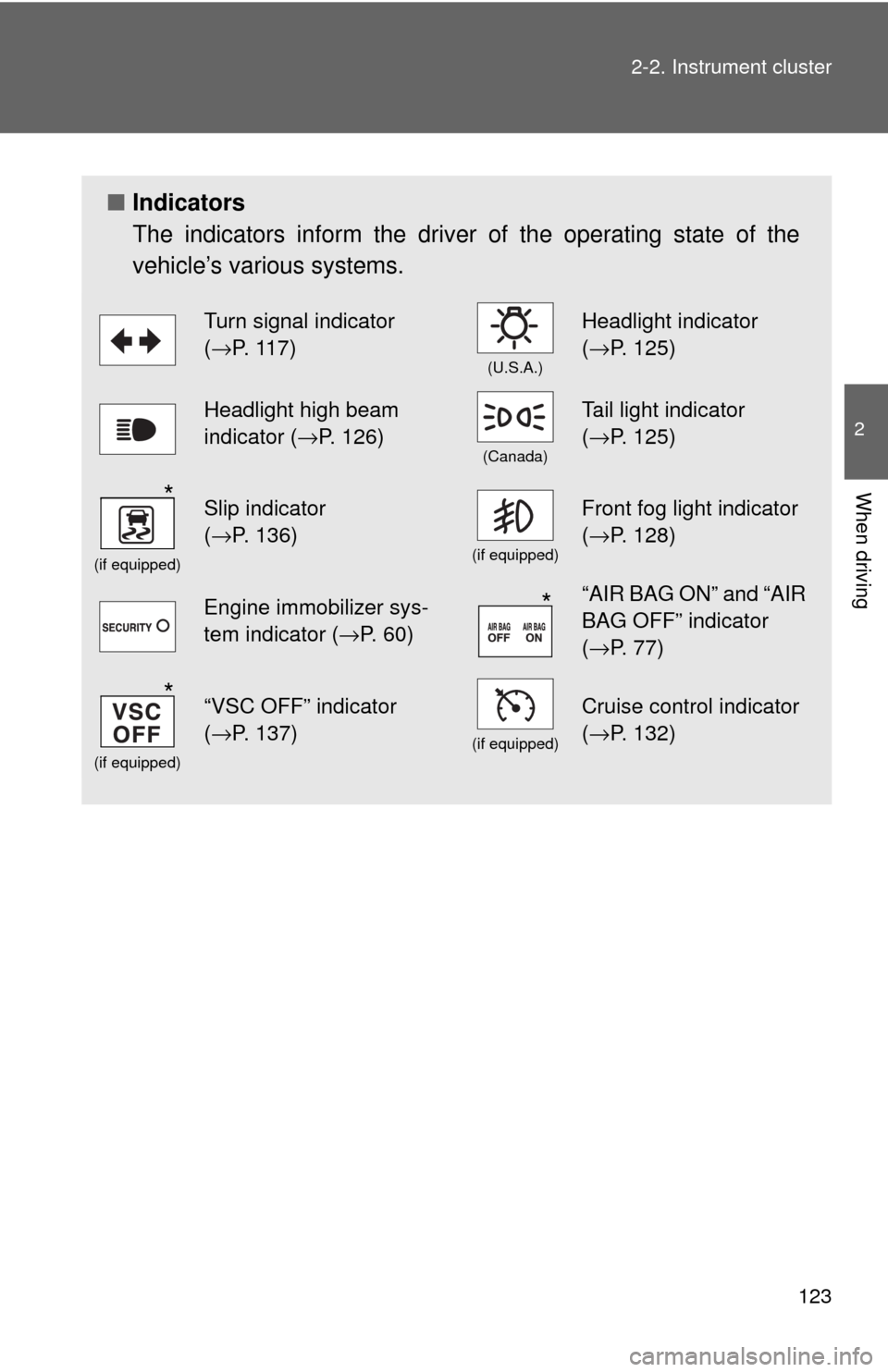
■Indicators
The indicators inform the driver of the operating state of the
vehicle’s various systems.
Turn signal indicator
(→P. 1 1 7 )
(U.S.A.)
Headlight indicator
(→P. 125)
Headlight high beam
indicator (→P. 126)
(Canada)
Tail light indicator
(→P. 125)
(if equipped)
Slip indicator
(→P. 136)
(if equipped)
Front fog light indicator
(→P. 128)
Engine immobilizer sys-
tem indicator (→P. 60)“AIR BAG ON” and “AIR
BAG OFF” indicator
(→P. 77)
(if equipped)
“VSC OFF” indicator
(→P. 137)
(if equipped)
Cruise control indicator
(→P. 132)
*
*
*
Page 124 of 440
124 2-2. Instrument cluster
CAUTION
■If a safety system warning light does not come on
Should a safety system light such as the ABS or the SRS airbag warning
light not come on when you start the engine, this could mean that these sys-
tems are not available to help protect you in an accident, which could result
in death or serious injury. Have the vehicle inspected by your Toyota dealer
immediately if this occurs.
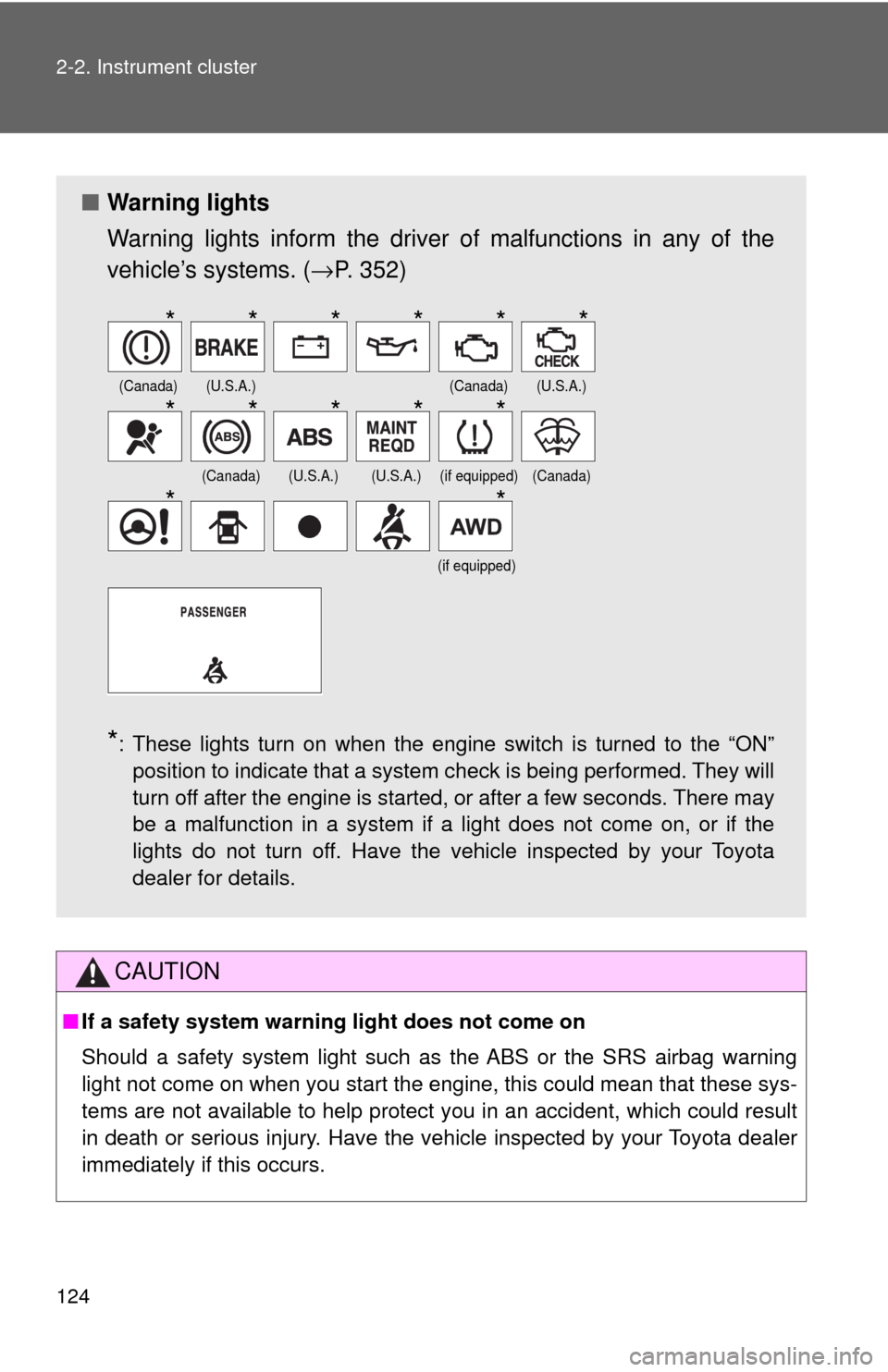
■Warning lights
Warning lights inform the driver of malfunctions in any of the
vehicle’s systems. (→P. 352)
*: These lights turn on when the engine switch is turned to the “ON”
position to indicate that a system check is being performed. They will
turn off after the engine is started, or after a few seconds. There may
be a malfunction in a system if a light does not come on, or if the
lights do not turn off. Have the vehicle inspected by your Toyota
dealer for details.
(Canada)(U.S.A.)(Canada)(U.S.A.)
(Canada)(U.S.A.)(U.S.A.)(if equipped)(Canada)
(if equipped)
******
*****
**
Page 329 of 440
329 4-3. Do-it-yourself maintenance
4
Maintenance and care
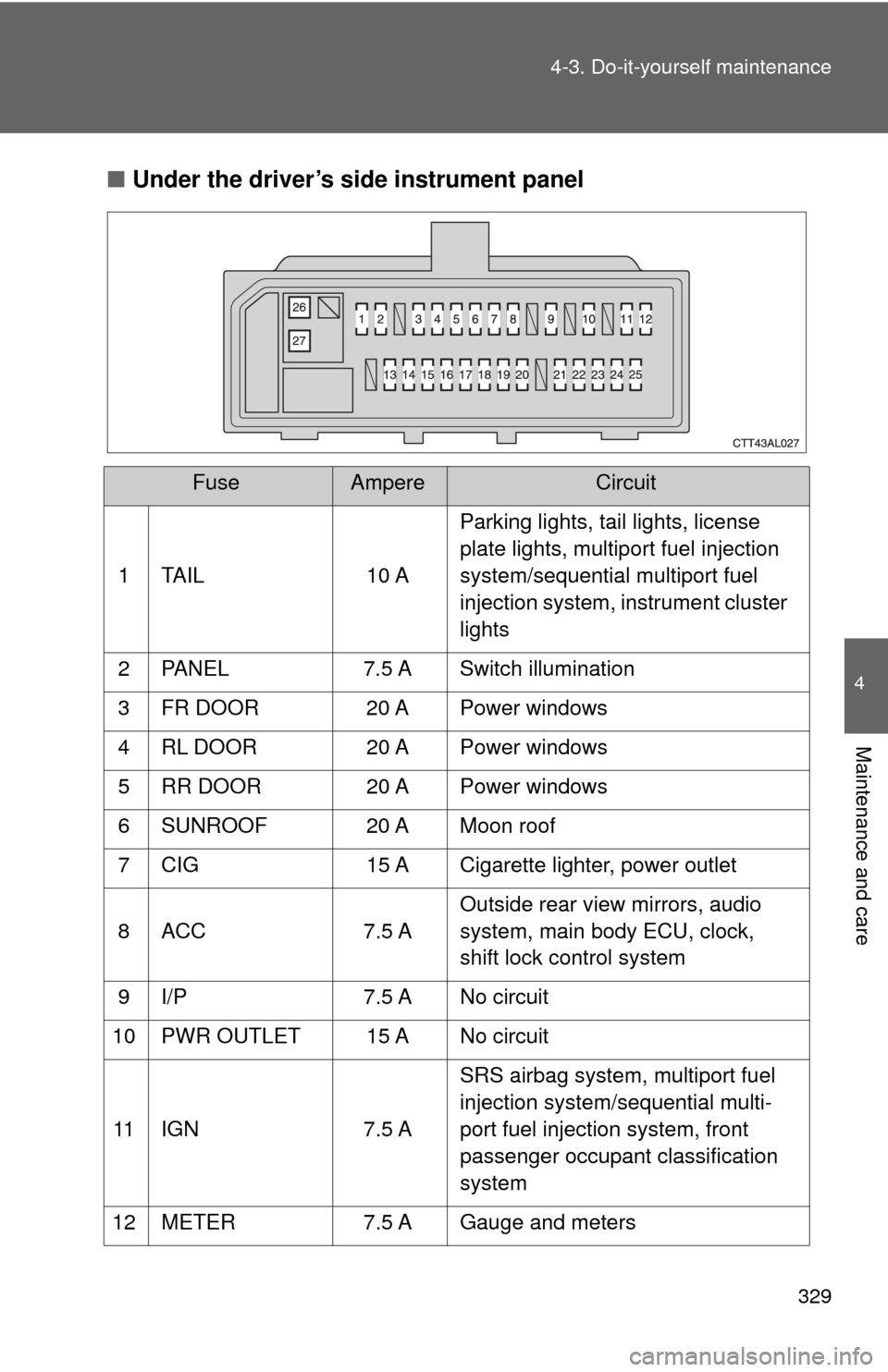
■Under the driver’s side instrument panel
FuseAmpereCircuit
1 TAIL 10 AParking lights, tail lights, license
plate lights, multiport fuel injection
system/sequential multiport fuel
injection system, instrument cluster
lights
2 PANEL 7.5 A Switch illumination
3 FR DOOR 20 A Power windows
4 RL DOOR 20 A Power windows
5 RR DOOR 20 A Power windows
6 SUNROOF 20 A Moon roof
7 CIG 15 A Cigarette lighter, power outlet
8 ACC 7.5 AOutside rear view mirrors, audio
system, main body ECU, clock,
shift lock control system
9 I/P 7.5 A No circuit
10 PWR OUTLET 15 A No circuit
11 I G N 7 . 5 ASRS airbag system, multiport fuel
injection system/sequential multi-
port fuel injection system, front
passenger occupant classification
system
12 METER 7.5 A Gauge and meters
Page 385 of 440
5
When trouble arises
385
5-2. Steps to take in an emergency
If your vehicle overheats
If your engine overheats:
Stop the vehicle in a safe place and turn off the air condi-
tioning system.
Check to see if steam is coming out from under the hood.
If you see steam:
Stop the engine. Wait until the steam subsides, and then
carefully lift the hood.
If you do not see steam:
Leave the engine running and carefully lift the hood.
Check to see if the cooling fans are operating.
If the fans are operating:
Wait until the temperature of the engine (shown on the
instrument cluster) begins to fall and then stop the
engine.
If the fans are not operating:
Stop the engine and call your Toyota dealer.
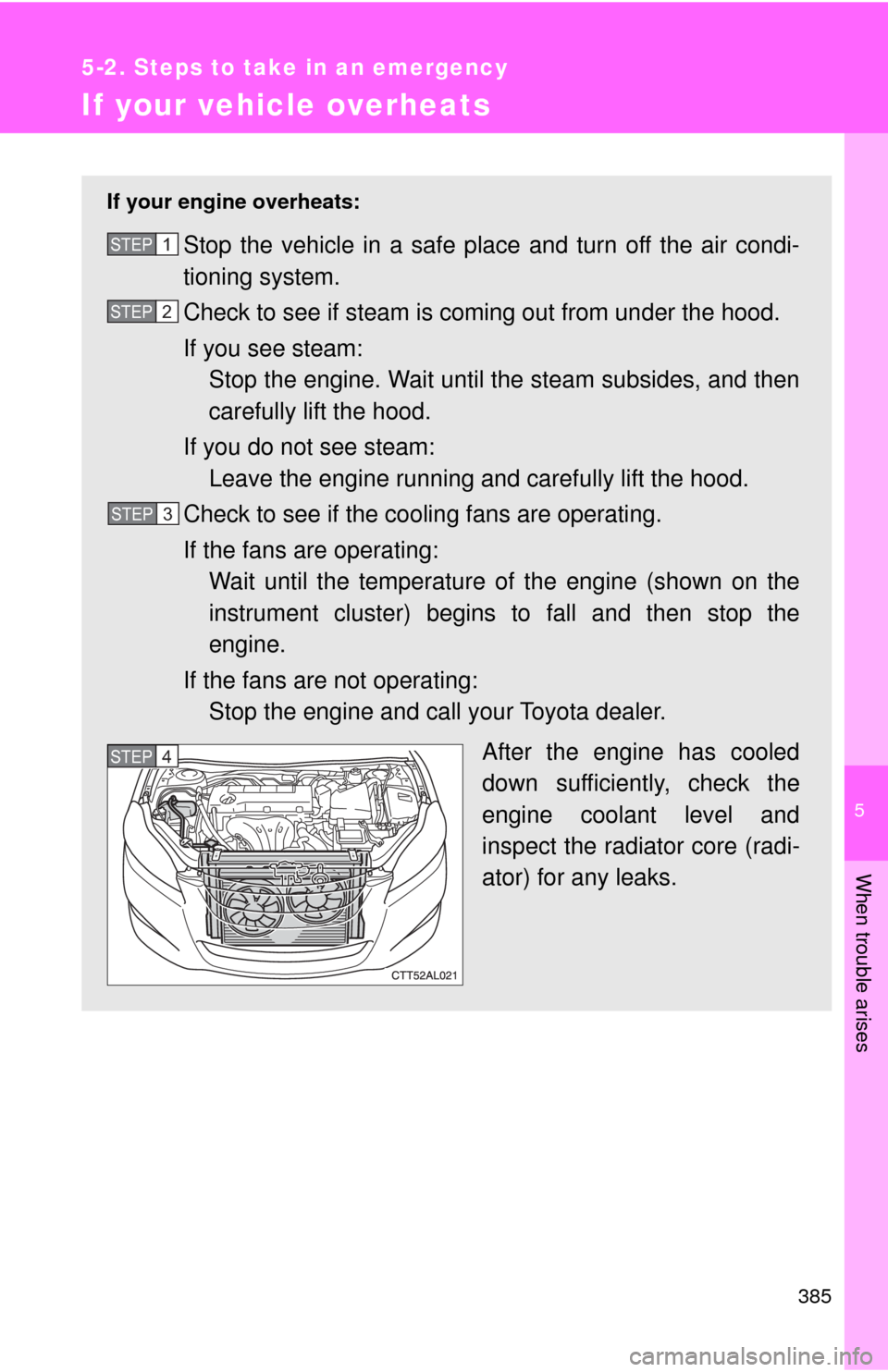
After the engine has cooled
down sufficiently, check the
engine coolant level and
inspect the radiator core (radi-
ator) for any leaks.STEP1
STEP2
STEP3
STEP5STEP4