fuel TOYOTA MATRIX 2010 E140 / 2.G Owner's Manual
[x] Cancel search | Manufacturer: TOYOTA, Model Year: 2010, Model line: MATRIX, Model: TOYOTA MATRIX 2010 E140 / 2.GPages: 448, PDF Size: 9.74 MB
Page 287 of 448
287 4-3. Do-it-yourself maintenance
4
Maintenance and care
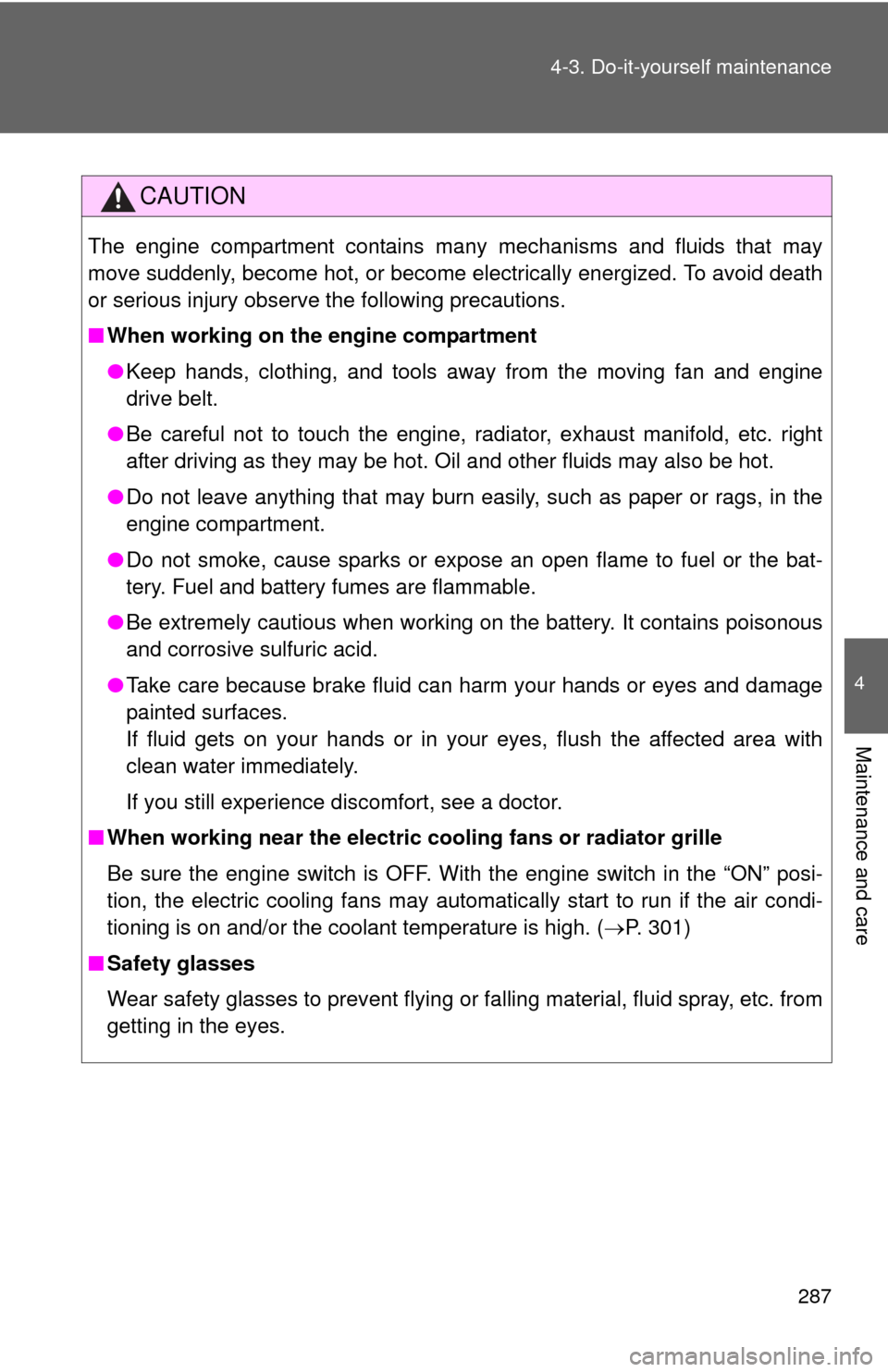
CAUTION
The engine compartment contains many mechanisms and fluids that may
move suddenly, become hot, or become electrically energized. To avoid death
or serious injury observe the following precautions.
■When working on the engine compartment
●Keep hands, clothing, and tools away from the moving fan and engine
drive belt.
●Be careful not to touch the engine, radiator, exhaust manifold, etc. right
after driving as they may be hot. Oil and other fluids may also be hot.
●Do not leave anything that may burn easily, such as paper or rags, in the
engine compartment.
●Do not smoke, cause sparks or expose an open flame to fuel or the bat-
tery. Fuel and battery fumes are flammable.
●Be extremely cautious when working on the battery. It contains poisonous
and corrosive sulfuric acid.
●Take care because brake fluid can harm your hands or eyes and damage
painted surfaces.
If fluid gets on your hands or in your eyes, flush the affected area with
clean water immediately.
If you still experience discomfort, see a doctor.
■When working near the electric cooling fans or radiator grille
Be sure the engine switch is OFF. With the engine switch in the “ON” posi-
tion, the electric cooling fans may automatically start to run if the air condi-
tioning is on and/or the coolant temperature is high. (P. 301)
■Safety glasses
Wear safety glasses to prevent flying or falling material, fluid spray, etc. from
getting in the eyes.
Page 319 of 448
319 4-3. Do-it-yourself maintenance
4
Maintenance and care
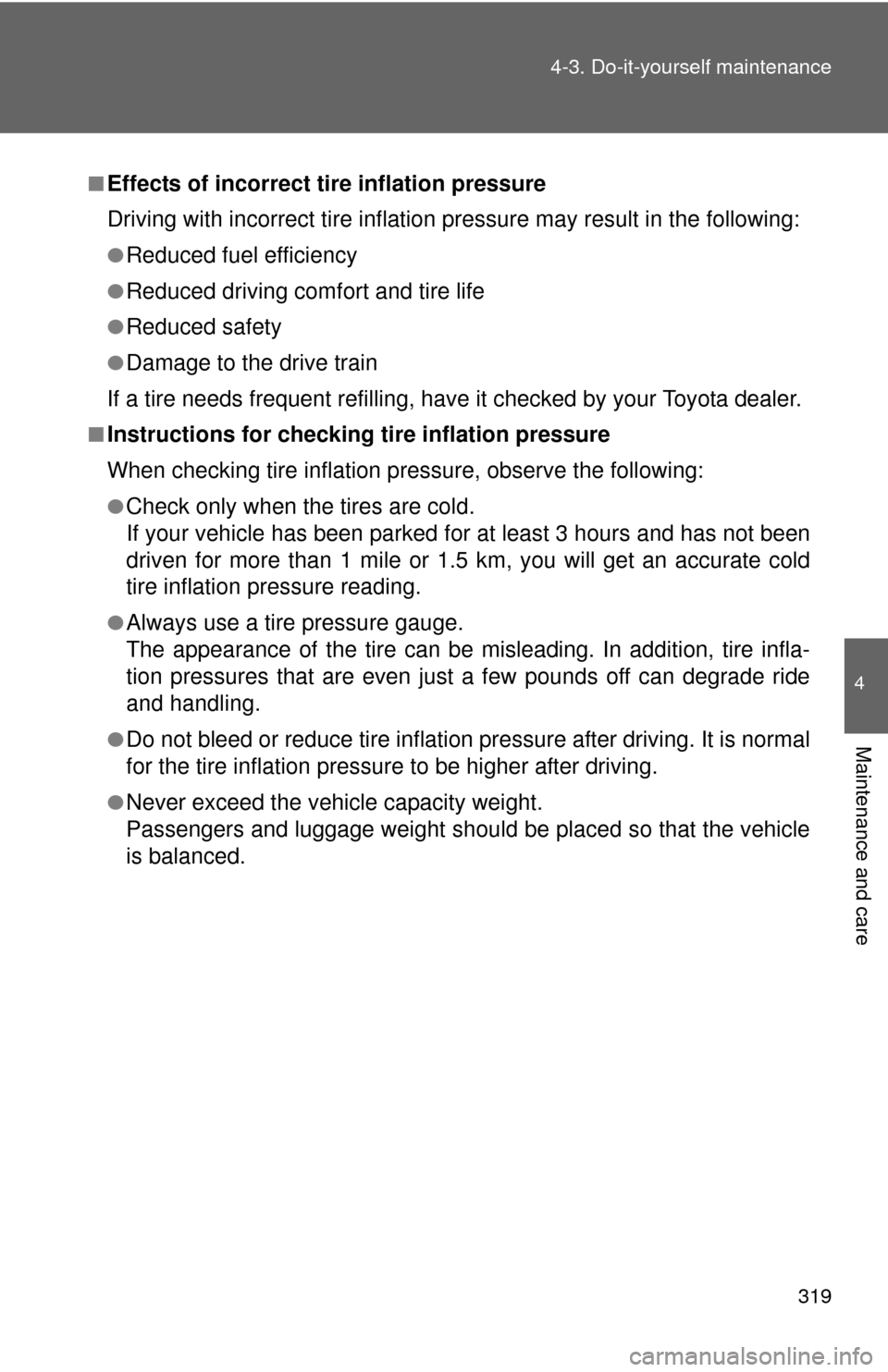
■Effects of incorrect tire inflation pressure
Driving with incorrect tire inflation pressure may result in the following:
●Reduced fuel efficiency
●Reduced driving comfort and tire life
●Reduced safety
●Damage to the drive train
If a tire needs frequent refilling, have it checked by your Toyota dealer.
■Instructions for checking tire inflation pressure
When checking tire inflation pressure, observe the following:
●Check only when the tires are cold.
If your vehicle has been parked for at least 3 hours and has not been
driven for more than 1 mile or 1.5 km, you will get an accurate cold
tire inflation pressure reading.
●Always use a tire pressure gauge.
The appearance of the tire can be misleading. In addition, tire infla-
tion pressures that are even just a few pounds off can degrade ride
and handling.
●Do not bleed or reduce tire inflation pressure after driving. It is normal
for the tire inflation pressure to be higher after driving.
●Never exceed the vehicle capacity weight.
Passengers and luggage weight should be placed so that the vehicle
is balanced.
Page 332 of 448
332 4-3. Do-it-yourself maintenance
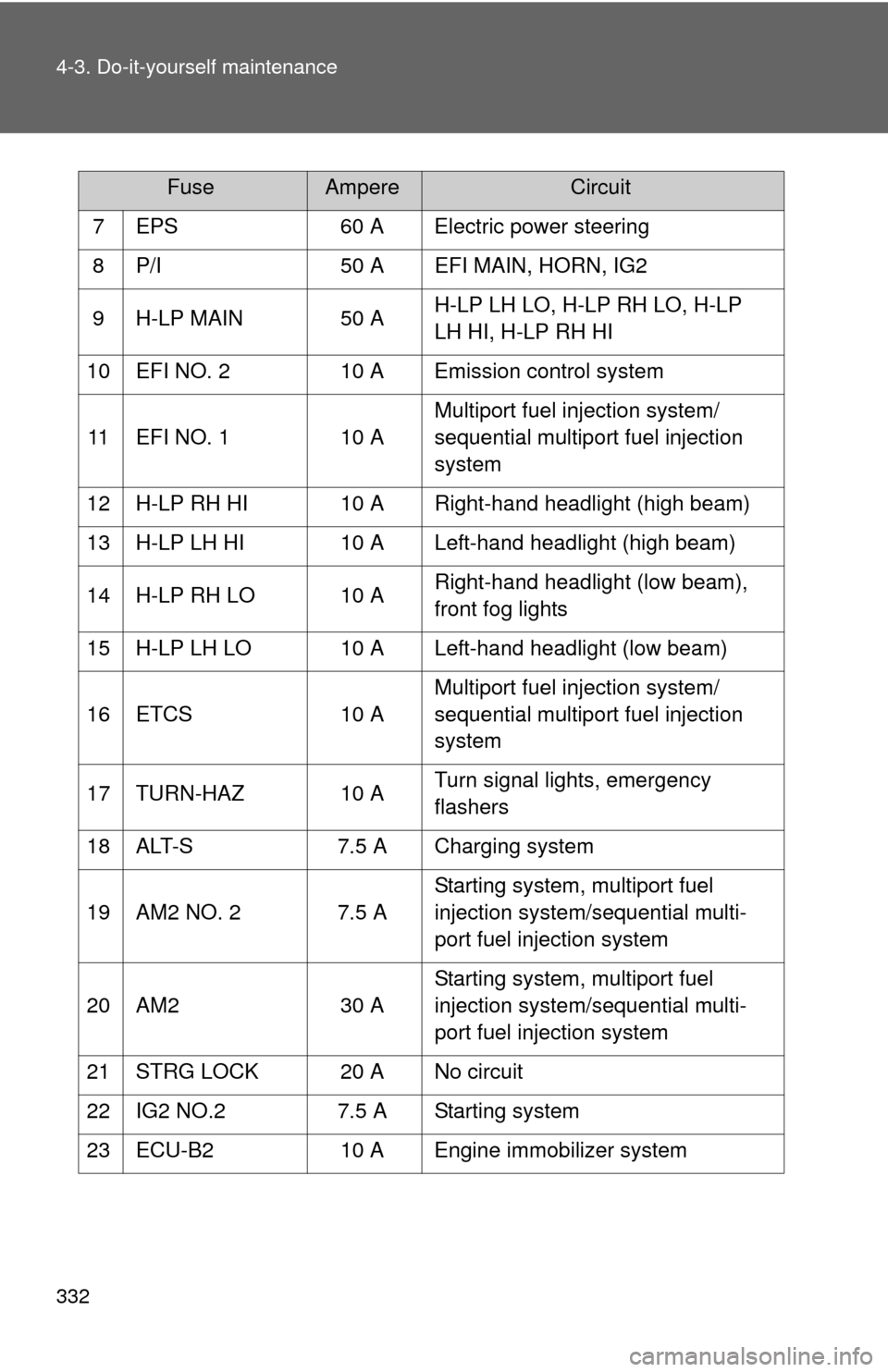
7 EPS 60 A Electric power steering
8 P/I 50 A EFI MAIN, HORN, IG2
9 H-LP MAIN 50 AH-LP LH LO, H-LP RH LO, H-LP
LH HI, H-LP RH HI
10 EFI NO. 2 10 A Emission control system
11 EFI NO. 1 10 AMultiport fuel injection system/
sequential multiport fuel injection
system
12 H-LP RH HI 10 A Right-hand headlight (high beam)
13 H-LP LH HI 10 A Left-hand headlight (high beam)
14 H-LP RH LO 10 ARight-hand headlight (low beam),
front fog lights
15 H-LP LH LO 10 A Left-hand headlight (low beam)
16 ETCS 10 AMultiport fuel injection system/
sequential multiport fuel injection
system
17 TURN-HAZ 10 ATurn signal lights, emergency
flashers
18 ALT-S 7.5 A Charging system
19 AM2 NO. 2 7.5 AStarting system, multiport fuel
injection system/sequential multi-
port fuel injection system
20 AM2 30 AStarting system, multiport fuel
injection system/sequential multi-
port fuel injection system
21 STRG LOCK 20 A No circuit
22 IG2 NO.2 7.5 A Starting system
23 ECU-B2 10 A Engine immobilizer system
FuseAmpereCircuit
Page 333 of 448
333 4-3. Do-it-yourself maintenance
4
Maintenance and care
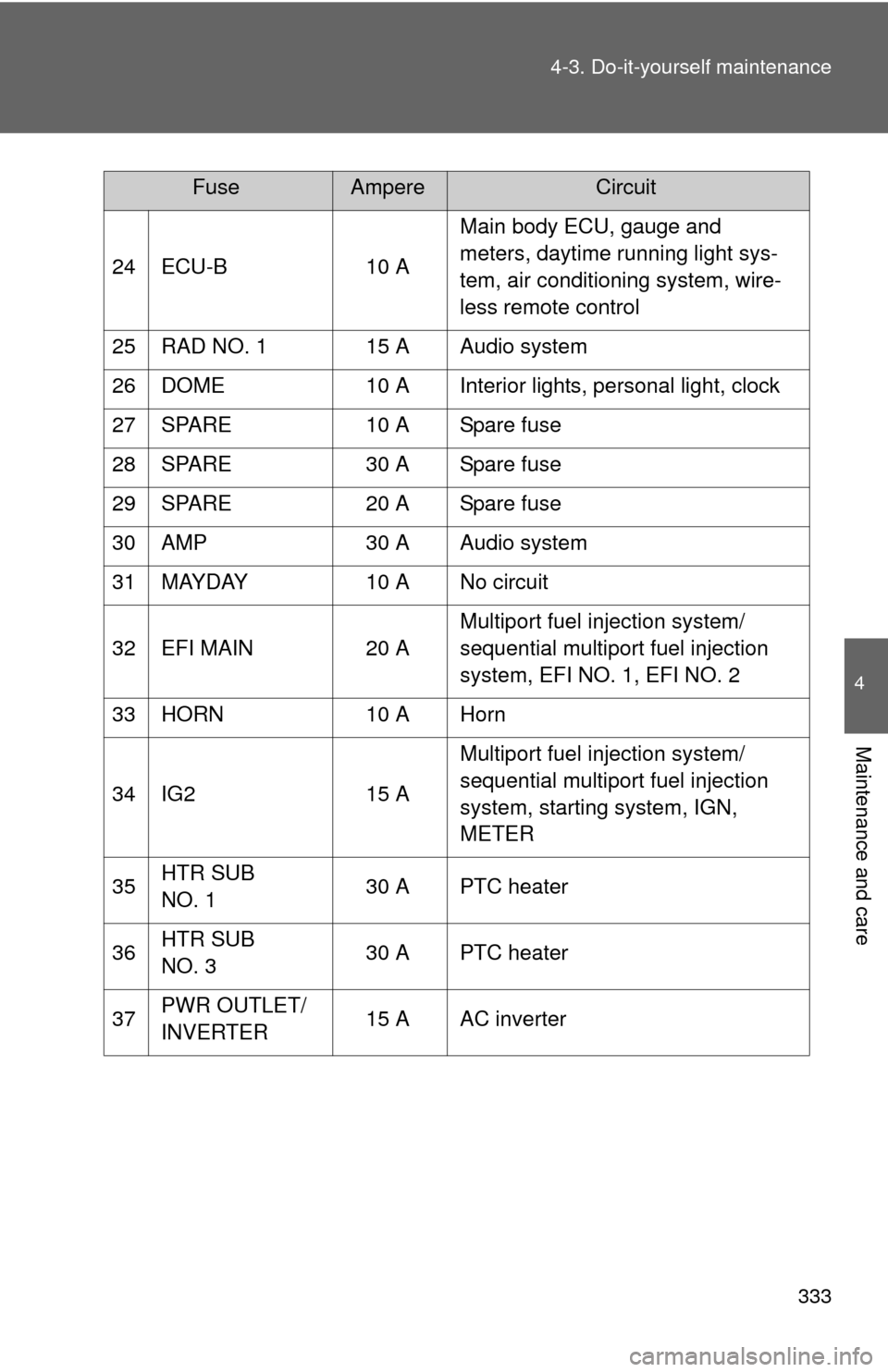
24 ECU-B 10 AMain body ECU, gauge and
meters, daytime running light sys-
tem, air conditioning system, wire-
less remote control
25 RAD NO. 1 15 A Audio system
26 DOME 10 A Interior lights, personal light, clock
27 SPARE 10 A Spare fuse
28 SPARE 30 A Spare fuse
29 SPARE 20 A Spare fuse
30 AMP 30 A Audio system
31 MAYDAY 10 A No circuit
32 EFI MAIN 20 AMultiport fuel injection system/
sequential multiport fuel injection
system, EFI NO. 1, EFI NO. 2
33 HORN 10 A Horn
34 IG2 15 AMultiport fuel injection system/
sequential multiport fuel injection
system, starting system, IGN,
METER
35HTR SUB
NO. 130 A PTC heater
36HTR SUB
NO. 330 A PTC heater
37PWR OUTLET/
INVERTER15 A AC inverter
FuseAmpereCircuit
Page 334 of 448
334 4-3. Do-it-yourself maintenance
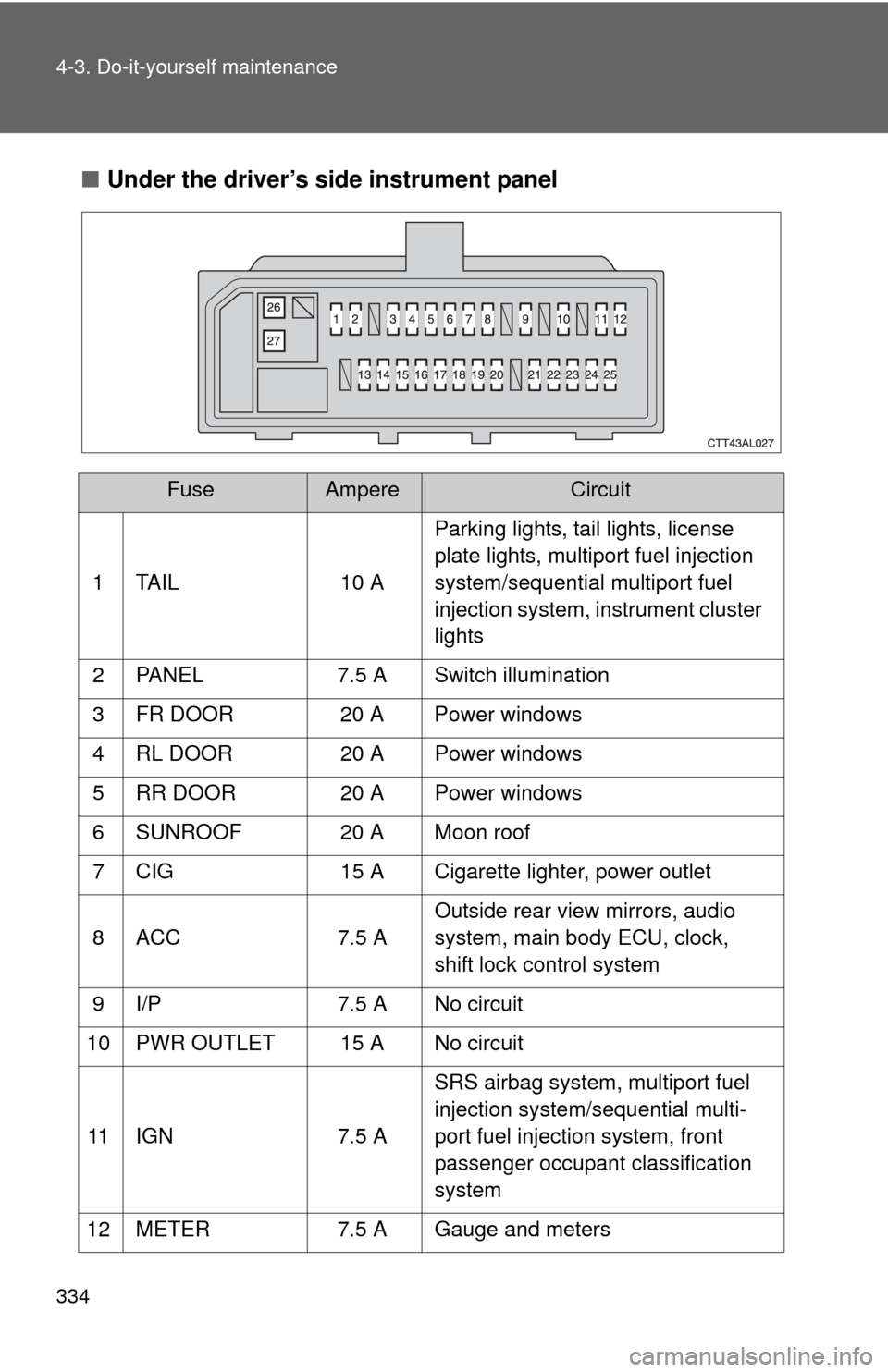
■Under the driver’s side instrument panel
FuseAmpereCircuit
1 TAIL 10 AParking lights, tail lights, license
plate lights, multiport fuel injection
system/sequential multiport fuel
injection system, instrument cluster
lights
2 PANEL 7.5 A Switch illumination
3 FR DOOR 20 A Power windows
4 RL DOOR 20 A Power windows
5 RR DOOR 20 A Power windows
6 SUNROOF 20 A Moon roof
7 CIG 15 A Cigarette lighter, power outlet
8 ACC 7.5 AOutside rear view mirrors, audio
system, main body ECU, clock,
shift lock control system
9 I/P 7.5 A No circuit
10 PWR OUTLET 15 A No circuit
11 IGN 7.5 ASRS airbag system, multiport fuel
injection system/sequential multi-
port fuel injection system, front
passenger occupant classification
system
12 METER 7.5 A Gauge and meters
Page 335 of 448
335 4-3. Do-it-yourself maintenance
4
Maintenance and care
13 HTR-IG 10 AAir conditioning system, rear win-
dow defogger
14 WIPER 25 A Windshield wipers
15 RR WIPER 15 A Rear window wiper
16 WASHER 15 A Windshield washer
17 ECU-IG NO. 1 10 AMain body ECU, electric power
steering, electric cooling fan(s),
shift lock control system, anti-lock
brake system, multiport fuel injec-
tion system/sequential multiport
fuel injection system, tire pressure
warning system, vehicle stability
control system
18 ECU-IG NO. 2 10 ABack-up lights, charging system,
rear window defogger
19 OBD 7.5 A On-board diagnosis system
20 STOP 10 AStop lights, high mounted stop-
light, anti-lock brake system, vehi-
cle stability control system,
multiport fuel injection system/
sequential multiport fuel injection
system, shift lock control system
21 DOOR 25 A Power door lock system
22 ACC-B 25 A CIG, ACC
23 4WD 7.5 A All wheel drive system
24 FR FOG 15 A Front fog lights
25 AM1 7.5 AStarting system, shift lock control
system, ACC, CIG
26 DEF 30 ARear window defogger, MIR HTR,
multiport fuel injection system/
sequential multiport fuel injection
system
27 POWER 30 A Power windows
FuseAmpereCircuit
Page 347 of 448
When trouble arises5
347
5-1. Essential information
Emergency flashers ......... 348
If your vehicle needs to
be towed ........................ 349
If you think something
is wrong ......................... 355
Fuel pump shut off
system ........................... 356
Event data recorder ......... 3575-2. Steps to take in an
emergency
If a warning light turns on
or a warning buzzer
sounds... ....................... 359
If you have a flat tire......... 369
If the engine will not
start ................................ 383
If the shift lever cannot be
shifted from P................. 384
If you lose your keys ........ 385
If the battery is
discharged ..................... 386
If your vehicle
overheats ....................... 391
If the vehicle becomes
stuck .............................. 394
Page 356 of 448
356
5-1. Essential information
Fuel pump shut off system
Follow the procedure below to restart the engine after the system is
activated.
Turn the engine switch to the “ACC” or “LOCK” position.
Restart the engine.
NOTICE
■Before starting the engine
Inspect the ground under the vehicle.
If you find that fuel has leaked on to the ground, the fuel system has been
damaged and is in need of repair. Do not restart the engine. Have the vehi-
cle checked and repaired by your Toyota dealer.
To minimize the risk of fuel leakage when the engine stalls or an air-
bag inflates upon collision, the fuel pump shut off system stops sup-
plying fuel to the engine.
STEP1
STEP2
Page 361 of 448
5
When trouble arises
361 5-2. Steps to take in an emergency
(U.S.A.)
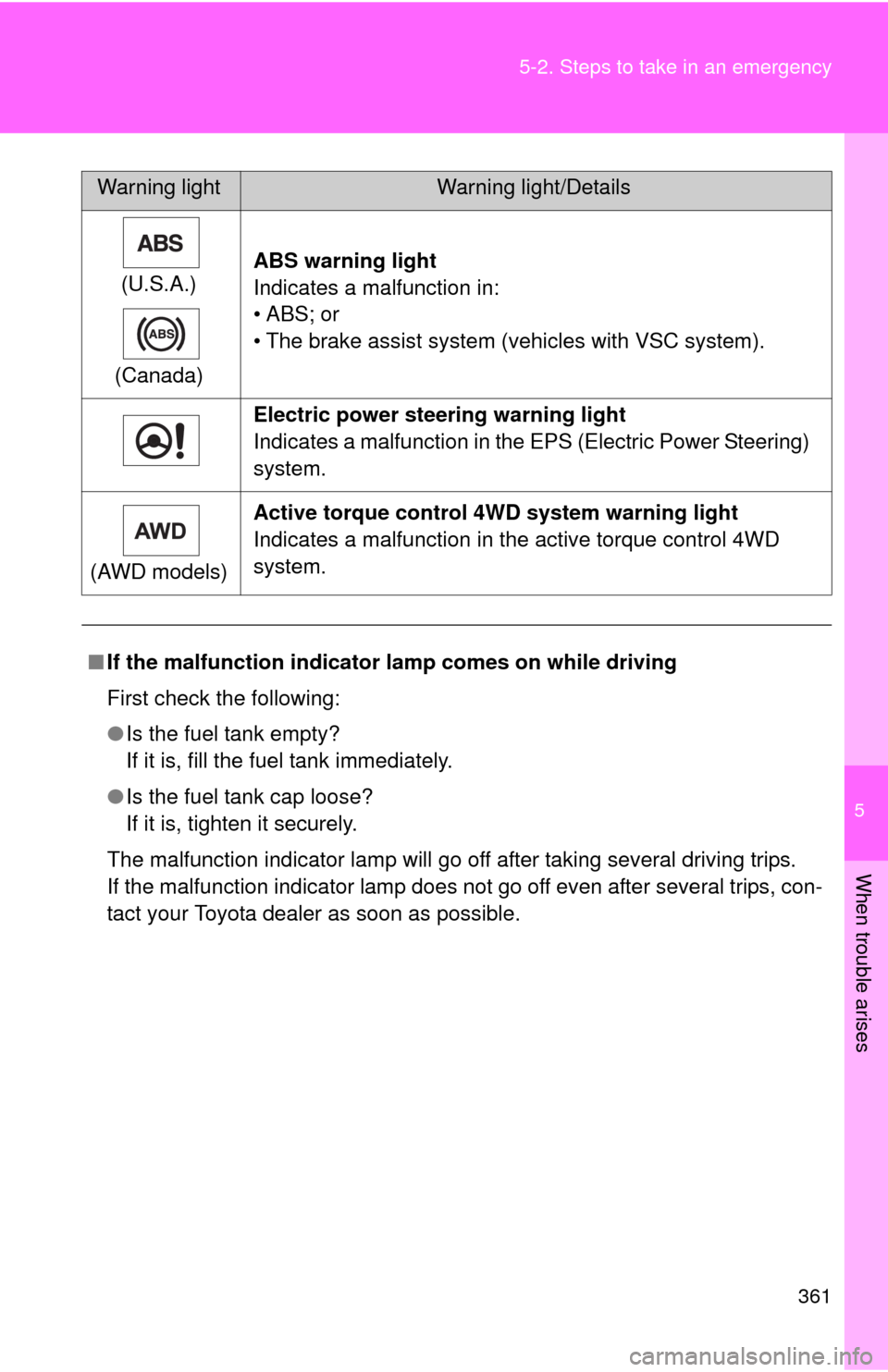
(Canada)ABS warning light
Indicates a malfunction in:
•ABS; or
• The brake assist system (vehicles with VSC system).
Electric power steering warning light
Indicates a malfunction in the EPS (Electric Power Steering)
system.
(AWD models)Active torque control 4WD system warning light
Indicates a malfunction in the active torque control 4WD
system.
■If the malfunction indicator lamp comes on while driving
First check the following:
●Is the fuel tank empty?
If it is, fill the fuel tank immediately.
●Is the fuel tank cap loose?
If it is, tighten it securely.
The malfunction indicator lamp will go off after taking several driving trips.
If the malfunction indicator lamp does not go off even after several trips, con-
tact your Toyota dealer as soon as possible.
Warning lightWarning light/Details
Page 362 of 448
362 5-2. Steps to take in an emergency
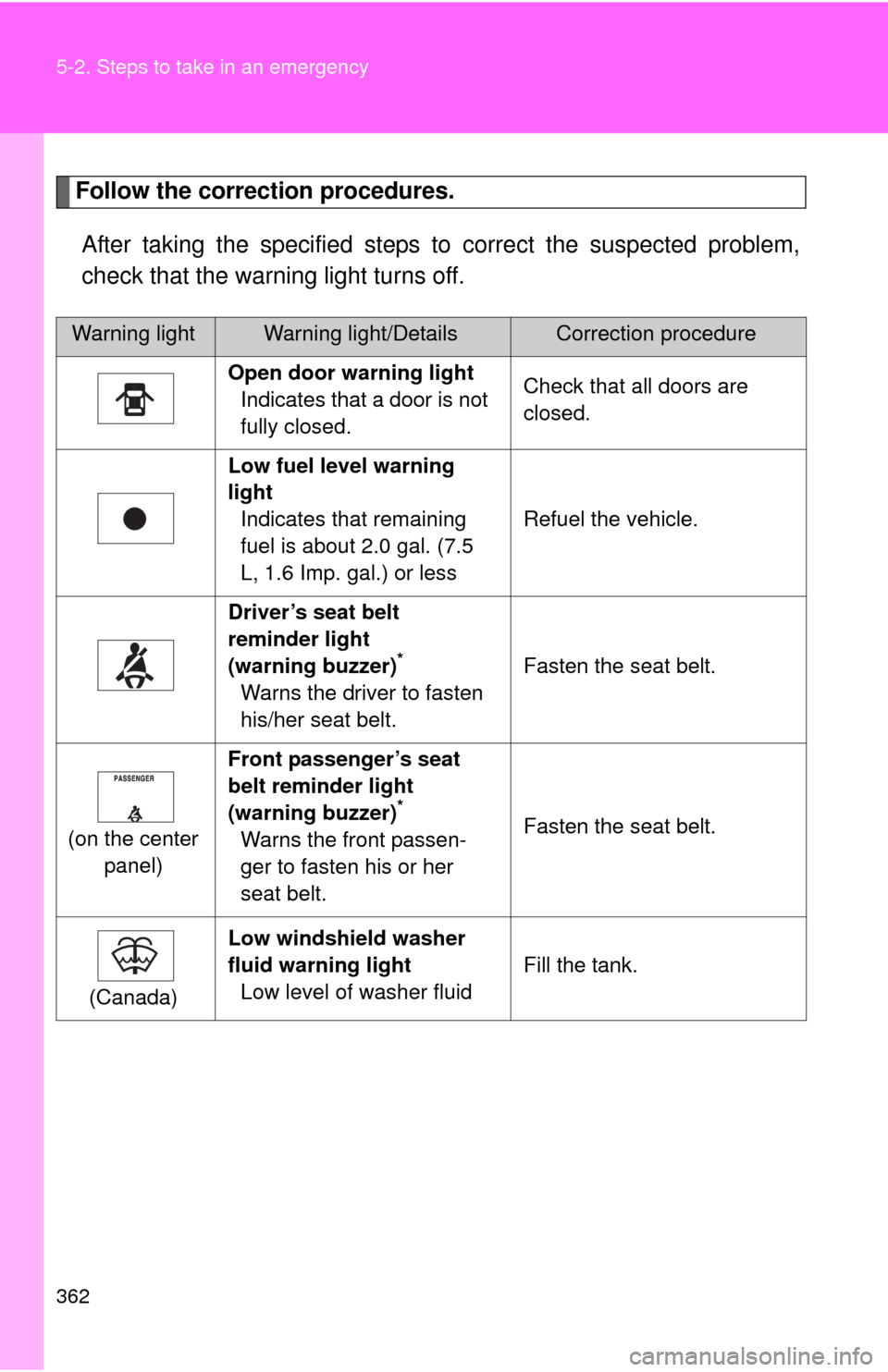
Follow the correction procedures.
After taking the specified steps to correct the suspected problem,
check that the warning light turns off.
Warning lightWarning light/DetailsCorrection procedure
Open door warning light
Indicates that a door is not
fully closed.Check that all doors are
closed.
Low fuel level warning
light
Indicates that remaining
fuel is about 2.0 gal. (7.5
L, 1.6 Imp. gal.) or lessRefuel the vehicle.
Driver’s seat belt
reminder light
(warning buzzer)
*
Warns the driver to fasten
his/her seat belt.Fasten the seat belt.
(on the center
panel)Front passenger’s seat
belt reminder light
(warning buzzer)
*
Warns the front passen-
ger to fasten his or her
seat belt.Fasten the seat belt.
(Canada)Low windshield washer
fluid warning light
Low level of washer fluidFill the tank.