headlights TOYOTA MATRIX 2010 E140 / 2.G Owners Manual
[x] Cancel search | Manufacturer: TOYOTA, Model Year: 2010, Model line: MATRIX, Model: TOYOTA MATRIX 2010 E140 / 2.GPages: 448, PDF Size: 9.74 MB
Page 6 of 448
6
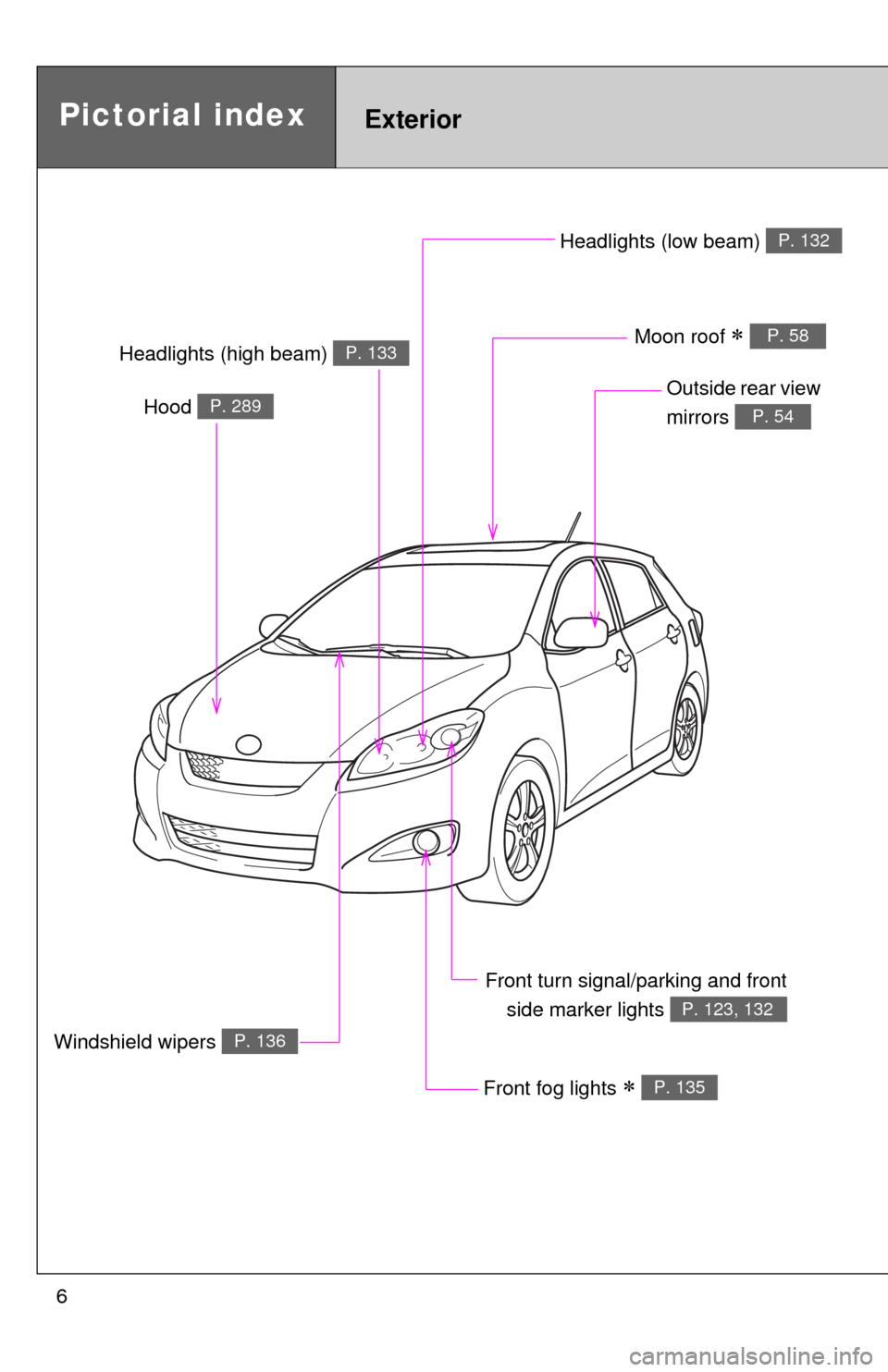
Headlights (low beam) P. 132
Pictorial indexExterior
Front fog lights P. 135
Hood P. 289
Windshield wipers P. 136
Outside rear view
mirrors
P. 54
Front turn signal/parking and front
side marker lights
P. 123, 132
Headlights (high beam) P. 133Moon roof P. 58
Page 52 of 448
52
1-3. Adjustable components (seats, mirrors, steering wheel)
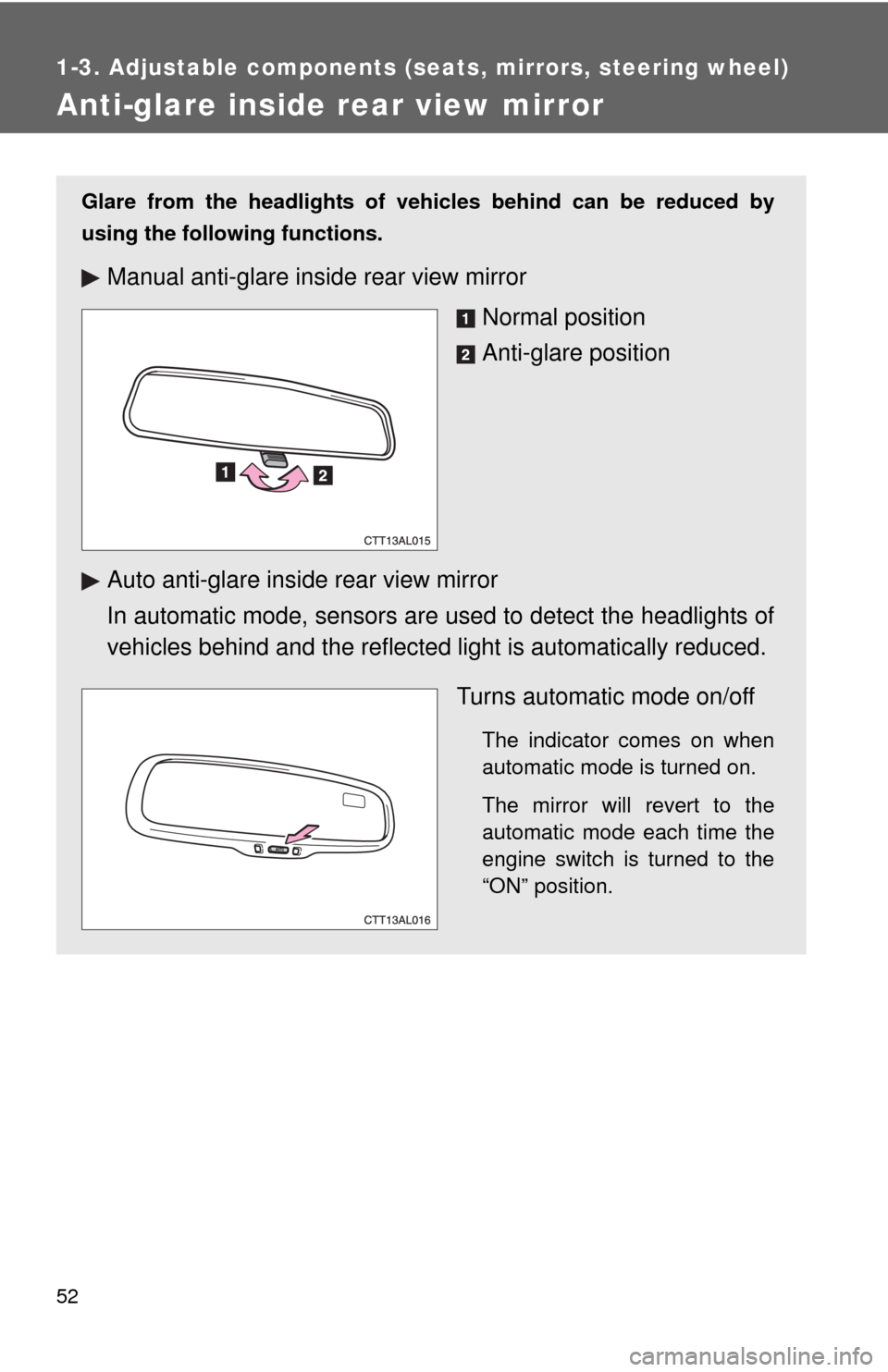
Anti-glare inside rear view mirror
Glare from the headlights of vehicles behind can be reduced by
using the following functions.
Manual anti-glare inside rear view mirror
Normal position
Anti-glare position
Auto anti-glare inside rear view mirror
In automatic mode, sensors are used to detect the headlights of
vehicles behind and the reflected light is automatically reduced.
Turns automatic mode on/off
The indicator comes on when
automatic mode is turned on.
The mirror will revert to the
automatic mode each time the
engine switch is turned to the
“ON” position.
Page 132 of 448
132
2-3. Operating the lights and wipers
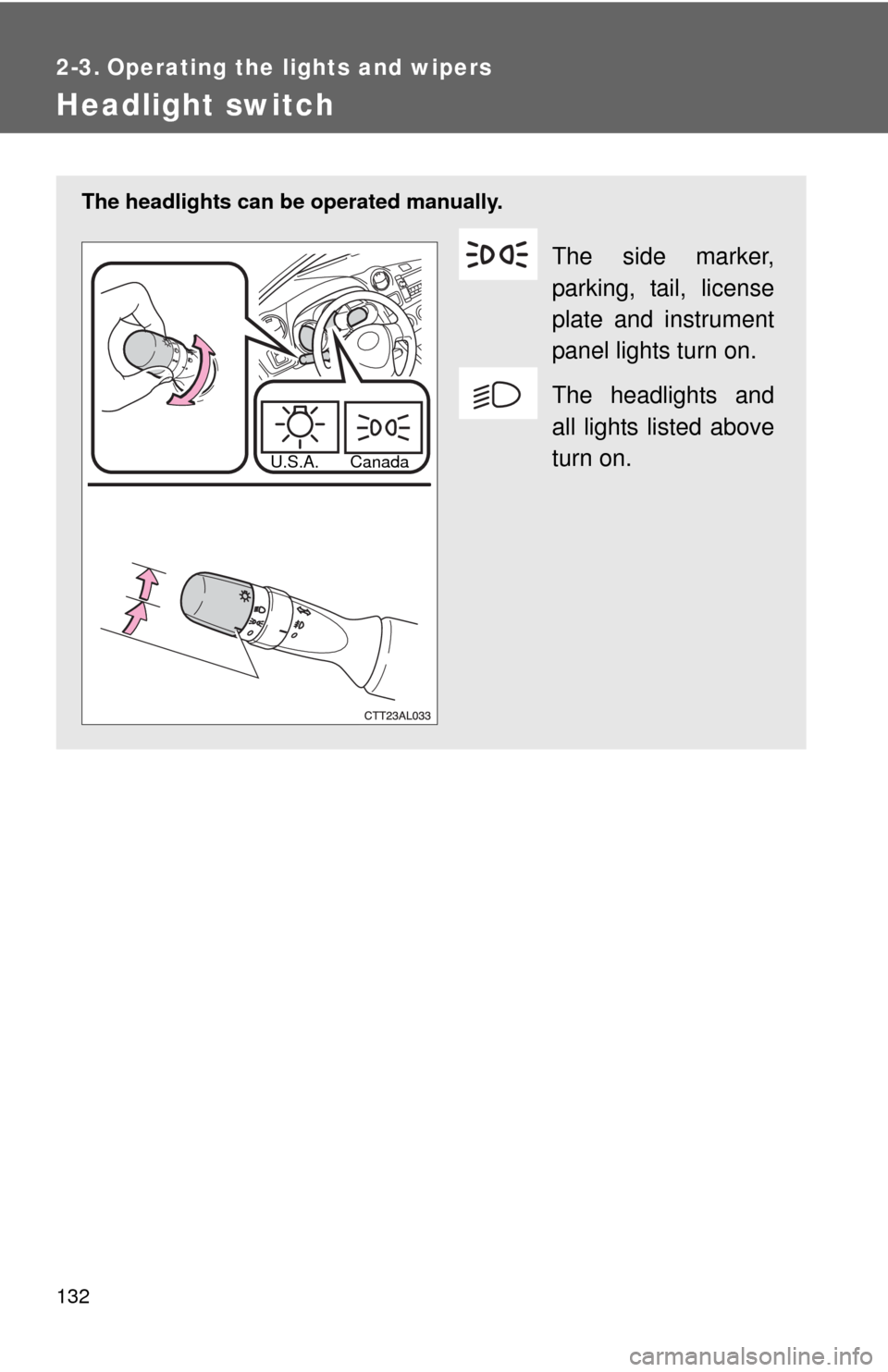
Headlight switch
The headlights can be operated manually.
The side marker,
parking, tail, license
plate and instrument
panel lights turn on.
The headlights and
all lights listed above
turn on.
U.S.A. Canada
Page 133 of 448
133 2-3. Operating the lights and wipers
2
When driving
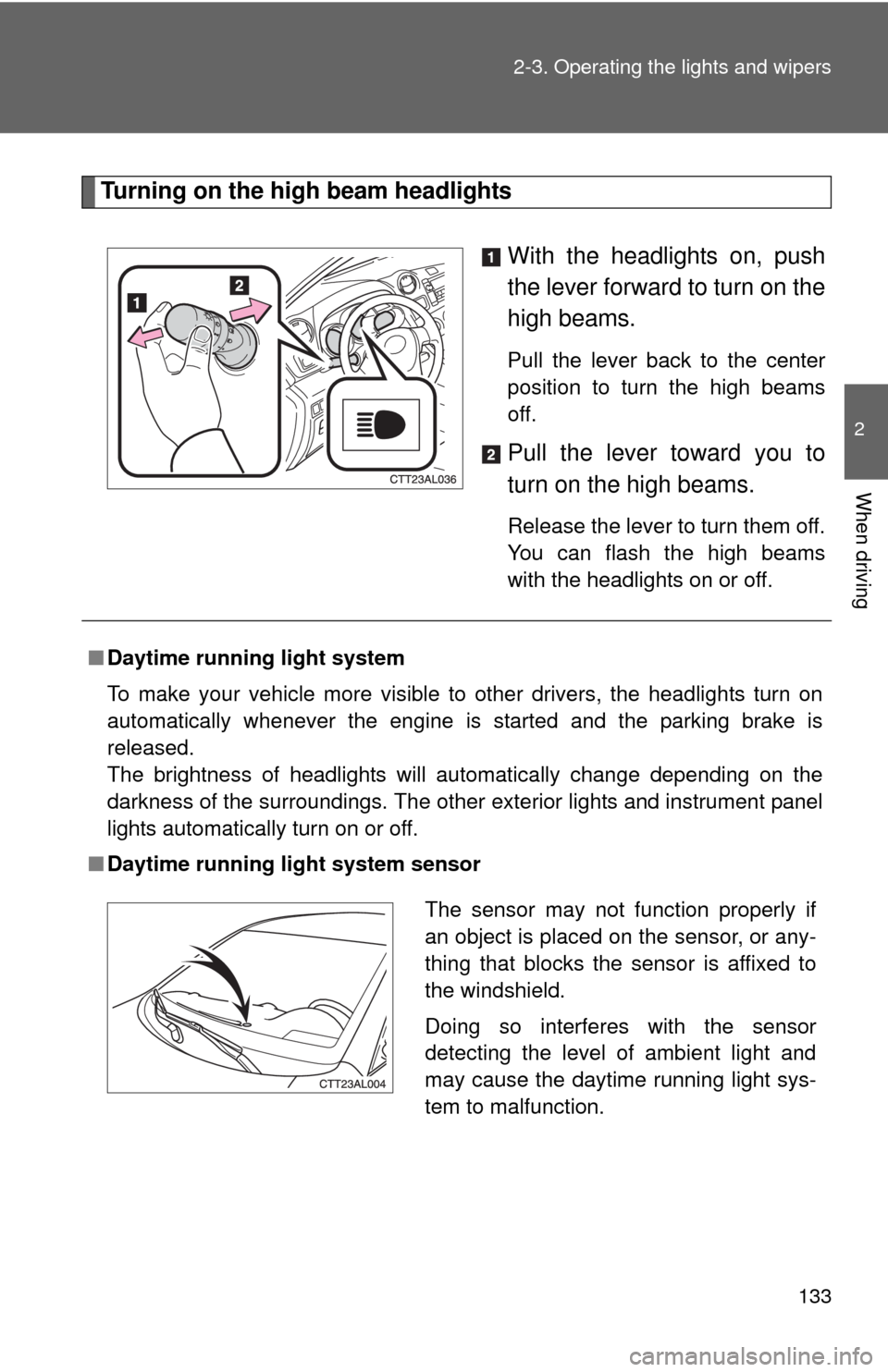
Turning on the high beam headlights
With the headlights on, push
the lever forward to turn on the
high beams.
Pull the lever back to the center
position to turn the high beams
off.
Pull the lever toward you to
turn on the high beams.
Release the lever to turn them off.
You can flash the high beams
with the headlights on or off.
■Daytime running light system
To make your vehicle more visible to other drivers, the headlights turn on
automatically whenever the engine is started and the parking brake is
released.
The brightness of headlights will automatically change depending on the
darkness of the surroundings. The other exterior lights and instrument panel
lights automatically turn on or off.
■Daytime running light system sensor
The sensor may not function properly if
an object is placed on the sensor, or any-
thing that blocks the sensor is affixed to
the windshield.
Doing so interferes with the sensor
detecting the level of ambient light and
may cause the daytime running light sys-
tem to malfunction.
Page 135 of 448
135
2-3. Operating the lights and wipers
2
When driving
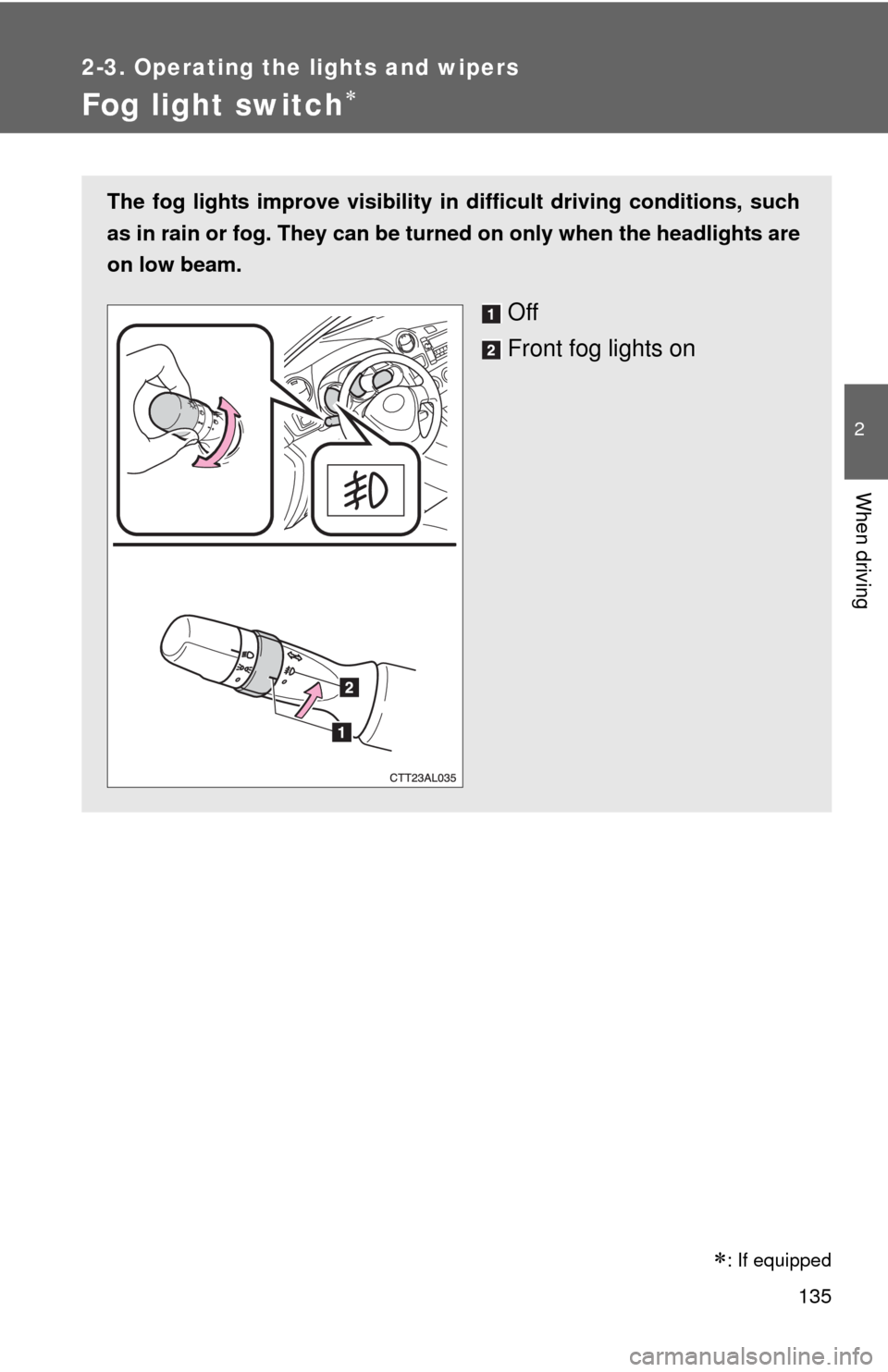
Fog light switch
The fog lights improve visibility in difficult driving conditions, such
as in rain or fog. They can be turned on only when the headlights are
on low beam.
Off
Front fog lights on
: If equipped
Page 345 of 448
345 4-3. Do-it-yourself maintenance
4
Maintenance and care
■Condensation build-up on the inside of the lens
Contact your Toyota dealer for more information in the following situations.
Temporary condensation build-up on the inside of the headlight lens does
not indicate a malfunction.
●Large drops of water are built up on the inside of the lens.
●Water has built up inside the headlight.
CAUTION
■Replacing light bulbs
●Turn off the headlights. Do not attempt to replace the bulb immediately
after turning off the headlights.
The bulbs become very hot and may cause burns.
●Do not touch the glass portion of the light bulb with bare hands. Hold the
bulb by the plastic or metal portion.
If the bulb is scratched or dropped it may blow out or crack.
●Fully install light bulbs and any parts used to secure them. Failing to do so
may result in heat damage, fire, or water entering the headlight unit. This
may damage the headlights or cause condensation to build up on the lens.
■To prevent damage or fire
Make sure bulbs are fully seated and locked.
Page 383 of 448
5
When trouble arises
383
5-2. Steps to take in an emergency
If the engine will not star t
If the engine still does not start after following the correct starting
procedure (P. 112) or releasing the steering lock (P. 114), confirm
the following points.
■The engine will not start even when the starter motor oper-
ates normally.
One of the following may be the cause of the problem.
●There may not be sufficient fuel in the vehicle’s tank.
Refuel the vehicle.
●The engine may be flooded.
Try to restart the engine once more following correct starting
procedures. (P. 1 1 2 )
●There may be a malfunction in the engine immobilizer system.
(P. 6 5 )
■The starter motor turns over slowly, the interior lights and
headlights are dim, or the horn does not sound or sounds at
a low volume.
One of the following may be the cause of the problem.
●The battery may be discharged. (P. 386)
●The battery terminal connections may be loose or corroded.
■The starter motor does not turn over, the interior lights and
headlights do not turn on, or the horn does not sound.
One of the following may be the cause of the problem.
●One or both of the battery terminals may be disconnected.
●The battery may be discharged. (P. 386)
Contact your Toyota dealer if the problem cannot be repaired, or if
repair procedures are unknown.
Page 389 of 448
5
When trouble arises
389 5-2. Steps to take in an emergency
■Avoiding a discharged battery
●Turn off the headlights and the audio system while the engine is turned
off.
●Turn off any unnecessary electrical components when the vehicle is run-
ning at a low speed for an extended period, such as in heavy traffic, etc.
CAUTION
■Avoiding battery fires or explosions
Observe the following precautions to prevent accidentally igniting the flam-
mable gas that may be emitted from the battery.
●Make sure the jumper cable is connected to the correct terminal and that it
is not unintentionally in contact with any part other than the intended termi-
nal.
●Do not allow the jumper cables to come into contact with the “+” and “-” ter-
minals.
●Do not smoke, use matches, cigarette lighters or allow open flame near
the battery.
■Battery precautions
The battery contains poisonous and corrosive acidic electrolyte, while
related parts contain lead and lead compounds. Observe the following pre-
cautions when handling the battery.
●When working with the battery, always wear safety glasses and take care
not to allow any battery fluids (acid) to come into contact with skin, clothing
or the vehicle body.
●Do not lean over the battery.
●In the event that battery fluid comes into contact with the skin or eyes,
immediately wash the affected area with water and seek medical attention.
Place a wet sponge or cloth over the affected area until medical attention
can be received.
●Always wash your hands after handling the battery support, terminals, and
other battery-related parts.
●Do not allow children near the battery.
Page 411 of 448
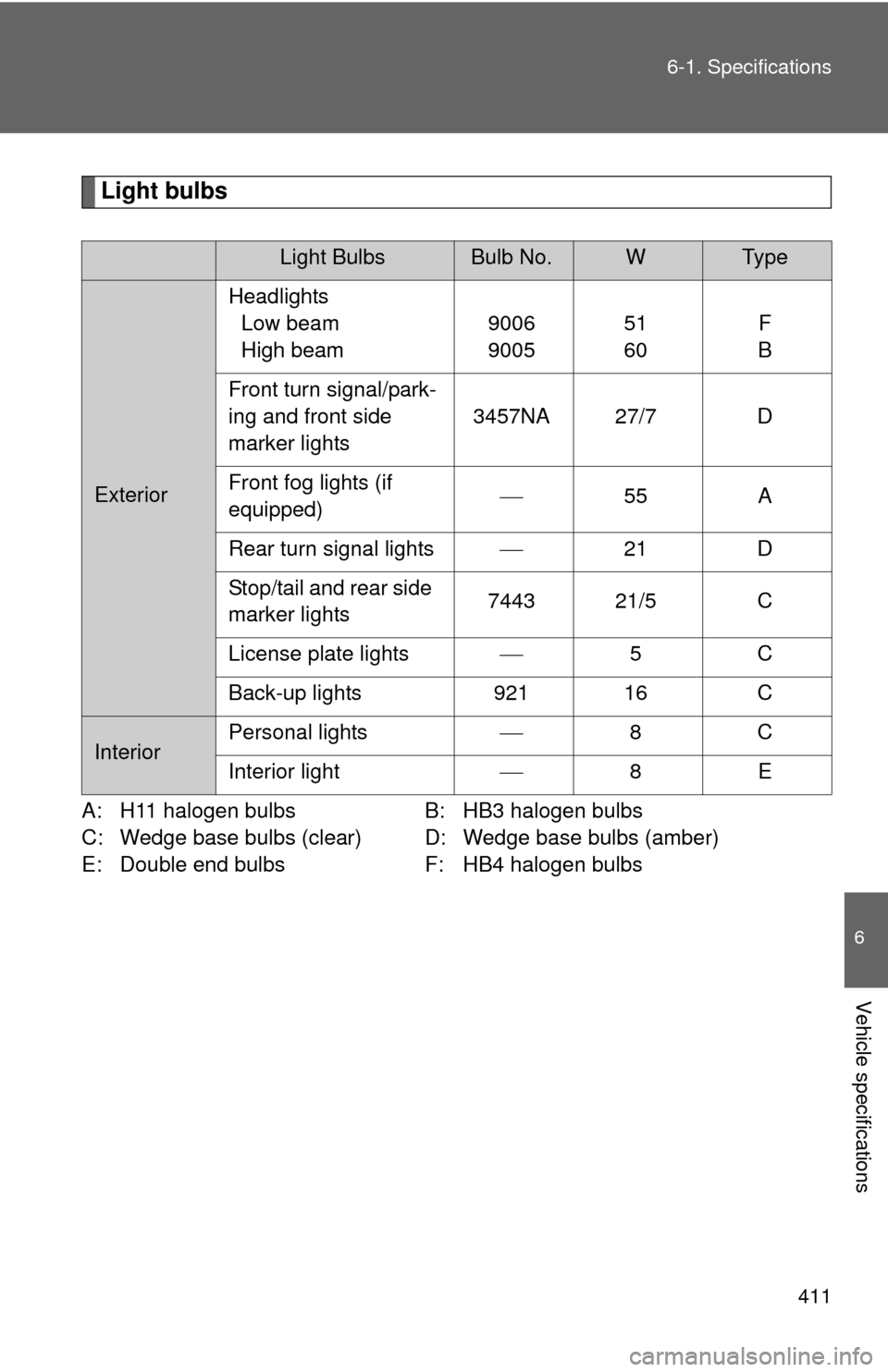
411 6-1. Specifications
6
Vehicle specifications
Light bulbs
A: H11 halogen bulbs B: HB3 halogen bulbs
C: Wedge base bulbs (clear) D: Wedge base bulbs (amber)
E: Double end bulbs F: HB4 halogen bulbs
Light BulbsBulb No.WTy p e
ExteriorHeadlights
Low beam
High beam9006
900551
60F
B
Front turn signal/park-
ing and front side
marker lights3457NA 27/7 D
Front fog lights (if
equipped)55 A
Rear turn signal lights21 D
Stop/tail and rear side
marker lights 7443 21/5 C
License plate lights5C
Back-up lights 921 16 C
InteriorPersonal lights8C
Interior light8E
Page 440 of 448

440 Alphabetical index
Floor mat................................... 260
Fluid
Brake ..................................... 302
Washer .................................. 306
Fog lights
Replacing light bulbs ............. 337
Switch.................................... 135
Wattage ................................. 411
Front passenger occupant
classification system ..............82
Front passenger's seat belt
reminder light......................... 362
Front seats
Adjustment ..............................37
Front side marker lights
Replacing light bulbs ............. 337
Switch.................................... 132
Wattage ................................. 411
Front turn signal lights
Replacing light bulbs ............. 337
Switch.................................... 123
Wattage ................................. 411
Fuel
Capacity ................................ 400
Fuel gauge ............................ 126
Fuel pump shut off system .... 356
Gas station information ......... 448
Information ............................ 412
Refueling .................................61
Type ...................................... 400
Fuel door.....................................61
Fuel filler door ............................61
Fuel pump shut off system ..... 356
Fuses......................................... 328Gas station information .......... 448
Gauges...................................... 126
Glove box ................................. 243
Grocery bag hooks .................. 257
Hands-free phone system
(for cellular phone) ................ 206
Hazard lights
Switch ................................... 348
Head restraints
Adjusting ................................ 43
Headlights
Replacing light bulbs ............. 337
Switch ................................... 132
Wattage................................. 411
Heaters
Side mirror ............................ 174
Hood.......................................... 289
Hooks
Cargo hooks.......................... 261
Grocery bag hooks................ 257
Horn .......................................... 125FG
H