air condition TOYOTA MATRIX 2011 E140 / 2.G Owner's Manual
[x] Cancel search | Manufacturer: TOYOTA, Model Year: 2011, Model line: MATRIX, Model: TOYOTA MATRIX 2011 E140 / 2.GPages: 501, PDF Size: 11.47 MB
Page 238 of 501
238 3-3. Using the Bluetooth
® audio system
■When using a voice command
For numbers, say a combination of single digits from zero to nine.
Say the command correctly and clearly.
■Situations where the system may not recognize your voice
●When driving on rough roads
●When driving at high speeds
●When air is blowing out of the vents onto the microphone
●When the air conditioning fan emits a loud noise
■Operations that cannot be performed while driving
●Operating the system with
●Registering a portable player to the system
■Changing the passkey
P. 244
Page 261 of 501
261 3-4. Using the hands-free phone system (for cellular phone)
3
Interior features
■Automatic adjustment of volume
When vehicle speed reaches 50 mph (80 km/h) or more, the volume auto-
matically increases. The volume returns to the previous volume setting when
vehicle speed drops to 43 mph (70 km/h) or less.
■When using a voice command
For numbers, say a combination of single digits from zero to nine, # (pound),
(star), and + (plus).
Say a command correctly and clearly.
■Situations that the system may not recognize your voice
●When driving on a rough road
●When driving at high speeds
●When air is blowing out of the vents onto the microphone
●When the air conditioning fan emits a loud noise
■Operations that cannot be performed while driving
●Operating the system with
●Registering a cellular phone to the system
■Changing the passkey
P. 269
Page 315 of 501
Maintenance and care4
315
4-1. Maintenance and care
Cleaning and protecting
the vehicle exterior......... 316
Cleaning and protecting
the vehicle interior.......... 319
4-2. Maintenance
Maintenance
requirements .................. 322
General maintenance....... 324
Emission inspection and
maintenance (I/M)
programs........................ 3274-3. Do-it-yourself maintenance
Do-it-yourself service
precautions .................... 328
Hood ................................ 332
Positioning a floor jack ..... 334
Engine compartment ........ 337
Tires ................................. 351
Tire inflation pressure ...... 360
Wheels ............................. 364
Air conditioning filter......... 366
Key battery ....................... 368
Checking and replacing
fuses .............................. 371
Light bulbs........................ 380
Page 360 of 501

359 4-3. Do-it-yourself maintenance
4
Maintenance and care
NOTICE
■Repairing or replacing tires, wheels, tire pressure warning valves,
transmitters and tire valve caps
●When removing or fitting the wheels, tires or the tire pressure warning
valves and transmitters, contact your Toyota dealer as the tire pressure
warning valves and transmitters may be damaged if not handled correctly.
●When replacing tire valve caps, do not use tire valve caps other than those
specified. The cap may become stuck.
■
To avoid damage to the tire pressure warning valves and transmit-
ters
When a tire is repaired with liquid sealants, the tire pressure warning
valve and transmitter may not operate properly. If a liquid sealant is
used, contact your Toyota dealer or other qualified service shop as soon
as possible. Make sure to replace the tire pressure warning valve and
transmitter when replacing the tire. (P. 352)
■Driving on rough roads
Take particular care when driving on roads with loose surfaces or pot-
holes.
These conditions may cause losses in tire air pressure, reducing the
cushioning ability of the tires. In addition, driving on rough roads may
cause damage to the tires themselves, as well as the vehicle’s wheels
and body.
■Low profile tires and wheels
Wheels with profile tires like 17- and 18-inch tires may cause greater
damage than usual to the tire wheel when receiving impact from the road
surface. Therefore pay attention to the following:
●Be sure to use proper tire inflation pressure. If tires are under-inflated,
they may be damaged more severely.
●Avoid pot holes, uneven pavement, curbs and other road hazards.
Failure to do so can lead to severe tire and wheel damage.
■If tire inflation pressures become low while driving
Do not continue driving, or your tires and/or wheels may be ruined.
Page 364 of 501
363 4-3. Do-it-yourself maintenance
4
Maintenance and care
CAUTION
■Proper inflation is critical to save tire performance
Keep your tires properly inflated. Otherwise, the following conditions
may occur and result in an accident causing death or serious injury.
●Excessive wear
●Uneven wear
●Poor handling
●Possibility of blowouts resulting from overheated tires
●Poor sealing of the tire bead
●Wheel deformation and/or tire separation
●A greater possibility of tire damage from road hazards
NOTICE
■When inspecting and adjusting tire inflation pressure
Be sure to reinstall the tire valve caps.
Without the valve caps, dirt or moisture could get into the valve and
cause air leakage, which could result in an accident. If the caps have
been lost, replace them as soon as possible.
Page 367 of 501
366
4-3. Do-it-yourself maintenance
Air conditioning filter
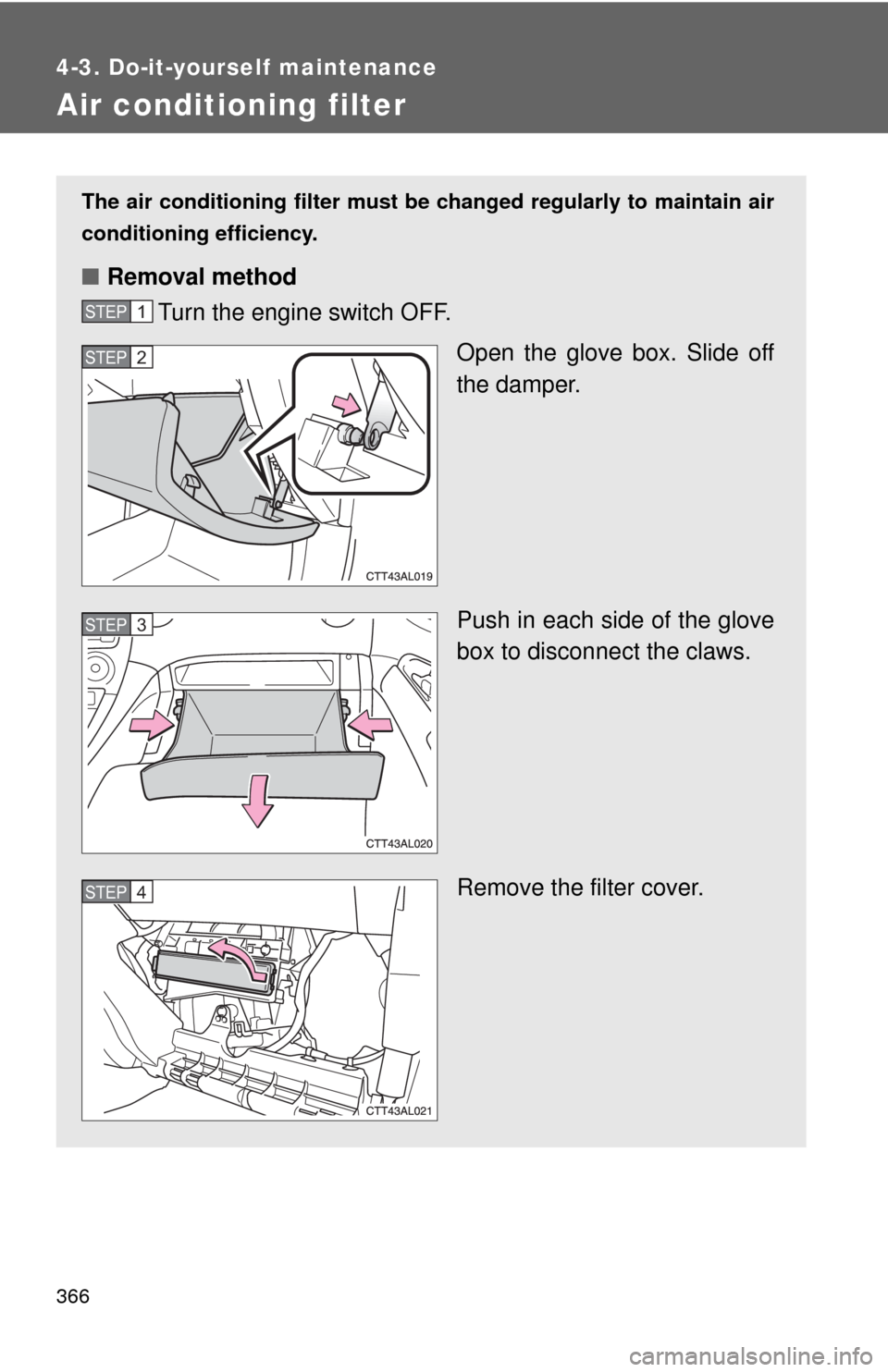
The air conditioning filter must be changed regularly to maintain air
conditioning efficiency.
■Removal method
Turn the engine switch OFF.
Open the glove box. Slide off
the damper.
Push in each side of the glove
box to disconnect the claws.
Remove the filter cover.
STEP1
STEP2
STEP3
STEP4
Page 368 of 501
367 4-3. Do-it-yourself maintenance
4
Maintenance and care
■Checking interval
Replace the air conditioning filter according to the maintenance schedule. In
dusty areas or areas with heavy traffic flow, early replacement may be
required. (For scheduled maintenance information, please refer to the
“Scheduled Maintenance Guide” or “Owner’s Manual Supplement”.)
■If air flow from the vents decreases dramatically
The filter may be clogged. Check the filter and replace if necessary.
NOTICE
■When using the air conditioning system
Make sure that a filter is always installed.
Using the air conditioning system without a filter may cause damage to the
system.
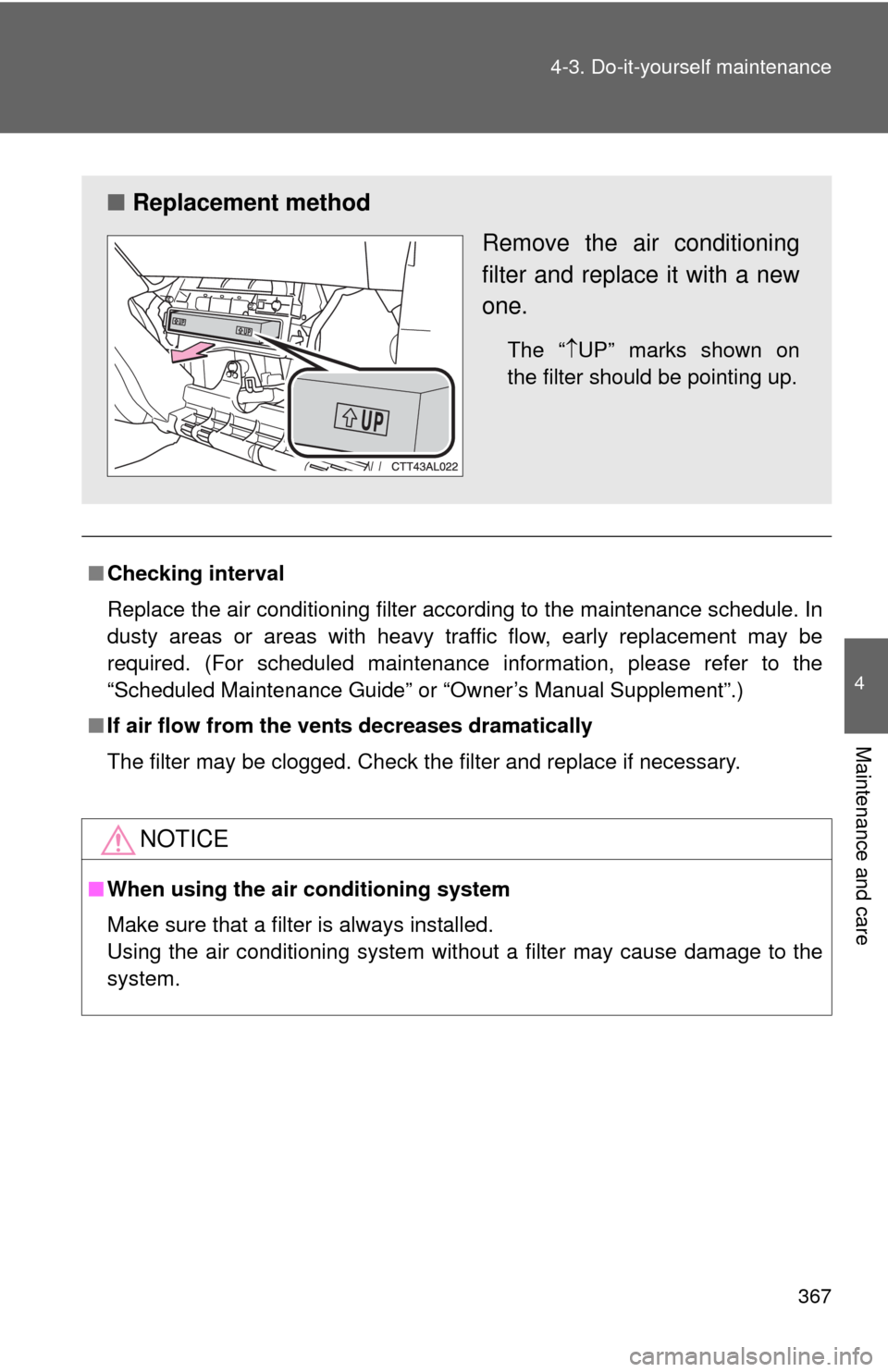
■Replacement method
Remove the air conditioning
filter and replace it with a new
one.
The “UP” marks shown on
the filter should be pointing up.
Page 375 of 501
374 4-3. Do-it-yourself maintenance
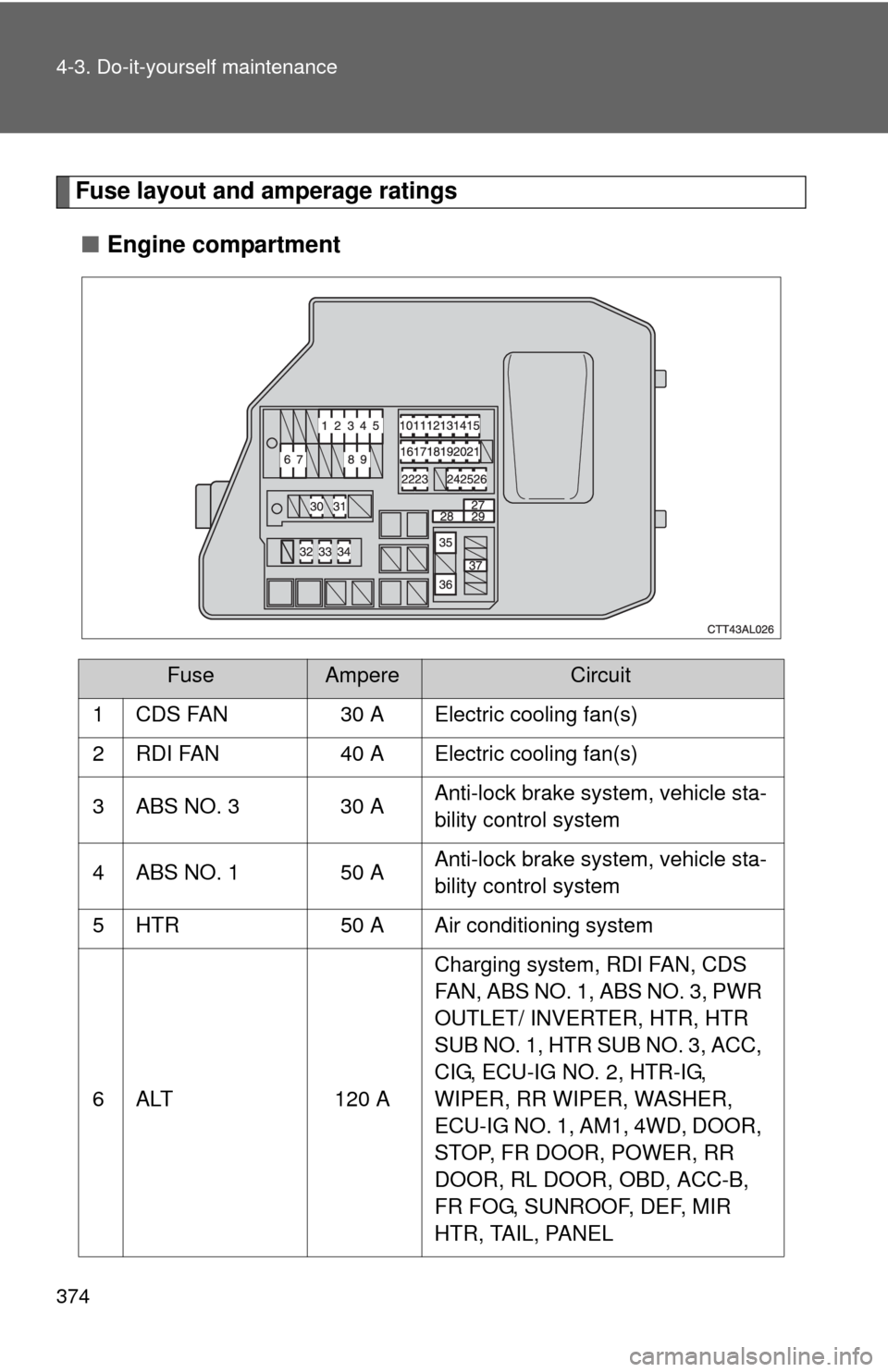
Fuse layout and amperage ratings
■Engine compartment
FuseAmpereCircuit
1 CDS FAN 30 A Electric cooling fan(s)
2 RDI FAN 40 A Electric cooling fan(s)
3 ABS NO. 3 30 AAnti-lock brake system, vehicle sta-
bility control system
4 ABS NO. 1 50 AAnti-lock brake system, vehicle sta-
bility control system
5 HTR 50 A Air conditioning system
6 ALT 120 ACharging system, RDI FAN, CDS
FAN, ABS NO. 1, ABS NO. 3, PWR
OUTLET/ INVERTER, HTR, HTR
SUB NO. 1, HTR SUB NO. 3, ACC,
CIG, ECU-IG NO. 2, HTR-IG,
WIPER, RR WIPER, WASHER,
ECU-IG NO. 1, AM1, 4WD, DOOR,
STOP, FR DOOR, POWER, RR
DOOR, RL DOOR, OBD, ACC-B,
FR FOG, SUNROOF, DEF, MIR
HTR, TAIL, PANEL
Page 379 of 501

378 4-3. Do-it-yourself maintenance
11 IGN 7.5 ASRS airbag system, multiport fuel
injection system/sequential multi-
port fuel injection system, front
passenger occupant classification
system
12 METER 7.5 A Gauge and meters
13 HTR-IG 10 AAir conditioning system, rear win-
dow defogger, PTC heater
14 WIPER 25 A Windshield wipers
15 RR WIPER 15 A Rear window wiper
16 WASHER 15 A Windshield washer
17 ECU-IG NO. 1 10 AMain body ECU, electric power
steering, electric cooling fan(s),
shift lock control system, anti-lock
brake system, multiport fuel injec-
tion system/sequential multiport
fuel injection system, tire pressure
warning system, vehicle stability
control system, all wheel drive sys-
tem
18 ECU-IG NO. 2 10 ABack-up lights, charging system,
rear window defogger, auto anti-
glare inside rear view mirror
19 OBD 7.5 A On-board diagnosis system
20 STOP 10 AStop lights, high mounted stop-
light, anti-lock brake system, vehi-
cle stability control system,
multiport fuel injection system/
sequential multiport fuel injection
system, shift lock control system
21 DOOR 25 A Power door lock system
22 ACC-B 25 A CIG, ACC
23 4WD 7.5 A All wheel drive system
FuseAmpereCircuit
Page 398 of 501
5
When trouble arises
397
5-1. Essential information
If you think something is wrong
If you notice any of the following symptoms, your vehicle probably
needs adjustment or repair. Contact your Toyota dealer as soon as
possible.
■Visible symptoms
●Fluid leaks under the vehicle
(Water dripping from the air conditioning after use is normal.)
●Flat-looking tires or uneven tire wear
●Engine coolant temperature gauge needle continually points
higher than normal
■Audible symptoms
●Changes in exhaust sound
●Excessive tire squeal when cornering
●Strange noises related to the suspension system
●Pinging or other noises related to the engine
■Operational symptoms
●Engine missing, stumbling or running rough
●Appreciable loss of power
●Vehicle pulls heavily to one side when braking
●Vehicle pulls heavily to one side when driving on a level road
●Loss of brake effectiveness, spongy feeling, pedal almost
touches the floor