light TOYOTA MATRIX 2011 E140 / 2.G Repair Manual
[x] Cancel search | Manufacturer: TOYOTA, Model Year: 2011, Model line: MATRIX, Model: TOYOTA MATRIX 2011 E140 / 2.GPages: 501, PDF Size: 11.47 MB
Page 161 of 501

161 2-5. Driving information
2
When driving
■Before towing
●Ensure that your vehicle’s tires are properly inflated. (P. 360)
●Trailer tires should be inflated according to the trailer manufacturer's rec-
ommendation.
●All trailer lights must work in order to be legal.
●Confirm all lights work each time you connect them.
●Check that your vehicle remains level when a loaded or unloaded trailer
is hitched. Do not drive if the vehicle is not level, and check for improper
tongue load, overloading, worn suspension, or other possible causes.
●Make sure the trailer cargo is securely loaded.
●Check that your rear view mirrors conform to any federal, state/provincial
or local regulations. If they do not, install rear view mirrors appropriate for
towing purposes.
■Break-in schedule
Toyota recommends that you do not use a new vehicle or a vehicle with any
new power train components (engine, transmission, differential, wheel bear-
ings, etc.) to tow a trailer for the first 500 miles (800 km) of driving.
■Maintenance
●If you tow a trailer, your vehicle will require more frequent maintenance
due to the additional load. (See “Scheduled Maintenance Guide” or
“Owner's Manual Supplement”.)
●Retighten the fixing bolts of the towing ball and bracket after approxi-
mately 600 miles (1000 km) of trailer towing.
Page 162 of 501
162 2-5. Driving information
CAUTION
■To avoid accident or injury
●Do not exceed the trailer hitch assembly weight, gross vehicle weight,
gross axle weight and trailer tongue load capacities.
●Never load more weight in the back than in the front of the trailer. About
60% of the load should be in the front half of the trailer, and the remaining
40% in the rear.
■Hitches
●If you wish to install a trailer hitch, contact your Toyota dealer.
●Use only a hitch that conforms to the total trailer weight requirement.
●Follow the directions supplied by the hitch manufacturer.
●Lubricate the hitch ball with a light coat of grease.
●Remove the trailer hitch whenever you are not towing a trailer. After
removing the hitch, seal any mounting hole in the vehicle body to prevent
entry of any substances into the vehicle.
■When towing a trailer
●If the gross trailer weight exceeds 1000 lb. (453 kg), trailer brakes are
required. Toyota recommends trailers with brakes that conform to all appli-
cable federal and state/provincial regulations.
●Never tap into your vehicle's hydraulic system, as this will lower the vehi-
cle's braking effectiveness.
●Never tow a trailer without using a safety chain securely attached to both
the trailer and the vehicle. If damage occurs to the coupling unit or hitch
ball, there is danger of the trailer wandering into another lane.
Page 163 of 501
163 2-5. Driving information
2
When driving
Trailer towing tips
Your vehicle will handle differently when towing a trailer. In order to
avoid accident, death or serious injury, keep the following in mind
when towing:
●Before starting out, check the trailer lights and the vehicle-trailer
connections. Recheck after driving a short distance.
●Practice turning, stopping and reversing with the trailer attached in
an area away from traffic until you become accustomed to the feel
of the vehicle.
NOTICE
■When installing a trailer hitch
●Use only the position recommended by your Toyota dealer. Do not install
the trailer hitch on the bumper; this may cause body damage.
●Do not use axle-mounted hitches, as they can cause damage to the axle
housing, wheel bearings, wheels or tires.
■Brakes
Toyota recommends trailers with brakes that conform to all applicable fed-
eral and state/provincial regulations.
■Safety chain
A safety chain must always be used between the towing vehicle and the
trailer. Leave sufficient slack in the chain for turns. The chain should cross
under the trailer tongue to prevent the tongue from dropping to the ground in
the case that it becomes damaged or separated. For the correct safety chain
installation procedure, ask your Toyota dealer.
■Do not directly splice trailer lights
Directly splicing trailer lights may damage your vehicle's electrical system
and cause a malfunction.
Page 171 of 501
Interior features3
171
3-4. Using the hands-free
phone system
(for cellular phone)
Hands-free phone system
(for cellular phone)
features .......................... 247
Using the hands-free
phone system
(for cellular phone) ......... 252
Making a phone call ......... 262
Setting a cellular phone ... 266
Security and system
setup .............................. 271
Using the phone book ...... 275
3-5. Using the interior lights
Interior lights list ............... 282
• Interior light .................... 283
• Personal/interior lights ... 284
• Personal lights ............... 2853-6. Using the storage features
List of storage features .... 286
• Glove box....................... 287
• Console box ................... 287
• Cup holders ................... 288
• Bottle holders ................. 290
• Auxiliary boxes ............... 291
3-7. Other interior features
Sun visors ........................ 293
Vanity mirrors ................... 294
Clock ................................ 295
Ashtrays ........................... 296
Cigarette lighter................ 297
Power outlet ..................... 298
Grocery bag hook ............ 300
Seatback table ................. 302
Floor mat .......................... 303
Luggage compartment
feature............................ 304
Compass .......................... 311
Page 196 of 501
196 3-2. Using the audio system
NOTICE
■CD player precautions
Failure to follow the precautions below may result in serious damage to the
CDs or the player itself.
●Do not insert anything other than CDs into the CD slot.
●Do not apply oil to the CD player.
●Store CDs away from direct sunlight.
●Never try to disassemble any part of the CD player.
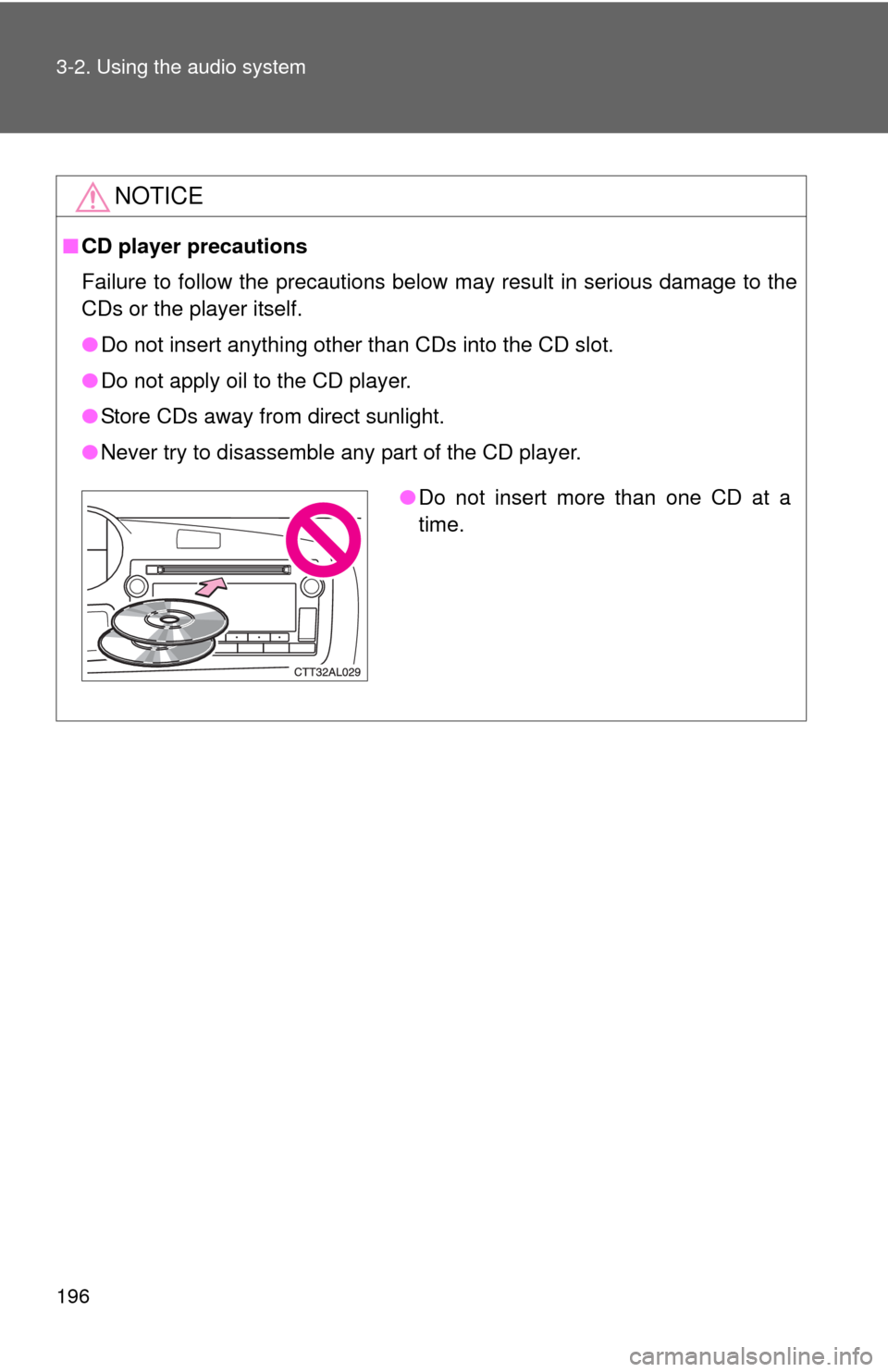
●Do not insert more than one CD at a
time.
Page 282 of 501
282
3-5. Using the interior lights
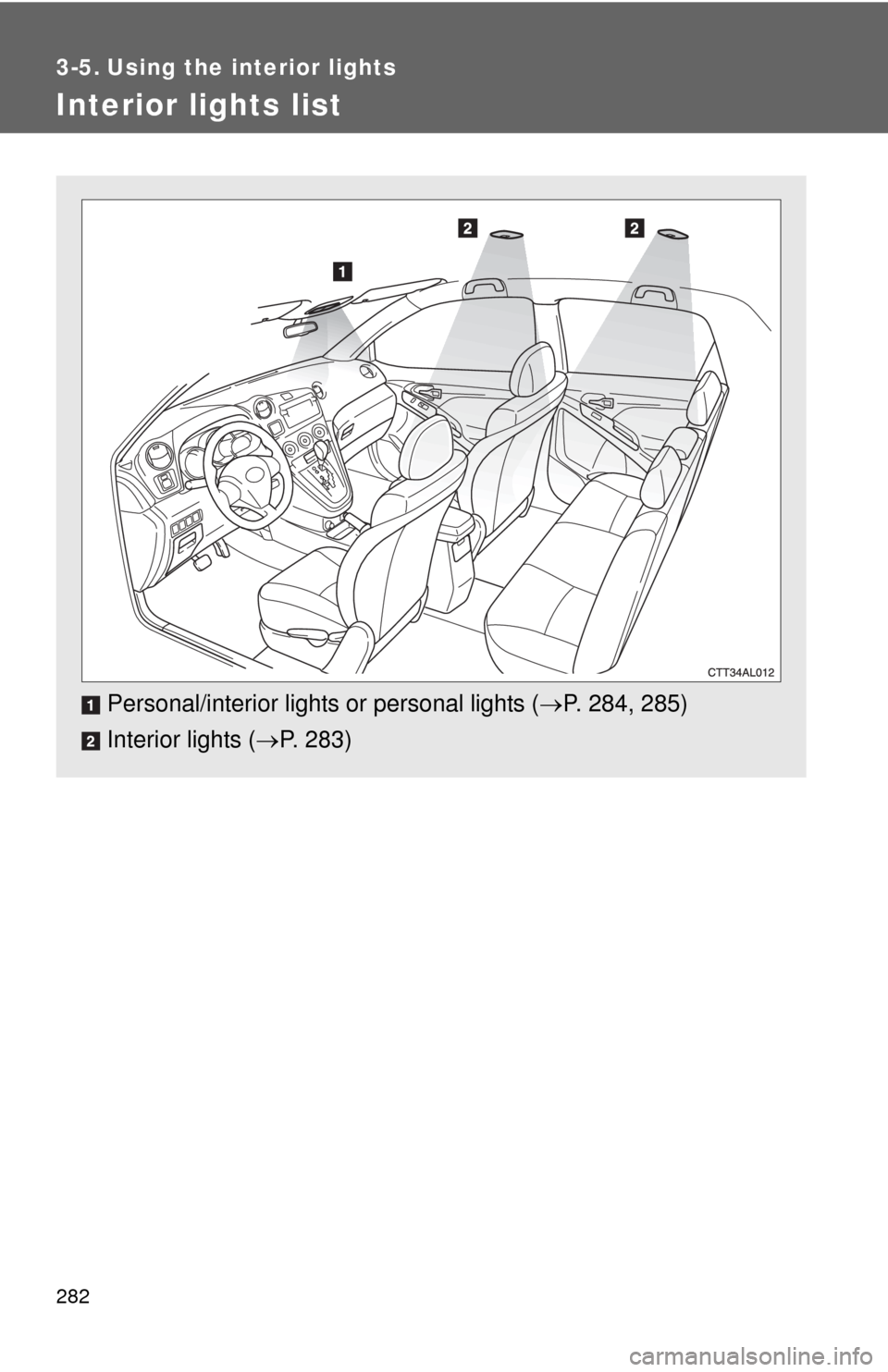
Interior lights list
Personal/interior lights or personal lights (P. 284, 285)
Interior lights (P. 283)
Page 283 of 501
283 3-5. Using the interior lights
3
Interior features
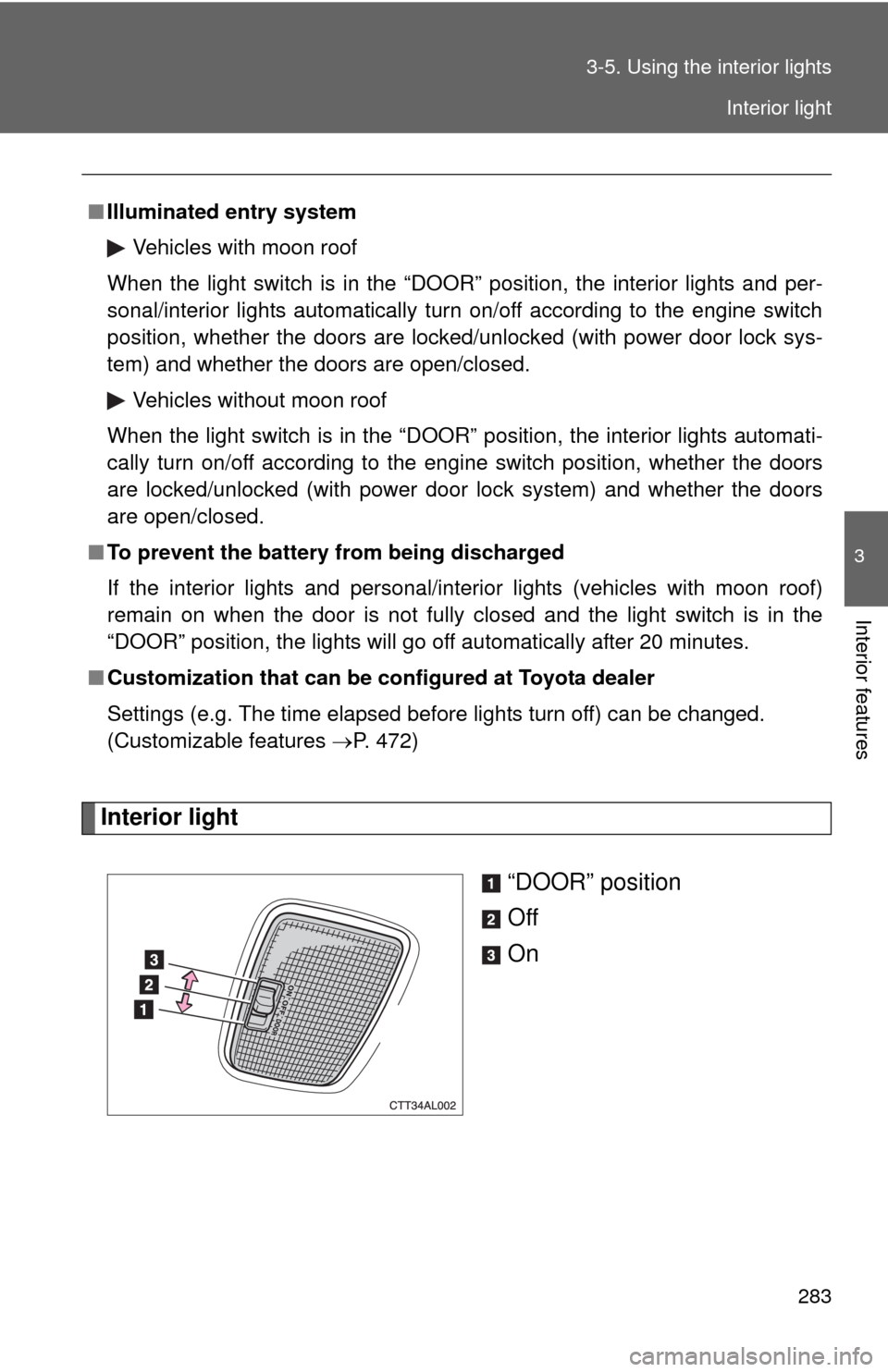
Interior light
“DOOR” position
Off
On
■Illuminated entry system
Vehicles with moon roof
When the light switch is in the “DOOR” position, the interior lights and per-
sonal/interior lights automatically turn on/off according to the engine switch
position, whether the doors are locked/unlocked (with power door lock sys-
tem) and whether the doors are open/closed.
Vehicles without moon roof
When the light switch is in the “DOOR” position, the interior lights automati-
cally turn on/off according to the engine switch position, whether the doors
are locked/unlocked (with power door lock system) and whether the doors
are open/closed.
■To prevent the battery from being discharged
If the interior lights and personal/interior lights (vehicles with moon roof)
remain on when the door is not fully closed and the light switch is in the
“DOOR” position, the lights will go off automatically after 20 minutes.
■Customization that can be configured at Toyota dealer
Settings (e.g. The time elapsed before lights turn off) can be changed.
(Customizable features P. 472)
Interior light
Page 284 of 501
284 3-5. Using the interior lights
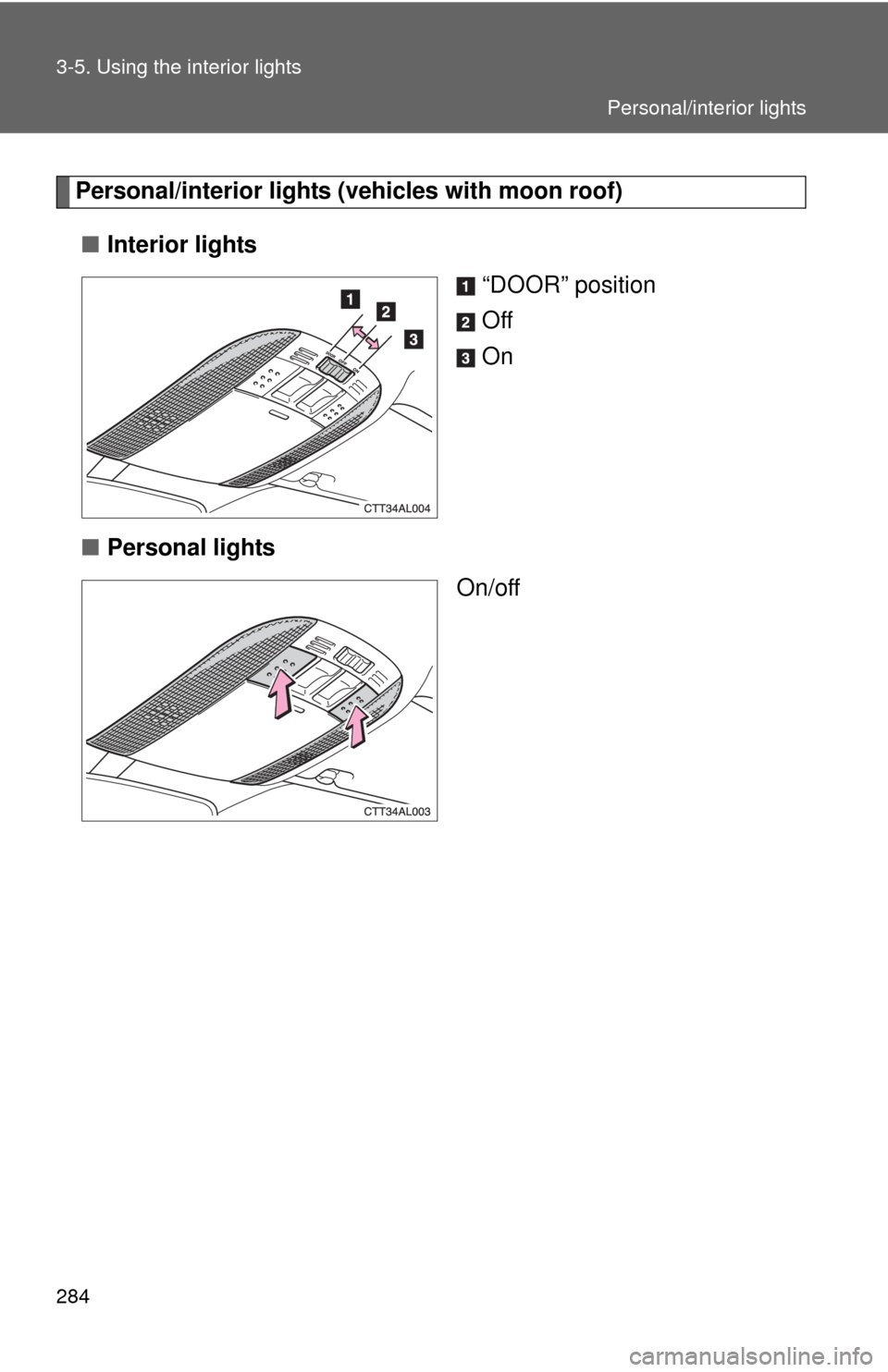
Personal/interior lights (vehicles with moon roof)
■Interior lights
“DOOR” position
Off
On
■Personal lights
On/off
Personal/interior lights
Page 285 of 501
285 3-5. Using the interior lights
3
Interior features
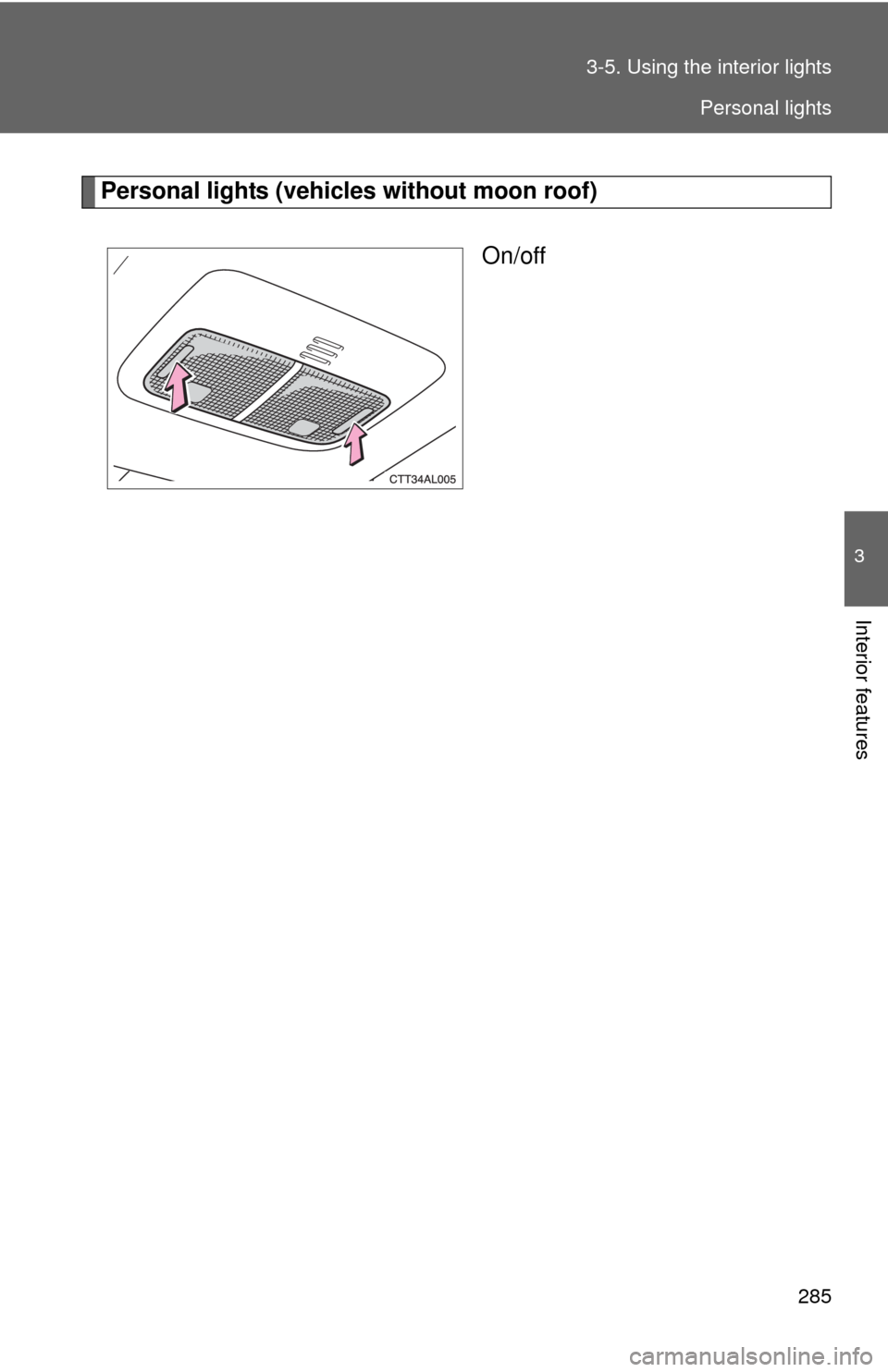
Personal lights (vehicles without moon roof)
On/off
Personal lights
Page 286 of 501
286
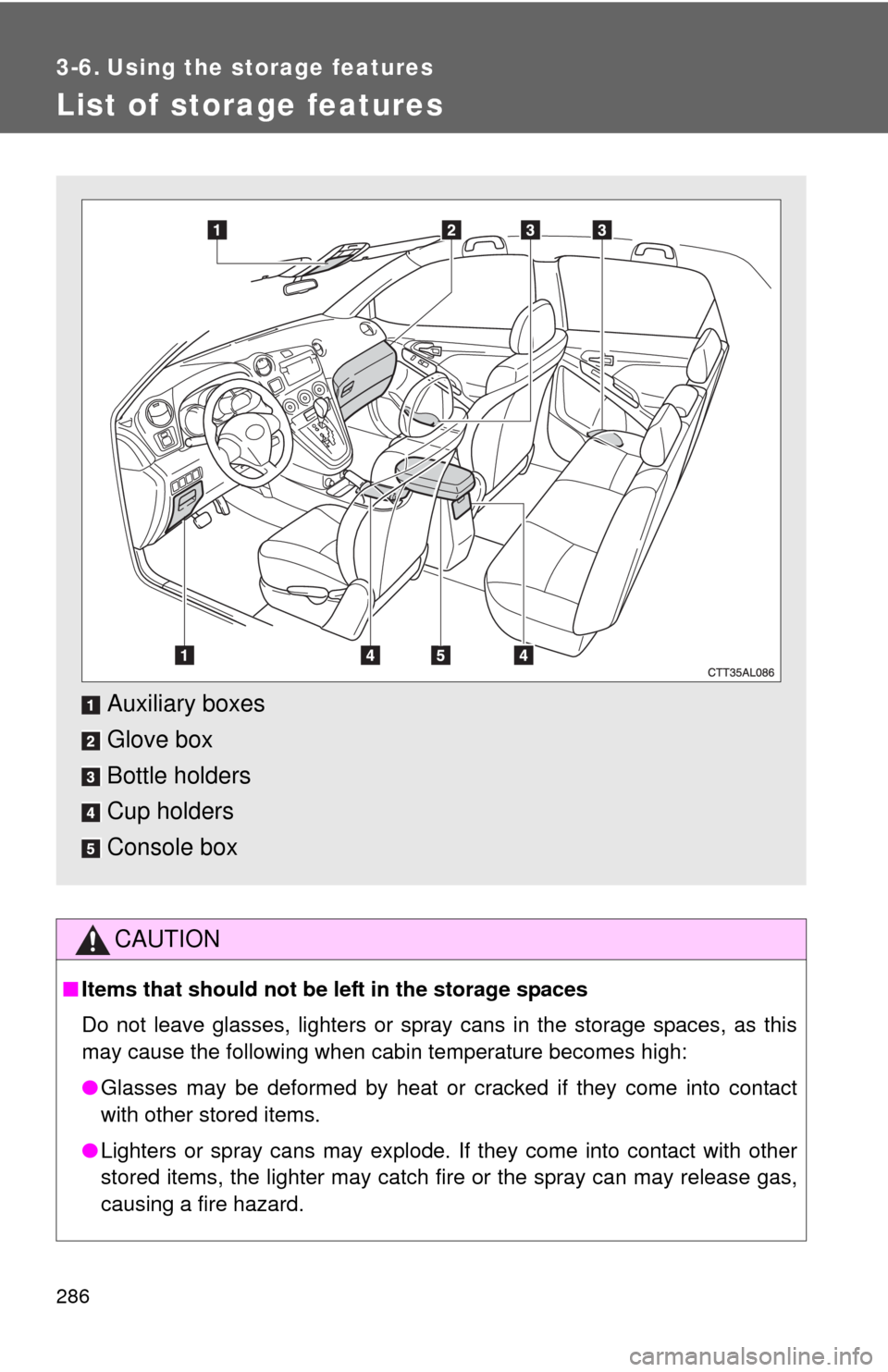
3-6. Using the storage features
List of storage features
CAUTION
■Items that should not be left in the storage spaces
Do not leave glasses, lighters or spray cans in the storage spaces, as this
may cause the following when cabin temperature becomes high:
●Glasses may be deformed by heat or cracked if they come into contact
with other stored items.
●Lighters or spray cans may explode. If they come into contact with other
stored items, the lighter may catch fire or the spray can may release gas,
causing a fire hazard.
Auxiliary boxes
Glove box
Bottle holders
Cup holders
Console box