engine TOYOTA MATRIX 2012 E140 / 2.G Owners Manual
[x] Cancel search | Manufacturer: TOYOTA, Model Year: 2012, Model line: MATRIX, Model: TOYOTA MATRIX 2012 E140 / 2.GPages: 516, PDF Size: 7.02 MB
Page 381 of 516
381
4-3. Do-it-yourself maintenance
4
Maintenance and care
Air conditioning filter
The air conditioning filter must be changed regularly to maintain air
conditioning efficiency.
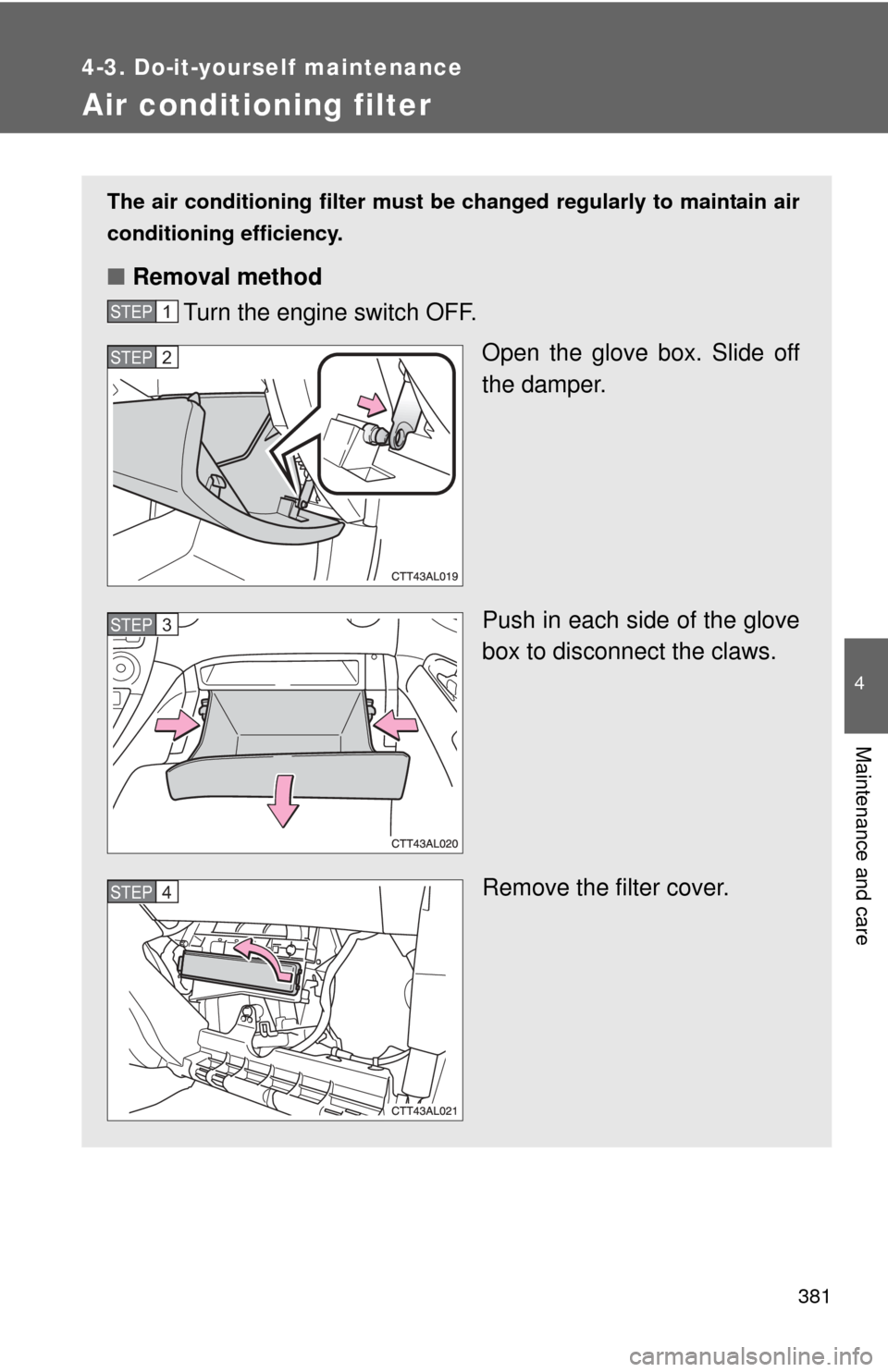
■ Removal method
Turn the engine switch OFF.
Open the glove box. Slide off
the damper.
Push in each side of the glove
box to disconnect the claws.
Remove the filter cover.
STEP1
STEP2
STEP3
STEP4
Page 385 of 516
385
4-3. Do-it-yourself maintenance
4
Maintenance and care
Checking and replacing fuses
If any of the electrical components do not operate, a fuse may have
blown. If this happens, check and replace the fuses as necessary.
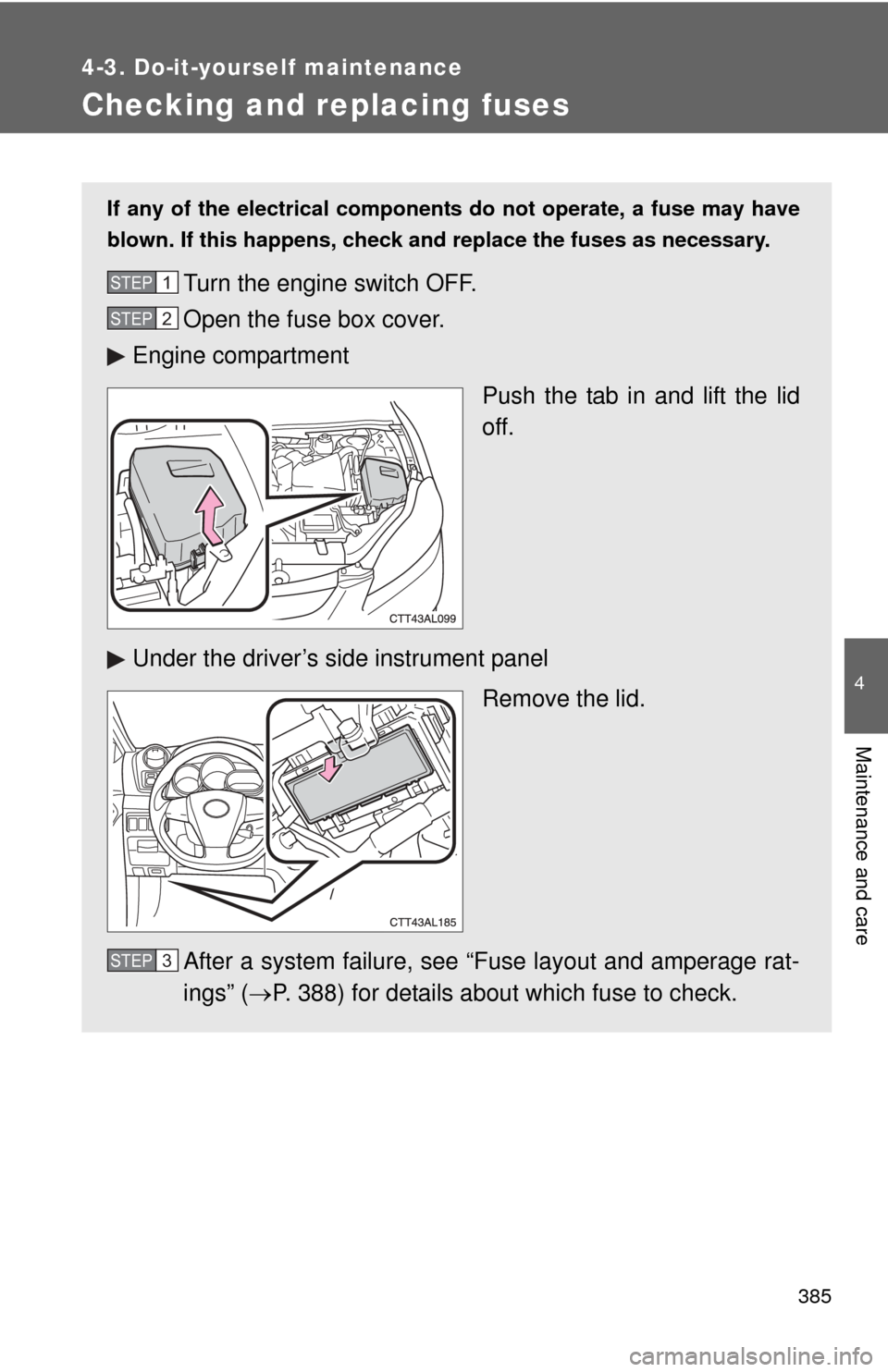
Turn the engine switch OFF.
Open the fuse box cover.
Engine compartment
Push the tab in and lift the lid
off.
Under the driver’s side instrument panel Remove the lid.
After a system failure, see “Fuse layout and amperage rat-
ings” ( P. 388) for details about which fuse to check.STEP1
STEP2
STEP3
Page 388 of 516
388 4-3. Do-it-yourself maintenance
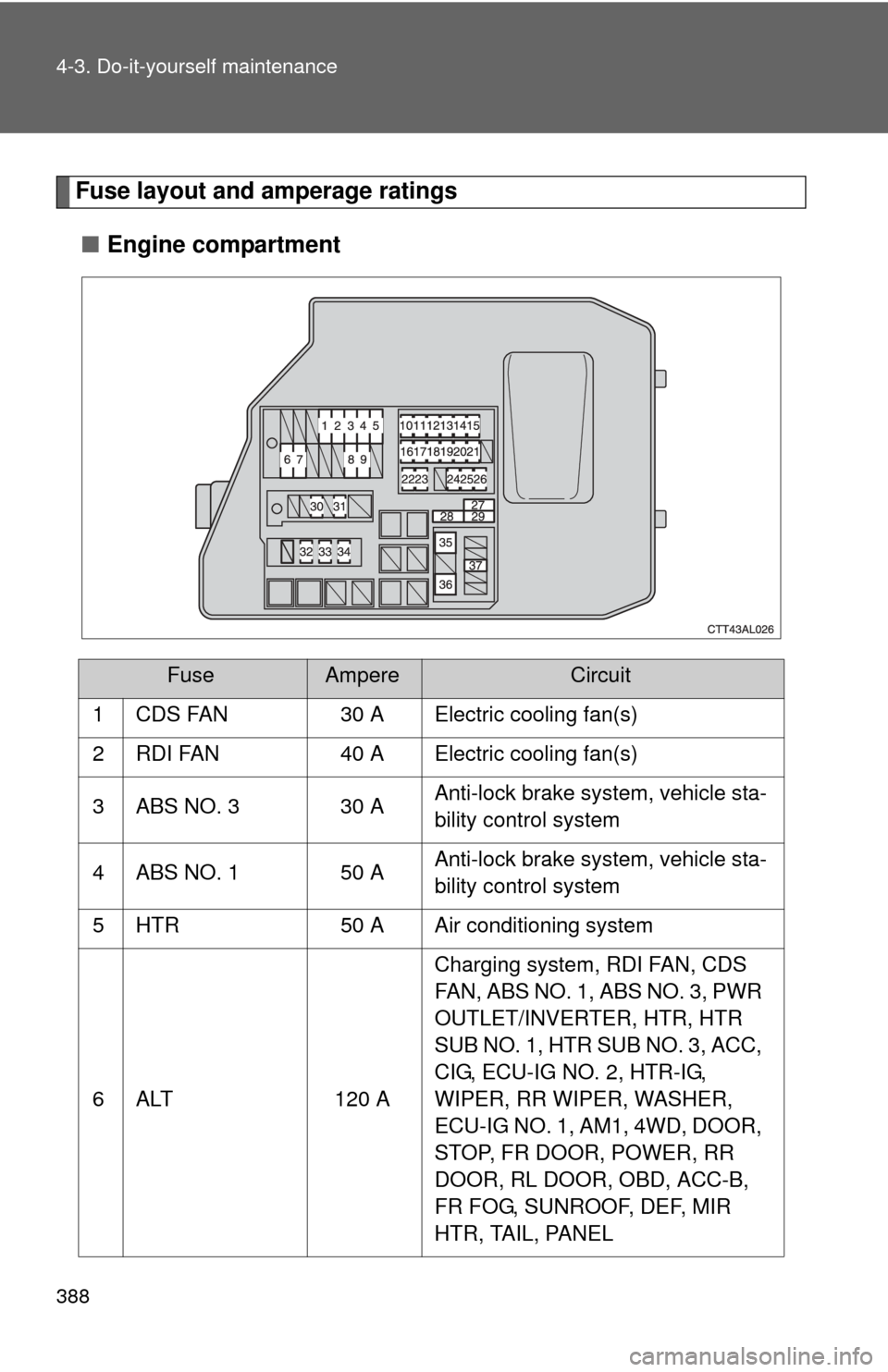
Fuse layout and amperage ratings■ Engine compartment
FuseAmpereCircuit
1 CDS FAN 30 A Electric cooling fan(s)
2 RDI FAN 40 A Electric cooling fan(s)
3 ABS NO. 3 30 A Anti-lock brake system, vehicle sta-
bility control system
4 ABS NO. 1 50 A Anti-lock brake system, vehicle sta-
bility control system
5 HTR 50 A Air conditioning system
6 ALT 120 A Charging system, RDI FAN, CDS
FAN, ABS NO. 1, ABS NO. 3, PWR
OUTLET/INVERTER, HTR, HTR
SUB NO. 1, HTR SUB NO. 3, ACC,
CIG, ECU-IG NO. 2, HTR-IG,
WIPER, RR WIPER, WASHER,
ECU-IG NO. 1, AM1, 4WD, DOOR,
STOP, FR DOOR, POWER, RR
DOOR, RL DOOR, OBD, ACC-B,
FR FOG, SUNROOF, DEF, MIR
HTR, TAIL, PANEL
Page 403 of 516
When trouble arises5
403
5-1. Essential informationEmergency flashers ......... 404
If your vehicle needs to be towed ........................ 405
If you think something is wrong ............................ 411
Fuel pump shut off system ........................... 412 5-2. Steps to take in an
emergency
If a warning light turns on or a warning buzzer
sounds... ....................... 413
If you have a flat tire......... 424
If the engine will not start ................................ 438
If the shift lever cannot be shifted from P................. 439
If you lose your keys ........ 440
If the battery is discharged ..................... 441
If your vehicle overheats ....................... 446
If the vehicle becomes stuck .............................. 449
If your vehicle has to be stopped in an
emergency ..................... 451
Page 404 of 516
404
5-1. Essential information
Emergency flashers
NOTICE
■To prevent battery discharge
Do not leave the emergency flashers on longer than necessary when the
engine is not running.
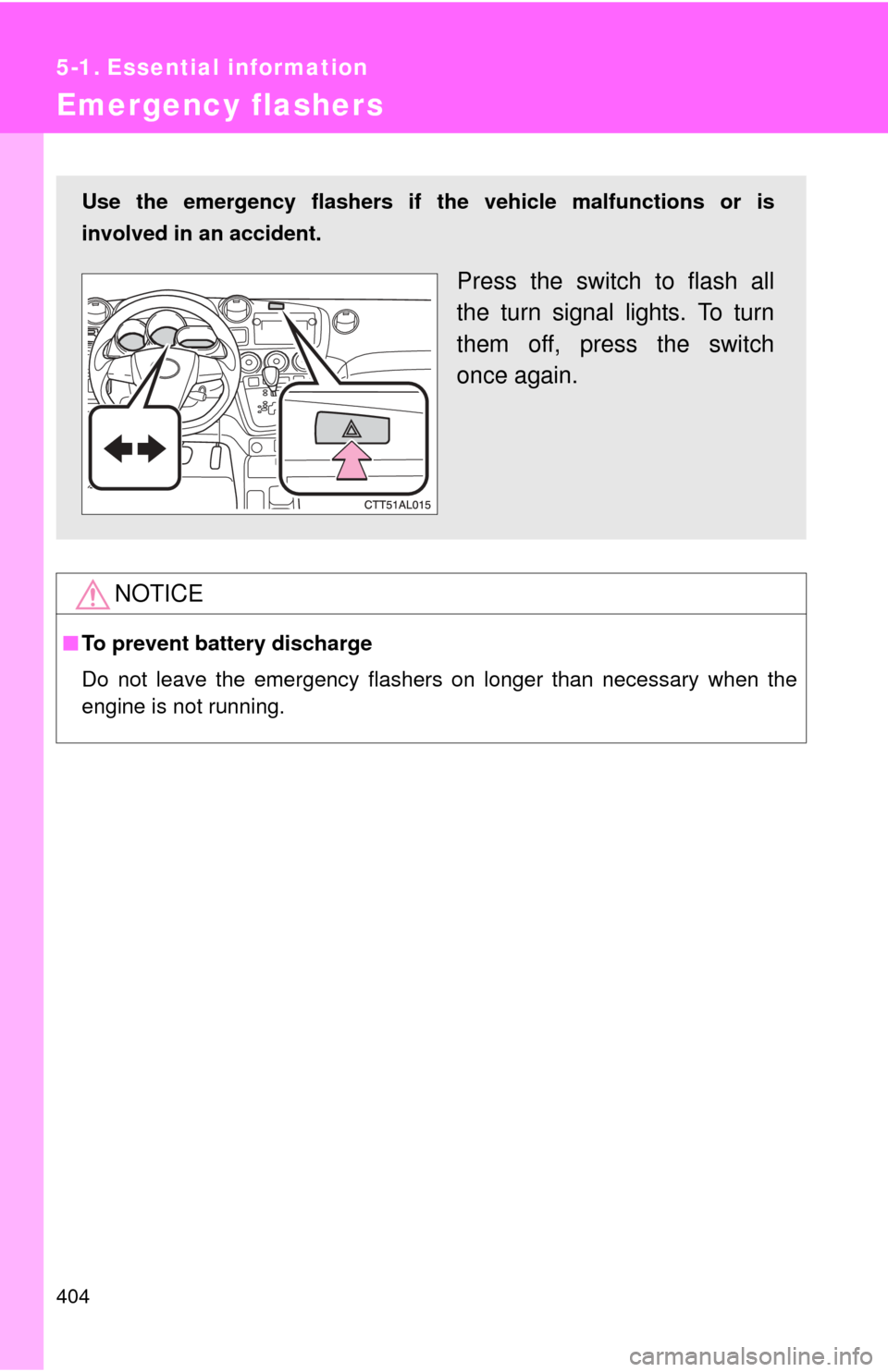
Use the emergency flashers if th e vehicle malfunctions or is
involved in an accident.
Press the switch to flash all
the turn signal lights. To turn
them off, press the switch
once again.
Page 405 of 516
5
When trouble arises
405
5-1. Essential information
If your vehicle needs to be towed
Before towingThe following may indicate a problem with your transmission. Contact
your Toyota dealer before towing.
● The engine is running, but the vehicle will not move.
● The vehicle makes an abnormal sound.
If towing is necessary, we recommend having your vehicle towed by
your Toyota dealer or a commerci al towing service, using a lift-type
truck or a flat bed truck.
Use a safety chain system for all to wing, and abide by all state/pro-
vincial and local laws.
2WD models: If towing your vehicle with a wheel-lift type truck from
the front, the vehicle's rear wheels and axles must be in good condi-
tions. ( P. 407, 410)
If they are damaged, use a towing dolly or flat bed truck.
AWD models: If towing your vehicle with a wheel-lift type truck, use a
towing dolly. ( P. 407, 410)
Page 406 of 516
406 5-1. Essential information
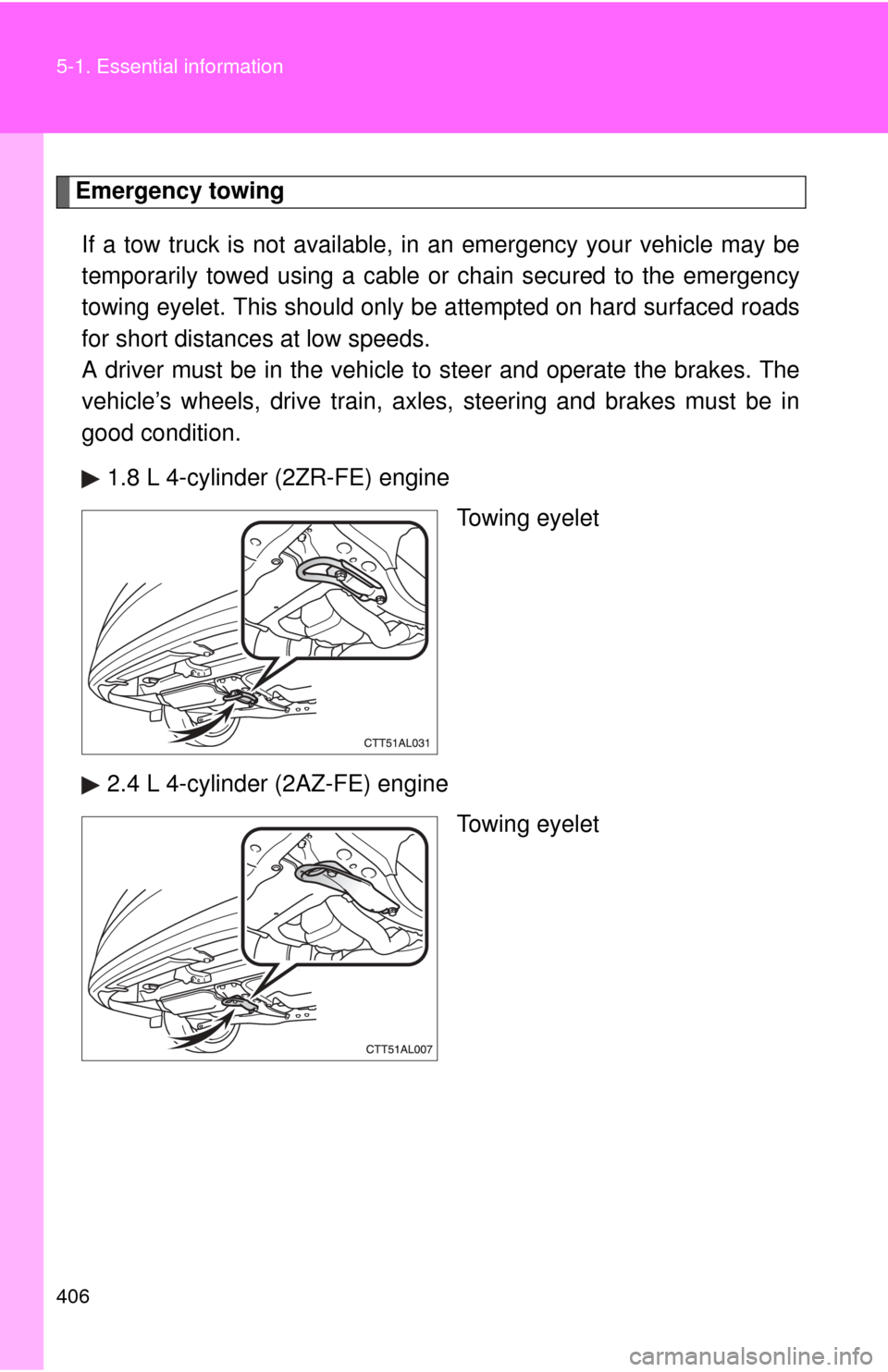
Emergency towingIf a tow truck is not available, in an emergency your vehicle may be
temporarily towed using a cable or chain secured to the emergency
towing eyelet. This should only be attempted on hard surfaced roads
for short distances at low speeds.
A driver must be in the vehicle to steer and operate the brakes. The
vehicle’s wheels, drive train, axles, steering and brakes must be in
good condition.
1.8 L 4-cylinder (2ZR-FE) engine Towing eyelet
2.4 L 4-cylinder (2AZ-FE) engine Towing eyelet
Page 408 of 516
408 5-1. Essential information
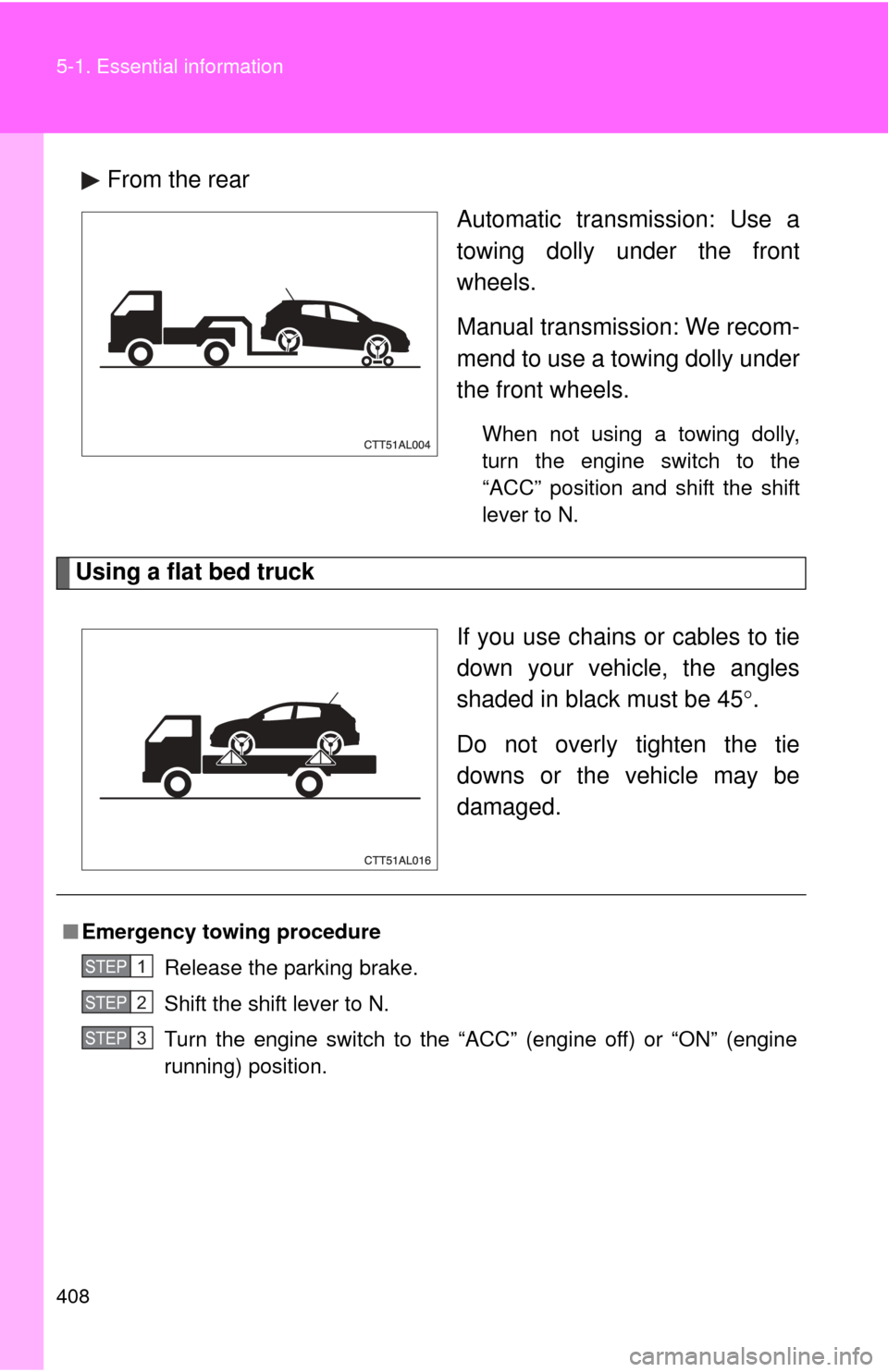
From the rearAutomatic transmission: Use a
towing dolly under the front
wheels.
Manual transmission: We recom-
mend to use a towing dolly under
the front wheels.
When not using a towing dolly,
turn the engine switch to the
“ACC” position and shift the shift
lever to N.
Using a flat bed truck
If you use chains or cables to tie
down your vehicle, the angles
shaded in black must be 45.
Do not overly tighten the tie
downs or the vehicle may be
damaged.
■ Emergency towin g procedure
Release the parking brake.
Shift the shift lever to N.
Turn the engine switch to the “ACC” (engine off) or “ON” (engine
running) position.
STEP1
STEP2
STEP3
Page 409 of 516

5
When trouble arises
409
5-1. Essential information
CAUTION
■
Caution while towing
●Use extreme caution when towing the vehicle.
Avoid sudden starts or erratic driving maneuvers which place excessive
stress on the emergency towing eyelet and the cables or chains. Always
be cautious of the surroundings and other vehicles while towing.
● If the engine is not running, the power assist for the brakes and steering
will not function, making steering and braking more difficult.
Page 410 of 516
410 5-1. Essential information
NOTICE
■To prevent body damage when towing with a sling-type truck
Do not tow with a sling-type truck, either from the front or rear.
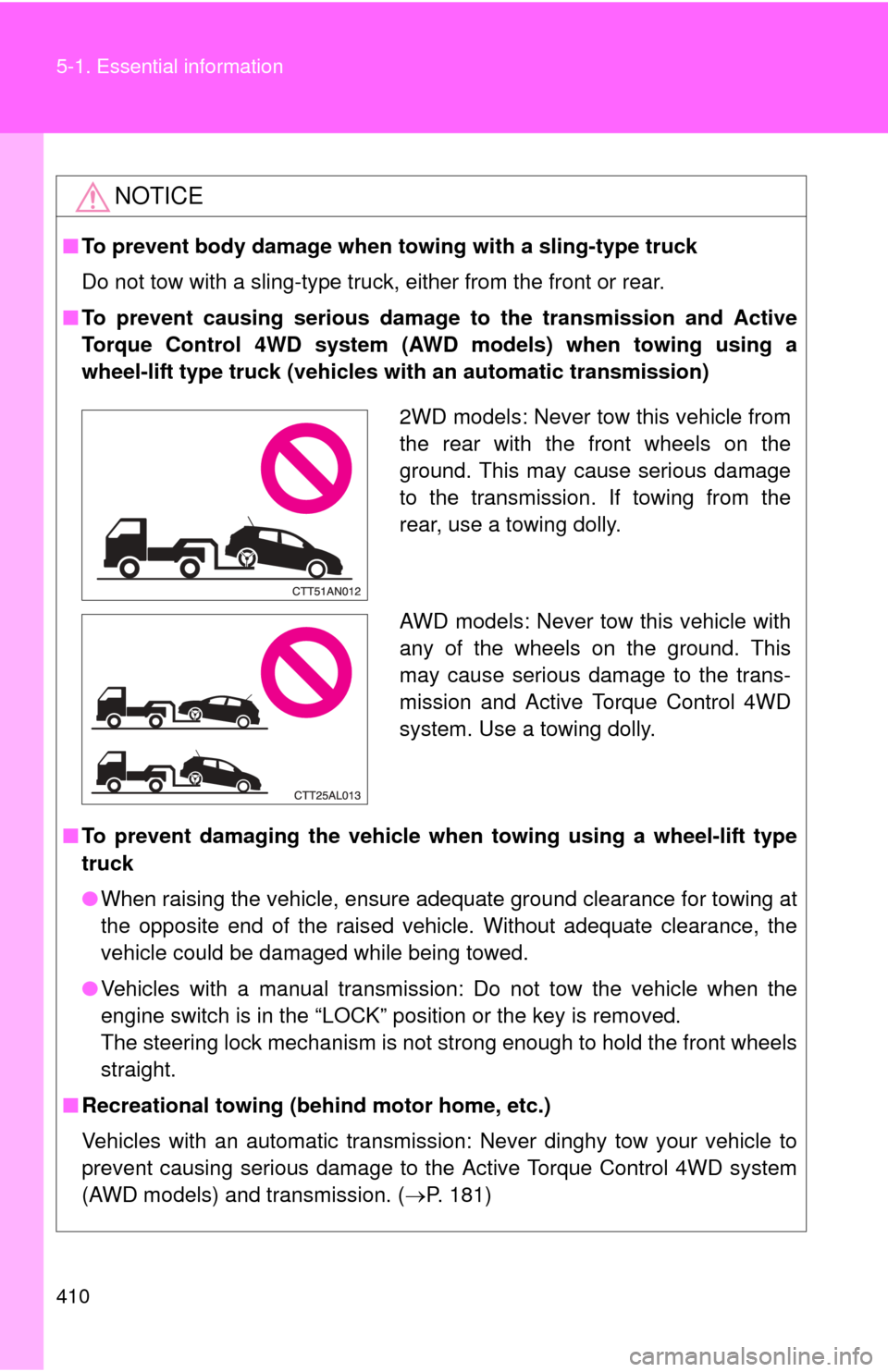
■ To prevent causing serious damage to the transmission and Active
Torque Control 4WD system (AWD models) when towing using a
wheel-lift type truck (vehicles with an automatic transmission)
■ To prevent damaging the vehicle wh en towing using a wheel-lift type
truck
● When raising the vehicle, ensure adequate ground clearance for towing at
the opposite end of the raised vehicle. Without adequate clearance, the
vehicle could be damaged while being towed.
● Vehicles with a manual transmission: Do not tow the vehicle when the
engine switch is in the “LOCK” position or the key is removed.
The steering lock mechanism is not strong enough to hold the front wheel\
s
straight.
■ Recreational towing (behind motor home, etc.)
Vehicles with an automatic transmission: Never dinghy tow your vehicle to
prevent causing serious damage to the Active Torque Control 4WD system
(AWD models) and transmission. ( P. 181)
2WD models: Never tow this vehicle from
the rear with the front wheels on the
ground. This may cause serious damage
to the transmission. If towing from the
rear, use a towing dolly.
AWD models: Never tow this vehicle with
any of the wheels on the ground. This
may cause serious damage to the trans-
mission and Active Torque Control 4WD
system. Use a towing dolly.