AUX TOYOTA MATRIX 2012 E140 / 2.G User Guide
[x] Cancel search | Manufacturer: TOYOTA, Model Year: 2012, Model line: MATRIX, Model: TOYOTA MATRIX 2012 E140 / 2.GPages: 516, PDF Size: 7.02 MB
Page 249 of 516
249
3-3. Using the Bluetooth
® audio system
3
Interior features
Operating the system using voice commands
By following voice guidance inst ructions output from the speaker,
voice commands enable the operation of the Bluetooth
® audio sys-
tem without the need to check the display or operate .
■ Operation procedure when using voice commands
Press the talk switch and follo w voice guidance instructions.
■ Auxiliary commands when using voice commands
The following auxiliary commands can be used when operating the
system using a voice command:
“Cancel”: Exits the Bluetooth
® audio setup
“Repeat”: Repeats the previous voice guidance instruction
“Go back”: Returns to the previous procedure
“Help”: Reads aloud the function summary if a help comment is
registered for the selected function
Page 269 of 516
269
3-4. Using the hand
s-free phone system (for cellular phone)
3
Interior features
Operating the system using a voice command
By following voice guidance inst ructions output from the speaker,
voice commands enable the operat ion of the hands-free phone sys-
tem without the need to check the display or operate .
■ Operation procedure when using a voice command
Press the talk switch and follo w voice guidance instructions.
■ Auxiliary commands when using a voice command
The following auxiliary commands can be used when operating the
system using a voice command:
“Cancel”: Exits the hands-free phone system
“Repeat”: Repeats the previous voice guidance instruction
“Go back”: Returns to the previous procedure
“Help”: Reads aloud the function summary if a help comment is
registered for the selected function
Page 300 of 516
300
3-6. Using the storage features
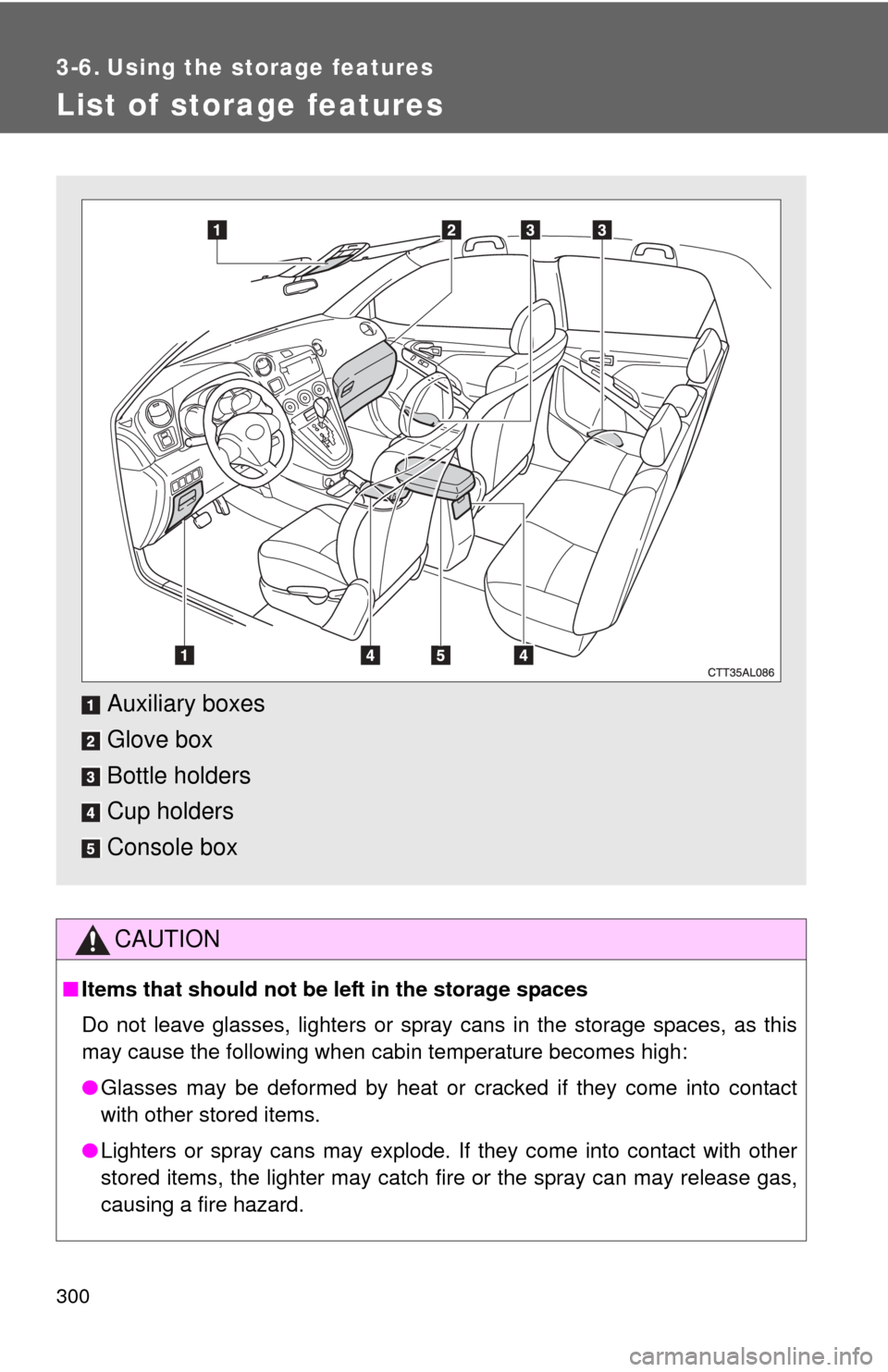
List of storage features
CAUTION
■Items that should not be left in the storage spaces
Do not leave glasses, lighters or spray cans in the storage spaces, as this
may cause the following when cabin temperature becomes high:
● Glasses may be deformed by heat or cracked if they come into contact
with other stored items.
● Lighters or spray cans may explode. If they come into contact with other
stored items, the lighter may catch fire or the spray can may release gas,
causing a fire hazard.
Auxiliary boxes
Glove box
Bottle holders
Cup holders
Console box
Page 305 of 516
305
3-6. Using the
storage features
3
Interior features
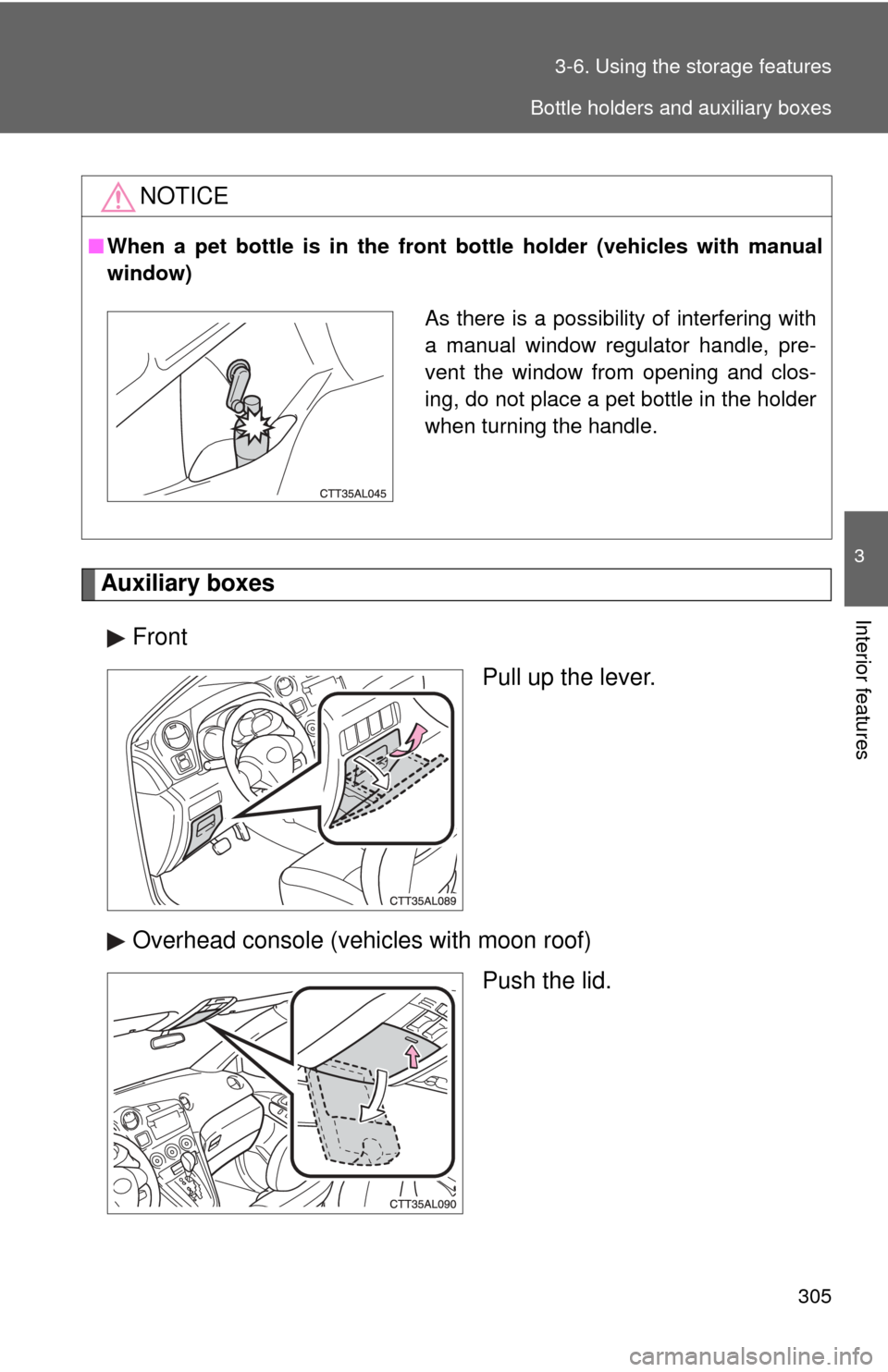
Auxiliary boxes
Front Pull up the lever.
Overhead console (vehicles with moon roof) Push the lid.
NOTICE
■When a pet bottle is in the front bottle holder (vehicles with manual
window)
As there is a possibility of interfering with
a manual window regulator handle, pre-
vent the window from opening and clos-
ing, do not place a pet bottle in the holder
when turning the handle.
Bottle holders and auxiliary boxes
Page 306 of 516

306 3-6. Using the storage features
CAUTION
■Caution while driving
Keep the auxiliary boxes closed.
Injuries may result in the event of an accident or sudden braking.
■ Items unsuitable for stor ing (overhead console only)
Do not store items heavier than 0.4 lb. (0.2 kg).
Doing so may cause the auxiliary box to open and the items inside may fall
out, resulting in an accident.
Auxiliary boxes
Page 319 of 516
319
3-7. Other interior features
3
Interior features
■
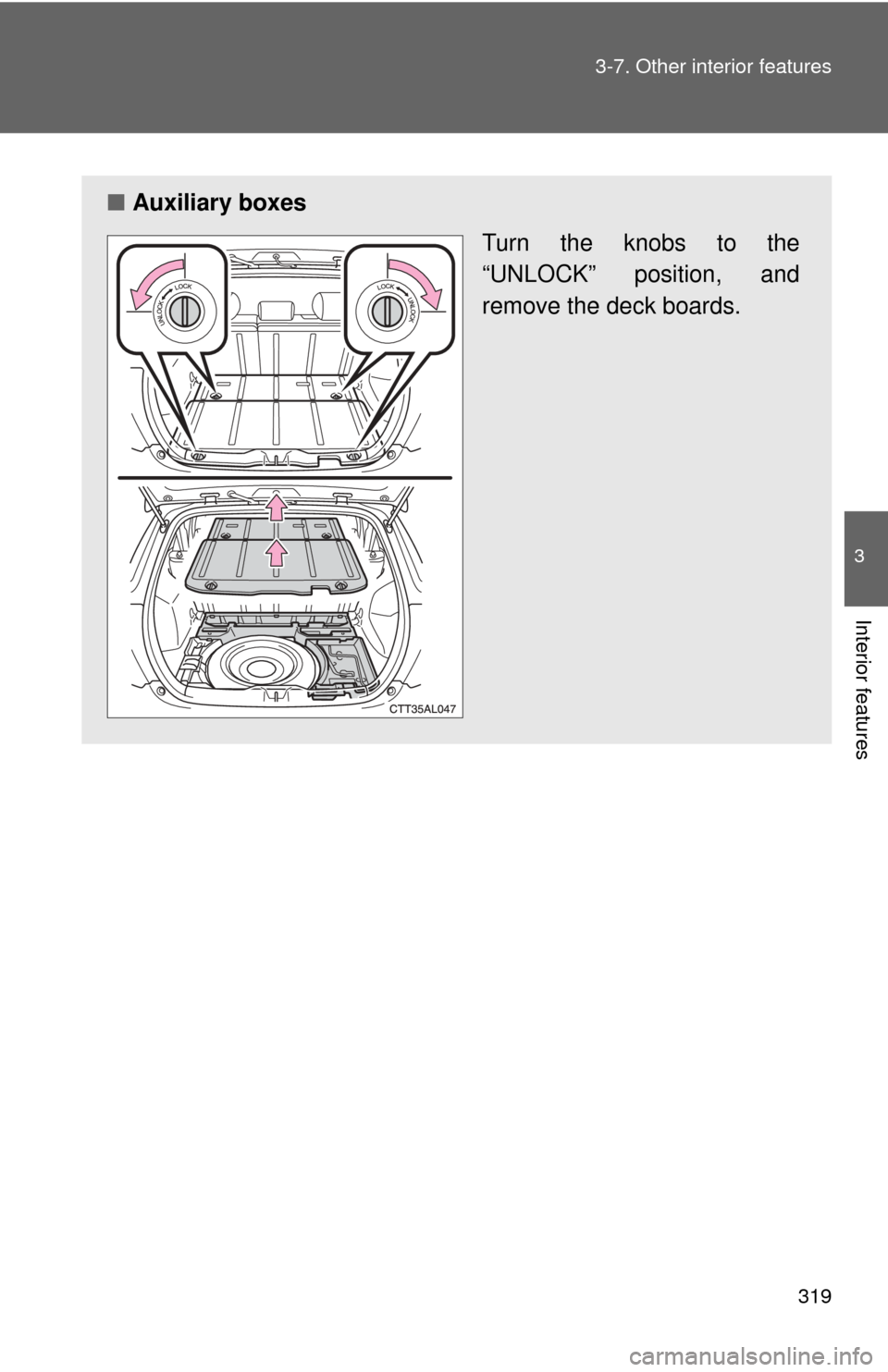
Auxiliary boxes
Turn the knobs to the
“UNLOCK” position, and
remove the deck boards.
Page 346 of 516
346
4-3. Do-it-yourself maintenance
Hood
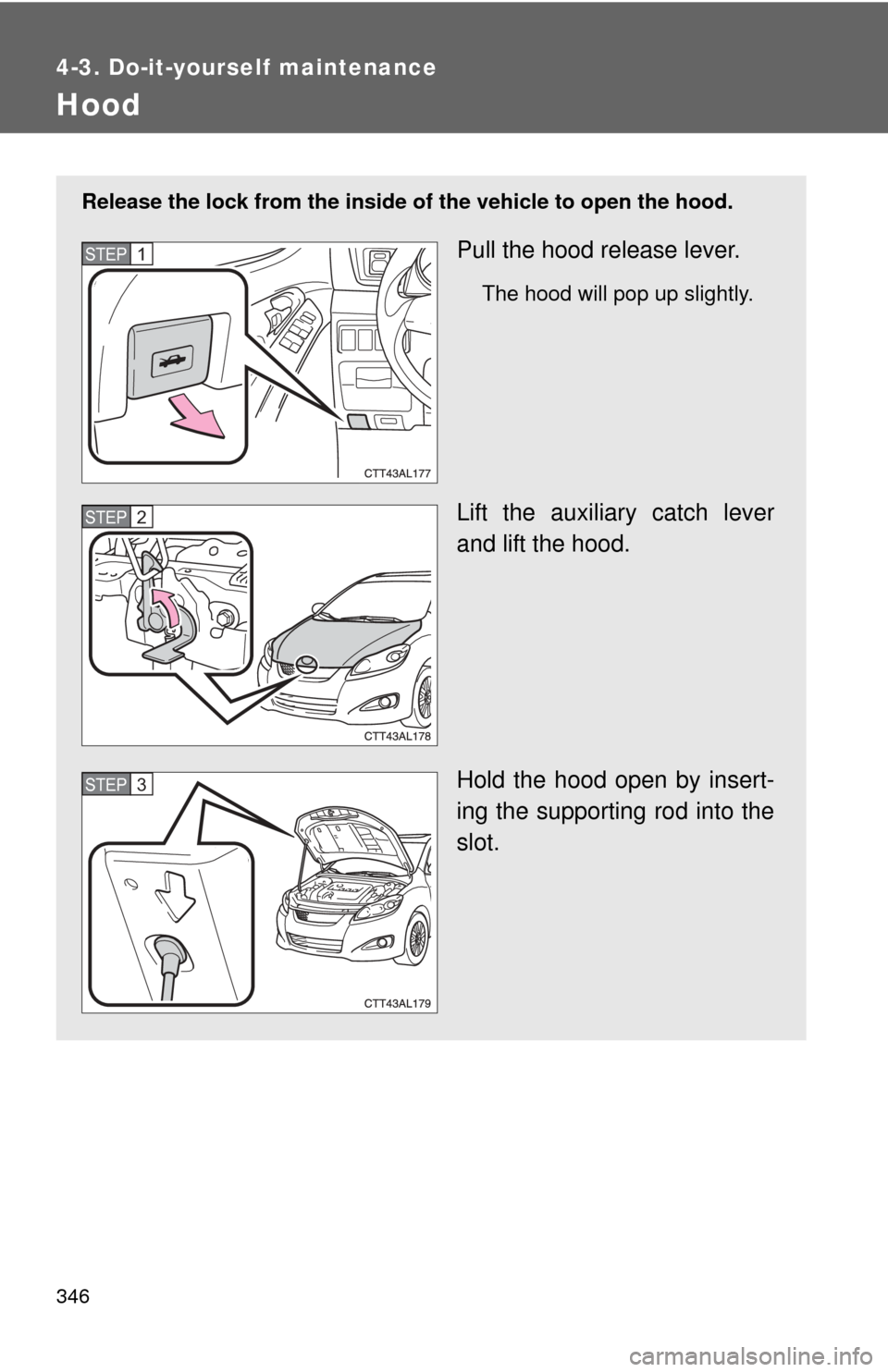
Release the lock from the inside of the vehicle to open the hood.
Pull the hood release lever.
The hood will pop up slightly.
Lift the auxiliary catch lever
and lift the hood.
Hold the hood open by insert-
ing the supporting rod into the
slot.
STEP1
STEP2
STEP3
Page 493 of 516
493
7
For owners
SRS airbag instructions for Canadian owners (in French)
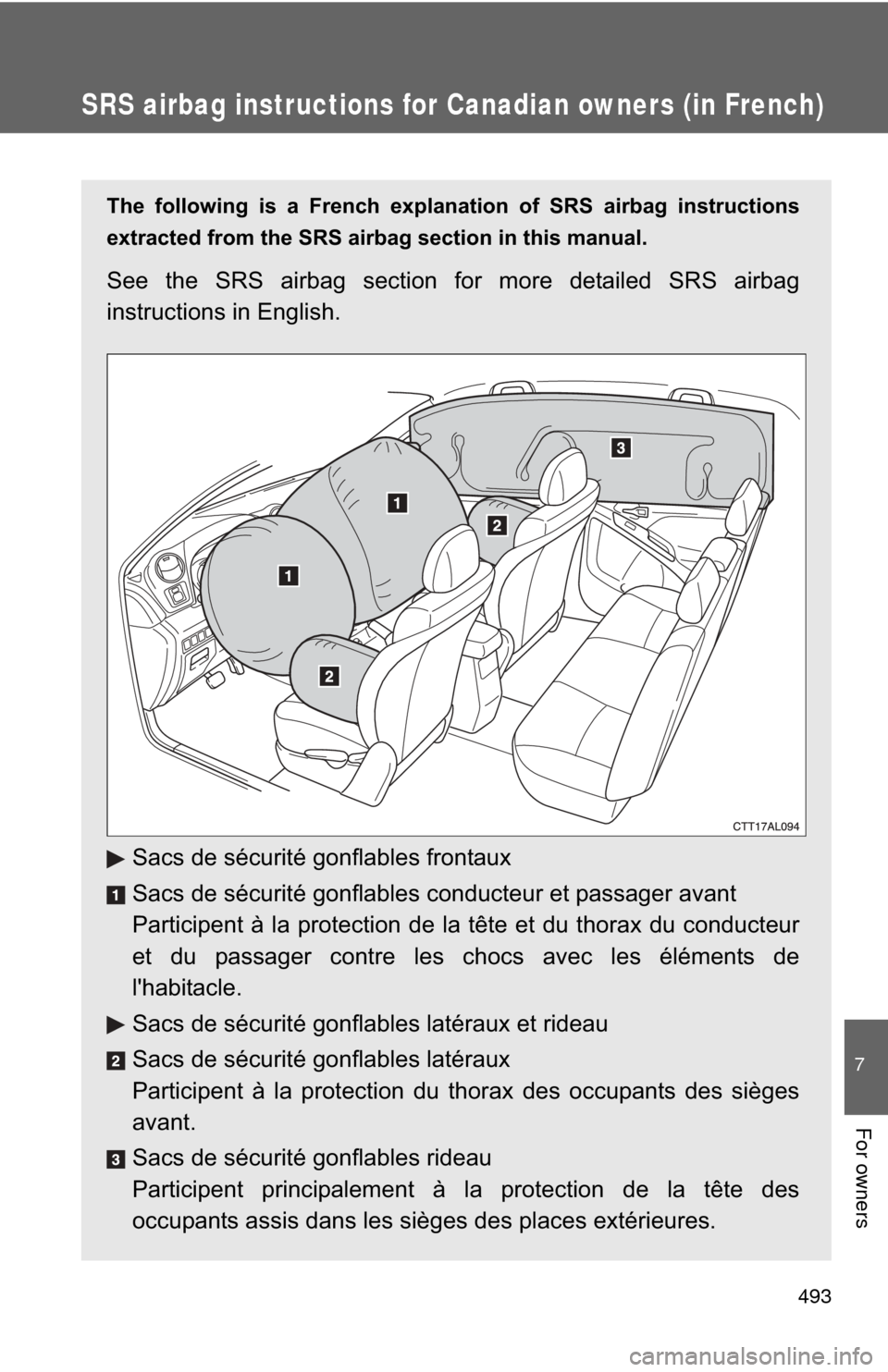
The following is a French explanation of SRS airbag instructions
extracted from the SRS airbag section in this manual.
See the SRS airbag section for more detailed SRS airbag
instructions in English.Sacs de sécurité gonflables frontaux
Sacs de sécurité gonflables conducteur et passager avant
Participent à la protection de la tête et du thorax du conducteur
et du passager contre les chocs avec les éléments de
l'habitacle.
Sacs de sécurité gonflables latéraux et rideau
Sacs de sécurité gonflables latéraux
Participent à la protection du thorax des occupants des sièges
avant.
Sacs de sécurité gonflables rideau
Participent principalement à la protection de la tête des
occupants assis dans les sièges des places extérieures.
Page 494 of 516
494
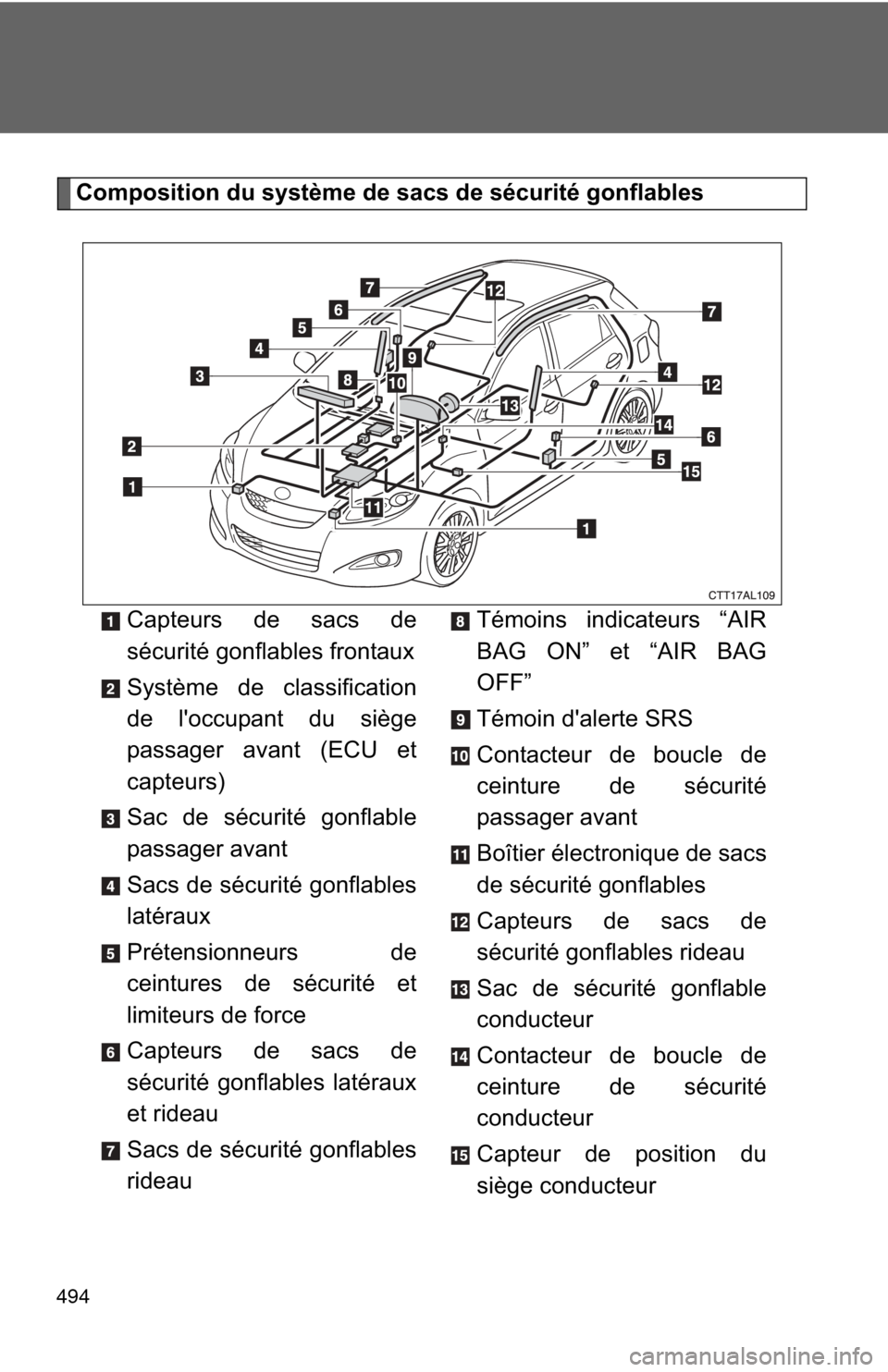
Composition du système de sacs de sécurité gonflablesCapteurs de sacs de
sécurité gonflables frontaux
Système de classification
de l'occupant du siège
passager avant (ECU et
capteurs)
Sac de sécurité gonflable
passager avant
Sacs de sécurité gonflables
latéraux
Prétensionneurs de
ceintures de sécurité et
limiteurs de force
Capteurs de sacs de
sécurité gonflables latéraux
et rideau
Sacs de sécurité gonflables
rideau Témoins indicateurs “AIR
BAG ON” et “AIR BAG
OFF”
Témoin d'alerte SRS
Contacteur de boucle de
ceinture de sécurité
passager avant
Boîtier électronique de sacs
de sécurité gonflables
Capteurs de sacs de
sécurité gonflables rideau
Sac de sécurité gonflable
conducteur
Contacteur de boucle de
ceinture de sécurité
conducteur
Capteur de position du
siège conducteur
Page 495 of 516
495
7
For owners
Votre véhicule est équipé de ADVANCED AIRBAGS conçus selon les
normes de sécurité américaines applicables aux véhicules à moteur
(FMVSS208). Le boîtier électronique (ECU) des sacs de sécurité
gonflables régule le déploiement de ces derniers sur la base des
informations qu'il reçoit des capteurs, etc. indiqués ci-dessus dans le
schéma illustrant les composants du système. Parmi ces
informations figurent la gravité du choc et l'occupation du véhicule
par les passagers. Le déploiement rapide des airbags est obtenu au
moyen d'une réaction chimique dans les dispositifs pyrotechniques,
qui produit un gaz inoffensif permettant d'amortir le mouvement des
occupants.