inflation pressure TOYOTA MATRIX 2012 E140 / 2.G Owners Manual
[x] Cancel search | Manufacturer: TOYOTA, Model Year: 2012, Model line: MATRIX, Model: TOYOTA MATRIX 2012 E140 / 2.GPages: 516, PDF Size: 7.02 MB
Page 4 of 516

TABLE OF CONTENTSIndex
4
3-5. Using the interior lightsInterior lights list ................. 296
• Interior light ...................... 297
• Personal/interior lights...... 298
• Personal lights ................. 299
3-6. Using the storage features List of storage features....... 300
• Glove box ......................... 301
• Console box ..................... 301
• Cup holders ...................... 302
• Bottle holders ................... 304
• Auxiliary boxes ................. 305
3-7. Other interior features Sun visors .......................... 307
Vanity mirrors ..................... 308
Clock .................................. 309
Ashtrays ............................. 310
Cigarette lighter .................. 311
Power outlet ....................... 312
Grocery bag hook............... 314
Seatback table ................... 316
Floor mat ............................ 317
Luggage compartment feature .............................. 318
Compass ............................ 325 4-1. Maintenance and care
Cleaning and protecting the vehicle exterior ........... 330
Cleaning and protecting the vehicle interior ............ 333
4-2. Maintenance Maintenance requirements .................... 336
General maintenance ......... 338
Emission inspection and maintenance (I/M)
programs .......................... 341
4-3. Do-it-yourself maintenance Do-it-yourself service precautions ....................... 342
Hood ................................... 346
Positioning a floor jack........ 348
Engine compartment .......... 351
Tires.................................... 365
Tire inflation pressure ......... 374
Wheels................................ 378
Air conditioning filter ........... 381
Key battery ......................... 383
Checking and replacing fuses ................................. 385
Light bulbs .......................... 394
4Maintenance and care
Page 7 of 516
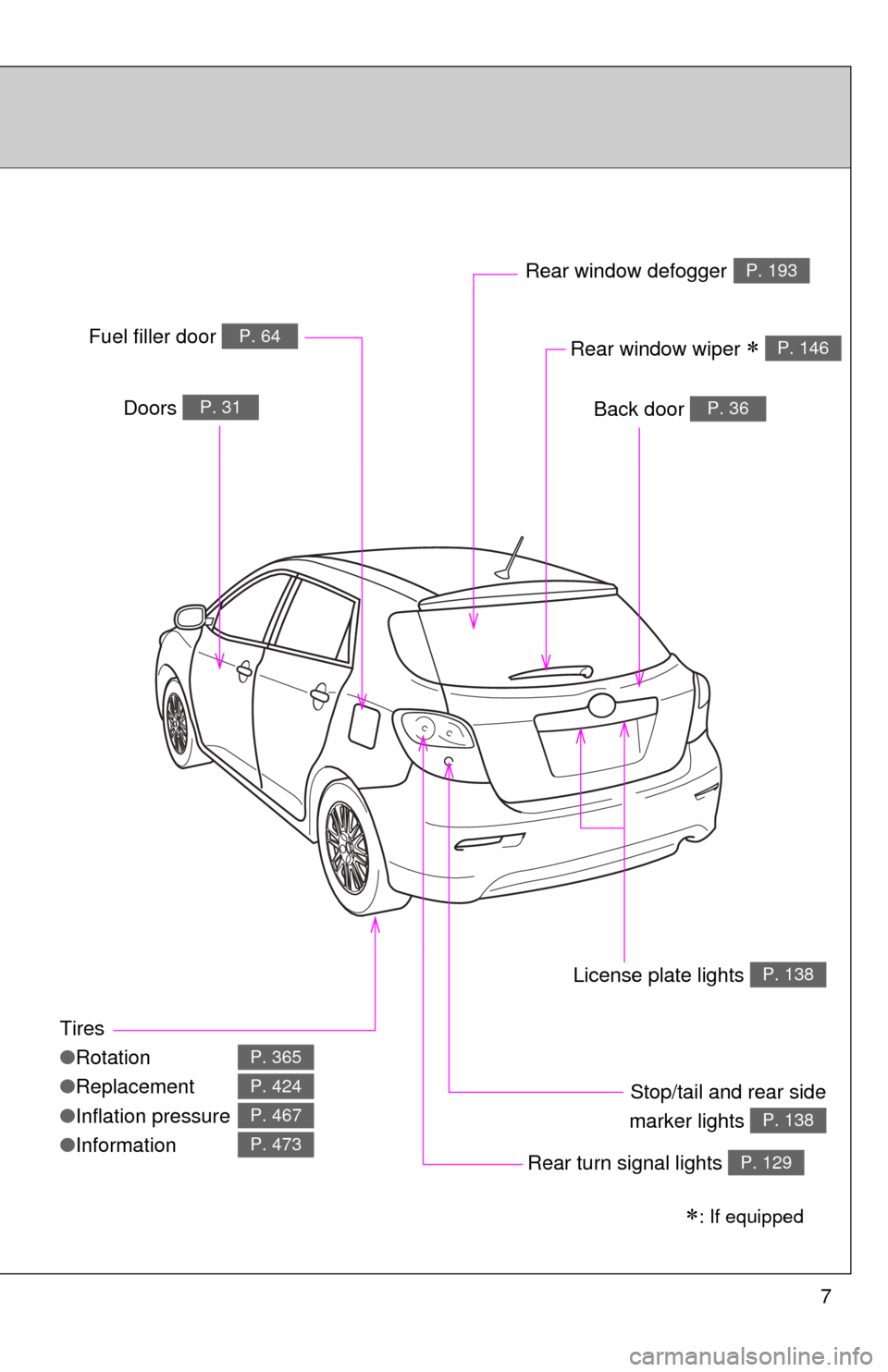
7
Tires
●Rotation
● Replacement
● Inflation pressure
● Information
P. 365
P. 424
P. 467
P. 473
Back door P. 36Doors P. 31
Fuel filler door P. 64
Rear turn signal lights P. 129
Rear window defoggerP. 193
: If equipped
Stop/tail and rear side
marker lights
P. 138
Rear window wiper P. 146
License plate lights P. 138
Page 329 of 516
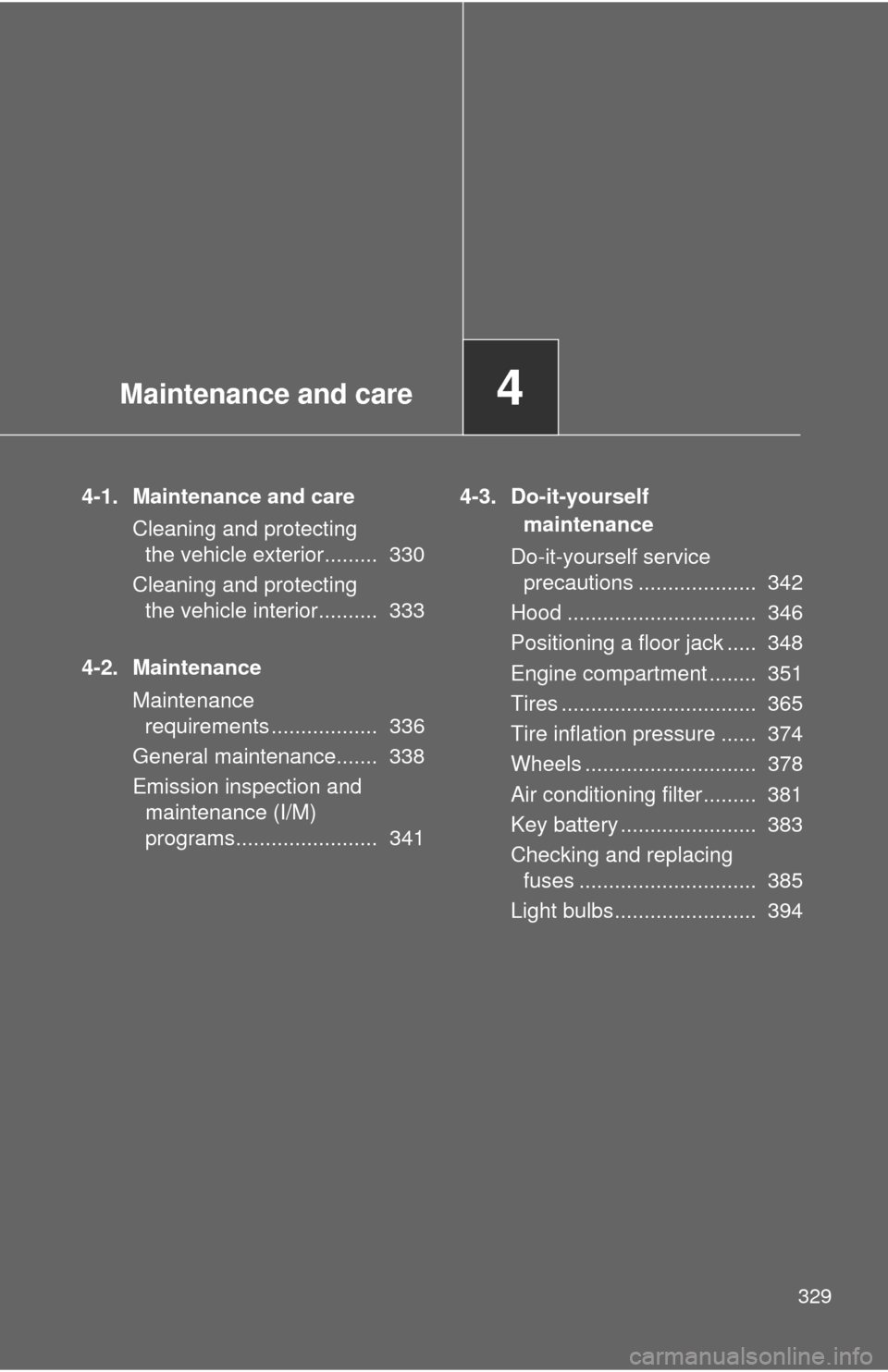
Maintenance and care4
329
4-1. Maintenance and careCleaning and protecting the vehicle exterior......... 330
Cleaning and protecting the vehicle interior.......... 333
4-2. Maintenance Maintenance requirements .................. 336
General maintenance....... 338
Emission inspection and maintenance (I/M)
programs........................ 341 4-3. Do-it-yourself
maintenance
Do-it-yourself service precautions .................... 342
Hood ................................ 346
Positioning a floor jack ..... 348
Engine compartment ........ 351
Tires ................................. 365
Tire inflation pressure ...... 374
Wheels ............................. 378
Air conditioning filter......... 381
Key battery ....................... 383
Checking and replacing fuses .............................. 385
Light bulbs........................ 394
Page 340 of 516
340 4-2. Maintenance
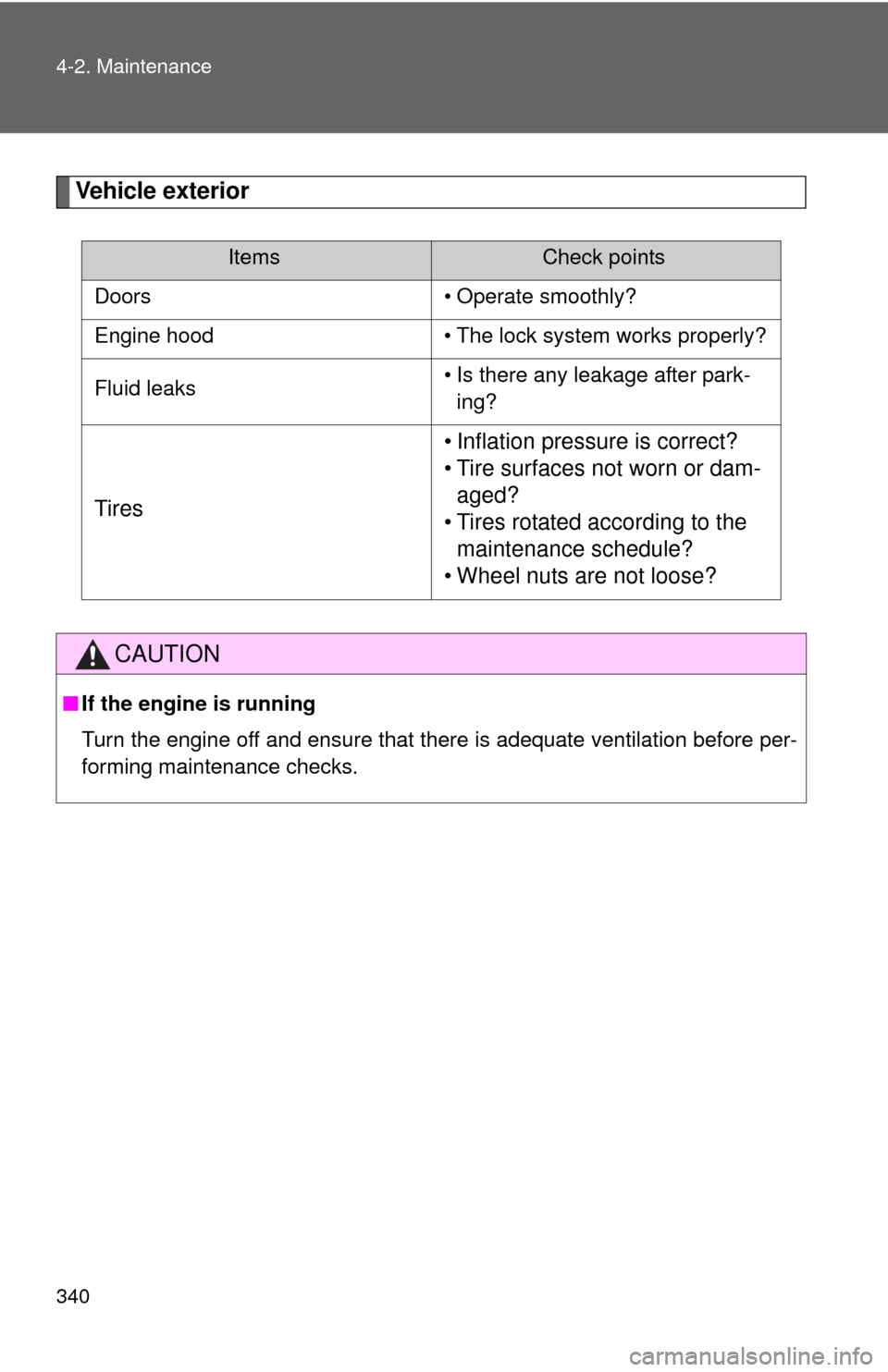
Vehicle exterior
ItemsCheck points
Doors • Operate smoothly?
Engine hood • The lock system works properly?
Fluid leaks • Is there any leakage after park-
ing?
Tires • Inflation pressure is correct?
• Tire surfaces not worn or dam-
aged?
• Tires rotated according to the maintenance schedule?
• Wheel nuts are not loose?
CAUTION
■ If the engine is running
Turn the engine off and ensure that there is adequate ventilation before per-
forming maintenance checks.
Page 343 of 516
343
4-3. Do-it-yourself maintenance
4
Maintenance and care
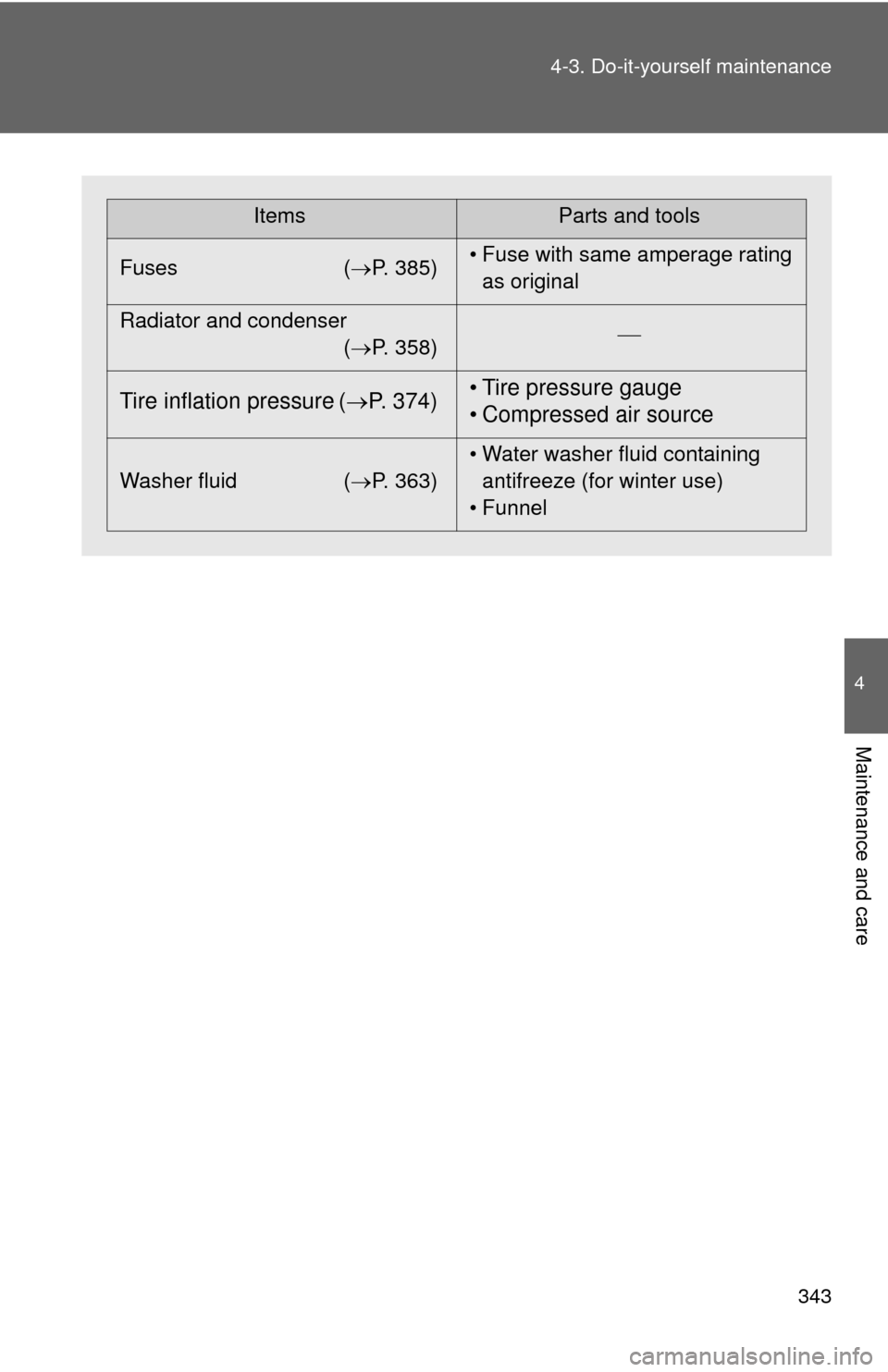
ItemsParts and tools
Fuses ( P. 385)• Fuse with same amperage rating
as original
Radiator and condenser (P. 358)
Tire inflation pressure (
P. 374) • Tire pressure gauge
• Compressed air source
Washer fluid
(P. 363) • Water washer fluid containing
antifreeze (for winter use)
• Funnel
Page 365 of 516
365
4-3. Do-it-yourself maintenance
4
Maintenance and care
Tires
Replace or rotate tires in accordance with maintenance sched-
ules and treadwear.
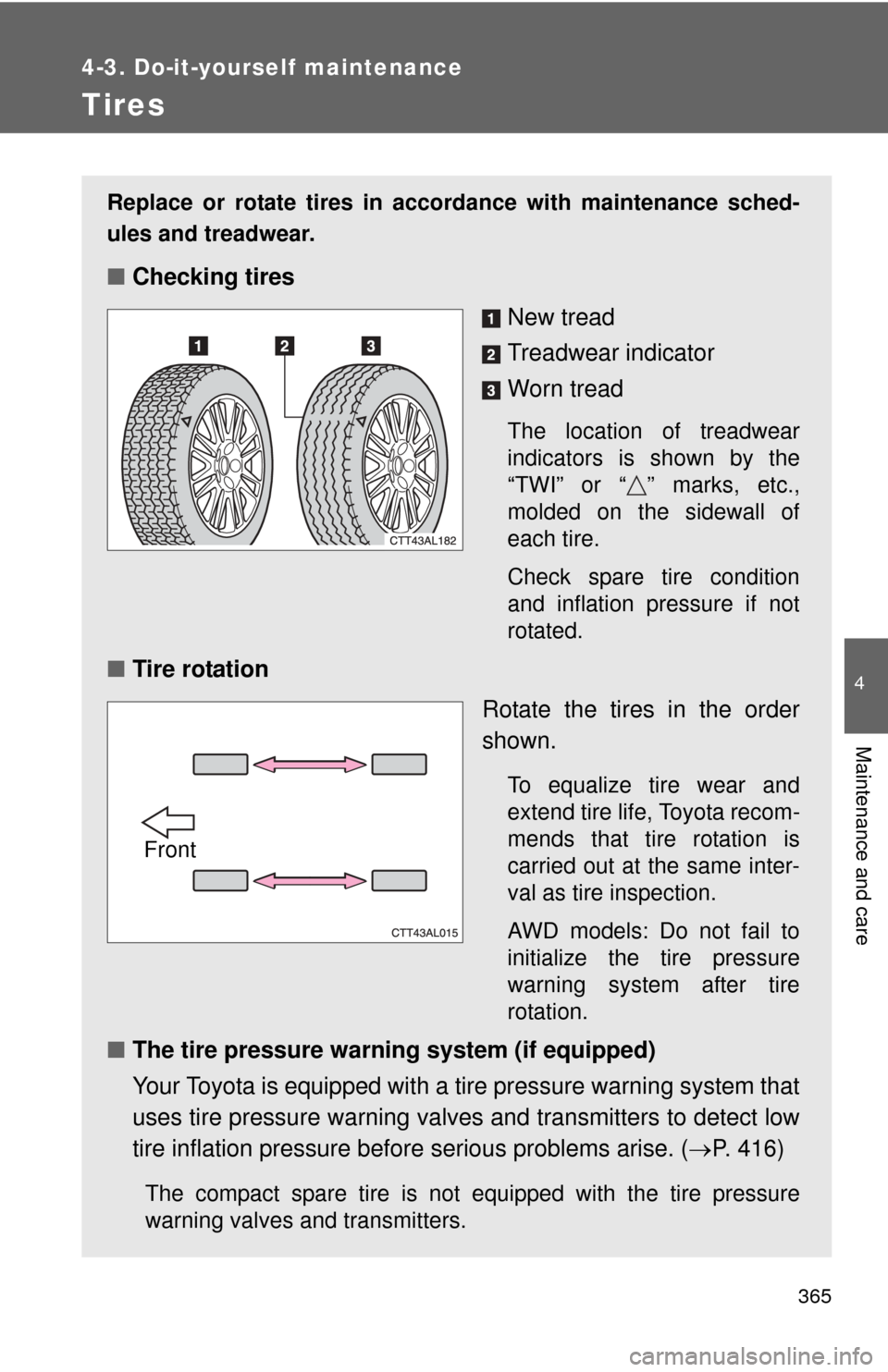
■Checking tires
New tread
Treadwear indicator
Worn tread
The location of treadwear
indicators is shown by the
“TWI” or “ ” marks, etc.,
molded on the sidewall of
each tire.
Check spare tire condition
and inflation pressure if not
rotated.
■Tire rotation
Rotate the tires in the order
shown.
To equalize tire wear and
extend tire life, Toyota recom-
mends that tire rotation is
carried out at the same inter-
val as tire inspection.
AWD models: Do not fail to
initialize the tire pressure
warning system after tire
rotation.
■The tire pressure warning system (if equipped)
Your Toyota is equipped with a tire pressure warning system that
uses tire pressure warning valves and transmitters to detect low
tire inflation pressure before serious problems arise. (P. 416)
The compact spare tire is not equipped with the tire pressure
warning valves and transmitters.
Front
Page 366 of 516

366 4-3. Do-it-yourself maintenance
Installing tire pressure warning valves and transmittersWhen replacing tires or wheels, tire pressure warning valves and
transmitters must also be installed.
When new tire pressure warning valves and transmitters are
installed, new tire pressure warn ing valve and transmitter ID codes
must be registered in the tire pressure warning computer and the tire
pressure warning system must be initialized. Have tire pressure
warning valve and transmitter ID codes registered by your Toyota
dealer
. ( P. 368)
Initializing the tire pressure warning system
■ The tire pressure warning system must be initialized in the fol-
lowing circumstances:
● When rotating the tires on vehicles differing with front and rear tire
inflation pressure.
● When changing the tire size.
When the tire pressure warning syst em is initialized, the current tire
inflation pressure is set as the pressure benchmark.
Page 367 of 516
367
4-3. Do-it-yourself maintenance
4
Maintenance and care
■
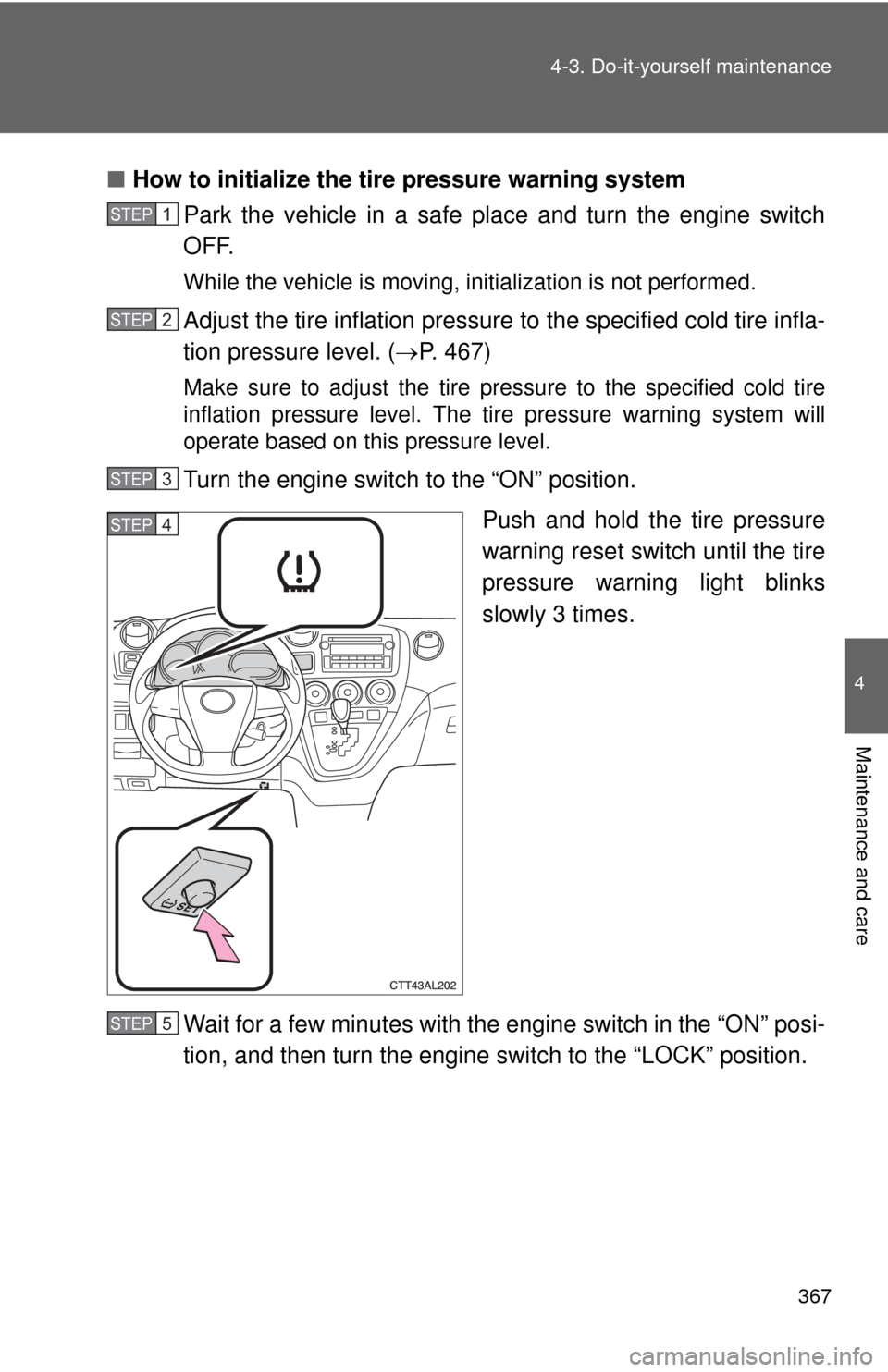
How to initialize the tire pressure warning system
Park the vehicle in a safe pl ace and turn the engine switch
OFF.
While the vehicle is moving, in itialization is not performed.
Adjust the tire inflation pressure to the specified cold tire infla-
tion pressure level. ( P. 467)
Make sure to adjust the tire pressure to the specified cold tire
inflation pressure level. The ti re pressure warning system will
operate based on this pressure level.
Turn the engine switch to the “ON” position.
Push and hold the tire pressure
warning reset switch until the tire
pressure warning light blinks
slowly 3 times.
Wait for a few minutes with the engine switch in the “ON” posi-
tion, and then turn the engine switch to the “LOCK” position.
STEP1
STEP2
STEP3
STEP4
STEP5
Page 369 of 516
369
4-3. Do-it-yourself maintenance
4
Maintenance and care
■When the initialization of the tire pressure warning system has
failed
Initialization can be completed in a few minutes. However, in the follow-
ing cases, the settings have not b
een recorded and the system will not
operate properly. If repeated attempts to record tire inflation pressure
settings are unsuccessful, have the vehicle inspected by your Toyota
dealer.
●When operating the tire pressure warning reset switch, the tire pres-
sure warning light doe s not blink 3 times.
●After carrying out the initialization procedure, the tire pressure warn-
ing light blinks for 1 minute then stays on after driving for about 20
minutes.
■Routine tire inflation pressure checks
The tire pressure warning system doe s not replace routine tire inflation
pressure checks. Make su re to check tire inflation pressure as part of
your routine of daily vehicle checks.
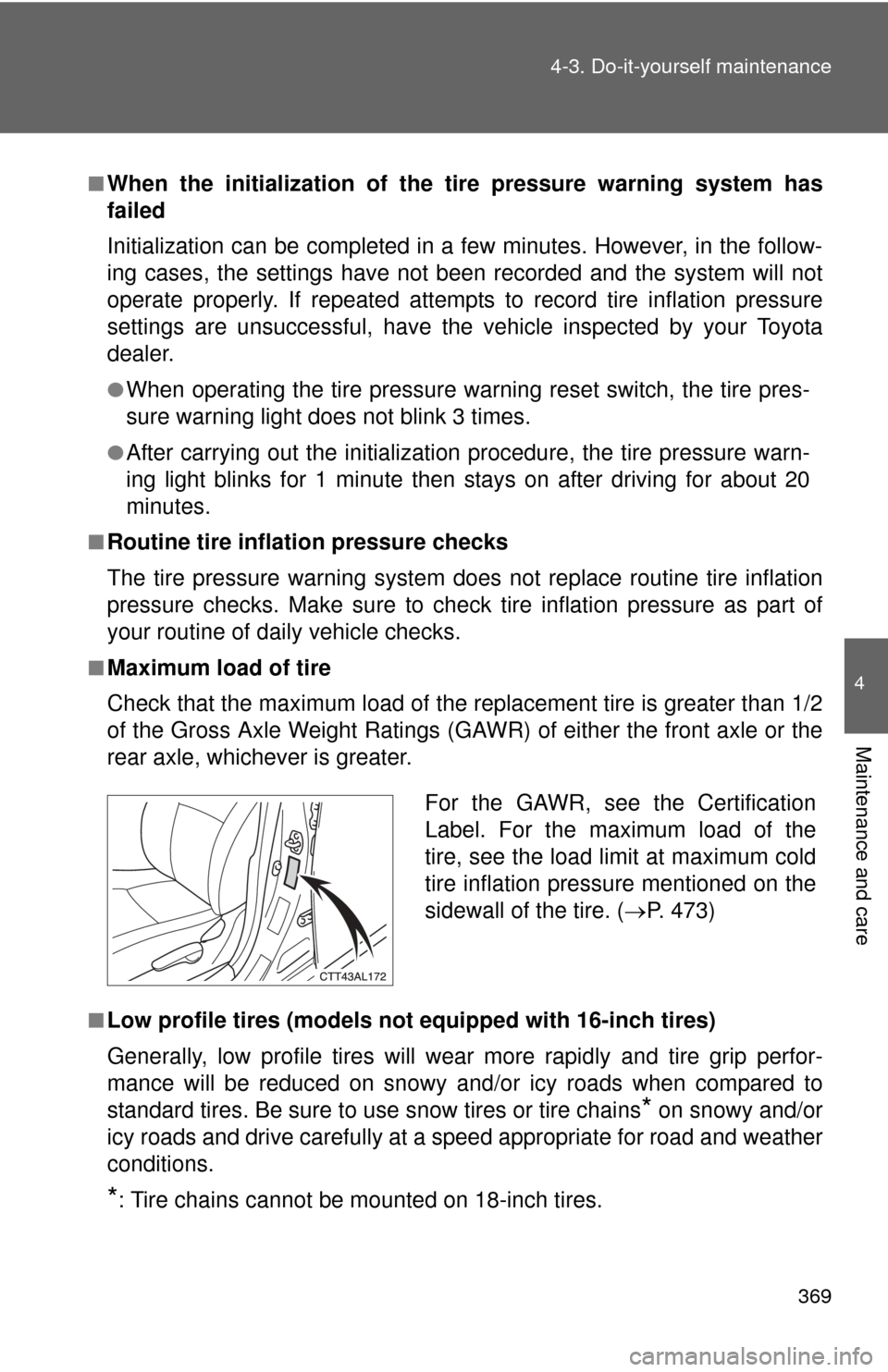
■Maximum load of tire
Check that the maximum load of the replacement tire is greater than 1/2
of the Gross Axle Weight Ratings (GAW R) of either the front axle or the
rear axle, whichever is greater.
■Low profile tires (models not equipped with 16-inch tires)
Generally, low profile tire s will wear more rapidly and tire grip perfor-
mance will be reduced on snowy and/or icy roads when compared to
standard tires. Be sure to use snow tires or tire chains
* on snowy and/or
icy roads and drive carefully at a speed appropriate for road and weather
conditions.
*: Tire chains cannot be mounted on 18-inch tires.
For the GAWR, see the Certification
Label. For the maximum load of the
tire, see the load limit at maximum cold
tire inflation pressure mentioned on the
sidewall of the tire. ( P. 473)
Page 372 of 516

372 4-3. Do-it-yourself maintenance
CAUTION
■When inspecting or replacing tires
Observe the following precautions to prevent accidents. Failure to do so
may cause damage to parts of the drive train, as well as dangerous han-
dling characteristics, which may lead to an accident resulting in death or
serious injury.
● Do not mix tires of different makes, models or tread patterns. Also, do not
mix tires of remarkably different treadwear.
●
Do not use tire sizes other than those recommended by Toyota.
● Do not mix differently constructed tires (radial, bias-belted or bias-ply
tires).
●
Do not mix summer, all season and winter tires.
■When initializing the tire pressure warning system
Do not push the tire pressure warnin g reset switch without first adjusting
the tire inflation pressure to the spec ified level. Otherwise, the tire pres-
sure warning light may not come on ev en if the tire inflation pressure is
low, or it may come on when the tire inflation pressure is actually normal.