manual transmission TOYOTA MATRIX 2012 E140 / 2.G Owners Manual
[x] Cancel search | Manufacturer: TOYOTA, Model Year: 2012, Model line: MATRIX, Model: TOYOTA MATRIX 2012 E140 / 2.GPages: 516, PDF Size: 7.02 MB
Page 2 of 516

TABLE OF CONTENTSIndex
2
1-1. Key informationKeys ..................................... 26
1-2. Opening, closing and
locking the doors
Wireless remote control ....... 28
Doors.................................... 31
Back door ............................. 36
1-3. Adjustable components
(seats, mirrors,
steering wheel)
Front seats ........................... 40
Rear seats ............................ 44
Head restraints ..................... 46
Seat belts ............................. 48
Steering wheel ..................... 54
Anti-glare inside rear view mirror.......................... 55
Outside rear view mirrors ..... 57
1-4. Opening a nd closing the
windo ws
Power windows .................... 59
Moon roof ............................. 61
1-5. Refueling Opening the fuel tank cap .... 64
1-6. Theft deterrent system Engine immobilizer system ................................ 68
Theft prevention labels ......... 70 1-7. Safety information
Correct driving posture ......... 71
SRS airbags ......................... 73
Front passenger occupant classification system ........... 85
Child restraint systems ......... 90
Installing child restraints ....... 94
2-1. Driving procedures Driving the vehicle .............. 106
Engine (ignition) switch....... 118
Automatic transmission ...... 122
Manual transmission........... 127
Turn signal lever ................. 129
Parking brake ..................... 130
Horn .................................... 131
2-2. Instrument cluster Gauges and meters ............ 132
Indicators and warning lights ................................. 135
2-3. Operating the lights and wipers
Headlight switch ................. 138
Fog light switch ................... 141
Windshield wipers and washer .............................. 143
Rear window wiper and washer .............................. 146
1Before driving
2When driving
Page 3 of 516

1
2
3
4
5
6
7
3
2-4. Using other drivingsystems
Cruise control ...................... 148
Driving assist systems ........ 152
2-5. Driving information Cargo and luggage ............. 157
Vehicle load limits ............... 160
Winter driving tips ............... 161
Trailer towing (1.8 L 4-cylinder
[2ZR-FE] engine) .............. 165
Trailer towing (2.4 L 4-cylinder
[2AZ-FE] engine) .............. 166
Dinghy towing (automatic transmission) .................... 181
Dinghy towing (manual transmission) .................... 182
3-1. Using the air conditioning
system a nd defogger
Air conditioning system ....... 186
Rear window and outside rear view
mirror defoggers ............... 193
3-2. Using the audio system Audio system types ............. 194
Using the radio .................... 197
Using the CD player ............ 204
Playing MP3 and WMA discs.................................. 211
Operating an iPod ............... 220 Operating a USB
memory ............................ 227
Optimal use of the audio system .............................. 235
Using the AUX port............. 239
Using the steering wheel audio switches.................. 241
3-3. Using the Bluetooth
®
audio s ystem
Bluetooth
® audio system .... 244
Using the Bluetooth®
audio system .................... 247
Operating a Bluetooth
®
enabled portable player.... 253
Setting up a Bluetooth
®
enabled portable player.... 255
Bluetooth
® audio system
setup ................................ 260
3-4. Using the ha nds-free
phone system
( for cellular phone)
Hands-free phone system (for cellular phone)
features ............................ 261
Using the hands-free phone system
(for cellular phone) ........... 266
Making a phone call ........... 276
Setting a cellular phone ...... 280
Security and system setup ................................ 285
Using the phone book ........ 289
3Interior features
Page 105 of 516
When driving2
105
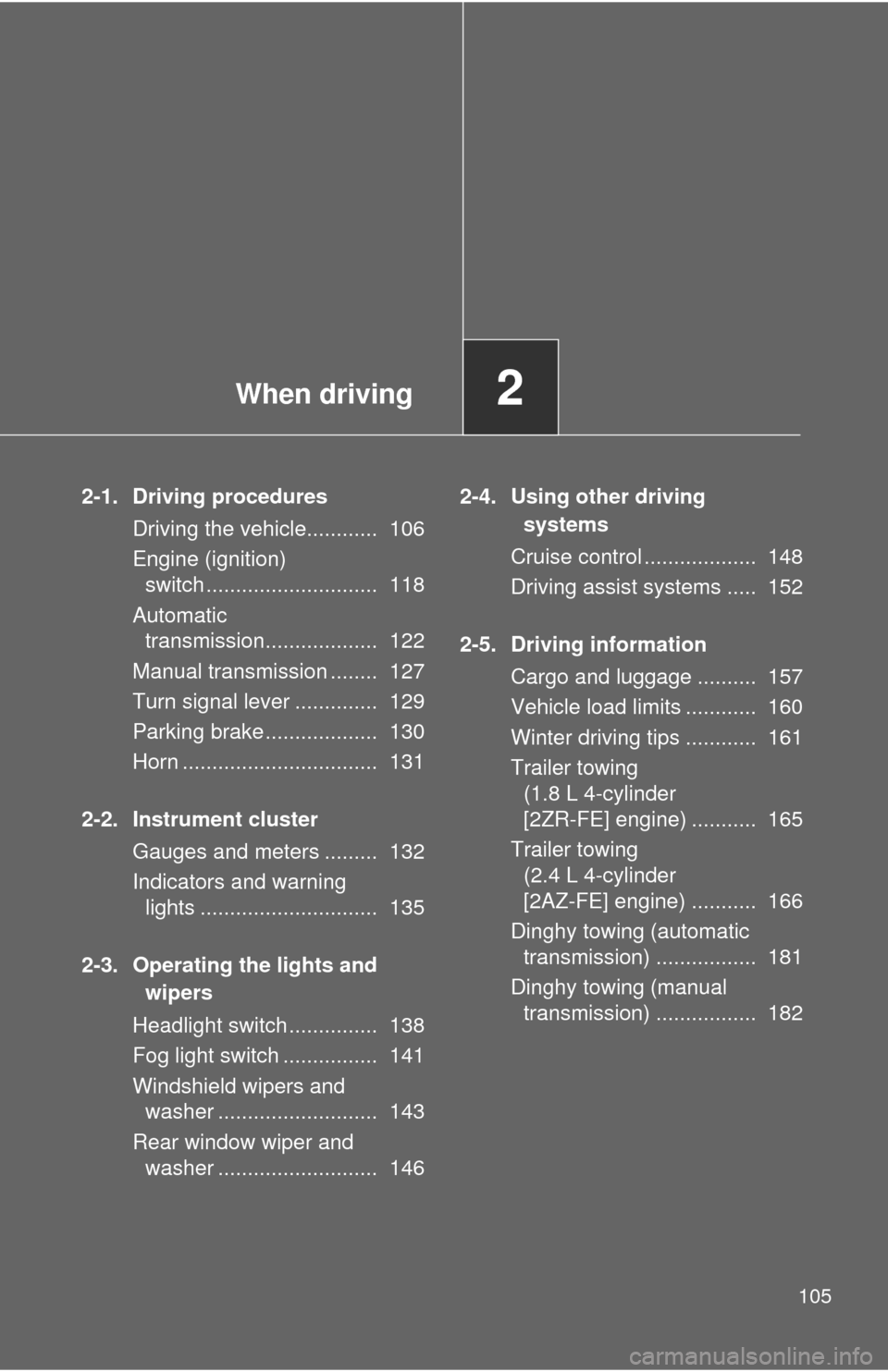
2-1. Driving proceduresDriving the vehicle............ 106
Engine (ignition) switch ............................. 118
Automatic transmission................... 122
Manual transmission ........ 127
Turn signal lever .............. 129
Parking brake ................... 130
Horn ................................. 131
2-2. Instrument cluster Gauges and meters ......... 132
Indicators and warning lights .............................. 135
2-3. Operating the lights and wipers
Headlight switch ............... 138
Fog light switch ................ 141
Windshield wipers and washer ........................... 143
Rear window wiper and washer ........................... 146 2-4. Using other driving
systems
Cruise control ................... 148
Driving assist systems ..... 152
2-5. Driving information Cargo and luggage .......... 157
Vehicle load limits ............ 160
Winter driving tips ............ 161
Trailer towing (1.8 L 4-cylinder
[2ZR-FE] engine) ........... 165
Trailer towing (2.4 L 4-cylinder
[2AZ-FE] engine) ........... 166
Dinghy towing (automatic transmission) ................. 181
Dinghy towing (manual transmission) ................. 182
Page 106 of 516
106
2-1. Driving procedures
Driving the vehicle
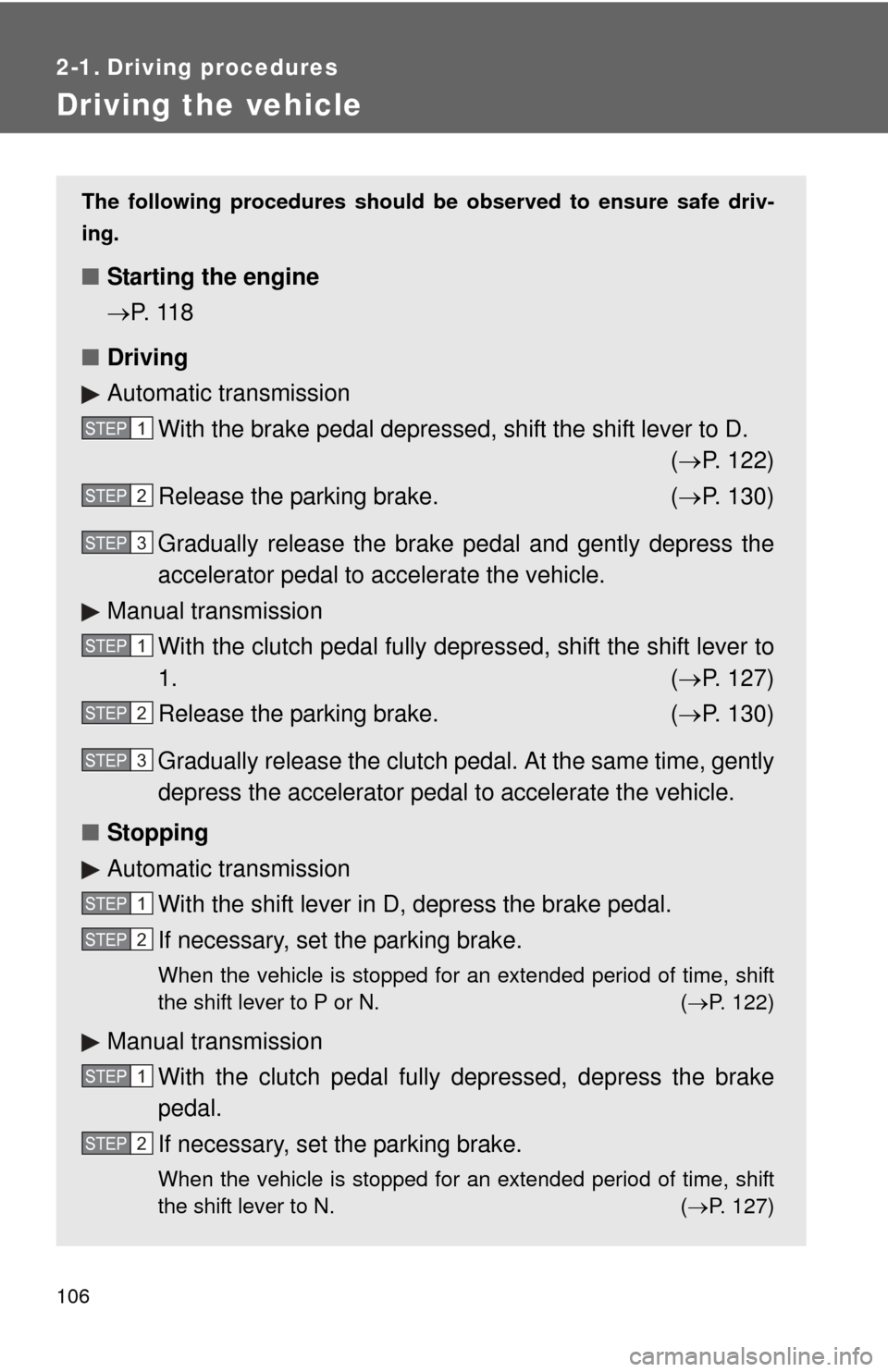
The following procedures should be observed to ensure safe driv-
ing.
■ Starting the engine
P. 11 8
■ Driving
Automatic transmission
With the brake pedal depressed, shift the shift lever to D. ( P. 122)
Release the parking brake. ( P. 130)
Gradually release the brake pedal and gently depress the
accelerator pedal to accelerate the vehicle.
Manual transmission With the clutch pedal fully depressed, shift the shift lever to
1. ( P. 127)
Release the parking brake. ( P. 130)
Gradually release the clutch pedal. At the same time, gently
depress the accelerator pedal to accelerate the vehicle.
■ Stopping
Automatic transmission
With the shift lever in D, depress the brake pedal.
If necessary, set the parking brake.
When the vehicle is stopped for an extended period of time, shift
the shift lever to P or N. ( P. 122)
Manual transmission
With the clutch pedal fully depressed, depress the brake
pedal.
If necessary, set the parking brake.
When the vehicle is stopped for an extended period of time, shift
the shift lever to N. ( P. 127)
STEP1
STEP2
STEP3
STEP1
STEP2
STEP3
STEP1
STEP2
STEP1
STEP2
Page 107 of 516
107
2-1. Driving procedures
2
When driving
■
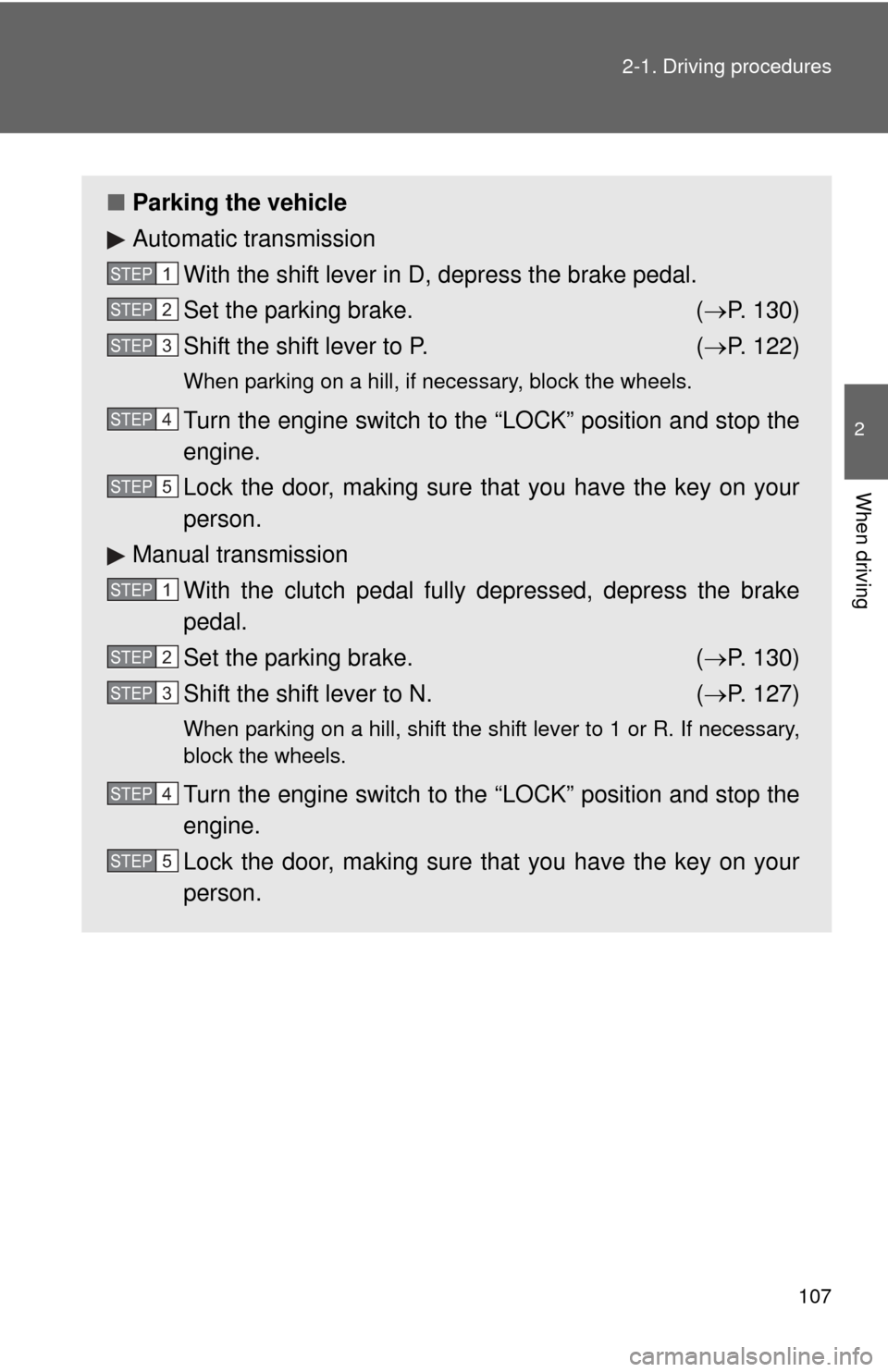
Parking the vehicle
Automatic transmission
With the shift lever in D, depress the brake pedal.
Set the parking brake. ( P. 130)
Shift the shift lever to P. ( P. 122)
When parking on a hill, if necessary, block the wheels.
Turn the engine switch to the “LOCK” position and stop the
engine.
Lock the door, making sure that you have the key on your
person.
Manual transmission With the clutch pedal fully depressed, depress the brake
pedal.
Set the parking brake. ( P. 130)
Shift the shift lever to N. ( P. 127)
When parking on a hill, shift the shift lever to 1 or R. If necessary,
block the wheels.
Turn the engine switch to the “LOCK” position and stop the
engine.
Lock the door, making sure that you have the key on your
person.
STEP1
STEP2
STEP3
STEP4
STEP5
STEP1
STEP2
STEP3
STEP4
STEP5
Page 108 of 516
108 2-1. Driving procedures
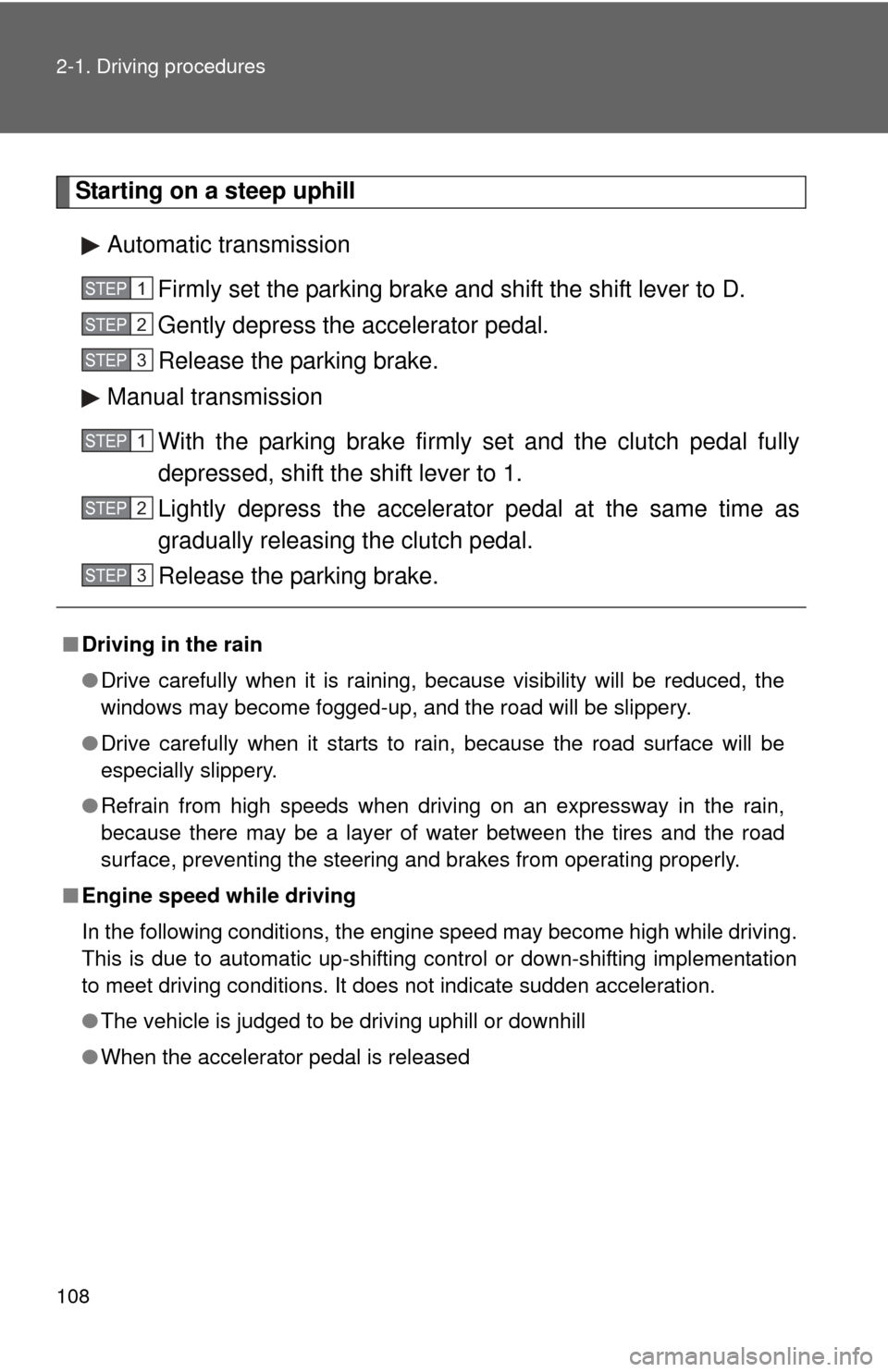
Starting on a steep uphillAutomatic transmission Firmly set the parking brake and shift the shift lever to D.
Gently depress the accelerator pedal.
Release the parking brake.
Manual transmission
With the parking brake firmly set and the clutch pedal fully
depressed, shift the shift lever to 1.
Lightly depress the accelerator pedal at the same time as
gradually releasing the clutch pedal.
Release the parking brake.
■Driving in the rain
●Drive carefully when it is raining, because visibility will be reduced, the
windows may become fogged-up, and the road will be slippery.
● Drive carefully when it starts to rain, because the road surface will be
especially slippery.
● Refrain from high speeds when driving on an expressway in the rain,
because there may be a layer of water between the tires and the road
surface, preventing the steering and brakes from operating properly.
■ Engine speed while driving
In the following conditions, the engine speed may become high while driving.
This is due to automatic up-shifting control or down-shifting implementation
to meet driving conditions. It does not indicate sudden acceleration.
●The vehicle is judged to be driving uphill or downhill
● When the accelerator pedal is released
STEP1
STEP2
STEP3
STEP1
STEP2
STEP3
Page 109 of 516

109
2-1. Driving procedures
2
When driving
■
Breaking in your new Toyota
To extend the life of the vehicle, the following precautions are recommended
to observe:
●For the first 200 miles (300 km):
Avoid sudden stops.
● For the first 500 miles (800 km):
Do not tow a trailer.
● For the first 1000 miles (1600 km):
• Do not drive at extremely high speeds.
• Avoid sudden acceleration.
• Do not drive slowly with the manual transmission in a high gear.
• Do not drive at a constant speed for extended periods.
■ Drum-in-disc type parking brake system (if equipped)
Your vehicle has a drum-in-disc type parking brake system. This type of
brake system needs bedding-down of the brake shoes periodically or when-
ever the parking brake shoes and/or drum are replaced. Have your Toyota
dealer perform the bedding down.
■ Operating your vehicle in a foreign country
Comply with the relevant vehicle registration laws and confirm the availability
of the correct fuel. ( P. 458)
Page 111 of 516

111
2-1. Driving procedures
2
When driving
CAUTION
●
If the smell of exhaust is noticed inside the vehicle, open the windows and
check that the back door is closed. Large amounts of exhaust in the vehi-
cle can cause driver drowsiness and an accident, resulting in death or a
serious health hazard. Have the vehicle inspected by your Toyota dealer
immediately.
● Vehicles with an automatic transmission: Do not shift the shift lever to P
while the vehicle is moving.
Doing so can damage the transmission and may result in a loss of vehicle\
control.
● Do not shift the shift lever to R while the vehicle is moving forward.
Doing so can damage the transmission and may result in a loss of vehicle\
control.
● Do not shift the shift lever to D (vehicles with an automatic transmission) or
1 (vehicles with a manual transmission) while the vehicle is moving back-
ward.
Doing so can damage the transmission and may result in a loss of vehicle\
control.
● Moving the shift lever to N while the vehicle is moving will disengage the
engine from the transmission. Engine braking is not available when N is
selected.
● During normal driving, do not turn off the engine. Turning the engine off
while driving will not cause loss of steering or braking control, but the
power assist to these systems will be lost. This will make it more difficult to
steer and brake, so you should pull over and stop the vehicle as soon as it
is safe to do so.
However, in the event of an emergency, such as if it becomes impossible
to stop the vehicle in the normal way: P. 451
● Use engine braking (downshift) to maintain a safe speed when driving
down a steep hill. Using the brakes continuously may cause the brakes to
overheat and lose effectiveness. ( P. 123)
Page 116 of 516

116 2-1. Driving procedures
NOTICE
■When driving the vehicle
●Do not depress the accelerator and brake pedals at the same time during
driving. If the brake pedal is depressed while driving with the accelerator
pedal depressed, driving torque may be restrained.
Manual transmission
● Do not shift gears unless the clutch pedal is fully depressed. After shifting,
do not release the clutch pedal abruptly. Doing so may damage the clutch,
transmission and gears.
● Observe the following to prevent the clutch from being damaged.
• Do not rest your foot on the clutch pedal while driving.
Doing so may cause clutch trouble.
• Do not use any gear other than the 1st gear when starting off and mov- ing forward.
Doing so may damage the clutch.
• Do not use the clutch to hold the vehicle when stopping on an uphill grade.
Doing so may damage the clutch.
● Do not shift the shift lever to R when the vehicle is still moving. Doing so
may damage the clutch, transmission and gears.
Automatic transmission
● Do not use the accelerator pedal or depress the accelerator and brake
pedals at the same time to hold the vehicle on a hill.
■ When parking the vehicle (vehicl es with an automatic transmission)
Always put the shift lever in P. Failure to do so may cause the vehicle to
move or the vehicle may accelerate suddenly if the accelerator pedal is acci-
dentally depressed.
■ Avoiding damage to vehicle parts
●Do not turn the steering wheel fully in either direction and hold it there for
an extended period of time.
Doing so may damage the power steering motor.
● When driving over bumps in the road, drive as slowly as possible to avoid
damaging the wheels, underside of the vehicle, etc.
Page 118 of 516
118
2-1. Driving procedures
Engine (ignition) switch
■Starting the engine
Automatic transmission
Check that the parking brake is set.
Check that the shift lever is set in P.
Sit in the driver’s seat and firmly depress the brake pedal.
Turn the engine switch to the “START” position and start
the engine.
1.8 L 4-cylinder (2ZR-FE) engine: The engine will crank until it
starts or for up to 25 seconds, whichever is less. If you turn the
engine switch, the engine will keep cranking for about 30 seconds
maximum.
Continue depressing the brake pedal until the engine is com-
pletely started.
Manual transmissionCheck that the parking brake is set.
Check that the shift lever is set in N.
Firmly depress the clutch pedal.
Turn the engine switch to the “START” position and start
the engine.
1.8 L 4-cylinder (2ZR-FE) engine: The engine will crank until it
starts or for up to 25 seconds, whichever is less. If you turn the
engine switch, the engine will keep cranking for about 30 seconds
maximum.
Continue depressing the brake pedal until the engine is com-
pletely started.
STEP1
STEP2
STEP3
STEP4
STEP1
STEP2
STEP3
STEP4