lights TOYOTA MATRIX 2014 E140 / 2.G Workshop Manual
[x] Cancel search | Manufacturer: TOYOTA, Model Year: 2014, Model line: MATRIX, Model: TOYOTA MATRIX 2014 E140 / 2.GPages: 500, PDF Size: 7.02 MB
Page 384 of 500
384 4-3. Do-it-yourself maintenance
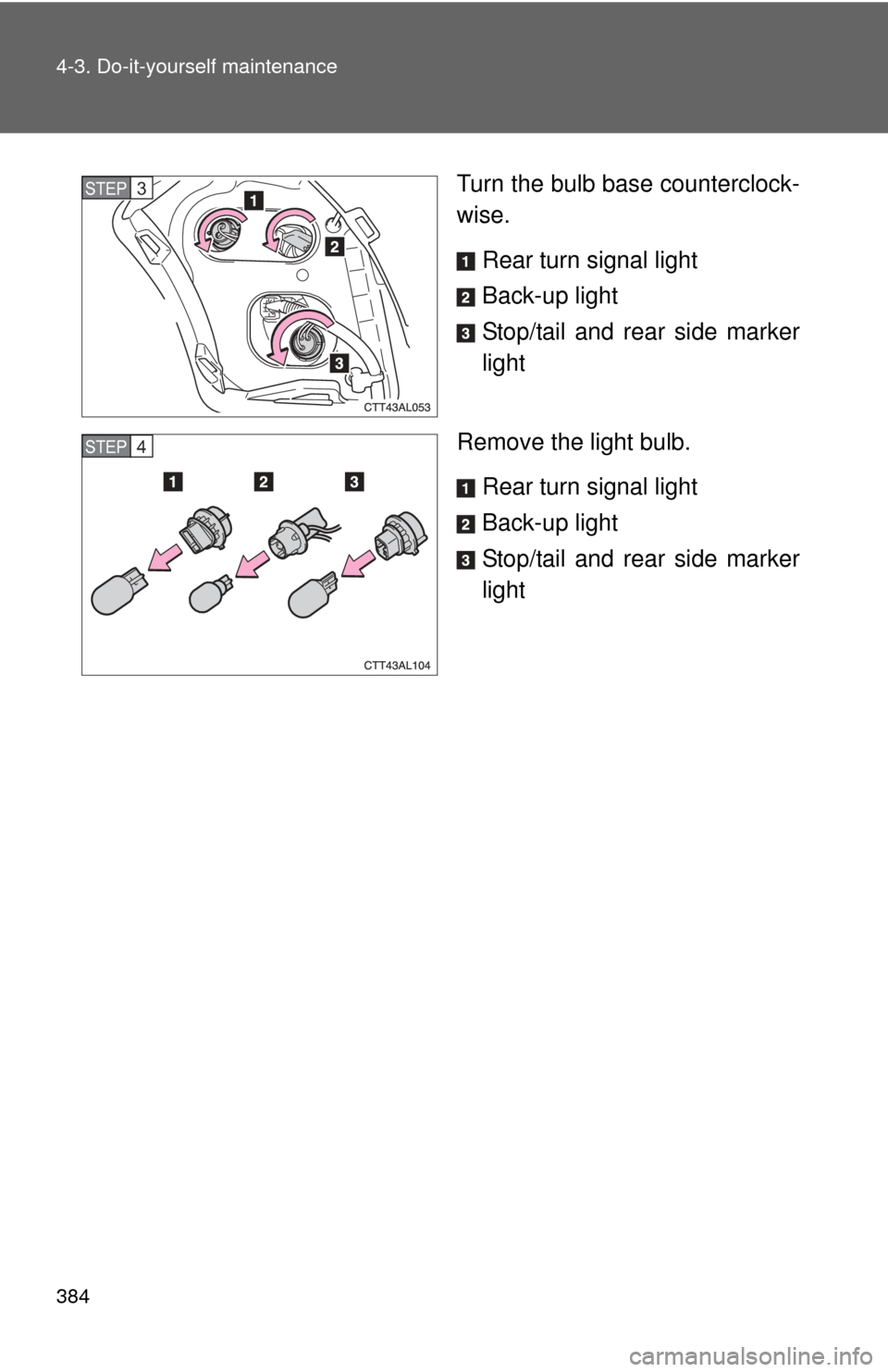
Turn the bulb base counterclock-
wise.Rear turn signal light
Back-up light
Stop/tail and rear side marker
light
Remove the light bulb. Rear turn signal light
Back-up light
Stop/tail and rear side marker
lightSTEP3
STEP4
Page 385 of 500
385
4-3. Do-it-yourself maintenance
4
Maintenance and care
■
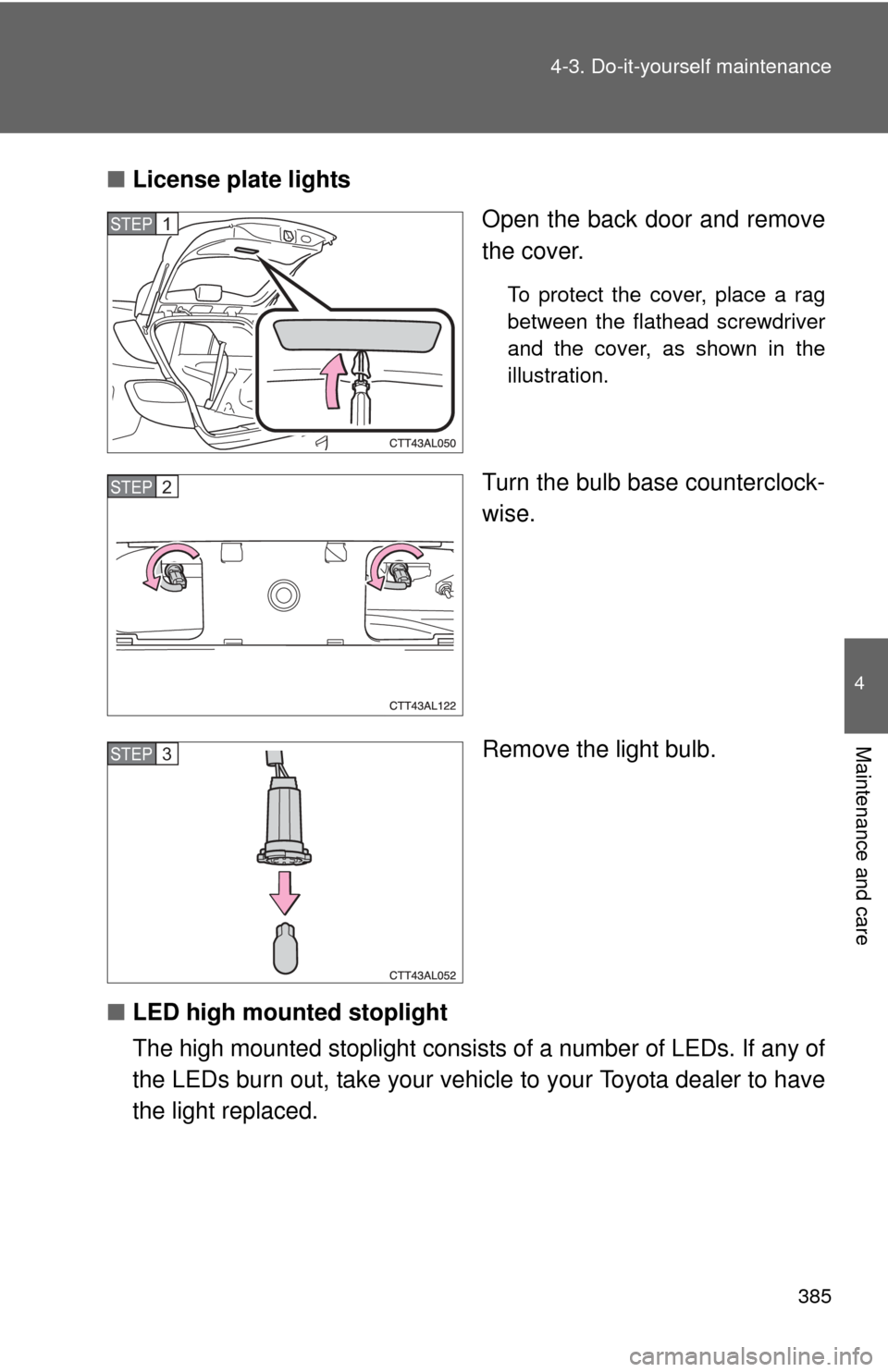
License plate lights
Open the back door and remove
the cover.
To protect the cover, place a rag
between the flathead screwdriver
and the cover, as shown in the
illustration.
Turn the bulb base counterclock-
wise.
Remove the light bulb.
■ LED high mounted stoplight
The high mounted stoplight consists of a numbe r of LEDs. If any of
the LEDs burn out, take your vehicle to your Toyota dealer to have
the light replaced.
STEP1
STEP2
STEP3
Page 386 of 500
386 4-3. Do-it-yourself maintenance
■Condensation build-up on th e inside of the lens
Temporary condensation build-up on the inside of the headlight lens does
not indicate a malfunction. Contact your Toyota dealer for more information
in the following situations:
● Large drops of water are built up on the inside of the lens.
● Water has built up inside the headlight.
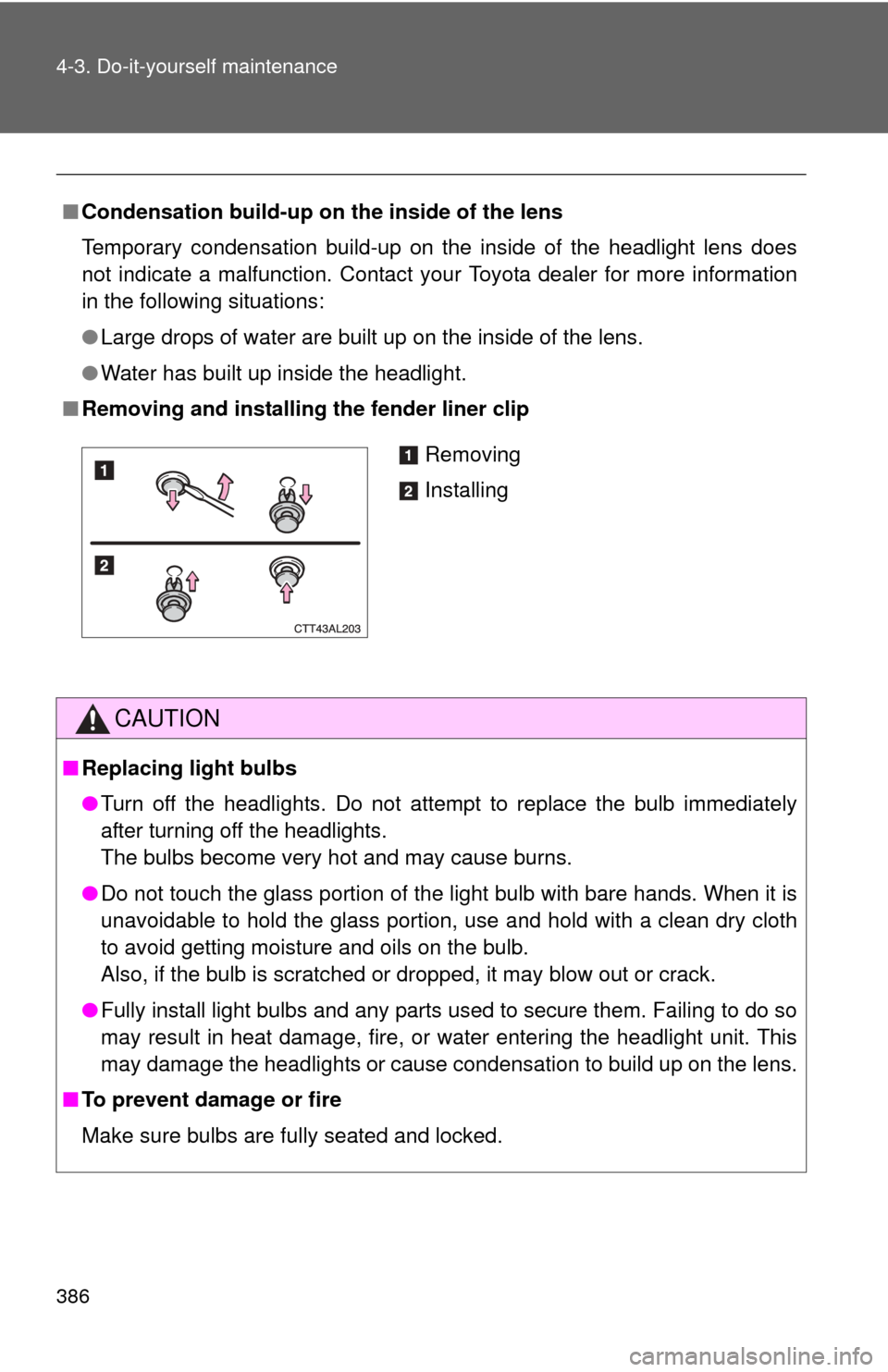
■ Removing and installing the fender liner clip
CAUTION
■Replacing light bulbs
●Turn off the headlights. Do not attempt to replace the bulb immediately
after turning off the headlights.
The bulbs become very hot and may cause burns.
● Do not touch the glass portion of the light bulb with bare hands. When i\
t is
unavoidable to hold the glass portion, use and hold with a clean dry cloth
to avoid getting moisture and oils on the bulb.
Also, if the bulb is scratched or dropped, it may blow out or crack.
● Fully install light bulbs and any parts used to secure them. Failing to do so
may result in heat damage, fire, or water entering the headlight unit. This
may damage the headlights or cause condensation to build up on the lens.
■ To prevent damage or fire
Make sure bulbs are fully seated and locked.
Removing
Installing
Page 388 of 500
388
5-1. Essential information
Emergency flashers
NOTICE
■To prevent battery discharge
Do not leave the emergency flashers on longer than necessary when the
engine is not running.
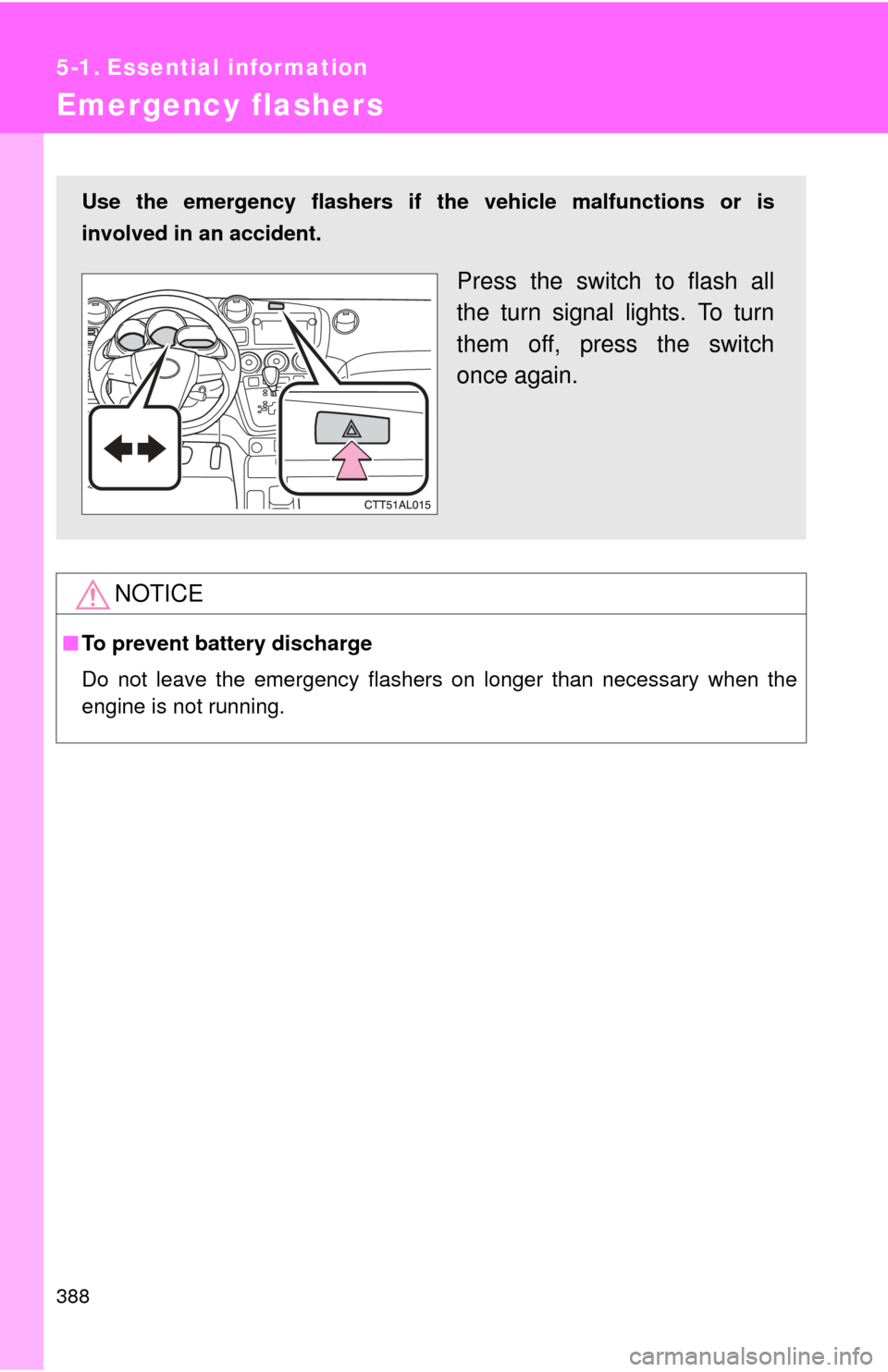
Use the emergency flashers if th e vehicle malfunctions or is
involved in an accident.
Press the switch to flash all
the turn signal lights. To turn
them off, press the switch
once again.
Page 397 of 500
5
When trouble arises
397
5-2. Steps to take in an emergency
If a war ning light turns on or a war ning buzzer sounds...
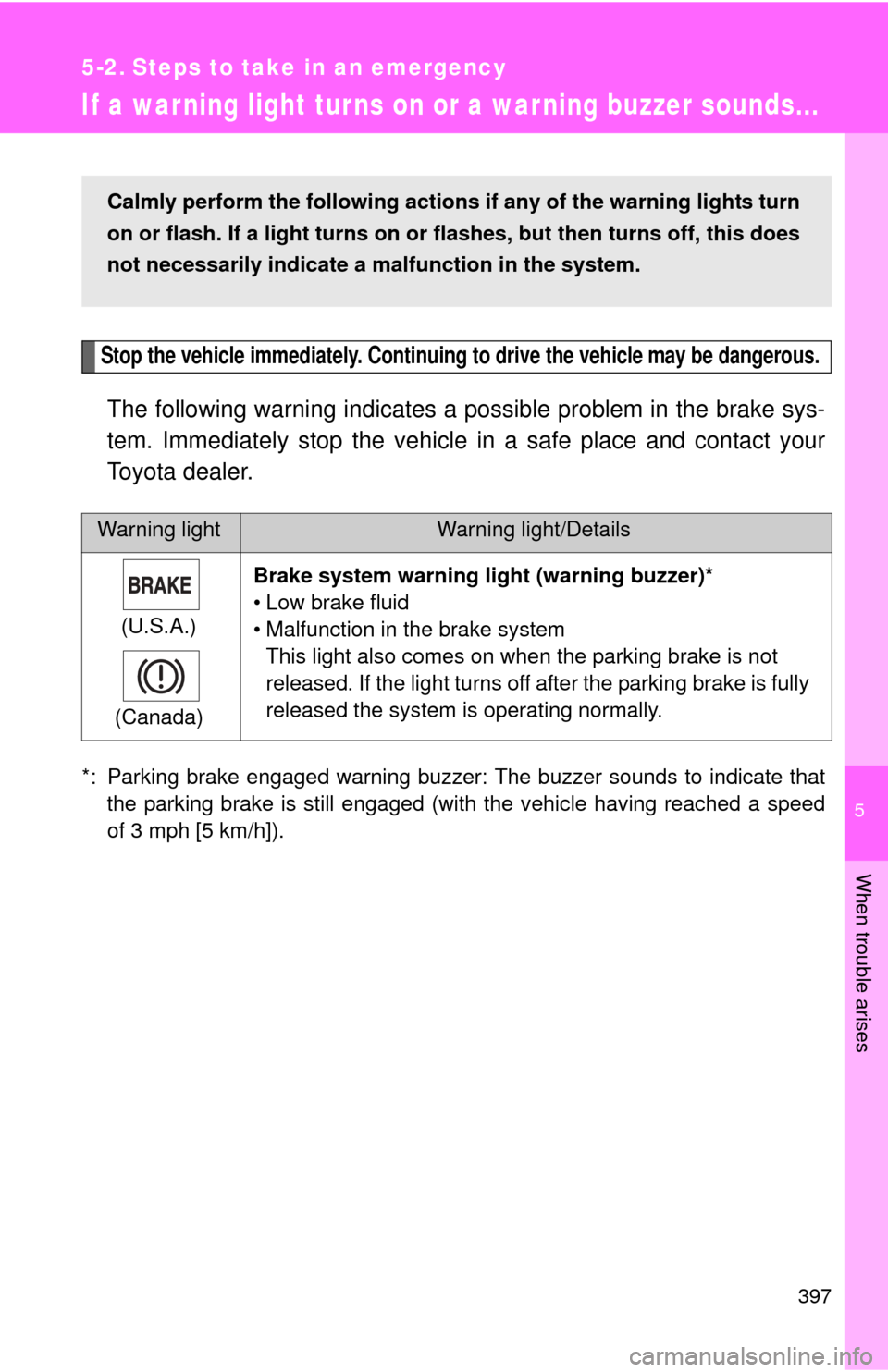
Stop the vehicle immediately. Continuing to drive the vehicle may be dangerous.
The following warning indicates a possible problem in the brake sys-
tem. Immediately stop the vehicle in a safe place and contact your
Toyota dealer.
*: Parking brake engaged warning buzzer: The buzzer sounds to indicate that the parking brake is still engaged (with the vehicle having reached a speed
of 3 mph [5 km/h]).
Warning lightWarning light/Details
(U.S.A.)
(Canada) Brake system warning light (warning buzzer)*
• Low brake fluid
• Malfunction in the brake system
This light also comes on when the parking brake is not
released. If the light turns off after the parking brake is fully
released the system is operating normally.
Calmly perform the following actions if any of the warning lights turn
on or flash. If a light turns on or flashes, but then turns off, this does
not necessarily indicate a malfunction in the system.
Page 422 of 500
422
5-2. Steps to take in an emergency
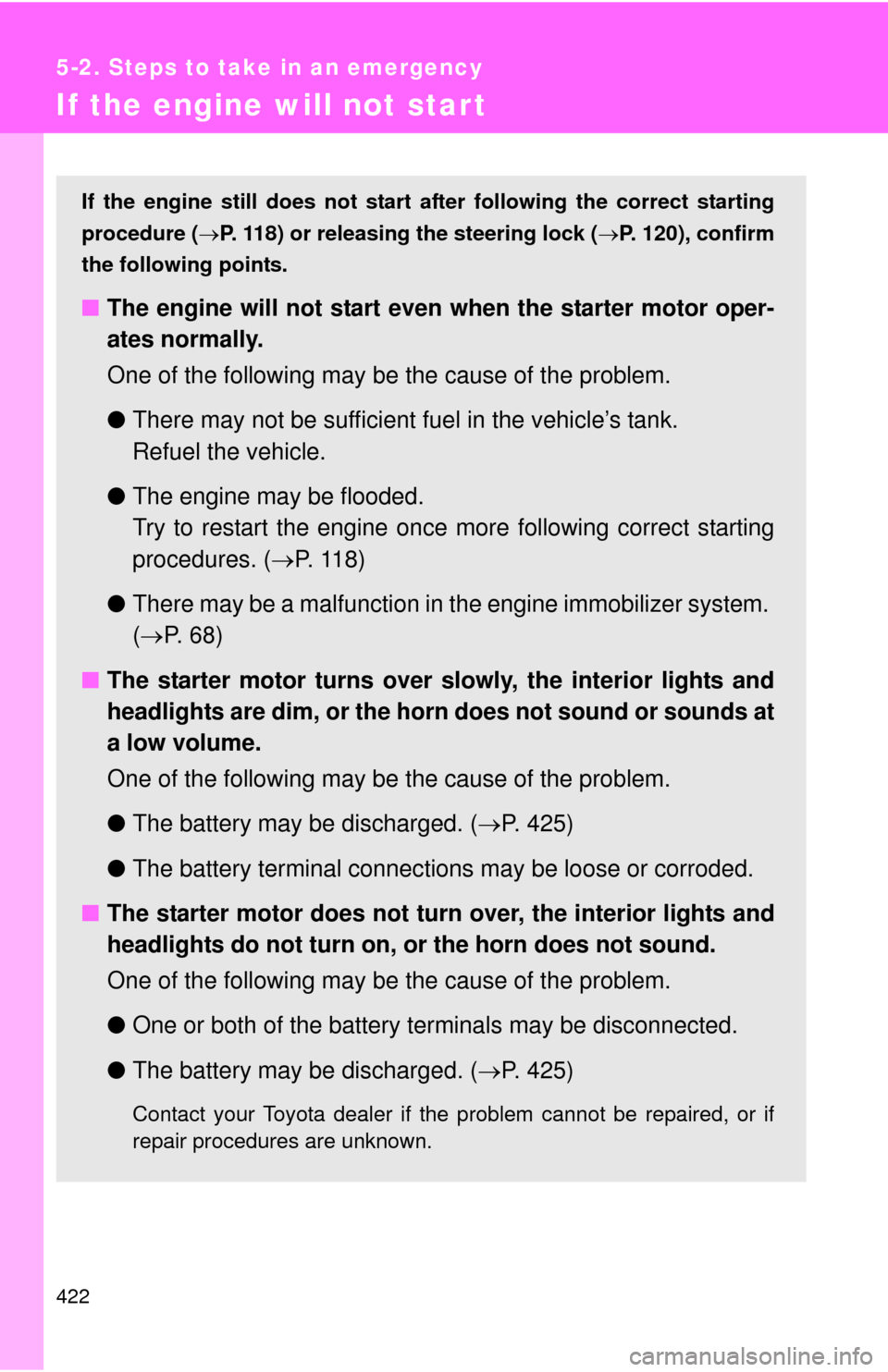
If the engine will not star t
If the engine still does not start after following the correct starting
procedure ( P. 118) or releasing the steering lock ( P. 120), confirm
the following points.
■ The engine will not start even when the starter motor oper-
ates normally.
One of the following may be the cause of the problem.
●There may not be sufficient fuel in the vehicle’s tank.
Refuel the vehicle.
● The engine may be flooded.
Try to restart the engine once more following correct starting
procedures. ( P. 1 1 8 )
● There may be a malfunction in the engine immobilizer system.
( P. 6 8 )
■ The starter motor turns over slowly, the interior lights and
headlights are dim, or the horn does not sound or sounds at
a low volume.
One of the following may be the cause of the problem.
●The battery may be discharged. ( P. 425)
● The battery terminal connec tions may be loose or corroded.
■ The starter motor does not turn over, the interior lights and
headlights do not turn on, or the horn does not sound.
One of the following may be the cause of the problem.
● One or both of the battery terminals may be disconnected.
● The battery may be discharged. ( P. 425)
Contact your Toyota dealer if the problem cannot be repaired, or if
repair procedures are unknown.
Page 428 of 500
428 5-2. Steps to take in an emergency
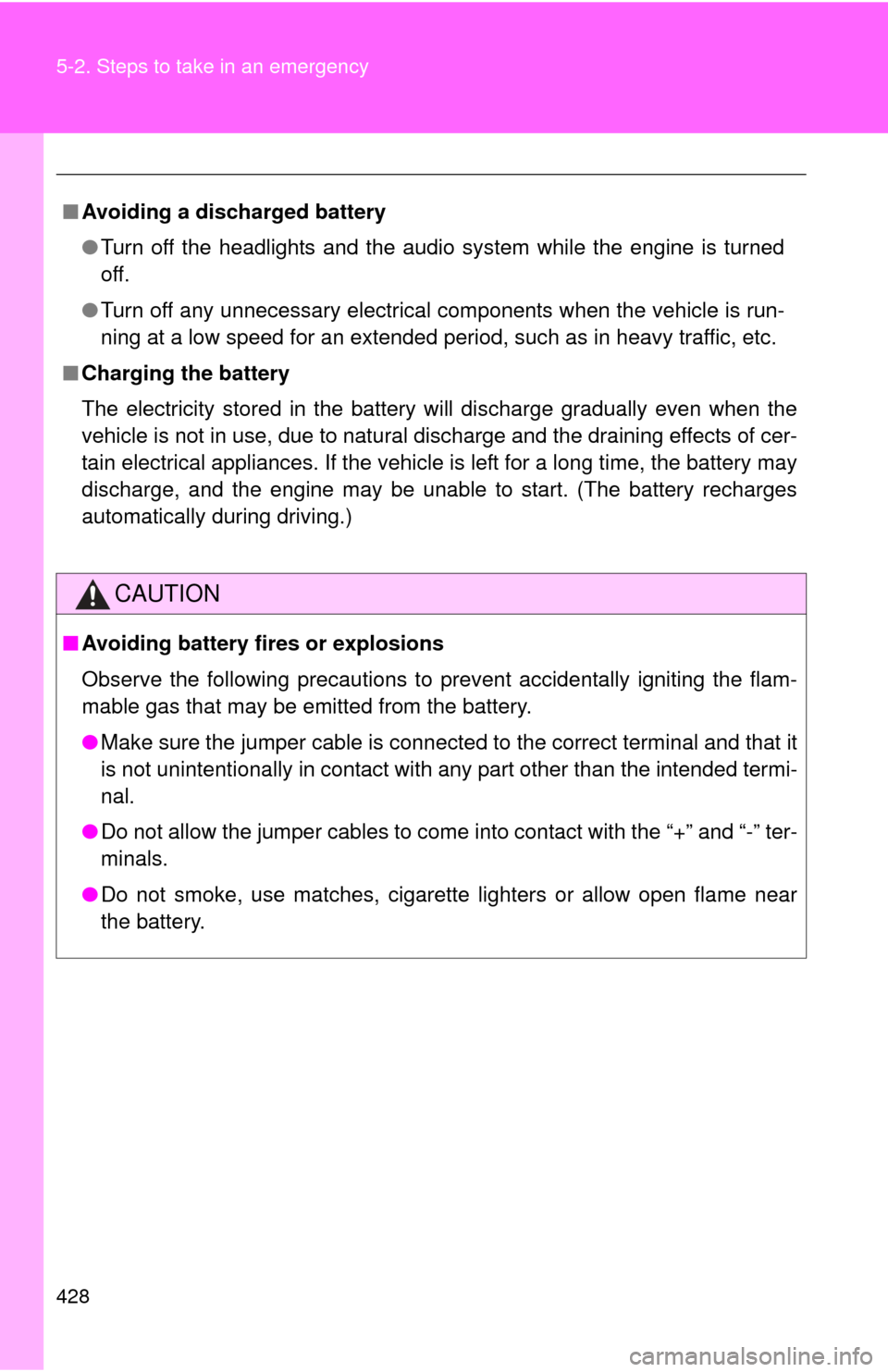
■Avoiding a discharged battery
●Turn off the headlights and the audio system while the engine is turned
off.
● Turn off any unnecessary electrical components when the vehicle is run-
ning at a low speed for an extended period, such as in heavy traffic, etc.
■ Charging the battery
The electricity stored in the battery will discharge gradually even when the
vehicle is not in use, due to natural discharge and the draining effects of cer-
tain electrical appliances. If the vehicle is left for a long time, the battery may
discharge, and the engine may be unable to start. (The battery recharges
automatically during driving.)
CAUTION
■Avoiding battery fires or explosions
Observe the following precautions to prevent accidentally igniting the flam-
mable gas that may be emitted from the battery.
●Make sure the jumper cable is connected to the correct terminal and that it
is not unintentionally in contact with any part other than the intended termi-
nal.
● Do not allow the jumper cables to come into contact with the “+” and “-” ter-
minals.
● Do not smoke, use matches, cigarette lighters or allow open flame near
the battery.
Page 446 of 500
446 6-1. Specifications
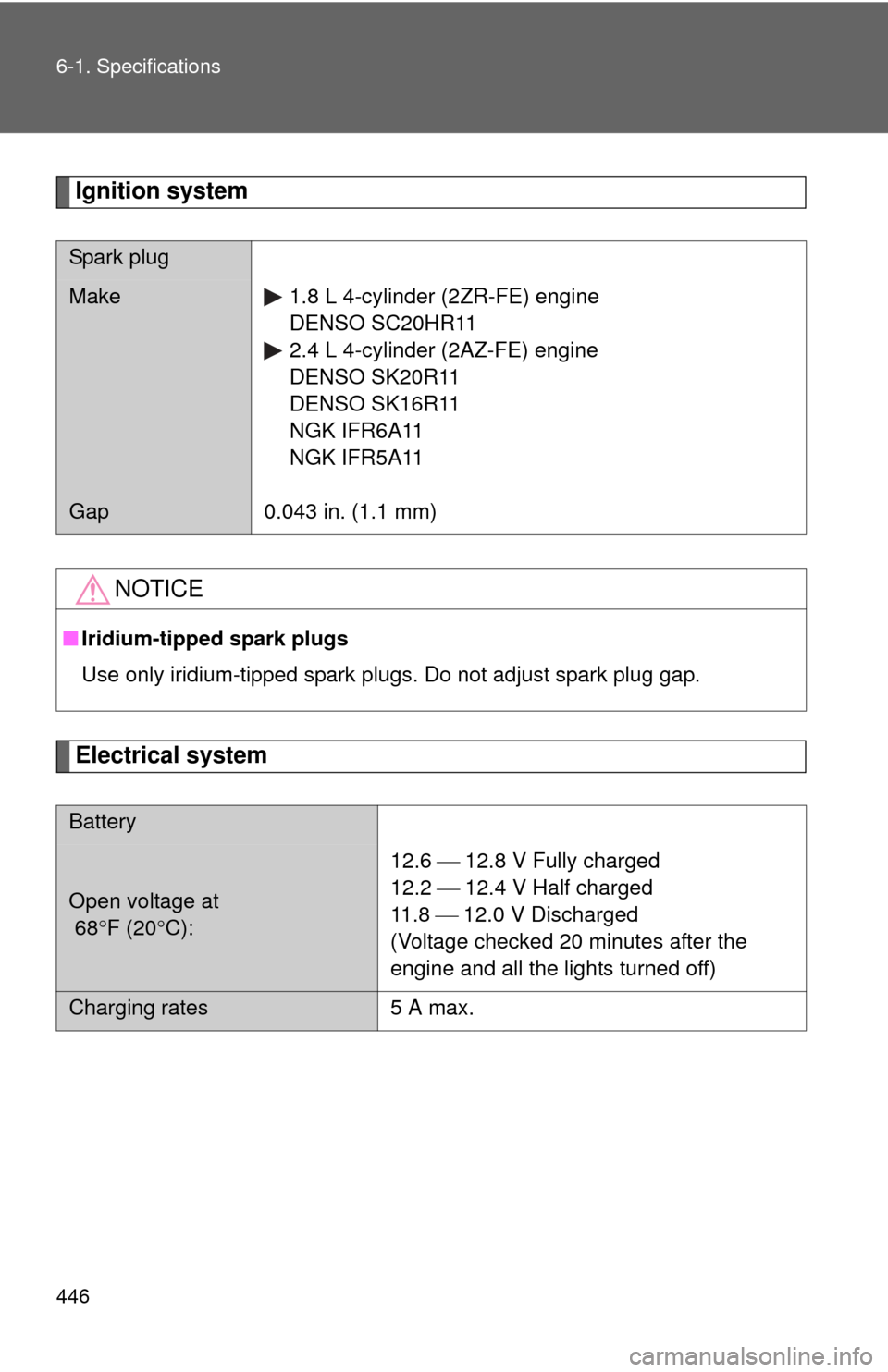
Ignition system
Electrical system
Spark plug
Make
Gap1.8 L 4-cylinder (2ZR-FE) engine
DENSO SC20HR11
2.4 L 4-cylinder (2AZ-FE) engine
DENSO SK20R11
DENSO SK16R11
NGK IFR6A11
NGK IFR5A11
0.043 in. (1.1 mm)
NOTICE
■ Iridium-tipped spark plugs
Use only iridium-tipped spark plugs. Do not adjust spark plug gap.
Battery
Open voltage at
68 F (20 C): 12.6 12.8 V Fully charged
12.2 12.4 V Half charged
11 . 8
12.0 V Discharged
(Voltage checked 20 minutes after the
engine and all the lights turned off)
Charging rates 5 A max.
Page 453 of 500
453
6-1. Specifications
6
Vehicle specifications
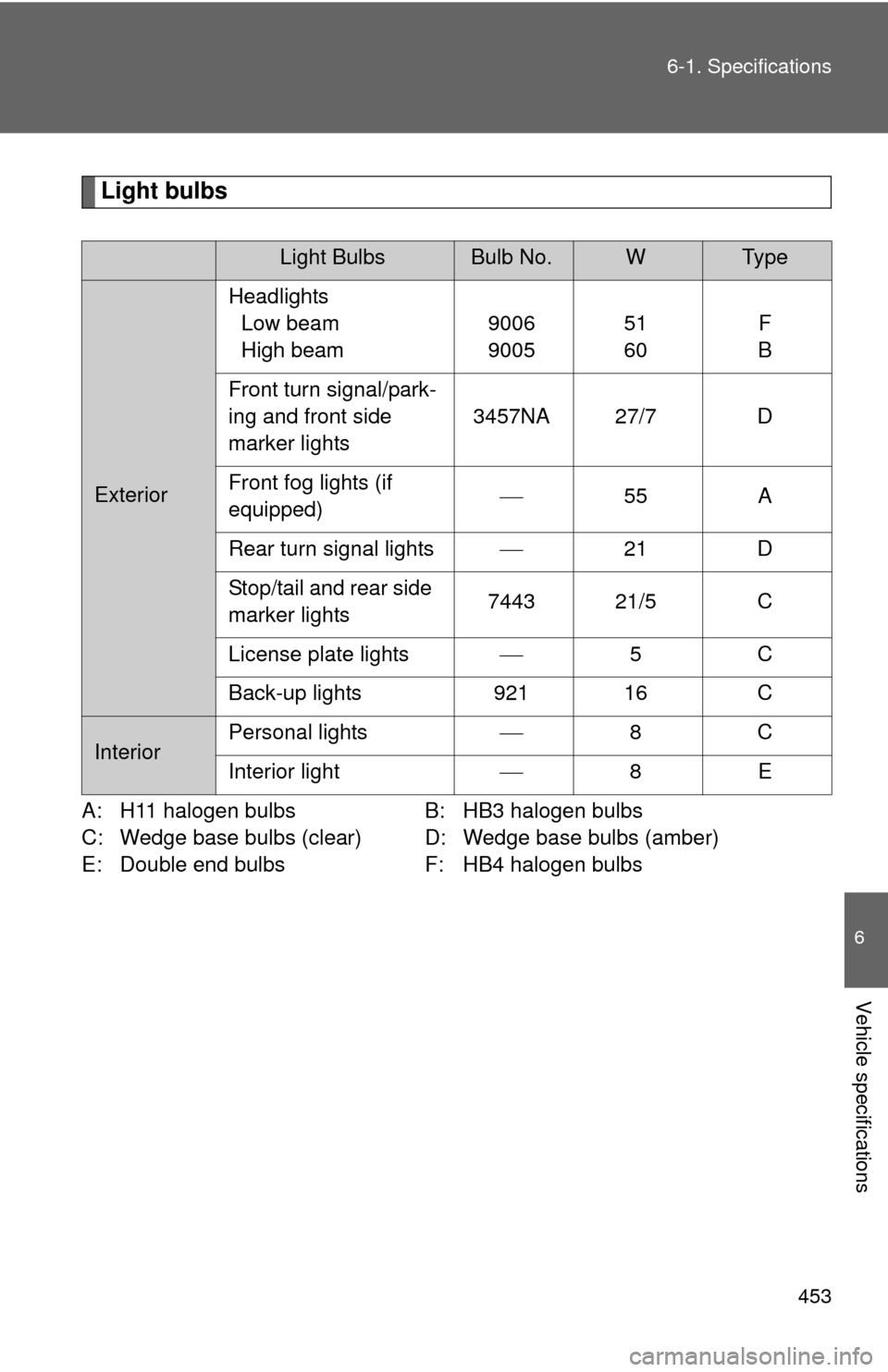
Light bulbs
A: H11 halogen bulbs
B: HB3 halogen bulbs
C: Wedge base bulbs (clear) D: Wedge base bulbs (amber)
E: Double end bulbs F: HB4 halogen bulbs
Light BulbsBulb No.WTy p e
ExteriorHeadlights
Low beam
High beam 9006
900551
60F
B
Front turn signal/park-
ing and front side
marker lights 3457NA 27/7 D
Front fog lights (if
equipped)
55 A
Rear turn signal lights 21 D
Stop/tail and rear side
marker lights 7443 21/5 C
License plate lights 5C
Back-up lights 921 16 C
Interior Personal lights
8C
Interior light 8E
Page 470 of 500
470 6-2. Customization
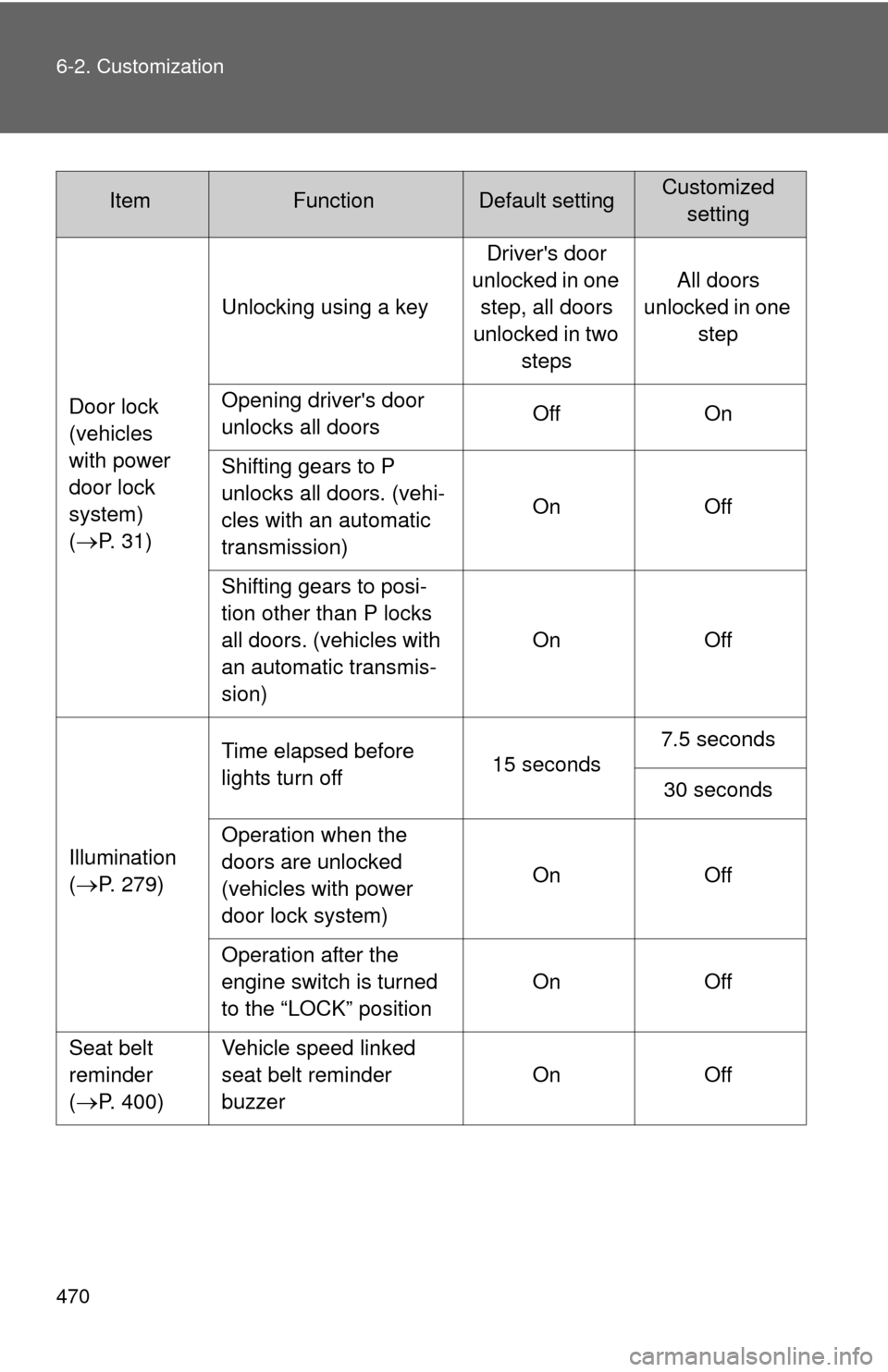
Door lock
(vehicles
with power
door lock
system)
(
P. 31)Unlocking using a key
Driver's door
unlocked in one step, all doors
unlocked in two steps All doors
unlocked in one step
Opening driver's door
unlocks all doors Off On
Shifting gears to P
unlocks all doors. (vehi-
cles with an automatic
transmission) On Off
Shifting gears to posi-
tion other than P locks
all doors. (vehicles with
an automatic transmis-
sion) On Off
Illumination
(
P. 279) Time elapsed before
lights turn off
15 seconds7.5 seconds
30 seconds
Operation when the
doors are unlocked
(vehicles with power
door lock system) On Off
Operation after the
engine switch is turned
to the “LOCK” position On Off
Seat belt
reminder
(
P. 400) Vehicle speed linked
seat belt reminder
buzzer
On Off
ItemFunctionDefault settingCustomized
setting