fuel cap TOYOTA MIRAI 2018 (in English) User Guide
[x] Cancel search | Manufacturer: TOYOTA, Model Year: 2018, Model line: MIRAI, Model: TOYOTA MIRAI 2018Pages: 464, PDF Size: 8.61 MB
Page 324 of 464

3247-3. Do-it-yourself maintenance
MIRAI_OM_USA_OM62025U
The coolant level is satisfactory if it is between the “FULL” a nd “LOW”
lines on the reservoir when the fuel cell system is cold.
“FULL” line
“LOW” line
If the level is on or below the
“LOW” line, contact your Toyota
dealer.
The coolant level is satisfact ory if it is between the “FULL” a nd “LOW”
lines on the reservoir when the fuel cell system is cold.
Inverter coolan t reservoir cap
“FULL” line
“LOW” line
If the level is on or below the
“LOW” line, add coolant up to the
“FULL” line.
■ Inverter coolant selection
Only use “Toyota Super Long Life Coolant” or a similar high quality ethylene
glycol based non-silicate, non-amine, non-nitrite, and non-bora te coolant with
long-life hybrid organic acid technology.
“Toyota Super Long Life Coolant” is a mixture of 50% coolant and 50% deion-
ized water. (Minimum temperature: -31 F [-35 C])
For more details about inverter coolant, contact your Toyota dealer.
Fuel cell stack coolant
NOTICE
■ Fuel cell stack coolant
An exclusive coolant for the fuel cell system is filled in the fuel cell stack
coolant reservoir. Do not use any substitute. It may damage you r vehicle.
Inverter coolant
Page 325 of 464

3257-3. Do-it-yourself maintenance
MIRAI_OM_USA_OM62025U
7
Maintenance and care
■If the inverter coolant level drops within a short time of repl enishing
Visually check the radiators, hoses, inverter coolant reservoir cap, drain cock
and water pump.
If you cannot find a leak, have your Toyota dealer test the cap and check for
leaks in the cooling system.
Check the radiator and condenser and clear away any foreign objects.
If either of the above parts is extremely dirty or you are not sure of
their condition, have your vehic le inspected by your Toyota dea ler.
WARNING
■When the fuel cell system is hot
Do not remove the coolant reservoir caps.
The cooling system may be under pressure and may spray hot coolant if the
cap is removed, causing serious injuries, such as burns.
NOTICE
■When adding coolant
Coolant is neither plain water nor straight antifreeze. The cor rect mixture of
water and antifreeze must be used to provide proper lubrication , corrosion
protection and cooling. Be sure to read the antifreeze or coolant label.
■ If you spill coolant
Be sure to wash it off with water to prevent it from damaging p arts or paint.
Radiator and condenser
WARNING
■When the fuel cell system is hot
Do not touch the radiator or condenser as they may be hot and c ause seri-
ous injuries, such as burns.
Page 347 of 464

3477-3. Do-it-yourself maintenance
MIRAI_OM_USA_OM62025U
7
Maintenance and care
Tire valve
Tire pressure gauge
Remove the tire valve cap.
Press the tip of the tire pressure gauge onto the tire valve.
Read the pressure using the gauge gradations.
If the tire inflation pressure is not at the recommended level, adjust
the pressure.
If you add too much air, press the center of the valve to defla te.
After completing the tire inflation pressure measurement and
adjustment, apply soapy water to the valve and check for leakage.
Put the tire valve cap back on.
■Tire inflation pressure check interval
You should check tire inflation p ressure every two weeks, or at least once
a month.
Do not forget to check the spare.
■Effects of incorrect tire inflation pressure
Driving with incorrec t tire inflation pressure may result in th e following:
●Reduced fuel economy
●Reduced driving comfort and poor handling
●Reduced tire life due to wear
●Reduced safety
●Damage to the drivetrain
If a tire needs frequent inflating , have it checked by your Toyota dealer.
Inspection and adjustment procedure
Page 404 of 464

4048-2. Steps to take in an emergency
MIRAI_OM_USA_OM62025U●
When the 12-volt battery is reconnected, start the fuel cell sy stem, depress
the brake pedal, and confirm that it is possible to shift into each shift posi-
tion.
● If the battery is removed or the terminals disconnected without operating the
water release function during cold weather, the vehicle may not start due to
the fuel cell system being frozen. To prevent this, operate the water release
function before removing the battery or disconnecting the termi nals.
( P. 176)
■ When exchanging the 12-volt battery
Use a Central Degassing type 12-volt battery (Japanese Industri al Stan-
dards). Also, use 12-volt batteries with case sizes similar to one prior the
exchange and an equivalent 20 hour rate capacity (20HR) or grea ter.
• If the sizes differ, the 12-volt battery cannot be properly se cured.
• If the 20 hour rate capacity is low, even if the time period w here the vehicle
is not used is a short time, the 12-volt battery may discharge and fuel cell
system may not be able to start.
For details, consult your Toyota dealer.
WARNING
■ Avoiding 12-volt batte ry fires or explosions
Observe the following precautions to prevent accidentally ignit ing the flam-
mable gas that may be emitted from the 12-volt battery:
● Make sure each jumper cable is connected to the correct terminal and that
it is not unintentionally in contact with any other than the in tended terminal.
● Do not allow the other end of the jumper cable connected to the “+” termi-
nal to come into contact with any other parts or metal surfaces in the area,
such as brackets or unpainted metal.
● Do not allow the + and - clamps of the jumper cables to come in to contact
with each other.
● Do not smoke, use matches, cigarette lighters or allow open fla me near
the 12-volt battery.
Page 410 of 464

4108-2. Steps to take in an emergency
MIRAI_OM_USA_OM62025U
Start the fuel cell system and turn the air conditioning system on
to check that the radiator coo ling fans operate and to check fo r
coolant leaks from t he radiator or hoses.
The fans operate when the air conditioning system is turned on immedi-
ately after a cold start. Confirm that the fans are operating b y checking
the fan sound and air flow. If it is difficult to check these, turn the air con-
ditioning system on and off repeatedly.
(The fans may not operate in freezing temperatures.)
If the fans are not operating:
Stop the fuel cell system immed iately and contact your Toyota
dealer.
If the fans are operating:
Have the vehicle inspected at the neare st Toyota dealer.
WARNING
■When inspecting under th e hood of your vehicle
Observe the following precautions.
Failure to do so may result in serious injury such as burns.
● If steam is seen coming from under the hood, do not open the ho od until
the steam has subsided. The motor compartment may be very hot.
● After the fuel cell system has been turned off, check that the “READY”
indicator is off.
When the fuel cell system is operating, the cooling fans may suddenly
operate even if the fuel cell system stops. Do not touch or app roach rotat-
ing parts such as the fans, which may lead to fingers or clothing (espe-
cially a tie, a scarf or a muffler) getting caught, resulting i n serious injury.
● Do not loosen the coolant reservoir caps or radiator cap, while the fuel cell
system and radiator are hot.
High temperature steam or coolant could spray out.
Page 416 of 464

4169-1. Specifications
MIRAI_OM_USA_OM62025U
Maintenance data (fuel, fluid level, etc.)
*: Unladen vehicles
Dimensions and weight
Overall length192.5 in. (4890 mm)
Overall width 71.5 in. (1815 mm)
Overall height*60.5 in. (1535 mm)
Wheelbase109.5 in. (2780 mm)
TreadFront60.5 in. (1535 mm)
Rear61.0 in. (1545 mm)
Vehicle capacity weight
(occupants + luggage) 690 lb. (315 kg)
Page 418 of 464

4189-1. Specifications
MIRAI_OM_USA_OM62025U*: This is the maximum possible fill amount. The actual fuel amount achieved
at hydrogen stations may be lower due to station capacity or station set-
tings.
Fuel
Fuel type Compressed hydrogen gas
Nominal working
pressure10150 psi (70 MPa, 714 kgf/cm2, 700 bar)
Hydrogen tanks’ fuel
capacity
(Reference)32.3 gal. (122.4 L, 26.9 Imp.gal.)
(Approximately 11.0 lb. [5 kg]
*)
Electric motor (t
raction motor)
Type Permanent magnet synchronous motor
Maximum output 113 kW
Maximum torque 247 ft•lbf (335 N•m, 34.2 kgf•m)
Traction battery
TypeNickel-metal hydride battery
Voltage7.2 V/module
Capacity 6.5 Ah (3HR)
Quantity 34 modules
Overall voltage 244.8 V
Page 419 of 464

4199-1. Specifications
MIRAI_OM_USA_OM62025U
9
Vehicle specifications
*: The fluid capacity is a reference quantity.If replacement is necessary, contact your Toyota dealer.
Cooling system
Capacity*
Fuel cell
stack 20.7 qt. (19.6 L, 17.2 Imp.qt.)
Inverter 5.0 qt. (4.7 L, 4.1 Imp.qt.)
Coolant
type
Fuel cell
stack“Toyota Genuine FC Stack Coolant”
• In order to safely cool the fuel cell stack,
which is at high voltages, the fuel cell stack
coolant is an exclusive high insulation prod-
uct.
• Never use water or other kinds of coolants as they will cause damage.
• Coolant changes are unnecessary.
• Do not reuse coolant that has been removed from the radiator.
• Coolant is colorless.
• Consult your Toyota dealer about replenish- ing or changing the fuel cell stack coolant.
Inverter Use either of the following:
• “Toyota Super Long Life Coolant”
• A similar high-quality ethylene glycol-based
non-silicate, non-amine, non-nitrite, and
non-borate coolant with long-life hybrid
organic acid technology
Do not use plain water alone.
NOTICE
The fuel cell stack coolant is exclusive for
fuel cell stack usage. Damage may occur
when water or any other type of coolant
is used, so never use any other fluid.
If the fuel cell stack coolant is low, imme-
diately contact your Toyota dealer.
Page 420 of 464
4209-1. Specifications
MIRAI_OM_USA_OM62025U
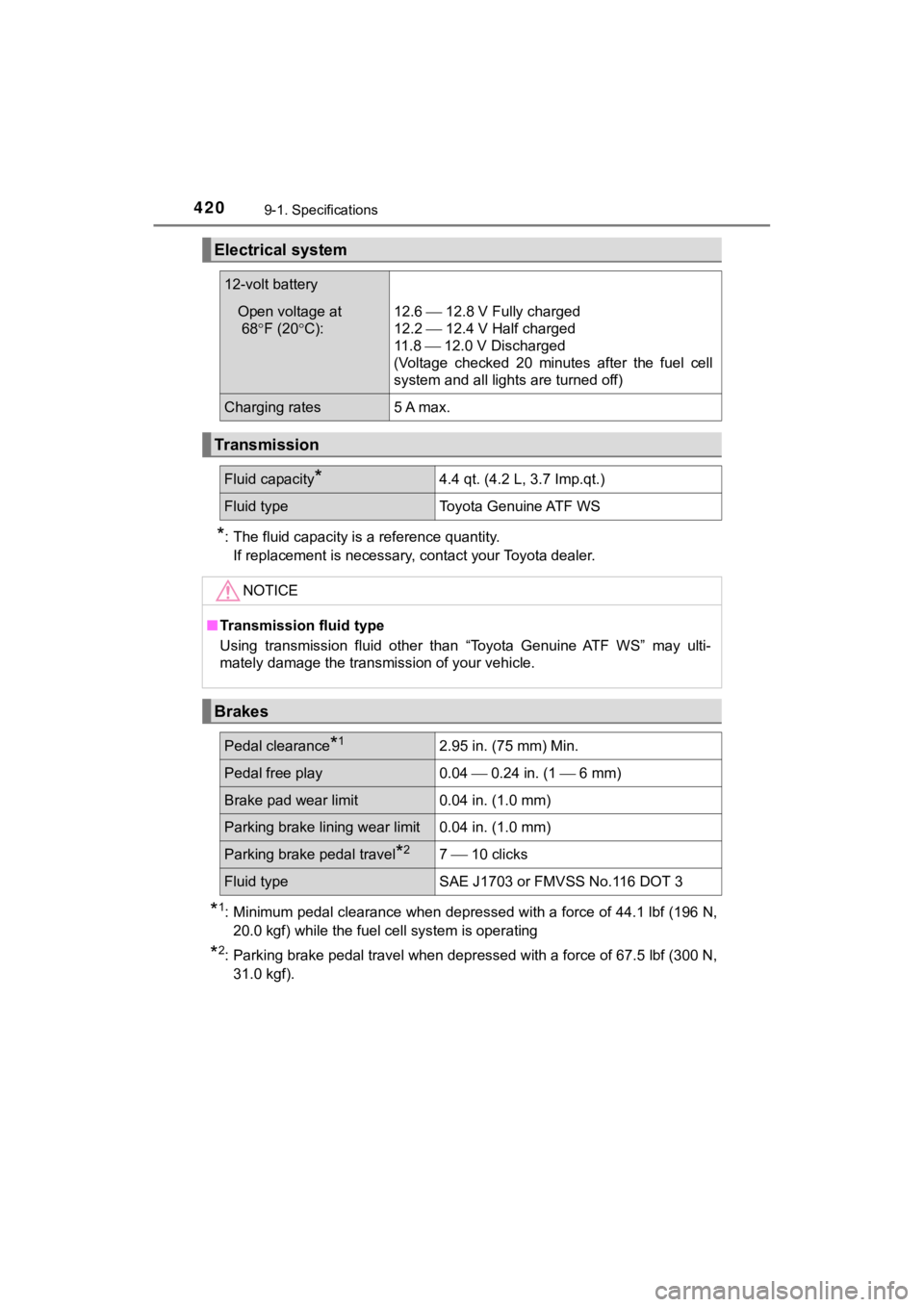
*: The fluid capacity is a reference quantity. If replacement is necessary, contact your Toyota dealer.
*1: Minimum pedal clearance when depressed with a force of 44.1 lb f (196 N,
20.0 kgf) while the fuel cell system is operating
*2: Parking brake pedal travel when depressed with a force of 67.5 lbf (300 N,
31.0 kgf).
Electrical system
12-volt battery
Open voltage at
68 F (20 C):12.6 12.8 V Fully charged
12.2 12.4 V Half charged
11 . 8 12.0 V Discharged
(Voltage checked 20 minutes after the fuel cell
system and all lights are turned off)
Charging rates5 A max.
Transmission
Fluid capacity*4.4 qt. (4.2 L, 3.7 Imp.qt.)
Fluid type Toyota Genuine ATF WS
NOTICE
■Transmission fluid type
Using transmission fluid other than “Toyota Genuine ATF WS” may ulti-
mately damage the transmission of your vehicle.
Brakes
Pedal clearance*12.95 in. (75 mm) Min.
Pedal free play 0.04 0.24 in. (1 6 mm)
Brake pad wear limit0.04 in. (1.0 mm)
Parking brake lining wear limit0.04 in. (1.0 mm)
Parking brake pedal travel*27 10 clicks
Fluid type SAE J1703 or FMVSS No.116 DOT 3
Page 428 of 464

4289-1. Specifications
MIRAI_OM_USA_OM62025U
Glossary of tire terminology
Tire related termMeaning
Cold tire inflation pres-
sure
Tire pressure when the vehicle has been
parked for three hours or more, or has not
been driven more than 1 mile or 1.5 km under
that condition
Maximum inflation
pressureThe maximum cold inflated pressure to which
a tire may be inflated, shown on the sidewall
of the tire
Recommended infla-
tion pressureCold tire inflation pressure recommended by a
manufacturer
Accessory weight
The combined weight (in excess of those stan-
dard items which may be replaced) of trans-
mission, power steering, power brakes, power
windows, power seats, radio and heater, to the
extent that these items are available as fac-
tory-installed equipment (whether installed or
not)
Curb weight
The weight of a motor vehicle with standard
equipment, including the maximum capacity of
fuel, oil and coolant, and if so equipped, air
conditioning and additional weight optional
engine
Maximum loaded vehi-
cle weight
The sum of:
(a) Curb weight
(b) Accessory weight
(c) Vehicle capacity weight
(d) Production options weight
Normal occupant
weight150 lb. (68 kg) times the number of occupants
specified in the second column of Table 1
*
that follows
Occupant distributionDistribution of occupants in a vehicle as speci-
fied in the third column of Table 1
* below