Seat adjust TOYOTA MIRAI 2019 Owners Manual (in English)
[x] Cancel search | Manufacturer: TOYOTA, Model Year: 2019, Model line: MIRAI, Model: TOYOTA MIRAI 2019Pages: 528, PDF Size: 11.84 MB
Page 1 of 528
MIRAI_OM_USA_OM62054U(18MY)_O
M62048U(19MY)
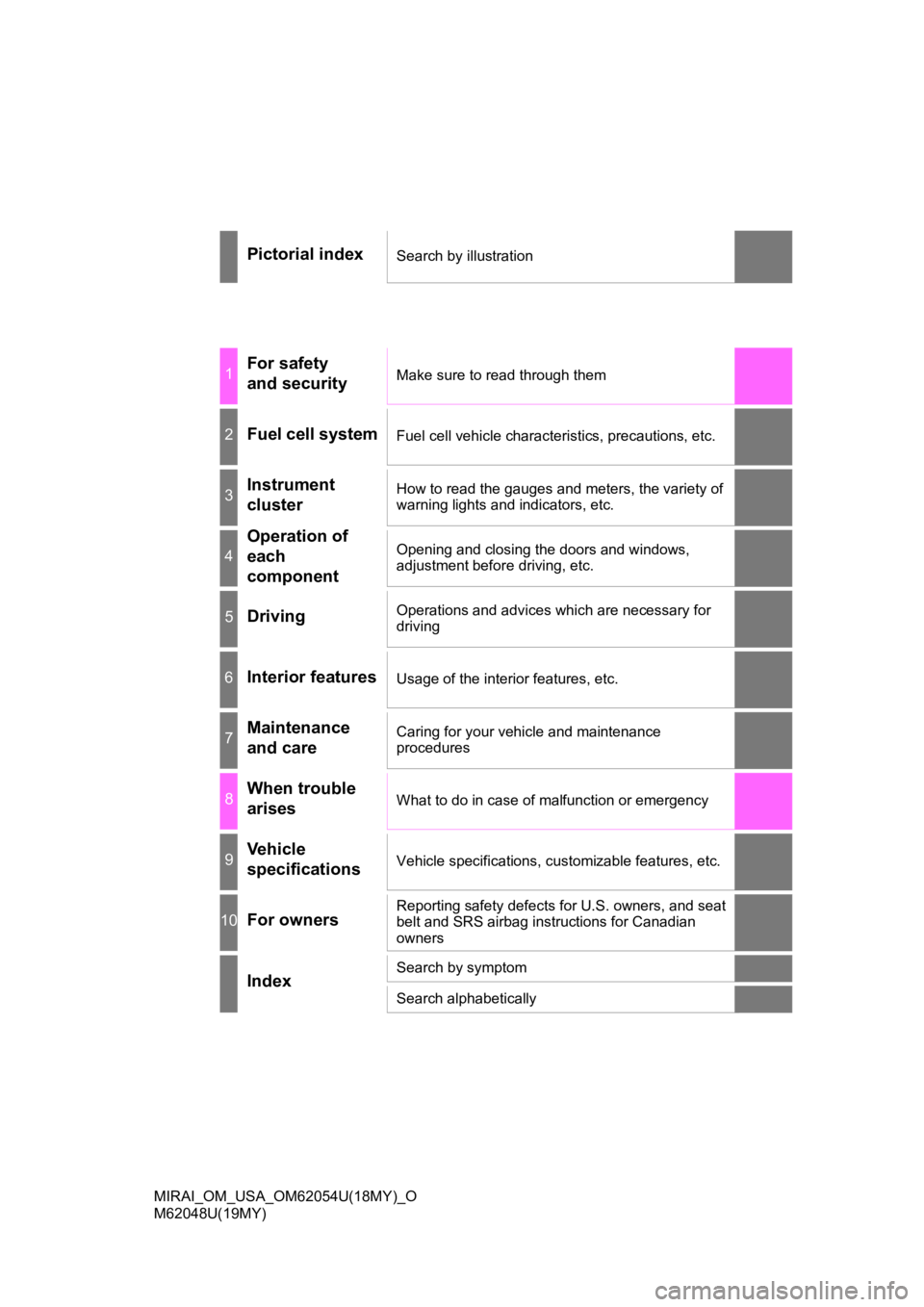
Pictorial indexSearch by illustration
1For safety
and securityMake sure to read through them
2Fuel cell systemFuel cell vehicle characteristics, precautions, etc.
3Instrument
clusterHow to read the gauges and meters, the variety of
warning lights and indicators, etc.
4
Operation of
each
componentOpening and closing the doors and windows,
adjustment before driving, etc.
5DrivingOperations and advices which are necessary for
driving
6Interior featuresUsage of the interior features, etc.
7Maintenance
and careCaring for your vehicle and maintenance
procedures
8When trouble
arisesWhat to do in case of malfunction or emergency
9Vehicle
specificationsVehicle specifications, customizable features, etc.
10For ownersReporting safety defects for U.S. owners, and seat
belt and SRS airbag instructions for Canadian
owners
IndexSearch by symptom
Search alphabetically
Page 2 of 528
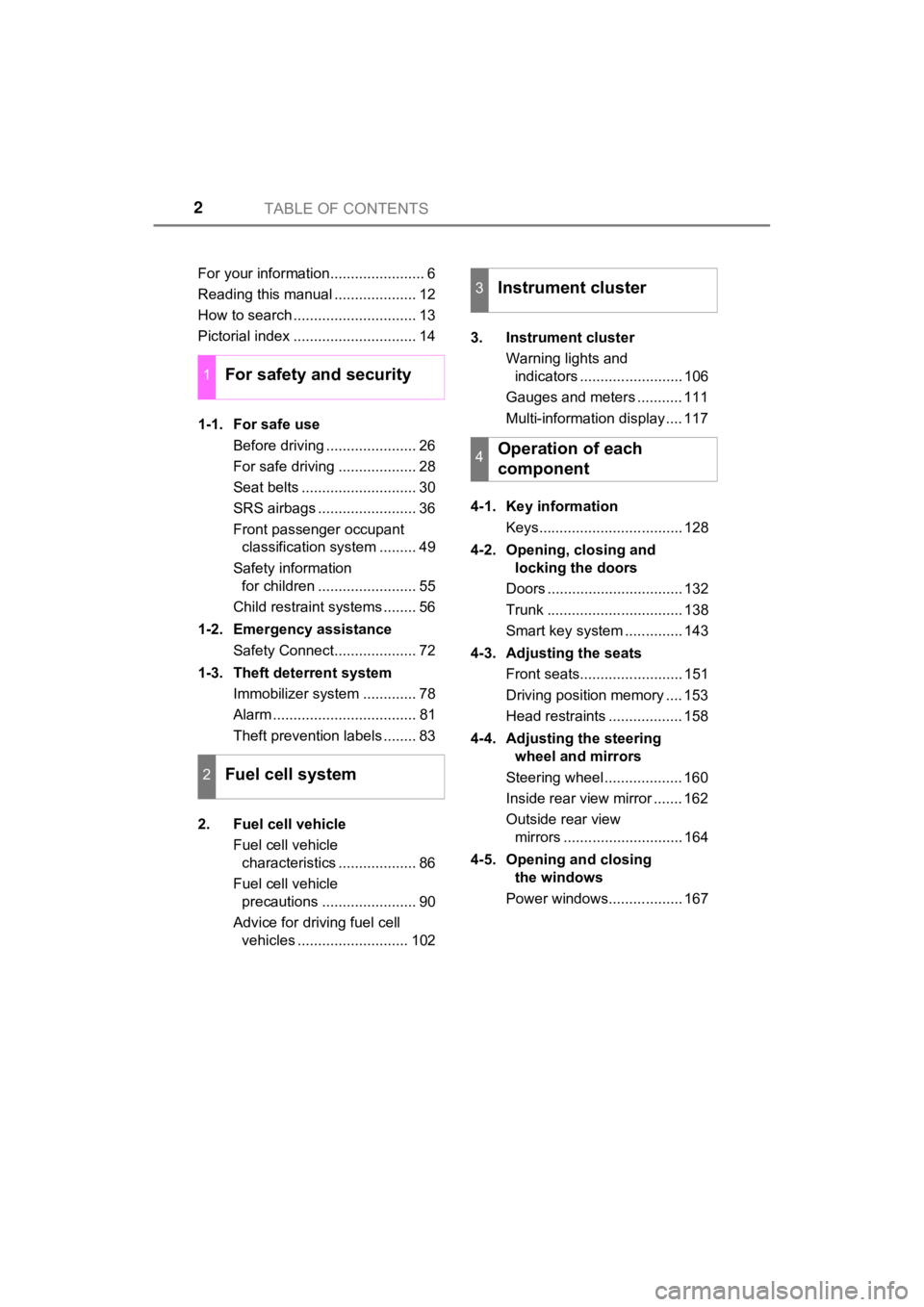
TABLE OF CONTENTS2
MIRAI_OM_USA_OM62054U(18MY)_O
M62048U(19MY)For your information....................... 6
Reading this manual .................... 12
How to search .............................. 13
Pictorial index .............................. 14
1-1. For safe use
Before driving ...................... 26
For safe driving ................... 28
Seat belts ............................ 30
SRS airbags ........................ 36
Front passenger occupant classification system ......... 49
Safety information for children ........................ 55
Child restraint systems ........ 56
1-2. Emergency assistance Safety Connect.................... 72
1-3. Theft deterrent system Immobilizer system ............. 78
Alarm ................................... 81
Theft prevention labels ........ 83
2. Fuel cell vehicle Fuel cell vehicle characteristics ................... 86
Fuel cell vehicle precautions ....................... 90
Advice for driving fuel cell vehicles ........................... 102 3. Instrument cluster
Warning lights and indicators ......................... 106
Gauges and meters ........... 111
Multi-information display .... 117
4-1. Key information Keys................................... 128
4-2. Opening, closing and locking the doors
Doors ................................. 132
Trunk ................................. 138
Smart key system .............. 143
4-3. Adjusting the seats Front seats......................... 151
Driving position memory .... 153
Head restraints .................. 158
4-4. Adjusting the steering wheel and mirrors
Steering wheel ................... 160
Inside rear view mirror ....... 162
Outside rear view mirrors ............................. 164
4-5. Opening and closing the windows
Power windows.................. 167
1For safety and security
2Fuel cell system
3Instrument cluster
4Operation of each
component
Page 10 of 528
10
MIRAI_OM_USA_OM62054U(18MY)_O
M62048U(19MY)The SRS airbag and seat belt pretensioner devices in your Toyot
a contain
explosive chemicals. If the vehicle is scrapped with the airbag s and seat belt
pretensioners left as they are, this may cause an accident such as fire. Be
sure to have the systems of the SRS airbag and seat belt preten sioner
removed and disposed of by a qualified service shop or by your Toyota dealer
before you scrap your vehicle.
Special handling may apply, See www.dtsc.ca.gov/hazardouswaste/ perchlorate.
Your vehicle has components that may contain perchlorate. These compo-
nents may include airbag, seat belt pretensioners, and wireless remote con-
trol batteries.
Scrapping of your Toyota
Perchlorate Material
WARNING
■ General precautions while driving
Driving under the influence: Never drive your vehicle when unde r the influ-
ence of alcohol or drugs that have impaired your ability to operate your vehi-
cle. Alcohol and certain drugs delay reaction time, impair judg ment and
reduce coordination, which could lead to an accident that could result in
death or serious injury.
Defensive driving: Always drive defensively. Anticipate mistake s that other
drivers or pedestrians might make and be ready to avoid acciden ts.
Driver distraction: Always give your full attention to driving. Anything that
distracts the driver, such as adjusting controls, talking on a cellular phone or
reading can result in a collision with resulting death or serio us injury to you,
your occupants or others.
■ General precaution regar ding children’s safety
Never leave children unattended in the vehicle, and never allow children to
have or use the key.
Children may be able to start the vehicle or shift the vehicle into neutral.
There is also a danger that children may injure themselves by p laying with
the windows, the moon roof, or other features of the vehicle. In addition,
heat build-up or extremely cold temperatures inside the vehicle can be fatal
to children.
Page 28 of 528
281-1. For safe use
MIRAI_OM_USA_OM62054U(18MY)_O
M62048U(19MY)
For safe driving
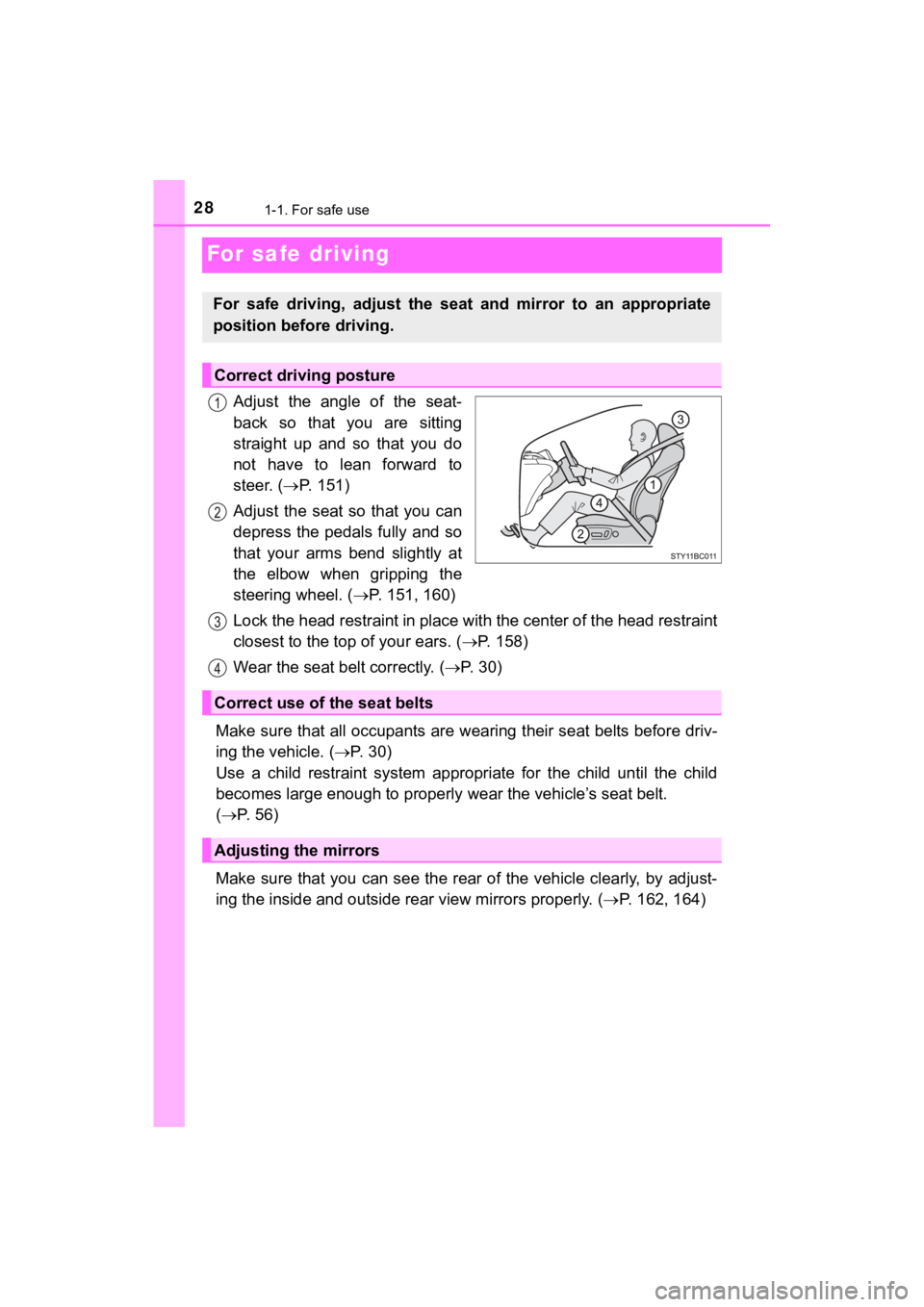
Adjust the angle of the seat-
back so that you are sitting
straight up and so that you do
not have to lean forward to
steer. (P. 1 5 1 )
Adjust the seat so that you can
depress the pedals fully and so
that your arms bend slightly at
the elbow when gripping the
steering wheel. ( P. 151, 160)
Lock the head restraint in place with the center of the head restraint
closest to the top of your ears. ( P. 1 5 8 )
Wear the seat belt correctly. ( P. 3 0 )
Make sure that all occupants are wearing their seat belts before driv-
ing the vehicle. ( P. 3 0 )
Use a child restraint system appropriate for the child until th e child
becomes large enough to properly wear the vehicle’s seat belt.
( P. 56)
Make sure that you can see the rear of the vehicle clearly, by adjust-
ing the inside and outside rear view mirrors properly. ( P. 162, 164)
For safe driving, adjust the seat and mirror to an appropriate
position before driving.
Correct driving posture
Correct use of the seat belts
Adjusting the mirrors
Page 29 of 528
291-1. For safe use
1
For safety and security
MIRAI_OM_USA_OM62054U(18MY)_O
M62048U(19MY)
WARNING
Observe the following precautions.
Failure to do so may result in death or serious injury.
●Do not adjust the position of the driver’s seat while driving.
Doing so could cause the driver to lose control of the vehicle.
● Do not place a cushion between the driver or passenger and the seatback.
A cushion may prevent correct posture from being achieved, and reduce
the effectiveness of the seat belt and head restraint.
● Do not place anything under the front seats.
Objects placed under the front seats may become jammed in the s eat
tracks and stop the seat from locking in place. This may lead t o an acci-
dent and the adjustment mechanism may also be damaged.
● Always observe the legal speed limit when driving on public roads.
● When driving over long distances, take regular breaks before yo u start to
feel tired.
Also, if you feel tired or sleepy while driving, do not force y ourself to con-
tinue driving and take a break immediately.
Page 30 of 528
301-1. For safe use
MIRAI_OM_USA_OM62054U(18MY)_O
M62048U(19MY)
Seat belts
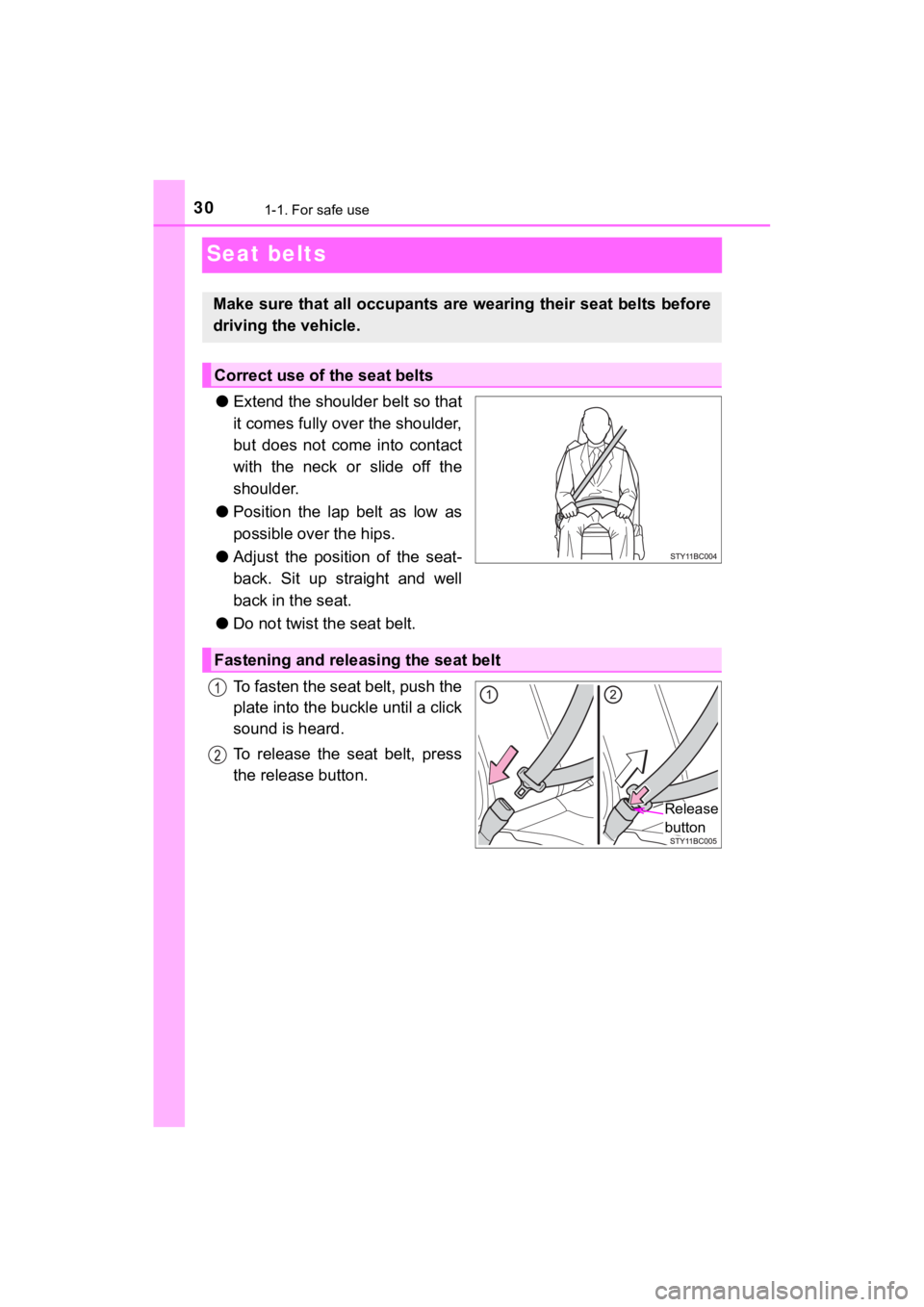
●Extend the shoulder belt so that
it comes fully over the shoulder,
but does not come into contact
with the neck or slide off the
shoulder.
● Position the lap belt as low as
possible over the hips.
● Adjust the position of the seat-
back. Sit up straight and well
back in the seat.
● Do not twist the seat belt.
To fasten the seat belt, push the
plate into the buckle until a click
sound is heard.
To release the seat belt, press
the release button.
Make sure that all occupants are wearing their seat belts before
driving the vehicle.
Correct use of the seat belts
Fastening and releasing the seat belt
Release
button
Page 31 of 528
311-1. For safe use
1
For safety and security
MIRAI_OM_USA_OM62054U(18MY)_O
M62048U(19MY)
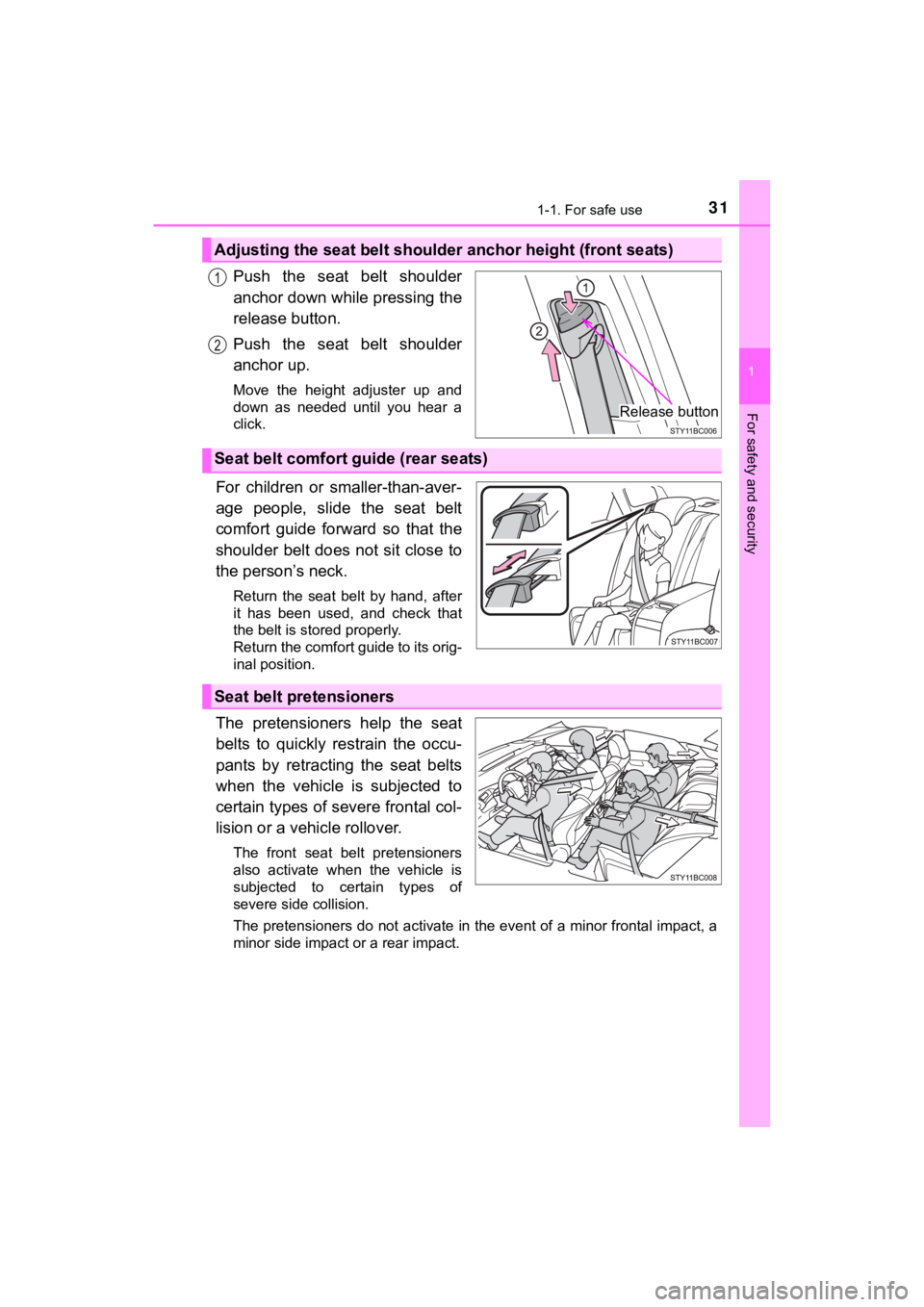
Push the seat belt shoulder
anchor down while pressing the
release button.
Push the seat belt shoulder
anchor up.
Move the height adjuster up and
down as needed until you hear a
click.
For children or smaller-than-aver-
age people, slide the seat belt
comfort guide forward so that the
shoulder belt does not sit close to
the person’s neck.
Return the seat belt by hand, after
it has been used, and check that
the belt is stored properly.
Return the comfort guide to its orig-
inal position.
The pretensioners help the seat
belts to quickly restrain the occu-
pants by retracting the seat belts
when the vehicle is subjected to
certain types of severe frontal col-
lision or a vehicle rollover.
The front seat belt pretensioners
also activate when the vehicle is
subjected to certain types of
severe side collision.
The pretensioners do not activate in the event of a minor front al impact, a
minor side impact or a rear impact.
Adjusting the seat be lt shoulder anchor height (front seats)
Release button
Seat belt comfort guide (rear seats)
Seat belt pretensioners
Page 34 of 528
341-1. For safe use
MIRAI_OM_USA_OM62054U(18MY)_O
M62048U(19MY)
WARNING
■When children are in the vehicle
Do not allow children to play with the seat belt. If the seat belt becomes
twisted around a child’s neck, it may lead to choking or other serious injuries
that could result in death.
If this occurs and the buckle cannot be unfastened, scissors sh ould be used
to cut the belt.
■ Seat belt pretensioners
● Do not place anything, such as a cushion, on the front passenger’s seat.
Doing so will disperse the passenger’s weight, which prevents t he sensor
from detecting the passenger’s weight properly. As a result, th e seat belt
pretensioner for the front passenger’s seat may not activate in the event of
a collision.
● If the pretensioner has activated, the SRS warning light will c ome on. In
that case, the seat belt cannot be used again and must be replaced at
your Toyota dealer.
■ Adjustable shoulder anchor (front seats)
Always make sure the shoulder belt is positioned across the cen ter of your
shoulder. The belt should be kept away from your neck, but not falling off
your shoulder. Failure to do so could reduce the amount of prot ection in an
accident and cause death or serious injuries in the event of a sudden stop,
sudden swerve or accident. ( P. 31)
■ Seat belt damage and wear
● Do not damage the seat belts by allowing the belt, plate, or bu ckle to be
jammed in the door.
● Inspect the seat belt system periodically. Check for cuts, fray ing, and loose
parts. Do not use a damaged seat belt until it is replaced. Dam aged seat
belts cannot protect an occupant from death or serious injury.
● Ensure that the belt and plate are locked and the belt is not twisted.
If the seat belt does not function correctly, immediately conta ct your Toyota
dealer.
● Replace the seat assembly, including the belts, if your vehicle has been
involved in a serious accident, even if there is no obvious dam age.
● Do not attempt to install, remove, modify, disassemble or dispo se of the
seat belts. Have any necessary repairs carried out by your Toyota dealer.
Inappropriate handling may lead to incorrect operation.
Page 39 of 528
391-1. For safe use
1
For safety and security
MIRAI_OM_USA_OM62054U(18MY)_O
M62048U(19MY)
Your vehicle is equipped with ADVANCED AIRBAGS designed based
on the US motor vehicle safety standards (FMVSS208). The airbag
sensor assembly (ECU) controls airbag deployment based on infor-
mation obtained from the sensors etc. shown in the system compo -
nents diagram above. This informat ion includes crash severity and
occupant information. As the airbags deploy, a chemical reactio n in
the inflators quickly fills the airbags with non-toxic gas to h elp restrain
the motion of t he occupants.
WARNING
■SRS airbag precautions
Observe the following precautions regarding the SRS airbags.
Failure to do so may cause death or serious injury.
● The driver and all passengers in the vehicle must wear their se at belts
properly.
The SRS airbags are supplemental devices to be used with the se at belts.
● The SRS driver airbag deploys with considerable force, and can cause
death or serious injury especially if the driver is very close to the airbag.
The National Highway Traffic Safety Administration (NHTSA) advi ses:
Since the risk zone for the driver’s airbag is the first 2 - 3 in. (50 - 75 mm)
of inflation, placing yourself 10 in. (250 mm) from your driver airbag pro-
vides you with a clear margin of safety. This distance is measured from
the center of the steering wheel to your breastbone. If you sit less than
10 in. (250 mm) away now, you can change your driving position in sev-
eral ways:
• Move your seat to the rear as far as you can while still reach ing the ped-
als comfortably.
• Slightly recline the back of the seat.
Although vehicle designs vary, many drivers can achieve the 10 in.
(250 mm) distance, even with the driver seat all the way forward , simply
by reclining the back of the seat somewhat. If reclining the ba ck of your
seat makes it hard to see the road, raise yourself by using a f irm, non-
slippery cushion, or raise the seat if your vehicle has that feature.
• If your steering wheel is adjustable, tilt it downward. This p oints the
airbag toward your chest instead of your head and neck.
The seat should be adjusted as recommended by NHTSA above, whil e
still maintaining control of the foot pedals, steering wheel, and your view
of the instrument panel controls.
Page 40 of 528
401-1. For safe use
MIRAI_OM_USA_OM62054U(18MY)_O
M62048U(19MY)
WARNING
■SRS airbag precautions
● The SRS front passenger airbag also deploys with considerable f orce, and
can cause death or serious injury especially if the front passe nger is very
close to the airbag. The front passenger seat should be as far from the
airbag as possible with the seatback adjusted, so the front passenger sits
upright.
● Improperly seated and/or restrained infants and children can be killed or
seriously injured by a deploying airbag. An infant or child who is too small
to use a seat belt should be properly secured using a child restraint sys-
tem. Toyota strongly recommends that all infants and children b e placed in
the rear seats of the vehicle and properly restrained. The rear seats are
safer for infants and children than the front passenger seat. ( P. 56)
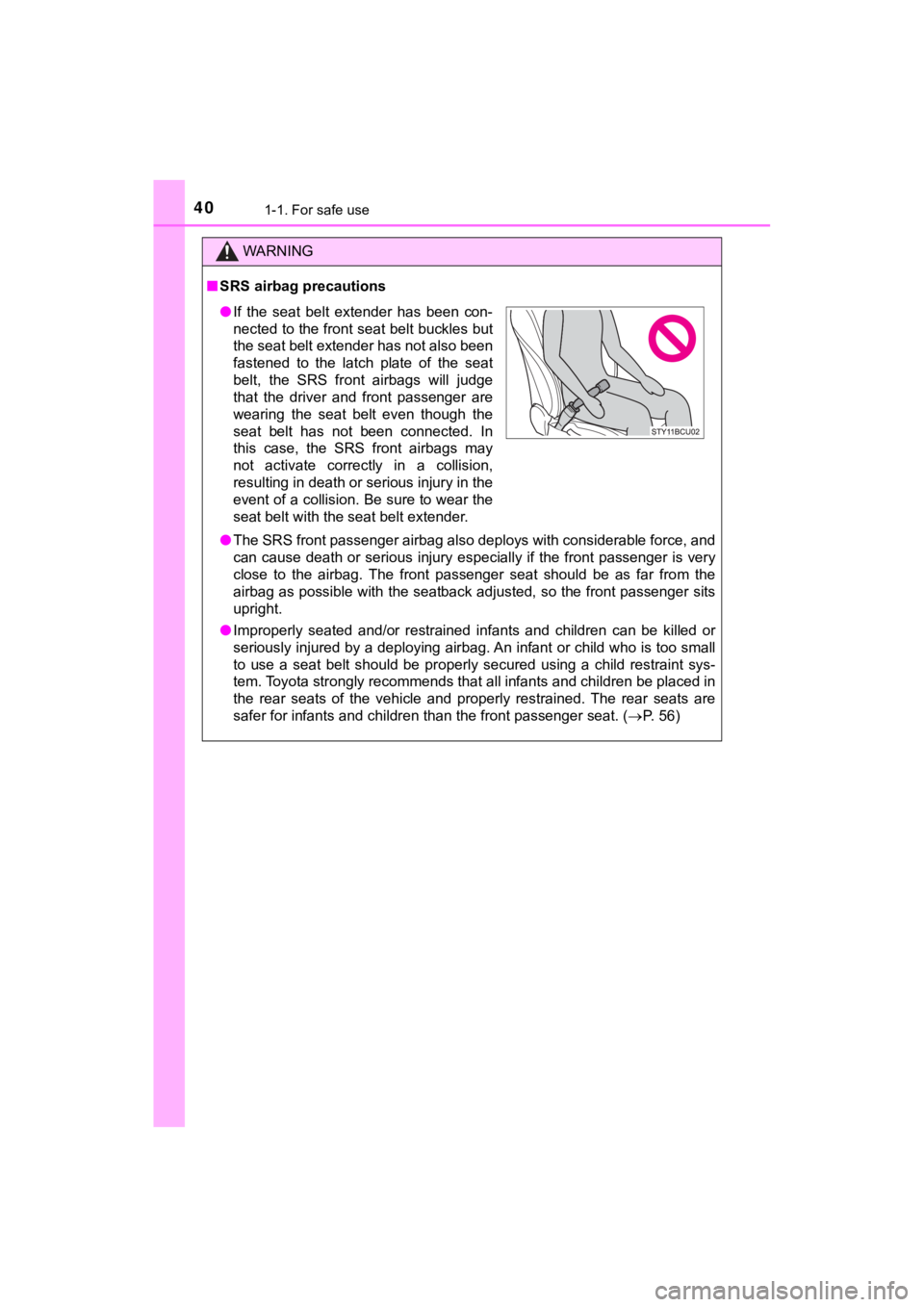
●If the seat belt extender has been con-
nected to the front seat belt buckles but
the seat belt extender has not also been
fastened to the latch plate of the seat
belt, the SRS front airbags will judge
that the driver and front passenger are
wearing the seat belt even though the
seat belt has not been connected. In
this case, the SRS front airbags may
not activate correctly in a collision,
resulting in death or serious injury in the
event of a collision. Be sure to wear the
seat belt with the seat belt extender.