ABS TOYOTA PASEO 1997 Owners Manual
[x] Cancel search | Manufacturer: TOYOTA, Model Year: 1997, Model line: PASEO, Model: TOYOTA PASEO 1997Pages: 182, PDF Size: 2.59 MB
Page 36 of 182
34
REAR SEAT BELT FOR CONVERT-
IBLE MODELS
Rear seat belt buckles for convertible
models are intended to be crossed as
shown in
the illustration to provide a prop-
er fit to the occupant. Make sure to insert
the seat belt tabs into the crossed buckles
as shown in the illustration left. The seat belt buckle and the appropriate tab are de-
signed to securely latch while the other
seat belt tab is designed not to securely
latch. Al ways check for secure latching by
pulling on the seat belt to make sure the
correct buckle and tab are latched.
CAUTION!
Make sure that both buckels are cor- rectly located and securely latched. Make sure the correct buckle is
matched with the correct tab by pull-
ing on it firmly. Failure to properly
match the buckle and tab may cause
severe injury in case of an accident
or a collision. If your seat belt cannot be fastened se- curely because it is not long enough, a
personalized seat belt extender is avail-
able from your Toyota dealer free of charge.
Please contact your local Toyota dealer
so that the dealer can order the proper re-
quired length for the extender. Bring the heaviest
coat you expect to wear for prop-
er measurement and selection of length.
Additional ordering information is avail-
able at your Toyota dealer.
CAUTION!
When using the seat belt extender,
observe the following. Failure to fol-
low these instructions could result
in less effectiveness of the seat belt
restraint system in case of vehicle
accident, increasing the chance of
personal injury. Never use the seat belt extender if
you can fasten the seat belt without it.
Remember that the extender pro-
vided for you may not be safe when
used on a different vehicle, or for
another person or at a different
seating position than the one origi-
nally intended for.
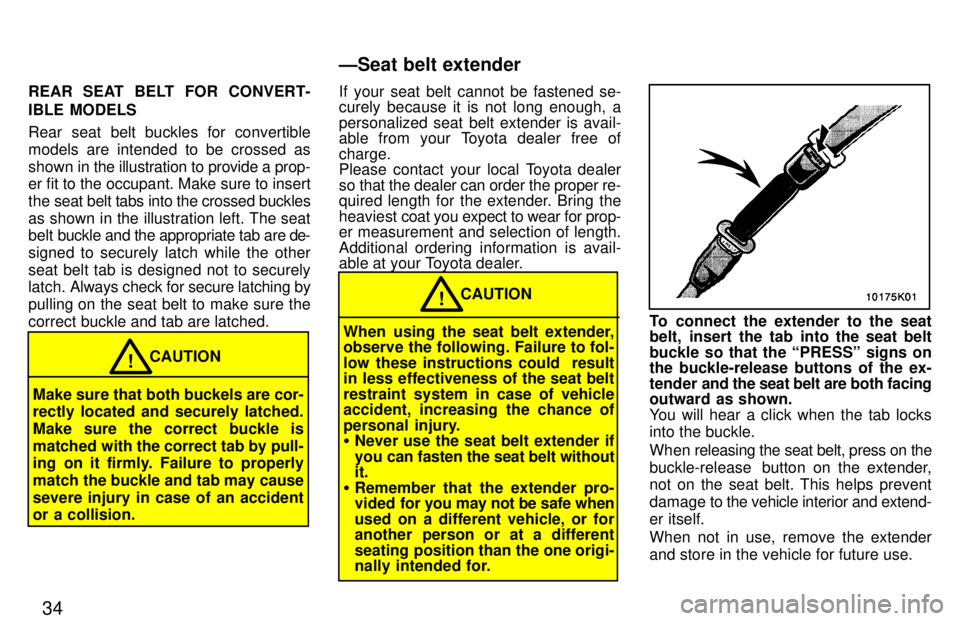
To connect the extender to the seat
belt, insert the tab into the seat belt
buckle so that the PRESSº signs on the buckle-release buttons of the ex-
tender and the seat belt are both facing
outward as shown.
You will hear a click when the tab locks into the buckle.
When releasing the seat belt, press on the
buckle-release button on the extender, not on the seat belt. This helps prevent
damage to the vehicle interior and extend-
er itself.
When not in use, remove the extender
and store in the vehicle for future use.
ÐSeat belt extender
Page 39 of 182
37
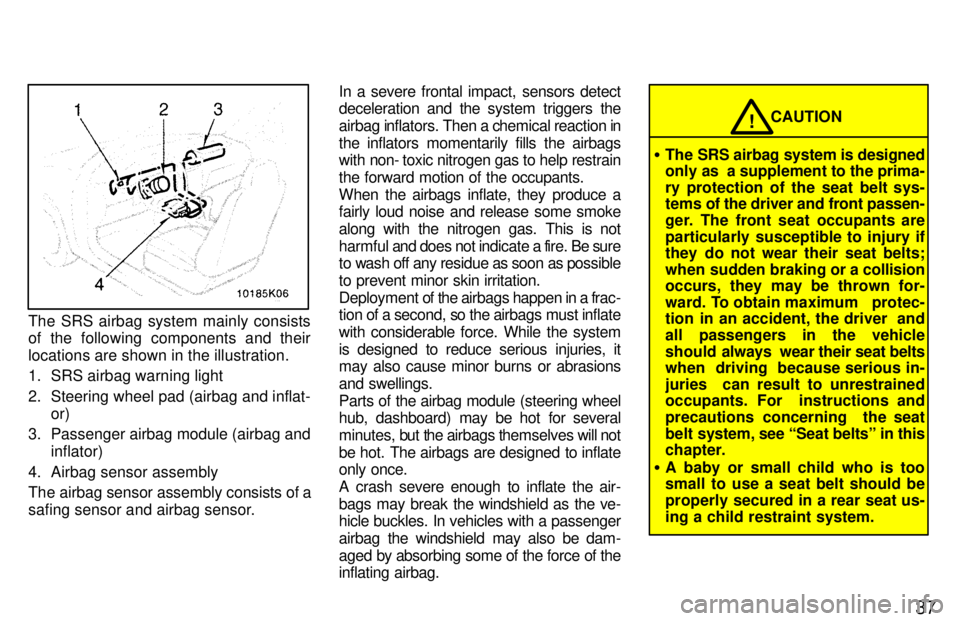
The SRS airbag system mainly consists
of the following components and their
locations are shown in the illustration.
1. SRS airbag warning light
2. Steering wheel pad (airbag and inflat-or)
3. Passenger airbag module (airbag and inflator)
4. Airbag sensor assembly
The airbag sensor assembly consists of a
safing sensor and airbag sensor. In a severe frontal impact, sensors detect
deceleration and the system triggers the
airbag inflators. Then a chemical reaction in
the inflators momentarily fills the airbags
with non- toxic nitrogen gas to help restrain
the forward motion of the occupants.
When the airbags inflate, they produce a
fairly loud noise and release some smoke
along with the nitrogen gas. This is not
harmful and does not indicate a fire. Be sure
to wash off any residue as soon as possible
to prevent minor skin irritation.
Deployment of the airbags happen in a frac-
tion of a second, so the airbags must inflate
with considerable force. While the system
is designed to reduce serious injuries, it
may also cause minor burns or abrasions
and swellings.
Parts of the airbag module (steering wheel
hub, dashboard) may be hot for several
minutes, but the airbags themselves will not
be hot. The airbags are designed to inflate
only once.
A crash severe enough to inflate the air-
bags may break the windshield as the ve-
hicle buckles. In vehicles with a passenger
airbag the windshield may also be dam-
aged by absorbing some of the force of the
inflating airbag.
CAUTION!
The SRS airbag system is designed
only as a supplement to the prima-
ry protection of the seat belt sys-
tems of the driver and front passen-
ger. The front seat occupants are
particularly susceptible to injury if
they do not wear their seat belts;
when sudden braking or a collision
occurs, they may be thrown for-
ward. To obtain maximum protec-
tion in an accident, the driver and
all passengers in the vehicle
should always wear their seat belts
when driving because serious in-
juries can result to unrestrained
occupants. For instructions and
precautions concerning the seat
belt system, see Seat beltsº in this
chapter.
A baby or small child who is too
small to use a seat belt should be
properly secured in a rear seat us-ing a child restraint system.
Page 71 of 182

69
(e) Malfunction Indicator Lamp
This lamp comes on in the following cases.
a. The fuel tank is completely empty.
(See Fuel gaugeº in Chapter 1-5 for instructions.)
b. The fuel tank cap is not tightened se- curely. (See F uel tank capº in Chapter
1-2 for instructions.)
c. There is a problem somewhere in your
engine or automatic transmission
electrical system.
If it comes on while you are driving in case
b, have your vehicle checked/repaired by
your Toyota dealer as soon as possible.
(f) Low Fuel Level Warning Light
This light comes on when the fuel level in
the tank becomes nearly empty. Fill up the
tank as soon as possible. (g) ABSº Warning Light
This light warns that there is a problem
somewhere in your anti-lock brake sys-tem.
If the light comes on while you are driving,
have your vehicle checked by your T
oyota
dealer as soon as possible.
The light will come on when the ignition
key is turned to the ONº position. After
about 3 seconds, the light will go off. When the ABSº warning light is on (and
the brake system warning light is off), thebrake system operates conventionally but
anti-lock brake system is not assistingbrake performance so that the wheels can
lock-up during sudden braking or braking
on slippery road surfaces.
(h) Open Door Warning Light
This light remains on until both side doors
are completely closed.
(i) SRS Airbag Warning Light
This light will come on when the igni-
tion key is turned to the ACCº or ONº
position. After about 6 seconds, the
light w ill go off. This means the airbag
system is operating properly. The warning light system monitors the air-
bag sensor assembly, inflators, warning
light, interconnecting wiring and power sources.
If either of the following conditions occurs, this indicates a malfunction somewhere in the parts monitored by the warning light
system. Contact your Toyota dealer as
soon as possible to service the vehicle.
The light does not come on when the
ignition key is turned to the ACCº or
ONº position or remains on.
The light comes on while driving.
Page 72 of 182

70(j) Light Reminder Buzzer
This buzzer will sound if the driver's door is opened with the key removed from the
ignition switch and the headlight switch
left on. (k) Key Reminder Buzzer
This buzzer reminds you to remove the
key when you open the driver's door with the ignition key in the ACCº or LOCKº position.
CHECKING SERVICE REMINDER
INDICATORS
1. Apply the parking brake.
2. Open either side door.
The open door warning light should come on.
3. Close the door. The open door warning light should go
off.
4. Turn the ignition key to ACCº. The SRS airbag warning light should
come on. It goes off after about 6 sec-onds. 5. Turn the ignition key to ONº, but do
not start the engine.
All the service reminder indicators ex-
cept the open door warning light and
SRS airbag warning light should come
on. The ABSº warning light goes off
after about 3 seconds.
If any service reminder indicator or warn-
ing buzzer does not function as described above, either the bulb is burned out or the
circuit is in need of repair. Have it checked
by your Toyota dealer as soon as pos-sible.
Page 108 of 182
106
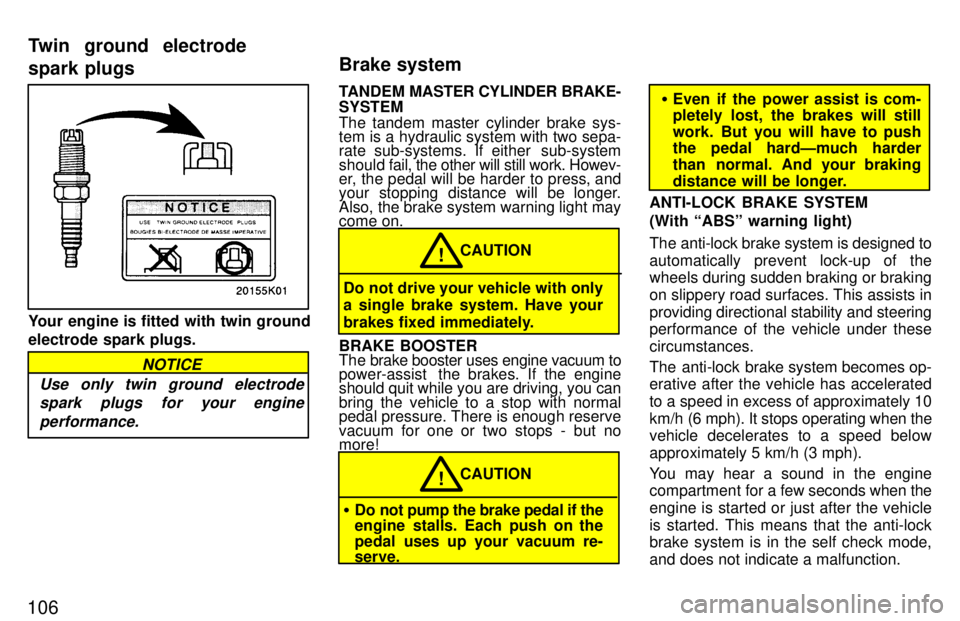
Your engine is fitted with twin ground electrode spark plugs.
Use only twin ground electrodespark plugs for your engine
performance.
NOTICE
TANDEM MASTER CYLINDER BRAKE-
SYSTEM
The tandem master cylinder brake sys-
tem is a hydraulic system with two sepa-
rate sub-systems. If either sub-system
should fa il, the other will still work. Howev-
er, the pedal will be harder to press, and
your stopping distance will be longer.
Also, the brake system warning light may come on.
CAUTION!
Do not drive your vehicle with only
a single brake system. Have your
brakes fixed immediately.
BRAKE BOOSTER
The brake booster uses engine vacuum to
power-assist the brakes. If the engine
should quit while you are driving, you can
bring the vehicle to a stop with normal
pedal pressure. There is enough reserve
vacuum for one or two stops - but no more!
CAUTION!
Do not pump the brake pedal if the
engine stalls. Each push on the
pedal uses up your vacuum re- serve.
Even if the power assist is com-
pletely lost, the brakes will still
work. But you will have to push
the pedal hardÐmuch harder
than normal. And your braking
distance will be longer.
ANTI-LOCK BRAKE SYSTEM (With ABSº warning light)
The anti-lock brake system is designed to automatically prevent lock-up of the
wheels during sudden braking or braking on slippery road surfaces. This assists in
providing directional stability and steering performance of the vehicle under these circumstances.
The anti-lock brake system becomes op- erative after the vehicle has accelerated
to a speed in excess of approximately 10
km/h (6 mph). It stops operating when the
vehicle decelerates to a speed below
approximately 5 km/h (3 mph).
You may hear a sound in the engine
compartment for a few seconds when the
engine is started or just after the vehicle is started. This means that the anti-lock
brake system is in the self check mode,
and does not indicate a malfunction.
Brake system
Twin ground electrode
spark plugs
Page 109 of 182
107
Effective way to press the ABSº brake
pedal: When the anti-lock brake system
function is in action, you may feel the brake pedal pulsating and hear a noise.
In this situation, to let the anti-lock brake
system work for you, just hold the brake
pedal down more firmly. Do not pumpthe brake. This will result in reduced
braking performance.
The brake pedal pulsation caused by the
anti-lock brake system may indicate haz- ardous road surface conditions. Althoughthe anti-lock brake system assists in pro-
viding vehicle control, it is still important to
drive with all due care, because the anti-
lock brake system cannot overcome the
laws of physics that act on your vehicle: Braking capab ility is dependent on tire
friction with the road surface.
Even though the anti-lock brake sys-
tem is operating, a driver cannot main- tain full control on certain slippery road
surfaces, when cornering at high speeds, or in violent maneuvers.
Avoid high speeds on wet roads. The
anti-lock brake system cannot elimi-
nate the risk of hydroplaning and loss of tire friction. Always maintain a safe distance from the
vehicle in
front of you. Compared with ve-
hicles not fitted with an anti-lock brake
system, your vehicle may require a longer
stopping distance in the following cases: Driving on rough, gravel or snow-cov-
ered roads.
Driving with tire chains installed.
Driving on roads where the road sur-
face is pitted or has other differences in surface height.
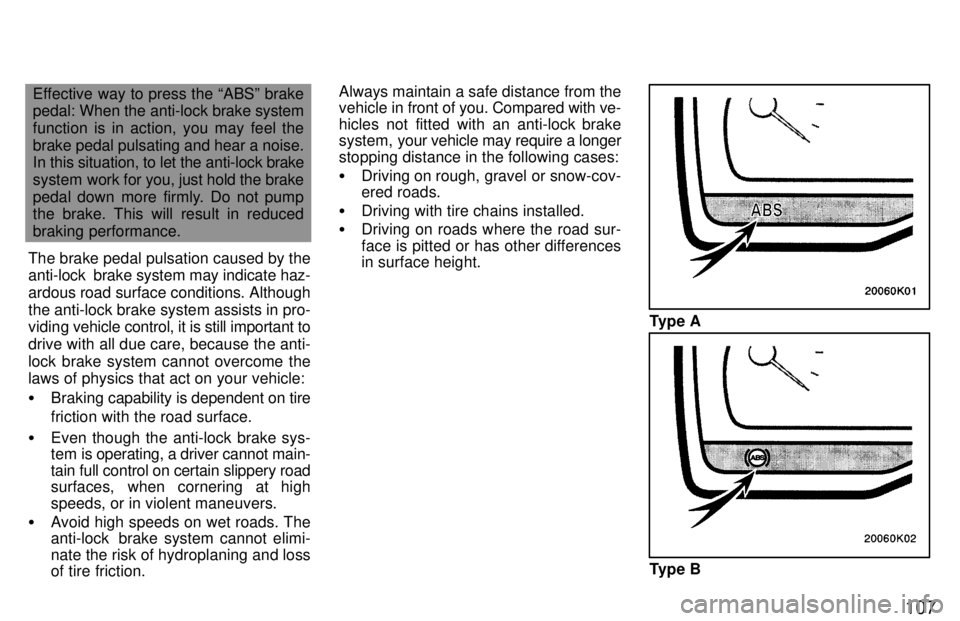
Type A
Type B
Page 110 of 182

108ABSº warning light
This light comes on when the ignition key is turned to the ONº position. After about
3 seconds, the light will go off.
If either of the following conditions occurs, this indicates a malfunction somewhere inthe parts monitored by the warning light
system. Contact your Toyota dealer as
soon as possible to service the vehicle.
The light does not come on as de-
scribed above, or remains on.
The light comes on while driving.
Even if the anti-lock brake system should
fail, the brake system will still operate con-
ventionally. However, when the ABSº
warning light is on (and the brake system
warning light is off), the anti-lock brake
system is not assisting brake perfor-
mance so that the wheel can lock-up dur-
ing sudden braking or braking on slippery
road surfaces. Have your vehicle checked
by your Toyota dealer as soon as pos- sible.
The brake pas wear limit indicators on your disc brakes give a warning noise
when the brake pads are worn to
where replacement is required.
If you hear a squealing or scraping noise
while driving, have the brake pads
checked and replaced by your Toyota
dealer as soon as possible. Expensive ro-
tor damage can result if the pads are not
replaced when necessary. When stowing luggage or cargo in the ve-
hicle, observe the following:
Put luggage in the trunk when at all pos -
sible. Be sure all items are secured in
place.
Be careful to keep the vehicle bal-
anced. Locating the weight as far for-
ward as possible helps maintain bal- ance.
For better fuel economy, do not carry unneeded weight.To prevent luggage or packages
from sliding forward during brak-
ing, do not stack anything in the
enlarged trunk room. Keep lug-
gage or packages low, as close to
the floor as possible.
Never allow anyone to ride in the enlarged trunk room. It is not de-
signed for passengers. They
should ride in their seats with
their seat belts properly fastened.
Otherwise, they are much more
likely to suffer serious bodily inju-
ry, in the event of sudden braking
or a collision.
CAUTION!
Brake pad wear limit indicators Luggage stowage precautions
Page 158 of 182
156To check the fluid level, simply look at
the see-through reservoir. The level
should be between the MAXº and
MINº lines on the reservoir. It is normal for the brake fluid level to go
down slightly as the
brake pads wear. So
be sure to keep the reservoir filled. If the reservoir needs frequent refilling, it may indicate a serious mechanical prob- lem.
If the level is low, add SAE J1703 or
FMVSS No. 116 DOT 3 brake fluid to the
brake reservoir. Remove and replace the reservoir cover by hand. Fill the brake fluid to the dotted
line. This brings the fluid to the correct
level when you put the cover back on.
Use only newly opened brake fluid. Once
opened, brake fluid absorbs moisture
from the air, and excess moisture can cause a dangerous loss of braking.
CAUTION
Take care when filling the reservoir
because brake fluid can harm your
eyes and damage painted surfaces. If
fluid gets in your eyes, flush your
eyes with clean water.!
If you spill the fluid, be sure to wash
it off with water to prevent it from
damaging the parts or paint.
NOTICE
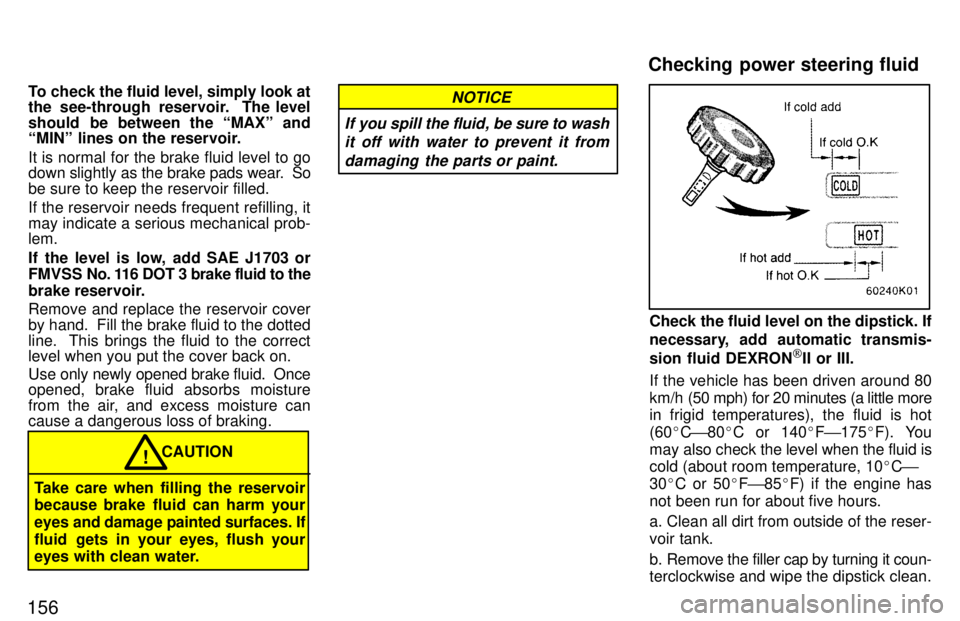
Check the fluid level on the dipstick. If
necessary, add automatic transmis-
sion fluid DEXRON [
II or III.
If the vehicle has been driven around 80
km/h (50 mph) for 20 minutes (a little more
in frigid temperatures), the fluid is hot (60 C ' 80 C or 140 F ' 175 F). You
may also check the level when the fluid is
cold (about room temperature, 10 C '
30 C or 50 F ' 85 F) if the engine has
not been run for about five hours.
a. Clean all dirt from outside of the reser- voir tank.
b. Remove the filler cap by turning it coun- terclockwise and wipe the dipstick clean.
Checking power steering fluid
Page 172 of 182

170
3. Release the bulb retaining springand remove the bulb. Install a new
bulb and the bulb retaining spring.
To install a bulb, align the tabs of the bulb with the cutouts of the mounting hole.4. Install the rubber cover with the TOPº mark upward, and snuggle
on the boss. Insert the connector.
Then install the plastic cover.
Make sure the rubber cover fits snugly on
the connector and the headlight body.
Aiming is not necessary after replacing
the bulb. When aiming adjustment is nec-
essary, contact you Toyota dealer.Use a Phillips-head screwdriver.
ÐParking, front side marker and front turn signal lights
Page 179 of 182

177
Instrument panel
17. GAUGE 10 A: Gauge and meters,
service reminder indicator and warning
buzzers (except discharge and open door
warning lights), back-up lights, rear win-
dow defogger
18. TURN 7.5 A: Turn signal lights,
emergency flashers
19. WIPER 20 A: Windshield wipers and
washers
20. ECU-IG 5 A: Anti-lock brake sys-
tem, air conditioning system
21. CIG&RADIO 15 A: Cigarette lighter,
car audio system, clock, anti-lock brake
system, theft deterrent system, shift lock control systemInstrument panel
22. IGN 5 A: Charging system, dis-
charge warning light, multiport fuel injec- tion system/sequential multiport fuel in-
jection system, SRS airbag system
23. SRS 5 A: SRS airbag warning light
Fuses (type B)
24. CDS FAN 30 A: Electric cooling fans
25. RAD FAN 30 A: Electric cooling fans
26. HEATER 40 A: Air conditioning sys-
tem, A/Cº fuses
27. DIMMER 30 A: HEAD RH (Lo)º,
HEAD LH (Lo)º, HEAD RH (Hi)º and
HEAD LH (Hi)º fuses
28. MAIN 30 A: Starter system 29. DEF 30 A:
Rear window defogger
30. PWR 30 A: Power windows, power
door lock system Fuses (type C)
31. ABS 60 A: Anti-lock brake system
32. AM1 50 A: DEFº, WIPERº,
GAUGEº, ECU-IGº, TURNº, IGNº and
PWRº fuses
33. ALT 100 A: ABSº, STOPº, TAILº,
SRSº, DEFº, AM1º, WIPERº,
GAUGEº, ECU-IGº, TURNº, IGNº and
PWRº fuses