low fuel TOYOTA PRIUS 2009 2.G Owners Manual
[x] Cancel search | Manufacturer: TOYOTA, Model Year: 2009, Model line: PRIUS, Model: TOYOTA PRIUS 2009 2.GPages: 508, PDF Size: 6.84 MB
Page 27 of 508

27
1-1. Hybrid system
1
Before driving
PRIUS_U_(OM47614U)
■
Hybrid battery air vent
Hybrid battery air vent
There is an air intake vent on the
side of the rear right seatback for
the purpose of cooling the hybrid
battery (traction battery). If the
vent becomes blocked, the hybrid
battery may overheat, leading to
a reduction in hybrid battery out-
put.
Emergency shut off system
The emergency shut off system blocks off the high voltage current
and stops the fuel pump to minimize the risk of electrocution and fuel
leakage when a certain level of impact is detected by the impact sen-
sor. If the emergency shut off syste m activates, your vehicle will not
restart. To restart the hybrid system, contact your Toyota dealer.
Energy monitor/consumption screen
You can view the status of your hybrid system on the touch screen
( P. 182). The following images are examples only, and may vary
slightly from actual conditions.
Page 31 of 508

31
1-1. Hybrid system
1
Before driving
PRIUS_U_(OM47614U)
Hybrid warning message
A message is automatically displa yed when a malfunction occurs in
the hybrid system or an impr oper operation is attempted.
If a warning message is shown
on the touch screen, read the
message and follow the instruc-
tions.
■Resetting the consumption data
Touching or
will reset the “Average fuel consumption”.
■If a warning light comes on or a wa rning message is displayed, or the
12 volt battery is disconnected
The hybrid system may not start. In that case, try to start the system again. If
the “READY” light does not come on, contact your Toyota dealer.
Page 79 of 508

79
1
Before driving
PRIUS_U_(OM47614U)
1-6. Refueling
Opening the fuel tank cap
Perform the following steps to open the fuel tank cap.
■Before refueling the vehicle
Turn the “POWER” switch OFF and ensure that all the doors and
windows are closed.
■ Opening the fuel tank cap
Open the fuel filler door.
To remove the fuel tank cap,
turn the cap slowly counter-
clockwise, then pause slightly
before removing it.
Hang the fuel tank cap on the
back of the fuel filler door.
STEP1
STEP2
STEP3
Page 81 of 508

81
1-6. Refueling
1
Before driving
PRIUS_U_(OM47614U)
CAUTION
■
When refueling the vehicle
Observe the following precautions while refueling the vehicle. Failure to do
so, may result in death or serious injury.
● Touch the vehicle or some other metal surface to discharge any static
electricity.
Sparks resulting from discharging static electricity may cause the fuel
vapors to ignite.
● Always hold the grips on the fuel tank cap and turn it slowly to remove it.
A whooshing sound may be heard when the fuel tank cap is loosened.
Wait until the sound cannot be heard before fully removing the cap. In hot
weather, pressurized fuel may spray out the filler neck and cause injury.
● Do not allow anyone that has not discharged static electricity from their
bodies to come close to an open fuel tank.
● Do not inhale vaporized fuel.
Fuel contains substances that are harmful if inhaled.
● Do not smoke while refueling the vehicle.
Doing so may cause the fuel to ignite and cause a fire.
● Do not return to the vehicle or touch any person or object that is statically
charged.
This may cause static electricity to build up, resulting in a possible ignition
hazard.
■ When replacing the fuel tank cap
Do not use anything but a genuine Toyota fuel tank cap designed for your
vehicle. Failure to do so may cause a fire or other incident which may result
in death or serious injury.
NOTICE
■Refueling
Do not spill fuel during refueling.
Failing to do so may damage the vehicle, such as causing the exhaust sys-
tems to operate abnormally or damaging fuel system components or the
vehicle’s painted surface.
Page 123 of 508

123
2-1. Driving procedures
2
When driving
PRIUS_U_(OM47614U)
■
Driving in the rain
● Drive carefully when it is raining, because visibility will be reduced, the
windows may become fogged-up, and the road will be slippery.
● Drive carefully when it starts to rain, because the road surface will be
especially slippery.
● Refrain from high speeds when driving on an expressway in the rain,
because there may be a layer of water between the tires and the road
surface, preventing the steering and brakes from operating properly.
■ Breaking in your new Toyota
To extend the life of the vehicle, the following precautions are recommended
to observe:
● For the first 180 miles (300 km):
Avoid sudden stops.
● For the first 621 miles (1000 km):
• Do not drive at extremely high speeds.
• Avoid sudden acceleration.
• Do not drive continuously in the low gears.
• Do not drive at a constant speed for extended periods.
■ Operating your vehicle in a foreign country
Comply with the relevant vehicle registration laws and confirm the availability
of the correct fuel. ( P. 462)
■ For efficient use
● Put the shift lever into “D” when driving
In the “N” position, the gasoline engine operates but electricity cannot be
generated.
The hybrid battery (traction battery) will be discharged requiring unnec-
essary engine power to recharge.
● Drive your vehicle smoothly
Avoid abrupt acceleration and deceleration. Gradual acceleration and
deceleration will make more effective use of the traction motor without
having to use gasoline engine power.
Page 140 of 508

140 2-1. Driving procedures
PRIUS_U_(OM47614U)
■Using engine brake
To use the engine braking, shift the shift lever to “B” position.
● During high speed driving, you may feel that deceleration by engine brak-
ing is less than that of a typical vehicle.
● Do not continue normal driving with the transmission in “B” for a long
time.
This may cause decreased fuel economy. To prevent this, use “D” for
normal driving.
■ Reverse warning buzzer
When shifting into “R”, a buzzer will sound to inform the driver that the shift
lever is in “R”.
■ If the system malfunctions
The following conditions, there is some problem in the system.
Immediately stop the vehicle in a safe place and contact your Toyota dealer.
● The indicator on the “P” position switch flashes. However, this does not
indicate a malfunction unless a warning message appears in the touch
screen.
● All frames of shift position indicators in the instrument cluster flash.
● The parking system error message appears on the touch screen.
● The instrument cluster and touch screen does not come on when the
“POWER” switch is in ON mode.
Page 145 of 508
145
2
When driving
PRIUS_U_(OM47614U)
2-2. Instrument cluster
Gauges and meters
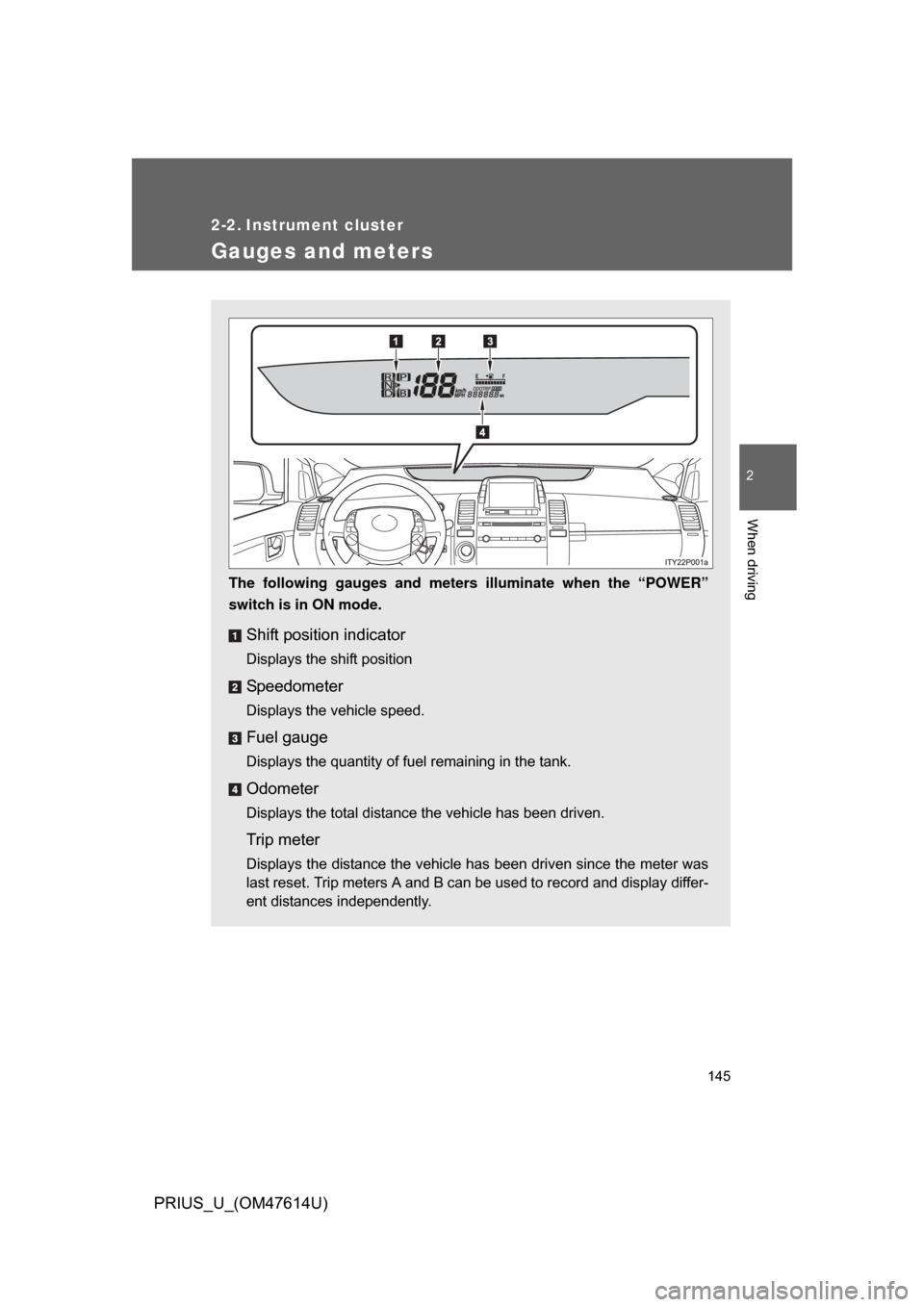
The following gauges and meters illuminate when the “POWER”
switch is in ON mode.
Shift position indicator
Displays the shift position
Speedometer
Displays the vehicle speed.
Fuel gauge
Displays the quantity of fuel remaining in the tank.
Odometer
Displays the total distance the vehicle has been driven.
Trip meter
Displays the distance the vehicle has been driven since the meter was
last reset. Trip meters A and B can be used to record and display differ-
ent distances independently.
Page 169 of 508
169
2
When driving
PRIUS_U_(OM47614U)
2-5. Driving information
Cargo and luggage
Capacity and distributionCargo capacity depends on the total weight of the occupants.
(Cargo capacity) = (Total load capa city) — (Total weight of occupants)
Steps for Determining Correct Load Limit—
(1) Locate the statement “The co mbined weight of occupants and
cargo should never exceed XXX kg or XXX lbs.” on your vehi-
cle’s placard.
(2) Determine the combined weight of the driver and passengers that will be riding in your vehicle.
(3) Subtract the combined weight of the driver and passengers from
XXX kg or XXX lbs.
(4) The resulting figure equals the available amount of cargo and luggage load capacity.
For example, if the “XXX” amount equals 1400 lbs. and there will
be five 150 lb passengers in your vehicle, the amount of avail-
able cargo and luggage load capacity is 650 lbs. (1400 - 750 (5
150) = 650 lbs.)
(5) Determine the combined weight of luggage and cargo being loaded on the vehicle.
That weight may not safely ex ceed the available cargo and lug-
gage load capacity calculated in Step 4.
Take notice of the following information about storage precau-
tions, cargo capacity and load.
● Stow cargo and luggage in the luggage compartment when-
ever possible. Be sure all items are secured in place.
● Be careful to keep the vehicle le vel. Placing the weight as far
forward as possible helps maintain vehicle balance.
● For better fuel economy, do no t carry unnecessary weight.
Page 202 of 508
202 3-2. Using the air conditioning system and defogger
PRIUS_U_(OM47614U)
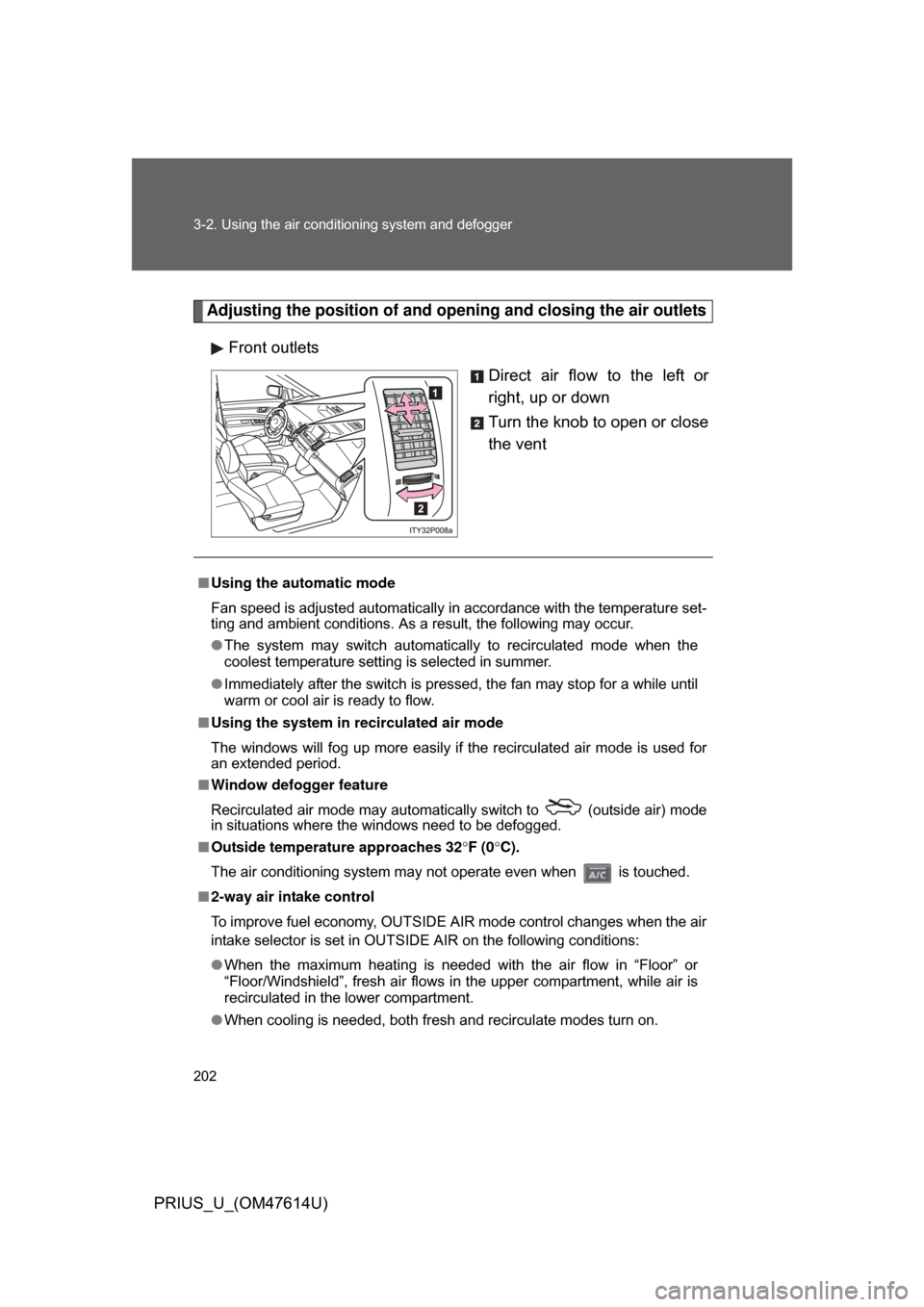
Adjusting the position of and opening and closing the air outlets
Front outlets Direct air flow to the left or
right, up or down
Turn the knob to open or close
the vent
■Using the automatic mode
Fan speed is adjusted automatically in accordance with the temperature set-
ting and ambient conditions. As a result, the following may occur.
● The system may switch automatically to recirculated mode when the
coolest temperature setting is selected in summer.
● Immediately after the switch is pressed, the fan may stop for a while until
warm or cool air is ready to flow.
■ Using the system in recirculated air mode
The windows will fog up more easily if the recirculated air mode is used for
an extended period.
■ Window defogger feature
Recirculated air mode may automatically switch to
(outside air) mode
in situations where the windows need to be defogged.
■ Outside temperature approaches 32 F (0 C).
The air conditioning system may not operate even when is touched.
■ 2-way air intake control
To improve fuel economy, OUTSIDE AIR mode control changes when the air
intake selector is set in OUTSIDE AIR on the following conditions:
● When the maximum heating is needed with the air flow in “Floor” or
“Floor/Windshield”, fresh air flows in the upper compartment, while air is
recirculated in the lower compartment.
● When cooling is needed, both fresh and recirculate modes turn on.
Page 209 of 508
209
3-2. Using the air conditioning system
and defogger
3
Interior features
PRIUS_U_(OM47614U)
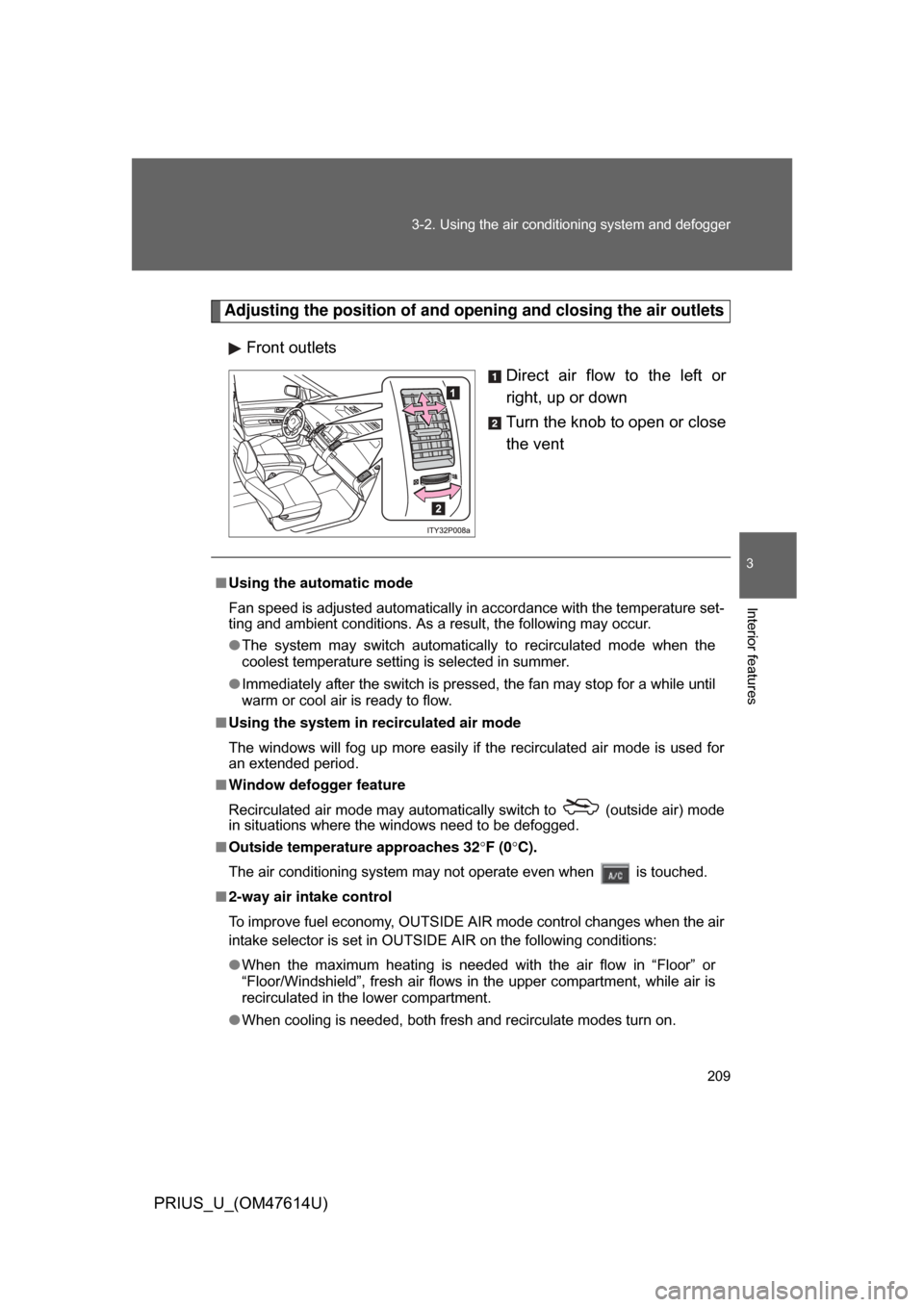
Adjusting the position of and opening and closing the air outlets
Front outlets Direct air flow to the left or
right, up or down
Turn the knob to open or close
the vent
■Using the automatic mode
Fan speed is adjusted automatically in accordance with the temperature set-
ting and ambient conditions. As a result, the following may occur.
● The system may switch automatically to recirculated mode when the
coolest temperature setting is selected in summer.
● Immediately after the switch is pressed, the fan may stop for a while until
warm or cool air is ready to flow.
■ Using the system in recirculated air mode
The windows will fog up more easily if the recirculated air mode is used for
an extended period.
■ Window defogger feature
Recirculated air mode may automatically switch to
(outside air) mode
in situations where the windows need to be defogged.
■ Outside temperatur e approaches 32F (0 C).
The air conditioning system may not operate even when is touched.
■ 2-way air intake control
To improve fuel economy, OUTSIDE AIR mode control changes when the air
intake selector is set in OUTSIDE AIR on the following conditions:
● When the maximum heating is needed with the air flow in “Floor” or
“Floor/Windshield”, fresh air flows in the upper compartment, while air is
recirculated in the lower compartment.
● When cooling is needed, both fresh and recirculate modes turn on.