Lift TOYOTA PRIUS 2012 3.G User Guide
[x] Cancel search | Manufacturer: TOYOTA, Model Year: 2012, Model line: PRIUS, Model: TOYOTA PRIUS 2012 3.GPages: 636, PDF Size: 11.02 MB
Page 417 of 636
417
4-3. Do-it-yourself maintenance
4
Maintenance and care
CAUTION
■
When raising your vehicle
Make sure to observe the following precautions to reduce the possibility of
death or serious injury:
●When using a floor jack, follow the instructions of the manual provided with
the jack.
● Do not use the jack that was supplied with your vehicle.
● Do not put any part of your body underneath the vehicle when it is sup-
ported only by the floor jack.
● Always use floor jack and/or automotive jack stands on a solid, flat, level
surface.
● Do not start the hybrid system while the vehicle is supported by the floor
jack.
● Stop the vehicle on level, firm ground, firmly set the parking brake and shift
the shift position to P.
● Make sure to set the floor jack properly at the jack point.
Raising the vehicle with an improperly positioned floor jack will damage
the vehicle and may cause the vehicle to fall off the floor jack.
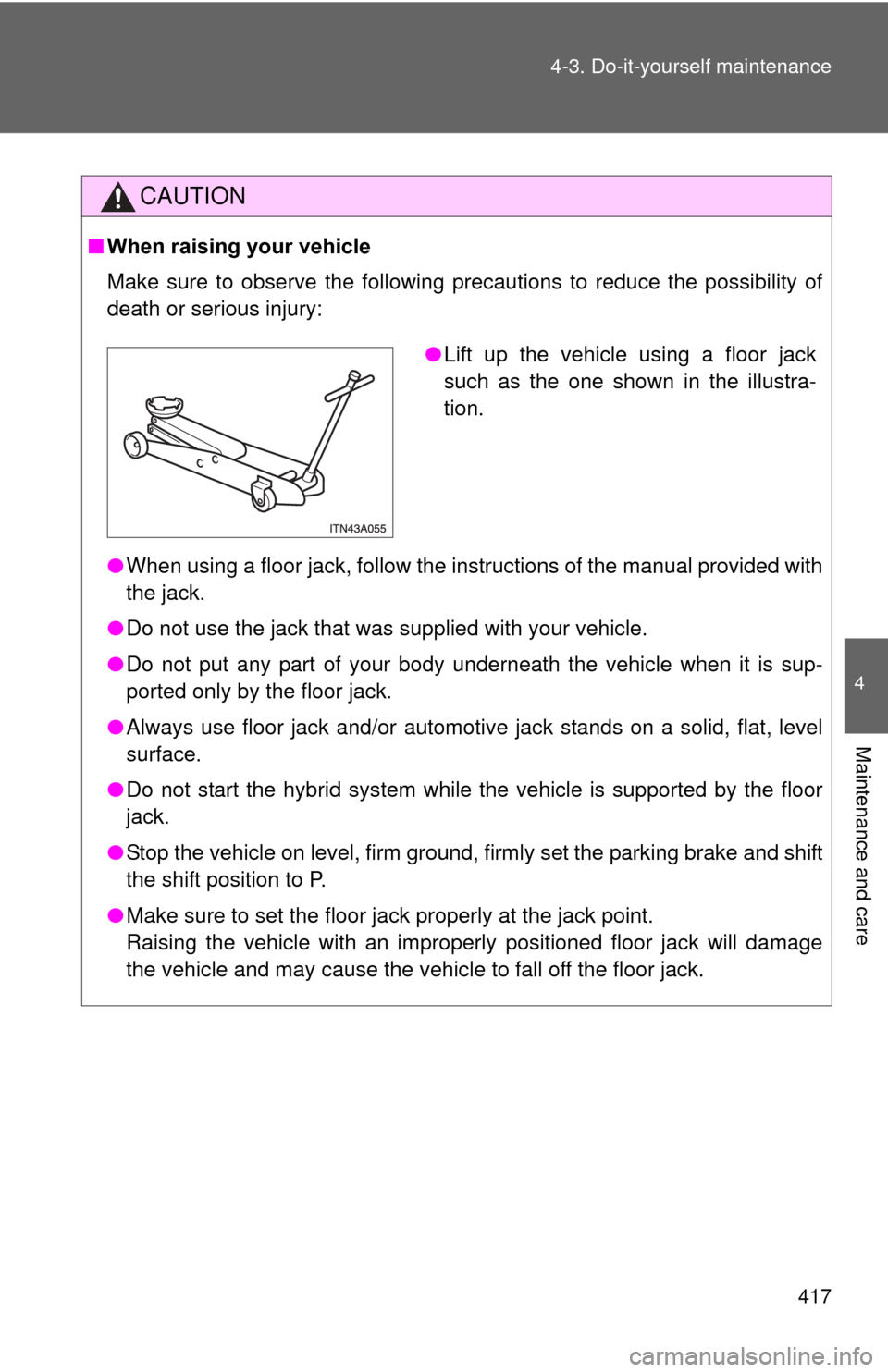
●Lift up the vehicle using a floor jack
such as the one shown in the illustra-
tion.
Page 427 of 636
427
4-3. Do-it-yourself maintenance
4
Maintenance and care
Brake fluid
■ Checking fluid level
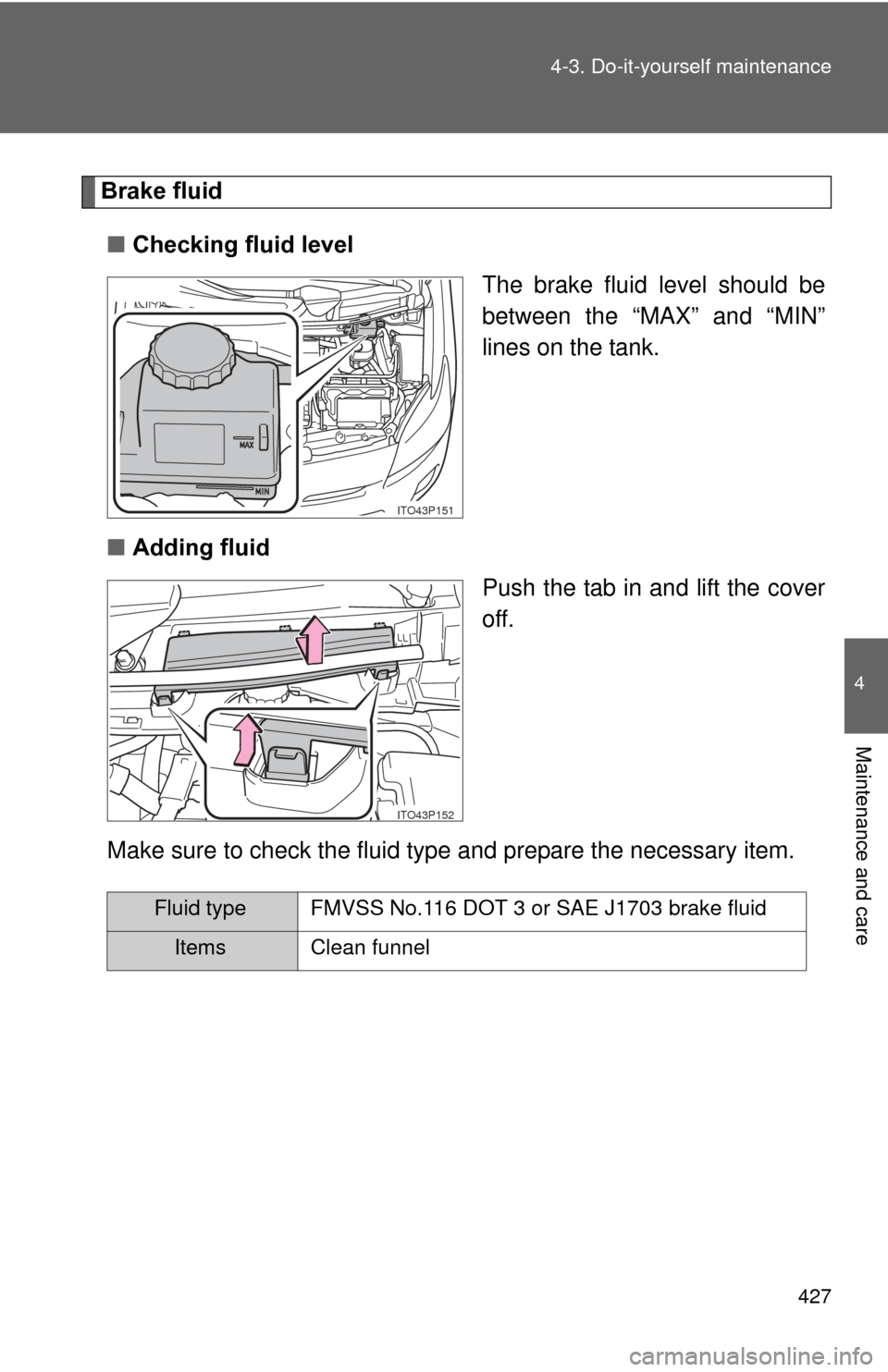
The brake fluid level should be
between the “MAX” and “MIN”
lines on the tank.
■ Adding fluid
Push the tab in and lift the cover
off.
Make sure to check the fluid type and prepare the necessary item.
ITO43P151
ITO43P152
Fluid type FMVSS No.116 DOT 3 or SAE J1703 brake fluid
Items Clean funnel
Page 456 of 636
456
4-3. Do-it-yourself maintenance
Checking and replacing fuses
If any of the electrical components do not operate, a fuse may have
blown. If this happens, check and replace the fuses as necessary.
Turn the “POWER” switch off.
Vehicles with Solar Ventilation Sy stem: Turn the Solar Ventilation
System off and make sure not to operate the Remote Air Condi-
tioning System.
Open the fuse box cover.
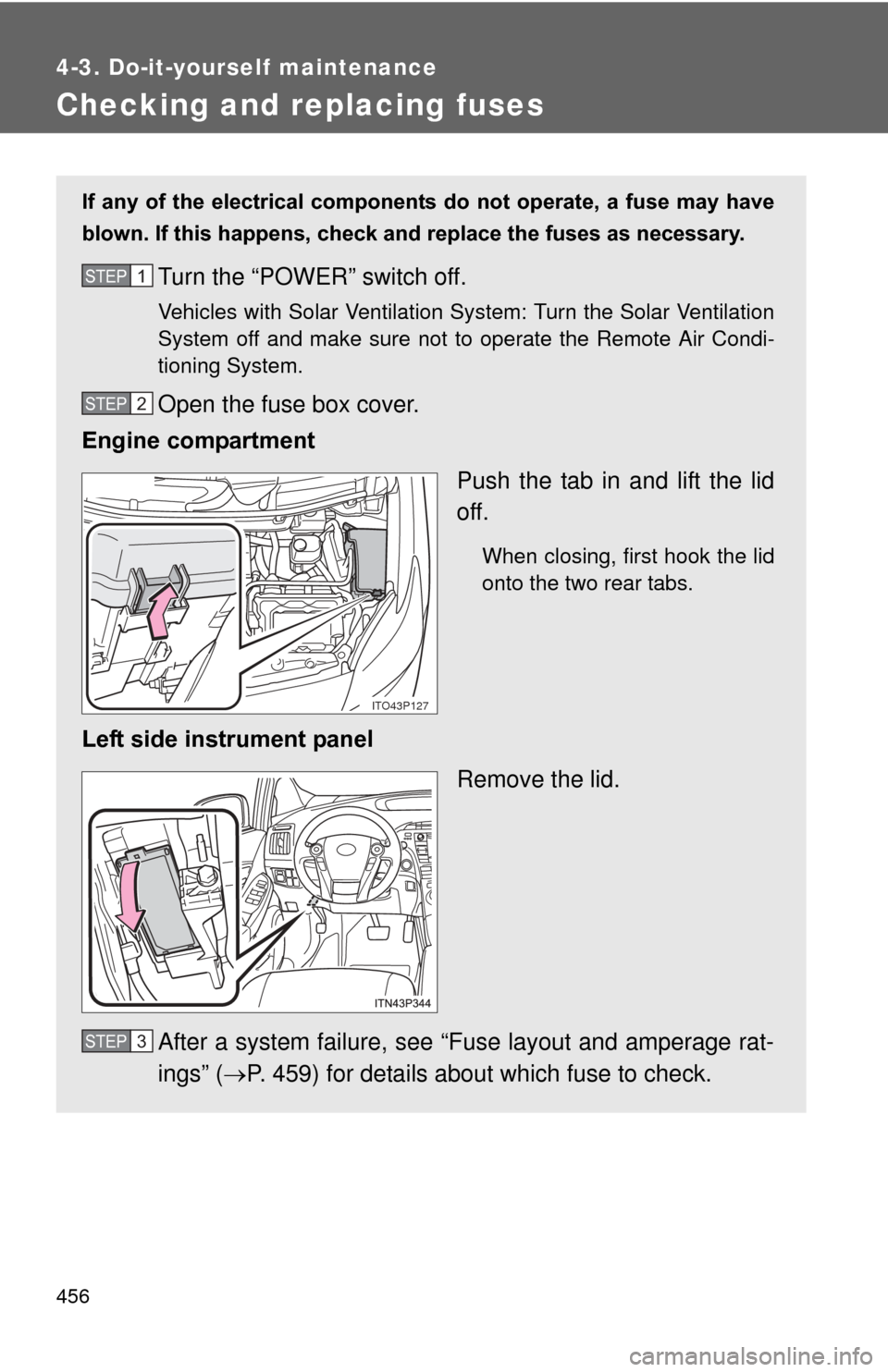
Engine compartment
Push the tab in and lift the lid
off.
When closing, first hook the lid
onto the two rear tabs.
Left side instrument panelRemove the lid.
After a system failure, see “Fuse layout and amperage rat-
ings” ( P. 459) for details about which fuse to check.
STEP 1
STEP 2
ITO43P127
STEP 3
Page 485 of 636
5
When trouble arises
485
5-1. Essential information
If your vehicle needs to be towed
Before towingThe following may indicate a problem with your hybrid transmission.
Contact your Toyota dealer before towing.
● The hybrid system is operating but the vehicle will not move.
● The vehicle makes an abnormal sound.
If there is a malfunction in the P position control system, the smart
key system or the immobilizer system , or if the 12-volt battery is dis-
charged, the vehicle cannot be tow ed with the front wheels on the
ground, as the front wheels may be locked. In this case, transport the
vehicle with both front wheels or all four wheels lifted.
If towing is necessary, we recommend having your vehicle towed by
your Toyota dealer or a commerci al towing service, using a lift-type
truck or flat bed truck.
Use a safety chain system for all to wing, and abide by all state/pro-
vincial and local laws.
Page 488 of 636
488 5-1. Essential information
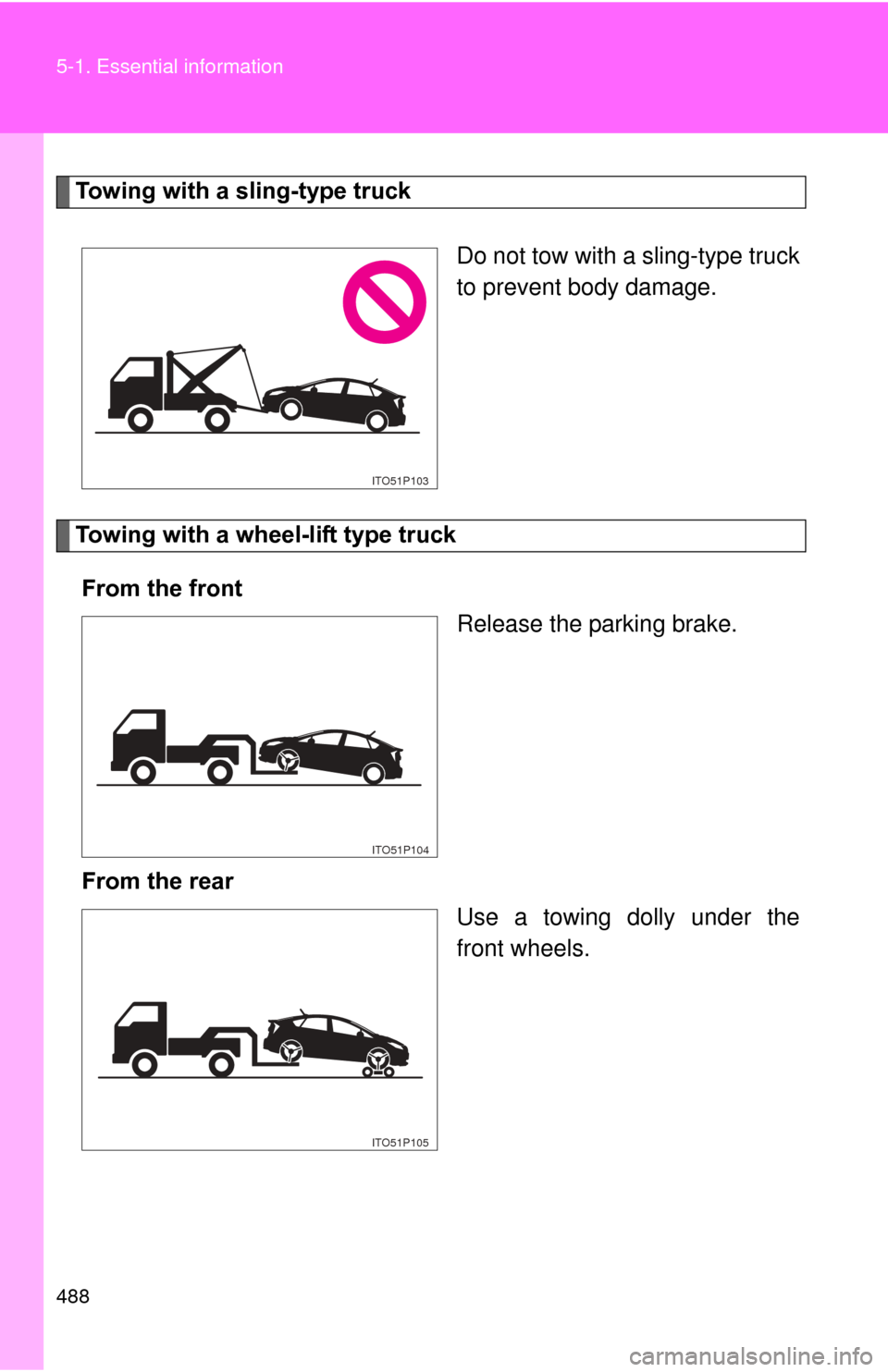
Towing with a sling-type truckDo not tow with a sling-type truck
to prevent body damage.
Towing with a wheel-lift type truckFrom the front Release the parking brake.
From the rear Use a towing dolly under the
front wheels.
ITO51P103
ITO51P104
ITO51P105
Page 491 of 636

5
When trouble arises
491
5-1. Essential information
NOTICE
■
To prevent damaging the vehicle
When raising the vehicle, ensure adequate ground clearance for towing at
the opposite end of the raised vehicle. Without adequate clearance, the
vehicle could be damaged while being towed.
■ To prevent causing serious damage to the hybrid transmission when
towing using a wheel-lift type truck
Never tow this vehicle from the front with the rear wheels on the ground.
■ To prevent body damage when towing with a sling-type truck
Do not tow with a sling-type truck, either from the front or rear.
■ To prevent causing serious damage to the hybrid transmission in
emergency towing
Never tow a vehicle from the rear with four wheels on the ground. This may
cause serious damage to the hybrid transmission.
Page 524 of 636
524 5-2. Steps to take in an emergency
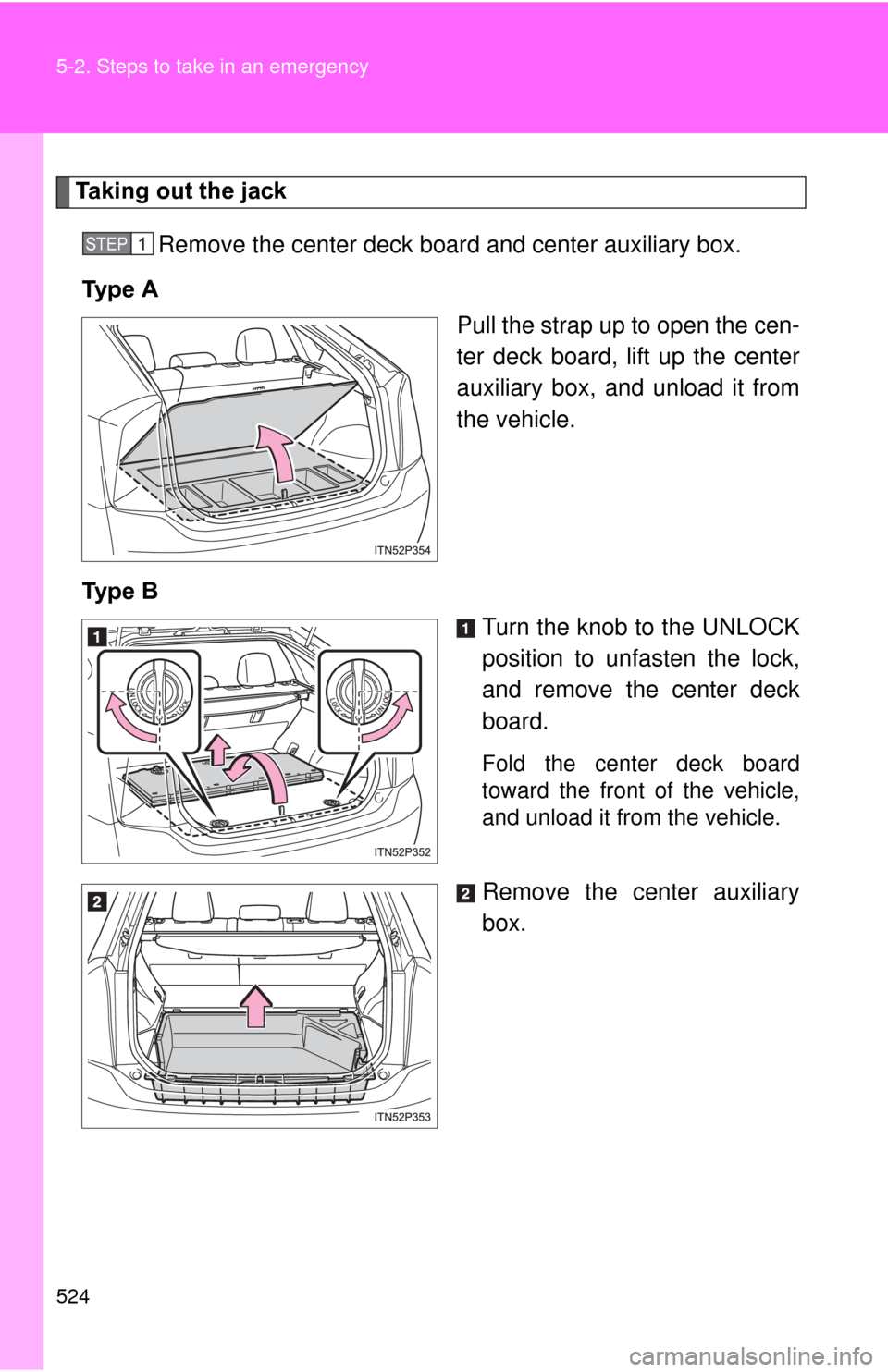
Taking out the jackRemove the center deck board and center auxiliary box.
Ty p e A Pull the strap up to open the cen-
ter deck board, lift up the center
auxiliary box, and unload it from
the vehicle.
Ty p e B Turn the knob to the UNLOCK
position to unfasten the lock,
and remove the center deck
board.
Fold the center deck board
toward the front of the vehicle,
and unload it from the vehicle.
Remove the center auxiliary
box.
STEP 1
Page 546 of 636

546 5-2. Steps to take in an emergency
■Starting the hybrid system when the 12-volt battery is discharged
The hybrid system cannot be started by push-starting.
■ To prevent 12-volt battery discharge
●Turn off the headlights and the audio system while the hybrid system is
off.
● Turn off any unnecessary electrical components when the vehicle is run-
ning at a low speed for an extended period, such as in heavy traffic.
■ When the 12-volt battery is removed or discharged
●The hybrid system may not start. ( P. 433)
● If the 12-volt battery is depleted with the shift position in P, it will not be
possible to shift the shift position other than P. In this case, the vehicle
cannot be towed without lifting both front wheels because the front
wheels are locked by the parking lock. ( P. 485)
● When the 12-volt battery is reconnected, start the hybrid system, depress
the brake pedal, and confirm that it is possible to shift into each shift posi-
tion.
■ Charging the 12-volt battery
The electricity stored in the 12-volt battery will discharge gradually even
when the vehicle is not in use, due to natural discharge and the draining
effects of certain electrical appliances. If the vehicle is left for a long time, the
12-volt battery may discharge, and the hybrid system may be unable to start.
(The 12-volt battery recharges automatically while the hybrid system is oper-
ating.)
Page 549 of 636
5
When trouble arises
549
5-2. Steps to take in an emergency
If your vehicle overheats
Correction procedures■ If the high coolant temperature warning light flashes or comes
on
Stop the vehicle in a safe place and turn off the air condition-
ing system.
Check to see if steam is coming out from under the hood.
If you see steam: Stop the hybrid system. Carefully lift the hood after the
steam subsides and then restart the hybrid system.
If you do not see steam: Leave the hybrid system operating and carefully lift the
hood.
The following may indicate that your vehicle is overheating:
●The high coolant temperature warn ing light flashes or comes on:
The engine may be overheating.
● “HYBRID SYSTEM OVERHEAT” is shown on the multi-informa-
tion display:
The power control unit may be overheating.
Follow the correction procedure as described below.
STEP 1
STEP 2
Page 551 of 636
5
When trouble arises
551
5-2. Steps to take in an emergency
■
If “HYBRID SYSTEM OVERHEAT” is shown on the multi-infor-
mation display
Stop the vehicle in a safe place and turn off the air condition-
ing system.
Leave the hybrid system operating and carefully lift the hood.
Check if the cooling fans are operating.
If the fans are operating: Wait until “HYBRID SYSTEM OVERHEAT” disappears and
then stop the hybrid system.
If the warning light does not turn off, call your Toyota dealer.
If the fans are not operating: Stop the hybrid system immediately and call your Toyota
dealer.
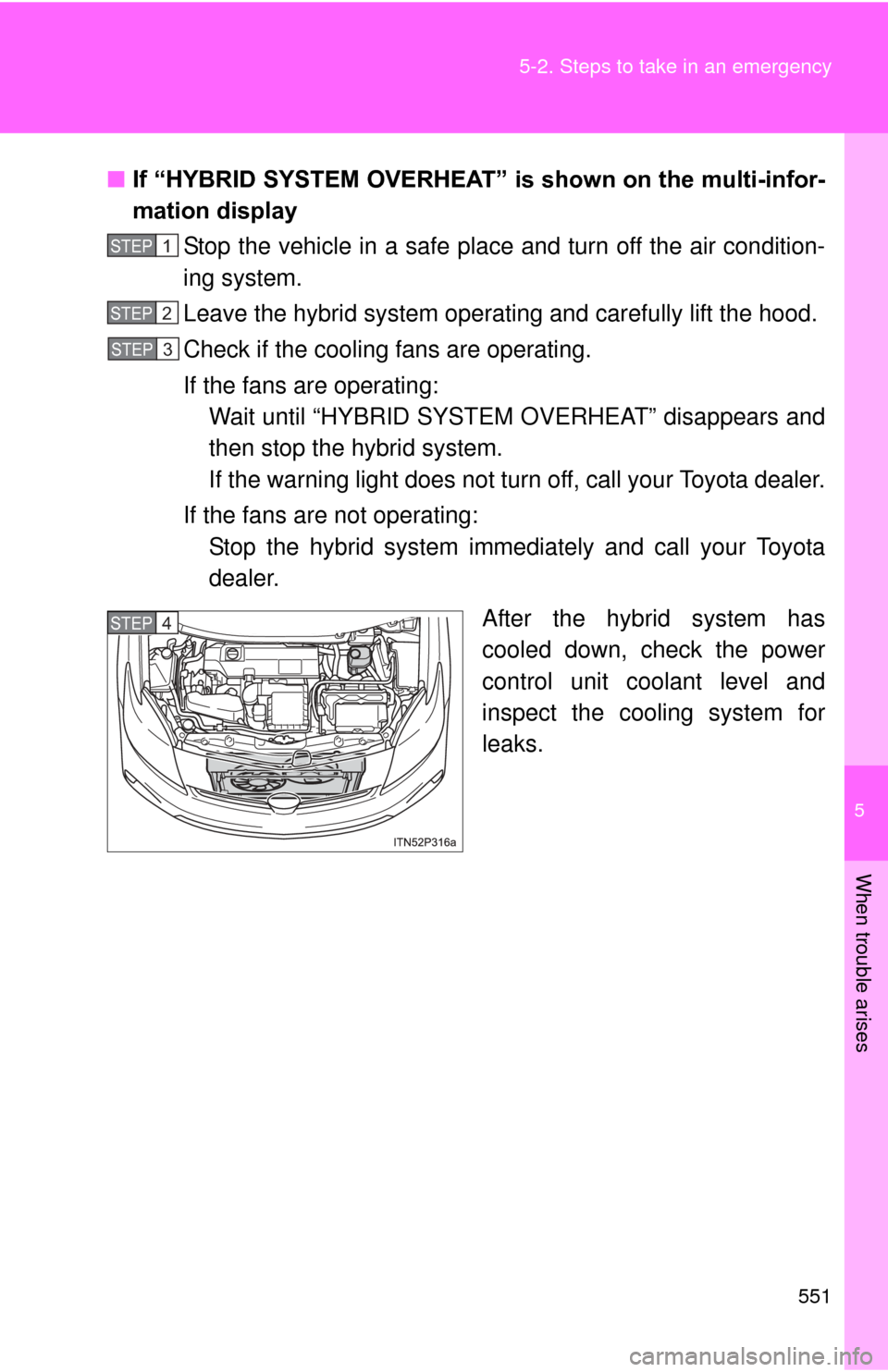
After the hybrid system has
cooled down, check the power
control unit coolant level and
inspect the cooling system for
leaks.
STEP 1
STEP 2
STEP 3
STEP 4