fog light TOYOTA PRIUS 2012 3.G User Guide
[x] Cancel search | Manufacturer: TOYOTA, Model Year: 2012, Model line: PRIUS, Model: TOYOTA PRIUS 2012 3.GPages: 636, PDF Size: 11.02 MB
Page 307 of 636
307
2-4. Using other
driving systems
2
When driving
■Obstacles not detected
The sensor cannot detect plastic obstacles such as traffic cones. There may
also be occasions when the sensor cannot detect pedestrians, animals,
bicycles, motorcycles, trees, or snowdrifts.
■ Situations in which the pre-collis ion system does not function properly
The system may not function effectively in situations such as the following:
● On roads with sharp bends or uneven surfaces
● If a vehicle suddenly moves in front of vehicle, such as at an intersection
● If a vehicle suddenly cuts in front of vehicle, such as when overtaking
● In inclement weather such as heavy rain, fog, snow or sand storms
● When your vehicle is skidding with the VSC system off
● When an extreme change in vehicle height occurs
● When the axis of the radar is out of adjustment
■ Automatic cancelation of the pre-collision system
When a malfunction occurs due to sensor contamination, etc. that results in
the sensors being unable to detect obstacles, the pre-collision system will be
automatically disabled. In this case, the system will not activate even if there
is a collision possibility.
■ When there is a malfunction in the system
Warning lights and/or warning messages will turn on or flash. ( P. 496, 509)
Page 325 of 636
Interior features3
325
3-1. Using the air conditioning system and defogger
Air conditioning system ........................... 326
Using the steering wheel climate remote control
switches ......................... 337
Solar Ventilation System ........................... 339
Remote Air Conditioning System ........................... 342
Rear window and outside rear view mirror defogger
switch ............................. 346
3-2. Using the audio system Audio system types .......... 347
Using the AUX port/USB port................................. 352 3-3. Using the interior lights
Interior lights list ............... 353
• Front interior lights ......... 354
• Personal lights ............... 355
• Rear interior light ........... 355
3-4. Using the storage features List of storage features .... 357
• Glove boxes ................... 358
• Console box ................... 359
• Cup holders ................... 360
• Bottle holders ................. 362
• Auxiliary boxes ............... 363
3-5. Other interior features Sun visors ........................ 364
Vanity mirrors ................... 365
Outside temperature display............................ 366
Power outlets ................... 367
Seat heaters..................... 369
Armrest ............................ 371
Floor mats ........................ 372
Luggage compartment features .......................... 374
Garage door opener......... 380
Safety Connect ................ 388
Page 339 of 636
339
3-1. Using the air conditioning system and defogger
3
Interior features
Solar Ventilation System
: If equipped
The Solar Ventilation System uses energy provided by solar panel
built into the roof to operate a fa n contained within the air condition-
ing system, allowing ventilation of the vehicle interior when the vehi-
cle is parked in direct sunlight.
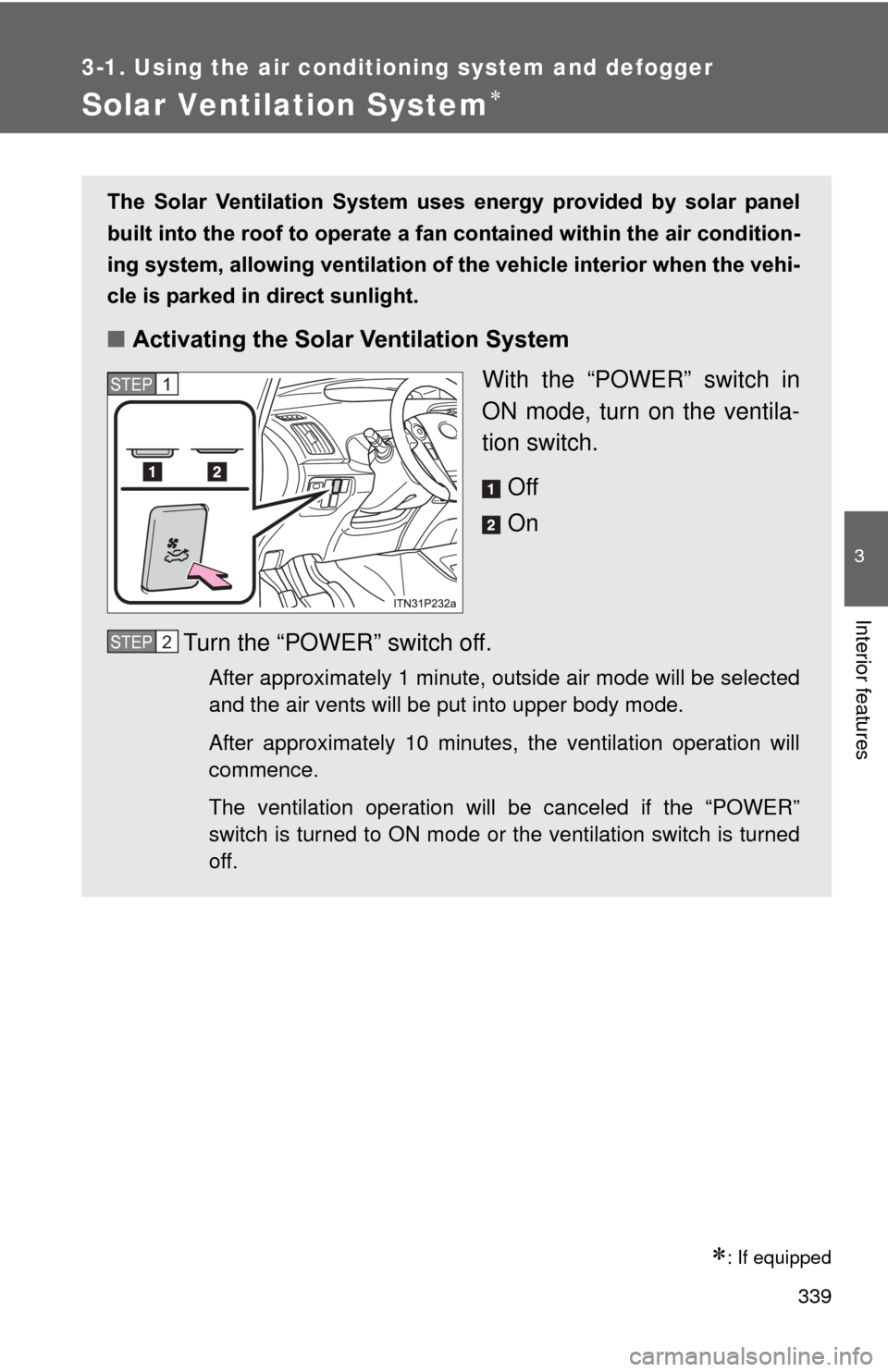
■ Activating the Solar Ventilation System
With the “POWER” switch in
ON mode, turn on the ventila-
tion switch.
Off
On
Turn the “POWER” switch off.
After approximately 1 minute, outside air mode will be selected
and the air vents will be put into upper body mode.
After approximately 10 minutes, the ventilation operation will
commence.
The ventilation operation will be canceled if the “POWER”
switch is turned to ON mode or the ventilation switch is turned
off.
STEP 1
STEP 2
Page 340 of 636

340 3-1. Using the air conditioning system and defogger
■Operating conditions
The Solar Ventilation System may not operate under the following circum-
stances due to a lack of power from the solar panel:
●Low amount of sunlight
● Ever when a part of the solar panel is cast by a shadow.
● Ever when a part of the solar panel is covered by fallen leaves or dirt.
● The solar panel is not at a high temperature.
■ Before using the Solar Ventilation System
Remove dirt or fallen leaves from the solar panel in order to ensure sufficient
electrical output.
■ Efficient use of the So lar Ventilation System
Efficient control of temperature increase can be achieved by using the sys-
tem in conjunction with the Remote Air Conditioning System. ( P. 342)
■ When using the Sola r Ventilation System
● Make sure that the “POWER” switch is in ON mode when turning the
ventilation switch on. If the ventilation switch is turned on while the
“POWER” switch is OFF, the air mode and the status of the air vents will
remain unchanged.
● If the Solar Ventilation System is not needed, be sure to turn the ventila-
tion switch off.
Dirty air and exhaust fumes from other vehicles may be drawn from out-
side. Also, use in winter may cause heated interior air to leave the vehi-
cle, thus leading to a drop in temperature.
■ Sounds when using the Solar Ventilation System
If the amount of sunlight is insufficient, you may hear a sound coming from
the air conditioning system. This is the sound of a control function to pre-
serve the fan and does not indicate a malfunction.
Page 343 of 636
343
3-1. Using the air conditioning system
and defogger
3
Interior features
■Using the Remote Air Conditioning System effectively
Efficiency can be increased by using the system in conjunction with the
Solar Ventilation System. ( P. 339)
■ When leaving the vehicle
●Check that the headlights are switched to either off or “AUTO”.
● Check that the wiper switch is turned off.
● Check that all windows are closed.
■ Remote Air Conditioning System automatic shut-off
The system will automatically shut off under the following conditions:
●About 3 minutes have passed since operation began
● Any one of the operating conditions is not met
The system may also shut off if the charge level of the hybrid battery (trac-
tion battery) drops to low. ( P. 42)
■ Conditions affecting operation
The system may not start in the following situations:
●The charge level of the hybrid battery (traction battery) is low ( P. 42)
● The air conditioning temperature is set at a high level or outside tempera-
ture is low
● When the vehicle has been left parked for a number of days
● When the hybrid system is cool (for example, after being left for a long
time in low temperatures)
Page 401 of 636
401
4-1. Maintenance and care
4
Maintenance and care
NOTICE
■
Cleaning detergents
●Do not use the following types of detergent, as they may discolor the vehi-
cle interior or cause streaks or damage to painted surfaces:
• Non-seat portions: Organic substances such as benzene or gasoline,
alkaline or acidic solutions, dye, and bleach
• Seats: Alkaline or acidic solutions, such as thinner, benzene, and alcohol
● Do not use polish wax or polish cleaner. The instrument panel’s or other
interior part’s painted surface may be damaged.
■ Preventing damage to leather surfaces
Observe the following precautions to avoid damage to and deterioration o\
f
leather surfaces:
●Remove any dust or dirt from leather surfaces immediately.
● Do not expose the vehicle to direct sunlight for extended periods of time.
Park the vehicle in the shade, especially during summer.
● Do not place items made of vinyl, plastic, or containing wax on the uphol-
stery, as they may stick to the leather surface if the vehicle interior heats
up significantly.
■ Water on the floor
Do not wash the vehicle floor with water.
Vehicle systems such as the audio system may be damaged if water comes
into contact with electrical components such as the audio system above or
under the floor of the vehicle. Water may also cause the body to rust.
■ Cleaning the inside of the rear window
●Do not use glass cleaner to clean the rear window, as this may cause
damage to the rear window defogger heater wires. Use a cloth dampened
with lukewarm water to gently wipe the window clean. Wipe the window in
strokes running parallel to the heater wires.
● Be careful not to scratch or damage the heater wires.
Page 461 of 636
461
4-3. Do-it-yourself maintenance
4
Maintenance and care
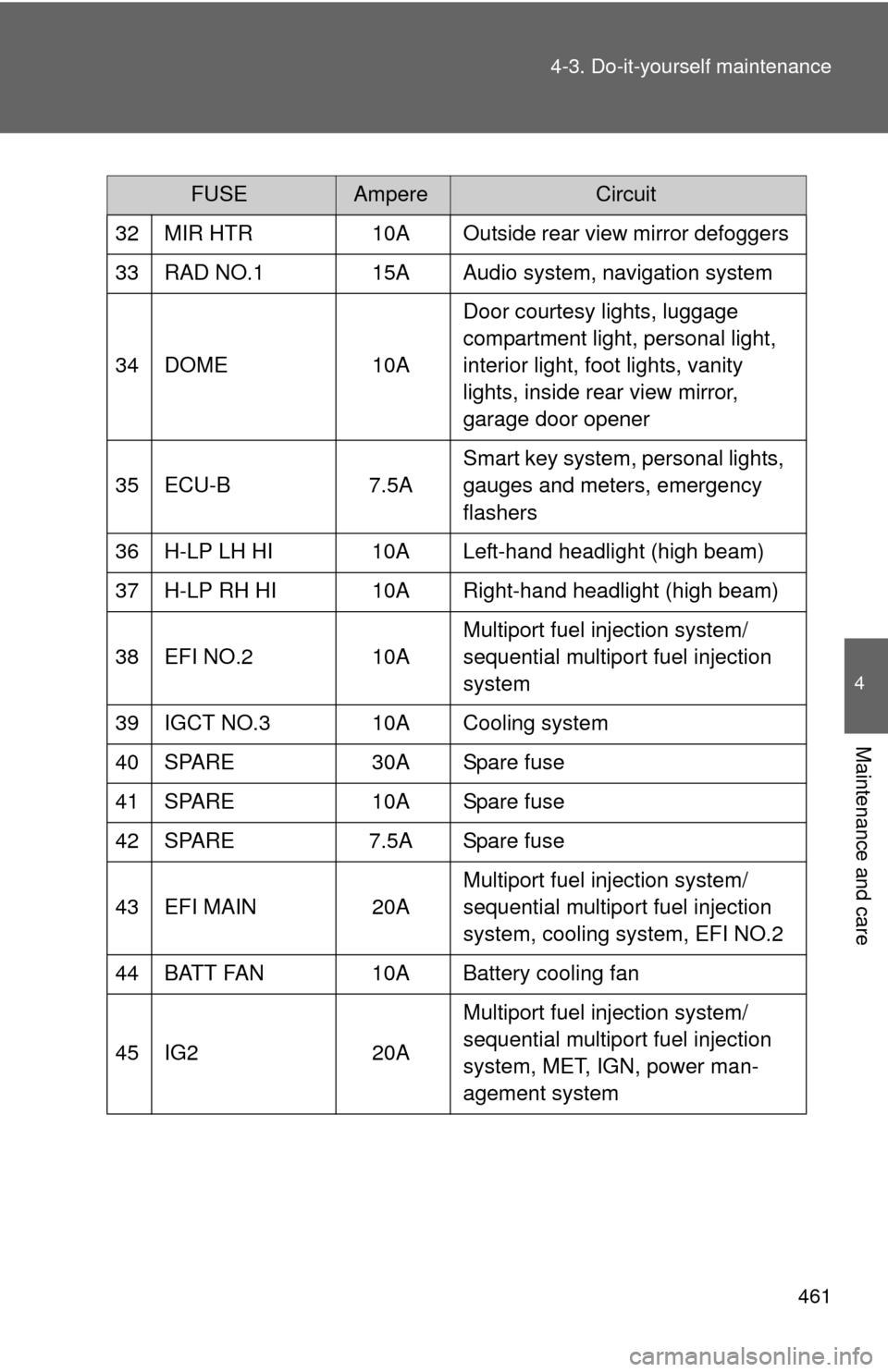
FUSEAmpereCircuit
32 MIR HTR 10A Outside rear view mirror defoggers
33 RAD NO.1 15A Audio system, navigation system
34 DOME 10ADoor courtesy lights, luggage
compartment light, personal light,
interior light, foot lights, vanity
lights, inside rear view mirror,
garage door opener
35 ECU-B 7.5ASmart key system, personal lights,
gauges and meters, emergency
flashers
36 H-LP LH HI 10A Left-hand headlight (high beam)
37 H-LP RH HI 10A Right-hand headlight (high beam)
38 EFI NO.2 10AMultiport fuel injection system/
sequential multiport fuel injection
system
39 IGCT NO.3 10A Cooling system
40 SPARE 30A Spare fuse
41 SPARE 10A Spare fuse
42 SPARE 7.5A Spare fuse
43 EFI MAIN 20AMultiport fuel injection system/
sequential multiport fuel injection
system, cooling system, EFI NO.2
44 BATT FAN 10A Battery cooling fan
45 IG2 20AMultiport fuel injection system/
sequential multiport fuel injection
system, MET, IGN, power man-
agement system
Page 462 of 636
462 4-3. Do-it-yourself maintenance
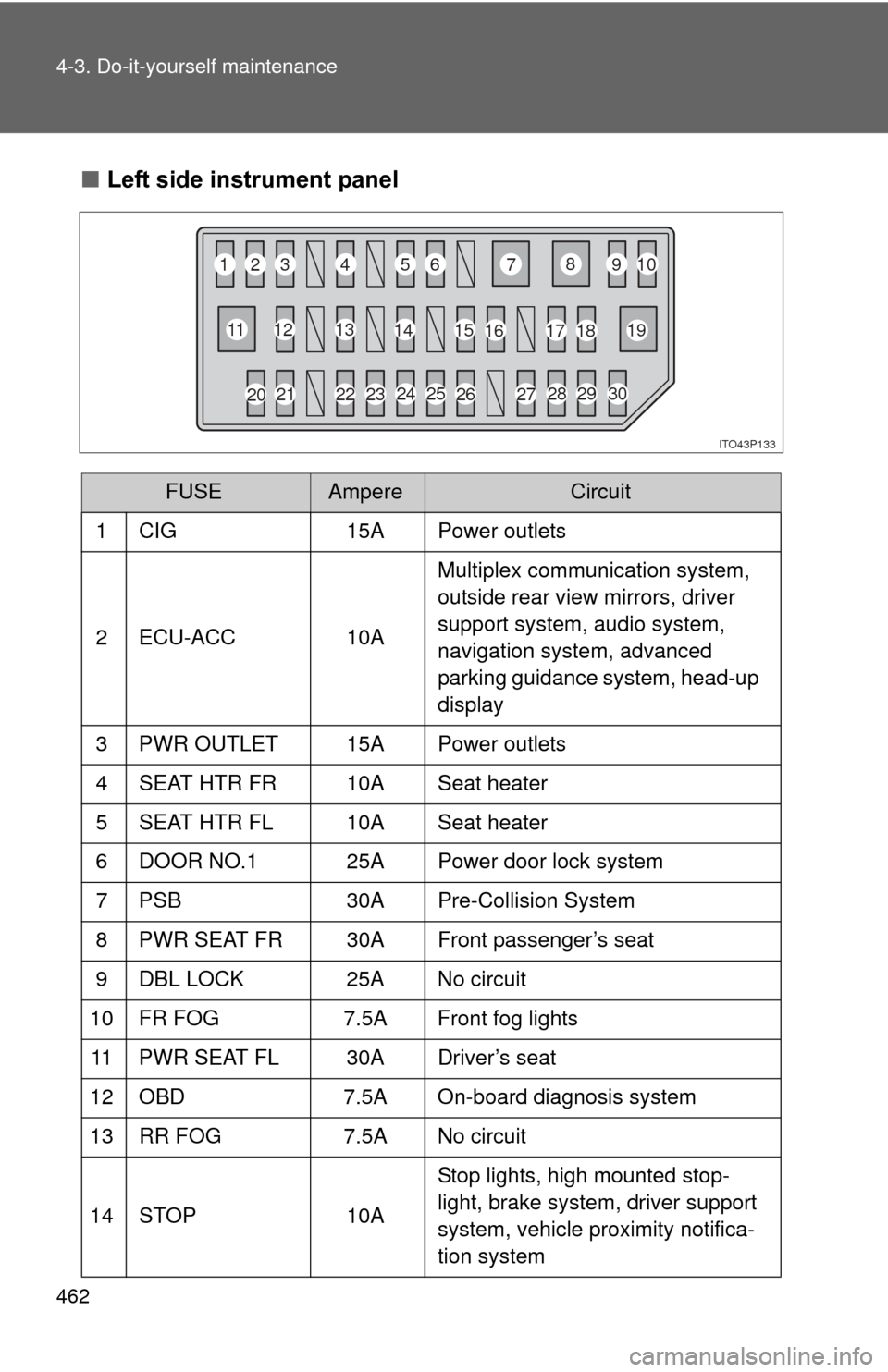
■Left side instrument panel
FUSEAmpereCircuit
1 CIG 15A Power outlets
2 ECU-ACC 10AMultiplex communication system,
outside rear view mirrors, driver
support system, audio system,
navigation system, advanced
parking guidance system, head-up
display
3 PWR OUTLET 15A Power outlets
4 SEAT HTR FR 10A Seat heater
5 SEAT HTR FL 10A Seat heater
6 DOOR NO.1 25A Power door lock system
7 PSB 30A Pre-Collision System
8 PWR SEAT FR 30A Front passenger’s seat
9 DBL LOCK 25A No circuit
10 FR FOG 7.5A Front fog lights
11 PWR SEAT FL 30A Driver’s seat
12 OBD 7.5A On-board diagnosis system
13 RR FOG 7.5A No circuit
14 STOP 10AStop lights, high mounted stop-
light, brake system, driver support
system, vehicle proximity notifica-
tion system
ITO43P133
1
2
3 4
56 7
8
910
11 12
13
14 15
16 17
18 19
23 24 25
26
2728
29
30
20 21 22
Page 464 of 636

464 4-3. Do-it-yourself maintenance
FUSEAmpereCircuit
25 RR WIP 20A Rear window wiper and washer
26 WIP 30A Windshield wipers
27 MET 7.5A Gauges and meters
28 IGN 10ABrake system, driver support sys-
tem, multiport fuel injection sys-
tem/sequential multiport fuel
injection system, SRS airbag sys-
tem, front passenger occupant
classification system (ECU and
sensors), power management sys-
tem, smart key system, front pas-
senger’s seat belt reminder light
29 PANEL 10AAir conditioning system, personal
light, transmission, P position
switch, navigation system, Solar
Ventilation System, Remote Air
Conditioning System, advanced
parking guidance system, head-
light cleaner, front passenger’s
seat belt reminder light, headlight
leveling system, glove box light,
clock, audio system, MPH or km/h
switch
30 TAIL 10AHeadlight leveling system, park-
ing lights, tail lights, license plate
lights, front fog lights, side marker
lights
Page 467 of 636
467
4-3. Do-it-yourself maintenance
4
Maintenance and care
Light bulbs
You may replace the following bulbs by yourself. The difficulty level
of replacement varies depending on the bulb. As there is a danger
that components may be damaged, we recommend that replacement
is carried out by your Toyota dealer.
■Preparing for light bulb replacement
Check the wattage of the light bulb to be replaced. ( P. 570)
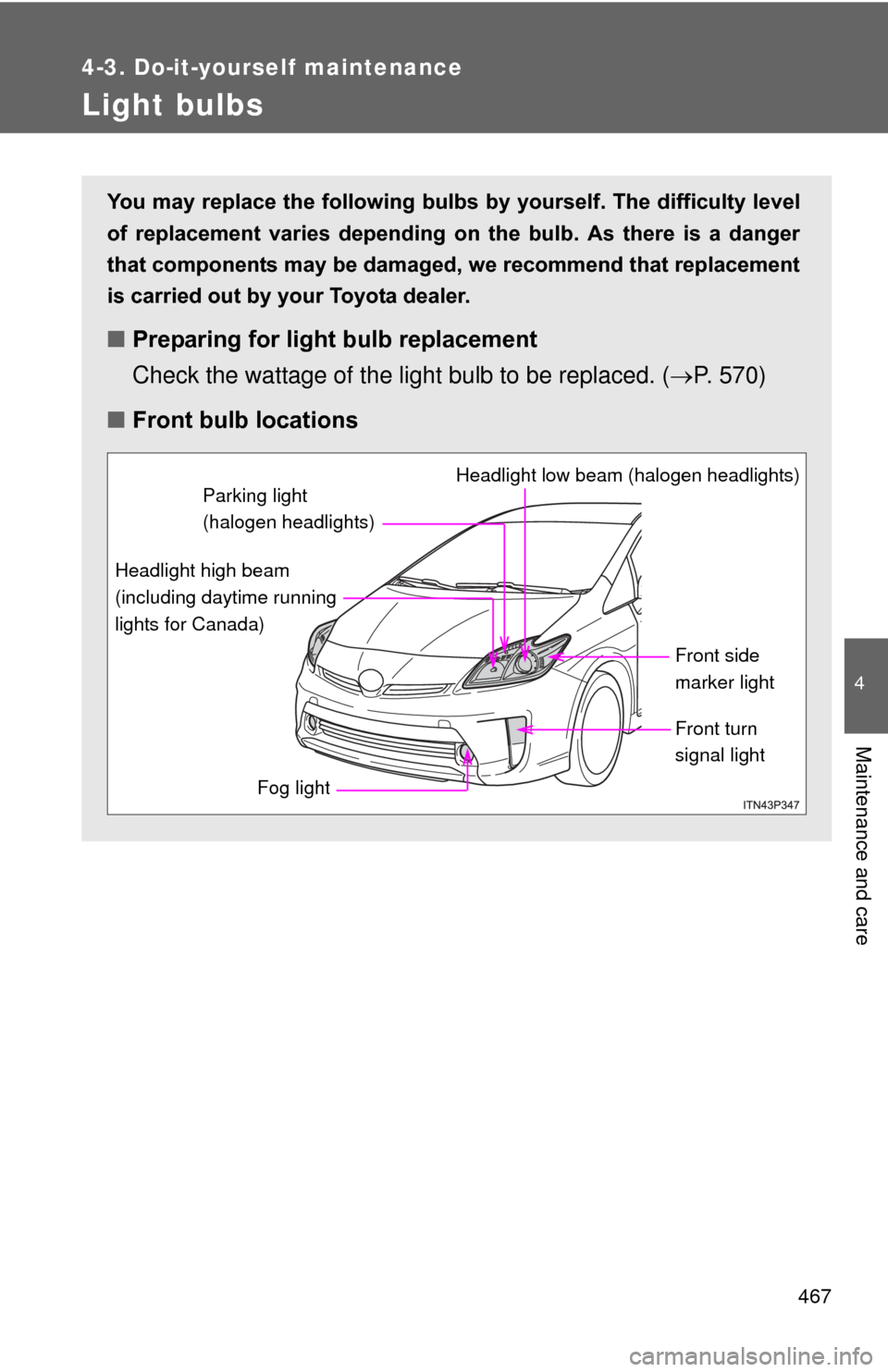
■ Front bulb locations
Front side
marker light
Headlight low beam (halogen headlights)
Headlight high beam
(including daytime running
lights for Canada)
Fog light
Front turn
signal light
Parking light
(halogen headlights)