flat TOYOTA PRIUS 2012 3.G Owner's Guide
[x] Cancel search | Manufacturer: TOYOTA, Model Year: 2012, Model line: PRIUS, Model: TOYOTA PRIUS 2012 3.GPages: 636, PDF Size: 11.02 MB
Page 447 of 636
447
4-3. Do-it-yourself maintenance
4
Maintenance and care
Tire inflation pressure
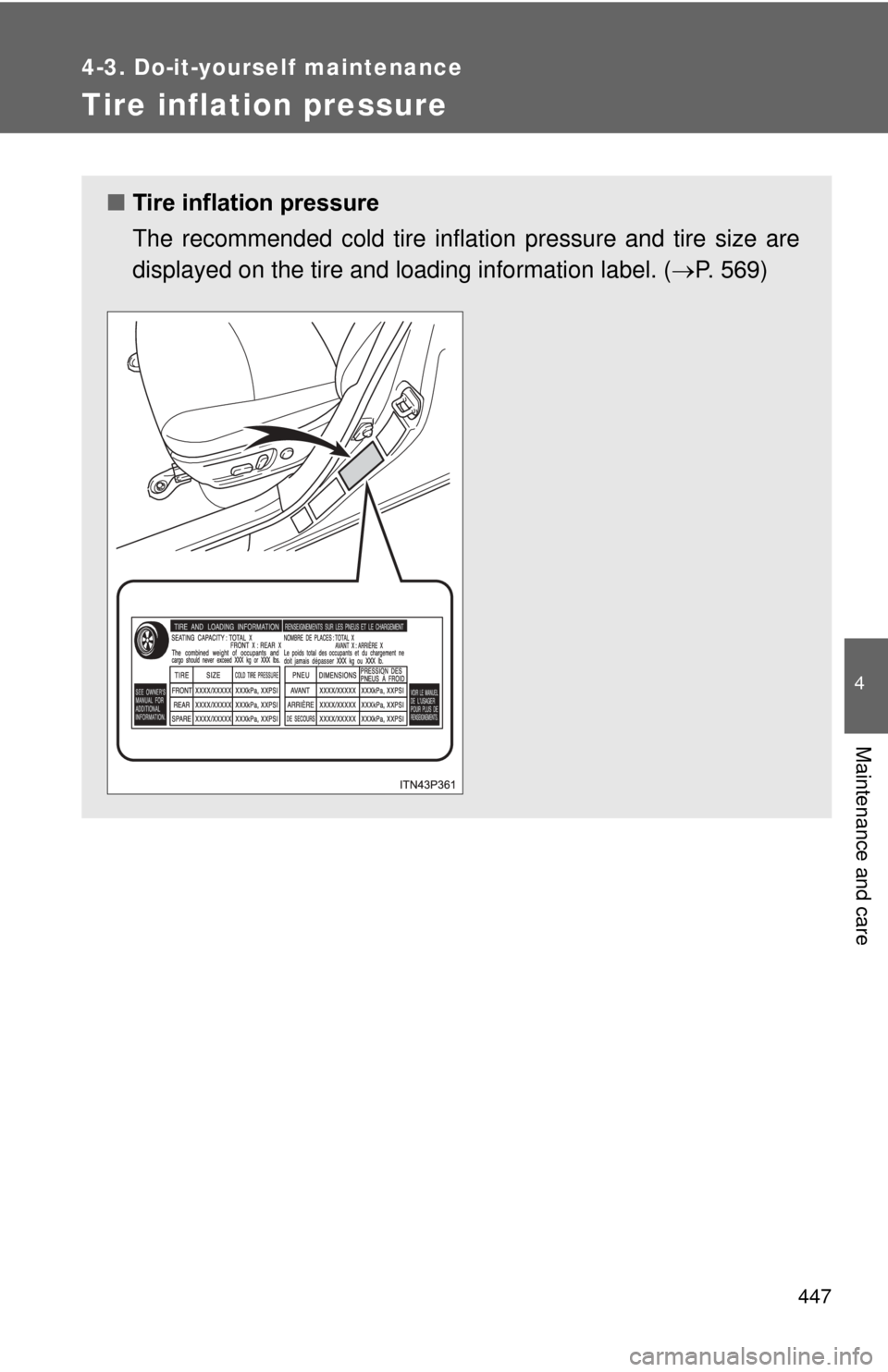
■Tire inflation pressure
The recommended cold tire inflation pressure and tire size are
displayed on the tire and loading information label. ( P. 569)
Page 448 of 636
448 4-3. Do-it-yourself maintenance
.
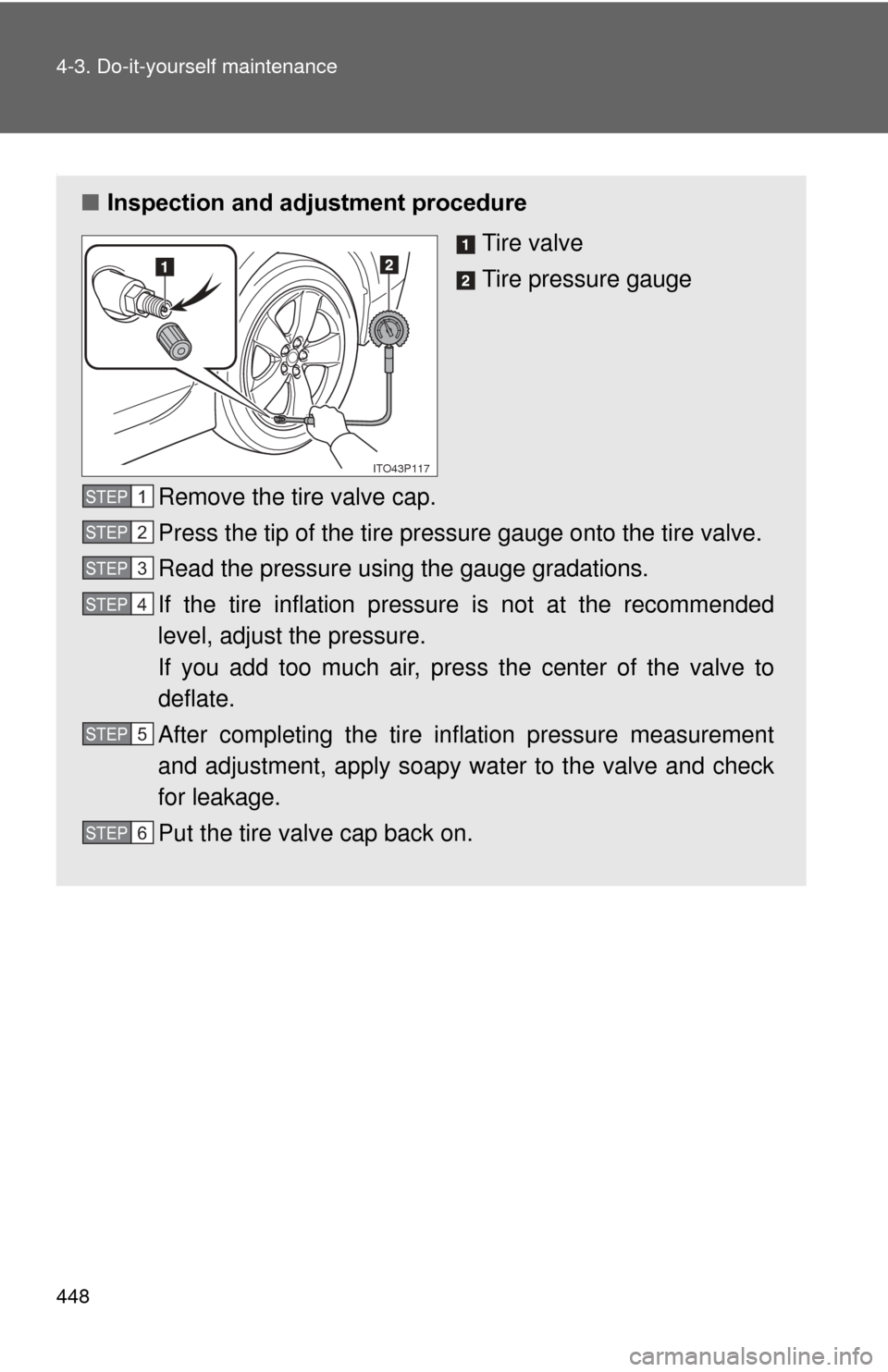
■Inspection and adjustment procedure
Tire valve
Tire pressure gauge
Remove the tire valve cap.
Press the tip of the tire pressure gauge onto the tire valve.
Read the pressure using the gauge gradations.
If the tire inflation pressure is not at the recommended
level, adjust the pressure.
If you add too much air, pres s the center of the valve to
deflate.
After completing the tire inflation pressure measurement
and adjustment, apply soapy water to the valve and check
for leakage.
Put the tire valve cap back on.
ITO43P117
STEP 1
STEP 2
STEP 3
STEP 4
STEP 5
STEP 6
Page 449 of 636

449
4-3. Do-it-yourself maintenance
4
Maintenance and care
■Tire inflation pressure check interval
You should check tire inflation pressure every two weeks, or at least
once a month.
Do not forget to check the spare.
■Effects of incorrect tire inflation pressure
Driving with incorrect ti
re inflation pressure ma y result in the following:
●Reduced fuel efficiency
●Reduced driving comfort and tire life
●Reduced safety
●Damage to the drive train
If a tire needs frequent inflating, have it checked by your Toyota dealer.
■Instructions for checking tire inflation pressure
When checking tire inflation pressure, observe the following:
●Check only when the tires are cold.
If your vehicle has been parked for at least 3 hours or has not been
driven for more than 1 mile or 1.5 km, you will get an accurate cold
tire inflation pressure reading.
●Always use a tire pressure gauge.
The appearance of the tire can be mi sleading. In addition, tire infla-
tion pressure that is even just a few pounds off can affect ride quality
and handling.
●Do not reduce tire inflation pressure after driving. It is normal for tire
inflation pressure to be higher after driving.
●Never exceed the vehicle capacity weight.
Passengers and luggage weight should be placed so that the vehicle
is balanced.
Page 450 of 636

450 4-3. Do-it-yourself maintenance
CAUTION
■Proper inflation is critical to save tire performance
Keep your tires properly inflated. Otherwise, the following conditions
may occur and result in an accident causing death or serious injury:
●Excessive wear
●Uneven wear
●Poor handling
●Possibility of blowouts resu lting from overheated tires
●Poor sealing of the tire bead
●Wheel deformation and/or tire separation
●A greater possibility of tire damage from road hazards
NOTICE
■When inspecting and adjusting tire inflation pressure
Be sure to put the tire valve caps back on.
Without the valve caps, dirt or mo isture could get into the valve and
cause air leakage, which could result in an accident. If the caps are lost,
replace them as soon as possible.
Page 452 of 636
452 4-3. Do-it-yourself maintenance
■When replacing wheels
The wheels of your vehicle are equipped with tire pressure warning
valves and transmitters that allow the tire pressure warning system to
provide advance warning in the event of a loss in tire inflation pressure.
Whenever wheels are replaced, tire pressure warning valves and trans-
mitters must be installed. (P. 438)
CAUTION
■When replacing wheels
●Do not use wheels that are a different size from those recommended in
the Owner’s Manual, as this may resu lt in a loss of handling control.
●Never use an inner tube in a leaking wheel which is designed for a
tubeless tire. Doing so may result in an accident, causing death or seri-
ous injury.
■When installing the wheel nuts
●Never use oil or grease on the wheel bolts or wheel nuts.
Oil and grease may cause the wheel nuts to be excessively tightened,
leading to bolt or disc wheel damage. In addition, the oil or grease can
cause the wheel nuts to loosen and the wheel may fall off, causing an
accident and resulting in death or serious injury. Remove any oil or
grease from the wheel bolts or wheel nuts.
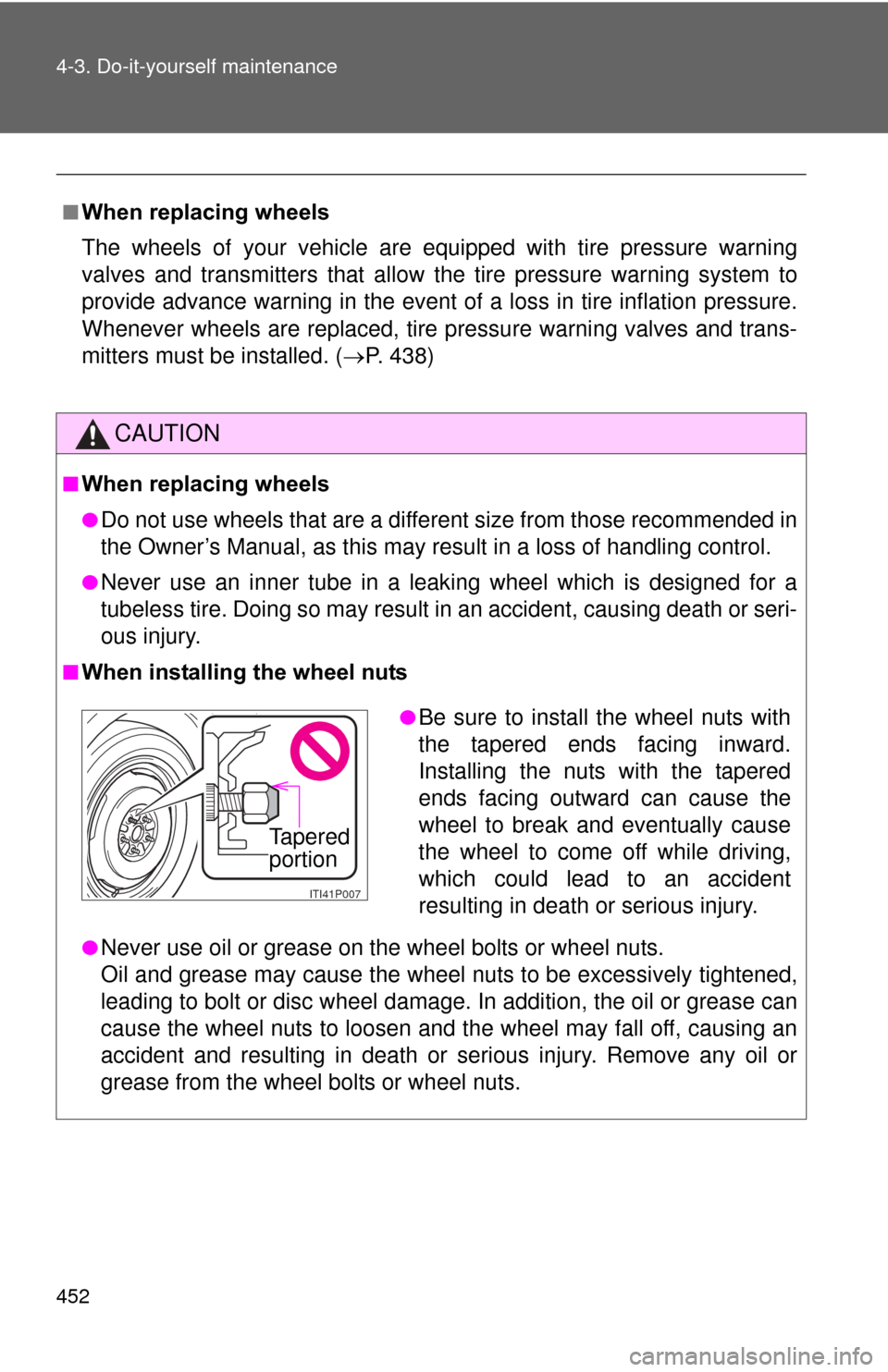
●Be sure to install the wheel nuts with
the tapered ends facing inward.
Installing the nuts with the tapered
ends facing outward can cause the
wheel to break and eventually cause
the wheel to come off while driving,
which could lead to an accident
resulting in death or serious injury.
ITI41P007
Ta p e r e d
portion
Page 454 of 636
454
4-3. Do-it-yourself maintenance
Electronic key batter y
Replace the battery with a new one if it is depleted.
■You will need the following items:
●Flathead screwdriver
● Lithium battery CR1632
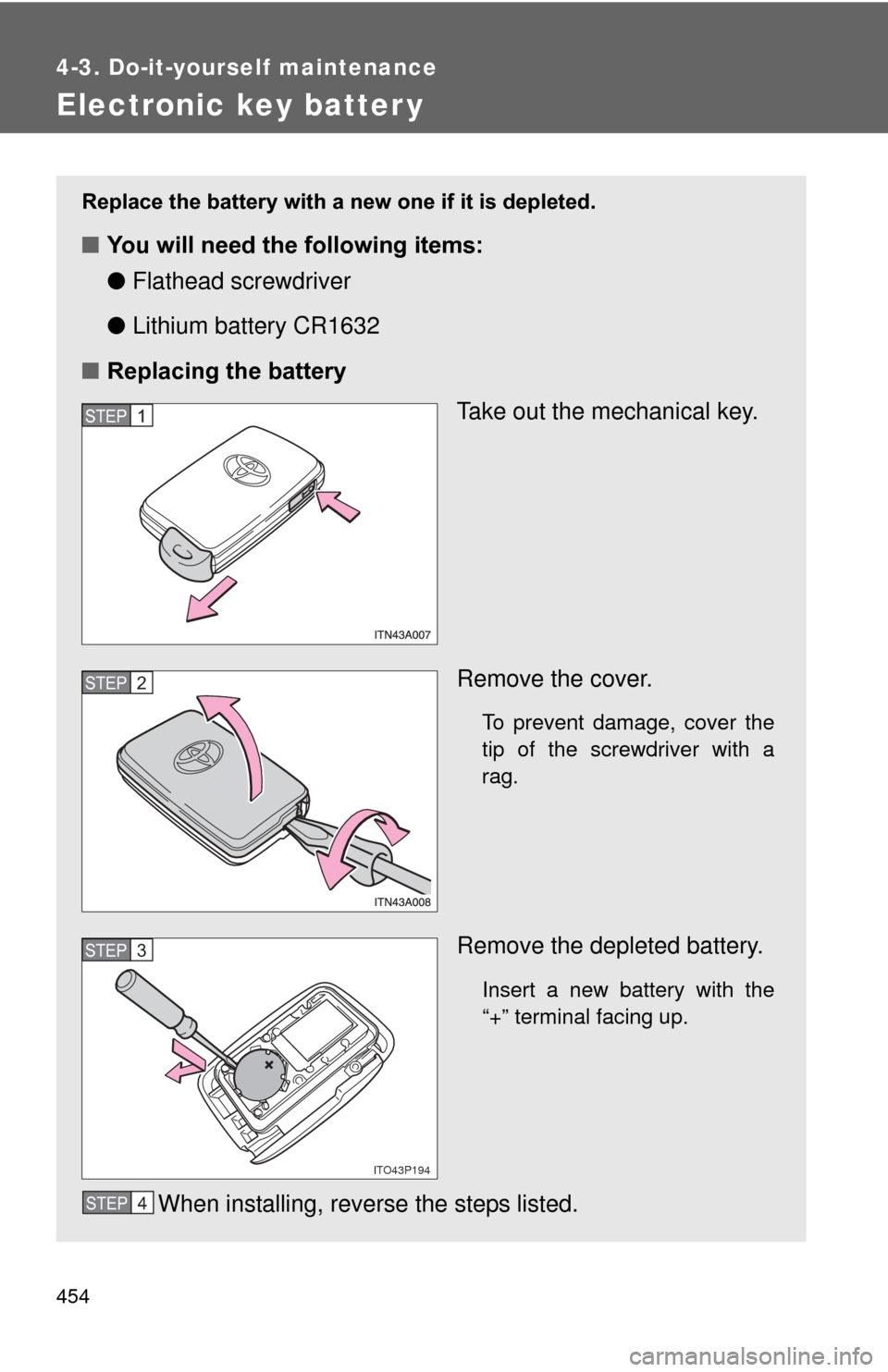
■ Replacing the battery
Take out the mechanical key.
Remove the cover.
To prevent damage, cover the
tip of the screwdriver with a
rag.
Remove the depleted battery.
Insert a new battery with the
“+” terminal facing up.
When installing, reverse the steps listed.
STEP 1
STEP 2
ITO43P194
STEP 3
STEP 4
Page 483 of 636
When trouble arises5
483
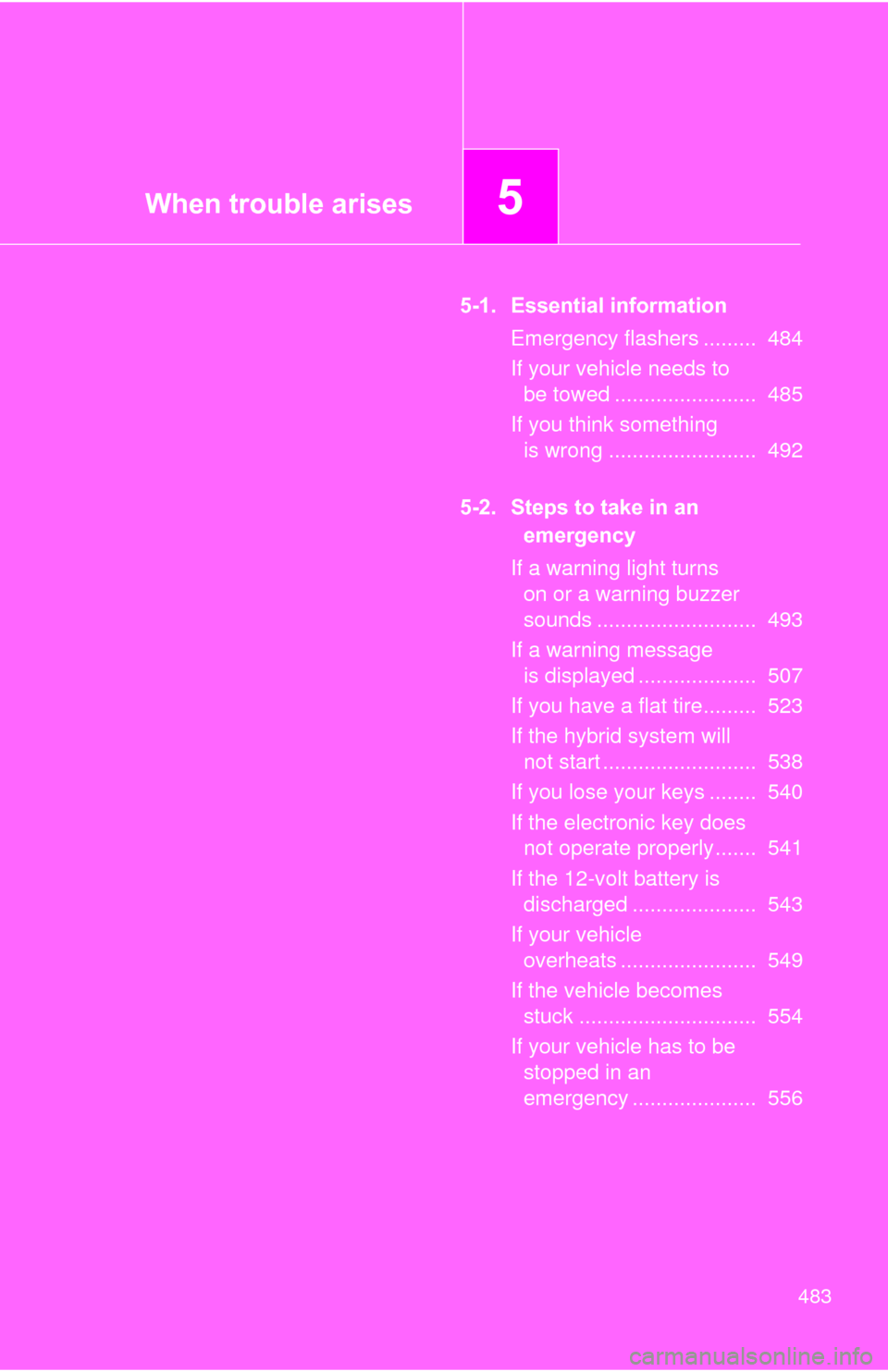
5-1. Essential informationEmergency flashers ......... 484
If your vehicle needs to be towed ........................ 485
If you think something is wrong ......................... 492
5-2. Steps to take in an emergency
If a warning light turns on or a warning buzzer
sounds ........................... 493
If a warning message is displayed .................... 507
If you have a flat tire......... 523
If the hybrid system will not start .......................... 538
If you lose your keys ........ 540
If the electronic key does not operate properly....... 541
If the 12-volt battery is discharged ..................... 543
If your vehicle overheats ....................... 549
If the vehicle becomes stuck .............................. 554
If your vehicle has to be stopped in an
emergency ..................... 556
Page 485 of 636
5
When trouble arises
485
5-1. Essential information
If your vehicle needs to be towed
Before towingThe following may indicate a problem with your hybrid transmission.
Contact your Toyota dealer before towing.
● The hybrid system is operating but the vehicle will not move.
● The vehicle makes an abnormal sound.
If there is a malfunction in the P position control system, the smart
key system or the immobilizer system , or if the 12-volt battery is dis-
charged, the vehicle cannot be tow ed with the front wheels on the
ground, as the front wheels may be locked. In this case, transport the
vehicle with both front wheels or all four wheels lifted.
If towing is necessary, we recommend having your vehicle towed by
your Toyota dealer or a commerci al towing service, using a lift-type
truck or flat bed truck.
Use a safety chain system for all to wing, and abide by all state/pro-
vincial and local laws.
Page 487 of 636
5
When trouble arises
487
5-1. Essential information
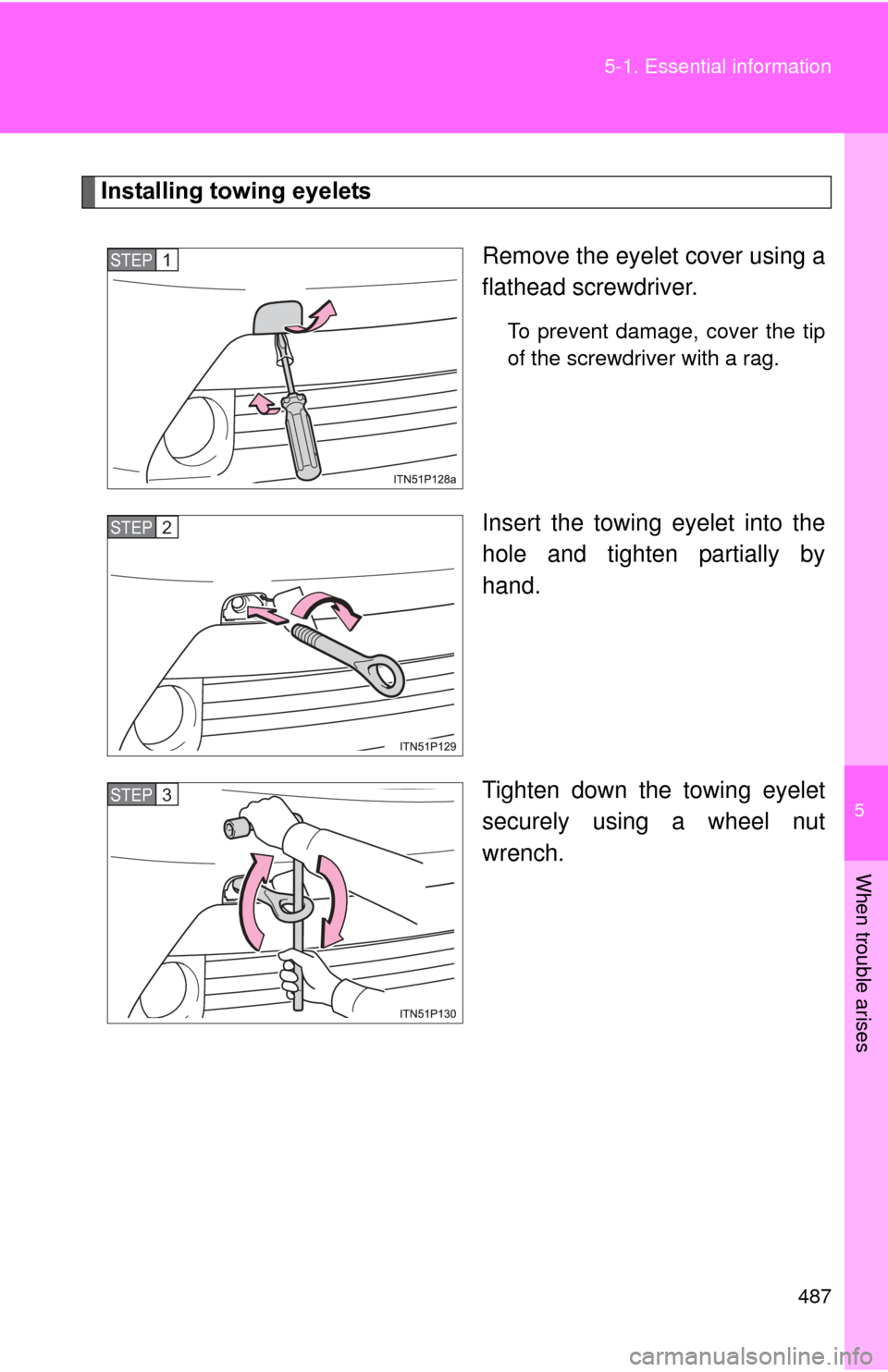
Installing towing eyelets
Remove the eyelet cover using a
flathead screwdriver.
To prevent damage, cover the tip
of the screwdriver with a rag.
Insert the towing eyelet into the
hole and tighten partially by
hand.
Tighten down the towing eyelet
securely using a wheel nut
wrench.
STEP 1
STEP 2
STEP 3
Page 489 of 636
5
When trouble arises
489
5-1. Essential information
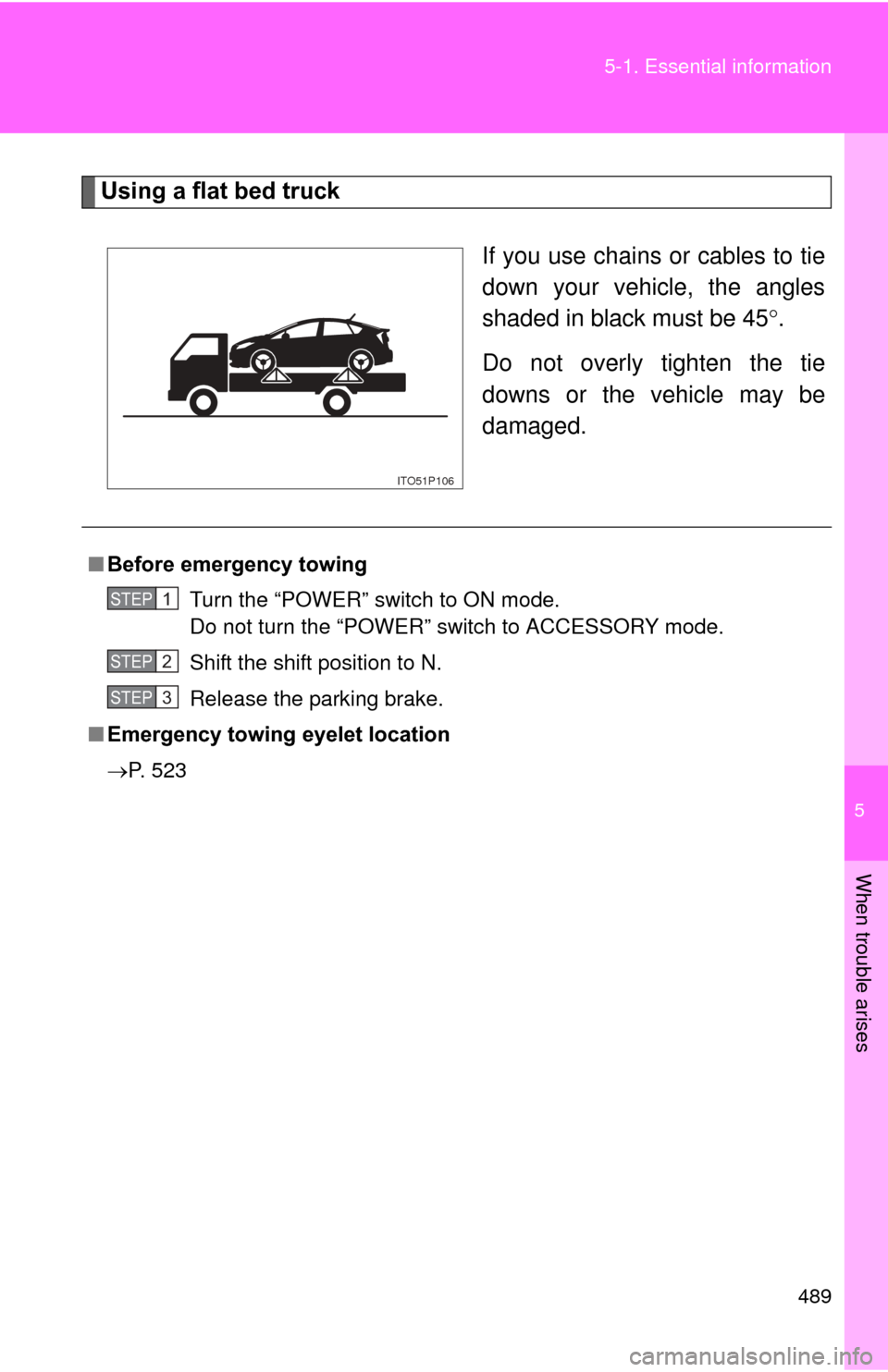
Using a flat bed truck
If you use chains or cables to tie
down your vehicle, the angles
shaded in black must be 45.
Do not overly tighten the tie
downs or the vehicle may be
damaged.
ITO51P106
■ Before emergency towing
Turn the “POWER” switch to ON mode.
Do not turn the “POWER” switch to ACCESSORY mode.
Shift the shift position to N.
Release the parking brake.
■ Emergency towing eyelet location
P. 523
STEP 1
STEP 2
STEP 3