battery TOYOTA PRIUS 2012 3.G Repair Manual
[x] Cancel search | Manufacturer: TOYOTA, Model Year: 2012, Model line: PRIUS, Model: TOYOTA PRIUS 2012 3.GPages: 636, PDF Size: 11.02 MB
Page 431 of 636
431
4-3. Do-it-yourself maintenance
4
Maintenance and care
12-volt batter y
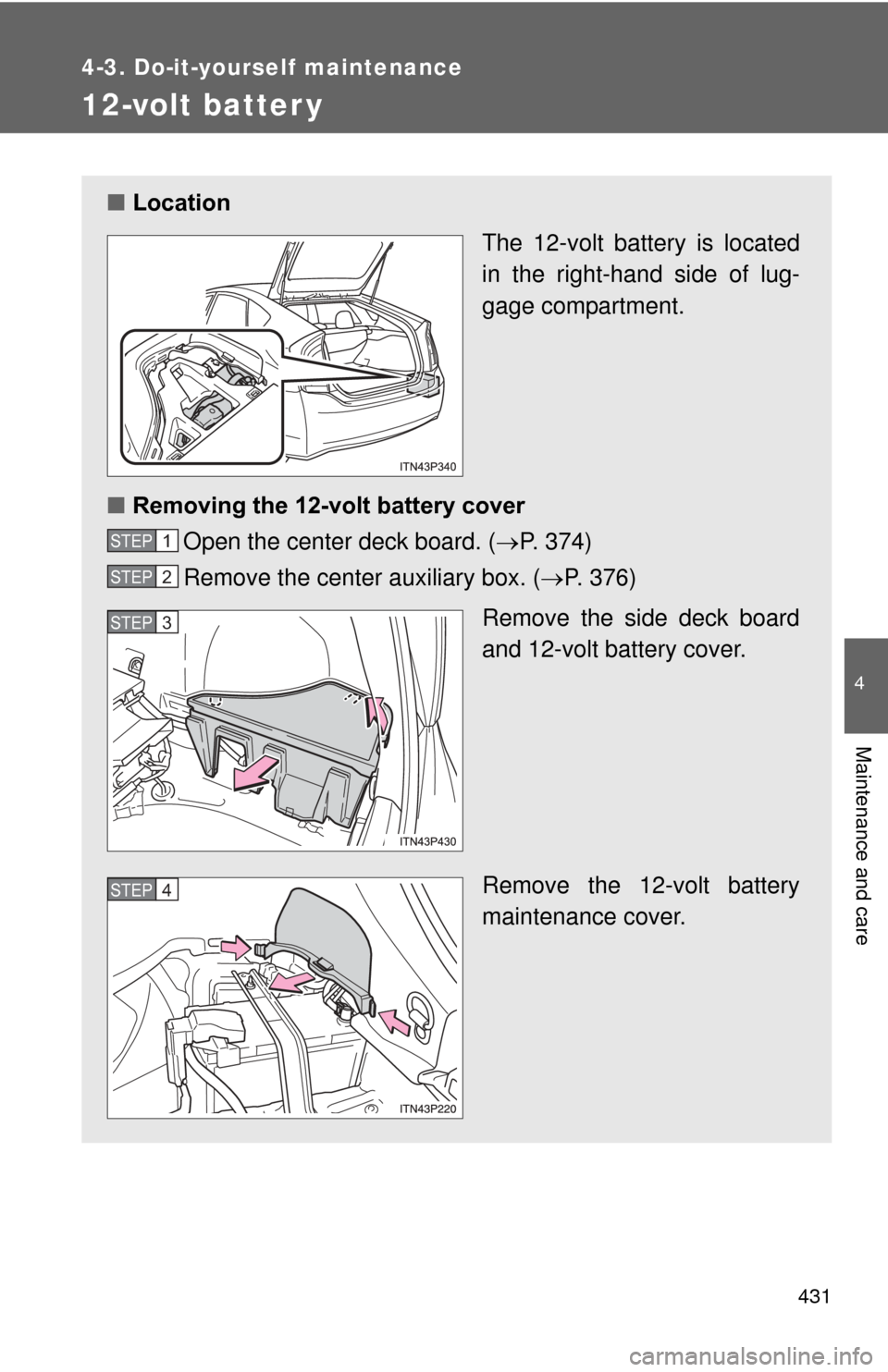
■Location
The 12-volt battery is located
in the right-hand side of lug-
gage compartment.
■ Removing the 12-volt battery cover
Open the center deck board. ( P. 374)
Remove the center auxiliary box. ( P. 376)
Remove the side deck board
and 12-volt battery cover.
Remove the 12-volt battery
maintenance cover.
STEP 1
STEP 2
STEP 3
STEP 4
Page 432 of 636
432 4-3. Do-it-yourself maintenance
■Before recharging
When recharging, the 12-volt battery produces hydrogen gas which is flam-
mable and explosive. Therefore, observe the following precautions before
recharging:
●If recharging with the 12-volt battery installed on the vehicle, be sure to
disconnect the ground cable.
● Make sure the power switch on the charger is off when connecting and
disconnecting the charger cables to the 12-volt battery.
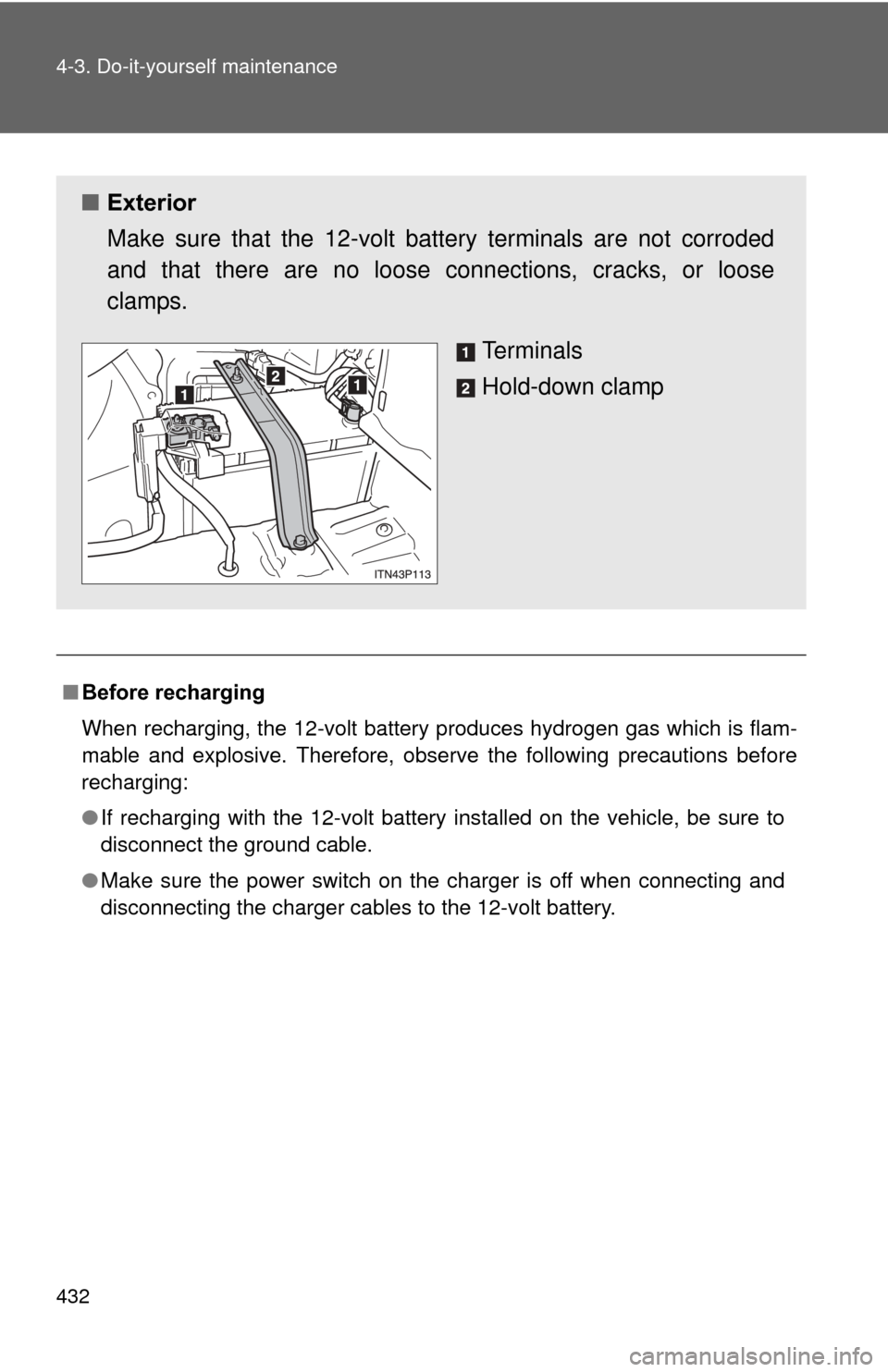
■ Exterior
Make sure that the 12-volt battery terminals are not corroded
and that there are no loose c onnections, cracks, or loose
clamps.
Terminals
Hold-down clamp
Page 433 of 636
433
4-3. Do-it-yourself maintenance
4
Maintenance and care
■
After recharging/reconnecting the 12-volt battery
●Unlocking the doors using the smart key system may not be possible
immediately after reconnecting the 12-volt battery. If this happens, use
the wireless remote control or the mechanical key to lock/unlock the
doors.
● Start the hybrid system with the “POWER” switch in ACCESSORY mode.
The hybrid system may not start with the “POWER” switch turned off.
However, the hybrid system will operate normally from the second
attempt.
● The “POWER” switch mode is recorded by the vehicle. If the 12-volt bat-
tery is reconnected, the vehicle will return the “POWER” switch mode to
the status it was in before the 12-volt battery was disconnected. Make
sure to turn off the power before disconnect the 12-volt battery. Take
extra care when connecting the 12-volt battery if the “POWER” switch
mode prior to discharge is unknown.
● Restart the hybrid system, depress the brake pedal, and confirm that it is
possible to shift into each shift position.
If the system will not start even after multiple attempts at all methods above,
contact your Toyota dealer.
Page 434 of 636
434 4-3. Do-it-yourself maintenance
CAUTION
■Chemicals in the 12-volt battery
The 12-volt battery contains poisonous and corrosive sulfuric acid and may
produce hydrogen gas which is flammable and explosive. To reduce the risk
of death or serious injury, take the following precautions while working on or
near the 12-volt battery:
●Do not cause sparks by touching the 12-volt battery terminals with tools.
● Do not smoke or light a match near the 12-volt battery.
● Avoid contact with eyes, skin and clothes.
● Never inhale or swallow electrolyte.
● Wear protective safety glasses when working near the 12-volt battery.
● Keep children away from the 12-volt battery.
■ Where to safely charge the 12-volt battery
Always charge the 12-volt battery in an open area. Do not charge the 12-volt
battery in a garage or closed room where there is insufficient ventilation.
■ How to recharge the 12-volt battery
Only perform a slow charge (5 A or less). The 12-volt battery may explode if
charged at a quicker rate.
Page 435 of 636
435
4-3. Do-it-yourself maintenance
4
Maintenance and care
CAUTION
■
Emergency measures regarding electrolyte
●If electrolyte gets in your eyes
Flush your eyes with clean water for at least 15 minutes and get immedi-
ate medical attention. If possible, continue to apply water with a sponge or
cloth while traveling to the nearest medical facility.
● If electrolyte gets on your skin
Wash the affected area thoroughly. If you feel pain or burning, get medical
attention immediately.
● If electrolyte gets on your clothes
It can soak through clothing on to your skin. Immediately take off the cloth-
ing and follow the procedure above if necessary.
● If you accidentally swallow electrolyte
Drink a large quantity of water or milk. Get emergency medical attention
immediately.
■ When replacing the 12-volt battery
Use a 12-volt battery designed for this vehicle. Failure to do so may ca\
use
gas (hydrogen) to enter the passenger co mpartment, causing a fire or explo-
sion.
For replacement of the 12-volt battery, contact your Toyota dealer.
Page 436 of 636
436 4-3. Do-it-yourself maintenance
CAUTION
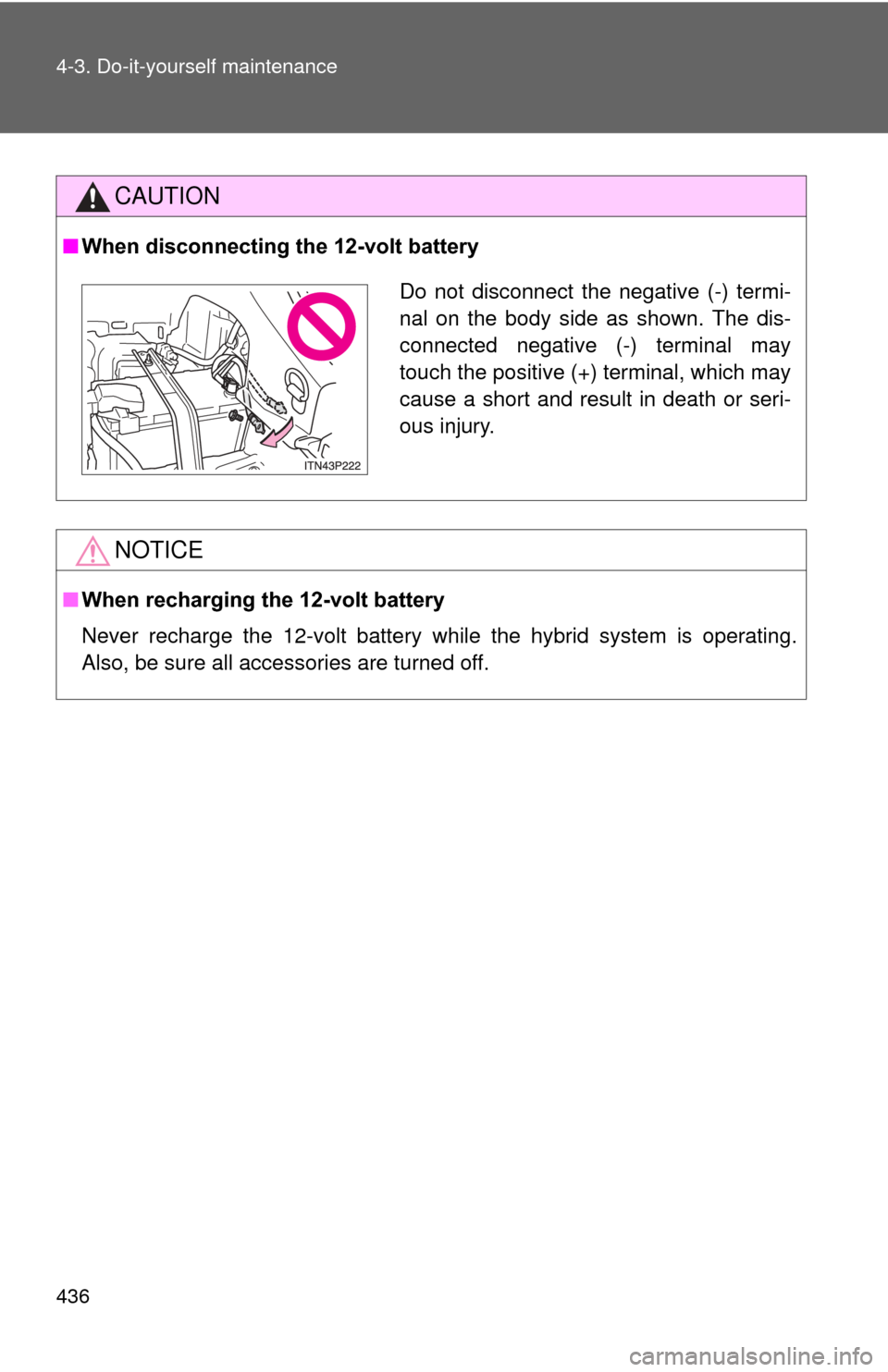
■When disconnecting the 12-volt battery
NOTICE
■When recharging the 12-volt battery
Never recharge the 12-volt battery while the hybrid system is operating.
Also, be sure all accessories are turned off.
Do not disconnect the negative (-) termi-
nal on the body side as shown. The dis-
connected negative (-) terminal may
touch the positive (+) terminal, which may
cause a short and result in death or seri-
ous injury.
Page 454 of 636
454
4-3. Do-it-yourself maintenance
Electronic key batter y
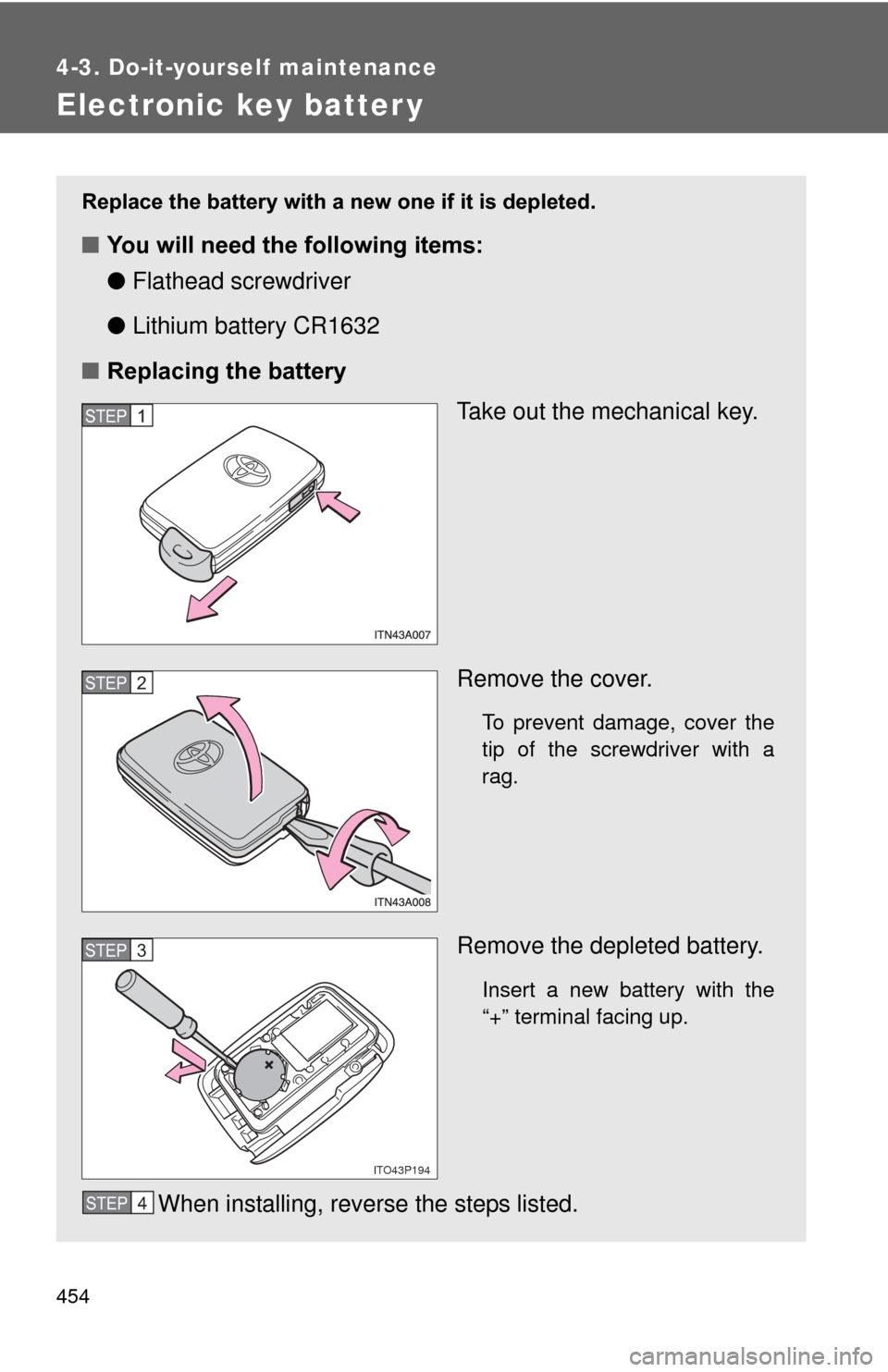
Replace the battery with a new one if it is depleted.
■You will need the following items:
●Flathead screwdriver
● Lithium battery CR1632
■ Replacing the battery
Take out the mechanical key.
Remove the cover.
To prevent damage, cover the
tip of the screwdriver with a
rag.
Remove the depleted battery.
Insert a new battery with the
“+” terminal facing up.
When installing, reverse the steps listed.
STEP 1
STEP 2
ITO43P194
STEP 3
STEP 4
Page 455 of 636
455
4-3. Do-it-yourself maintenance
4
Maintenance and care
■
Use a CR1632 lithium battery
●Batteries can be purchased at your Toyota dealer, local electrical appli-
ance shops or camera stores.
● Replace only with the same or equivalent type recommended by the
manufacturer.
● Dispose of used batteries according to local laws.
■ If the electronic key battery is depleted
The following symptoms may occur:
●The smart key system and wireless remote control will not function prop-
erly.
● The operational range will be reduced.
CAUTION
■Removed battery and other parts
Keep away from children. These parts are small and if swallowed by a child,
they can cause choking. Failure to do so could result in death or serious
injury.
NOTICE
■For normal operation after replacing the battery
Observe the following precautions to prevent accidents:
●Always work with dry hands.
Moisture may cause the battery to rust.
● Do not touch or move any other component inside the remote control.
● Do not bend either of the battery terminals.
Page 461 of 636
461
4-3. Do-it-yourself maintenance
4
Maintenance and care
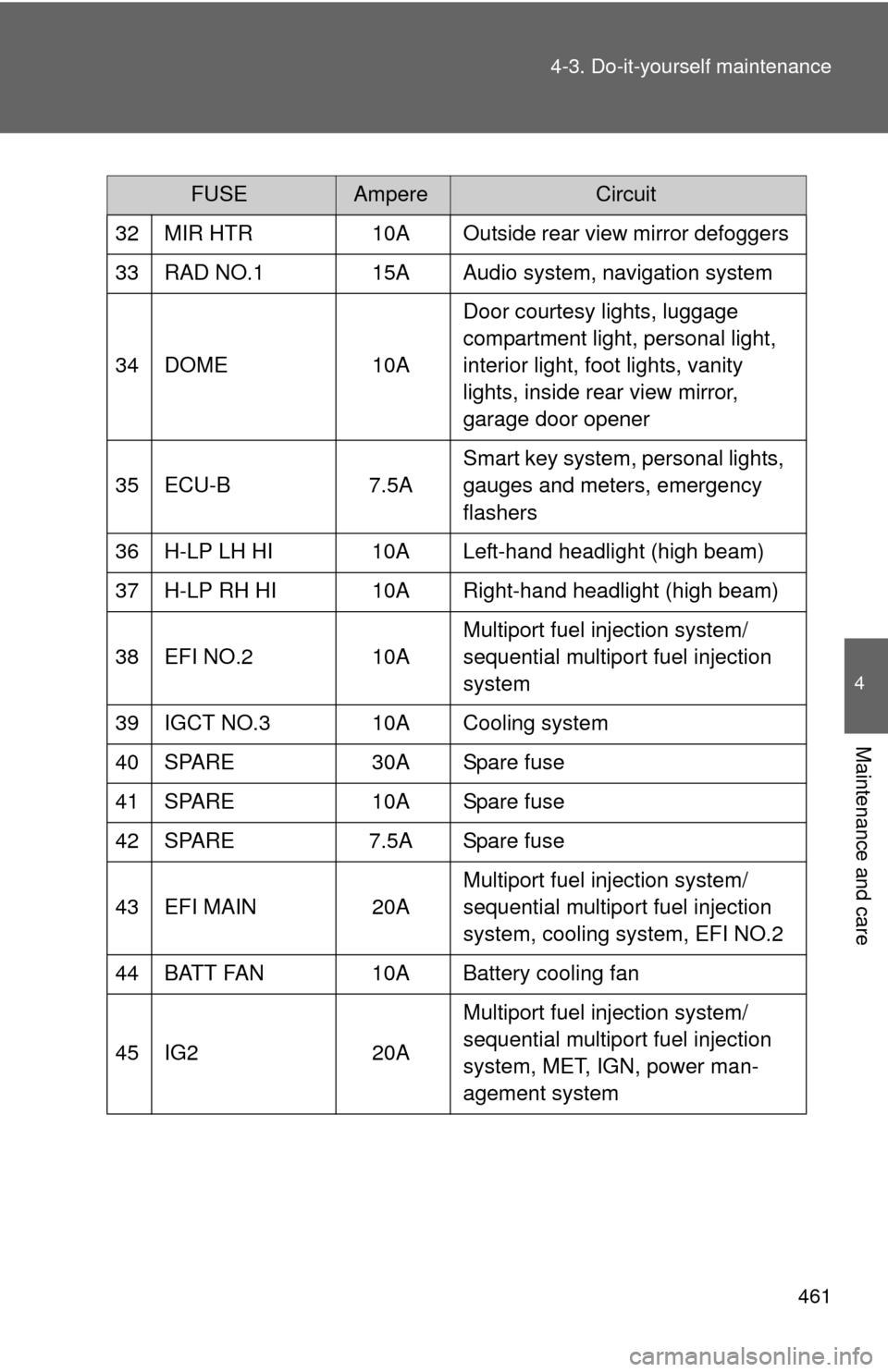
FUSEAmpereCircuit
32 MIR HTR 10A Outside rear view mirror defoggers
33 RAD NO.1 15A Audio system, navigation system
34 DOME 10ADoor courtesy lights, luggage
compartment light, personal light,
interior light, foot lights, vanity
lights, inside rear view mirror,
garage door opener
35 ECU-B 7.5ASmart key system, personal lights,
gauges and meters, emergency
flashers
36 H-LP LH HI 10A Left-hand headlight (high beam)
37 H-LP RH HI 10A Right-hand headlight (high beam)
38 EFI NO.2 10AMultiport fuel injection system/
sequential multiport fuel injection
system
39 IGCT NO.3 10A Cooling system
40 SPARE 30A Spare fuse
41 SPARE 10A Spare fuse
42 SPARE 7.5A Spare fuse
43 EFI MAIN 20AMultiport fuel injection system/
sequential multiport fuel injection
system, cooling system, EFI NO.2
44 BATT FAN 10A Battery cooling fan
45 IG2 20AMultiport fuel injection system/
sequential multiport fuel injection
system, MET, IGN, power man-
agement system
Page 483 of 636
When trouble arises5
483
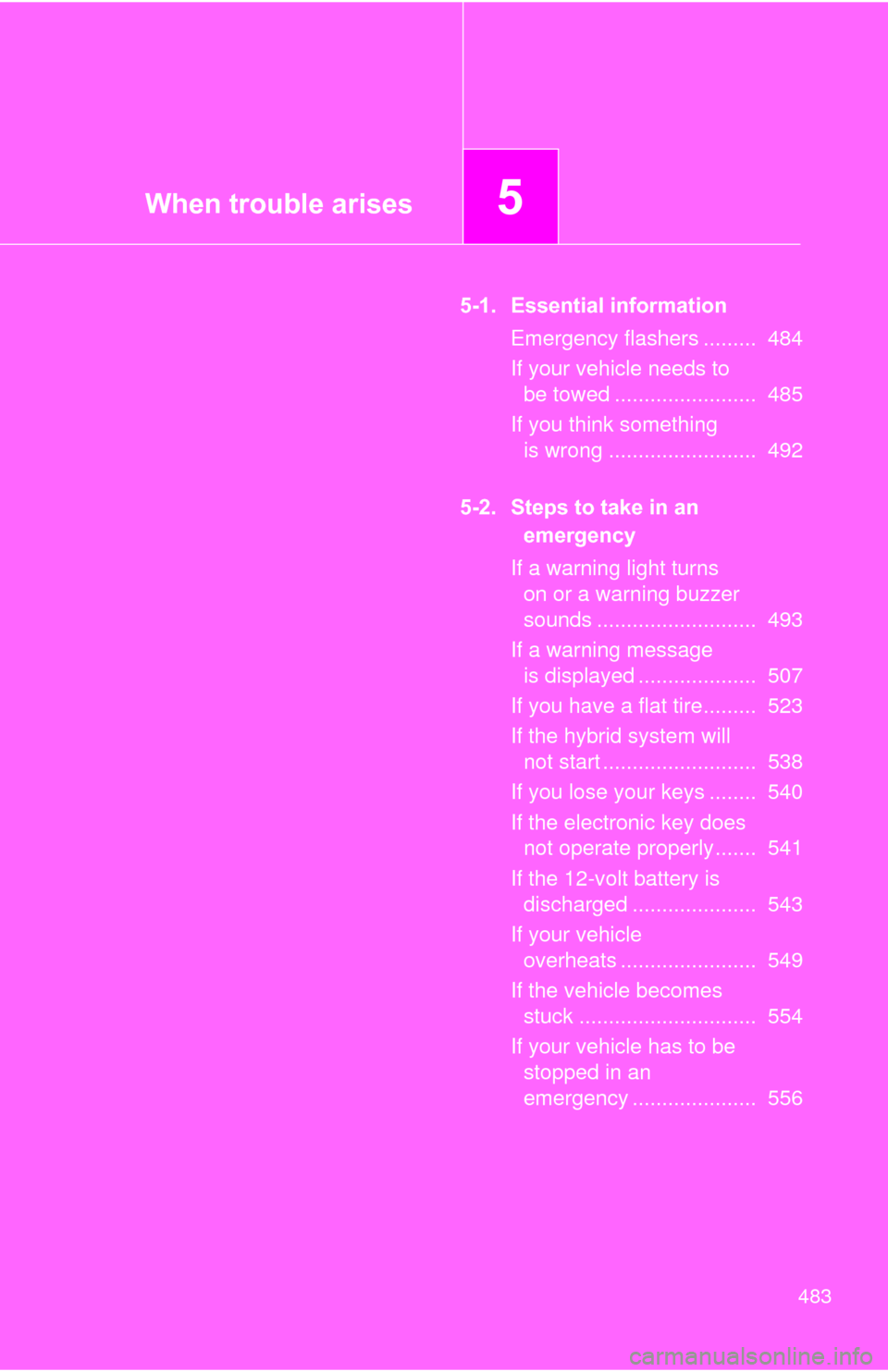
5-1. Essential informationEmergency flashers ......... 484
If your vehicle needs to be towed ........................ 485
If you think something is wrong ......................... 492
5-2. Steps to take in an emergency
If a warning light turns on or a warning buzzer
sounds ........................... 493
If a warning message is displayed .................... 507
If you have a flat tire......... 523
If the hybrid system will not start .......................... 538
If you lose your keys ........ 540
If the electronic key does not operate properly....... 541
If the 12-volt battery is discharged ..................... 543
If your vehicle overheats ....................... 549
If the vehicle becomes stuck .............................. 554
If your vehicle has to be stopped in an
emergency ..................... 556