Gas TOYOTA PRIUS 2016 4.G Owners Manual
[x] Cancel search | Manufacturer: TOYOTA, Model Year: 2016, Model line: PRIUS, Model: TOYOTA PRIUS 2016 4.GPages: 800, PDF Size: 16.69 MB
Page 2 of 800
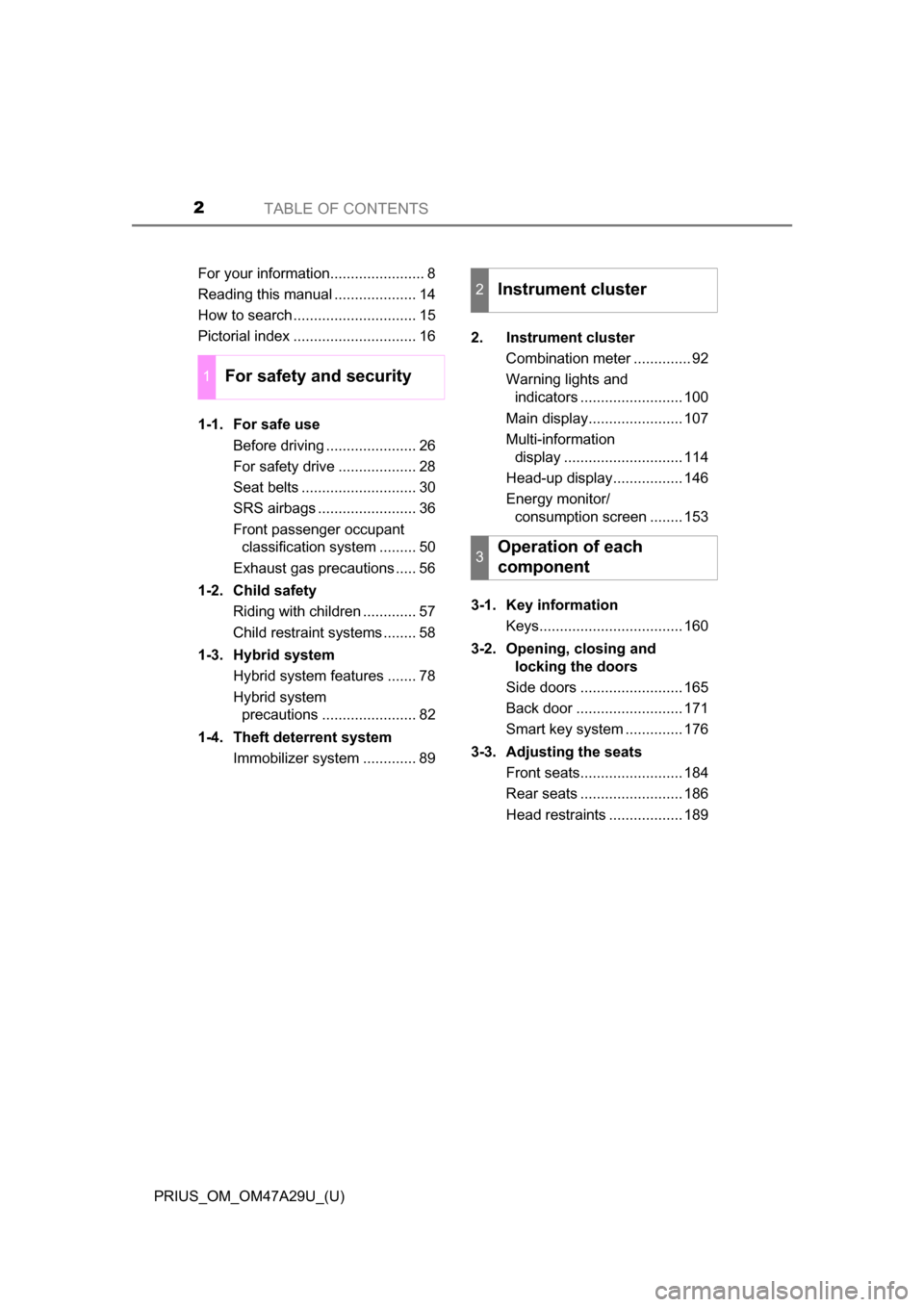
TABLE OF CONTENTS2
PRIUS_OM_OM47A29U_(U)For your information....................... 8
Reading this manual .................... 14
How to search .............................. 15
Pictorial index .............................. 16
1-1. For safe use
Before driving ...................... 26
For safety drive ................... 28
Seat belts ............................ 30
SRS airbags ........................ 36
Front passenger occupant classification system ......... 50
Exhaust gas precautions ..... 56
1-2. Child safety Riding with children ............. 57
Child restraint systems ........ 58
1-3. Hybrid system Hybrid system features ....... 78
Hybrid system precautions ....................... 82
1-4. Theft deterrent system Immobilizer system ............. 89 2. Instrument cluster
Combination meter .............. 92
Warning lights and indicators ......................... 100
Main display....................... 107
Multi-information display ............................. 114
Head-up display................. 146
Energy monitor/ consumption screen ........ 153
3-1. Key information Keys................................... 160
3-2. Opening, closing and locking the doors
Side doors ......................... 165
Back door .......................... 171
Smart key system .............. 176
3-3. Adjusting the seats Front seats......................... 184
Rear seats ......................... 186
Head restraints .................. 189
1For safety and security
2Instrument cluster
3Operation of each
component
Page 9 of 800
PRIUS_OM_OM47A29U_(U)
9
The installation of a mobile two-way radio system in your vehicle could affect
electronic systems such as:
●Hybrid system
● Multiport fuel injection system/sequential multiport fuel injection system
● Dynamic radar cruise control with full-speed range
● Cruise control system
● Anti-lock brake system
● SRS airbag system
● Seat belt pretensioner system
Be sure to check with your Toyota dealer for precautionary measures or spe-
cial instructions regarding installation of a mobile two-way radio system.
High voltage parts and cables on the hybrid vehicles emit approximately the
same amount of electromagnetic waves as the conventional gasoline pow-
ered vehicles or home electronic appliances despite of their electromagnetic
shielding.
Unwanted noise may occur in the reception of the mobile two-way radio.
Installation of a mobile two-way radio system
Page 25 of 800
25
PRIUS_OM_OM47A29U_(U)
For safety and security1
1-1. For safe useBefore driving ...................... 26
For safety drive ................... 28
Seat belts ............................ 30
SRS airbags ........................ 36
Front passenger occupant classification system ......... 50
Exhaust gas precautions..... 56
1-2. Child safety Riding with children ............. 57
Child restraint systems........ 58
1-3. Hybrid system Hybrid system features ....... 78
Hybrid system precautions ....................... 82
1-4. Theft deterrent system Immobilizer system ............. 89
Page 38 of 800
381-1. For safe use
PRIUS_OM_OM47A29U_(U)
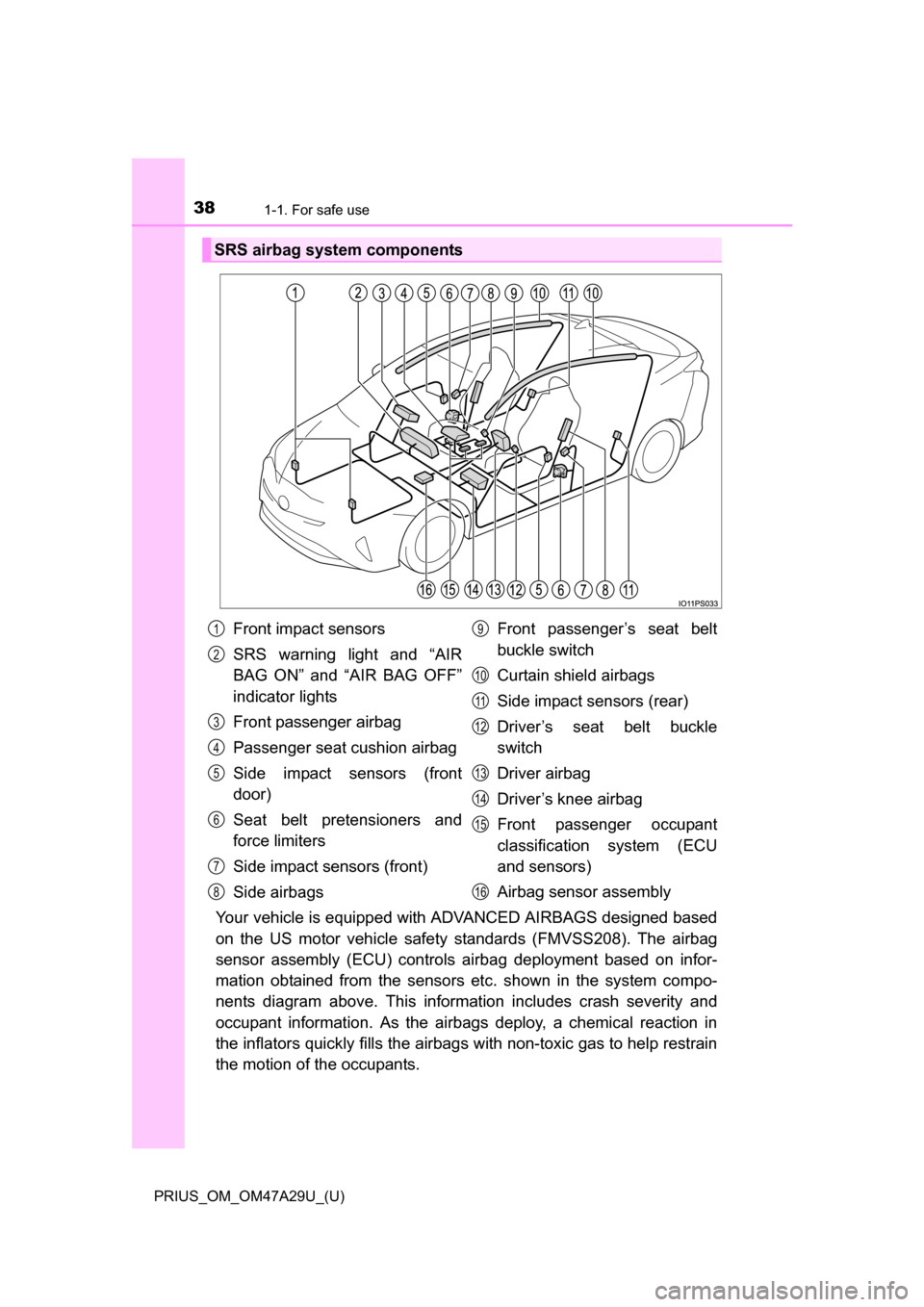
Your vehicle is equipped with ADVANCED AIRBAGS designed based
on the US motor vehicle safety standards (FMVSS208). The airbag
sensor assembly (ECU) controls airbag deployment based on infor-
mation obtained from the sensors et c. shown in the system compo-
nents diagram above. This informat ion includes crash severity and
occupant information. As the airbags deploy, a chemical reaction in
the inflators quickly fills the airbag s with non-toxic gas to help restrain
the motion of the occupants.
SRS airbag system components
Front impact sensors
SRS warning light and “AIR
BAG ON” and “AIR BAG OFF”
indicator lights
Front passenger airbag
Passenger seat cushion airbag
Side impact sensors (front
door)
Seat belt pretensioners and
force limiters
Side impact sensors (front)
Side airbags Front passenger’s seat belt
buckle switch
Curtain shield airbags
Side impact sensors (rear)
Driver’s seat belt buckle
switch
Driver airbag
Driver’s knee airbag
Front passenger occupant
classification system (ECU
and sensors)
Airbag sensor assembly1
2
3
4
5
6
7
8
9
10
11
12
13
14
15
16
Page 44 of 800

441-1. For safe use
PRIUS_OM_OM47A29U_(U)
■If the SRS airbags deploy (inflate)
●Slight abrasions, burns, bruising etc., may be sustained from SRS airbags,
due to the extremely high speed deployment (inflation) by hot gases.
● A loud noise and white powder will be emitted.
● Parts of the airbag module (steering wheel hub, airbag cover and inflator) as
well as the front seats, parts of the front and rear pillars, and roof side rails,
may be hot for several minutes. The airbag itself may also be hot.
● The windshield may crack.
● For Safety Connect subscribers, if the SRS airbags deploy or in the event of
a severe rear-end collision, the system is designed to send an emergency
call to the response center, notifying them of the vehicle’s location (without
needing to push the “SOS” button) and an agent will attempt to speak with
the occupants to ascertain the level of emergency and assistance required.
If the occupants are unable to communicate, the agent automatically treats
the call as an emergency and helps to dispatch the necessary emergency
services. ( P. 561)
■ SRS airbag deployment conditions (SRS front airbags)
●The SRS front airbags will deploy in the event of an impact that exceeds the
set threshold level (the level of force corresponding to an approximately 12 -
18 mph [20 - 30 km/h] frontal collision with a fixed wall that does not move or
deform).
However, this threshold velocity will be considerably higher in the following
situations:
• If the vehicle strikes an object, such as a parked vehicle or sign pole,
which can move or deform on impact
• If the vehicle is involved in an underride collision, such as a collision in which the front of the vehicle “underrides”, or goes under, the bed of a
truck
● Depending on the type of collision, it is possible that only the seat belt pre-
tensioners will activate.
● The SRS front airbags for the front pass enger will not activate if there is no
passenger sitting in the front passenger seat. However, the SRS front air-
bags for the front passenger may deploy if luggage is put in the seat, even if
the seat is unoccupied. ( P. 50)
● The SRS seat cushion airbag on the front passenger seat will not operate if
the occupant is not wearing a seat belt.
Page 56 of 800
561-1. For safe use
PRIUS_OM_OM47A29U_(U)
Exhaust gas precautions
Harmful substance to the human body is included in exhaust
gases if inhaled.
WARNING
Exhaust gases include harmful carbon monoxide (CO), which is colorless and
odorless. Observe the following precautions.
Failure to do so may cause exhaust gases enter the vehicle and may lead to
an accident caused by light-headedness, or may lead to death or a serious
health hazard.
■Important points while driving
●Keep the back door closed.
● If you smell exhaust gases in the vehicle even when the back door is
closed, open the side windows and have the vehicle inspected at your
Toyota dealer as soon as possible.
■ When parking
●If the vehicle is in a poorly ventilated area or a closed area, such as a
garage, stop the hybrid system.
● Do not leave the vehicle with the hybrid system on for a long time.
If such a situation cannot be avoided, park the vehicle in an open space
and ensure that exhaust fumes do not enter the vehicle interior.
● Do not leave the hybrid system operating in an area with snow build-up, or
where it is snowing. If snowbanks build up around the vehicle while the
hybrid system is operating, exhaust gases may collect and enter the vehi\
-
cle.
■ Exhaust pipe
The exhaust system needs to be checked periodically. If there is a hole or
crack caused by corrosion, damage to a joint or abnormal exhaust noise, be
sure to have the vehicle inspected and repaired by your Toyota dealer.
Page 78 of 800
781-3. Hybrid system
PRIUS_OM_OM47A29U_(U)
Hybrid system features
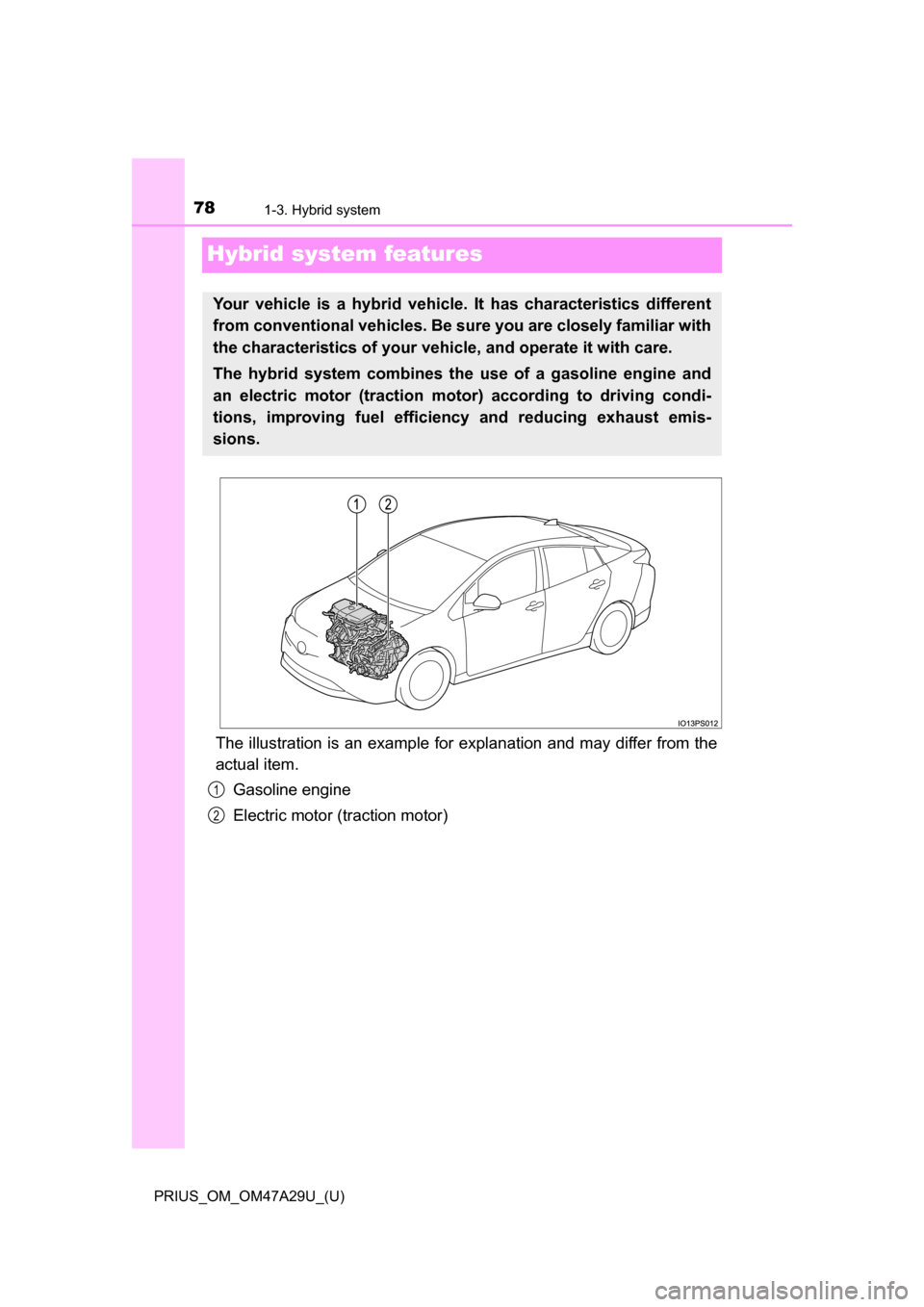
The illustration is an example for explanation and may differ from the
actual item.Gasoline engine
Electric motor (traction motor)
Your vehicle is a hybrid vehicle. It has characteristics different
from conventional vehicles. Be sure you are closely familiar with
the characteristics of your vehicle, and operate it with care.
The hybrid system combines the use of a gasoline engine and
an electric motor (traction moto r) according to driving condi-
tions, improving fuel efficien cy and reducing exhaust emis-
sions.
1
2
Page 79 of 800
791-3. Hybrid system
PRIUS_OM_OM47A29U_(U)
1
For safety and security
◆When stopped/during start off
The gasoline engine stops
* when the vehicle is stopped. During
start off, the electric motor (tra ction motor) drives the vehicle. At
slow speeds or when traveling down a gentle slope, the engine is
stopped
* and the electric motor (traction motor) is used.
When shift position is in N, the hybrid battery (traction battery) is not
being charged.
*: When the hybrid battery (traction battery) requires charging or the engine is warming up, etc., the gasoline engine will not automatically stop.
( P. 80)
◆During normal driving
The gasoline engine is predominantly used. The electric motor
(traction motor) charges the hybrid battery (traction battery) as nec-
essary.
◆When accelerating sharply
When the accelerator pedal is depressed heavily, the power of the
hybrid battery (traction battery) is added to that of the gasoline
engine via the electric motor (traction motor).
◆When braking (regenerative braking)
The wheels operate the electric motor (traction motor) as a power
generator, and the hybrid battery (traction battery) is charged.
When driving with the gasoline engine stopped, a sound, which
changes in accordance with the driving speed, will be played in order
to warn people nearby of the vehi cle’s approach. The sound will stop
when the vehicle speed exceeds approximately 15 mph (25 km/h).
Vehicle proximity notification system
Page 80 of 800
801-3. Hybrid system
PRIUS_OM_OM47A29U_(U)
■Regenerative braking
In the following situations, kinetic energy is converted to electric energy and
deceleration force can be obtained in conjunction with the recharging of the
hybrid battery (traction battery).
●The accelerator pedal is released while driving with the shift position in D or
B.
● The brake pedal is depressed while driving with the shift position in D or B.
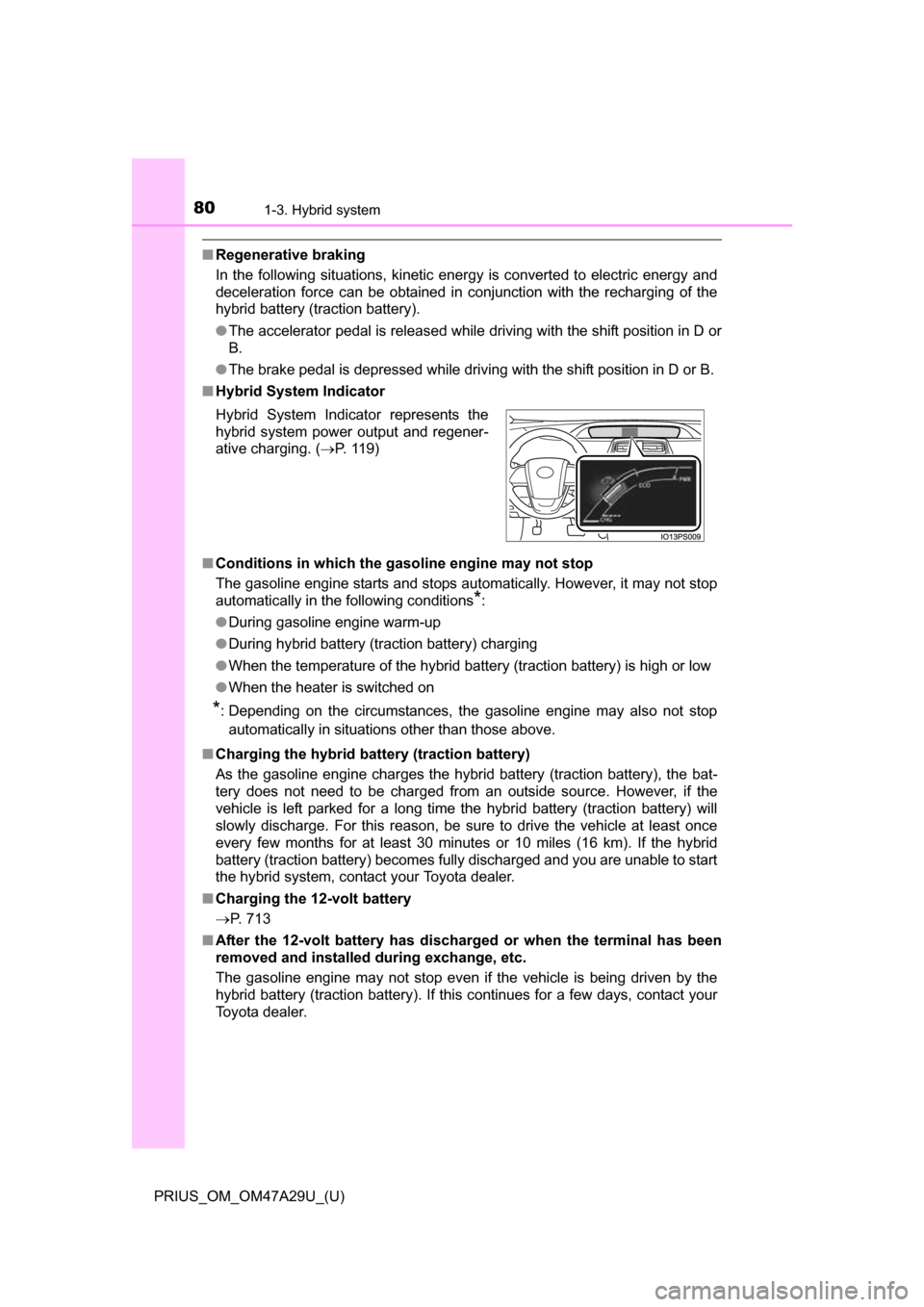
■ Hybrid System Indicator
■ Conditions in which the gasoline engine may not stop
The gasoline engine starts and stops automatically. However, it may not stop
automatically in the following conditions
*:
● During gasoline engine warm-up
● During hybrid battery (traction battery) charging
● When the temperature of the hybrid battery (traction battery) is high or low
● When the heater is switched on
*: Depending on the circumstances, the gasoline engine may also not stop
automatically in situations other than those above.
■ Charging the hybrid battery (traction battery)
As the gasoline engine charges the hybrid battery (traction battery), the bat-
tery does not need to be charged from an outside source. However, if the
vehicle is left parked for a long time the hybrid battery (traction battery) will
slowly discharge. For this reason, be sure to drive the vehicle at least once
every few months for at least 30 minutes or 10 miles (16 km). If the hybrid
battery (traction battery) becomes fully discharged and you are unable to start
the hybrid system, contact your Toyota dealer.
■ Charging the 12-volt battery
P. 713
■ After the 12-volt battery has dischar ged or when the terminal has been
removed and installed during exchange, etc.
The gasoline engine may not stop even if the vehicle is being driven by the
hybrid battery (traction battery). If this continues for a few days, contact your
Toyota dealer. Hybrid System Indicator represents the
hybrid system power output and regener-
ative charging. ( P. 119)
Page 81 of 800
811-3. Hybrid system
PRIUS_OM_OM47A29U_(U)
1
For safety and security
■Sounds and vibrations specific to a hybrid vehicle
There may be no engine sound or vibration even though the vehicle is able to
move with the “READY” indicator is illuminated. For safety, apply the parking
brake and make sure to shift the shift position to P when parked.
The following sounds or vibrations may occur when the hybrid system is
operating and are not a malfunction:
●Motor sounds may be heard from the engine compartment.
● Sounds may be heard from the hybrid battery (traction battery) when the
hybrid system starts or stops.
● Relay operating sounds such as a snap or soft clank will be emitted from the
hybrid battery (traction battery), behind the rear seats, when the hybrid sys-
tem is started or stopped.
● Sounds from the hybrid system may be heard when the back door is open.
● Sounds may be heard from the transmission when the gasoline engine
starts or stops, when driving at low speeds, or during idling.
● Engine sounds may be heard when accelerating sharply.
● Sounds may be heard due to regenerative braking when the brake pedal is
depressed or as the accelerator pedal is released.
● Vibration may be felt when the gasoline engine starts or stops.
● Cooling fan sounds may be heard from the air intake vent. ( P. 83)
■ Vehicle proximity notification system
In the following cases, the vehicle proximity notification system may be diffi-
cult for surrounding people to hear.
●In very noisy areas
● In the wind or the rain
Also, as the vehicle proximity notification system is installed on the front of
the vehicle, it may be more difficult to hear from the rear of the vehicle com-
pared to the front.
■ Maintenance, repair, recycling, and disposal
Contact your Toyota dealer regarding maintenance, repair, recycling and dis-
posal. Do not dispose of the vehicle yourself.