API TOYOTA PRIUS 2017 4.G User Guide
[x] Cancel search | Manufacturer: TOYOTA, Model Year: 2017, Model line: PRIUS, Model: TOYOTA PRIUS 2017 4.GPages: 796, PDF Size: 20.13 MB
Page 556 of 796
556
PRIUS_OM_OM47B54U_(U)
6-4. Using the other interior features
■Programming an entry gate (for U.S.A. owners)/Programming a
devices in the Canadian market
Place the remote control transmitter 1 to 3 in. (25 to 75 mm)
away from the HomeLink
® buttons.
Keep the HomeLink® indicator light in view while programming.
Press and hold the selected HomeLink® button.
Repeatedly press and release (cyc le) the remote control trans-
mitter for 2 seconds each until step 4 is completed.
When the HomeLink
® indicator light starts to flash rapidly,
release the buttons.
Test the HomeLink
® operation by pressing the newly pro-
grammed button. Check to see if the gate/device operates cor-
rectly.
Repeat the steps above to program another device for any of the
remaining HomeLink
® buttons.
■Programming other devices
To program other devices such as home security systems, home
door locks and lighting, contact your Toyota dealer for assistance.
■Reprogramming a button
The individual HomeLink
® buttons cannot be erased but can be
reprogrammed. To reprogram a button, follow the “Reprogramming
a HomeLink
® button” instructions.
Press the appropriate HomeLink
® button. The HomeLink® indicator
light should come on.
The HomeLink® compatible transceiver in your vehicle continues to send a
signal for up to 20 seconds as long as the button is pressed.
Operating HomeLink®
1
2
3
4
5
6
Page 557 of 796
PRIUS_OM_OM47B54U_(U)
5576-4. Using the other interior features
6
Interior features
Press and hold the desired HomeLink® button. After 20 seconds, the
HomeLink® indicator light will start flashing slowly. Keep pressing the
HomeLink® button and press and hold the transmitter button until the
HomeLink® indicator light changes from a slow to a rapid flash.
Release the buttons.
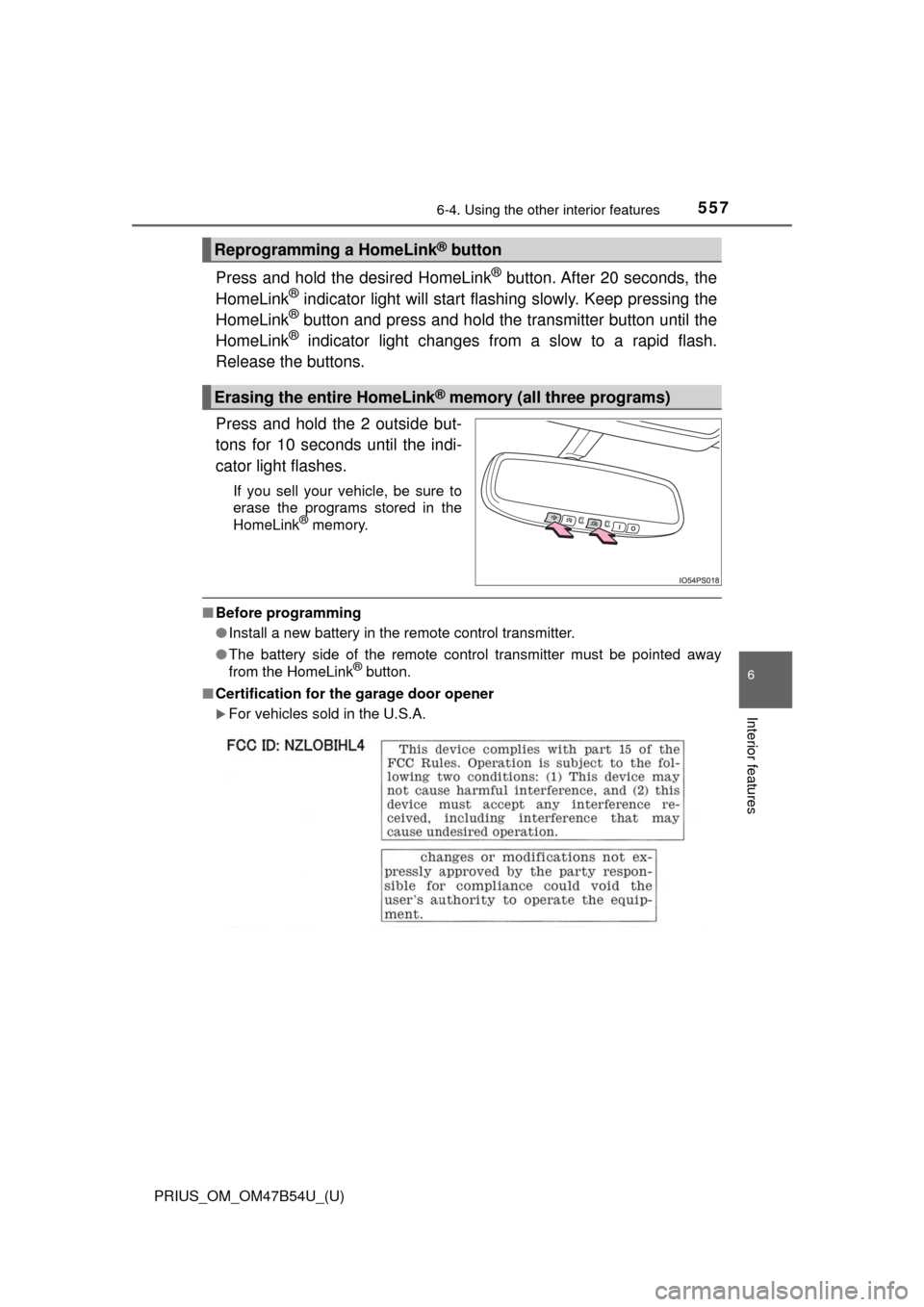
Press and hold the 2 outside but-
tons for 10 seconds until the indi-
cator light flashes.
If you sell your vehicle, be sure to
erase the programs stored in the
HomeLink
® memory.
■ Before programming
●Install a new battery in the remote control transmitter.
● The battery side of the remote control transmitter must be pointed away
from the HomeLink
® button.
■ Certification for the garage door opener
For vehicles sold in the U.S.A.
Reprogramming a HomeLink® button
Erasing the entire HomeLink® memory (all three programs)
Page 609 of 796

PRIUS_OM_OM47B54U_(U)
6097-3. Do-it-yourself maintenance
7
Maintenance and care
■Tire types
●Summer tires
Summer tires are high-speed performance tires best suited to highway
driving under dry conditions. Since summer tires do not have the same
traction performance as snow tires, summer tires are inadequate for
driving on snow-covered or icy ro ads. For driving on snow-covered
roads or icy roads, the use of snow tires is recommended. When install-
ing snow tires, be sure to replace all four tires.
●All season tires
All season tires are designed to provide better traction in snow and to
be adequate for driving in most winter conditions as well as for use
year-round. All season tires, however, do not have adequate traction
performance compared with snow tires in heavy or loose snow. Also, all
season tires fall short in acceleration and handling performance com-
pared with summer tires in highway driving.
●Snow tires
For driving on snow-covered roads or icy roads, we recommend using
snow tires. If you need snow tires, select tires of the same size, con-
struction and load capacity as the or iginally installed tires. Since your
vehicle has radial tires as original equipment, make sure your snow
tires also have radial construction. Do not install studded tires without
first checking local regulations fo r possible restrictions. Snow tires
should be installed on all wheels. ( →P. 412)
■If the tread on snow tires wears down below 0.16 in. (4 mm)
The effectiveness of the tire s as snow tires is lost.
■Low profile tires (vehicles with 17-inch tires)
Generally, low profile tires will wear mo re rapidly and tire grip perfor-
mance will be reduced on snowy and/ or icy roads when compared to
standard tires.
Be sure to use snow tires or tire chains on snowy and/or icy roads and
drive carefully at a speed appropriate for road and weather conditions.
Page 610 of 796

610
PRIUS_OM_OM47B54U_(U)
7-3. Do-it-yourself maintenance
■Situations in which the tire pressure warning system may not oper-
ate properly
●In the following cases, the tire pressure warning system may not operate
properly.
• If non-genuine Toyota wheels are used.
• When a replacement tire is used , the system may not operate cor-
rectly due to the structure of the replacement tire.
• A tire has been replaced with a tire that is not of the specified size.
• Tire chains etc. are equipped.
• An auxiliary-supported run- flat tire is equipped.
• If a window tint that affects the radio wave signals is installed.
• If there is a lot of snow or ice on the vehicle, particularly around the wheels or wheel housings.
• If the tire inflation pressure is extremely higher than the specified level.
• If wheel without the tire pressure warning valve and transmitter is
used.
• If the ID code on the tire pressure warning valves and transmitters is not registered in the tire pressure warning computer.
●Performance may be affected in the following situations.
• Near a TV tower, electric power plant, gas station, radio station, largedisplay, airport or other facility that generates strong radio waves or
electrical noise
• When carrying a portable radio, cellular phone, cordless phone or other wireless communication device
●When the vehicle is parked, the time taken for the warning to start or go
off could be extended.
●When tire inflation pressure declines rapidly for example when a tire has
burst, the warning may not function.
■The initialization operation
●Make sure to carry out in itialization after adjusting the tire inflation pres-
sure.
Also, make sure the tires are cold be fore carrying out initialization or tire
inflation pressure adjustment.
●If you have accidentally turned the po wer switch off during initialization,
it is not necessary to press the reset switch again as initialization will
restart automatically when the powe r switch has been turned to ON
mode for the next time.
●If you accidentally press the reset s witch when initialization is not neces-
sary, adjust the tire inflation pressu re to the specified level when the
tires are cold, and conduct initialization again.
Page 720 of 796
7208-2. Steps to take in an emergency
PRIUS_OM_OM47B54U_(U)
WARNING
■When attempting to free a stuck vehicle
If you choose to push the vehicle back and forth to free it, make sure the
surrounding area is clear to avoid striking other vehicles, objects or people.
The vehicle may also lunge forward or lunge back suddenly as it becomes
free. Use extreme caution.
■ When changing the shift position
Be careful not to change the shift position with the accelerator pedal
depressed.
This may lead to unexpected rapid acceleration of the vehicle that may
cause an accident resulting in death or serious injury.
NOTICE
■To avoid damage to the hybrid transmission and other components
● Avoid spinning the front wheels and depressing the accelerator pedal
more than necessary.
● If the vehicle remains stuck even after these procedures are performed,
the vehicle may require towing to be freed.
Page 764 of 796

764
PRIUS_OM_OM47B54U_(U)
Votre véhicule est doté de COUSSINS GONFLABLES ÉVOLUÉS
dont la conception s’appuie sur les normes de sécurité des véhicules
à moteur américains (FMVSS208). Le module de capteur de coussin
gonflable (ECU) contrôle le dépl oiement des coussins gonflables en
fonction des informations obtenues des capteurs et d’autres éléments
affichés dans le diagramme des composants du système ci-dessus.
Ces informations comprennent des données relatives à la gravité de
l’accident et aux occupants. Au moment du déploiement des coussins
gonflables, une réaction chimique se produit dans les gonfleurs de
coussin gonflable et les coussins gonflables se remplissent rapide-
ment d’un gaz non toxique pour aider à limiter le mouvement des
occupants.
Page 769 of 796
PRIUS_OM_OM47B54U_(U)
769
10
For owners
AVERTISSEMENT
■Précautions relatives aux coussins gonflables SRS
● Si vous avez de la difficulté à respirer après le déploiement des coussins
gonflables SRS, ouvrez une portière ou une glace latérale pour laisser
entrer l’air frais, ou quittez le véhicule si vous pouvez le faire en toute
sécurité. Dès que possible, nettoyez tous les résidus afin d’éviter les irrita-
tions cutanées.
● Si les emplacements de stockage des coussins gonflables SRS, tels que
le tampon de volant et les garnitures des montants avant et arrière, sont
endommagés ou fissurés, faites-les remplacer par votre concessionnaire
Toyota.
● Ne placez aucun objet, par exemple un coussin, sur le siège du passager
avant. Cela disperserait le poids du passager, ce qui empêcherait le cap-
teur de le détecter correctement. Cela pourrait empêcher le déploiement
des coussins gonflables SRS du passager avant en cas de collision.
■ Modification et mise au rebut des composants du système de coussins
gonflables SRS
Ne mettez pas votre véhicule au rebut et n’effectuez aucune des modifica-
tions suivantes sans d’abord consulter votre concessionnaire Toyota. Les
coussins gonflables SRS pourraient fonctionner de manière incorrecte ou
se déployer (gonfler) accidentellement, ce qui serait susceptible d’occasion-
ner des blessures graves, voire mortelles.
● Installation, retrait, démontage et réparation des coussins gonflables SRS
● Réparations, modifications, retrait ou remplacement du volant, du tableau
de bord, de la planche de bord, des sièges ou du capitonnage des sièges,
des montants avant, latéraux et arrière, des brancards de pavillon, des
panneaux des portières avant, de la garniture des portières avant ou des
haut-parleurs des portières avant
● Modifications du panneau de la portière avant (comme le perforer)
● Réparations ou modifications de l’aile avant, du pare-chocs avant ou du
côté de l’habitacle
● Installation d’une protection de calandre (barre safari, barre kangourou,
etc.), de lames de déneigement, de treuils ou d’un porte-bagages de toit
● Modifications du système de suspension du véhicule
● Installation d’appareils électroniques tels qu’un émetteur-récepteur radio
ou un lecteur de CD
● Modifications à votre véhicule pour une personne aux capacités physiques
réduites