sensor TOYOTA PRIUS 2020 Owners Manual (in English)
[x] Cancel search | Manufacturer: TOYOTA, Model Year: 2020, Model line: PRIUS, Model: TOYOTA PRIUS 2020Pages: 56, PDF Size: 5.69 MB
Page 3 of 56
OVERVIEW
FEATURES & OPERATIONS
TOYOTA SAFETY SENSE
SAFETY & EMERGENCY FEATURES
1
INDEX
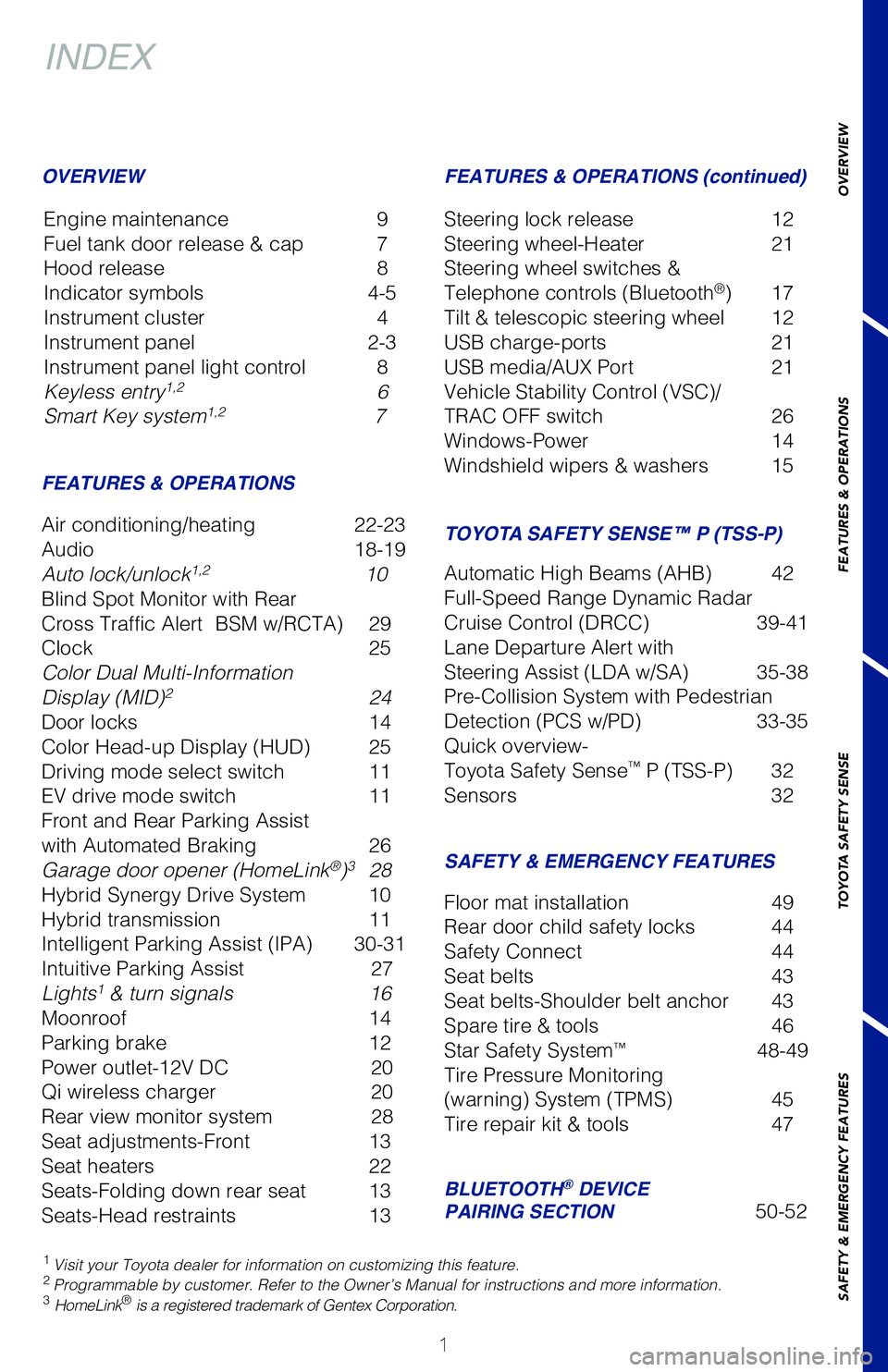
Engine maintenance 9
Fuel tank door release & cap 7
Hood release 8
Indicator symbols 4-5
Instrument cluster 4
Instrument panel 2-3
Instrument panel light control 8
Keyless entry
1,2 6
Smart Key system1,2 7
1 Visit your Toyota dealer for information on customizing this feature.2 Programmable by customer. Refer to the Owner’s Manual for instructions and more information.3 HomeLink® is a registered trademark of Gentex Corporation.
OVERVIEW FEATURES & OPERATIONS (continued)
FEATURES & OPERATIONS
SAFETY & EMERGENCY FEATURES TOYOTA SAFETY SENSE™ P (TSS-P)
Air conditioning/heating 22-23
Audio 18-19
Auto lock/unlock
1,2 10
Blind Spot Monitor with Rear
Cross Traffic Alert BSM w/RCTA) 29
Clock 25
Color Dual Multi-Information
Display (MID)
2 24
Door locks 14
Color Head-up Display (HUD) 25
Driving mode select switch 11
EV drive mode switch 11
Front and Rear Parking Assist
with Automated Braking 26
Garage door opener (HomeLink
®)3 28
Hybrid Synergy Drive System 10
Hybrid transmission 11
Intelligent Parking Assist (IPA) 30-31
Intuitive Parking Assist 27
Lights
1 & turn signals 16
Moonroof 14
Parking brake 12
Power outlet-12V DC 20
Qi wireless charger 20
Rear view monitor system 28
Seat adjustments-Front 13
Seat heaters 22
Seats-Folding down rear seat 13
Seats-Head restraints 13 Floor mat installation
49
Rear door child safety locks 44
Safety Connect 44
Seat belts 43
Seat belts-Shoulder belt anchor 43
Spare tire & tools 46
Star Safety System
™ 48-49
Tire Pressure Monitoring
(warning) System (TPMS) 45
Tire repair kit & tools 47
Automatic High Beams (AHB)
42
Full-Speed Range Dynamic Radar
Cruise Control (DRCC) 39-41
Lane Departure Alert with
Steering Assist (LDA w/SA) 35-38
Pre-Collision System with Pedestrian
Detection (PCS w/PD) 33-35
Quick overview-
Toyota Safety Sense
™ P (TSS-P) 32
Sensors 32
Steering lock release
12
Steering wheel-Heater 21
Steering wheel switches &
Telephone controls (Bluetooth
®) 17
Tilt & telescopic steering wheel 12
USB charge-ports 21
USB media/AUX Port 21
Vehicle Stability Control (VSC)/
TRAC OFF switch 26
Windows-Power 14
Windshield wipers & washers 15
BLUETOOTH® DEVICE
PAIRING SECTION 50-52
62443_MY20_Prius_Text.indd 18/22/19 7:34 PM
Page 17 of 56
15
FRONT-INTERMITTENT (IF EQUIPPED)
REAR (IF EQUIPPED)
FRONT-AUTO (RAIN-SENSING)(IF EQUIPPED)
Windshield wipers & washers
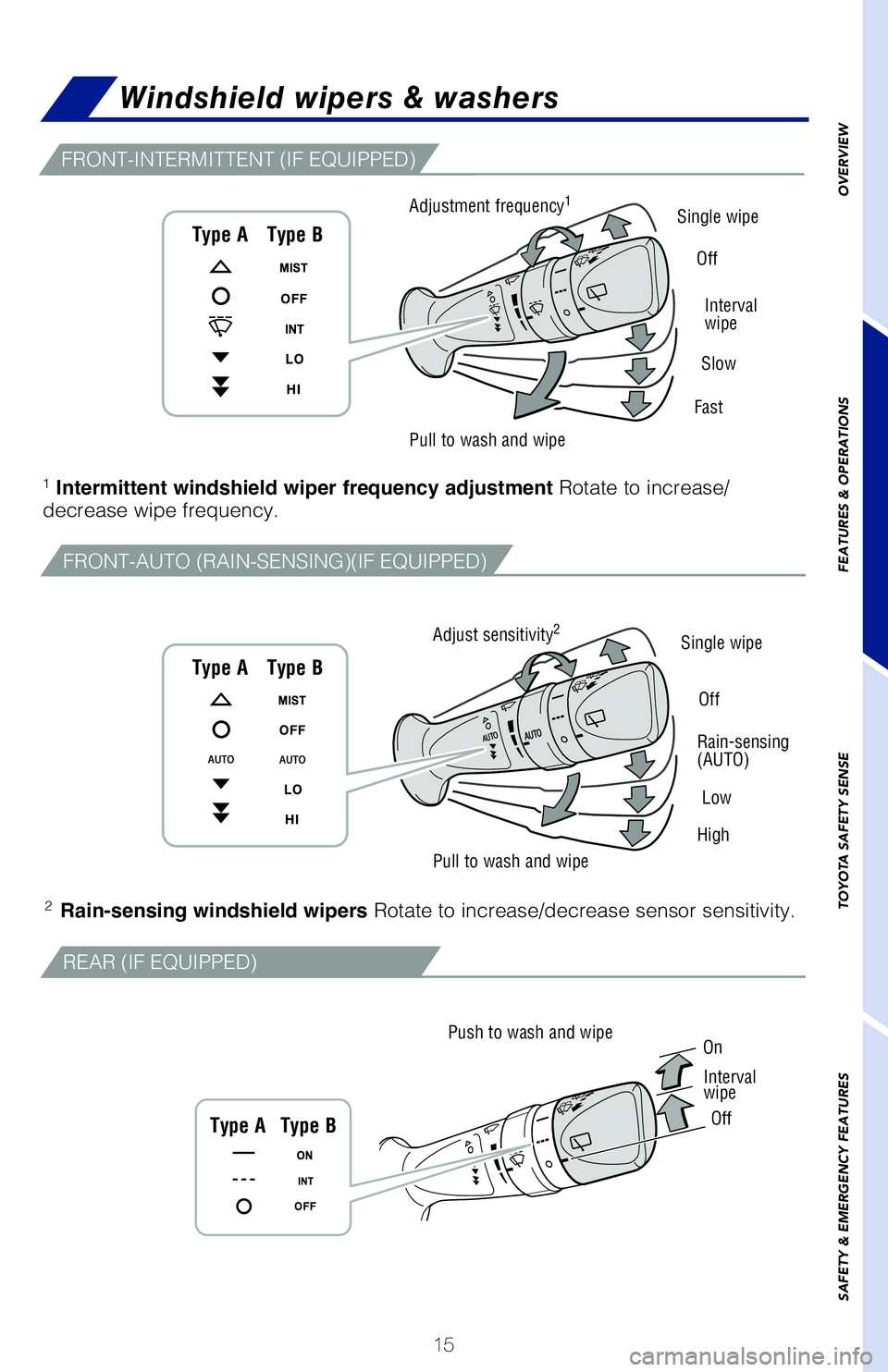
1 Intermittent windshield wiper frequency adjustment Rotate to increase/
decrease wipe frequency.
2 Rain-sensing windshield wipers Rotate to increase/decrease sensor sensitivity.
Type A
Type A
Type A
Type B
Type B
Type B
OVERVIEW
FEATURES & OPERATIONS
TOYOTA SAFETY SENSE
SAFETY & EMERGENCY FEATURES
Single wipe
Pull to wash and wipe
Adjustment frequency1
Interval
wipe
Slow
Fast Off
Single wipe Off
Adjust sensitivity
2
Pull to wash and wipe Rain-sensing
(AUTO)
Low
High
Off
On
Interval
wipe
Push to wash and wipe
62443_MY20_Prius_Text.indd 158/22/19 7:34 PM
Page 28 of 56
26
FEATURES & OPERATIONS
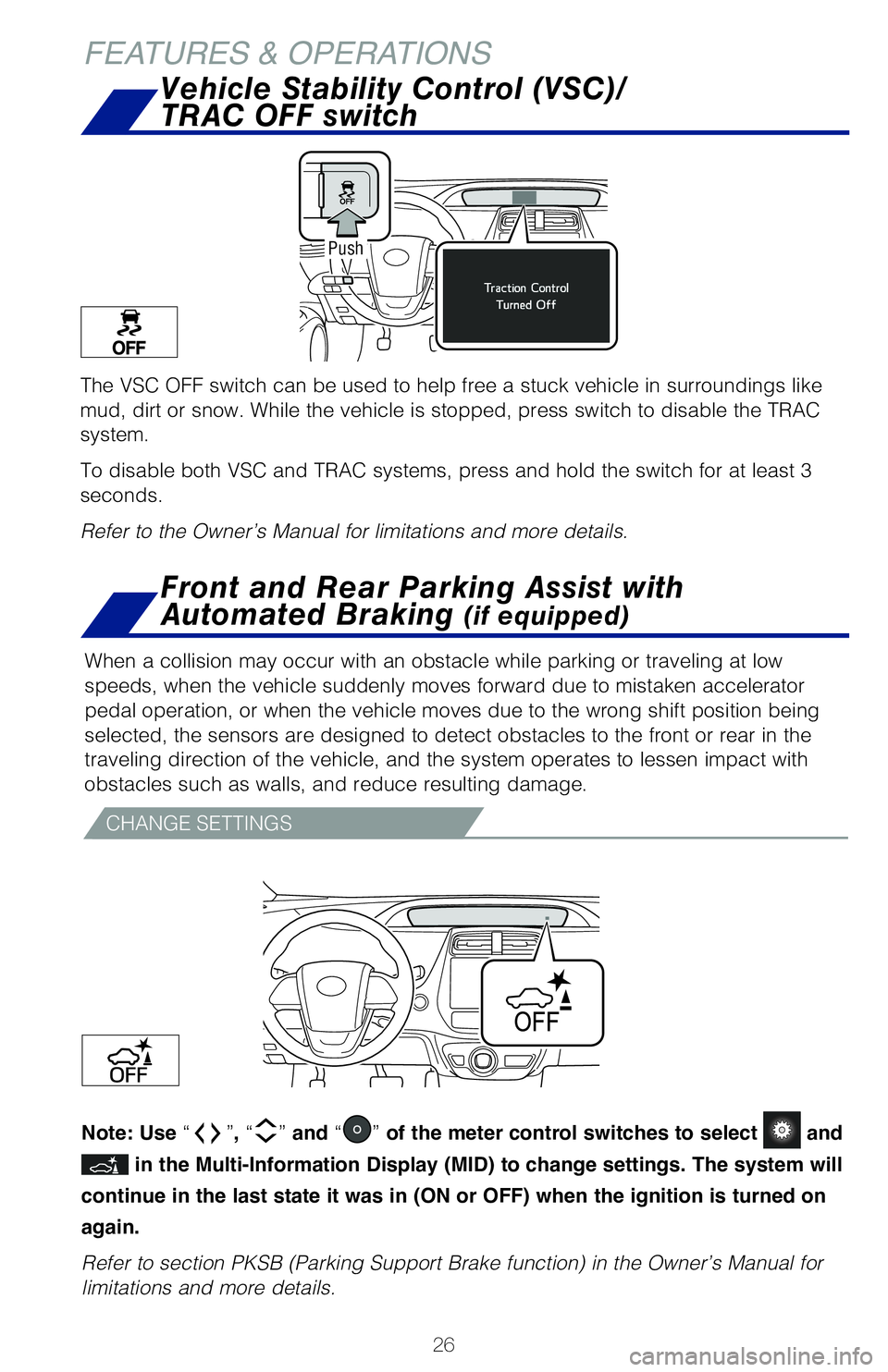
The VSC OFF switch can be used to help free a stuck vehicle in surroundings like
mud, dirt or snow. While the vehicle is stopped, press switch to disable the TRAC
system.
To disable both VSC and TRAC systems, press and hold the switch for at least 3
seconds.
Refer to the Owner’s Manual for limitations and more details.
Push
Vehicle Stability Control (VSC)/
TRAC OFF switch
Front and Rear Parking Assist with
Automated Braking
(if equipped)
When a collision may occur with an obstacle while parking or traveling at low
speeds, when the vehicle suddenly moves forward due to mistaken accelerator
pedal operation, or when the vehicle moves due to the wrong shift position being
selected, the sensors are designed to detect obstacles to the front or rear in the
traveling direction of the vehicle, and the system operates to lessen impact with
obstacles such as walls, and reduce resulting damage.
CHANGE SETTINGS
Note: Use “”, “” and “” of the meter control switches to select and
in the Multi-Information Display (MID) to change settings. The system will
continue in the last state it was in (ON or OFF) when the ignition is turned on
again.
Refer to section PKSB (Parking Support Brake function) in the Owner’s Manual for
limitations and more details.
62443_MY20_Prius_Text.indd 268/22/19 7:34 PM
Page 29 of 56
27
OVERVIEW
FEATURES & OPERATIONS
TOYOTA SAFETY SENSE
SAFETY & EMERGENCY FEATURES
Intuitive Parking Assist (if equipped)
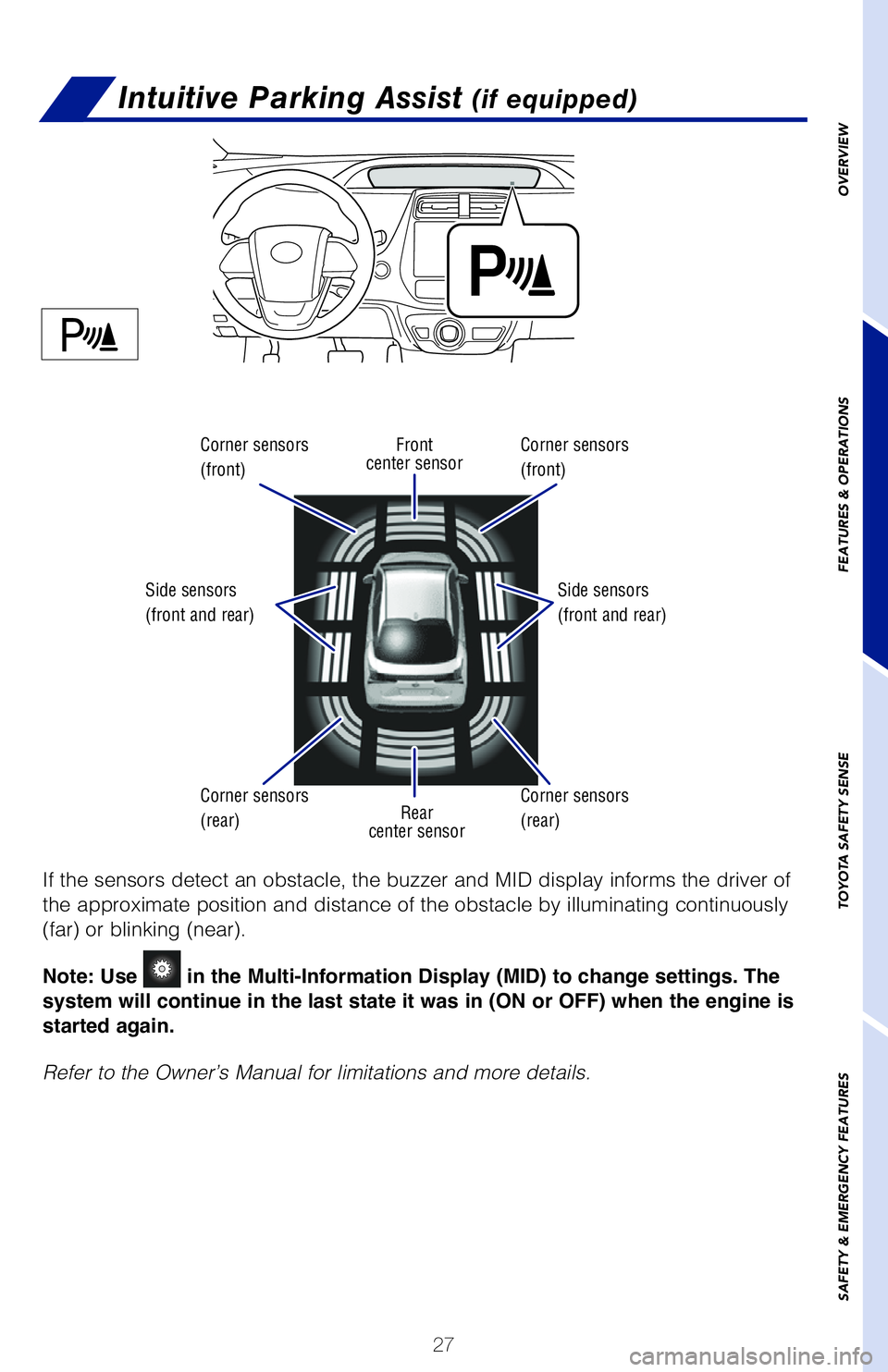
If the sensors detect an obstacle, the buzzer and MID display informs the driver of
the approximate position and distance of the obstacle by illuminating continuously
(far) or blinking (near).
Note: Use
in the Multi-Information Display (MID) to change settings. The
system will continue in the last state it was in (ON or OFF) when the engine is
started again.
Refer to the Owner’s Manual for limitations and more details.
Front
center sensor
Rear
center sensor
Corner sensors
(front)
Corner sensors
(rear)
Side sensors
(front and rear)
Side sensors
(front and rear)
Corner sensors
(front)
Corner sensors
(rear)
62443_MY20_Prius_Text.indd 278/22/19 7:34 PM
Page 31 of 56
29
OVERVIEW
FEATURES & OPERATIONS
TOYOTA SAFETY SENSE
SAFETY & EMERGENCY FEATURES
Blind Spot Monitor with Rear Cross Traffic
Alert (BSM w/RCTA)
(if equipped)
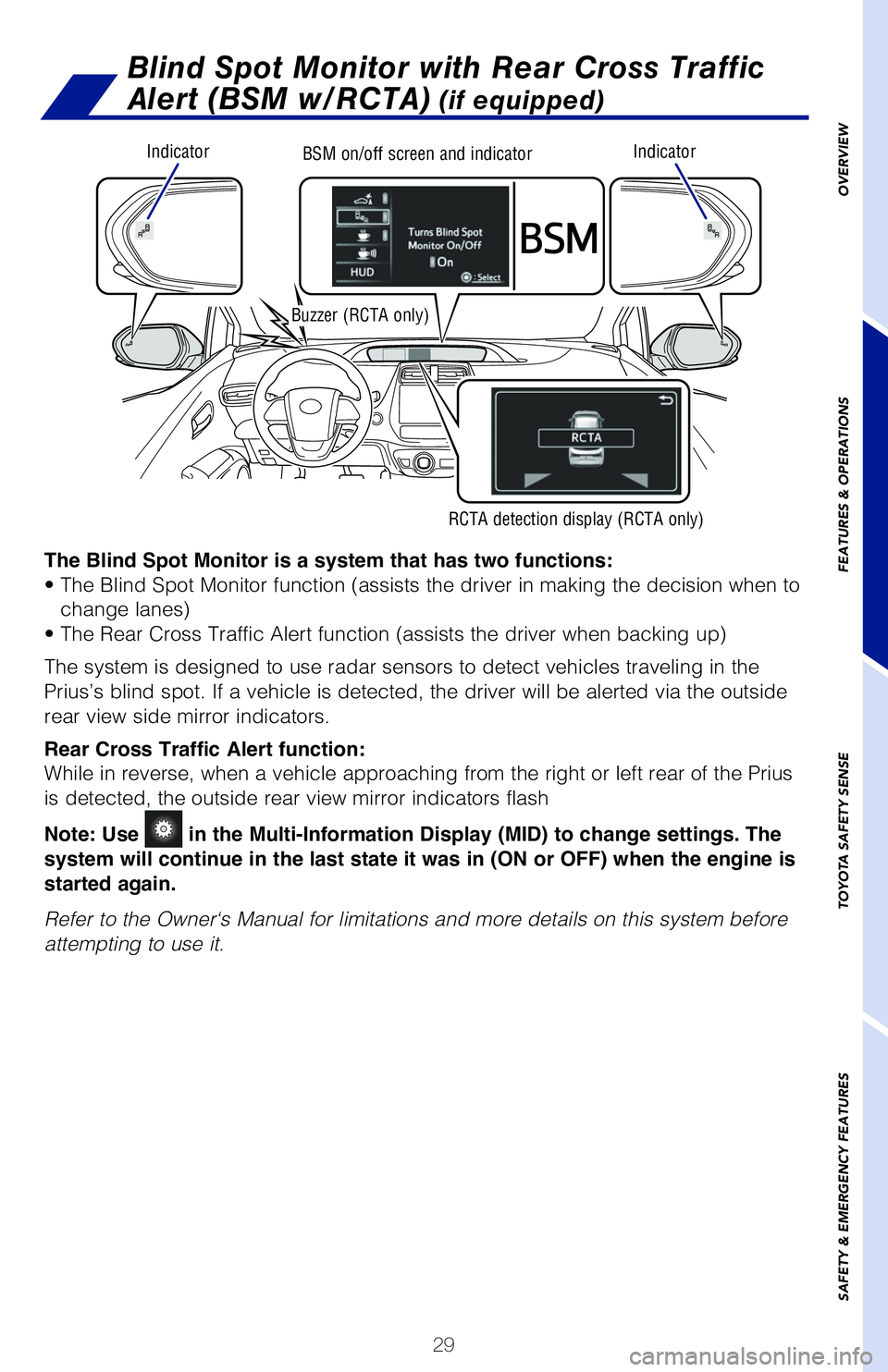
The Blind Spot Monitor is a system that has two functions:
• The Blind Spot Monitor function (assists the driver in making the decision when to
change lanes)
• The Rear Cross Traffic Alert function (assists the driver when backing up)
The system is designed to use radar sensors to detect vehicles traveling in the
Prius’s blind spot. If a vehicle is detected, the driver will be alerted via the outside
rear view side mirror indicators.
Rear Cross Traffic Alert function:
While in reverse, when a vehicle approaching from the right or left rear of the Prius
is detected, the outside rear view mirror indicators flash
Note: Use
in the Multi-Information Display (MID) to change settings. The
system will continue in the last state it was in (ON or OFF) when the engine is
started again.
Refer to the Owner‘s Manual for limitations and more details on this system before
attempting to use it.
IndicatorIndicatorBSM on/off screen and indicator
Buzzer (RCTA only)
RCTA detection display (RCTA only)
62443_MY20_Prius_Text.indd 298/22/19 7:34 PM
Page 34 of 56
32
Quick overview-Toyota Safety Sense™ P (TSS-P)
Sensors
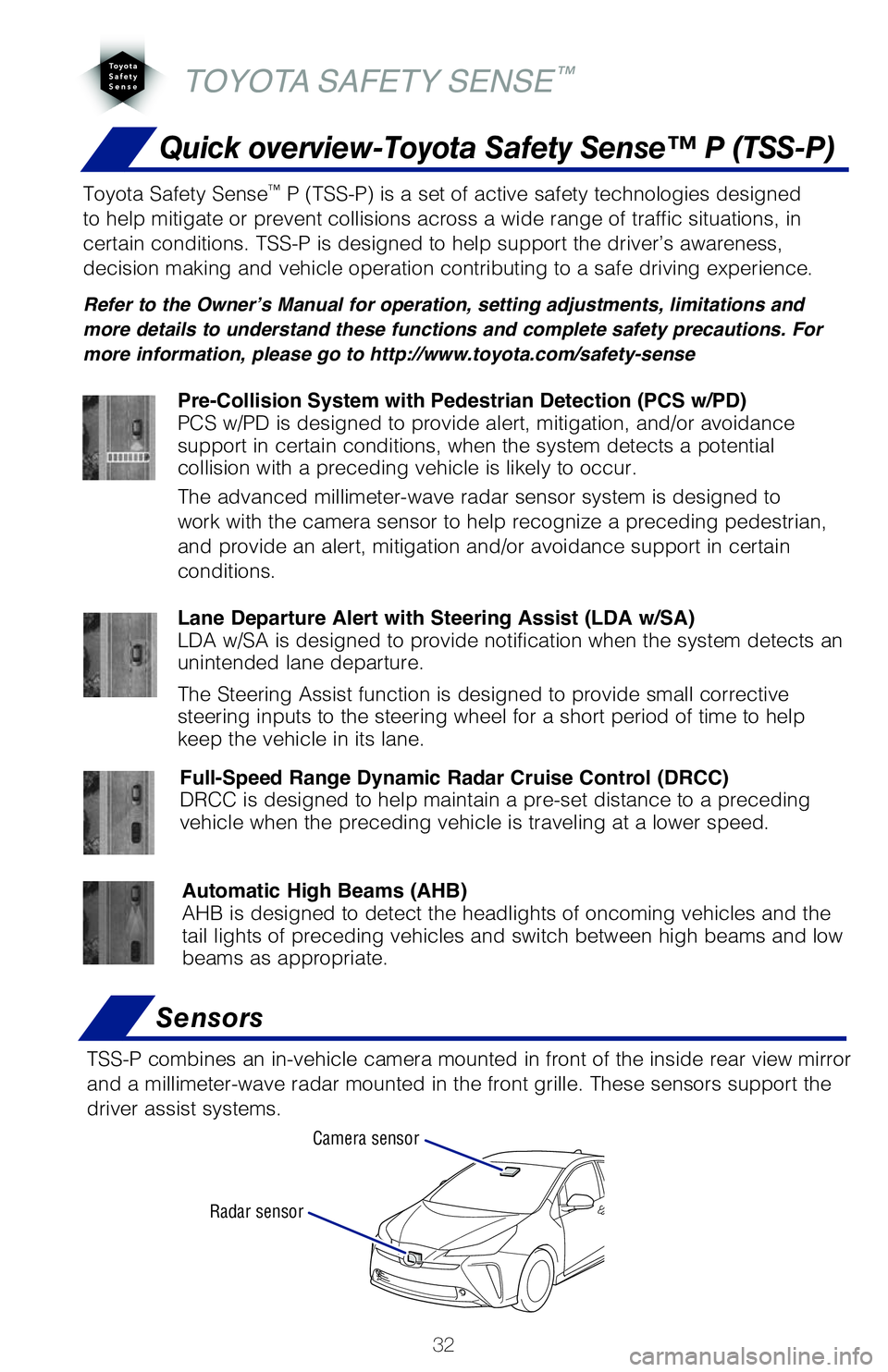
TSS-P combines an in-vehicle camera mounted in front of the inside rear view mirror
and a millimeter-wave radar mounted in the front grille. These sensors support the
driver assist systems.
Camera sensor
Radar sensor
TOYOTA SAFETY SENSE™
Toyota Safety Sense™ P (TSS-P) is a set of active safety technologies designed
to help mitigate or prevent collisions across a wide range of traffic situations, in
certain conditions. TSS-P is designed to help support the driver’s awareness,
decision making and vehicle operation contributing to a safe driving experience.
Refer to the Owner’s Manual for operation, setting adjustments, limitations and
more details to understand these functions and complete safety precautions. For
more information, please go to http://www.toyota.com/safety-sense
Lane Departure Alert with Steering Assist (LDA w/SA)
LDA w/SA is designed to provide notification when the system detects an
unintended lane departure.
The Steering Assist function is designed to provide small corrective
steering inputs to the steering wheel for a short period of time to help
keep the vehicle in its lane.
Automatic High Beams (AHB)
AHB is designed to detect the headlights of oncoming vehicles and the
tail lights of preceding vehicles and switch between high beams and low
beams as appropriate.
Pre-Collision System with Pedestrian Detection (PCS w/PD)
PCS w/PD is designed to provide alert, mitigation, and/or avoidance
support in certain conditions, when the system detects a potential
collision with a preceding vehicle is likely to occur.
The advanced millimeter-wave radar sensor system is designed to
work with the camera sensor to help recognize a preceding pedestrian,
and provide an alert, mitigation and/or avoidance support in certain
conditions.
Full-Speed Range Dynamic Radar Cruise Control (DRCC)
DRCC is designed to help maintain a pre-set distance to a preceding
vehicle when the preceding vehicle is traveling at a lower speed.
62443_MY20_Prius_Text.indd 328/22/19 7:35 PM
Page 35 of 56
33
OVERVIEW
FEATURES & OPERATIONS
TOYOTA SAFETY SENSE
SAFETY & EMERGENCY FEATURES
The Pre-Collision System uses a radar sensor and camera sensor to help detect a
vehicle or pedestrian in front of your vehicle.
As there is a limit to the degree of recognition accuracy and control performance
that this system can provide, do not overly rely on this system. This system will not
prevent collisions or lessen collision damage or injury in every situation. Do not use
PCS instead of normal braking operations under any circumstances. Do not attempt
to test the operation of the pre-collision system yourself, as the system may not
operate or engage, possibly leading to an accident. In some situations, such as
when driving in inclement weather such as heavy rain, fog, snow or a sandstorm or
while driving on a curve and for a few seconds after driving on a curve, a vehicle or
pedestrian may not be detected by the radar and camera sensors, preventing the
system from operating or engaging properly.
Refer to the Toyota Owner’s Manual for a list of additional situations in which the
system may not operate properly.
Refer to the Toyota Owner’s Manual for additional information on PCS w/PD
operation, settings adjustments, limitations, and precautions before attempting to
use it. Pre-Collision Warning
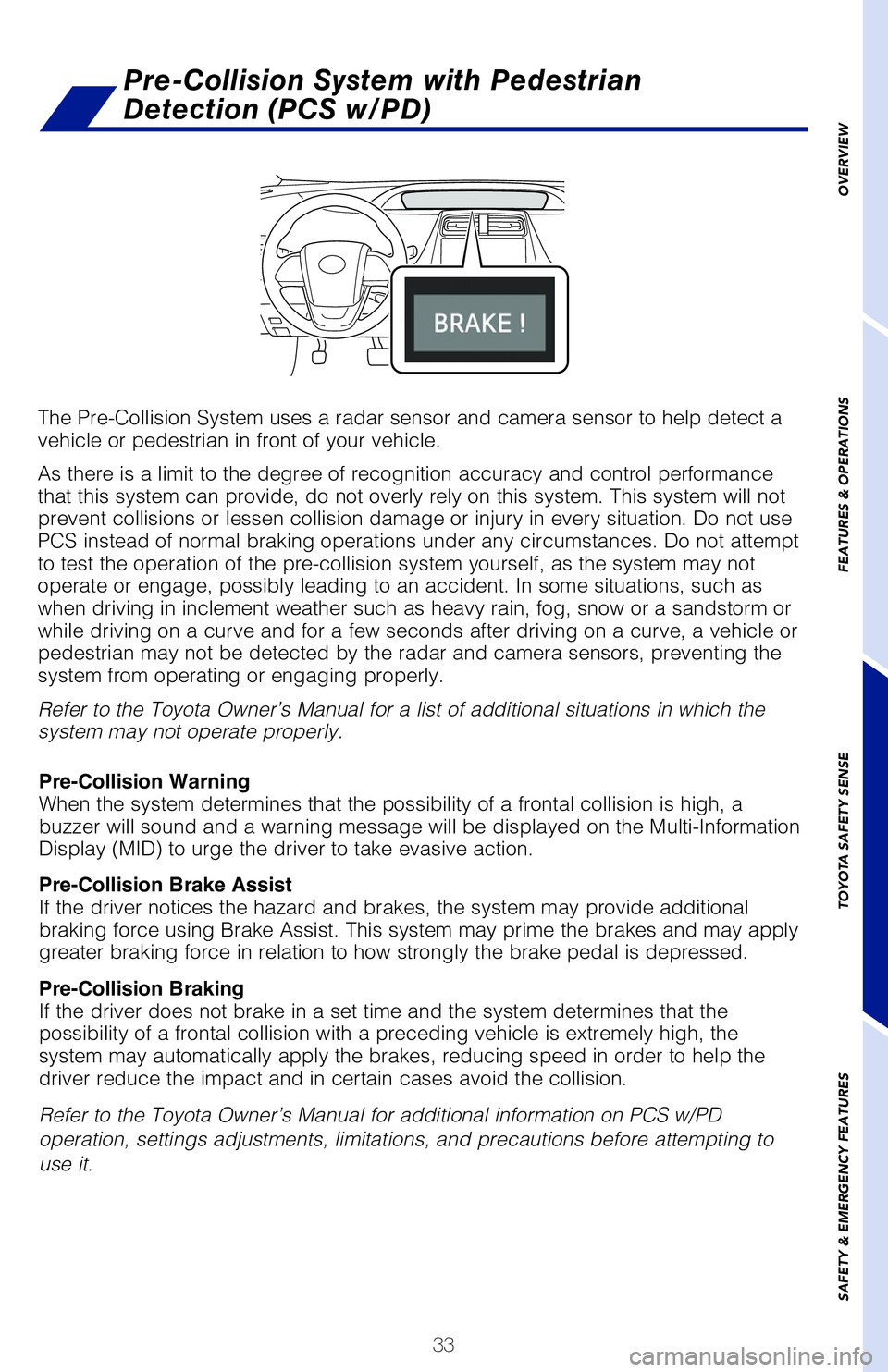
When the system determines that the possibility of a frontal collision is high, a
buzzer will sound and a warning message will be displayed on the Multi-Information
Display (MID) to urge the driver to take evasive action.
Pre-Collision Brake Assist
If the driver notices the hazard and brakes, the system may provide additional
braking force using Brake Assist. This system may prime the brakes and may apply
greater braking force in relation to how strongly the brake pedal is depressed.
Pre-Collision Braking
If the driver does not brake in a set time and the system determines that the
possibility of a frontal collision with a preceding vehicle is extremely high, the
system may automatically apply the brakes, reducing speed in order to help the
driver reduce the impact and in certain cases avoid the collision.
Pre-Collision System with Pedestrian
Detection (PCS w/PD)
62443_MY20_Prius_Text.indd 338/22/19 7:35 PM
Page 36 of 56
34
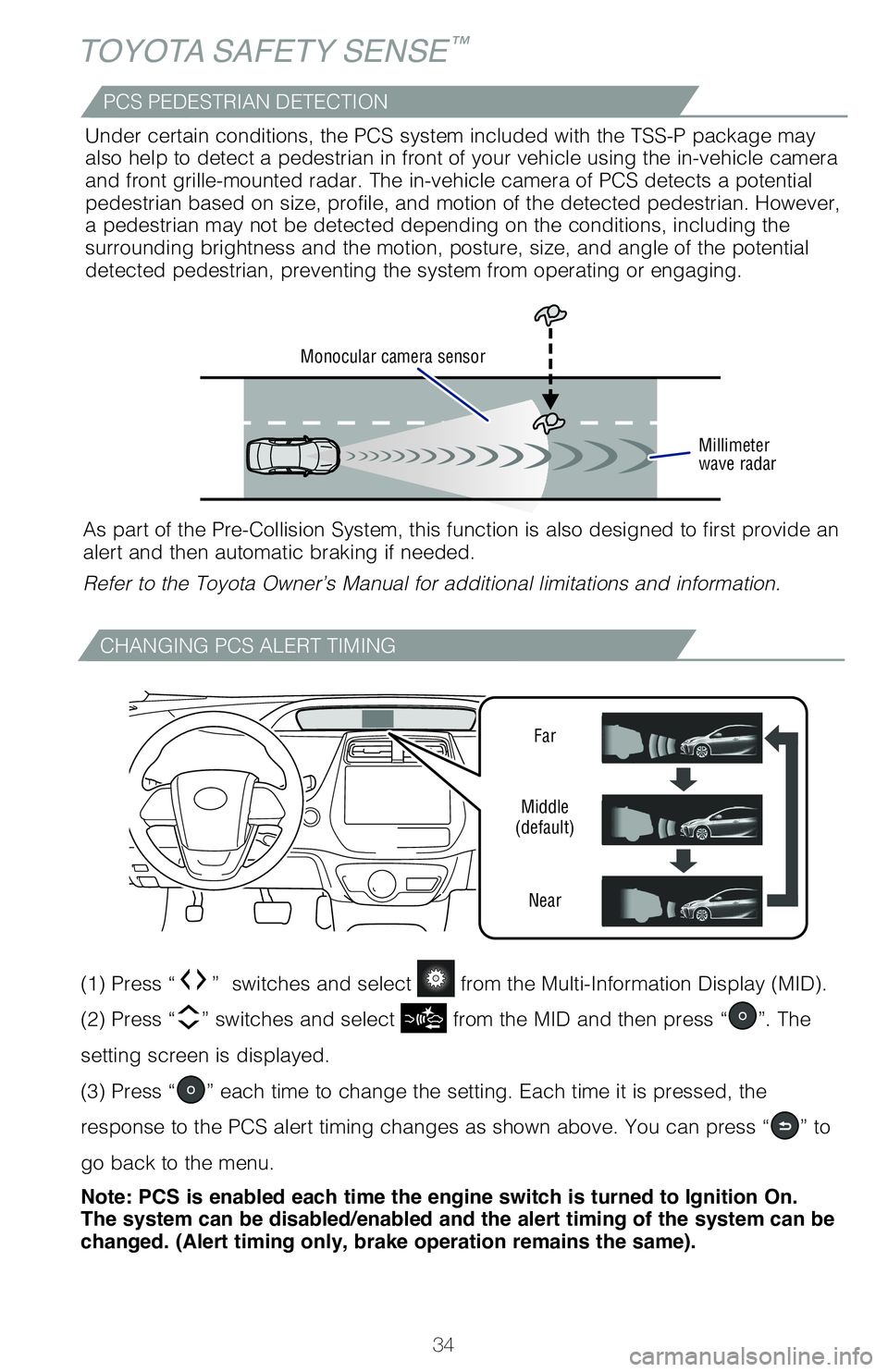
CHANGING PCS ALERT TIMING
TOYOTA SAFETY SENSE™
Far
Middle
(default)
Near
(1) Press “” switches and select from the Multi-Information Display (MID).
(2) Press “
” switches and select from the MID and then press “”. The
setting screen is displayed.
(3) Press “
” each time to change the setting. Each time it is pressed, the
response to the PCS alert timing changes as shown above. You can press “
” to
go back to the menu.
Note: PCS is enabled each time the engine switch is turned to Ignition On.
The system can be disabled/enabled and the alert timing of the system can be
changed. (Alert timing only, brake operation remains the same).
Monocular camera sensor
Millimeter
wave radar
As part of the Pre-Collision System, this function is also designed to first provide an
alert and then automatic braking if needed.Under certain conditions, the PCS system included with the TSS-P package may
also help to detect a pedestrian in front of your vehicle using the in-vehicle camera
and front grille-mounted radar. The in-vehicle camera of PCS detects a potential
pedestrian based on size, profile, and motion of the detected pedestrian. However,
a pedestrian may not be detected depending on the conditions, including the
surrounding brightness and the motion, posture, size, and angle of the potential
detected pedestrian, preventing the system from operating or engaging.
PCS PEDESTRIAN DETECTION
Refer to the Toyota Owner’s Manual for additional limitations and information.
62443_MY20_Prius_Text.indd 348/22/19 7:35 PM
Page 42 of 56
40
ADJUSTING DISTANCE
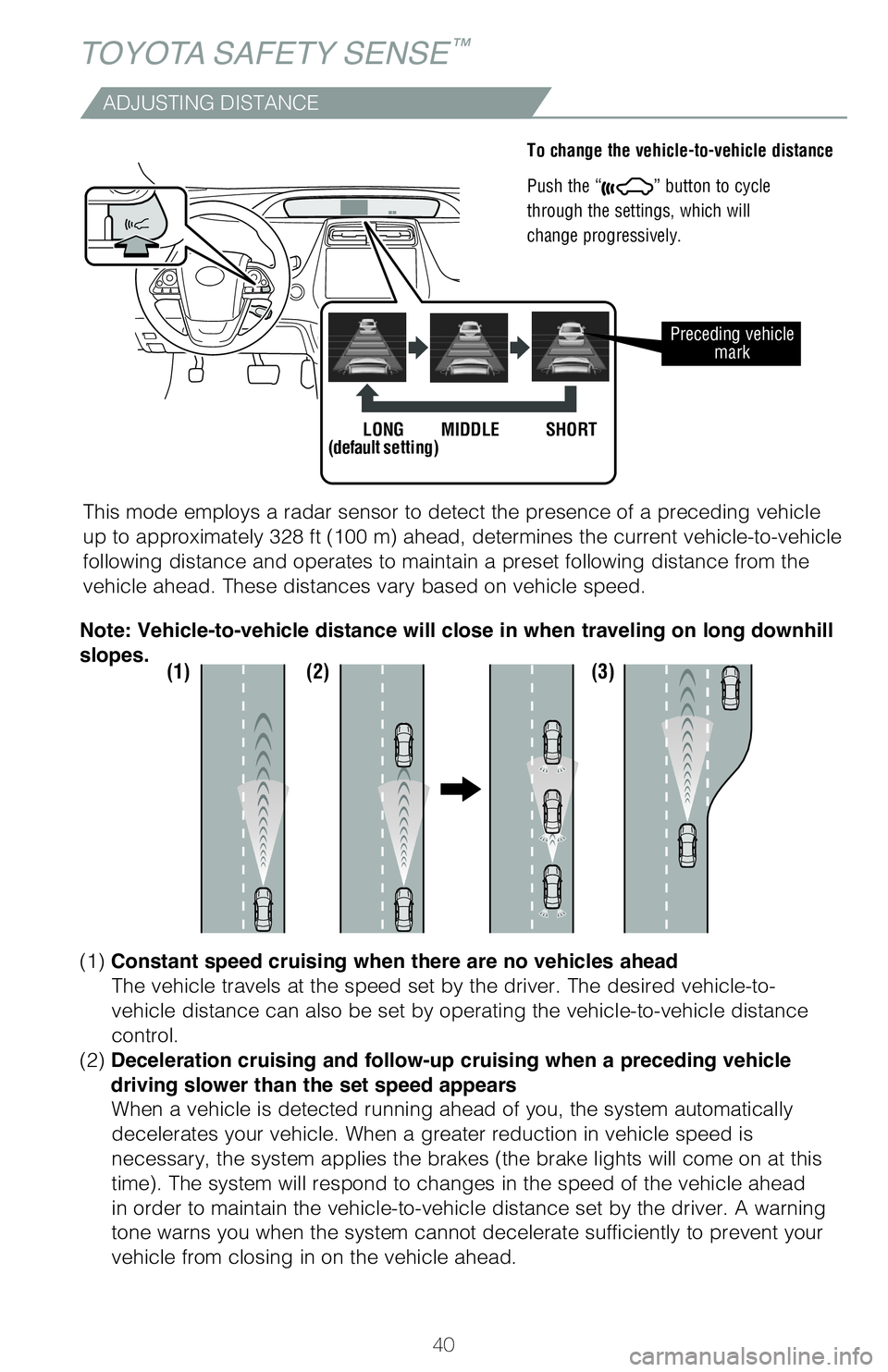
To change the vehicle-to-vehicle distance
Push the “
” button to cycle
through the settings, which will
change progressively.
This mode employs a radar sensor to detect the presence of a preceding vehicle
up to approximately 328 ft (100 m) ahead, determines the current vehicle-to-vehicle
following distance and operates to maintain a preset following distance from the
vehicle ahead. These distances vary based on vehicle speed.
Preceding vehicle mark
LONG
(default setting) MIDDLE SHORT
(1) (2) (3)
(1) Constant speed cruising when there are no vehicles ahead
The vehicle travels at the speed set by the driver. The desired vehicle-to-
vehicle distance can also be set by operating the vehicle-to-vehicle distance
control.
(2) Deceleration cruising and follow-up cruising when a preceding vehicle
driving slower than the set speed appears When a vehicle is detected running ahead of you, the system automatically
decelerates your vehicle. When a greater reduction in vehicle speed is
necessary, the system applies the brakes (the brake lights will come on at this
time). The system will respond to changes in the speed of the vehicle ahead
in order to maintain the vehicle-to-vehicle distance set by the driver. A warning
tone warns you when the system cannot decelerate sufficiently to prevent your
vehicle from closing in on the vehicle ahead.
Note: Vehicle-to-vehicle distance will close in when traveling on long downhill
slopes.
TOYOTA SAFETY SENSE™
62443_MY20_Prius_Text.indd 408/22/19 7:35 PM
Page 50 of 56
48
SAFETY & EMERGENCY FEATURES
SMART STOP TECHNOLOGY (SST)
Star Safety System™
Smart Stop Technology automatically reduces engine power when the accelerator
and brake pedals are pressed simultaneously under certain conditions.
SST engages when the accelerator is depressed first and the brakes are applied
firmly for longer than one-half second at speeds greater than five miles per hour.
SST doesn’t engage if the brake pedal is depressed before the accelerator pedal,
allowing vehicles to start on a steep hill and safely accelerate without rolling
backward.
Refer to the Brake Override System section in the Owner’s Manual for more
information on Smart Stop Technology.
ENHANCED VEHICLE STABILITY CONTROL (VSC)
Enhanced Vehicle Stability Control provides cooperative control of the ABS, TRAC,
VSC and EPS.
Enhanced VSC helps to maintain directional stability when loss of traction occurs
during a turn.
ANTI-LOCK BRAKE SYSTEM (ABS)
Toyota’s ABS sensors detect which wheels are locking up and limits wheel lockup
by “pulsing” each wheel’s brakes independently. Pulsing releases brake pressure
repeatedly for fractions of a second. This helps the tires attain the traction that
current road conditions will allow, helping you to stay in directional control.
BRAKE ASSIST (BA)
Brake Assist is designed to detect sudden or “panic” braking, and then add braking
pressure to help decrease the vehicle’s stopping distance. When there’s only a split
second to react, Brake Assist can add additional brake pressure more quickly than
just the driver alone can.
ELECTRONIC BRAKE FORCE DISTRIBUTION (EBD)
Toyota’s ABS technology has Electronic Brake-force Distribution (EBD) to help
maintain control and balance when braking. EBD responds to sudden stops by
redistributing brake force to enhance the braking effectiveness of all four wheels. Your vehicle comes standard with the Star Safety System
TM, which combines Anti-
lock Braking System (ABS), Brake Assist (BA), Electronic Brake-force Distribution
(EBD), Smart Stop Technology (SST), Traction Control (TRAC) and Vehicle Stability
Control (VSC).
Refer to the Owner’s Manual for more details and important information on limitations
to these systems.
62443_MY20_Prius_Text.indd 488/22/19 7:35 PM