engine TOYOTA PRIUS 2022 Manual PDF
[x] Cancel search | Manufacturer: TOYOTA, Model Year: 2022, Model line: PRIUS, Model: TOYOTA PRIUS 2022Pages: 744, PDF Size: 14.35 MB
Page 648 of 744
6487-2. Steps to take in an emergency
PRIUS_OM_OM47F01U_(U)
Once the hybrid system has started, remove the jumper cables in
the exact reverse order from which they were connected.
To install the engine cover, conduct the removal procedure in
reverse. After installing, check that the fixed pins are inserted
securely.
Once the hybrid system starts, have the vehicle inspected at yo ur
Toyota dealer as soon as possible.
■ When opening the cover of the positive (+) battery terminal
P. 521
■ Starting the hybrid system when the 12-volt battery is discharged
The hybrid system cannot be started by push-starting.
■ To prevent 12-volt battery discharge
●Turn off the headlights and the audio system while the hybrid s ystem is off.
● Turn off any unnecessary electrical components when the vehicle is running
at a low speed for an extended period, such as in heavy traffic .
■ When the 12-volt battery is removed or discharged
● Information stored in the ECU is cleared. When the 12-volt batt ery is
depleted, have the vehicle inspected at your Toyota dealer.
● Some systems may require initialization. ( P. 697)
■ When removing the 12-vo lt battery terminals
When the 12-volt battery terminals are removed, the information stored in the
ECU is cleared. Before removing the 12-volt battery terminals, contact your
Toyota dealer.
■ Charging the 12-volt battery
The electricity stored in the 12-volt battery will discharge gr adually even when
the vehicle is not in use, due to natural discharge and the dra ining effects of
certain electrical appliances. If the vehicle is left for a lon g time, the 12-volt
battery may discharge, and the hybrid system may be unable to s tart. (The
12-volt battery recharges automatically while the hybrid system is operating.)
7
8
Page 655 of 744
6557-2. Steps to take in an emergency
PRIUS_OM_OM47F01U_(U)
7
When trouble arises
After stopping the hybrid system and waiting for 5 minutes or
more, start the hybrid system again and check if “Hybrid System
Overheated” is shown on the multi-information display.
If the message d oes not disappear:
Stop the hybrid system and contact your Toyota dealer.
If the message is not displayed:
The hybrid system temperature has dropped and the vehicle may
be driven normally.
However, if the message appears again frequently, contact your Toyota
dealer.
WARNING
■ To prevent an accident or injury when inspecting under the hood of
your vehicle
Observe the following precautions.
Failure to do so may result in serious injury such as burns.
● If steam is seen coming from under the hood, do not open the ho od until
the steam has subsided. The engine compartment may be very hot.
● After the hybrid system has been turned off, check that the “Ac cessory”,
“Ignition ON” or mileage display ( P. 116) on the main display and the
“READY” indicator are off.
When the hybrid system is operating, the gasoline engine may au tomati-
cally start, or the cooling fans may suddenly operate even if the gasoline
engine stops. Do not touch or approach rotating parts such as the fan,
which may lead to fingers or clothing (especially a tie, a scarf or a muffler)
getting caught, resulting in serious injury.
● Do not loosen the coolant reservoir caps while the hybrid syste m and radi-
ator are hot.
High temperature steam or coolant could spray out.
6
Page 656 of 744
6567-2. Steps to take in an emergency
PRIUS_OM_OM47F01U_(U)
NOTICE
■When adding engine/power control unit coolant
Add coolant slowly after the hybrid system has cooled down sufficiently.
Adding cool coolant to a hot hybrid system too quickly can cause damage to
the hybrid system.
■ To prevent damage to the cooling system
Observe the following precautions:
● Avoid contaminating the coolant with foreign matter (such as sand or dust
etc.).
● Do not use any coolant additive.
Page 662 of 744
662
PRIUS_OM_OM47F01U_(U)
8-1. Specifications
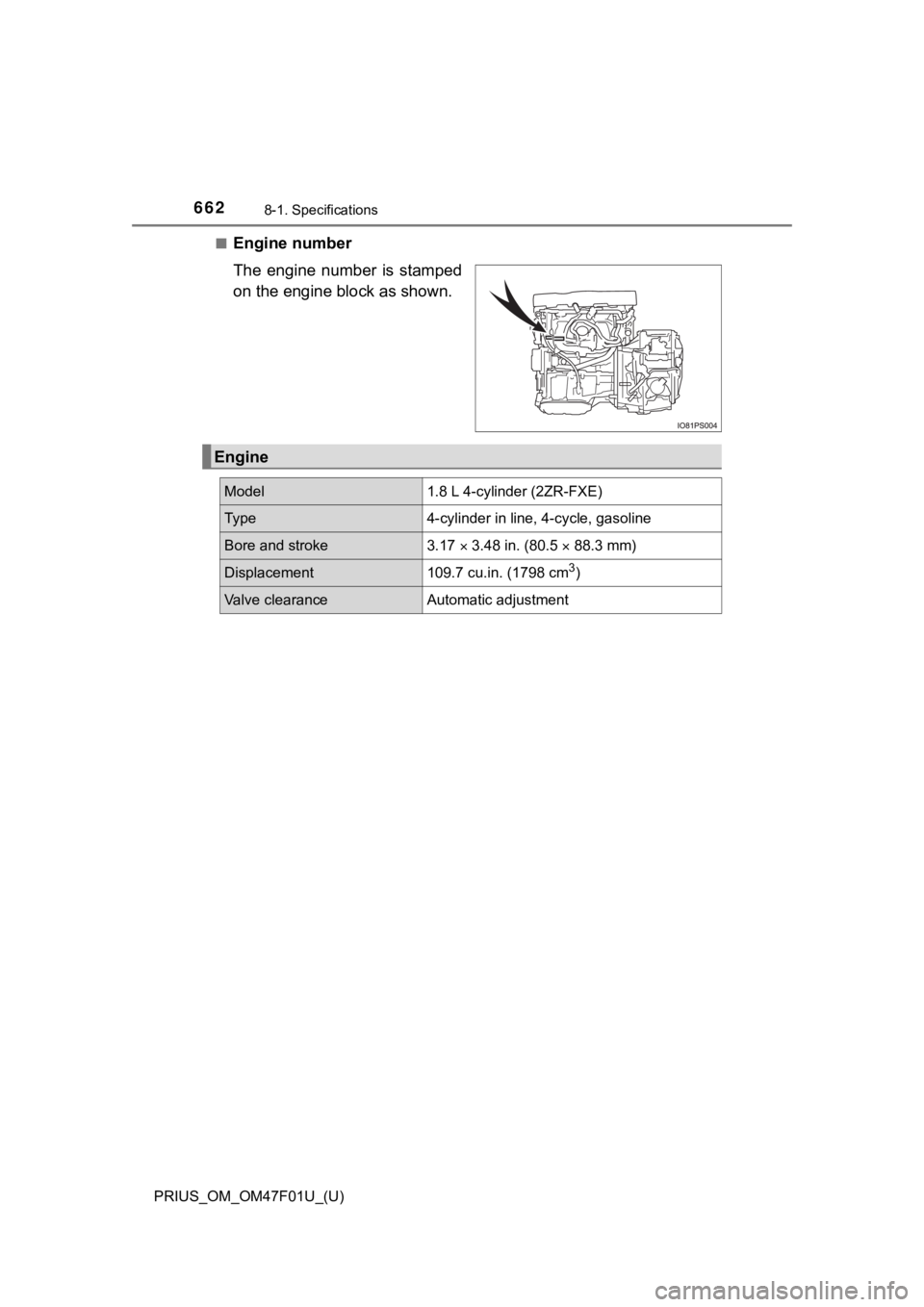
■Engine number
The engine number is stamped
on the engine block as shown.
Engine
Model1.8 L 4-cylinder (2ZR-FXE)
Ty p e4-cylinder in line, 4-cycle, gasoline
Bore and stroke3.17 3.48 in. (80.5 88.3 mm)
Displacement109.7 cu.in. (1798 cm3)
Valve clearanceAutomatic adjustment
Page 664 of 744
![TOYOTA PRIUS 2022 Manual PDF 664
PRIUS_OM_OM47F01U_(U)
8-1. Specifications
■Oil capacity (Drain and refill [Reference*])
*: The engine oil capacity is a reference quantity to be used when changing
the engine oil. Park th](/img/14/59258/w960_59258-663.png "TOYOTA PRIUS 2022 Manual PDF 664
PRIUS_OM_OM47F01U_(U)
8-1. Specifications
■Oil capacity (Drain and refill [Reference*])
*: The engine oil capacity is a reference quantity to be used when changing
the engine oil. Park th")
664
PRIUS_OM_OM47F01U_(U)
8-1. Specifications
■Oil capacity (Drain and refill [Reference*])
*: The engine oil capacity is a reference quantity to be used when changing
the engine oil. Park the vehicle on level ground. After warming up the
engine and turning off the hybrid system, wait more than 5 minu tes, and
check the oil level on the dipstick.
■
Engine oil selection
“Toyota Genuine Motor Oil” is used in your Toyota vehicle. Use
Toyota approved “Toyota Genuine Motor Oil” or equivalent to sat isfy
the following grade and viscosity.
Oil grade:
ILSAC GF-6B multigrade engine oil
Recommended viscosity:
SAE 0W-16
SAE 0W-16 is the best choice
for good fuel economy and
good starting in cold weather.
If SAE 0W-16 is not available,
SAE 0W-20 oil may be used.
However, it must be replaced
with SAE 0W-16 at the next oil
change.
Oil viscosity (0W-16 is expl ained here as an example):
• The 0W in 0W-16 indicates the characteristic of the oil which allows cold startability. Oils wi th a lower value before the W allow
for easier starting of the engine in cold weather.
• The 16 in 0W-16 indicates the vi scosity characteristic of the oil
when the oil is at high temperature. An oil with a higher visco sity
(one with a higher value) may be better suited if the vehicle i s
operated at high speeds, or un der extreme load conditions.
Lubrication system
With filter4.4 qt. (4.2 L, 3.7 Imp.qt.)
Without filter4.1 qt. (3.9 L, 3.4 Imp.qt.)
Outside temperature
Page 666 of 744
666
PRIUS_OM_OM47F01U_(U)
8-1. Specifications
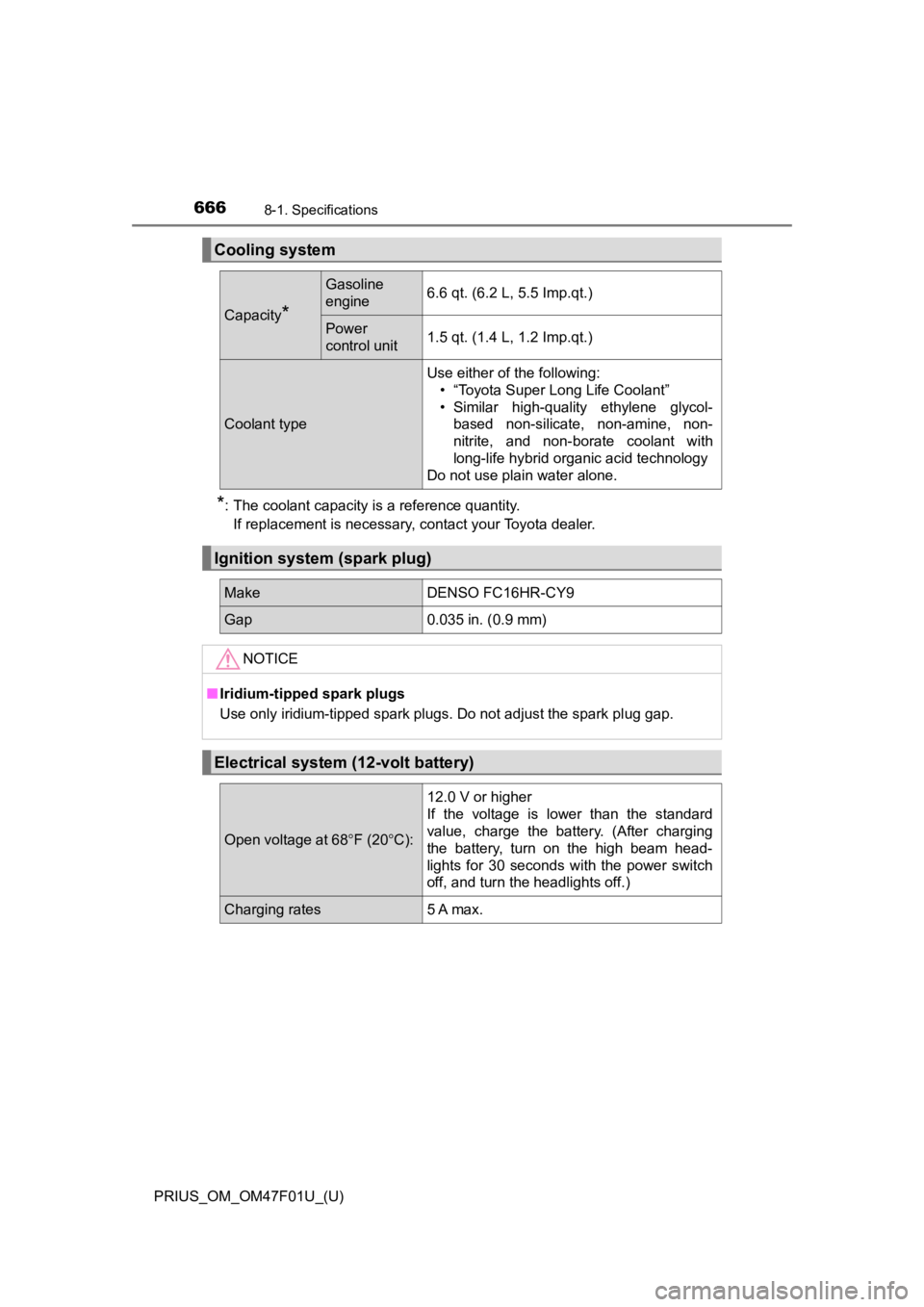
*: The coolant capacity is a reference quantity.If replacement is necessary, contact your Toyota dealer.
Cooling system
Capacity*
Gasoline
engine6.6 qt. (6.2 L, 5.5 Imp.qt.)
Power
control unit1.5 qt. (1.4 L, 1.2 Imp.qt.)
Coolant type
Use either of the following: • “Toyota Super Long Life Coolant”
• Similar high-quality ethylene glycol-based non-silicate, non-amine, non-
nitrite, and non-borate coolant with
long-life hybrid organic acid technology
Do not use plain water alone.
Ignition system (spark plug)
MakeDENSO FC16HR-CY9
Gap0.035 in. (0.9 mm)
NOTICE
■ Iridium-tipped spark plugs
Use only iridium-tipped spark plugs. Do not adjust the spark pl ug gap.
Electrical system (12-volt battery)
Open voltage at 68F (20 C):
12.0 V or higher
If the voltage is lower than the standard
value, charge the battery. (After charging
the battery, turn on the high beam head-
lights for 30 seconds with the power switch
off, and turn the headlights off.)
Charging rates5 A max.
Page 671 of 744
671
PRIUS_OM_OM47F01U_(U)
8-1. Specifications
8
Vehicle specifications
Fuel information
■Gasoline quality
In very few cases, driveability problems may be caused by the b rand of gaso-
line you are using. If driveability problems persist, try changing the brand of
gasoline. If this does not correct the problem, consult your To yota dealer.
■ Recommendation of the use of gaso line containing detergent additives
● Toyota recommends the use of gasoline that contains detergent a dditives to
avoid the build-up of engine deposits.
● All gasoline sold in the U.S.A. contains minimum detergent addi tives to
clean and/or keep clean intake systems, per EPA’s lowest additi ves concen-
tration program.
● Toyota strongly recommends the use of Top Tier Detergent Gasoli ne. For
more information on Top Tier Detergent Gasoline and a list of marketers,
please go to the official website www.toptiergas.com.
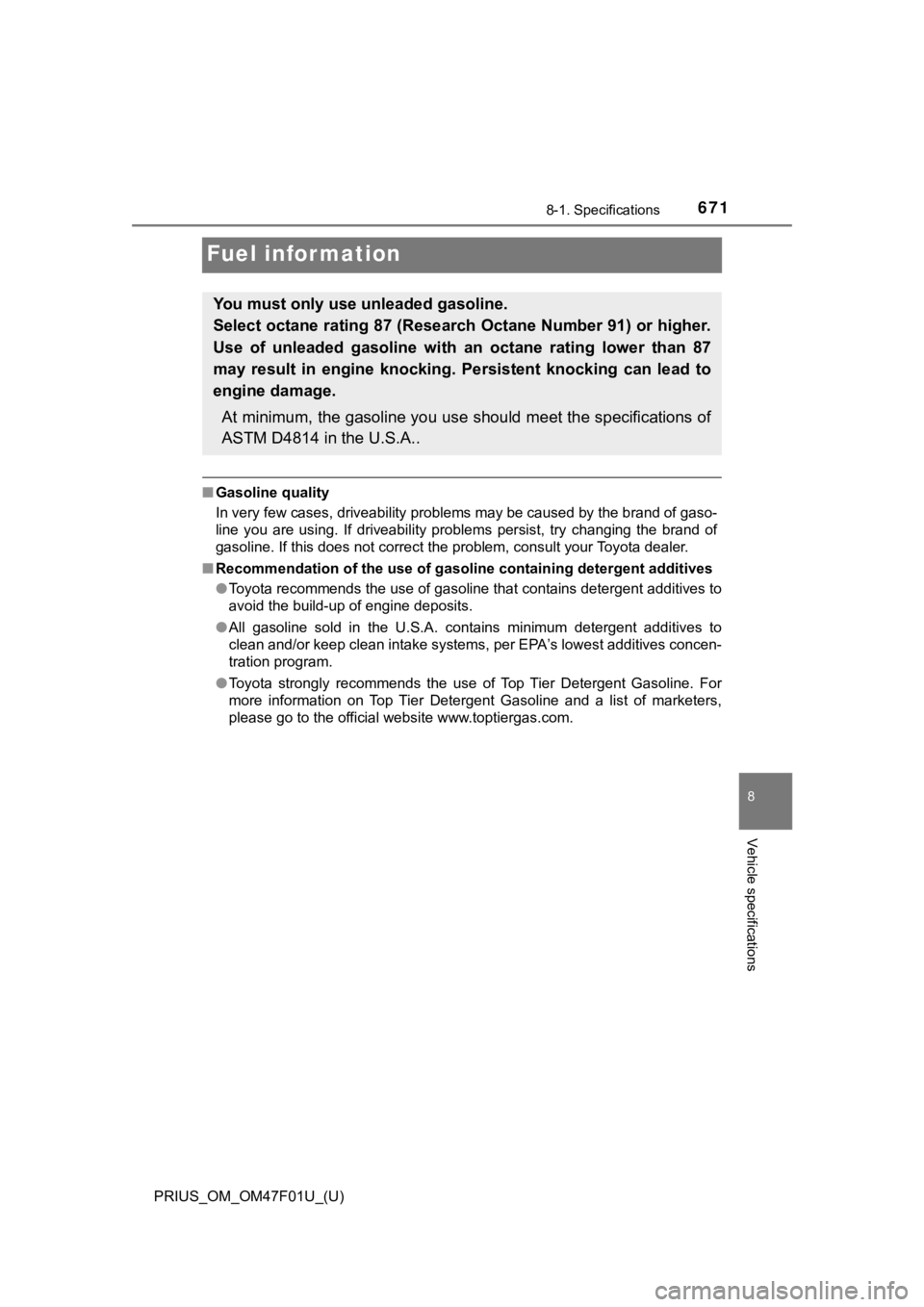
You must only use unleaded gasoline.
Select octane rating 87 (Research Octane Number 91) or higher.
Use of unleaded gasoline with an octane rating lower than 87
may result in engine knocking. Persistent knocking can lead to
engine damage.
At minimum, the gasoline you use should meet the specifications of
ASTM D4814 in the U.S.A..
Page 672 of 744
672
PRIUS_OM_OM47F01U_(U)
8-1. Specifications
■Recommendation of the use of low emissions gasoline
Gasolines containing oxygenates such as ethers and ethanol, as well as
reformulated gasolines, are available in some cities. These fue ls are typically
acceptable for use, providing they meet other fuel requirements .
Toyota recommends these fuels, since the formulations allow for reduced
vehicle emissions.
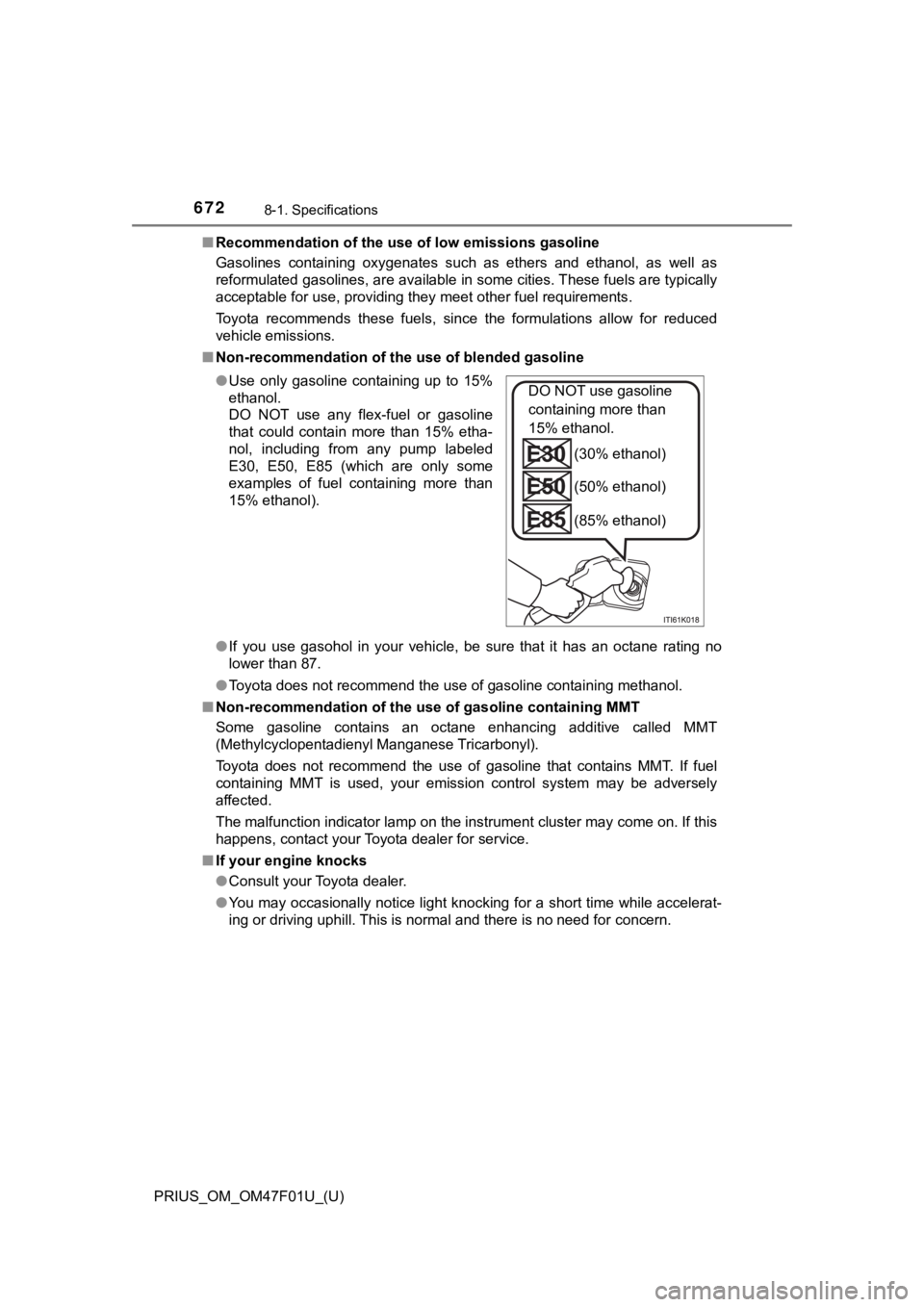
■ Non-recommendation of the use of blended gasoline
●If you use gasohol in your vehicle, be sure that it has an octa ne rating no
lower than 87.
● Toyota does not recommend the use of gasoline containing methan ol.
■ Non-recommendation of the use of gasoline containing MMT
Some gasoline contains an octane enhancing additive called MMT
(Methylcyclopentadienyl Manganese Tricarbonyl).
Toyota does not recommend the use of gasoline that contains MMT. If fuel
containing MMT is used, your emission control system may be adversely
affected.
The malfunction indicator lamp on the instrument cluster may come on. If this
happens, contact your Toyota dealer for service.
■ If your engine knocks
●Consult your Toyota dealer.
● You may occasionally notice light knocking for a short time whi le accelerat-
ing or driving uphill. This is normal and there is no need for concern.
●
Use only gasoline containing up to 15%
ethanol.
DO NOT use any flex-fuel or gasoline
that could contain more than 15% etha-
nol, including from any pump labeled
E30, E50, E85 (which are only some
examples of fuel containing more than
15% ethanol).
DO NOT use gasoline
containing more than
15% ethanol.
(30% ethanol)
(50% ethanol)
(85% ethanol)
Page 673 of 744
PRIUS_OM_OM47F01U_(U)
6738-1. Specifications
8
Vehicle specifications
NOTICE
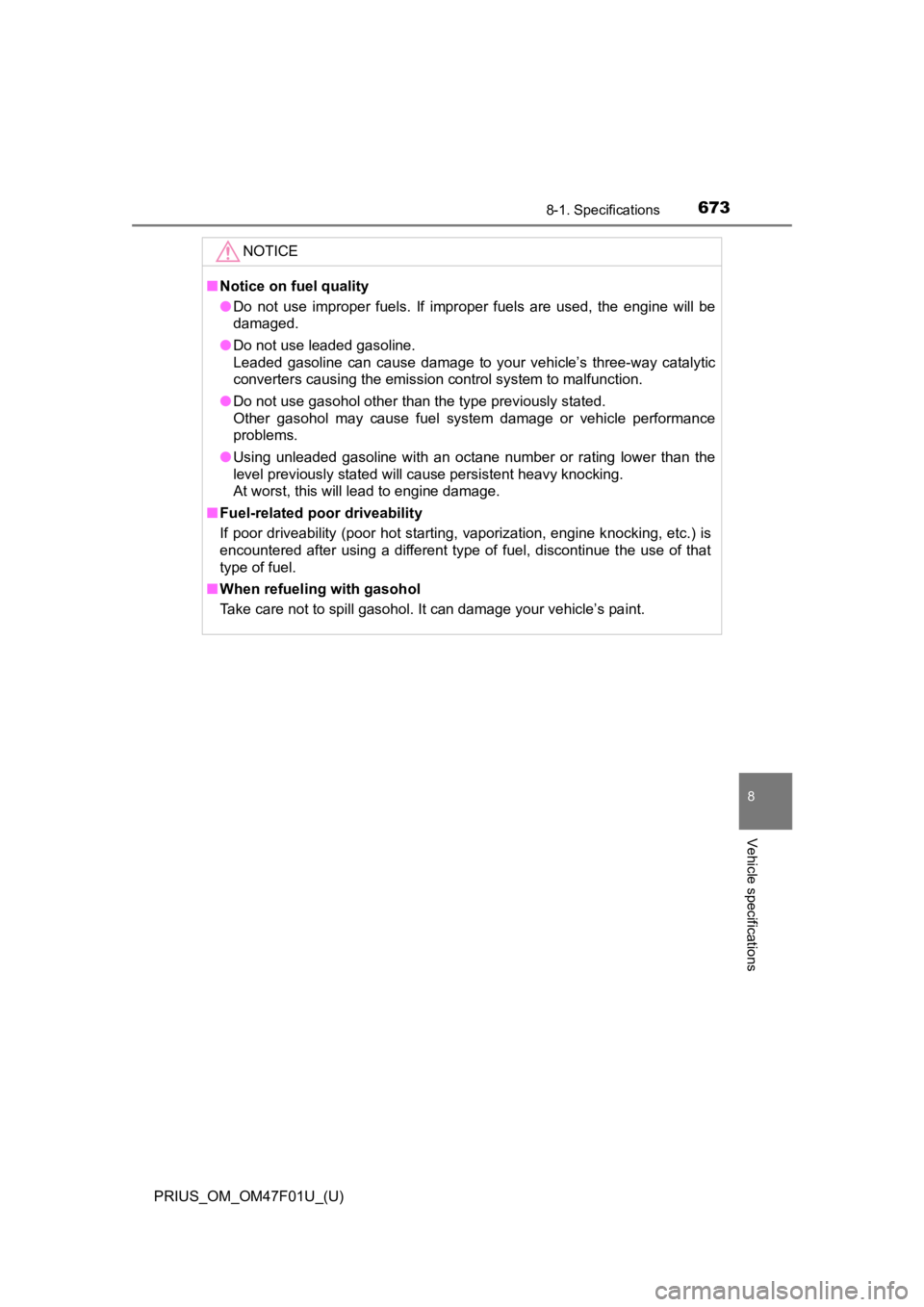
■Notice on fuel quality
● Do not use improper fuels. If improper fuels are used, the engi ne will be
damaged.
● Do not use leaded gasoline.
Leaded gasoline can cause damage to your vehicle’s three-way ca talytic
converters causing the emission control system to malfunction.
● Do not use gasohol other than the type previously stated.
Other gasohol may cause fuel system damage or vehicle performance
problems.
● Using unleaded gasoline with an octane number or rating lower than the
level previously stated will cause persistent heavy knocking.
At worst, this will lead to engine damage.
■ Fuel-related poor driveability
If poor driveability (poor hot starting, vaporization, engine k nocking, etc.) is
encountered after using a different type of fuel, discontinue the use of that
type of fuel.
■ When refueling with gasohol
Take care not to spill gasohol. It can damage your vehicle’s paint.
Page 680 of 744
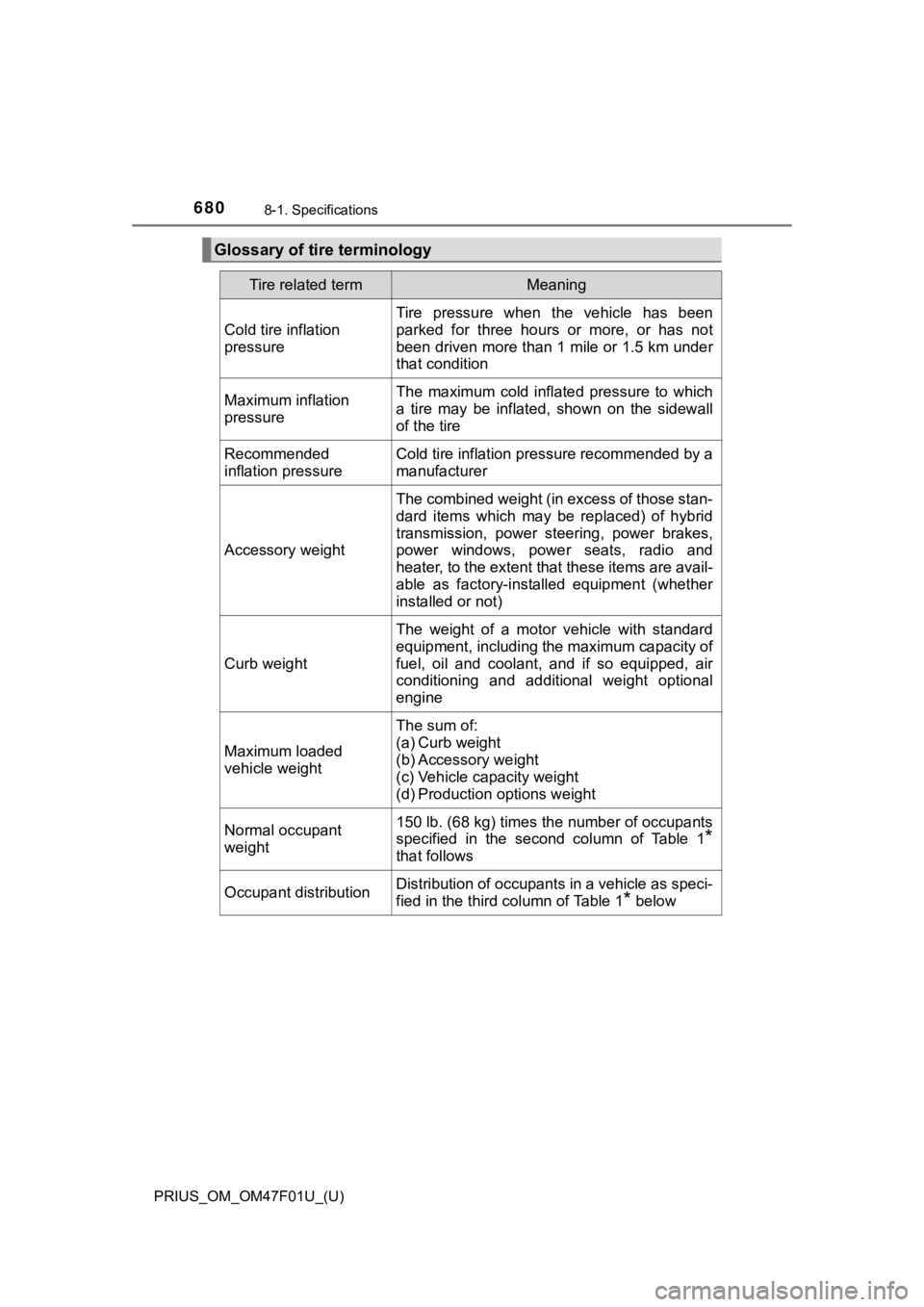
680
PRIUS_OM_OM47F01U_(U)
8-1. Specifications
Glossary of tire terminology
Tire related termMeaning
Cold tire inflation
pressure
Tire pressure when the vehicle has been
parked for three hours or more, or has not
been driven more than 1 mile or 1.5 km under
that condition
Maximum inflation
pressureThe maximum cold inflated pressure to which
a tire may be inflated, shown on the sidewall
of the tire
Recommended
inflation pressureCold tire inflation pressure recommended by a
manufacturer
Accessory weight
The combined weight (in excess of those stan-
dard items which may be replaced) of hybrid
transmission, power steering, power brakes,
power windows, power seats, radio and
heater, to the extent that these items are avail-
able as factory-installed equipment (whether
installed or not)
Curb weight
The weight of a motor vehicle with standard
equipment, including the maximum capacity of
fuel, oil and coolant, and if so equipped, air
conditioning and additional weight optional
engine
Maximum loaded
vehicle weight
The sum of:
(a) Curb weight
(b) Accessory weight
(c) Vehicle capacity weight
(d) Production options weight
Normal occupant
weight150 lb. (68 kg) times the number of occupants
specified in the second column of Table 1
*
that follows
Occupant distributionDistribution of occupants in a vehicle as speci-
fied in the third column of Table 1
* below