belt TOYOTA PRIUS 2023 User Guide
[x] Cancel search | Manufacturer: TOYOTA, Model Year: 2023, Model line: PRIUS, Model: TOYOTA PRIUS 2023Pages: 770, PDF Size: 122.55 MB
Page 38 of 770
361-1. For safe use
PRIUS_OM_OM47F32E_(EE)
■Emergency locking retractor (ELR)
The retractor will lock the belt during a sudden stop or on impact. It may also
lock if you lean forward too quickly. A slow, easy motion will allow the belt to
extend so that you can move around fully.
■ Child seat belt usage
The seat belts of your vehicle were principally designed for persons of adult
size.
● Use a child restraint system appropriate for the child, until the child
becomes large enough to properly wear the vehicle’s seat belt. ( P. 5 4 )
● When the child becomes large enough to properly wear the vehicle’s seat
belt, follow the instructions regarding seat belt usage. ( P. 34)
■ Replacing the belt after the pretensioner has been activated
If the vehicle is involved in multiple collisions, the pretensioner will activate for
the first collision, but will not activate for the second or subsequent collisions.
■ Seat belt regulations
If seat belt regulations exist in the country where you reside, please contact
any authorized Toyota retailer or Toyota authorized repairer, or any reliable
repairer for seat belt repl acement or installation.
WARNING
Observe the following precautions to reduce the risk of injury in the event of
sudden braking, sudden swerving or an accident.
Failing to do so may cause death or serious injury.
■ Wearing a seat belt
● Ensure that all passengers wear a seat belt.
● Always wear a seat belt properly.
● Each seat belt should be used by one person only. Do not use a seat belt
for more than one person at once, including children.
● Toyota recommends that children be seated in the rear seat and always
use a seat belt and/or an appropriate child restraint system.
● To achieve a proper seating position, do not recline the seat more than
necessary. The seat belt is most effective when the occupants are sitting
up straight and well back in the seats.
● Do not wear the shoulder belt under your arm.
● Always wear your seat belt low and snug across your hips.
Page 39 of 770
371-1. For safe use
1
PRIUS_OM_OM47F32E_(EE)
For safety and security
WARNING
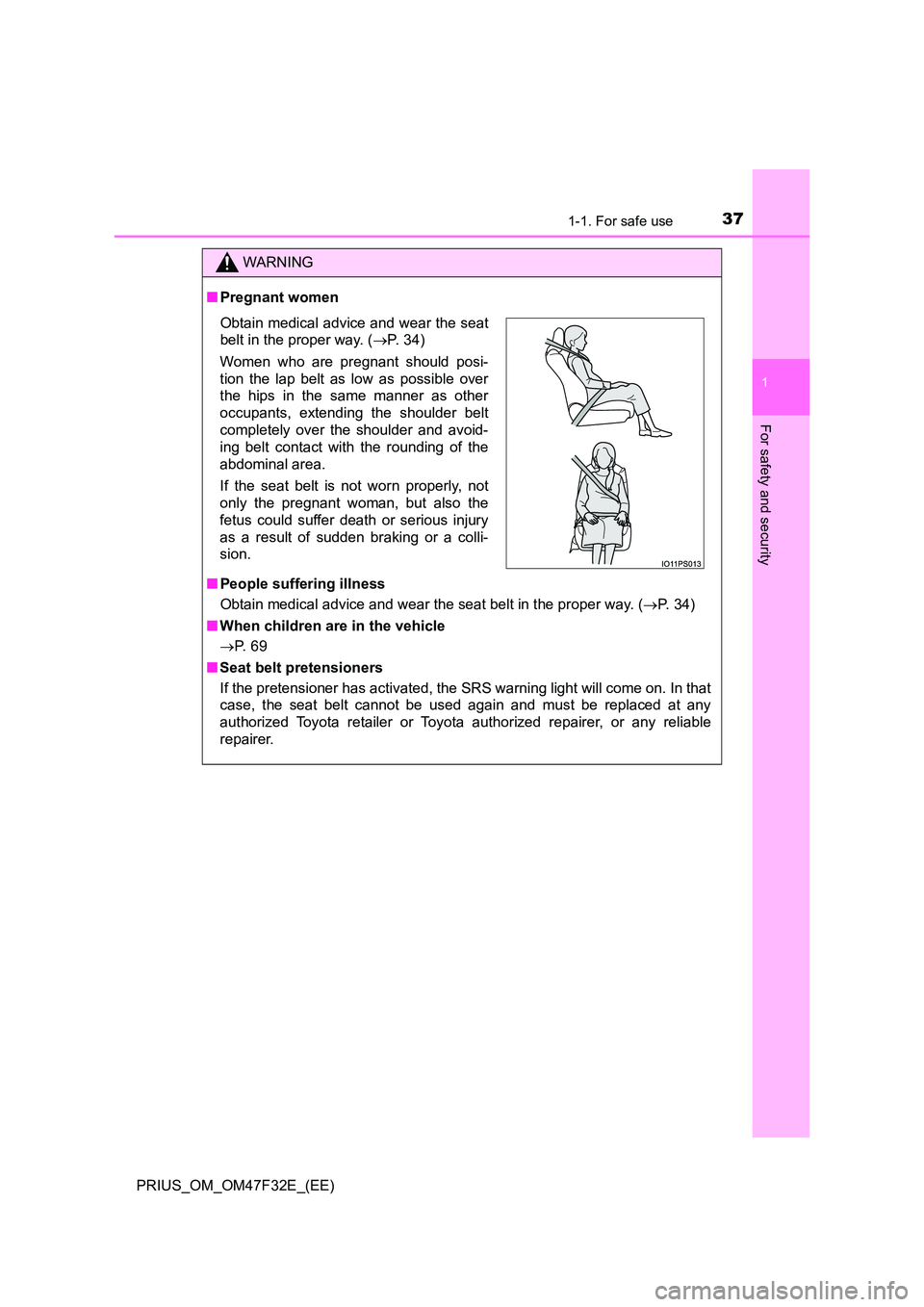
■Pregnant women
■ People suffering illness
Obtain medical advice and wear the seat belt in the proper way. ( P. 34)
■ When children are in the vehicle
P. 6 9
■ Seat belt pretensioners
If the pretensioner has activated, the SRS warning light will come on. In that
case, the seat belt cannot be used again and must be replaced at any
authorized Toyota retailer or Toyota authorized repairer, or any reliable
repairer.
Obtain medical advice and wear the seat
belt in the proper way. ( P. 34)
Women who are pregnant should posi-
tion the lap belt as low as possible over
the hips in the same manner as other
occupants, extending the shoulder belt
completely over the shoulder and avoid-
ing belt contact with the rounding of the
abdominal area.
If the seat belt is not worn properly, not
only the pregnant woman, but also the
fetus could suffer death or serious injury
as a result of sudden braking or a colli-
sion.
Page 40 of 770
381-1. For safe use
PRIUS_OM_OM47F32E_(EE)
WARNING
■Adjustable shoulder anchor
Always make sure the shoulder belt is positioned across the center of your
shoulder. The belt should be kept away from your neck, but not falling off
your shoulder. Failure to do so could reduce the amount of protection in an
accident and cause death or serious injuries in the event of a sudden stop,
sudden swerve or accident. ( P. 35)
■ Seat belt damage and wear
● Do not damage the seat belts by allowing the belt, plate, or buckle to be
jammed in the door.
● Inspect the seat belt system periodically. Check for cuts, fraying, and loose
parts. Do not use a damaged seat belt until it is replaced. Damaged seat
belts cannot protect an occupant from death or serious injury.
● Ensure that the belt and plate are locked and the belt is not twisted.
If the seat belt does not function correctly, immediately contact any autho-
rized Toyota retailer or Toyota authorized repairer, or any reliable repairer.
● Replace the seat assembly, including the belts, if your vehicle has been
involved in a serious accident, even if there is no obvious damage.
● Do not attempt to install, remove, modify, disassemble or dispose of the
seat belts. Have any necessary repairs carried out by any authorized
Toyota retailer or Toyota authorized repairer, or any reliable repairer. Inap-
propriate handling may lead to incorrect operation.
Page 41 of 770
391-1. For safe use
1
For safety and security
PRIUS_OM_OM47F32E_(EE)
SRS airbags
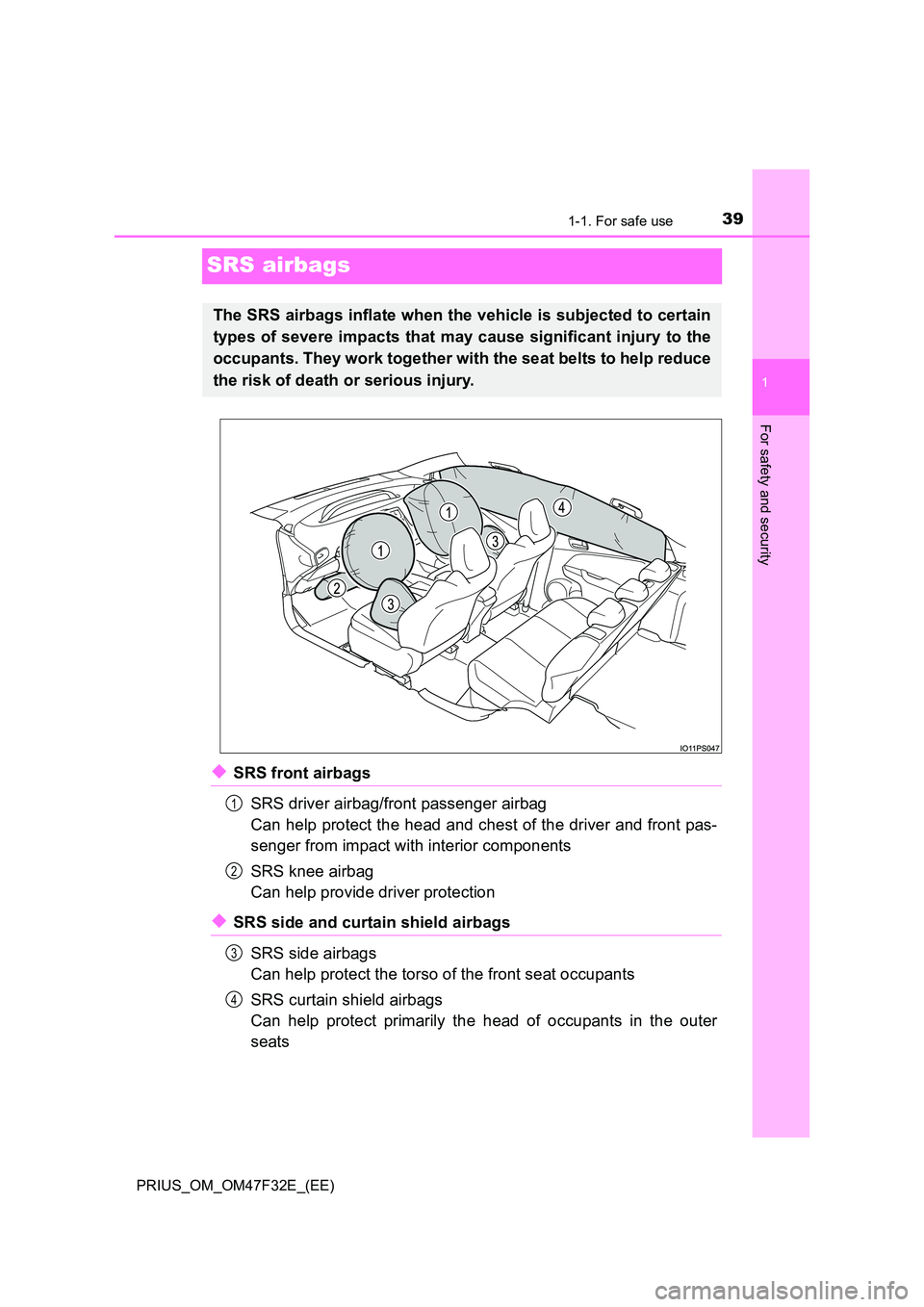
◆SRS front airbags
SRS driver airbag/front passenger airbag
Can help protect the head and chest of the driver and front pas-
senger from impact with interior components
SRS knee airbag
Can help provide driver protection
◆SRS side and curtain shield airbags
SRS side airbags
Can help protect the torso of the front seat occupants
SRS curtain shield airbags
Can help protect primarily the head of occupants in the outer
seats
The SRS airbags inflate when the vehicle is subjected to certain
types of severe impacts that may cause significant injury to the
occupants. They work together with the seat belts to help reduce
the risk of death or serious injury.
1
2
3
4
Page 42 of 770
401-1. For safe use
PRIUS_OM_OM47F32E_(EE)
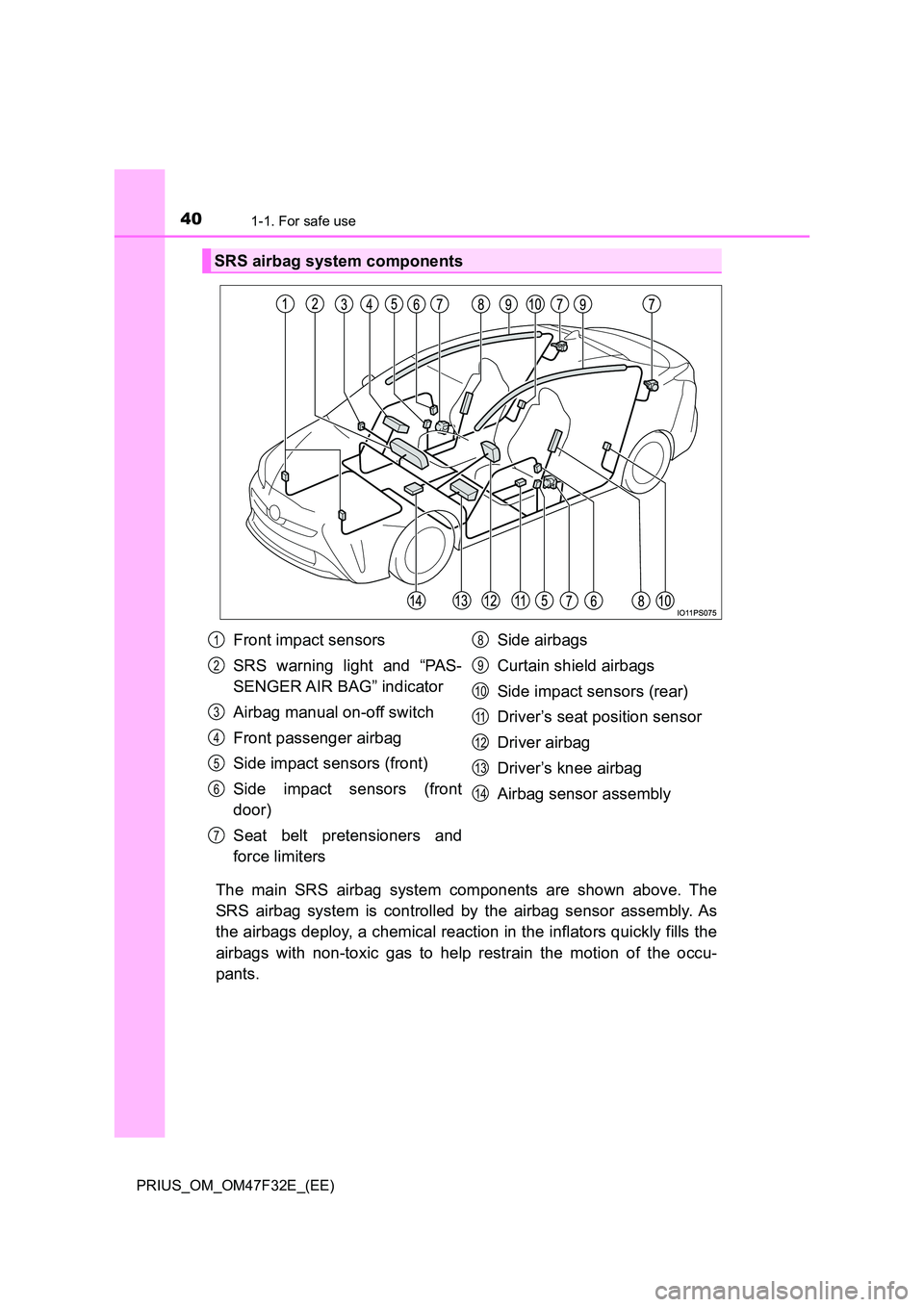
The main SRS airbag system components are shown above. The
SRS airbag system is controlled by the airbag sensor assembly. As
the airbags deploy, a chemical reaction in the inflators quickly fills the
airbags with non-toxic gas to help restrain the motion of the occu-
pants.
SRS airbag system components
Front impact sensors
SRS warning light and “PAS-
SENGER AIR BAG” indicator
Airbag manual on-off switch
Front passenger airbag
Side impact sensors (front)
Side impact sensors (front
door)
Seat belt pretensioners and
force limiters
Side airbags
Curtain shield airbags
Side impact sensors (rear)
Driver’s seat position sensor
Driver airbag
Driver’s knee airbag
Airbag sensor assembly
1
2
3
4
5
6
7
8
9
10
11
12
13
14
Page 43 of 770
411-1. For safe use
1
PRIUS_OM_OM47F32E_(EE)
For safety and security
WARNING
■SRS airbag precautions
Observe the following precautions regarding the SRS airbags.
Failure to do so may cause death or serious injury.
● The driver and all passengers in the vehicle must wear their seat belts
properly.
The SRS airbags are supplemental devic es to be used with the seat belts.
● The SRS driver airbag deploys with considerable force, and can cause
death or serious injury especially if the driver is very close to the airbag.
Since the risk zone for the driver’s airbag is the first 50 - 75 mm (2 - 3 in.)
of inflation, placing yourself 250 mm ( 10 in.) from your driver airbag pro-
vides you with a clear margin of safety. This distance is measured from
the center of the steering wheel to your breastbone. If you sit less than
250 mm (10 in.) away now, you can change your driving position in sev-
eral ways:
• Move your seat to the rear as far as you can while still reaching the ped-
als comfortably.
• Slightly recline the back of the seat. Although vehicle designs vary,
many drivers can achieve the 250 mm (10 in.) distance, even with the
driver seat all the way forward, simply by reclining the back of the seat
somewhat. If reclining the back of your seat makes it hard to see the
road, raise yourself by using a firm, non-slippery cushion, or raise the
seat if your vehicle has that feature.
• If your steering wheel is adjustable, tilt it downward. This points the air-
bag toward your chest instead of your head and neck.
The seat should be adjusted as recommended above, while still maintain-
ing control of the foot pedals, steering wheel, and your view of the instru-
ment panel controls.
● The SRS front passenger airbag also deploys with considerable force, and
can cause death or serious injury especially if the front passenger is very
close to the airbag. The front passenger seat should be as far from the air-
bag as possible with the seatback adjusted, so the front passenger sits
upright.
● Improperly seated and/or restrained infants and children can be killed or
seriously injured by a deploying airbag. An infant or child who is too small
to use a seat belt should be properly secured using a child restraint sys-
tem. Toyota strongly recommends that all infants and children be placed in
the rear seats of the vehicle and proper ly restrained. The rear seats are
safer for infants and children than the front passenger seat. ( P. 54)
Page 47 of 770
451-1. For safe use
1
PRIUS_OM_OM47F32E_(EE)
For safety and security
■If the SRS airbags deploy (inflate)
● Slight abrasions, burns, bruising etc., may be sustained from SRS airbags,
due to the extremely high speed deployment (inflation) by hot gases.
● A loud noise and white powder will be emitted.
● Parts of the airbag module (steering wheel hub, airbag cover and inflator) as
well as the front seats, parts of the front and rear pillars, and roof side rails,
may be hot for several minutes. The airbag itself may also be hot.
● The windshield may crack.
● The hybrid system will be stopped and fuel supply to the engine will be
stopped. ( P. 85)
● The emergency flashers will turn on automatically. (P. 568)
● Vehicles with “ERA-GLONASS/EVAK”: If any of the following situations
occur, the system is designed to send an emergency call* to the “ERA-
GLONASS/EVAK control center”, notifying them of the vehicle’s location
(without needing to push the “SOS” button) and an agent will attempt to
speak with the occupants to ascertain the level of emergency and assis-
tance required. If the occupants are unable to communicate, the agent auto-
matically treats the call as an emergency and helps to dispatch the
necessary emergency services. ( P. 74)
• An SRS airbag is deployed.
• A seat belt pretensioner is activated.
• The vehicle is involved in a severe rear-end collision.
• The vehicle is involved in a rollover accident.
*: In some cases, the call cannot be made. ( P. 7 7 )
■ SRS airbag deployment conditions (SRS front airbags)
● The SRS front airbags will deploy in the event of an impact that exceeds the
set threshold level (the level of force corresponding to an approximately 20 -
30 km/h [12 - 18 mph] frontal collision with a fixed wall that does not move or
deform).
However, this threshold velocity will be considerably higher in the following
situations:
• If the vehicle strikes an object, such as a parked vehicle or sign pole,
which can move or deform on impact
• If the vehicle is involved in an underride collision, such as a collision in
which the front of the vehicle “underrides”, or goes under, the bed of a
truck
● Depending on the type of collision, it is possible that only the seat belt pre-
tensioners will activate.
Page 55 of 770
531-2. Child safety
1
For safety and security
PRIUS_OM_OM47F32E_(EE)
Riding with children
●It is recommended that children sit in the rear seats to avoid acci-
dental contact with the shift lever, wiper switch etc.
● Use the rear door child-protector lock or the window lock switch to
avoid children opening the door while driving or operating the
power window accidentally. ( P. 180, 210)
● Do not let small children operate equipment which may catch or
pinch body parts, such as the power window, hood, back door,
seats etc.
Observe the following precautions when children are in the vehi-
cle.
Use a child restraint system appropriate for the child, until the
child becomes large enough to properly wear the vehicle’s seat
belt.
WARNING
Never leave children unattended in the vehicle, and never allow children to
have or use the key.
Children may be able to start the vehicle or shift the vehicle into neutral.
There is also a danger that children may injure themselves by playing with
the side windows, the moon roof (if equipped) or other features of the vehi-
cle. In addition, heat build-up or extremely cold temperatures inside the
vehicle can be fatal to children.
Page 56 of 770
541-2. Child safety
PRIUS_OM_OM47F32E_(EE)
Child restraint systems
Points to remember................................................................. P. 54
When using a child restraint system ....................................... P. 56
Child restraint system compatibility for each seating
position..................................................................................... P. 59
Child restraint system installation method ............................... P. 67
• Fixed with a seat belt .......................................................... P. 68
• Fixed with an ISOFIX lower anchorage............................... P. 70
• Using a top tether anchorage .............................................. P. 72
● Prioritize and observe the warnings, as well as the laws and regula-
tions for child restraint systems.
● Use a child restraint system until the child becomes large enough to
properly wear the vehicle’s seat belt.
● Choose a child restraint system appropriate to the age and size of
the child.
● Note that not all child restraint systems can fit in all vehicles.
Before using or purchasing a child restraint system, check the com-
patibility of the child restraint system with seat positions. ( P. 5 9 )
Before installing a child restraint system in the vehicle, there are
precautions that need to be observed, different types of child
restraint systems, as well as installation methods, etc., written in
this manual.
● Use a child restraint system when riding with a small child that
cannot properly use a seat belt. For the child’s safety, install the
child restraint system to a rear seat. Be sure to follow the installa-
tion method that is in the operation manual enclosed with the
restraint system.
● The use of a Toyota genuine child restraint system is recom-
mended, as it is safer to use in this vehicle. Toyota genuine child
restraint systems are made specifically for Toyota vehicles. They
can be purchased at a Toyota dealer.
Table of contents
Points to remember
Page 57 of 770
551-2. Child safety
1
PRIUS_OM_OM47F32E_(EE)
For safety and security
WARNING
■When a child is riding
Observe the following precautions.
Failure to do so may result in death or serious injury.
● For effective protection in automobile accidents and sudden stops, a child
must be properly restrained, using a seat belt or child restraint system
which is correctly installed. For inst allation details, refer to the operation
manual enclosed with the child restraint system. General installation
instructions are provided in this manual.
● Toyota strongly urges the use of a proper child restraint system that con-
forms to the weight and size of the child, installed on the rear seat. Accord-
ing to accident statistics, the child is safer when properly restrained in the
rear seat than in the front seat.
● Holding a child in your or someone else’s arms is not a substitute for a
child restraint system. In an accident, the child can be crushed against the
windshield or between the holder and the interior of the vehicle.
■ Handling the child restraint system
If the child restraint system is not properly fixed in place, the child or other
passengers may be seriously injured or even killed in the event of sudden
braking, sudden swerving, or an accident.
● If the vehicle were to receive a strong impact from an accident, etc., it is
possible that the child restraint system has damage that is not readily visi-
ble. In such cases, do not reuse the restraint system.
● Depending on the child restraint system, installation may be difficult or
impossible. In those cases, check whether the child restraint system is
suitable for installment in the vehicle ( P. 59). Be sure to install and
observe the usage rules after carefully reading the child restraint system
fixing method in this manual, as well as the operation manual enclosed
with the child restraint system.
● Keep the child restraint system properly secured on the seat even if it is
not in use. Do not store the child restraint system unsecured in the pas-
senger compartment.
● If it is necessary to detach the child restraint system, remove it from the
vehicle or store it securely in the luggage compartment.