height TOYOTA PRIUS 2023 User Guide
[x] Cancel search | Manufacturer: TOYOTA, Model Year: 2023, Model line: PRIUS, Model: TOYOTA PRIUS 2023Pages: 770, PDF Size: 122.55 MB
Page 376 of 770
3744-5. Using the driving support systems
PRIUS_OM_OM47F32E_(EE)■Conditions under which the system may not function correctly
●The Blind Spot Monitor function may not detect vehicles correctly in the fol-
lowing situations:
• When the sensor is misaligned due to a strong impact to the sensor or its
surrounding area
• When mud, snow, ice, a sticker, etc. is covering the sensor or surround-
ing area on the rear bumper
• When driving on a road surface that is wet with standing water during bad
weather, such as heavy rain, snow, or fog
• When multiple vehicles are approaching with only a small gap between
each vehicle
• When the distance between your vehicle and a following vehicle is short
• When there is a significant difference in speed between your vehicle and
the vehicle that enters the detection area
• When the difference in speed between your vehicle and another vehicle
is changing
• When a vehicle enters a detection area traveling at about the same
speed as your vehicle
• As your vehicle starts from a stop, a vehicle remains in the detection area
• When driving up and down consecutive steep inclines, such as hills, dips
in the road, etc.
• When driving on roads with sharp bends, consecutive curves, or uneven
surfaces
• When vehicle lanes are wide, or when driving on the edge of a lane, and
the vehicle in an adjacent lane is far away from your vehicle
• When a bicycle carrier or other accessory is installed to the rear of the
vehicle
• When there is a significant difference in height between your vehicle and
the vehicle that enters the detection area
• Immediately after the Blind Spot Monitor function is turned on
●Instances of the Blind Spot Monitor function unnecessarily detecting a vehi-
cle and/or object may increase in the following situations:
• When the sensor is misaligned due to a strong impact to the sensor or its
surrounding area
• When the distance between your vehicle and a guardrail, wall, etc. that
enters the detection area is short
• When driving up and down consecutive steep inclines, such as hills, dips
in the road, etc.
• When vehicle lanes are narrow, or when driving on the edge of a lane,
and a vehicle traveling in a lane other than the adjacent lanes enters the
detection area
• When driving on roads with sharp bends, consecutive curves, or uneven
surfaces
• When the tires are slipping or spinning
• When the distance between your vehicle and a following vehicle is short
• When a bicycle carrier or other accessory is installed to the rear of the
vehicle
Page 380 of 770
3784-5. Using the driving support systems
PRIUS_OM_OM47F32E_(EE)
■ Situations in which the system may not operate properly
The Rear Crossing Traffic Alert function may not detect vehicles correctly in
the following situations:
● When the sensor is misaligned due to a strong impact to the sensor or its
surrounding area
● When mud, snow, ice, a sticker, etc. is covering the sensor or surrounding
area on the position above the rear bumper
● When driving on a road surface that is wet with standing water during bad
weather, such as heavy rain, snow, or fog
● When multiple vehicles are approaching with only a small gap between
each vehicle
● When a vehicle is approaching at high speed
● When equipment that may obstruct a sensor is installed, such as a towing
eyelet, bumper protector (an additional trim strip, etc.), bicycle carrier, or
snow plow
● When towing a trailer
● When there is a significant difference in height between your vehicle and the
vehicle that enters the detection area
● When a sensor or the area around a sensor is extremely hot or cold
● If the suspension has been modified or tires of a size other than specified
are installed
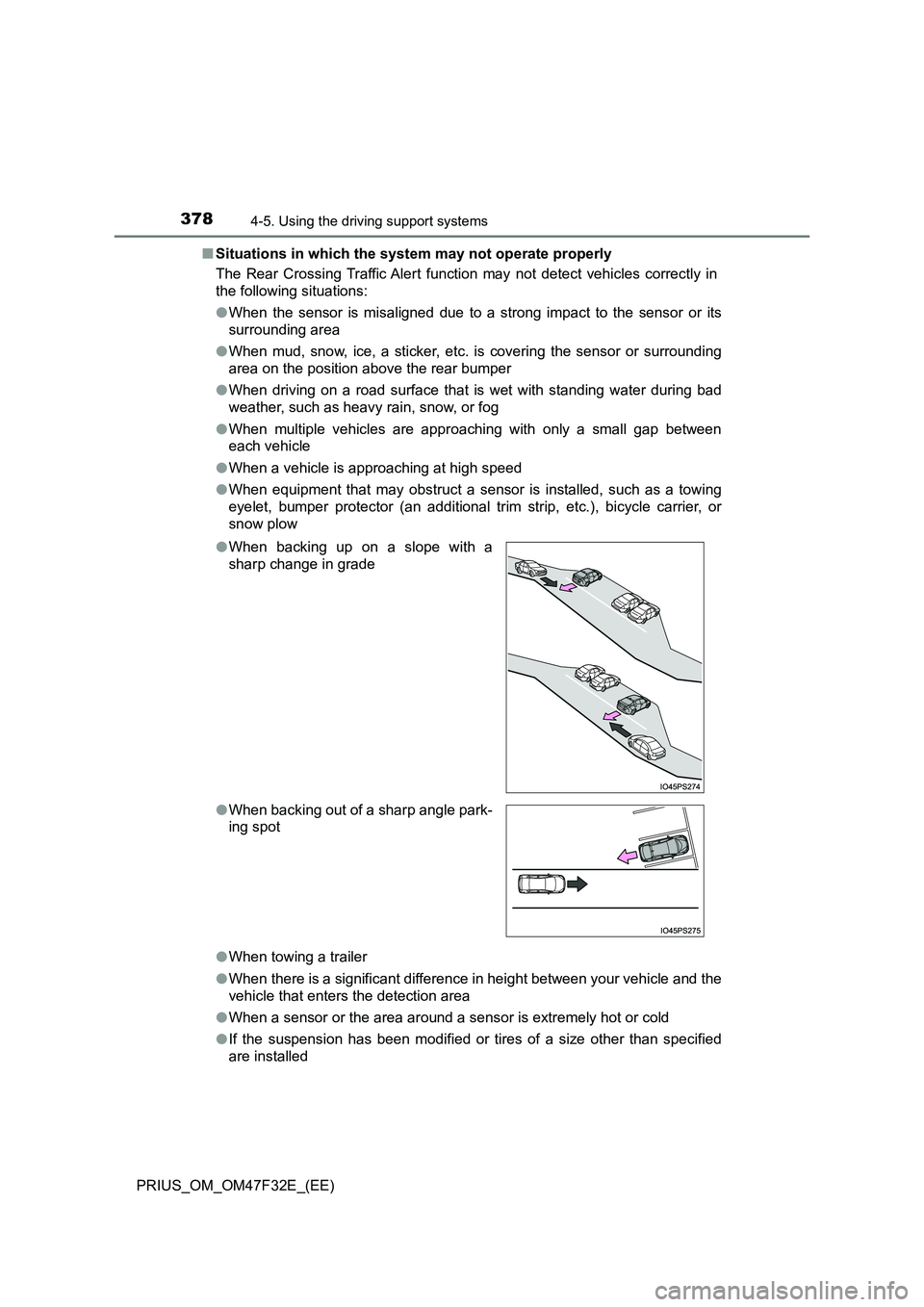
● When backing up on a slope with a
sharp change in grade
● When backing out of a sharp angle park-
ing spot
Page 405 of 770
4034-5. Using the driving support systems
4
Driving
PRIUS_OM_OM47F32E_(EE)
WARNING
■When to disable the Parking Support Brake
In the following situations, disable the Parking Support Brake as the system
may operate even though there is no possibility of a collision.
● When inspecting the vehicle using a chassis roller, chassis dynamo or free
roller
● When loading the vehicle onto a boat, truck or other transport vessel
● If the suspension has been modified or tires of a size other than specified
are installed
● If the front of the vehicle is raised or lowered due to the carried load
● When equipment that may obstruct a sensor is installed, such as a towing
eyelet, bumper protector (an additional tr im strip, etc.), bicycle carrier, or
snow plow
● When using automatic car washing devices
● If the vehicle cannot be driven in a stable manner, such as when the vehi-
cle has been in an accident or is malfunctioning
● When the vehicle is driven in a sporty manner or off-road
● When the tires are not properly inflated
● When the tires are very worn
● When tire chains, compact spare tire or an emergency tire puncture repair
kit are used
■ To ensure the system can operate properly
P. 3 9 2
■ Handling the suspension
Do not modify the suspension, as changes to the height or incline of the
vehicle may prevent the sensors from correctly detecting obstacles, may
cause the system not operate, or may cause the system to operate unnec-
essarily.
■ If the Parking Support Brake function (static objects) operates unnec-
essarily, such as at a railroad crossing
P. 4 0 1
■ Notes when washing the vehicle
P. 3 9 3
Page 406 of 770
4044-5. Using the driving support systems
PRIUS_OM_OM47F32E_(EE)
NOTICE
■Preventing sensor malfunctions
● If the area around a sensor is subjected to an impact, equipment may not
operate properly due to a sensor malfunction. Have the vehicle inspected
at any authorized Toyota retailer or Toyota authorized repairer, or any reli-
able repairer.
● When using a high-pressure washer to wash the vehicle, do not spray
water directly on the sensors. The sensors may not function properly if
subjected to an impact from strong water pressure.
● When using steam to wash the vehicle, do not direct steam too close to
the sensors. The sensors may not function properly if subjected to steam.
■ Preventing unnecessary operation
In the following situations, turn the Parking Support Brake function off. The
system may operate even though there is no possibility of a collision.
● A chassis roller, chassis dynamo, free roller or similar equipment is being
used for an inspection, etc.
● The vehicle is being loaded onto a ship, truck or other transport vessel
● The suspension has been lowered or tires that have a different size than
the genuine tires are equipped
● The height of the vehicle has drastically changed due to the carried load
(the nose tilts up or down).
● A towing eyelet is installed
● When using an automatic car wash
■ Notes when washing the vehicle
P. 393
Page 544 of 770
5426-3. Do-it-yourself maintenance
PRIUS_OM_OM47F32E_(EE)
Air conditioning filter
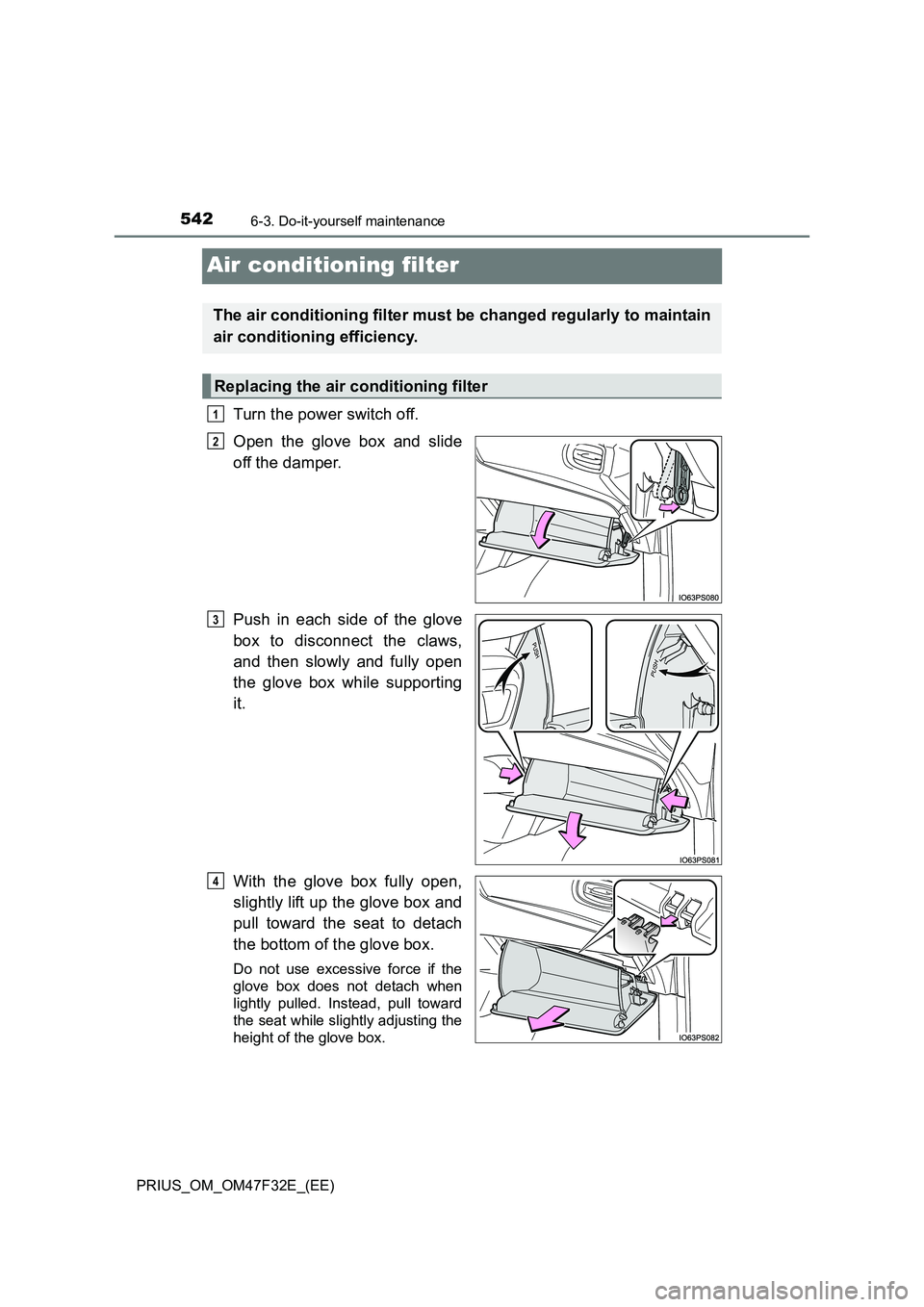
Turn the power switch off.
Open the glove box and slide
off the damper.
Push in each side of the glove
box to disconnect the claws,
and then slowly and fully open
the glove box while supporting
it.
With the glove box fully open,
slightly lift up the glove box and
pull toward the seat to detach
the bottom of the glove box.
Do not use excessive force if the
glove box does not detach when
lightly pulled. Instead, pull toward
the seat while slightly adjusting the
height of the glove box.
The air conditioning filter must be changed regularly to maintain
air conditioning efficiency.
Replacing the air conditioning filter
1
2
3
4
Page 572 of 770
5707-1. Essential information
PRIUS_OM_OM47F32E_(EE)
If the vehicle is submerged or water on the
road is rising
● If the door can be opened, open the door and exit the vehicle.
● If the door can not be opened, open the window using the power
window switch and ensure an escape route.
● If the window can be opened, exit the vehicle through the window.
● If the door and window cannot be opened due to the rising water,
remain calm, wait until the water level inside the vehicle rises to the
point that the water pressure inside of the vehicle equals the water
pressure outside of the vehicle and then open the door after waiting
for the rising water to enter the vehicle, and exit the vehicle. When
the outside water level exceeds half the height of the door, the door
cannot be opened from the inside due to water pressure.
This vehicle is not designed to be able to drive on roads that are
deeply flooded with water. Do not drive on roads where the
roads may be submerged or the water may be rising. It is dan-
gerous to remain in the vehicle, if it anticipated that the vehicle
will be flooded or set a drift. Remain calm and follow the follow-
ing.
Page 623 of 770
6217-2. Steps to take in an emergency
PRIUS_OM_OM47F32E_(EE)
7
When trouble arises
WARNING
■Using the tire jack
Observe the following precautions.
Improper use of the tire jack may cause the vehicle to suddenly fall off the
jack, leading to death or serious injury.
● Only use the tire jack that comes with this vehicle for replacing a flat tire.
Do not use it on other vehicles, and do not use other tire jacks for replac-
ing tires on this vehicle.
● Do not raise the vehicle while someone is inside.
● Do not use the tire jack for any purpose other than replacing tires or install-
ing and removing tire chains.
● Do not put any part of your body under the vehicle while it is supported by
the jack.
● Do not start the hybrid system or drive the vehicle while the vehicle is sup-
ported by the jack.
● When raising the vehicle, do not put an object on or under the jack.
● Do not raise the vehicle to a height greater than that required to replace
the tire.
● Use a jack stand if it is necessary to get under the vehicle.
● When lowering the vehicle, make sure that there is no-one near the vehi-
cle. If there are people nearby, warn them vocally before lowering.
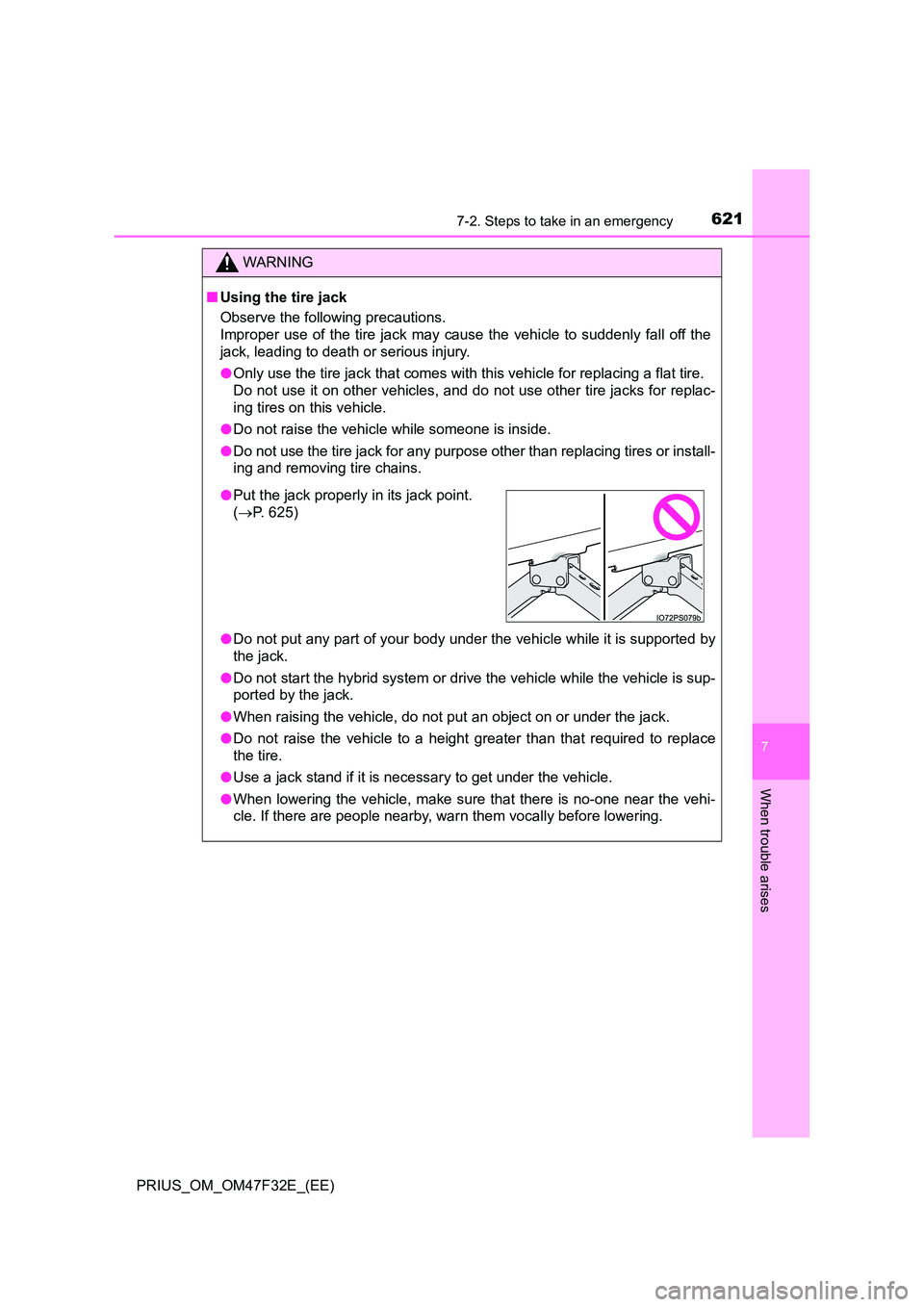
● Put the jack properly in its jack point.
( P. 625)
Page 631 of 770
6297-2. Steps to take in an emergency
PRIUS_OM_OM47F32E_(EE)
7
When trouble arises
■The compact spare tire (if equipped)
● The compact spare tire is identified by the label “TEMPORARY USE ONLY”
on the tire sidewall.
Use the compact spare tire temporarily, and only in an emergency.
● Make sure to check the tire inflation pressure of the compact spare tire.
( P. 665)
■ When using the compact spare tire (vehicles with the tire pressure warn-
ing system)
As the compact spare tire is not equipped with a tire pressure warning valve
and transmitter, low inflation pressure of the spare tire will not be indicated by
the tire pressure warning system. Also, if you replace the compact spare tire
after the tire pressure warning light comes on, the light remains on.
■ When the compact spare tire is equipped (if equipped)
The vehicle height may become lower when driving with the compact spare
tire compared to when driving with standard tires.
■ If you have a flat front tire on a road covered with snow or ice (vehicles
with compact spare tire)
Install the compact spare tire on one of the rear wheels of the vehicle. Per-
form the following steps and fit tire chains to the front tires:
Replace a rear tire with the compact spare tire.
Replace the flat front tire with the tire removed from the rear of the vehicle.
Fit tire chains to the front tires.
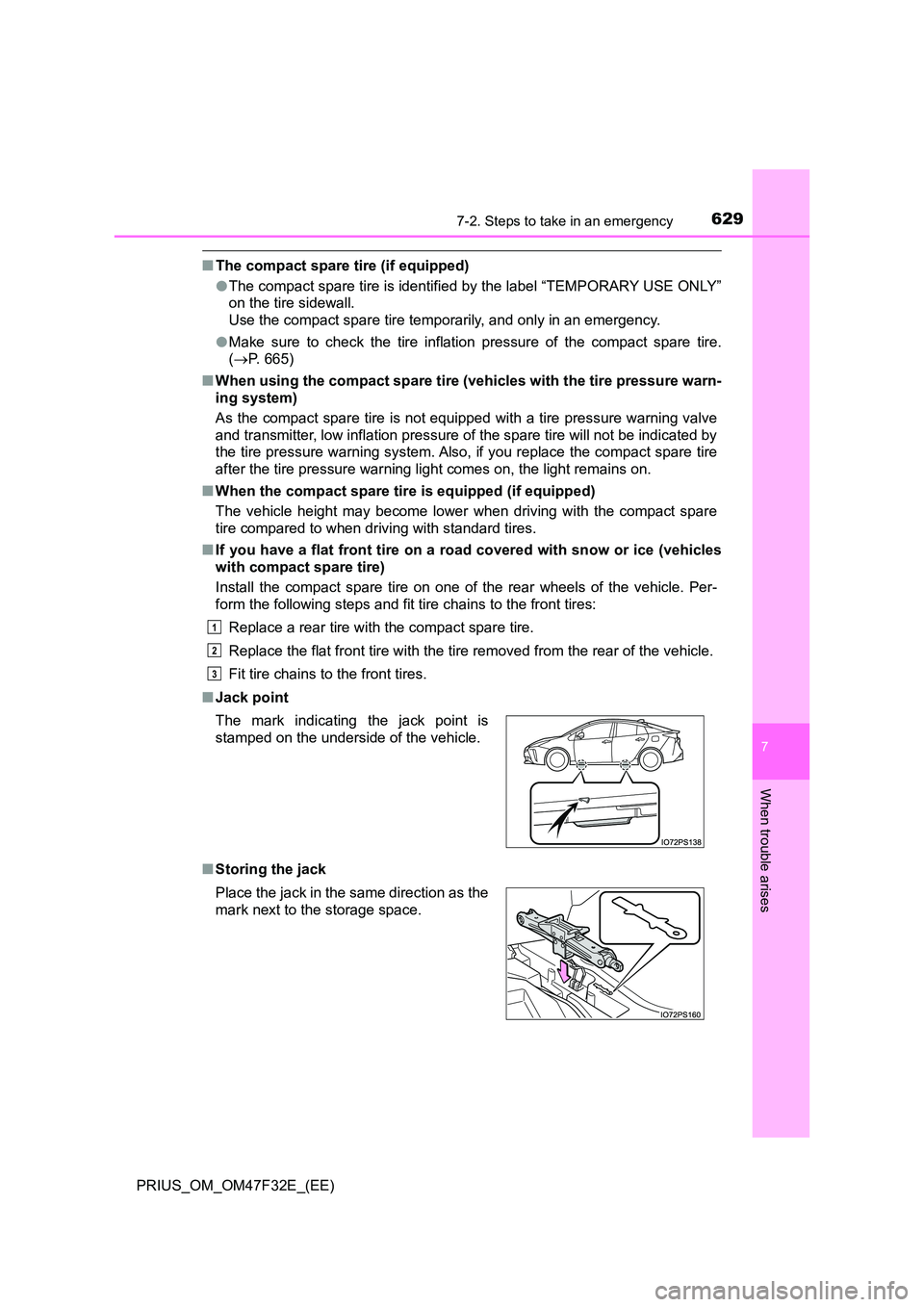
■ Jack point
■ Storing the jack
The mark indicating the jack point is
stamped on the underside of the vehicle.
Place the jack in the same direction as the
mark next to the storage space.
1
2
3
Page 635 of 770
6337-2. Steps to take in an emergency
PRIUS_OM_OM47F32E_(EE)
7
When trouble arises
NOTICE
■Be careful when driving over bumps with the compact spare tire
installed on the vehicle. (if equipped)
The vehicle height may become lower w hen driving with the compact spare
tire, compared to when driving with st andard tires. Be careful when driving
over uneven road surfaces.
■ Driving with tire chains and the compact spare tire (if equipped)
Do not fit tire chains to the compact spare tire.
Tire chains may damage the vehicle body and adversely affect driving per-
formance.
■ When replacing the tires (vehicles with the tire pressure warning sys-
tem)
When removing or fitting the wheels, tire s or the tire pressure warning valve
and transmitter, contact any authorized Toyota retailer or Toyota authorized
repairer, or any reliable repairer as the tire pressure warning valve and
transmitter may be damaged if not handled correctly.
■ Handling the decorative resin parts (for vehicles equipped with 17-inch
wheels)
P. 500
Page 656 of 770
6548-1. Specifications
PRIUS_OM_OM47F32E_(EE)
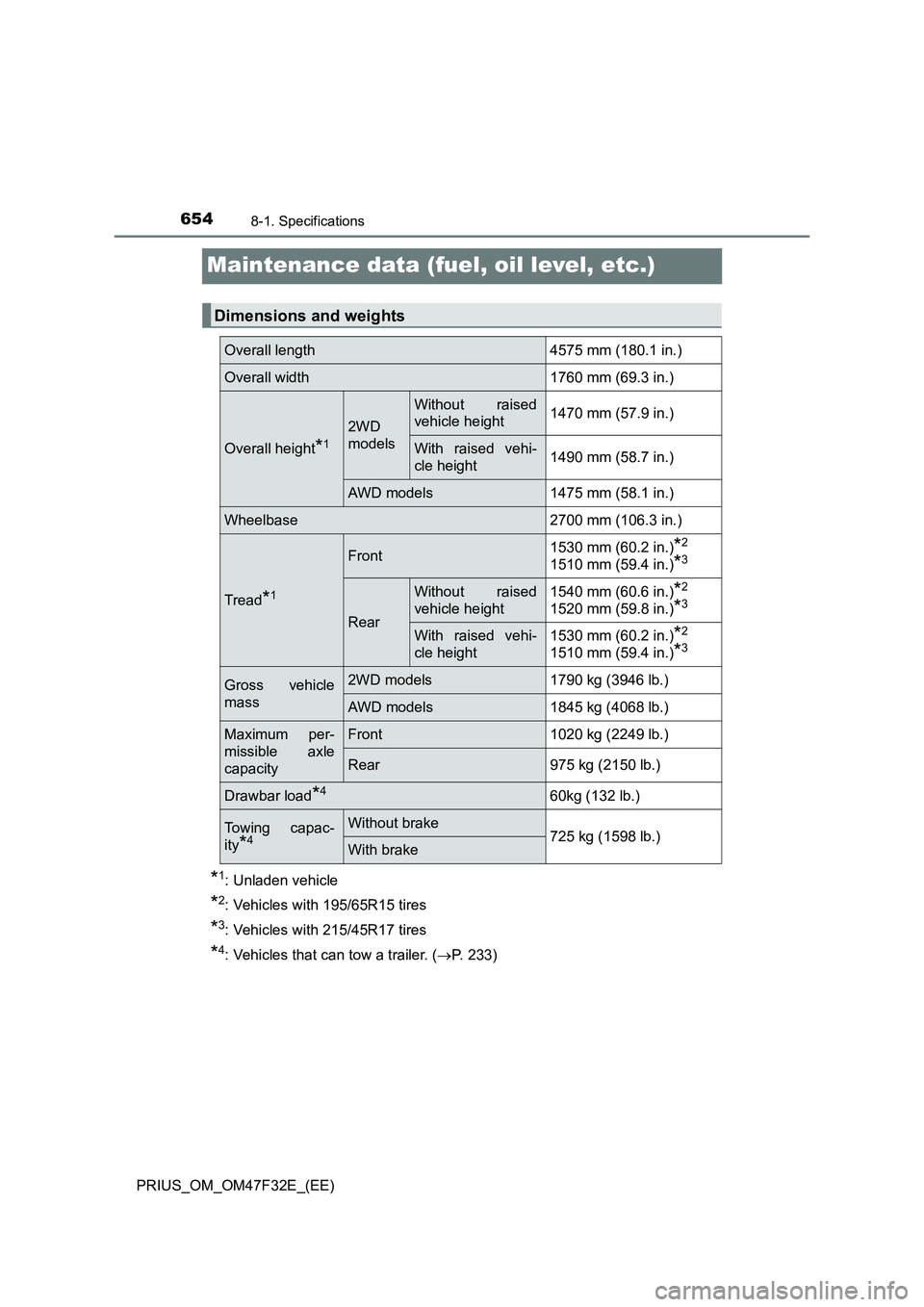
Maintenance data (fuel, oil level, etc.)
*1: Unladen vehicle
*2: Vehicles with 195/65R15 tires
*3: Vehicles with 215/45R17 tires
*4: Vehicles that can tow a trailer. (P. 233)
Dimensions and weights
Overall length4575 mm (180.1 in.)
Overall width1760 mm (69.3 in.)
Overall height*1
2WD
models
Without raised
vehicle height1470 mm (57.9 in.)
With raised vehi-
cle height1490 mm (58.7 in.)
AWD models1475 mm (58.1 in.)
Wheelbase2700 mm (106.3 in.)
Tread*1
Front1530 mm (60.2 in.)*2
1510 mm (59.4 in.)*3
Rear
Without raised
vehicle height1540 mm (60.6 in.)*2
1520 mm (59.8 in.)*3
With raised vehi-
cle height1530 mm (60.2 in.)*2
1510 mm (59.4 in.)*3
Gross vehicle
mass2WD models1790 kg (3946 lb.)
AWD models1845 kg (4068 lb.)
Maximum per-
missible axle
capacityFront1020 kg (2249 lb.)
Rear975 kg (2150 lb.)
Drawbar load*460kg (132 lb.)
Towing capac-
ity
*4
Without brake725 kg (1598 lb.)With brake