trailer TOYOTA PRIUS 2023 User Guide
[x] Cancel search | Manufacturer: TOYOTA, Model Year: 2023, Model line: PRIUS, Model: TOYOTA PRIUS 2023Pages: 770, PDF Size: 122.55 MB
Page 244 of 770
2424-1. Before driving
PRIUS_OM_OM47F32E_(EE)
WARNING
Follow all the instructions described in this section.
Failure to do so could cause an accident resulting in death or serious injury.
■ Trailer towing precautions
When towing, make sure that none of the weight limits are exceeded.
( P. 2 3 4 )
■ To avoid accident or injury
● Vehicles with a compact spare tire:
Do not tow a trailer when the compact spare tire is installed on your vehi-
cle.
● Vehicles with the emergency tire puncture repair kit:
Do not tow a trailer when the tire installed is repaired with the emergency
tire puncture repair kit.
● Do not use cruise control or dynamic radar cruise control with full-speed
range when trailer towing. (if equipped)
■ Vehicle speed in towing
Observe the legal maximum speeds for trailer towing.
■ Before descending hills or long declines
Reduce speed and downshift. However, never downshift suddenly while
descending steep or long downhill grades.
■ Operation of the brake pedal
Do not hold the brake pedal depressed often or for long periods of time.
Doing so may result in the brake overheating or reduce braking effects.
NOTICE
■ Do not directly splice trailer lights
Directly splicing trailer lights may damage your vehicle’s electrical system
and cause a malfunction.
Page 245 of 770
243
4
4-1. Before driving
Driving
PRIUS_OM_OM47F32E_(EE)
Trailer towing (AWD models)
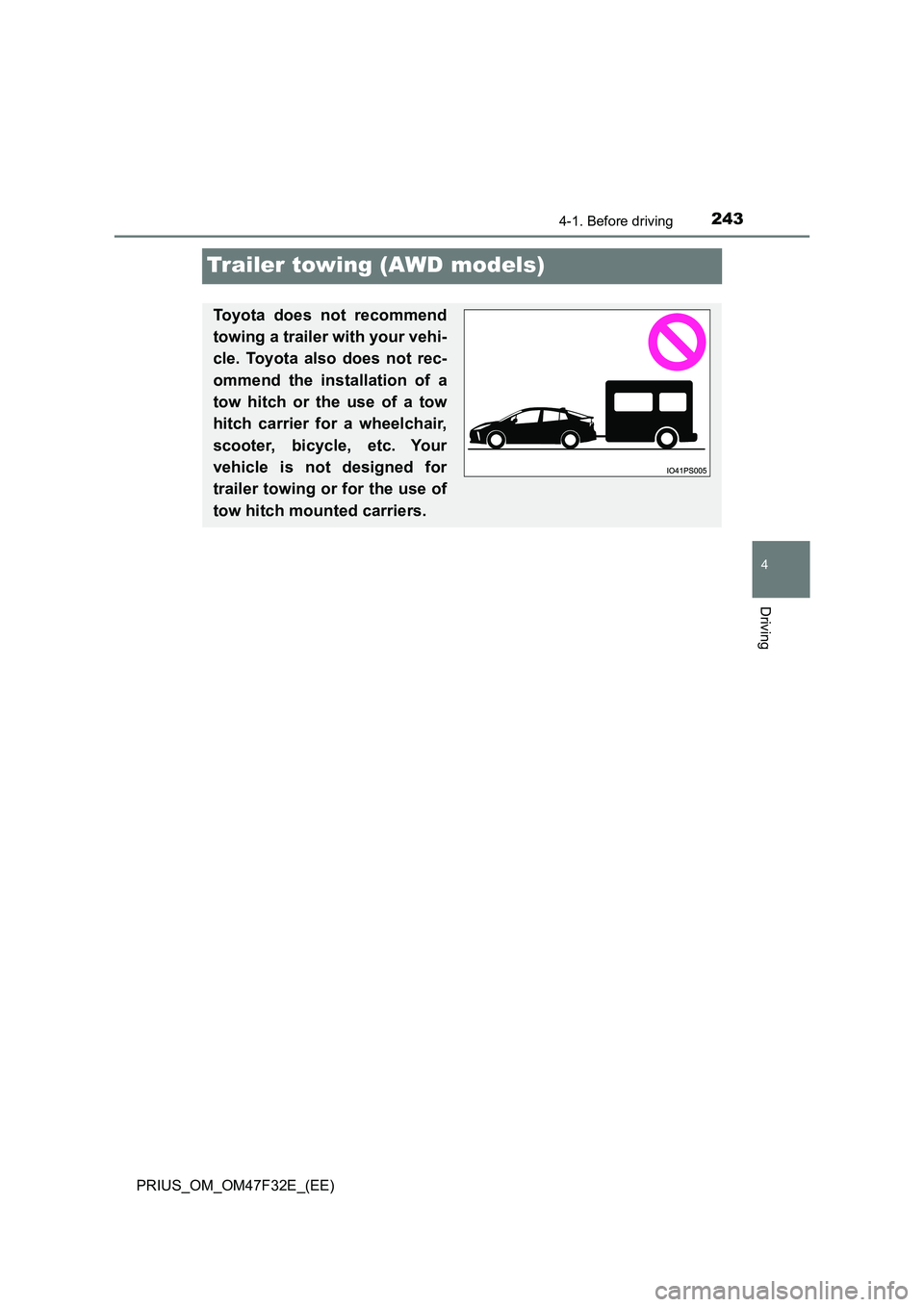
Toyota does not recommend
towing a trailer with your vehi-
cle. Toyota also does not rec-
ommend the installation of a
tow hitch or the use of a tow
hitch carrier for a wheelchair,
scooter, bicycle, etc. Your
vehicle is not designed for
trailer towing or for the use of
tow hitch mounted carriers.
Page 271 of 770
2694-3. Operating the lights and wipers
4
Driving
PRIUS_OM_OM47F32E_(EE)●In the situations shown below, the system may not be able to accurately
detect surrounding brightness levels. This may cause the low beams to
remain on or the high beams to cause problems for pedestrians, vehicles
ahead or other parties. In these cases, manually switch between the high
and low beams.
• In bad weather (rain, snow, fog, sandstorms etc.)
• The windshield is obscured by fog, mist, ice, dirt etc.
• The windshield is cracked or damaged.
• The front camera is deformed or dirty.
• The front camera temperature is extremely high.
• Surrounding brightness levels are equal to those of headlights, tail lights
or fog lights.
• Vehicles ahead have headlights that are either switched off, dirty, are
changing color, or are not aimed properly.
• When driving through an area of intermittently changing brightness and
darkness.
• When frequently and repeatedly driving ascending/descending roads, or
roads with rough, bumpy or uneven surfaces (such as stone-paved
roads, gravel tracks etc.).
• When frequently and repeatedly taking curves or driving on a winding
road.
• There is a highly reflective object ahead of the vehicle, such as a sign or
a mirror.
• The back of a vehicle ahead is highly reflective, such as a container on a
truck.
• The vehicle’s headlights are damaged or dirty.
• The vehicle is listing or tilting, due to a flat tire, a trailer being towed etc.
• The high beam and low beam are repeatedly being switched between in
an abnormal manner.
• The driver believes that the high beam may be causing problems or dis-
tress to other drivers or pedestrians nearby.
■If “Headlight System Malfunction Visit Your Dealer” is displayed on the
multi-information display
The system may be malfunctioning. Have the vehicle inspected by any autho-
rized Toyota retailer or Toyota authorized repairer, or any reliable repairer.
Page 307 of 770
3054-5. Using the driving support systems
4
Driving
PRIUS_OM_OM47F32E_(EE)• When a very bright light ahead, such as the sun or the headlights of
oncoming traffic, shines directly into the front camera
• When approaching the side or front of a vehicle ahead
• If a vehicle ahead is a motorcycle
• If a vehicle ahead is narrow, such as a personal mobility vehicle
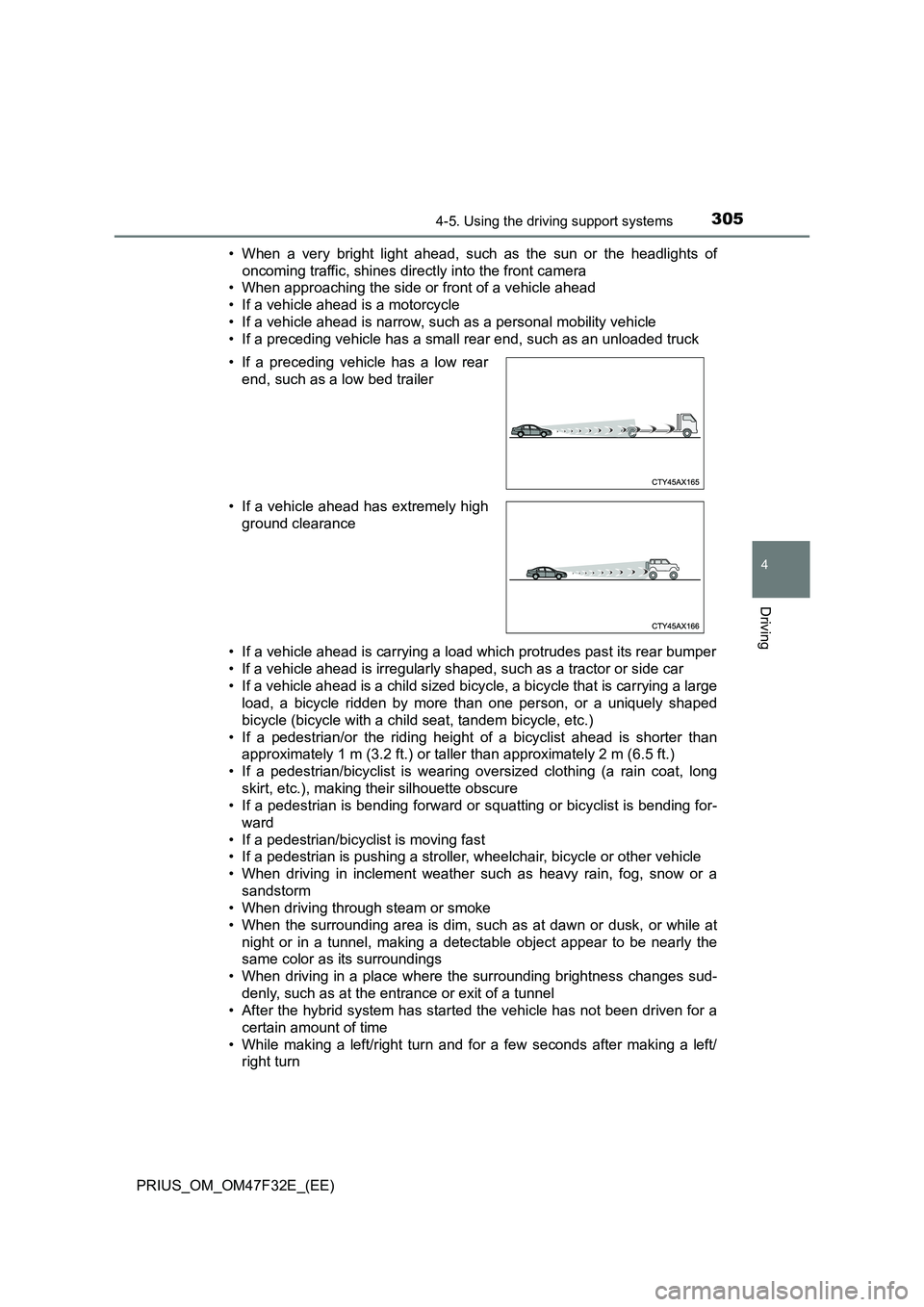
• If a preceding vehicle has a small rear end, such as an unloaded truck
• If a vehicle ahead is carrying a load which protrudes past its rear bumper
• If a vehicle ahead is irregularly shaped, such as a tractor or side car
• If a vehicle ahead is a child sized bicycle, a bicycle that is carrying a large
load, a bicycle ridden by more than one person, or a uniquely shaped
bicycle (bicycle with a child seat, tandem bicycle, etc.)
• If a pedestrian/or the riding height of a bicyclist ahead is shorter than
approximately 1 m (3.2 ft.) or taller than approximately 2 m (6.5 ft.)
• If a pedestrian/bicyclist is wearing oversized clothing (a rain coat, long
skirt, etc.), making their silhouette obscure
• If a pedestrian is bending forward or squatting or bicyclist is bending for-
ward
• If a pedestrian/bicyclist is moving fast
• If a pedestrian is pushing a stroller, wheelchair, bicycle or other vehicle
• When driving in inclement weather such as heavy rain, fog, snow or a
sandstorm
• When driving through steam or smoke
• When the surrounding area is dim, such as at dawn or dusk, or while at
night or in a tunnel, making a detectable object appear to be nearly the
same color as its surroundings
• When driving in a place where the surrounding brightness changes sud-
denly, such as at the entrance or exit of a tunnel
• After the hybrid system has started the vehicle has not been driven for a
certain amount of time
• While making a left/right turn and for a few seconds after making a left/
right turn • If a preceding vehicle has a low rear
end, such as a low bed trailer
• If a vehicle ahead has extremely high
ground clearance
Page 334 of 770
3324-5. Using the driving support systems
PRIUS_OM_OM47F32E_(EE)
WARNING
■Situations unsuitable for dynamic radar cruise control with full-speed
range
Do not use dynamic radar cruise control with full-speed range in any of the
following situations.
Doing so may result in inappropriate speed control and could cause an acci-
dent resulting in death or serious injury.
● Roads where there are pedestrians, cyclists, etc.
● In heavy traffic
● On roads with sharp bends
● On winding roads
● On slippery roads, such as those covered with rain, ice or snow
● On steep downhills, or where there are sudden changes between sharp up
and down gradients
Vehicle speed may exceed the set speed when driving down a steep hill.
● At entrances to freeways and highways
● When weather conditions are bad enough that they may prevent the sen-
sors from detecting correctly (fog, snow, sandstorm, heavy rain, etc.)
● When there is rain, snow, etc. on the front surface of the radar or front
camera
● In traffic conditions that require frequent repeated acceleration and decel-
eration
● When your vehicle is towing a trailer* or during emergency towing
*: Vehicles that can tow a trailer: P. 233
● When an approach warning buzzer is heard often
Page 346 of 770
3444-5. Using the driving support systems
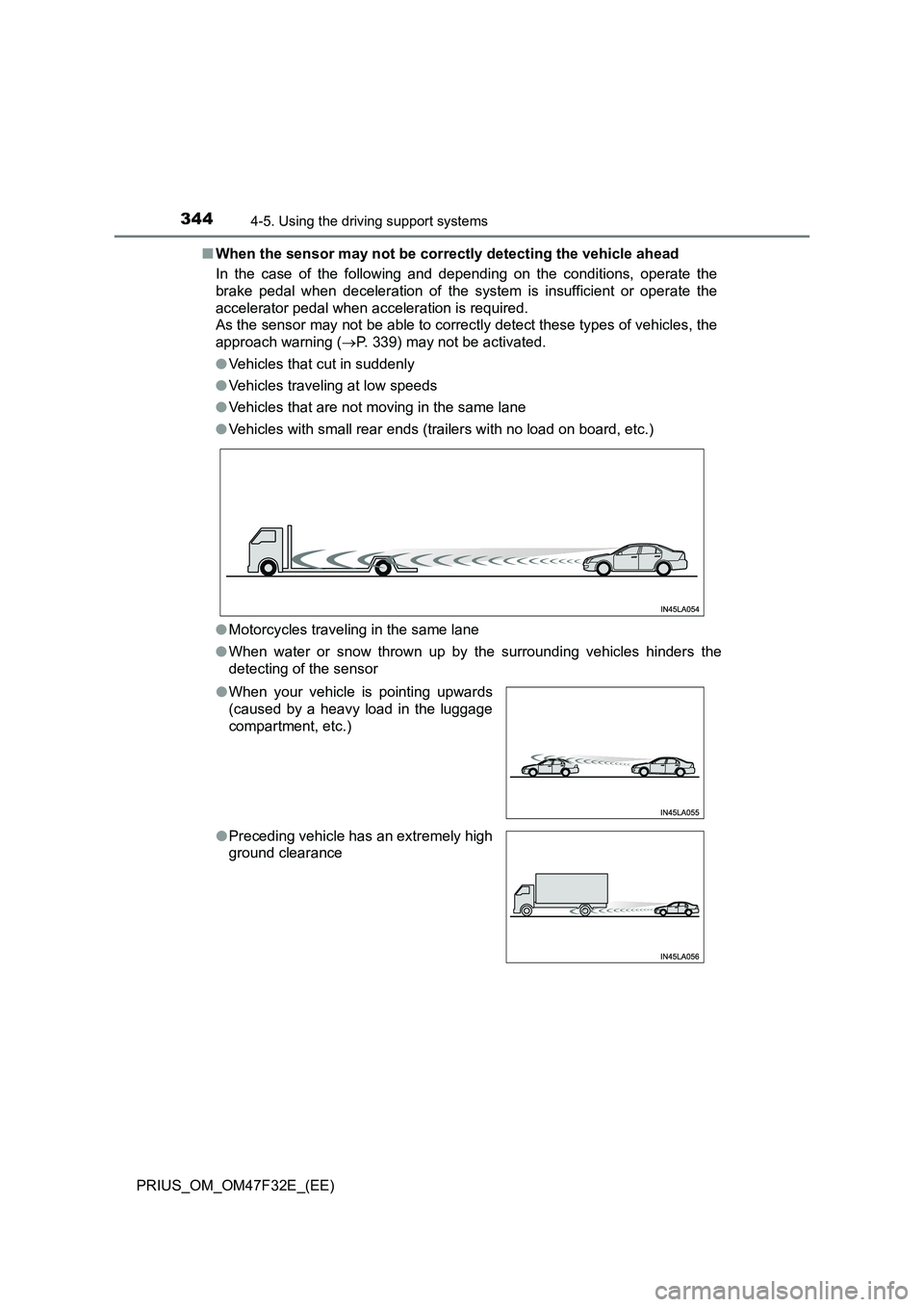
PRIUS_OM_OM47F32E_(EE)■When the sensor may not be correctly detecting the vehicle ahead
In the case of the following and depending on the conditions, operate the
brake pedal when deceleration of the system is insufficient or operate the
accelerator pedal when acceleration is required.
As the sensor may not be able to correctly detect these types of vehicles, the
approach warning (P. 339) may not be activated.
●Vehicles that cut in suddenly
●Vehicles traveling at low speeds
●Vehicles that are not moving in the same lane
●Vehicles with small rear ends (trailers with no load on board, etc.)
●Motorcycles traveling in the same lane
●When water or snow thrown up by the surrounding vehicles hinders the
detecting of the sensor
●When your vehicle is pointing upwards
(caused by a heavy load in the luggage
compartment, etc.)
●Preceding vehicle has an extremely high
ground clearance
Page 352 of 770
3504-5. Using the driving support systems
PRIUS_OM_OM47F32E_(EE)
WARNING
■To avoid operating the cruise control by mistake
Switch the cruise control off using the “ON-OFF” button when not in use.
■ Situations unsuitable for cruise control
Do not use cruise control in any of the following situations.
Doing so may result in loss of control and could cause an accident resulting
in death or serious injury.
● Roads where there are pedestrians, cyclists, etc.
● In heavy traffic
● On roads with sharp bends
● On winding roads
● On slippery roads, such as those covered with rain, ice or snow
● On steep downhills
Vehicle speed may exceed the set speed when driving down a steep hill.
● When your vehicle is towing a trailer* or during emergency towing
*: Vehicles that can tow a trailer: P. 233
Page 357 of 770
3554-5. Using the driving support systems
4
Driving
PRIUS_OM_OM47F32E_(EE)
■ Automatic speed limiter cancellation
The set speed is automatically canceled in any of the situations:
● Cruise control is activated.
● When the VSC system and/or TRC system is turned off.
■ If the “Speed Limiter Malfunction Visit Your Dealer” is displayed on the
multi-information display
Stop in a safe location, turn the power switch off and back on again, and then
set the speed limiter. If the speed limiter cannot be set, the system may be
malfunctioning. Even though the vehicle can be driven normally, have the
vehicle inspected by any authorized Toyota retailer or Toyota authorized
repairer, or any reliable repairer.
WARNING
■ To avoid operating the speed limiter by mistake
Keep the speed limiter switch off when not in use.
■ Situations unsuitable for speed limiter
Do not use the speed limiter in either of the following situations.
Doing so may result in control of the vehicle being lost and could cause a
serious or fatal accident.
● On slippery roads, such as those covered with rain, ice or snow
● On steep hills
● When towing a trailer or emergency towing
NOTICE
When a warning is issued using the meter display and buzzer after exceed-
ing the set speed limit on a steep decline, depress the brake pedal to decel-
erate.
Page 380 of 770
3784-5. Using the driving support systems
PRIUS_OM_OM47F32E_(EE)
■ Situations in which the system may not operate properly
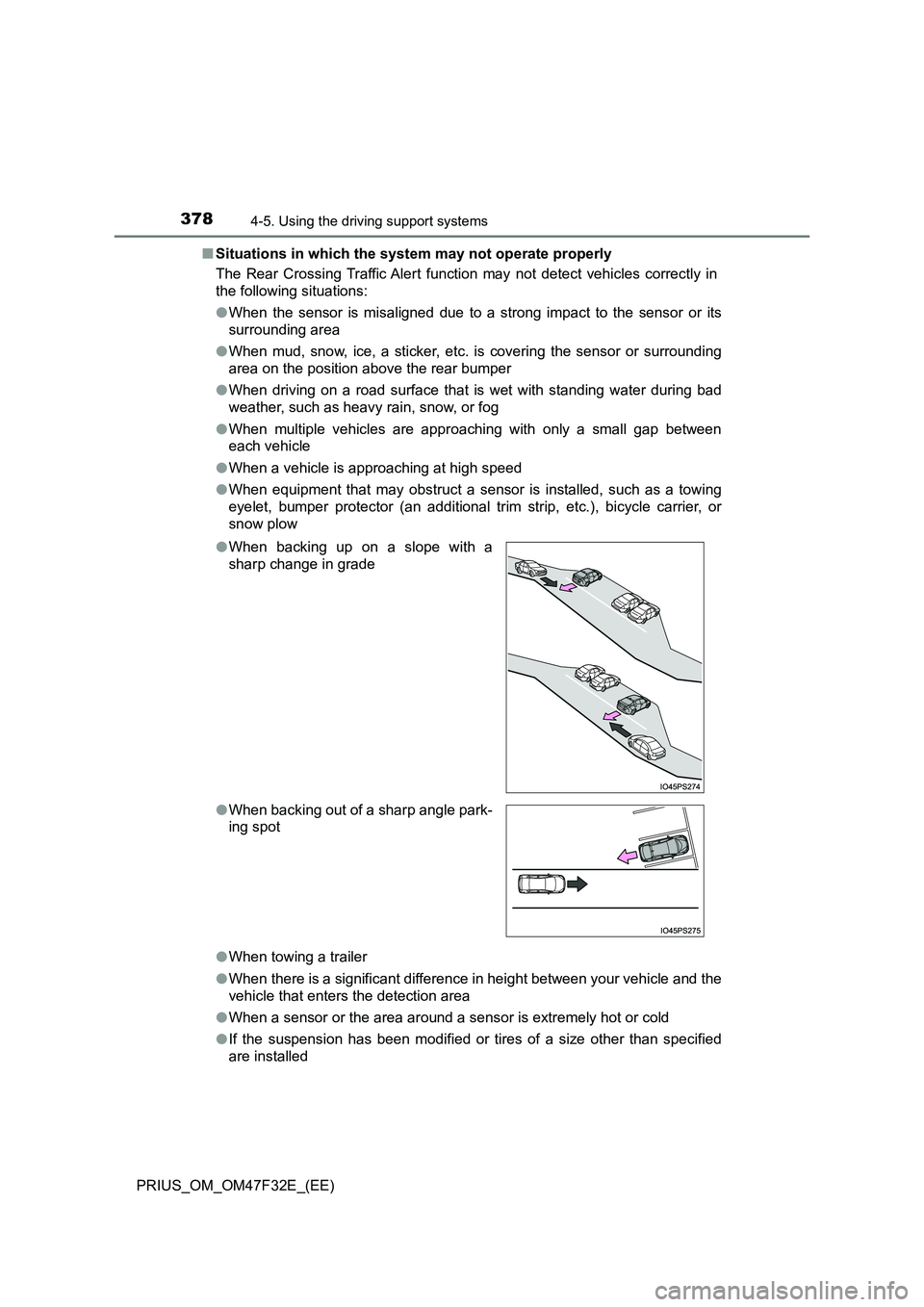
The Rear Crossing Traffic Alert function may not detect vehicles correctly in
the following situations:
● When the sensor is misaligned due to a strong impact to the sensor or its
surrounding area
● When mud, snow, ice, a sticker, etc. is covering the sensor or surrounding
area on the position above the rear bumper
● When driving on a road surface that is wet with standing water during bad
weather, such as heavy rain, snow, or fog
● When multiple vehicles are approaching with only a small gap between
each vehicle
● When a vehicle is approaching at high speed
● When equipment that may obstruct a sensor is installed, such as a towing
eyelet, bumper protector (an additional trim strip, etc.), bicycle carrier, or
snow plow
● When towing a trailer
● When there is a significant difference in height between your vehicle and the
vehicle that enters the detection area
● When a sensor or the area around a sensor is extremely hot or cold
● If the suspension has been modified or tires of a size other than specified
are installed
● When backing up on a slope with a
sharp change in grade
● When backing out of a sharp angle park-
ing spot
Page 656 of 770
6548-1. Specifications
PRIUS_OM_OM47F32E_(EE)
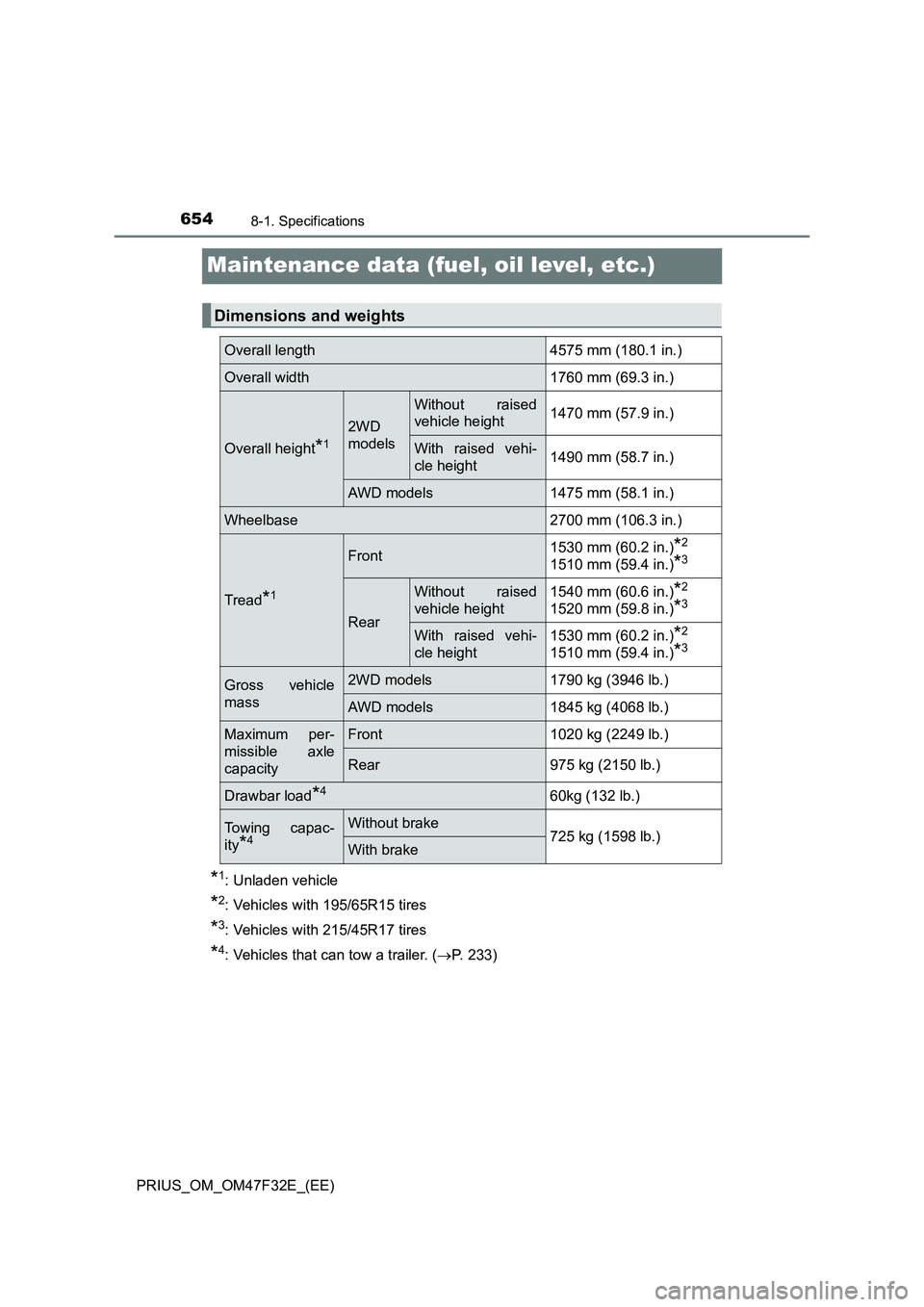
Maintenance data (fuel, oil level, etc.)
*1: Unladen vehicle
*2: Vehicles with 195/65R15 tires
*3: Vehicles with 215/45R17 tires
*4: Vehicles that can tow a trailer. (P. 233)
Dimensions and weights
Overall length4575 mm (180.1 in.)
Overall width1760 mm (69.3 in.)
Overall height*1
2WD
models
Without raised
vehicle height1470 mm (57.9 in.)
With raised vehi-
cle height1490 mm (58.7 in.)
AWD models1475 mm (58.1 in.)
Wheelbase2700 mm (106.3 in.)
Tread*1
Front1530 mm (60.2 in.)*2
1510 mm (59.4 in.)*3
Rear
Without raised
vehicle height1540 mm (60.6 in.)*2
1520 mm (59.8 in.)*3
With raised vehi-
cle height1530 mm (60.2 in.)*2
1510 mm (59.4 in.)*3
Gross vehicle
mass2WD models1790 kg (3946 lb.)
AWD models1845 kg (4068 lb.)
Maximum per-
missible axle
capacityFront1020 kg (2249 lb.)
Rear975 kg (2150 lb.)
Drawbar load*460kg (132 lb.)
Towing capac-
ity
*4
Without brake725 kg (1598 lb.)With brake