flat tire TOYOTA PRIUS 2023 Owners Manual
[x] Cancel search | Manufacturer: TOYOTA, Model Year: 2023, Model line: PRIUS, Model: TOYOTA PRIUS 2023Pages: 770, PDF Size: 122.55 MB
Page 6 of 770
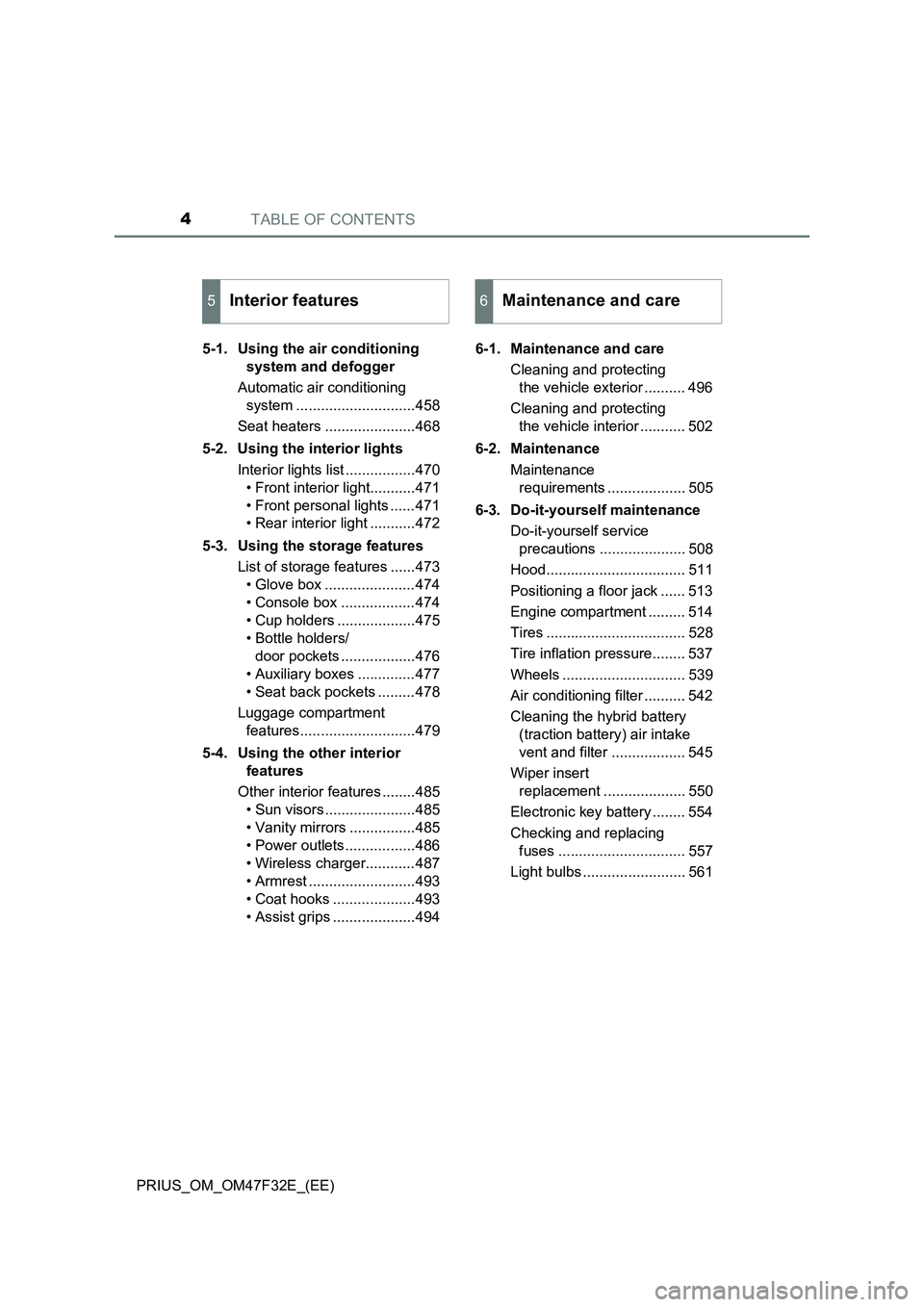
TABLE OF CONTENTS4
PRIUS_OM_OM47F32E_(EE)5-1. Using the air conditioning
system and defogger
Automatic air conditioning
system .............................458
Seat heaters ......................468
5-2. Using the interior lights
Interior lights list .................470
• Front interior light...........471
• Front personal lights ......471
• Rear interior light ...........472
5-3. Using the storage features
List of storage features ......473
• Glove box ......................474
• Console box ..................474
• Cup holders ...................475
• Bottle holders/
door pockets ..................476
• Auxiliary boxes ..............477
• Seat back pockets .........478
Luggage compartment
features............................479
5-4. Using the other interior
features
Other interior features ........485
• Sun visors ......................485
• Vanity mirrors ................485
• Power outlets .................486
• Wireless charger............487
• Armrest ..........................493
• Coat hooks ....................493
• Assist grips ....................4946-1. Maintenance and care
Cleaning and protecting
the vehicle exterior .......... 496
Cleaning and protecting
the vehicle interior ........... 502
6-2. Maintenance
Maintenance
requirements ................... 505
6-3. Do-it-yourself maintenance
Do-it-yourself service
precautions ..................... 508
Hood.................................. 511
Positioning a floor jack ...... 513
Engine compartment ......... 514
Tires .................................. 528
Tire inflation pressure........ 537
Wheels .............................. 539
Air conditioning filter .......... 542
Cleaning the hybrid battery
(traction battery) air intake
vent and filter .................. 545
Wiper insert
replacement .................... 550
Electronic key battery ........ 554
Checking and replacing
fuses ............................... 557
Light bulbs ......................... 561
5Interior features6Maintenance and care
Page 7 of 770
5
1
8
7
6
5
4
3
2
PRIUS_OM_OM47F32E_(EE)
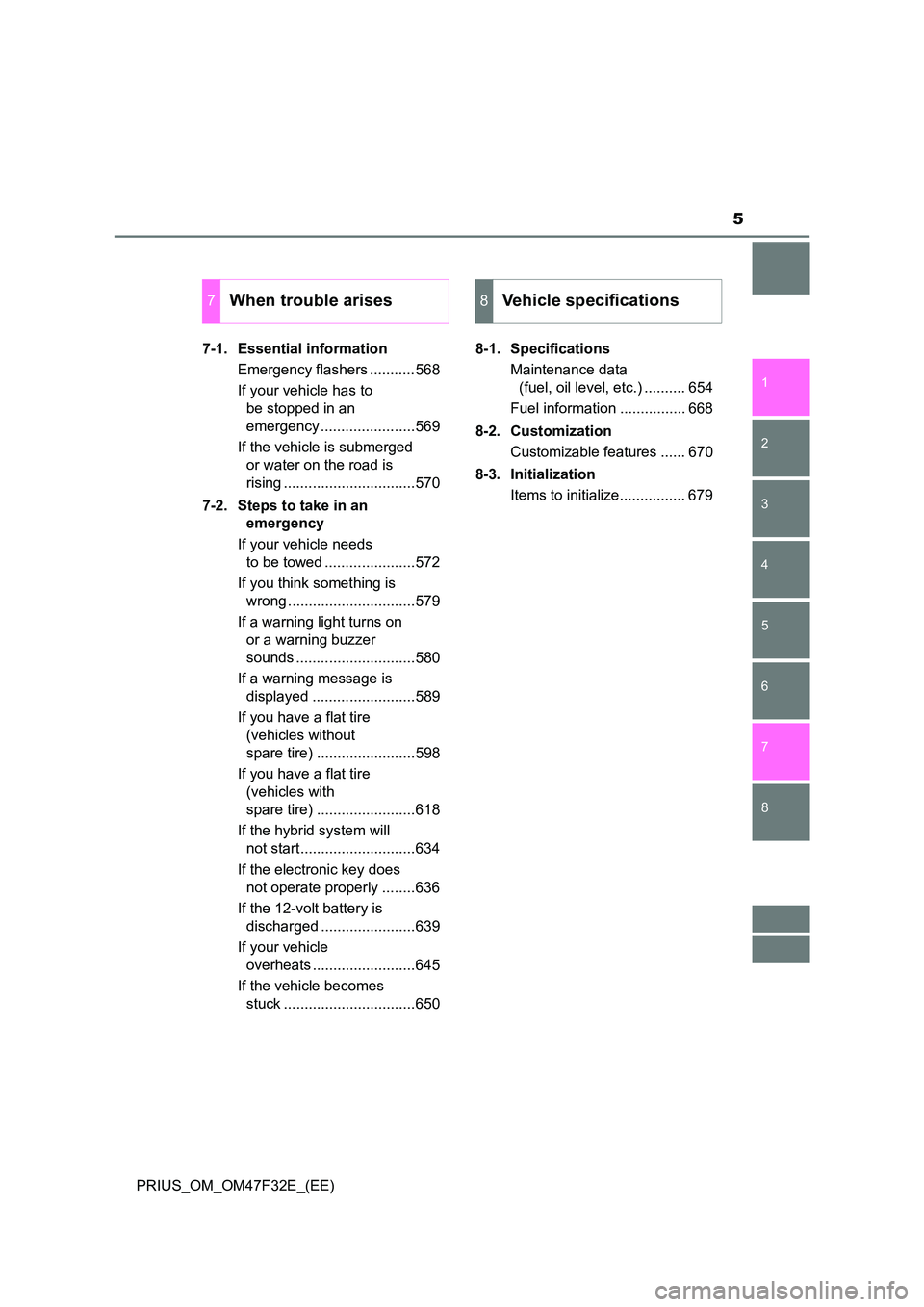
7-1. Essential information
Emergency flashers ...........568
If your vehicle has to
be stopped in an
emergency .......................569
If the vehicle is submerged
or water on the road is
rising ................................570
7-2. Steps to take in an
emergency
If your vehicle needs
to be towed ......................572
If you think something is
wrong ...............................579
If a warning light turns on
or a warning buzzer
sounds .............................580
If a warning message is
displayed .........................589
If you have a flat tire
(vehicles without
spare tire) ........................598
If you have a flat tire
(vehicles with
spare tire) ........................618
If the hybrid system will
not start............................634
If the electronic key does
not operate properly ........636
If the 12-volt battery is
discharged .......................639
If your vehicle
overheats .........................645
If the vehicle becomes
stuck ................................650
8-1. Specifications
Maintenance data
(fuel, oil level, etc.) .......... 654
Fuel information ................ 668
8-2. Customization
Customizable features ...... 670
8-3. Initialization
Items to initialize................ 679
7When trouble arises8Vehicle specifications
Page 17 of 770
15Pictorial index
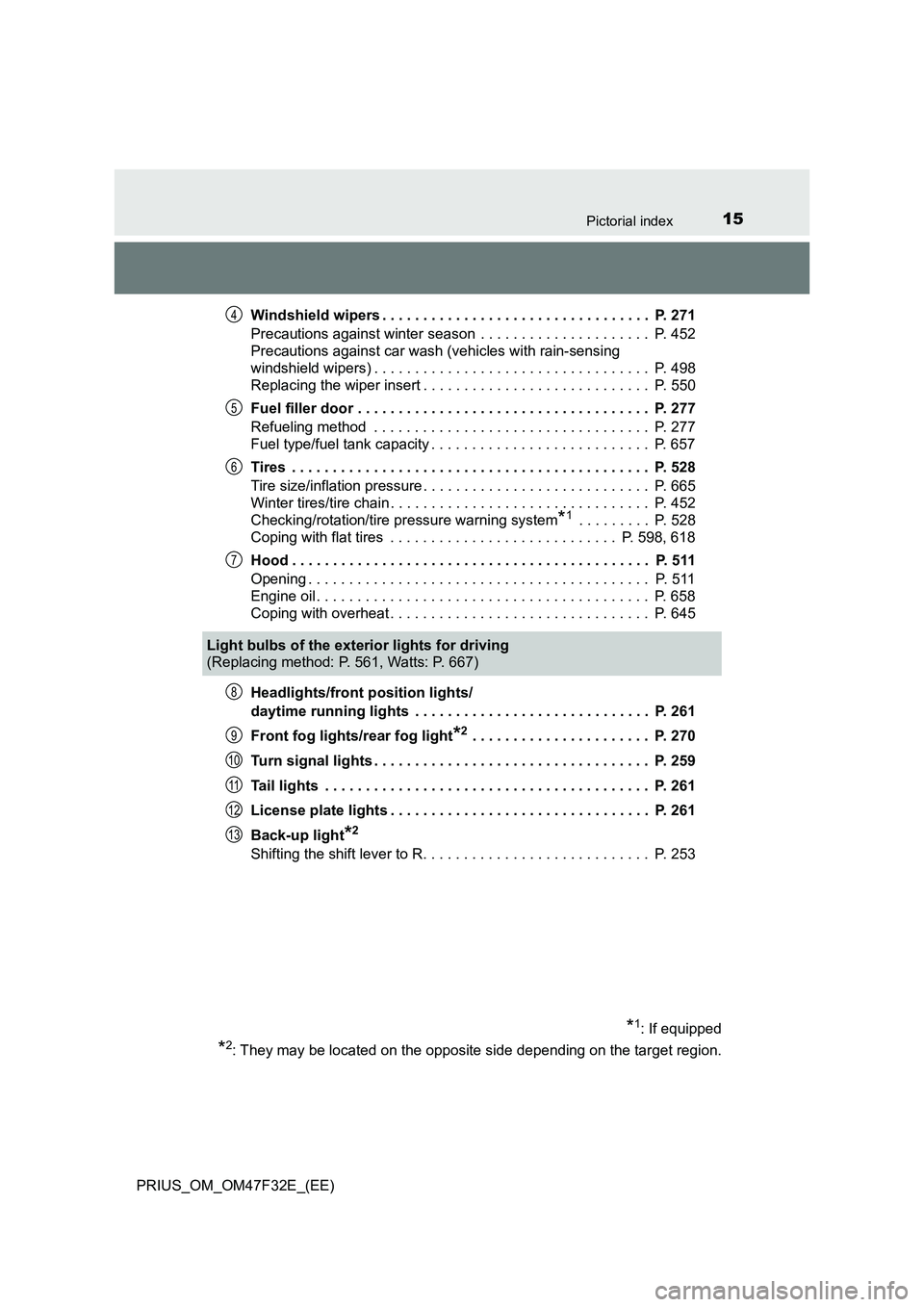
PRIUS_OM_OM47F32E_(EE)Windshield wipers . . . . . . . . . . . . . . . . . . . . . . . . . . . . . . . . . P. 271
Precautions against winter season . . . . . . . . . . . . . . . . . . . . . P. 452
Precautions against car wash (vehicles with rain-sensing
windshield wipers) . . . . . . . . . . . . . . . . . . . . . . . . . . . . . . . . . . P. 498
Replacing the wiper insert . . . . . . . . . . . . . . . . . . . . . . . . . . . . P. 550
Fuel filler door . . . . . . . . . . . . . . . . . . . . . . . . . . . . . . . . . . . . P. 277
Refueling method . . . . . . . . . . . . . . . . . . . . . . . . . . . . . . . . . . P. 277
Fuel type/fuel tank capacity . . . . . . . . . . . . . . . . . . . . . . . . . . . P. 657
Tires . . . . . . . . . . . . . . . . . . . . . . . . . . . . . . . . . . . . . . . . . . . . P. 528
Tire size/inflation pressure . . . . . . . . . . . . . . . . . . . . . . . . . . . . P. 665
Winter tires/tire chain . . . . . . . . . . . . . . . . . . . . . . . . . . . . . . . . P. 452
Checking/rotation/tire pressure warning system
*1 . . . . . . . . . P. 528
Coping with flat tires . . . . . . . . . . . . . . . . . . . . . . . . . . . . P. 598, 618
Hood . . . . . . . . . . . . . . . . . . . . . . . . . . . . . . . . . . . . . . . . . . . . P. 511
Opening . . . . . . . . . . . . . . . . . . . . . . . . . . . . . . . . . . . . . . . . . . P. 511
Engine oil . . . . . . . . . . . . . . . . . . . . . . . . . . . . . . . . . . . . . . . . . P. 658
Coping with overheat . . . . . . . . . . . . . . . . . . . . . . . . . . . . . . . . P. 645
Headlights/front position lights/
daytime running lights . . . . . . . . . . . . . . . . . . . . . . . . . . . . . P. 261
Front fog lights/rear fog light
*2 . . . . . . . . . . . . . . . . . . . . . . P. 270
Turn signal lights . . . . . . . . . . . . . . . . . . . . . . . . . . . . . . . . . . P. 259
Tail lights . . . . . . . . . . . . . . . . . . . . . . . . . . . . . . . . . . . . . . . . P. 261
License plate lights . . . . . . . . . . . . . . . . . . . . . . . . . . . . . . . . P. 261
Back-up light
*2
Shifting the shift lever to R. . . . . . . . . . . . . . . . . . . . . . . . . . . . P. 253
4
5
6
7
Light bulbs of the exterior lights for driving
(Replacing method: P. 561, Watts: P. 667)
*1: If equipped
*2: They may be located on the opposite side depending on the target region.
8
9
10
11
12
13
Page 231 of 770
2294-1. Before driving
4
Driving
PRIUS_OM_OM47F32E_(EE)
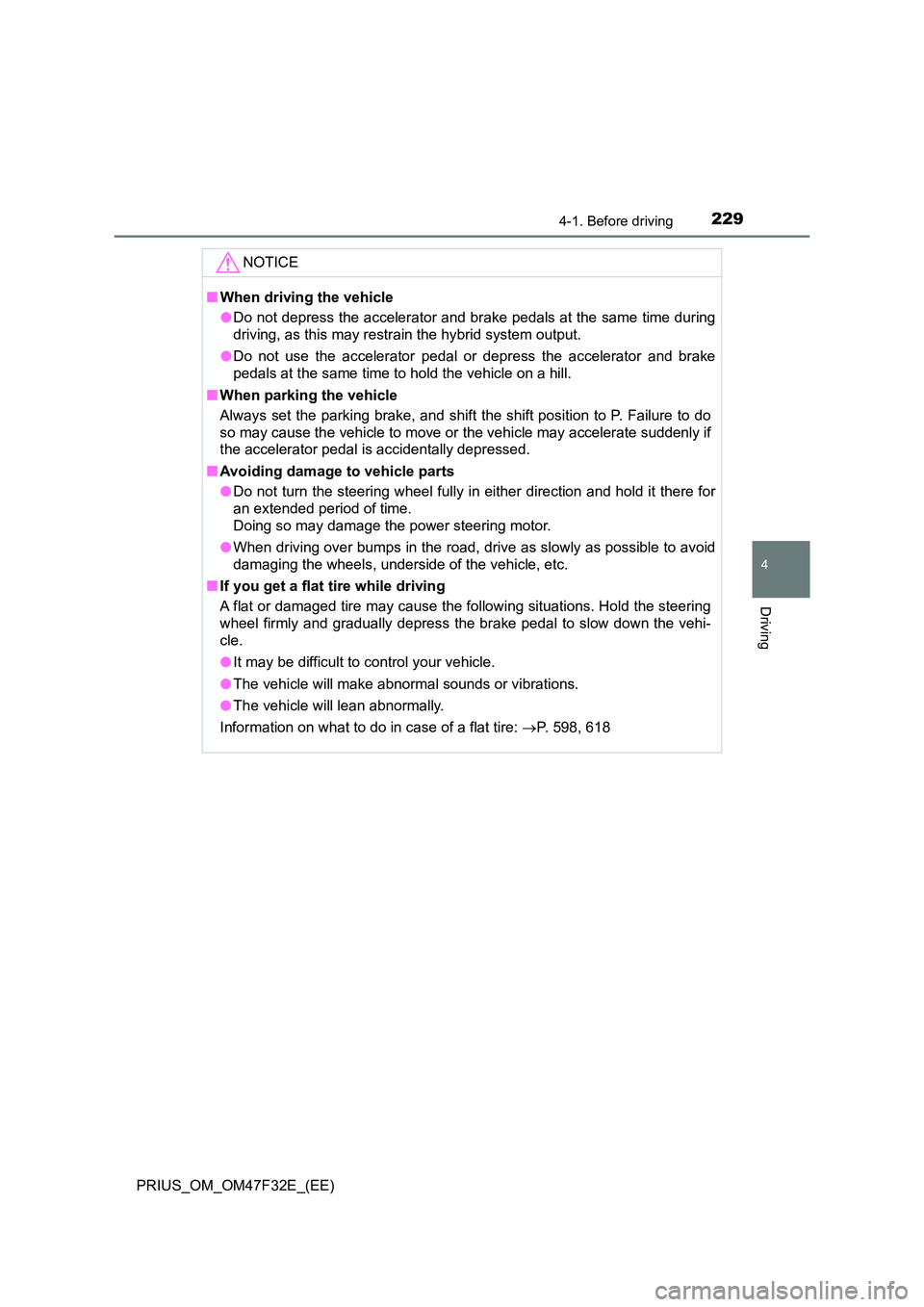
NOTICE
■When driving the vehicle
● Do not depress the accelerator and brake pedals at the same time during
driving, as this may restrain the hybrid system output.
● Do not use the accelerator pedal or depress the accelerator and brake
pedals at the same time to hold the vehicle on a hill.
■ When parking the vehicle
Always set the parking brake, and shift the shift position to P. Failure to do
so may cause the vehicle to move or the vehicle may accelerate suddenly if
the accelerator pedal is accidentally depressed.
■ Avoiding damage to vehicle parts
● Do not turn the steering wheel fully in either direction and hold it there for
an extended period of time.
Doing so may damage the power steering motor.
● When driving over bumps in the road, drive as slowly as possible to avoid
damaging the wheels, underside of the vehicle, etc.
■ If you get a flat tire while driving
A flat or damaged tire may cause the following situations. Hold the steering
wheel firmly and gradually depress the brake pedal to slow down the vehi-
cle.
● It may be difficult to control your vehicle.
● The vehicle will make abnormal sounds or vibrations.
● The vehicle will lean abnormally.
Information on what to do in case of a flat tire: P. 598, 618
Page 237 of 770
2354-1. Before driving
4
Driving
PRIUS_OM_OM47F32E_(EE)
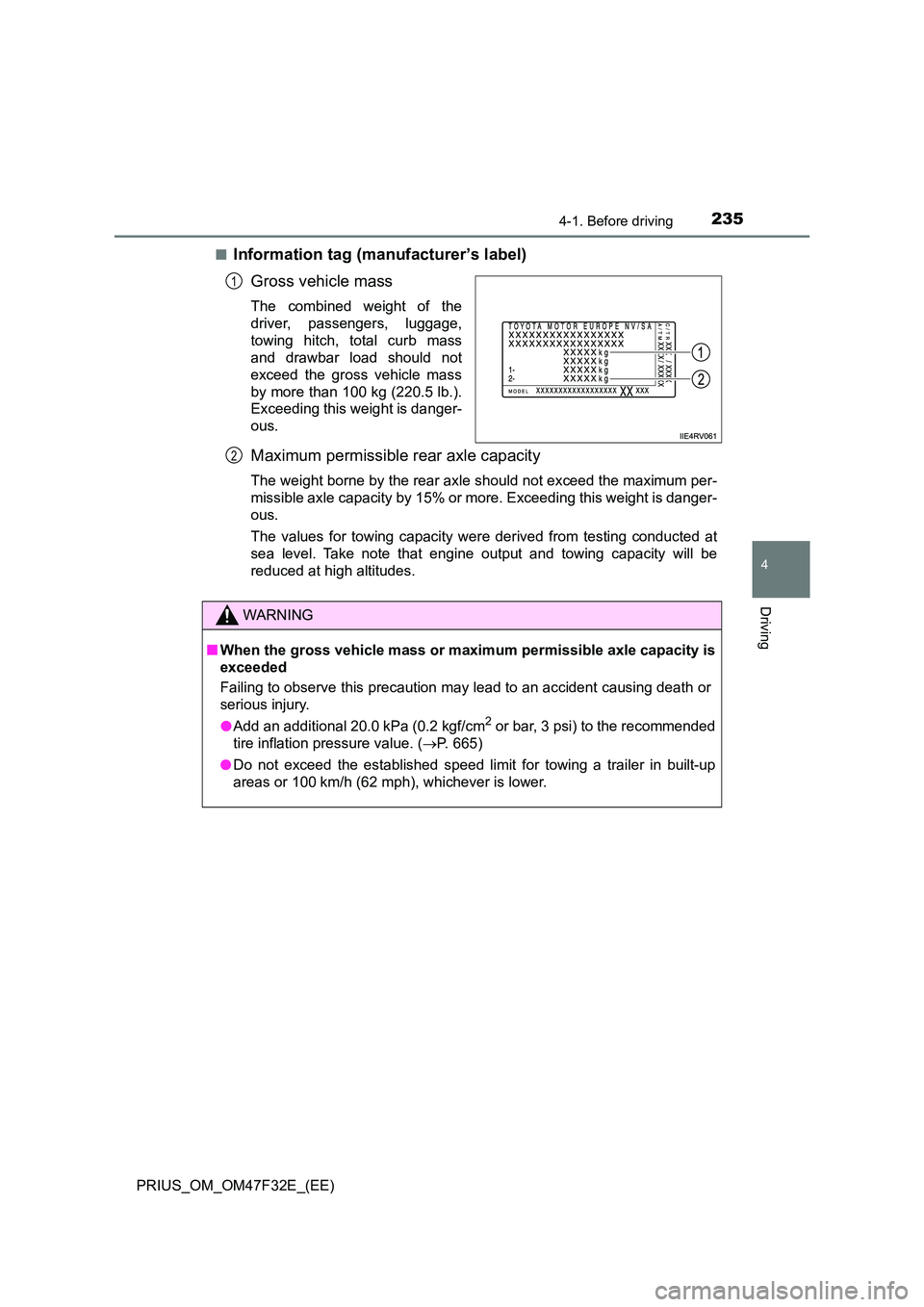
■Information tag (manufacturer’s label)
Gross vehicle mass
The combined weight of the
driver, passengers, luggage,
towing hitch, total curb mass
and drawbar load should not
exceed the gross vehicle mass
by more than 100 kg (220.5 lb.).
Exceeding this weight is danger-
ous.
Maximum permissible rear axle capacity
The weight borne by the rear axle should not exceed the maximum per-
missible axle capacity by 15% or more. Exceeding this weight is danger-
ous.
The values for towing capacity were derived from testing conducted at
sea level. Take note that engine output and towing capacity will be
reduced at high altitudes.
1
2
WARNING
■ When the gross vehicle mass or maximum permissible axle capacity is
exceeded
Failing to observe this precaution may lead to an accident causing death or
serious injury.
● Add an additional 20.0 kPa (0.2 kgf/cm2 or bar, 3 psi) to the recommended
tire inflation pressure value. ( P. 665)
● Do not exceed the established speed limit for towing a trailer in built-up
areas or 100 km/h (62 mph), whichever is lower.
Page 240 of 770
2384-1. Before driving
PRIUS_OM_OM47F32E_(EE)
■Tire information
●Increase the tire inflation pressure to 20.0 kPa (0.2 kgf/cm2 or bar, 3 psi)
greater than the recommended value when towing. (P. 665)
●Increase the air pressure of the trailer tires in accordance with the total
trailer weight and according to the values recommended by the manufac-
turer of your trailer.
■Break-in schedule
Toyota recommends that vehicles fitted with new power train components
should not be used for towing trailers for the first 800 km (500 miles).
■Safety checks before towing
●Check that the maximum load limit for the towing hitch/bracket and hitch ball
is not exceeded. Bear in mind that the coupling weight of the trailer will add
to the load exerted on the vehicle. Also make sure that the total load exerted
on the vehicle is within the range of the weight limits. (P. 234)
●Ensure that the trailer load is secure.
●Supplementary outside rear view mirrors should be added to the vehicle if
the traffic behind cannot be clearly seen with standard mirrors. Adjust the
extending arms of these mirrors on both sides of the vehicle so that they
always provide maximum visibility of the road behind.
■Maintenance
●Maintenance must be performed more frequently when using the vehicle for
towing due to the greater weight burden placed on the vehicle compared to
normal driving.
●Retighten all bolts securing the hitching ball and bracket after towing for
approximately 1000 km (600 miles).
Page 271 of 770
2694-3. Operating the lights and wipers
4
Driving
PRIUS_OM_OM47F32E_(EE)●In the situations shown below, the system may not be able to accurately
detect surrounding brightness levels. This may cause the low beams to
remain on or the high beams to cause problems for pedestrians, vehicles
ahead or other parties. In these cases, manually switch between the high
and low beams.
• In bad weather (rain, snow, fog, sandstorms etc.)
• The windshield is obscured by fog, mist, ice, dirt etc.
• The windshield is cracked or damaged.
• The front camera is deformed or dirty.
• The front camera temperature is extremely high.
• Surrounding brightness levels are equal to those of headlights, tail lights
or fog lights.
• Vehicles ahead have headlights that are either switched off, dirty, are
changing color, or are not aimed properly.
• When driving through an area of intermittently changing brightness and
darkness.
• When frequently and repeatedly driving ascending/descending roads, or
roads with rough, bumpy or uneven surfaces (such as stone-paved
roads, gravel tracks etc.).
• When frequently and repeatedly taking curves or driving on a winding
road.
• There is a highly reflective object ahead of the vehicle, such as a sign or
a mirror.
• The back of a vehicle ahead is highly reflective, such as a container on a
truck.
• The vehicle’s headlights are damaged or dirty.
• The vehicle is listing or tilting, due to a flat tire, a trailer being towed etc.
• The high beam and low beam are repeatedly being switched between in
an abnormal manner.
• The driver believes that the high beam may be causing problems or dis-
tress to other drivers or pedestrians nearby.
■If “Headlight System Malfunction Visit Your Dealer” is displayed on the
multi-information display
The system may be malfunctioning. Have the vehicle inspected by any autho-
rized Toyota retailer or Toyota authorized repairer, or any reliable repairer.
Page 301 of 770
2994-5. Using the driving support systems
4
Driving
PRIUS_OM_OM47F32E_(EE)
WARNING
■When to disable the pre-collision system
In the following situations, disable the system, as it may not operate prop-
erly, possibly leading to an accident resulting in death or serious injury:
● When the vehicle is being towed
● When your vehicle is towing another vehicle
● When transporting the vehicle via truck, boat, train or similar means of
transportation
● When the vehicle is raised on a lift with the hybrid system on and the tires
are allowed to rotate freely
● When inspecting the vehicle using a drum tester such as a chassis
dynamometer or speedometer tester , or when using an on vehicle wheel
balancer
● When a strong impact is applied to the front bumper or front grille, due to
an accident or other reasons
● If the vehicle cannot be driven in a stable manner, such as when the vehi-
cle has been in an accident or is malfunctioning
● When the vehicle is driven in a sporty manner or off-road
● When the tires are not properly inflated
● When the tires are very worn
● When tires of a size other than specified are installed
● When tire chains are installed
● When a compact spare tire or an emergency tire puncture repair kit is used
● If equipment (snow plow, etc.) that may obstruct the radar sensor or front
camera is temporarily installed to the vehicle
Page 308 of 770
3064-5. Using the driving support systems
PRIUS_OM_OM47F32E_(EE)• While driving on a curve and for a few seconds after driving on a curve
• If your vehicle is skidding
• If the wheels are misaligned
• If a wiper blade is blocking the front camera
• The vehicle is being driven at extremely high speeds
• When driving on a hill
• If the radar sensor or front camera is misaligned
●In some situations such as the following, sufficient braking force may not be
obtained, preventing the system from performing properly:
• If the braking functions cannot operate to their full extent, such as when
the brake parts are extremely cold, extremely hot, or wet
• If the vehicle is not properly maintained (brakes or tires are excessively
worn, improper tire inflation pressure, etc.)
• When the vehicle is being driven on a gravel road or other slippery sur-
face
■If VSC is disabled
●If VSC is disabled (P. 443), the pre-collision brake assist and pre-collision
braking functions are also disabled.
●The PCS warning light will turn on and “VSC Turned Off Pre-Collision Brake
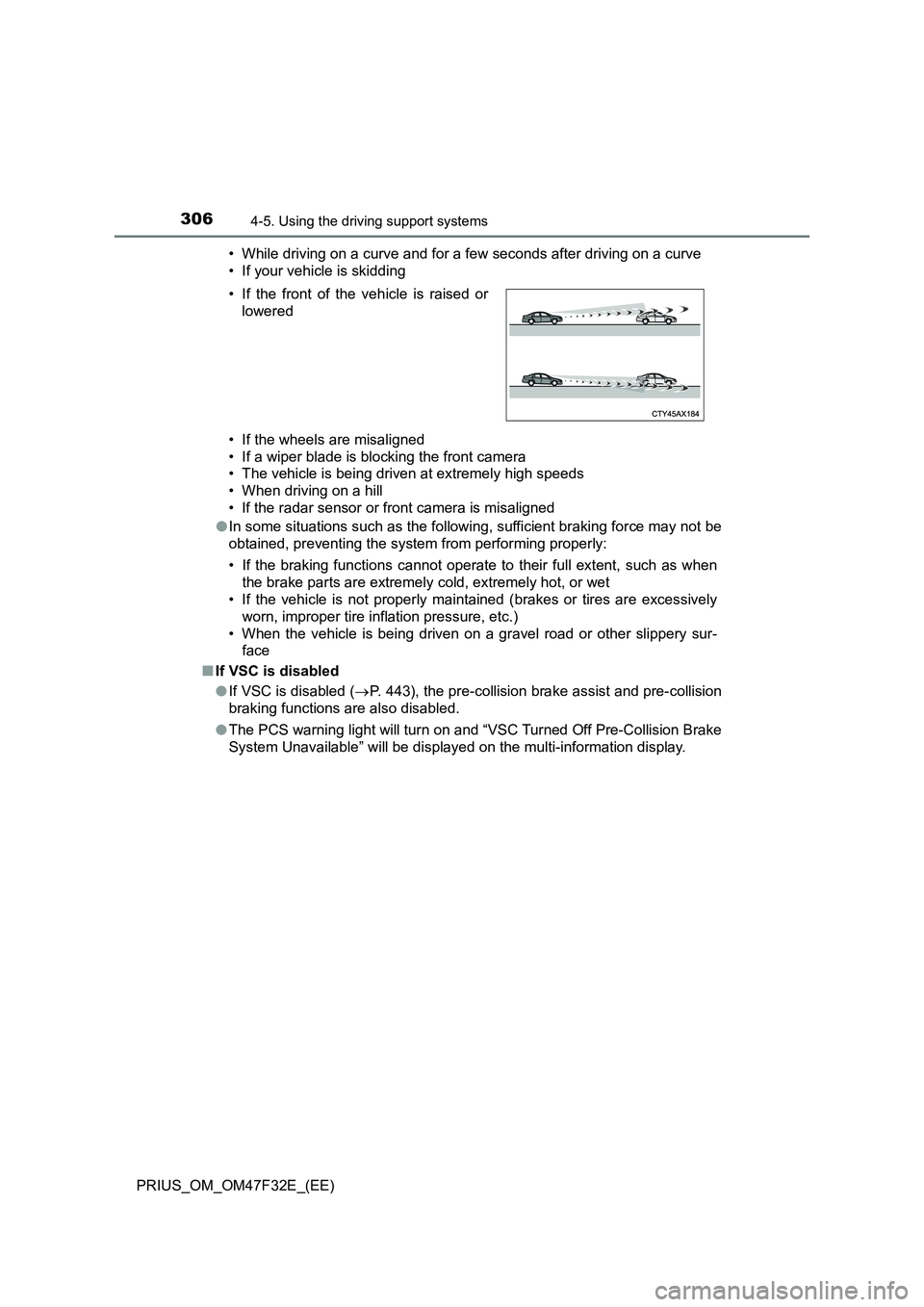
System Unavailable” will be displayed on the multi-information display. • If the front of the vehicle is raised or
lowered
Page 310 of 770
3084-5. Using the driving support systems
PRIUS_OM_OM47F32E_(EE)
WARNING
■Before using LTA system
● Do not rely solely upon the LTA system. The LTA system does not auto-
matically drive the vehicle or reduce the amount of attention that must be
paid to the area in front of the vehicle. The driver must always assume full
responsibility for driving safely by paying careful attention to the surround-
ing conditions and operating the steering wheel to correct the path of the
vehicle. Also, the driver must take adequate breaks when fatigued, such
as from driving for a long period of time.
● Failure to perform appropriate driving operations and pay careful attention
may lead to an accident, resulting in death or serious injury.
● When not using the LTA system, use the LTA switch to turn the system off.
■ Situations unsuitable for LTA system
In the following situations, use the LTA switch to turn the system off. Failure
to do so may lead to an accident, resulting in death or serious injury.
● Vehicle is driven on a road surface which is slippery due to rainy weather,
fallen snow, freezing, etc.
● Vehicle is driven on a snow-covered road.
● White (yellow) lines are difficult to see due to rain, snow, fog, dust, etc.
● Vehicle is driven in a temporary lane or restricted lane due to construction
work.
● Vehicle is driven in a construction zone.
● A spare tire, tire chains, etc. are equipped.
● When the tires have been excessively worn, or when the tire inflation pres-
sure is low.
● During emergency towing.
■ Preventing LTA system malfunctions and operations performed by
mistake
● Do not modify the headlights or place stickers, etc. on the surface of the
lights.
● Do not modify the suspension etc. If the suspension etc. needs to be
replaced, contact any authorized Toyota retailer or Toyota authorized
repairer, or any reliable repairer.
● Do not install or place anything on the hood or grille. Also, do not install a
grille guard (bull bars, kangaroo bar, etc.).
● If your windshield needs repairs, contact any authorized Toyota retailer or
Toyota authorized repairer, or any reliable repairer.