belt TOYOTA PRIUS C 2013 NHP10 / 1.G User Guide
[x] Cancel search | Manufacturer: TOYOTA, Model Year: 2013, Model line: PRIUS C, Model: TOYOTA PRIUS C 2013 NHP10 / 1.GPages: 556, PDF Size: 8.88 MB
Page 77 of 556
77
1
1-4. Adjustable components (seats, mirrors, steering wheel)
Before driving
Rear seats
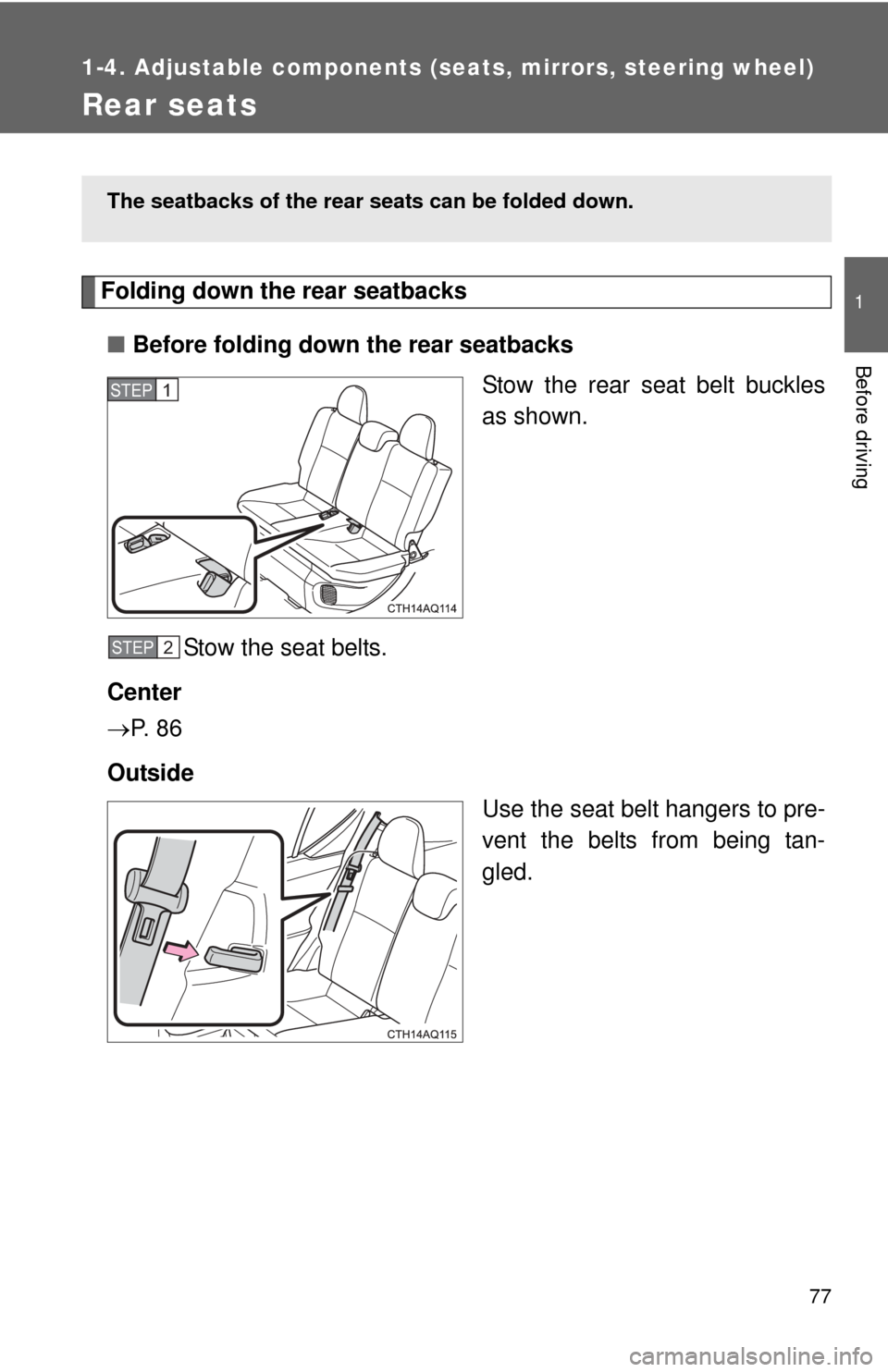
Folding down the rear seatbacks■ Before folding down the rear seatbacks
Stow the rear seat belt buckles
as shown.
Stow the seat belts.
Center
P. 8 6
Outside Use the seat belt hangers to pre-
vent the belts from being tan-
gled.
The seatbacks of the rear seats can be folded down.
STEP1
STEP2
Page 79 of 556
79
1-4. Adjustable components (s
eats, mirrors, steering wheel)
1
Before driving
CAUTION
■When folding the rear seatbacks down
Observe the following precautions. Failure to do so may result in death or
serious injury.
●Do not fold the seatbacks down while driving.
● Stop the vehicle on level ground, set the parking brake and shift the shift
lever to P.
● Do not allow anyone to sit on a folded seatback or in the luggage compart-
ment while driving.
● Do not allow children to enter the luggage compartment.
● For vehicles with split rear seats, do not allow anyone sit on the rear center
seat if the rear right seat is folded down, as the seat belt buckle for \
the rear
center seat belt is then concealed under the folded seat and cannot be
used.
● Be careful not to catch your hand when folding the rear seatbacks.
● If it is necessary to detach the head restraints, remove it from the vehicle
or store it securely in the luggage compartment. This will prevent it from
injuring passengers in the event of sudden braking, sudden swerving or an
accident.
● Adjust the position of the front seat before folding down the rear seatbacks
so that the front seat does not interfere with the rear seatbacks when fold-
ing down the rear seatbacks.
Page 80 of 556
80 1-4. Adjustable components (seats, mirrors, steering wheel)
CAUTION
■After returning the rear seatback to the upright position
Observe the following precautions. Failure to do so may result in death or
serious injury.
●Check that the seat belts are not twisted or caught in the seatback.
NOTICE
■Stowing the seat belts
The seat belts and the buckles must be stowed before you fold down the
rear seatbacks.
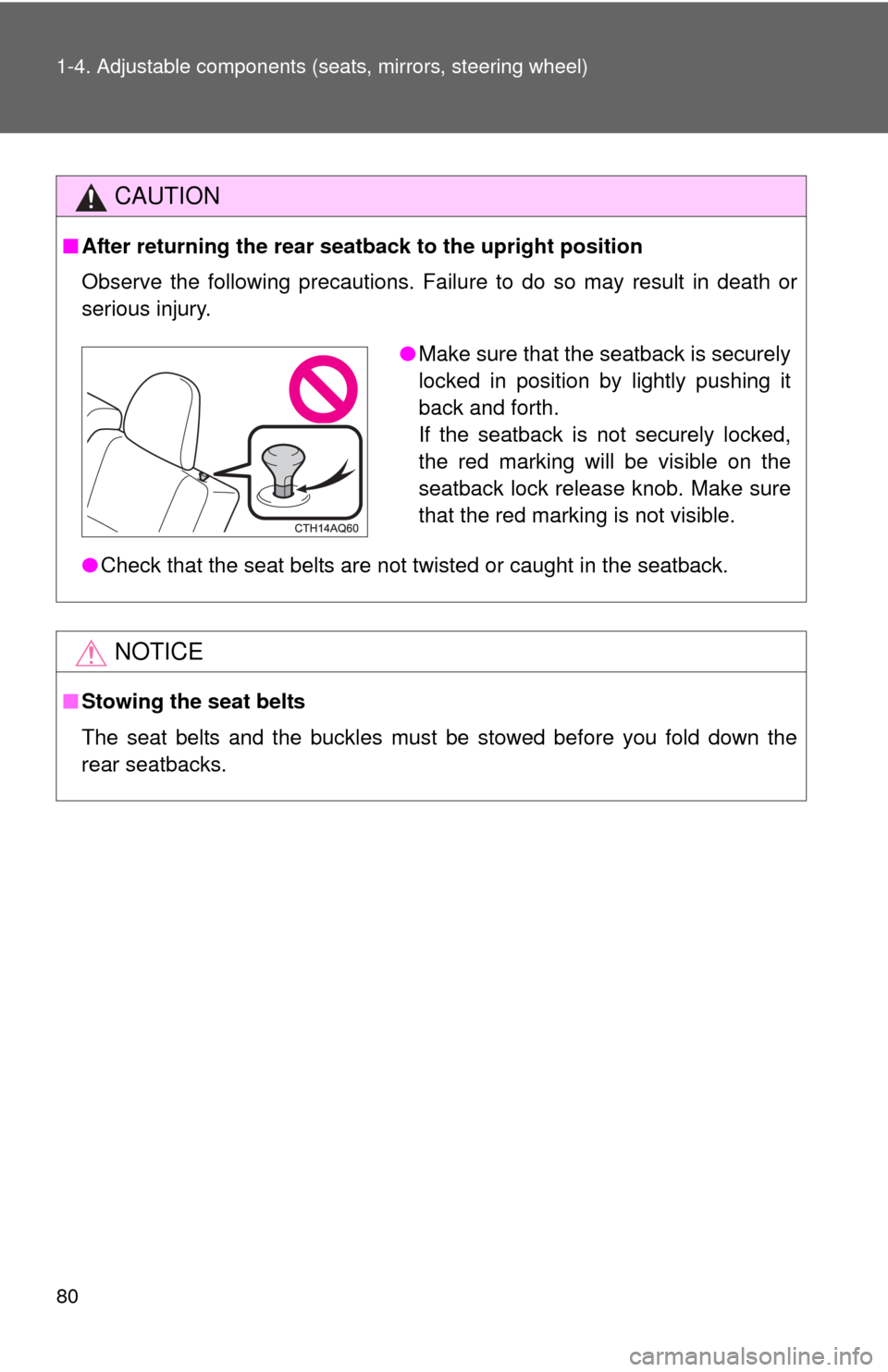
●Make sure that the seatback is securely
locked in position by lightly pushing it
back and forth.
If the seatback is not securely locked,
the red marking will be visible on the
seatback lock release knob. Make sure
that the red marking is not visible.
Page 84 of 556
84
1-4. Adjustable components (seats, mirrors, steering wheel)
Seat belts
Make sure that all occupants are wearing their seat belts before driv-
ing the vehicle.
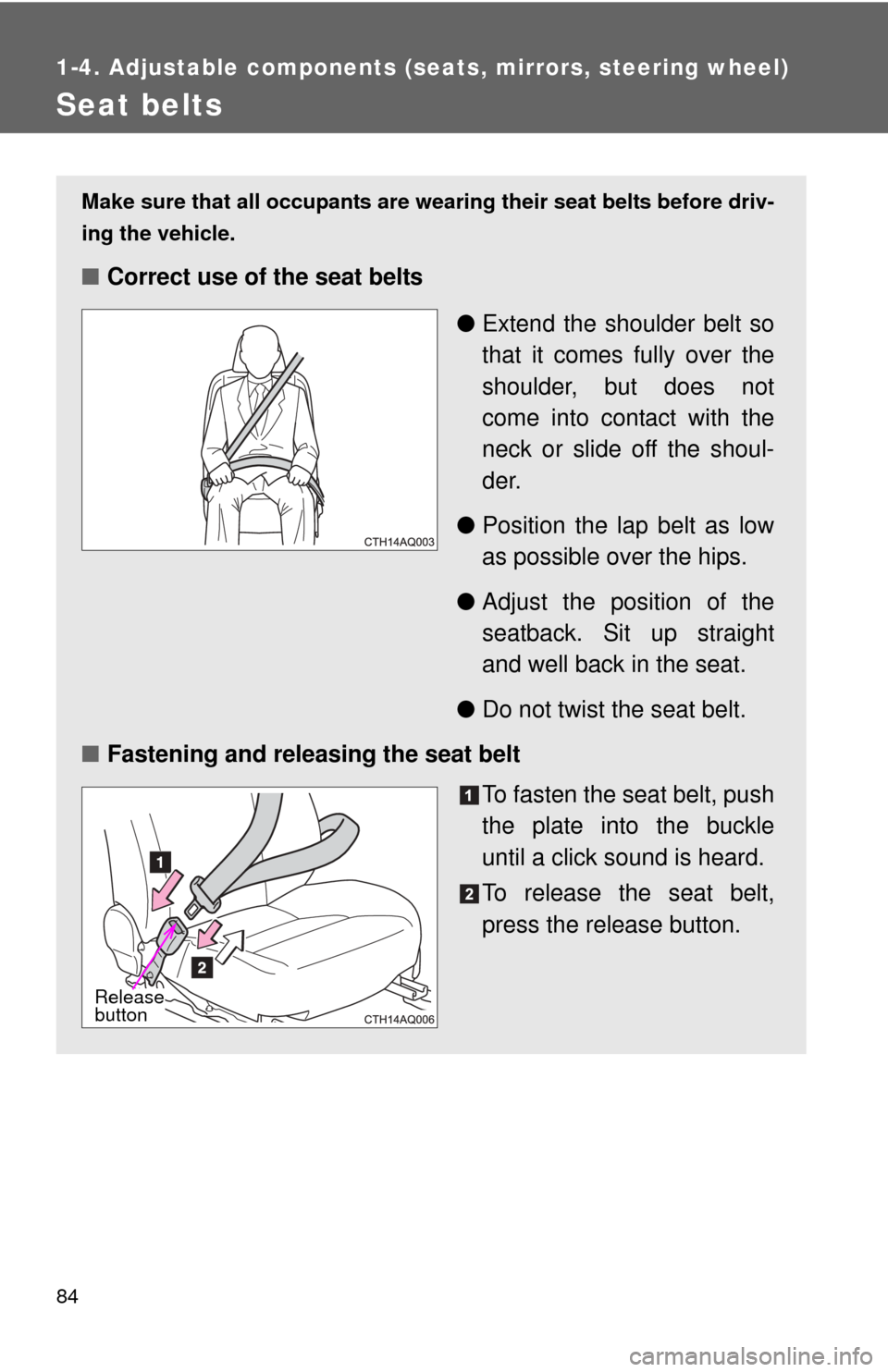
■Correct use of the seat belts
●Extend the shoulder belt so
that it comes fully over the
shoulder, but does not
come into contact with the
neck or slide off the shoul-
der.
● Position the lap belt as low
as possible over the hips.
● Adjust the position of the
seatback. Sit up straight
and well back in the seat.
● Do not twist the seat belt.
■ Fastening and releasing the seat belt
To fasten the seat belt, push
the plate into the buckle
until a click sound is heard.
To release the seat belt,
press the release button.
Release
button
Page 85 of 556
85
1-4. Adjustable components (s
eats, mirrors, steering wheel)
1
Before driving
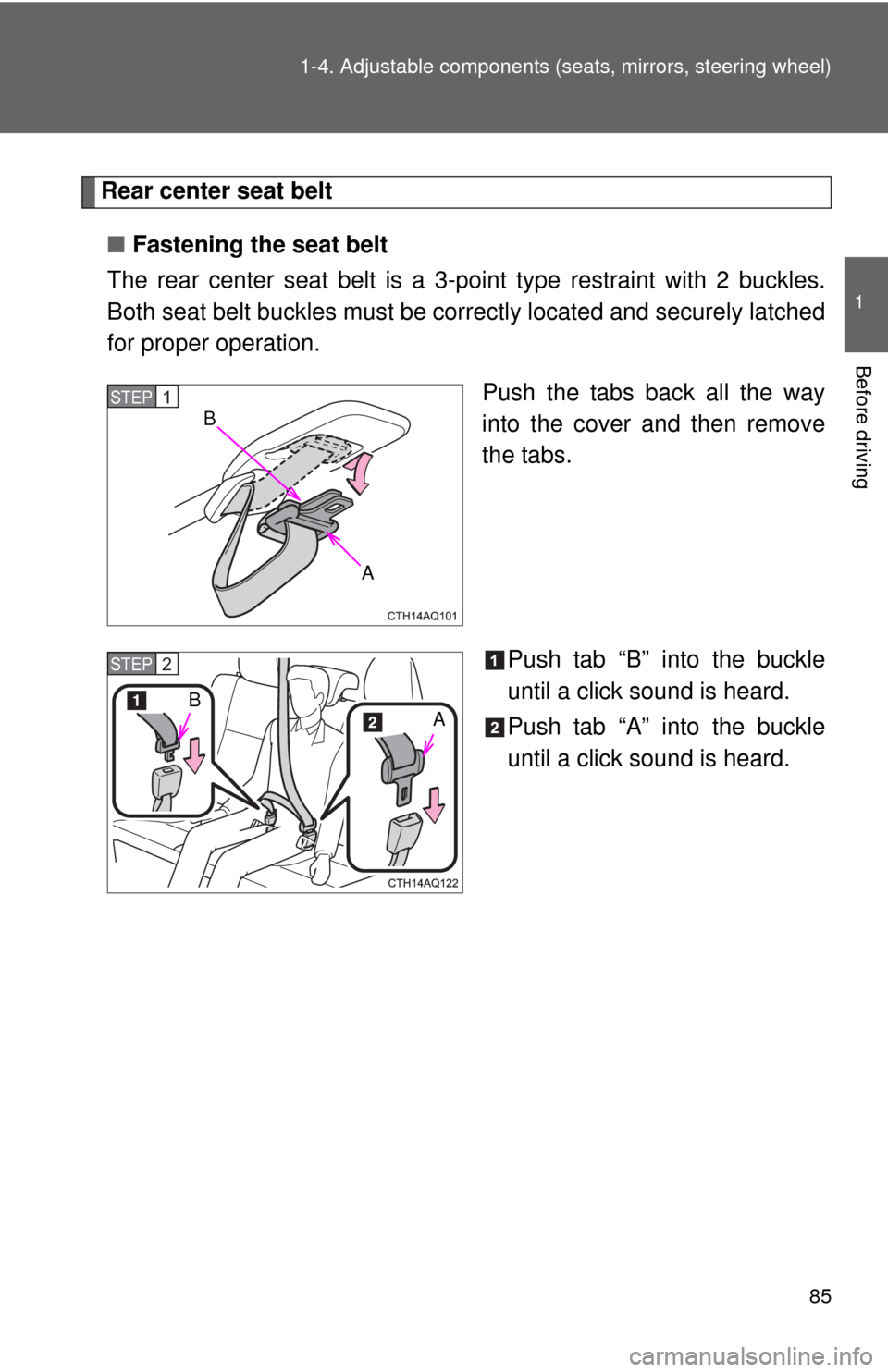
Rear center seat belt
■ Fastening the seat belt
The rear center seat belt is a 3- point type restraint with 2 buckles.
Both seat belt buckles must be co rrectly located and securely latched
for proper operation.
Push the tabs back all the way
into the cover and then remove
the tabs.
Push tab “B” into the buckle
until a click sound is heard.
Push tab “A” into the buckle
until a click sound is heard.
B
A
STEP1
STEP2
B A
Page 86 of 556
86 1-4. Adjustable components (seats, mirrors, steering wheel)
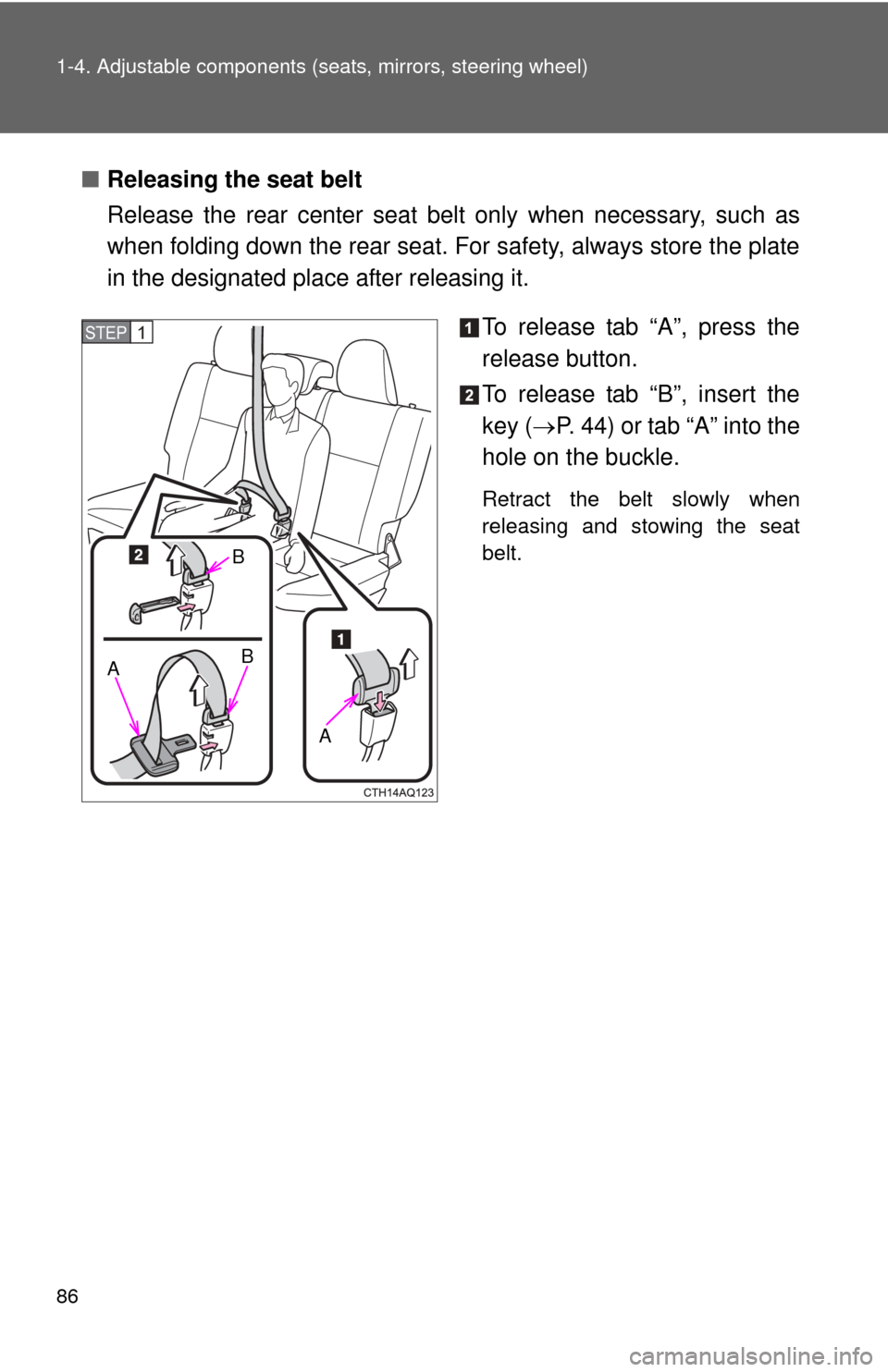
■Releasing the seat belt
Release the rear center seat belt only when necessary, such as
when folding down the rear seat. For safety, always store the plate
in the designated place after releasing it.
To release tab “A”, press the
release button.
To release tab “B”, insert the
key (P. 44) or tab “A” into the
hole on the buckle.
Retract the belt slowly when
releasing and stowing the seat
belt.
STEP1
A
A
B
B
Page 88 of 556
88 1-4. Adjustable components (seats, mirrors, steering wheel)
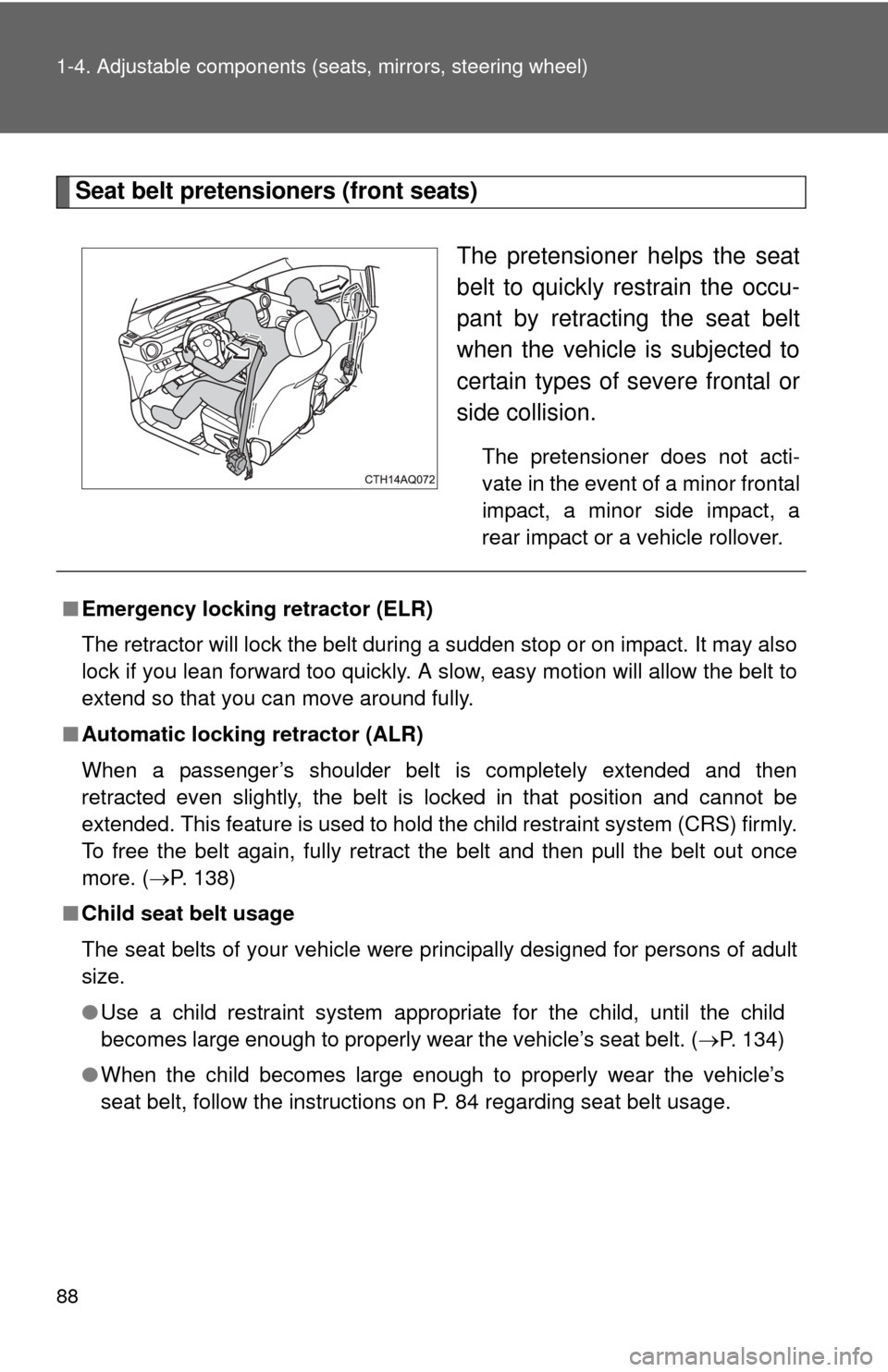
Seat belt pretensioners (front seats)
The pretensioner helps the seat
belt to quickly restrain the occu-
pant by retracting the seat belt
when the vehicle is subjected to
certain types of severe frontal or
side collision.
The pretensioner does not acti-
vate in the event of a minor frontal
impact, a minor side impact, a
rear impact or a vehicle rollover.
■Emergency locking retractor (ELR)
The retractor will lock the belt during a sudden stop or on impact. It may also
lock if you lean forward too quickly. A slow, easy motion will allow the belt to
extend so that you can move around fully.
■ Automatic locking retractor (ALR)
When a passenger’s shoulder belt is completely extended and then
retracted even slightly, the belt is locked in that position and cannot be
extended. This feature is used to hold the child restraint system (CRS) firmly.
To free the belt again, fully retract the belt and then pull the belt out once
more. ( P. 138)
■ Child seat belt usage
The seat belts of your vehicle were principally designed for persons of adult
size.
●Use a child restraint system appropriate for the child, until the child
becomes large enough to properly wear the vehicle’s seat belt. ( P. 134)
● When the child becomes large enough to properly wear the vehicle’s
seat belt, follow the instructions on P. 84 regarding seat belt usage.
Page 89 of 556
89
1-4. Adjustable components (s
eats, mirrors, steering wheel)
1
Before driving
■Replacing the belt after the pretensioner has been activated
If the vehicle is involved in multiple collisions, the pretensioner will activate
for the first collision, but will not activate for the second or subsequent colli-
sions.
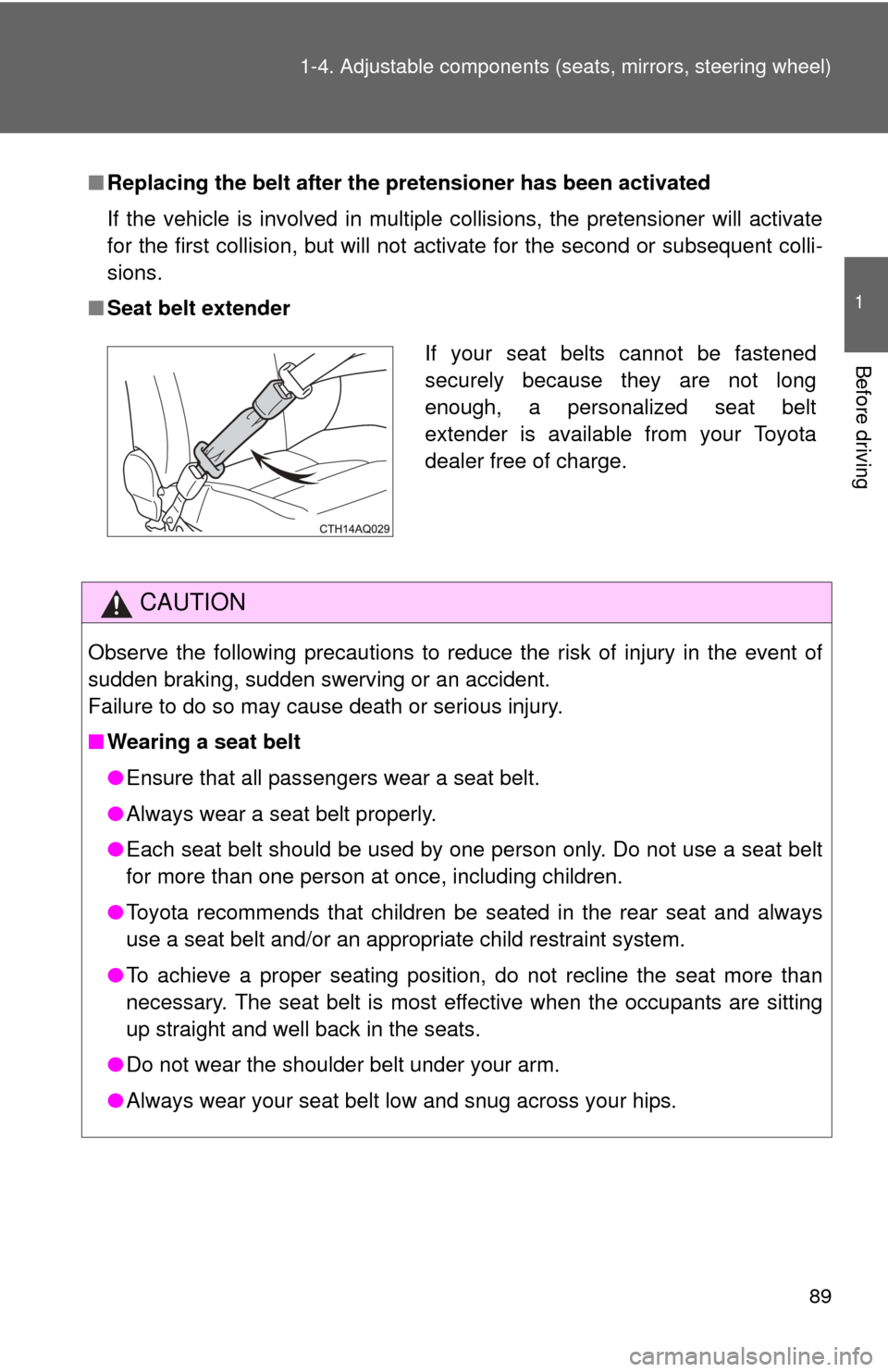
■ Seat belt extender
CAUTION
Observe the following precautions to reduce the risk of injury in the event of
sudden braking, sudden swerving or an accident.
Failure to do so may cause death or serious injury.
■Wearing a seat belt
●Ensure that all passengers wear a seat belt.
● Always wear a seat belt properly.
● Each seat belt should be used by one person only. Do not use a seat belt
for more than one person at once, including children.
● Toyota recommends that children be seated in the rear seat and always
use a seat belt and/or an appropriate child restraint system.
● To achieve a proper seating position, do not recline the seat more than
necessary. The seat belt is most effective when the occupants are sitting
up straight and well back in the seats.
● Do not wear the shoulder belt under your arm.
● Always wear your seat belt low and snug across your hips.
If your seat belts cannot be fastened
securely because they are not long
enough, a personalized seat belt
extender is available from your Toyota
dealer free of charge.
Page 90 of 556
90 1-4. Adjustable components (seats, mirrors, steering wheel)
CAUTION
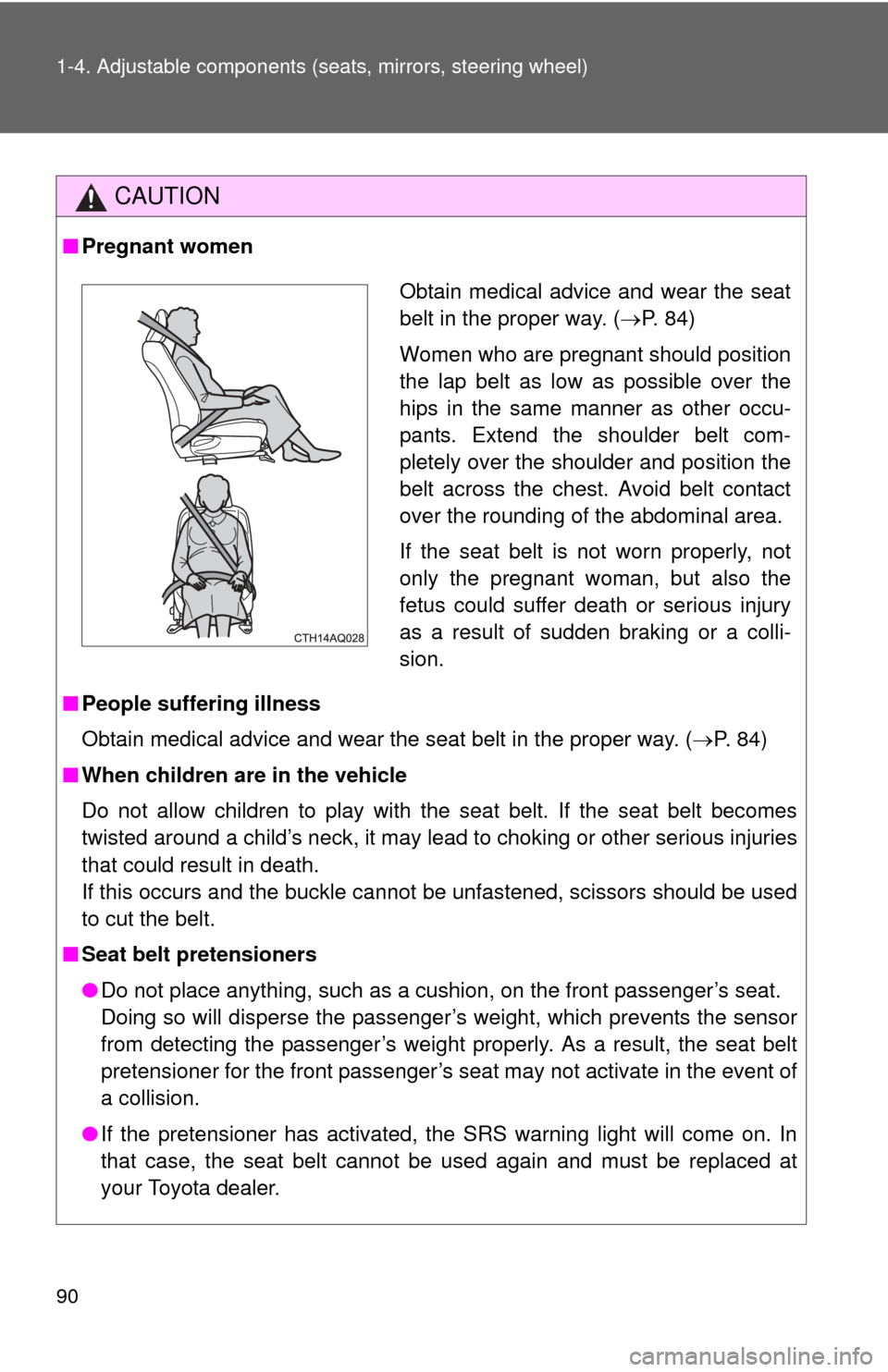
■Pregnant women
■ People suffering illness
Obtain medical advice and wear the seat belt in the proper way. ( P. 84)
■ When children are in the vehicle
Do not allow children to play with the seat belt. If the seat belt becomes
twisted around a child’s neck, it may lead to choking or other serious injuries
that could result in death.
If this occurs and the buckle cannot be unfastened, scissors should be used
to cut the belt.
■ Seat belt pretensioners
●Do not place anything, such as a cushion, on the front passenger’s seat.
Doing so will disperse the passenger’s weight, which prevents the sensor
from detecting the passenger’s weight properly. As a result, the seat belt
pretensioner for the front passenger’s seat may not activate in the event of
a collision.
● If the pretensioner has activated, the SRS warning light will come on. In
that case, the seat belt cannot be used again and must be replaced at
your Toyota dealer.
Obtain medical advice and wear the seat
belt in the proper way. ( P. 84)
Women who are pregnant should position
the lap belt as low as possible over the
hips in the same manner as other occu-
pants. Extend the shoulder belt com-
pletely over the shoulder and position the
belt across the chest. Avoid belt contact
over the rounding of the abdominal area.
If the seat belt is not worn properly, not
only the pregnant woman, but also the
fetus could suffer death or serious injury
as a result of sudden braking or a colli-
sion.
Page 91 of 556
91
1-4. Adjustable components (s
eats, mirrors, steering wheel)
1
Before driving
CAUTION
■Seat belt damage and wear
●Do not damage the seat belts by allowing the belt, plate, or buckle to be
jammed in the door.
● Inspect the seat belt system periodically. Check for cuts, fraying, and loose
parts. Do not use a damaged seat belt until it is replaced. Damaged seat
belts cannot protect an occupant from death or serious injury.
● Ensure that the belt and plate are locked and the belt is not twisted.
If the seat belt does not function correctly, immediately contact your Toyota
dealer.
● Replace the seat assembly, including the belts, if your vehicle has been
involved in a serious accident, even if there’s no obvious damage.
● Do not attempt to install, remove, modify, disassemble or dispose of the
seat belts. Have any necessary repairs carried out by your Toyota dealer.
Inappropriate handling of the pretensioner may prevent it from operating
properly, resulting in death or serious injury.
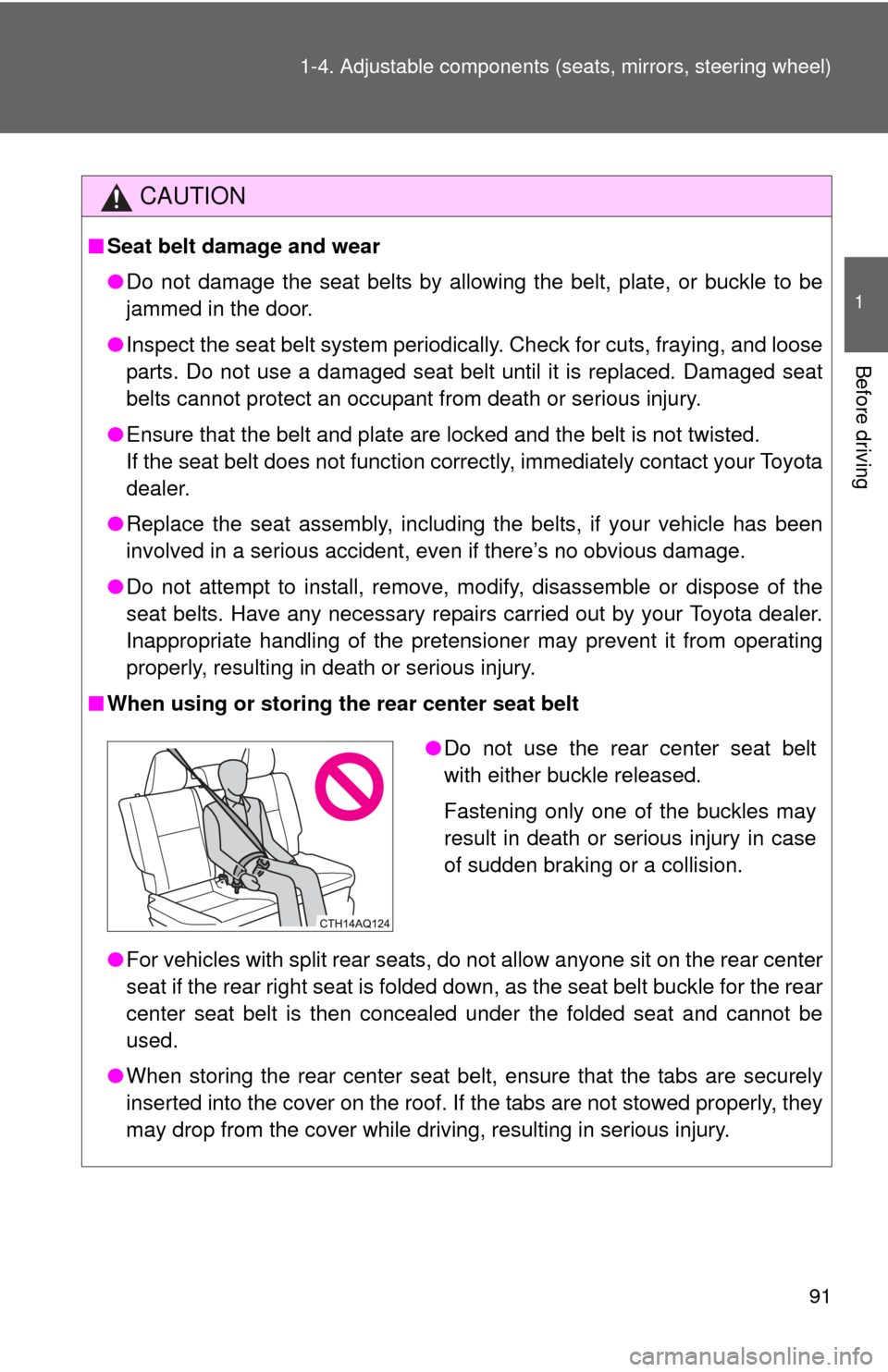
■ When using or storing the rear center seat belt
●For vehicles with split rear seats, do not allow anyone sit on the rear center
seat if the rear right seat is folded down, as the seat belt buckle for \
the rear
center seat belt is then concealed under the folded seat and cannot be
used.
● When storing the rear center seat bel t, ensure that the tabs are securely
inserted into the cover on the roof. If the tabs are not stowed properly, they
may drop from the cover while driving, resulting in serious injury.
● Do not use the rear center seat belt
with either buckle released.
Fastening only one of the buckles may
result in death or serious injury in case
of sudden braking or a collision.