belt TOYOTA PRIUS C 2013 NHP10 / 1.G Service Manual
[x] Cancel search | Manufacturer: TOYOTA, Model Year: 2013, Model line: PRIUS C, Model: TOYOTA PRIUS C 2013 NHP10 / 1.GPages: 556, PDF Size: 8.88 MB
Page 141 of 556
141
1-8. Safety information
1
Before driving
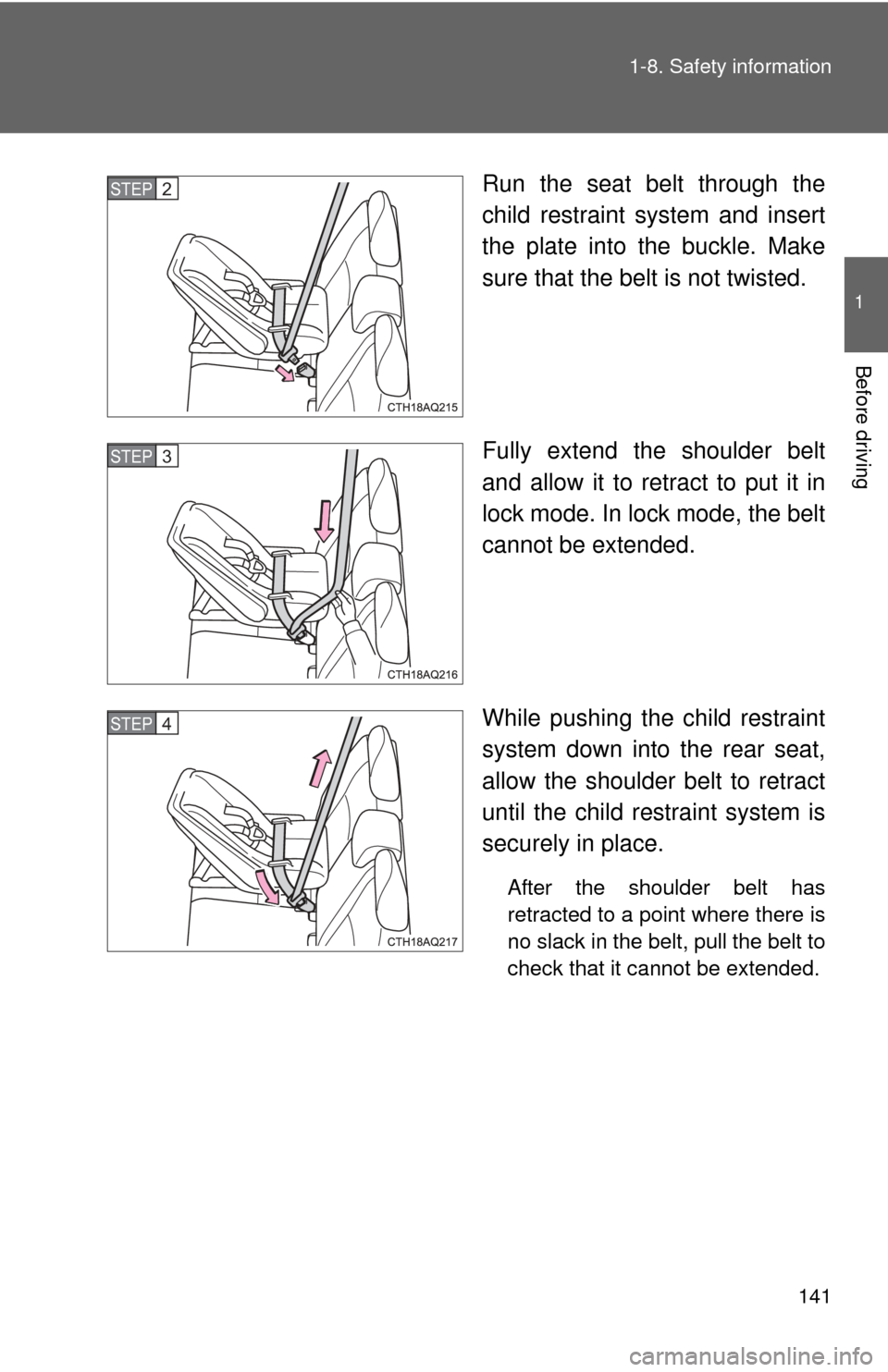
Run the seat belt through the
child restraint system and insert
the plate into the buckle. Make
sure that the belt is not twisted.
Fully extend the shoulder belt
and allow it to retract to put it in
lock mode. In lock mode, the belt
cannot be extended.
While pushing the child restraint
system down into the rear seat,
allow the shoulder belt to retract
until the child re
straint system is
securely in place.
After the shoulder belt has
retracted to a point where there is
no slack in the belt, pull the belt to
check that it cannot be extended.
STEP2
STEP3
STEP4
Page 142 of 556
142 1-8. Safety information
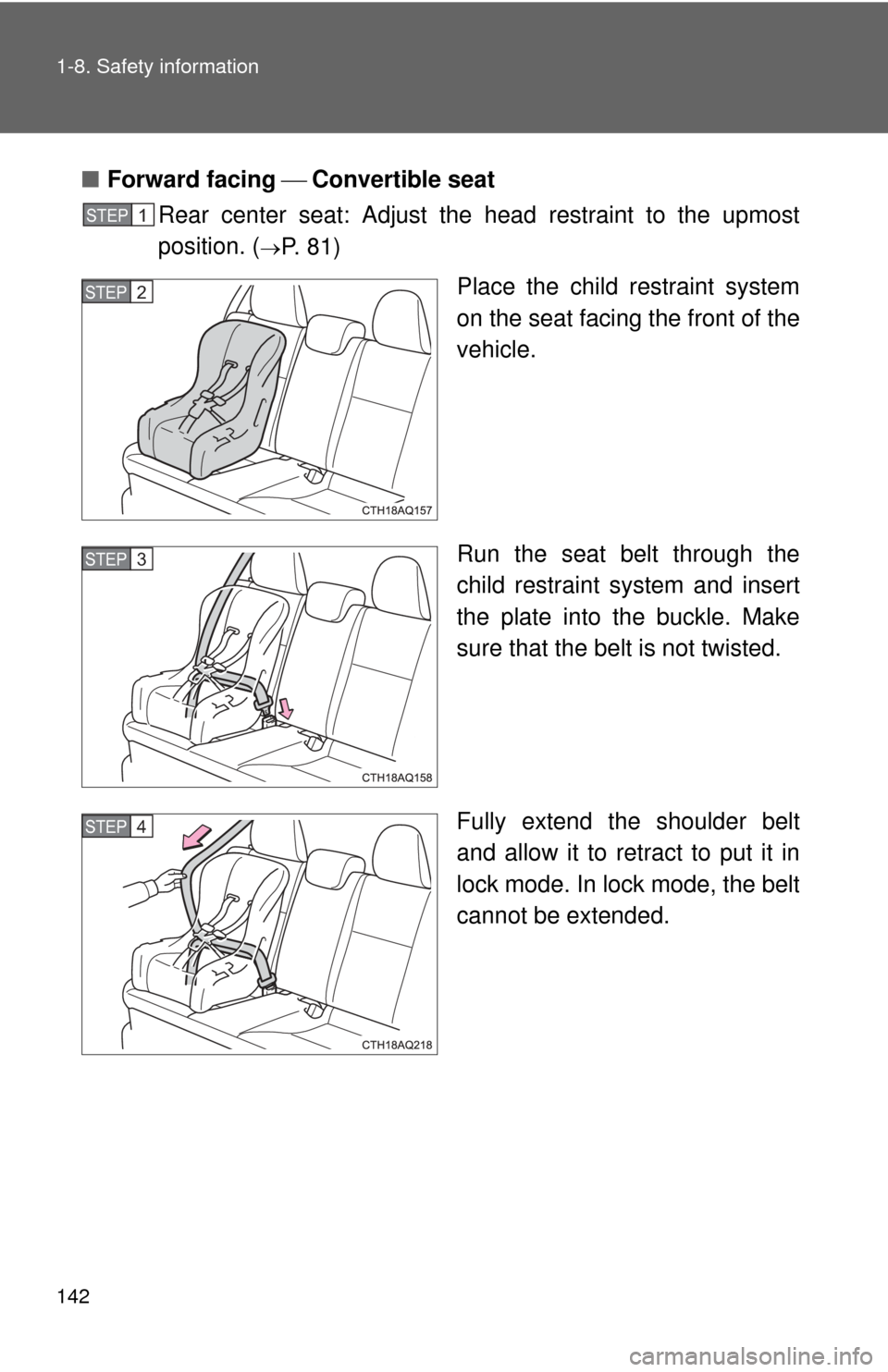
■Forward facing Convertible seat
Rear center seat: Adjust the head restraint to the upmost
position. (
P. 8 1 )
Place the child restraint system
on the seat facing the front of the
vehicle.
Run the seat belt through the
child restraint system and insert
the plate into the buckle. Make
sure that the belt is not twisted.
Fully extend the shoulder belt
and allow it to retract to put it in
lock mode. In lock mode, the belt
cannot be extended.
STEP1
STEP2
STEP3
STEP4
Page 143 of 556
143
1-8. Safety information
1
Before driving
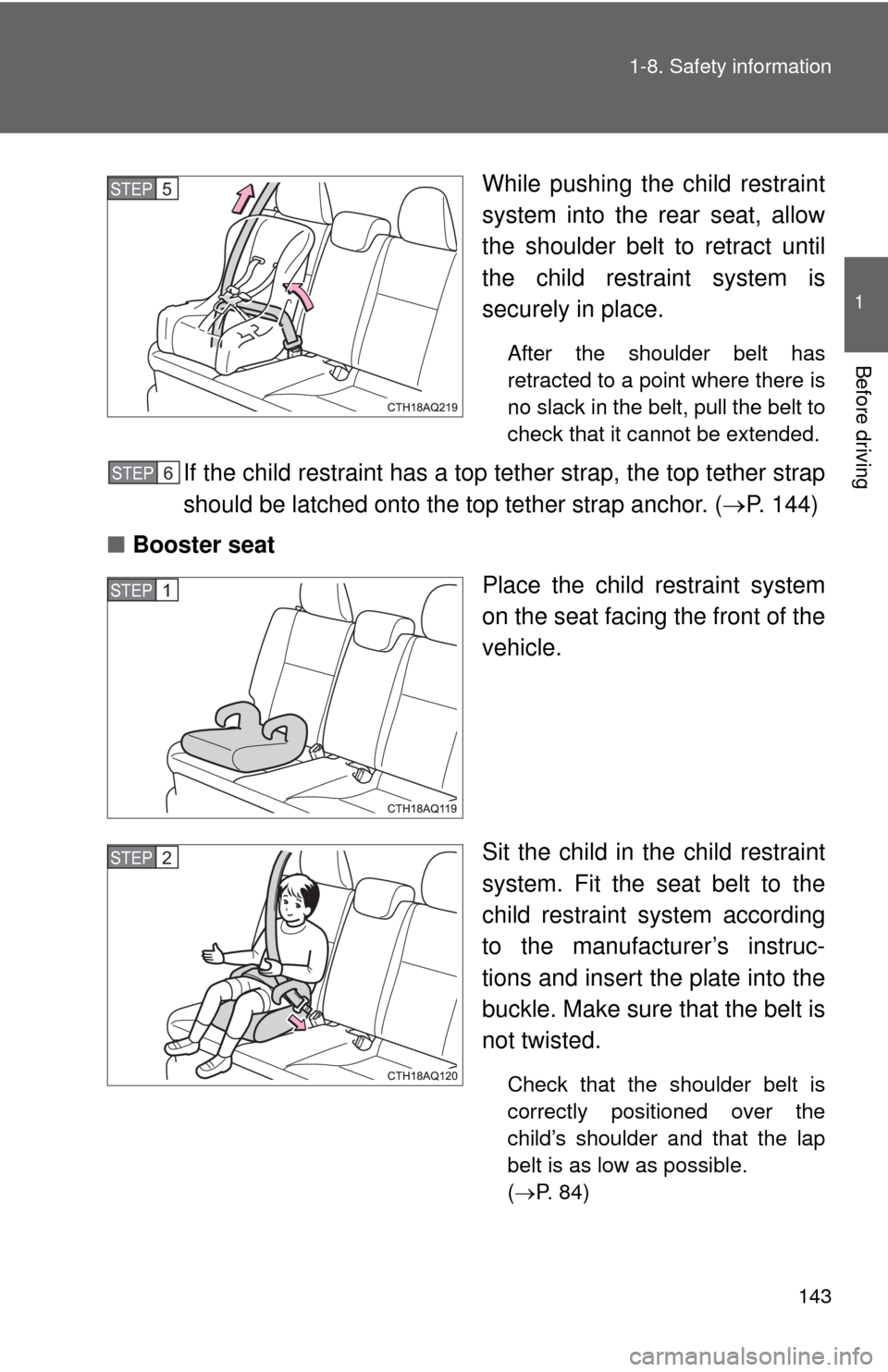
While pushing the child restraint
system into the rear seat, allow
the shoulder belt to retract until
the child restraint system is
securely in place.
After the shoulder belt has
retracted to a point where there is
no slack in the belt, pull the belt to
check that it cannot be extended.
If the child restraint has a top te
ther strap, the top tether strap
should be latched onto the top tether strap anchor. ( P. 144)
■ Booster seat
Place the child restraint system
on the seat facing the front of the
vehicle.
Sit the child in the child restraint
system. Fit the seat belt to the
child restraint system according
to the manufacturer’s instruc-
tions and insert the plate into the
buckle. Make sure that the belt is
not twisted.
Check that the shoulder belt is
correctly positioned over the
child’s shoulder and that the lap
belt is as low as possible.
( P. 84)
STEP5
STEP6
STEP1
STEP2
Page 144 of 556
144 1-8. Safety information
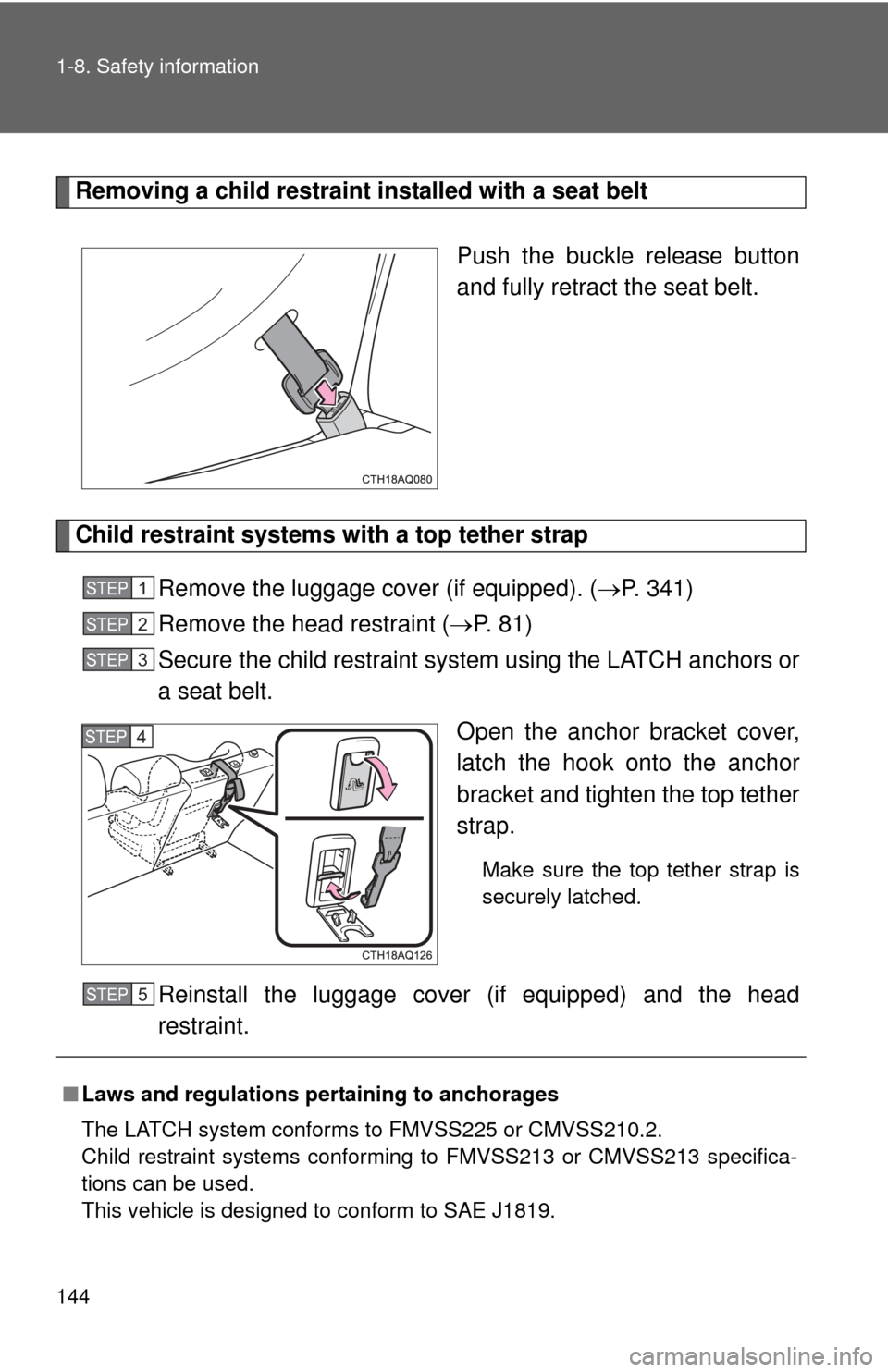
Removing a child restraint installed with a seat beltPush the buckle release button
and fully retract the seat belt.
Child restraint systems with a top tether strapRemove the luggage cover (if equipped). ( P. 341)
Remove the head restraint ( P. 81)
Secure the child restraint system using the LATCH anchors or
a seat belt.
Open the anchor bracket cover,
latch the hook onto the anchor
bracket and tighten the top tether
strap.
Make sure the top tether strap is
securely latched.
Reinstall the luggage cover (if equipped) and the head
restraint.
STEP1
STEP2
STEP3
STEP4
■Laws and regulations pertaining to anchorages
The LATCH system conforms to FMVSS225 or CMVSS210.2.
Child restraint systems conforming to FMVSS213 or CMVSS213 specifica-
tions can be used.
This vehicle is designed to conform to SAE J1819.
STEP5
Page 145 of 556
145
1-8. Safety information
1
Before driving
CAUTION
■
When installing a booster seat
To prevent the belt from going into ALR lock mode, do not fully extend the
shoulder belt. ALR mode causes the belt to tighten only. This could cause
injury or discomfort to the child. ( P. 88)
■ When installing a child restraint system
Follow the directions given in the child restraint system installation manual
and fix the child restraint system securely in place.
If the child restraint system is not correctly fixed in place, the child or other
passengers may be seriously injured or even killed in the event of sudden
braking, sudden swerving or an accident.
●When a booster seat is installed, always ensure that the shoulder belt is
positioned across the center of the child’s shoulder. The belt should be
kept away from the child’s neck, but not so that it could fall off the child’s
shoulder. Failure to do so may result in death or serious injury in the event
of sudden braking, sudden swerving or an accident.
● Ensure that the belt and plate are securely locked and the seat belt is not
twisted.
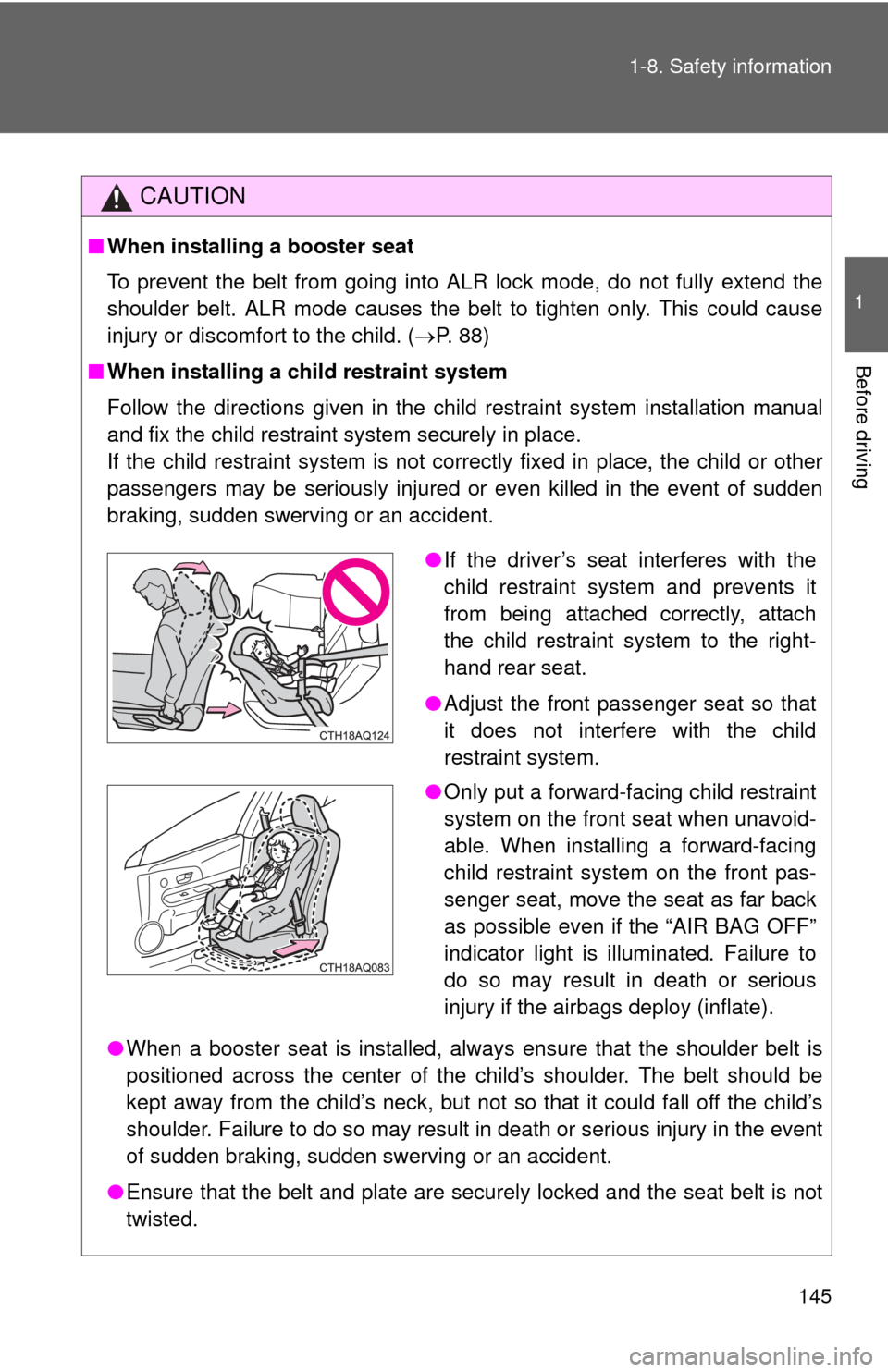
●If the driver’s seat interferes with the
child restraint system and prevents it
from being attached correctly, attach
the child restraint system to the right-
hand rear seat.
● Adjust the front passenger seat so that
it does not interfere with the child
restraint system.
● Only put a forward-facing child restraint
system on the front seat when unavoid-
able. When installing a forward-facing
child restraint system on the front pas-
senger seat, move the seat as far back
as possible even if the “AIR BAG OFF”
indicator light is illuminated. Failure to
do so may result in death or serious
injury if the airbags deploy (inflate).
Page 146 of 556
146 1-8. Safety information
CAUTION
■When installing a child restraint system
●Shake the child restraint system left and right, and forward and backward
to ensure that it has been securely installed.
● After securing a child restraint system, never adjust the seat.
● Follow all installation instructions provided by the child restraint system
manufacturer.
● When a child restraint system with a top tether strap is installed, do not
install the head restraint. The head restraint may interfere with the top
tether strap preventing secure installation of the child restraint system.
● Make sure to properly store the removed head restraint in a secure place
when you use the child restraint system on the rear seat.
■ Do not use a seat belt extender
If a seat belt extender is used when installing a child restraint system, the
seat belt will not securely hold the child restraint system, which could cause
death or serious injury to the child or other passengers in the event of sud-
den braking, sudden swerving or an accident.
■ To correctly attach a child r estraint system to the anchors
When using the LATCH anchors, be sure that there are no foreign objects
around the anchors and that the seat belt is not caught behind the child
restraint. Make sure the child restraint system is securely attached, or it may
cause death or serious injury to the child or other passengers in the event of
sudden braking, sudden swerving or an accident.
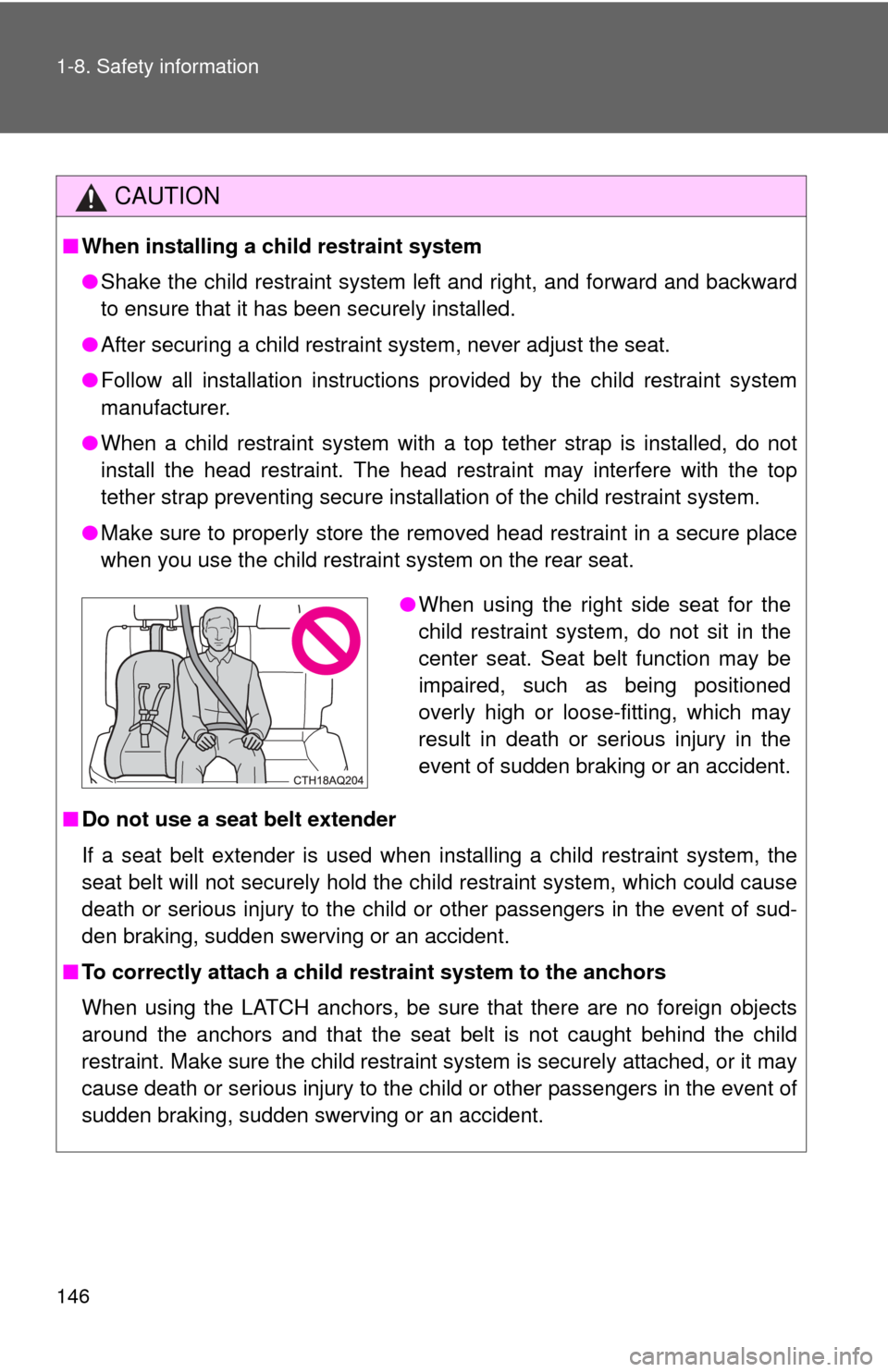
● When using the right side seat for the
child restraint system, do not sit in the
center seat. Seat belt function may be
impaired, such as being positioned
overly high or loose-fitting, which may
result in death or serious injury in the
event of sudden braking or an accident.
Page 227 of 556
227
2-5. Driving information
2
When driving
CAUTION
●Secure all items in the occupant compartment, as they may shift and
injure someone during sudden braking, sudden swerving or an acci-
dent.
●When you fold down the rear seats, long items should not be placed
directly behind the front seats.
●Never allow anyone to ride in the luggage compartment. It is not
designed for passengers. They should ride in their seats with their seat
belts properly fastened. Otherwise,
they are much more likely to suffer
death or serious bodily injury, in t he event of sudden braking, sudden
swerving or an accident.
■Capacity and distribution
●Do not exceed the maximum axle weight rating or the total vehicle
weight rating.
●Even if the total load of occupant's weight and the cargo load is less
than the total load capacity, do no t apply the load unevenly. Improper
loading may cause deterioration of st eering or braking control which
may cause death or serious injury.
Page 347 of 556
347
4-1. Maintenance and care
4
Maintenance and care
Cleaning and protecting the vehicle interior
■Shampooing the carpets
There are several commercial foaming-type cleaners available. Use a
sponge or brush to apply the foam. Rub in overlapping circles. Do not use
water. Wipe dirty surfaces and let them dry. Excellent results are obtained by
keeping the carpet as dry as possible.
■ Seat belts
Clean with mild soap and lukewarm water using a cloth or sponge. Also
check the belts periodically for excessive wear, fraying or cuts.
The following procedures will help prot ect your vehicle's interior and
keep it in top condition:
■ Protecting the vehicle interior
Remove dirt and dust using a vacuum cleaner. Wipe dirty sur-
faces with a cloth dampened with lukewarm water.
■ Cleaning the synthetic leather areas
●Remove loose dirt using a vacuum cleaner.
● Apply a mild soap solution to the synthetic leather using a
sponge or soft cloth.
● Allow the solution to soak in for a few minutes. Remove the
dirt and wipe off the solution with a clean, damp cloth.
Page 355 of 556
355
4-2. Maintenance
4
Maintenance and care
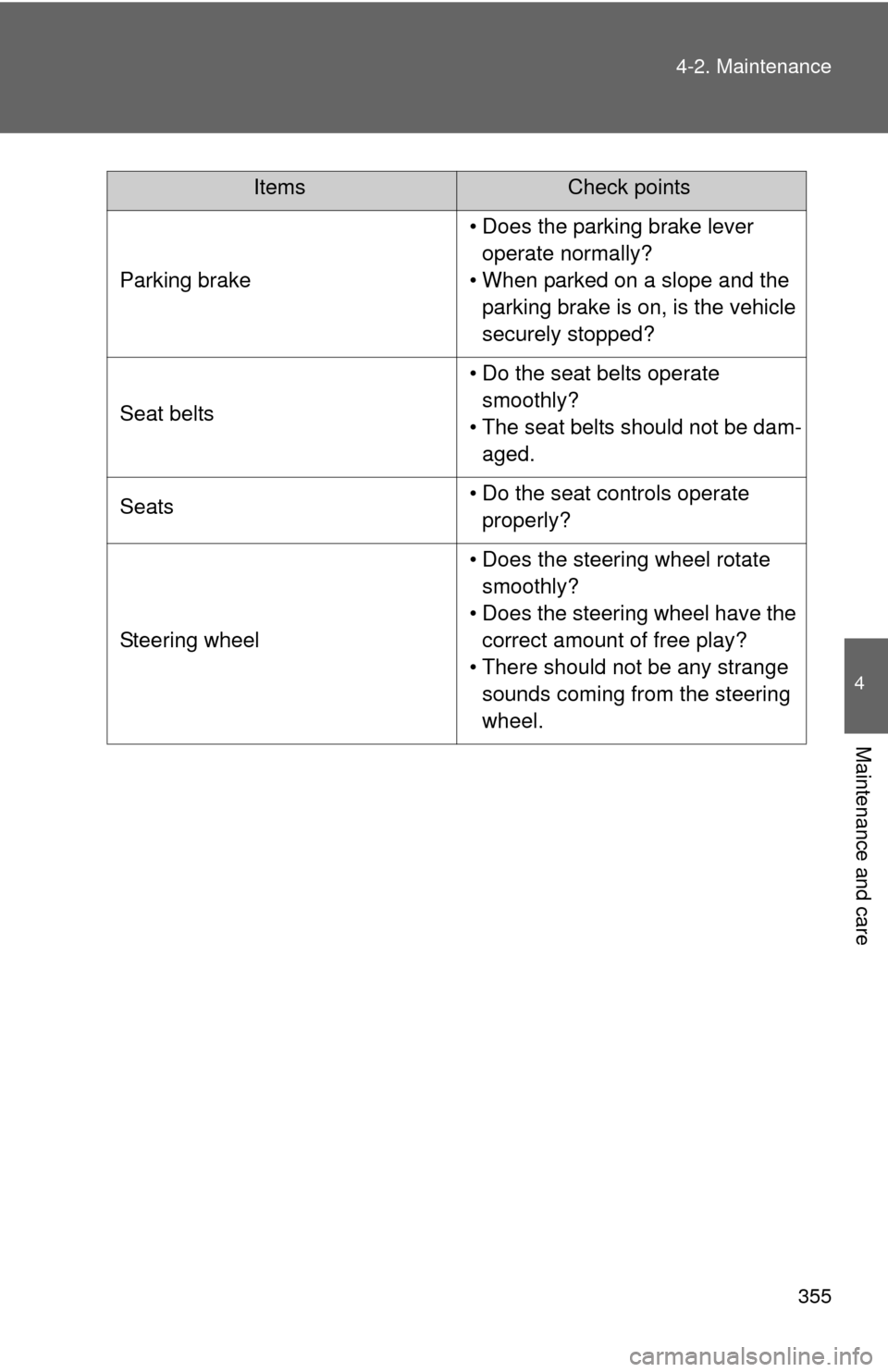
Parking brake
• Does the parking brake lever
operate normally?
• When parked on a slope and the parking brake is on, is the vehicle
securely stopped?
Seat belts • Do the seat belts operate
smoothly?
• The seat belts should not be dam- aged.
Seats • Do the seat controls operate
properly?
Steering wheel • Does the steering wheel rotate
smoothly?
• Does the steering wheel have the correct amount of free play?
• There should not be any strange sounds coming from the steering
wheel.
ItemsCheck points
Page 360 of 556
360 4-3. Do-it-yourself maintenance
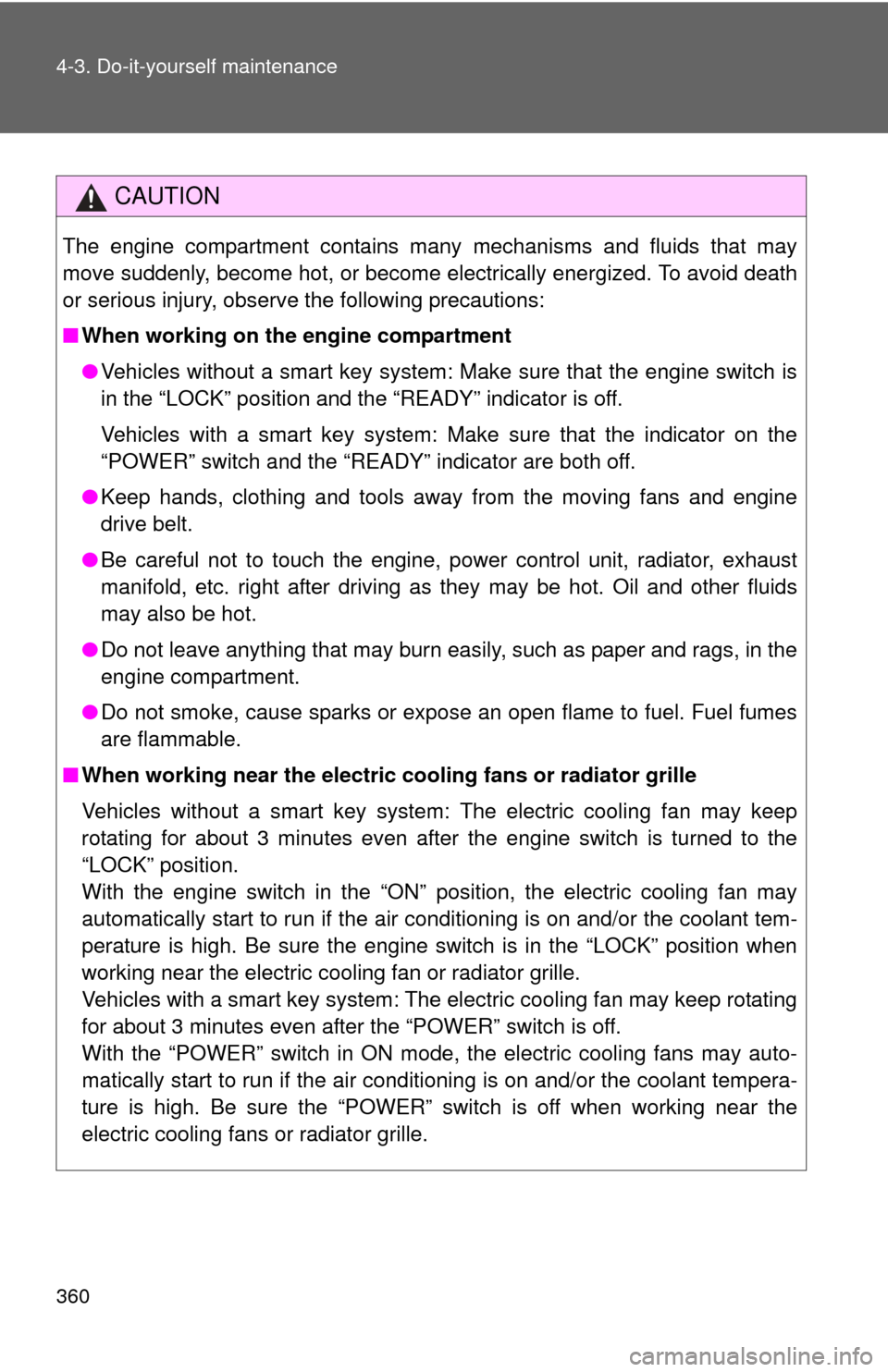
CAUTION
The engine compartment contains many mechanisms and fluids that may
move suddenly, become hot, or become electrically energized. To avoid death
or serious injury, observe the following precautions:
■When working on the engine compartment
●Vehicles without a smart key system: Make sure that the engine switch is
in the “LOCK” position and the “READY” indicator is off.
Vehicles with a smart key system: Make sure that the indicator on the
“POWER” switch and the “READY” indicator are both off.
● Keep hands, clothing and tools away from the moving fans and engine
drive belt.
● Be careful not to touch the engine, power control unit, radiator, exhaust
manifold, etc. right after driving as they may be hot. Oil and other fluids
may also be hot.
● Do not leave anything that may burn easily, such as paper and rags, in the
engine compartment.
● Do not smoke, cause sparks or expose an open flame to fuel. Fuel fumes
are flammable.
■ When working near the electric c ooling fans or radiator grille
Vehicles without a smart key system: The electric cooling fan may keep
rotating for about 3 minutes even after the engine switch is turned to the
“LOCK” position.
With the engine switch in the “ON” position, the electric cooling fan may
automatically start to run if the air conditioning is on and/or the coolant tem-
perature is high. Be sure the engine switch is in the “LOCK” position when
working near the electric cooling fan or radiator grille.
Vehicles with a smart key system: The electric cooling fan may keep rotating
for about 3 minutes even after the “POWER” switch is off.
With the “POWER” switch in ON mode, the electric cooling fans may auto-
matically start to run if the air conditioning is on and/or the coolant tempera-
ture is high. Be sure the “POWER” switch is off when working near the
electric cooling fans or radiator grille.