stop start TOYOTA PRIUS C 2014 NHP10 / 1.G Owner's Manual
[x] Cancel search | Manufacturer: TOYOTA, Model Year: 2014, Model line: PRIUS C, Model: TOYOTA PRIUS C 2014 NHP10 / 1.GPages: 563, PDF Size: 8.89 MB
Page 222 of 563
221
2-4. Using other driving systems
2
When driving
Driving assist systems
To help enhance driving safety and performance, the following sys-
tems operate automatically in res ponse to various driving situations.
Be aware, however, that these systems are supplementary and
should not be relied upon too heavi ly when operating the vehicle.
■ABS (Anti-lock Brake System)
Helps to prevent wheel lock when the brakes are applied suddenly, or if
the brakes are applied while driving on a slippery road surface
■Brake assist
Generates an increased level of braking force after the brake pedal is
depressed when the system detects a panic stop situation
■VSC (Vehicle Stability Control)
Helps the driver to control skidding when swerving suddenly or turning
on slippery road surfaces
■TRAC (Traction Control)
Helps to maintain drive power and prevent the drive wheels from spin-
ning when starting the vehicle or accelerating on slippery roads
■Hill-start assist control
Helps to prevent the vehicle from rolling backward when starting on an
incline
■EPS (Electric Power Steering)
Employs an electric motor to reduce the amount of effort needed to turn
the steering wheel
Page 223 of 563
222 2-4. Using other driving systems
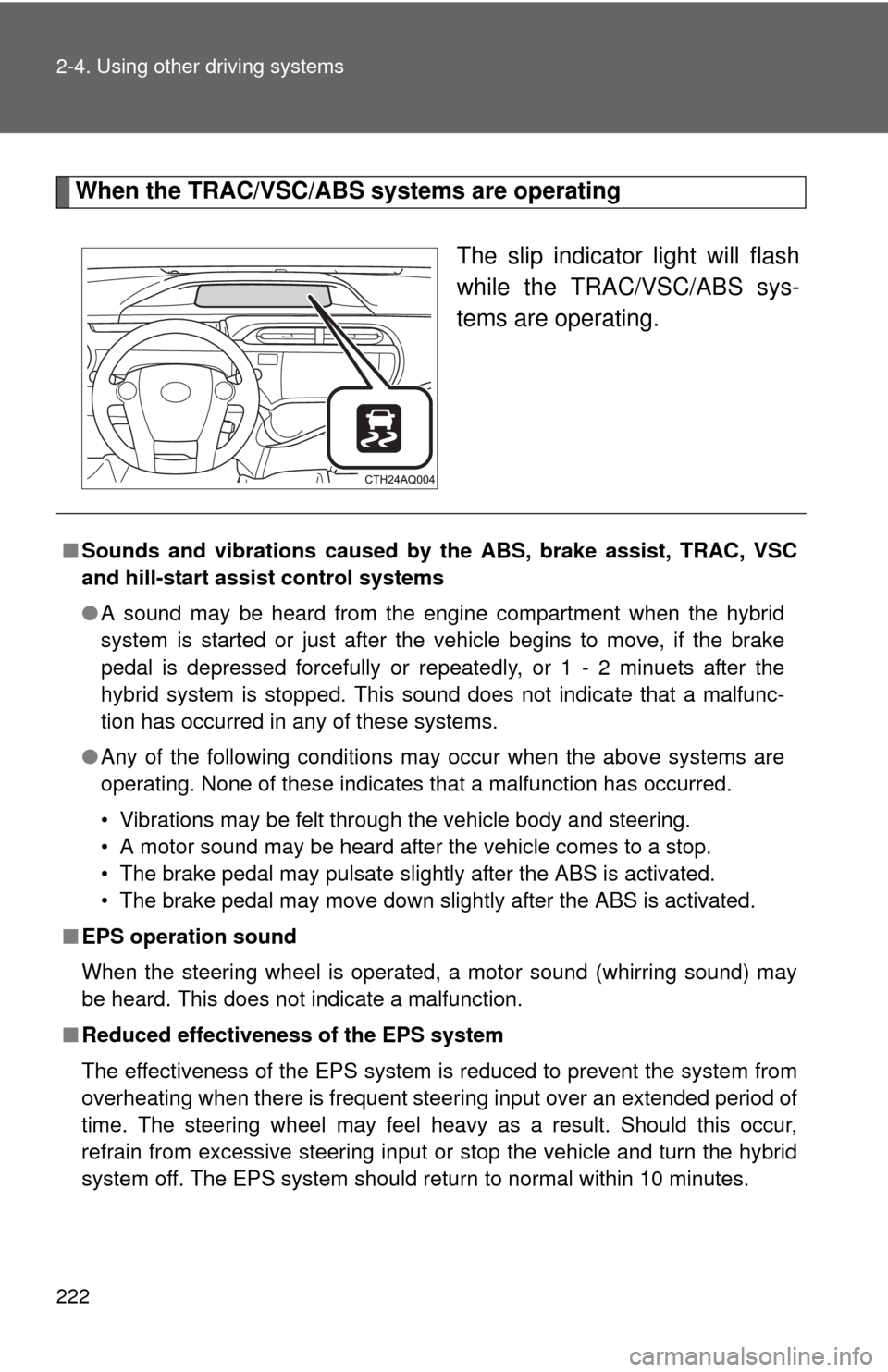
When the TRAC/VSC/ABS systems are operatingThe slip indicator light will flash
while the TRAC/VSC/ABS sys-
tems are operating.
■Sounds and vibrations caused by the ABS, brake assist, TRAC, VSC
and hill-start assist control systems
● A sound may be heard from the engine compartment when the hybrid
system is started or just after the vehicle begins to move, if the brake
pedal is depressed forcefully or repeatedly, or 1 - 2 minuets after the
hybrid system is stopped. This sound does not indicate that a malfunc-
tion has occurred in any of these systems.
● Any of the following conditions may occur when the above systems are
operating. None of these indicates that a malfunction has occurred.
• Vibrations may be felt through the vehicle body and steering.
• A motor sound may be heard after the vehicle comes to a stop.
• The brake pedal may pulsate slightly after the ABS is activated.
• The brake pedal may move down slightly after the ABS is activated.
■ EPS operation sound
When the steering wheel is operated, a motor sound (whirring sound) may
be heard. This does not indicate a malfunction.
■ Reduced effectiveness of the EPS system
The effectiveness of the EPS system is reduced to prevent the system from
overheating when there is frequent steering input over an extended period of
time. The steering wheel may feel heavy as a result. Should this occur,
refrain from excessive steering input or stop the vehicle and turn the hybrid
system off. The EPS system should return to normal within 10 minutes.
Page 224 of 563

223
2-4. Using other
driving systems
2
When driving
■Operating conditions of hill-start assist control
When the following four conditions are met, the hill-start assist control will
operate:
● The shift lever is in a position other than P or N (when starting off for-
ward/backward on an upward incline).
● The vehicle is stopped.
● The accelerator pedal is not depressed.
● The parking brake is not engaged.
■ Automatic system cancelation of hill-start assist control
The hill-start assist control will turn off in any of the following situations:
●The shift lever is moved to P or N.
● The accelerator pedal is depressed.
● The parking brake is engaged.
● Approximately 2 seconds elapse after the brake pedal is released.
Page 225 of 563

224 2-4. Using other driving systems
CAUTION
■The ABS does not operate effectively when
●The limits of tire gripping performance have been exceeded (such as
excessively worn tires on a snow covered road).
● The vehicle hydroplanes while driving at high speed on wet or slick roads.
■ Stopping distance when the ABS is operating may exceed that of nor-
mal conditions
The ABS is not designed to shorten the vehicle’s stopping distance. Always
maintain a safe distance from the vehicle in front of you, especially in the fol-
lowing situations:
● When driving on dirt, gravel or snow-covered roads
● When driving with tire chains
● When driving over bumps in the road
● When driving over roads with potholes or uneven surfaces
■ TRAC may not operate effectively when
Directional control and power may not be achievable while driving on slip-
pery road surfaces, even if the TRAC system is operating.
Drive the vehicle carefully in conditions where stability and power may be
lost.
■ Hill-start assist control
●Do not overly rely on hill-start assist control. Hill-start assist control may
not operate effectively on steep inclines and roads covered with ice.
● Unlike the parking brake, hill-start assist control is not intended to hold the
vehicle stationary for an extended period of time. Do not attempt to use
hill-start assist control to hold the vehicle on an incline, as doing so may
lead to an accident.
Page 370 of 563
367
4-3. Do-it-yourself maintenance
4
Maintenance and care
CAUTION
■
When raising your vehicle
Make sure to observe the following precautions to reduce the possibility of
death or serious injury:
●When using a floor jack, follow the instructions of the manual provided with
the jack.
● Do not use the jack that was supplied with your vehicle.
● Do not put any part of your body underneath the vehicle when it is sup-
ported only by the floor jack.
● Always use floor jack and/or automotive jack stands on a solid, flat, level
surface.
● Do not start the hybrid system while the vehicle is supported by the floor
jack.
● Stop the vehicle on level, firm ground, set the parking brake and shift the
shift lever to P.
● Make sure to set the floor jack properly at the jack point.
Raising the vehicle with an improperly positioned floor jack will damage
the vehicle and may cause the vehicle to fall off the floor jack.
● Do not raise the vehicle while someone is in the vehicle.
● When raising the vehicle, do not place any object on top of or underneath
the floor jack.
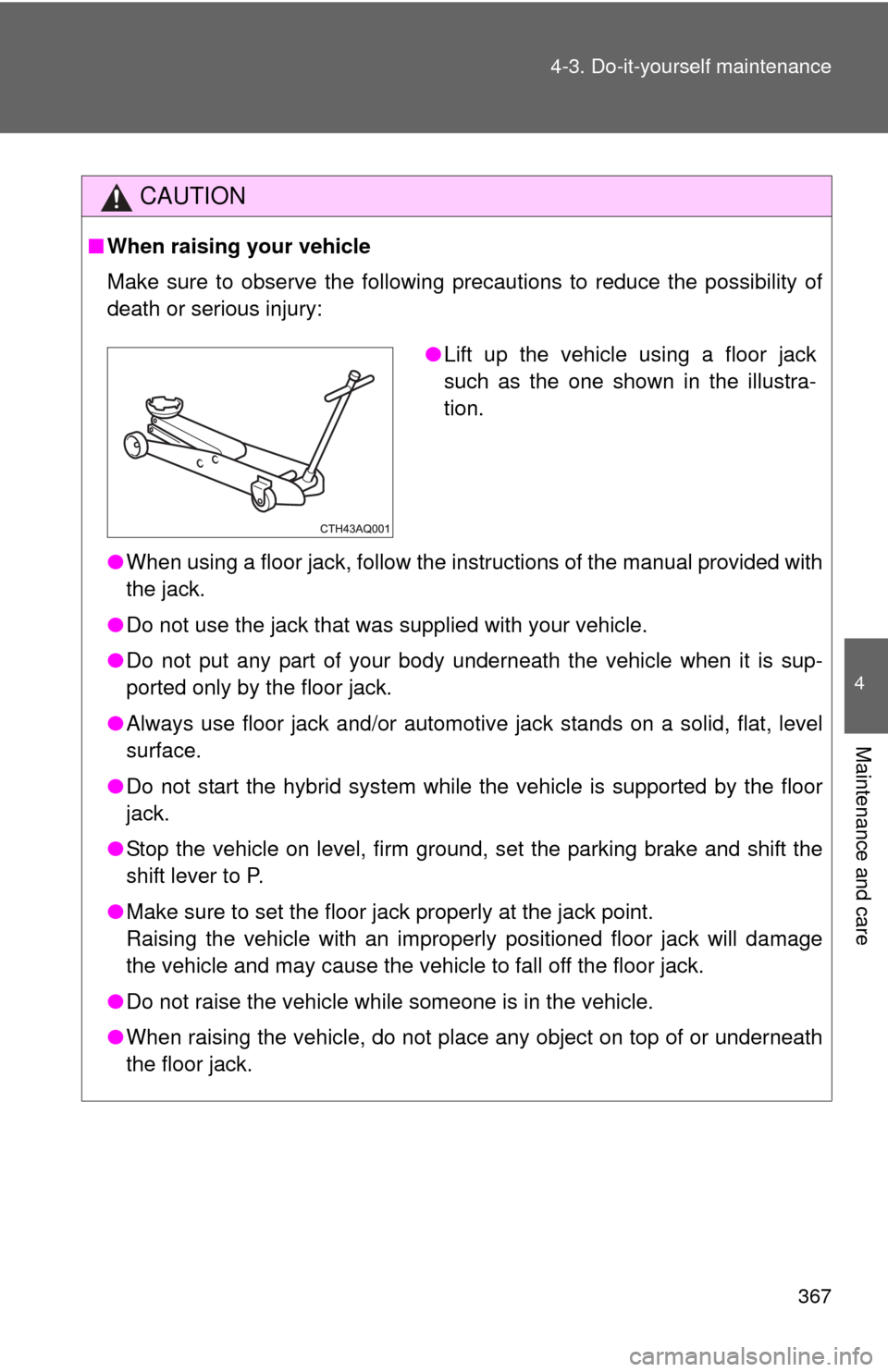
●Lift up the vehicle using a floor jack
such as the one shown in the illustra-
tion.
Page 416 of 563

413
4-3. Do-it-yourself maintenance
4
Maintenance and care
13 DOOR R/L 20 A Rear pow
er window (left side)
14 DOOR D 20 A Front power window (left side)
15 CIG 15 A Power outlet
16 ACC 5 A Main body ECU, audio system, out-
side rear view mirrors, shift lock
control system
17 D/L 25 A Power door lock system
18 OBD 7.5 A On-board diagnosis
19 STOP 7.5 A Starter system, shift lock control
system, vehicle proximity notifica-
tion system, brake system, stop
lights, high mounted stoplight
20 AM1 7.5 A Starter system
21 FOG FR 15 A Front fog lights
22 S/ROOF 25 A Moon roof
23 S/HTR 15 A Seat heaters, air conditioning sys-
tem
■ After a fuse is replaced
●If the lights do not turn on even after the fuse has been replaced, a bulb
may need replacement. ( P. 415)
● If the replaced fuse blows again, have the vehicle inspected by your
Toyota dealer.
■ If there is an overload in a circuit
The fuses are designed to blow, protecting the wiring harness from damage.
FuseAmpereCircuit
Page 430 of 563
When trouble arises5
427
5-1. Essential informationEmergency flashers ......... 428
If your vehicle needs to be towed ........................ 429
If you think something is wrong ......................... 436
5-2. Steps to take in an emergency
If a warning light turns on or a warning buzzer
sounds ........................... 437
If a warning message is displayed........................ 447
If you have a flat tire......... 463
If the hybrid system will not start .......................... 475
If the shift lever cannot be shifted from P............ 477
If you lose your keys ........ 478
If the electronic key does not operate properly....... 479
If the vehicle 12-volt battery is discharged ...... 481
If your vehicle overheats ....................... 487
If the vehicle becomes stuck .............................. 492
If your vehicle has to be stopped in an
emergency ..................... 493
Page 448 of 563

5
When trouble arises
445
5-2. Steps to take in an emergency
CAUTION
■Maintenance of the tires
Each tire, including the spare (if provided), should be checked monthly
when cold and inflated to the inflation pressure recommended by the
vehicle manufacturer on the vehicle
placard or tire inflation pressure
label (tire and load information label). (If your vehicle has tires of a differ-
ent size than the size indicated on the vehicle placard or tire inflation
pressure label [tire and load information label], you should determine the
proper tire inflation pr essure for those tires.)
As an added safety feature, your vehicle has been equipped with a tire
pressure monitoring system (TPMS-ti re pressure warning system) that
illuminates a low tire pressure telltal e (tire pressure warning light) when
one or more of your tires is significantly under-inflated. Accordingly,
when the low tire pressure telltale (tire pre ssure warning light) illumi-
nates, you should stop and check your tires as soon as possible, and
inflate them to the proper pressure. Driving on a significantly under-
inflated tire causes the tire to overheat and can lead to tire failure.
Under-inflation also reduces fuel effi ciency and tire tread life, and may
affect the vehicle's hand ling and stopping ability.
Please note that the TPMS (tire pressure warning system) is not a sub-
stitute for proper ti re maintenance, an d it is the driver's responsibility to
maintain correct tire pressure, even if under-inflation has not reached the
level to trigger illu mination of the TPMS low ti re pressure telltale (tire
pressure warning light).
Your vehicle has also been equipped with a TPMS (tire pressure warning
system) malfunction indicator to indi cate when the system is not operat-
ing properly. The TPMS (tire pressure warning system) malfunction indi-
cator is combined with the low tire pressure telltale (tire pressure
warning light). When the system det ects a malfunction, the telltale will
flash for approximately one minute an d then remain continuously illumi-
nated. This sequence will continue upon subsequent vehicle start-ups as
long as the malfunction exists. When the malfunction indi cator is illumi-
nated, the system may not be able to detect or signal low tire pressure
as intended.
Page 483 of 563
480 5-2. Steps to take in an emergency
Firmly depress the brake pedal and check that is dis-
played on the multi-information display.
Press the “POWER” switch.
In the event that the “POWER” swit ch still cannot be operated, con-
tact your Toyota dealer.
■ Stopping the hybrid system
Shift the shift lever to P and press the “POWER” switch as you normally do
when stopping the hybrid system.
■ Replacing the key battery
As the above procedure is a temporary measure, it is recommended that the
electronic key battery be replaced immediately when the battery is depleted.
(P. 401)
■ Changing “POWER” switch modes
Release the brake pedal and press the “POWER” switch in above.
The hybrid system does not start and modes will be changed each time the
switch is pressed. ( P. 166)
■ If the doors cannot be locked or unlocked by the smart key system
Lock and unlock the doors by the mechanical key or wireless remote contr\
ol.
■ When the electronic key does not work properly
Check if battery-saving mode is set. If it is set, cancel the function.
(P. 54)
STEP3
STEP4
STEP3
Page 491 of 563
488 5-2. Steps to take in an emergency
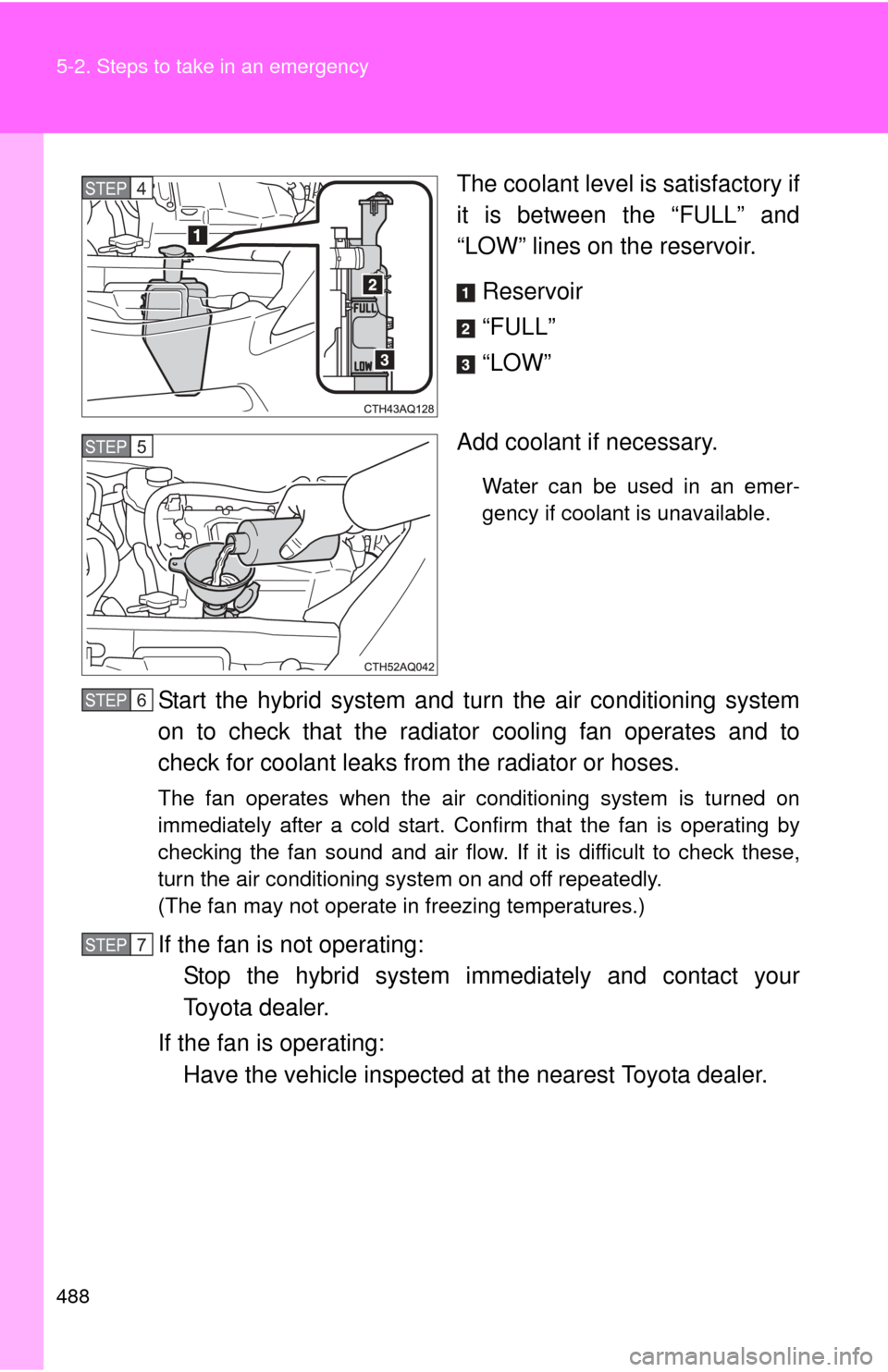
The coolant level is satisfactory if
it is between the “FULL” and
“LOW” lines on the reservoir.Reservoir
“FULL”
“LOW”
Add coolant if necessary.
Water can be used in an emer-
gency if coolant is unavailable.
Start the hybrid system and turn the air conditioning system
on to check that the radiator cooling fan operates and to
check for coolant leaks from the radiator or hoses.
The fan operates when the air conditioning system is turned on
immediately after a cold start. Confirm that the fan is operating by
checking the fan sound and air flow. If it is difficult to check these,
turn the air conditioning system on and off repeatedly.
(The fan may not operate in freezing temperatures.)
If the fan is not operating: Stop the hybrid system im mediately and contact your
Toyota dealer.
If the fan is operating: Have the vehicle inspected at the nearest Toyota dealer.
STEP4
STEP5
STEP6
STEP7