light TOYOTA PRIUS C 2019 (in English) Owner's Manual
[x] Cancel search | Manufacturer: TOYOTA, Model Year: 2019, Model line: PRIUS C, Model: TOYOTA PRIUS C 2019Pages: 596, PDF Size: 10.42 MB
Page 54 of 596
541-1. For safe use
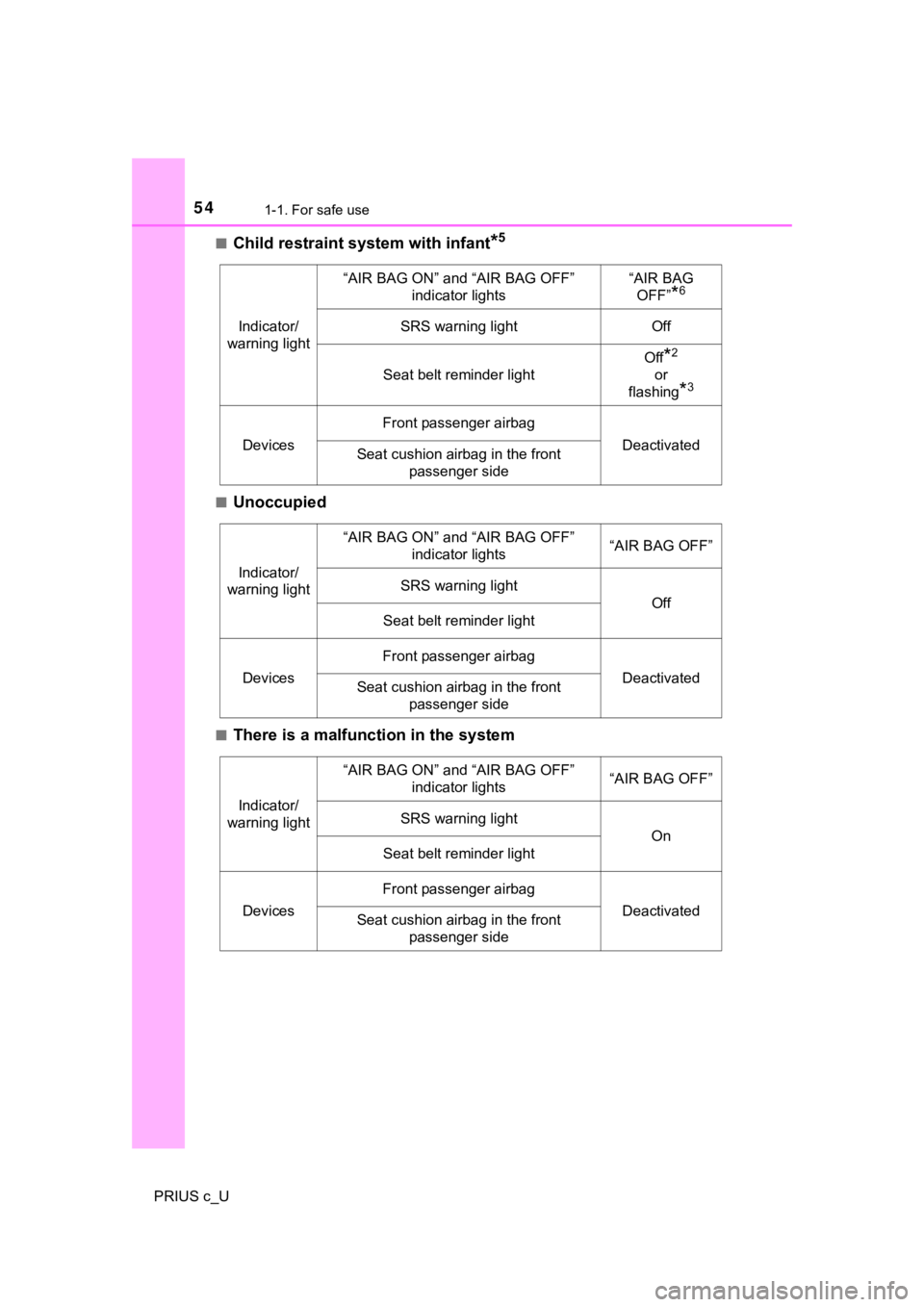
PRIUS c_U■
Child restraint system with infant*5
■Unoccupied
■There is a malfunction in the system
Indicator/
warning light
“AIR BAG ON” and “AIR BAG OFF” indicator lights“AIR BAG OFF”
*6
SRS warning lightOff
Seat belt reminder light
Off*2
or
flashing
*3
Devices
Front passenger airbag
DeactivatedSeat cushion airbag in the front passenger side
Indicator/
warning light
“AIR BAG ON” and “AIR BAG OFF” indicator lights“AIR BAG OFF”
SRS warning light
Off
Seat belt reminder light
Devices
Front passenger airbag
DeactivatedSeat cushion airbag in the front passenger side
Indicator/
warning light
“AIR BAG ON” and “AIR BAG OFF” indicator lights“AIR BAG OFF”
SRS warning light
On
Seat belt reminder light
Devices
Front passenger airbag
DeactivatedSeat cushion airbag in the front passenger side
Page 55 of 596
551-1. For safe use
1
For safety and security
PRIUS c_U
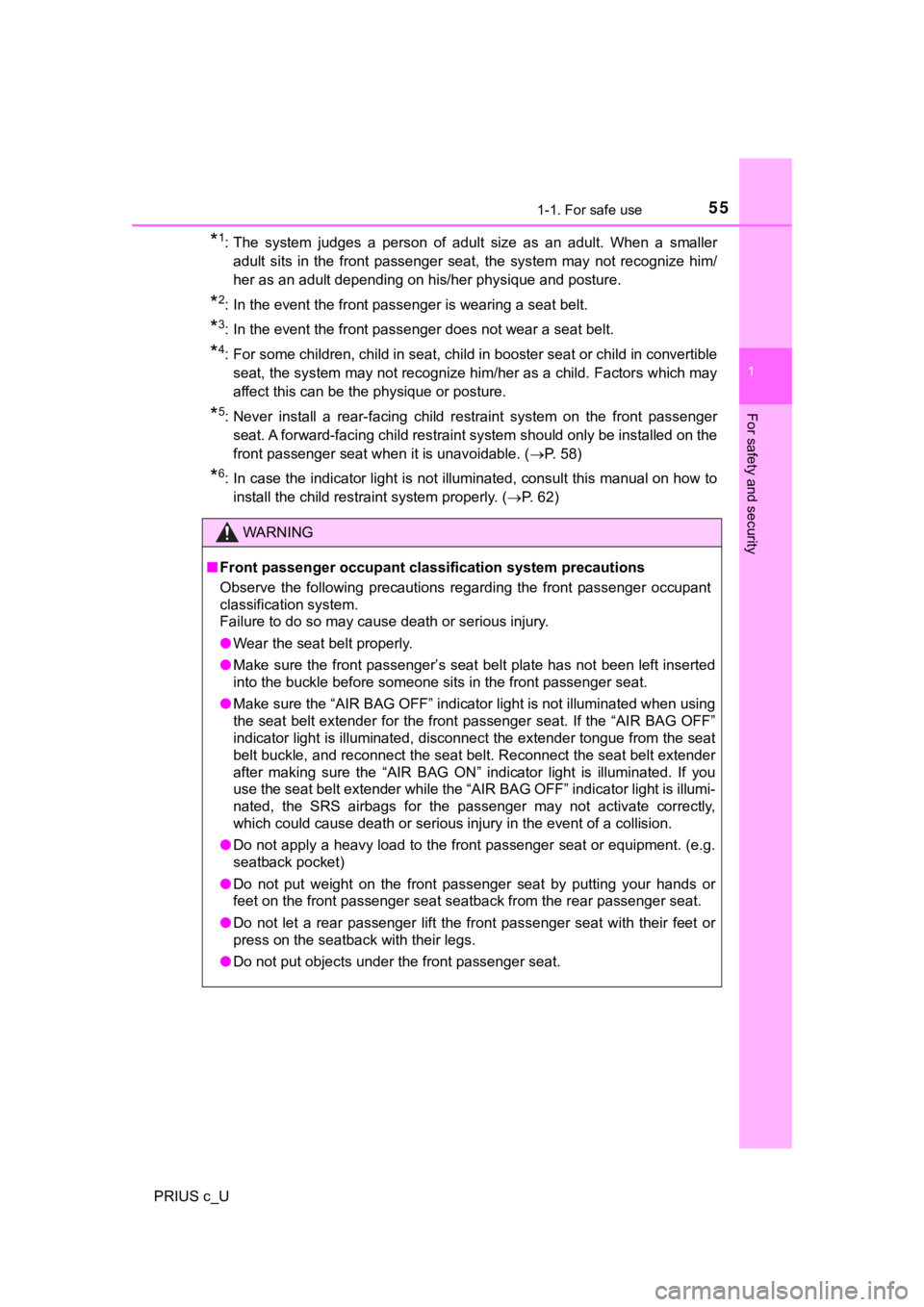
*1: The system judges a person of adult size as an adult. When a smaller
adult sits in the front passenger seat, the system may not recognize him/
her as an adult depending on his/her physique and posture.
*2: In the event the front passenger is wearing a seat belt.
*3: In the event the front passenger does not wear a seat belt.
*4: For some children, child in seat, child in booster seat or chi ld in convertible
seat, the system may not recognize him/her as a child. Factors which may
affect this can be the physique or posture.
*5: Never install a rear-facing child restraint system on the front passenger seat. A forward-facing child restraint system should only be in stalled on the
front passenger seat when it is unavoidable. ( P. 58)
*6: In case the indicator light is not illuminated, consult this m anual on how to
install the child restraint system properly. ( P. 62)
WARNING
■Front passenger occupant classification system precautions
Observe the following precautions regarding the front passenger occupant
classification system.
Failure to do so may cause death or serious injury.
● Wear the seat belt properly.
● Make sure the front passenger’s seat belt plate has not been le ft inserted
into the buckle before someone sits in the front passenger seat .
● Make sure the “AIR BAG OFF” indicator light is not illuminated when using
the seat belt extender for the front passenger seat. If the “AI R BAG OFF”
indicator light is illuminated, disconnect the extender tongue from the seat
belt buckle, and reconnect the seat belt. Reconnect the seat be lt extender
after making sure the “AIR BAG ON” indicator light is illuminat ed. If you
use the seat belt extender while the “AIR BAG OFF” indicator li ght is illumi-
nated, the SRS airbags for the passenger may not activate corre ctly,
which could cause death or serious injury in the event of a col lision.
● Do not apply a heavy load to the front passenger seat or equipm ent. (e.g.
seatback pocket)
● Do not put weight on the front passenger seat by putting your hands or
feet on the front passenger seat seatback from the rear passeng er seat.
● Do not let a rear passenger lift the front passenger seat with their feet or
press on the seatback with their legs.
● Do not put objects under the front passenger seat.
Page 56 of 596
561-1. For safe use
PRIUS c_U
WARNING
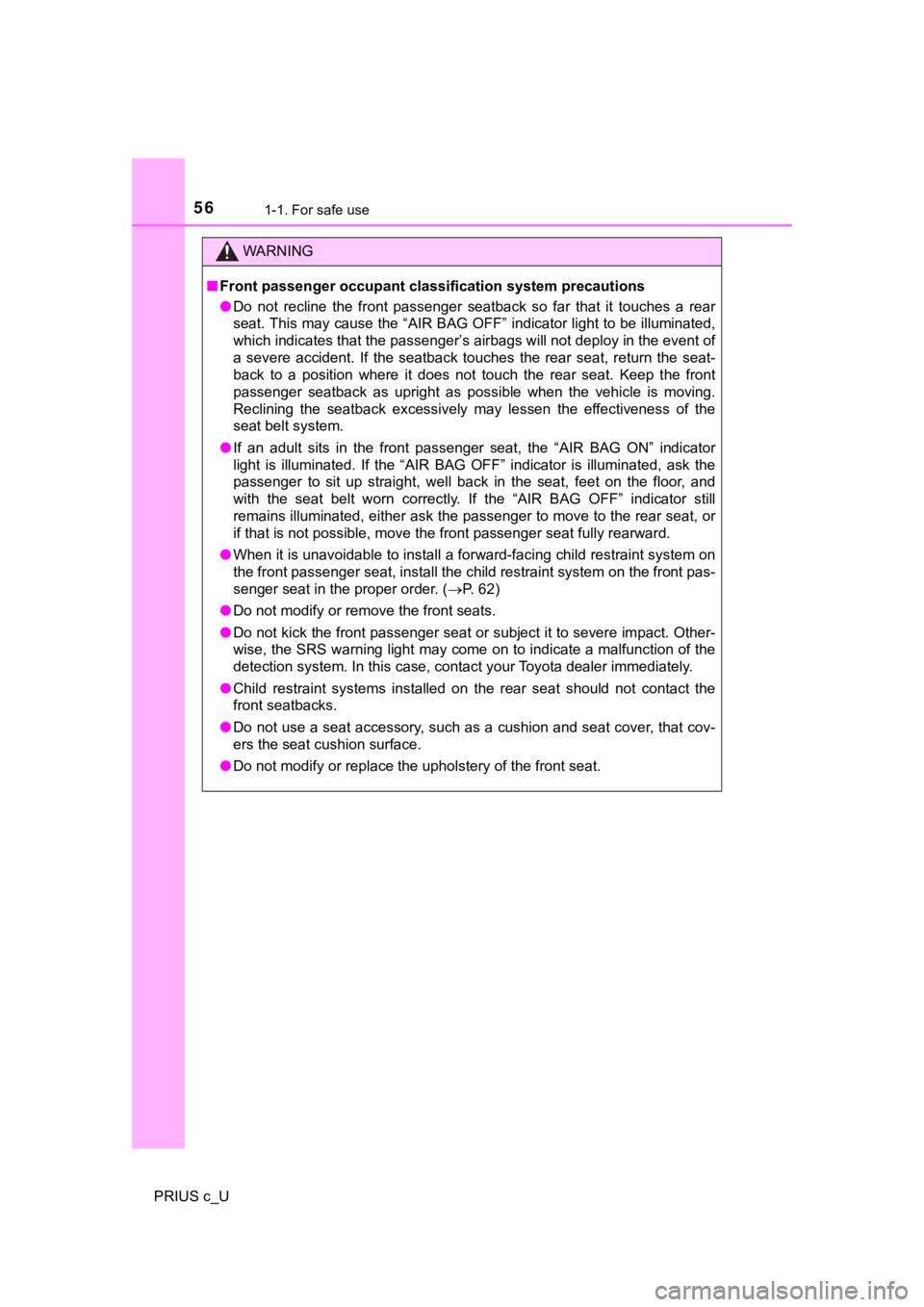
■Front passenger occupant classification system precautions
● Do not recline the front passenger seatback so far that it touc hes a rear
seat. This may cause the “AIR BAG OFF” indicator light to be il luminated,
which indicates that the passenger’s airbags will not deploy in the event of
a severe accident. If the seatback touches the rear seat, return the seat-
back to a position where it does not touch the rear seat. Keep the front
passenger seatback as upright as possible when the vehicle is m oving.
Reclining the seatback excessively may lessen the effectiveness of the
seat belt system.
● If an adult sits in the front passenger seat, the “AIR BAG ON” indicator
light is illuminated. If the “AIR BAG OFF” indicator is illuminated, ask the
passenger to sit up straight, well back in the seat, feet on the floor, and
with the seat belt worn correctly. If the “AIR BAG OFF” indicat or still
remains illuminated, either ask the passenger to move to the re ar seat, or
if that is not possible, move the front passenger seat fully re arward.
● When it is unavoidable to install a forward-facing child restra int system on
the front passenger seat, install the child restraint system on the front pas-
senger seat in the proper order. ( P. 62)
● Do not modify or remove the front seats.
● Do not kick the front passenger seat or subject it to severe im pact. Other-
wise, the SRS warning light may come on to indicate a malfuncti on of the
detection system. In this case, contact your Toyota dealer imme diately.
● Child restraint systems installed on the rear seat should not c ontact the
front seatbacks.
● Do not use a seat accessory, such as a cushion and seat cover, that cov-
ers the seat cushion surface.
● Do not modify or replace the upholstery of the front seat.
Page 60 of 596
601-1. For safe use
PRIUS c_U
WARNING
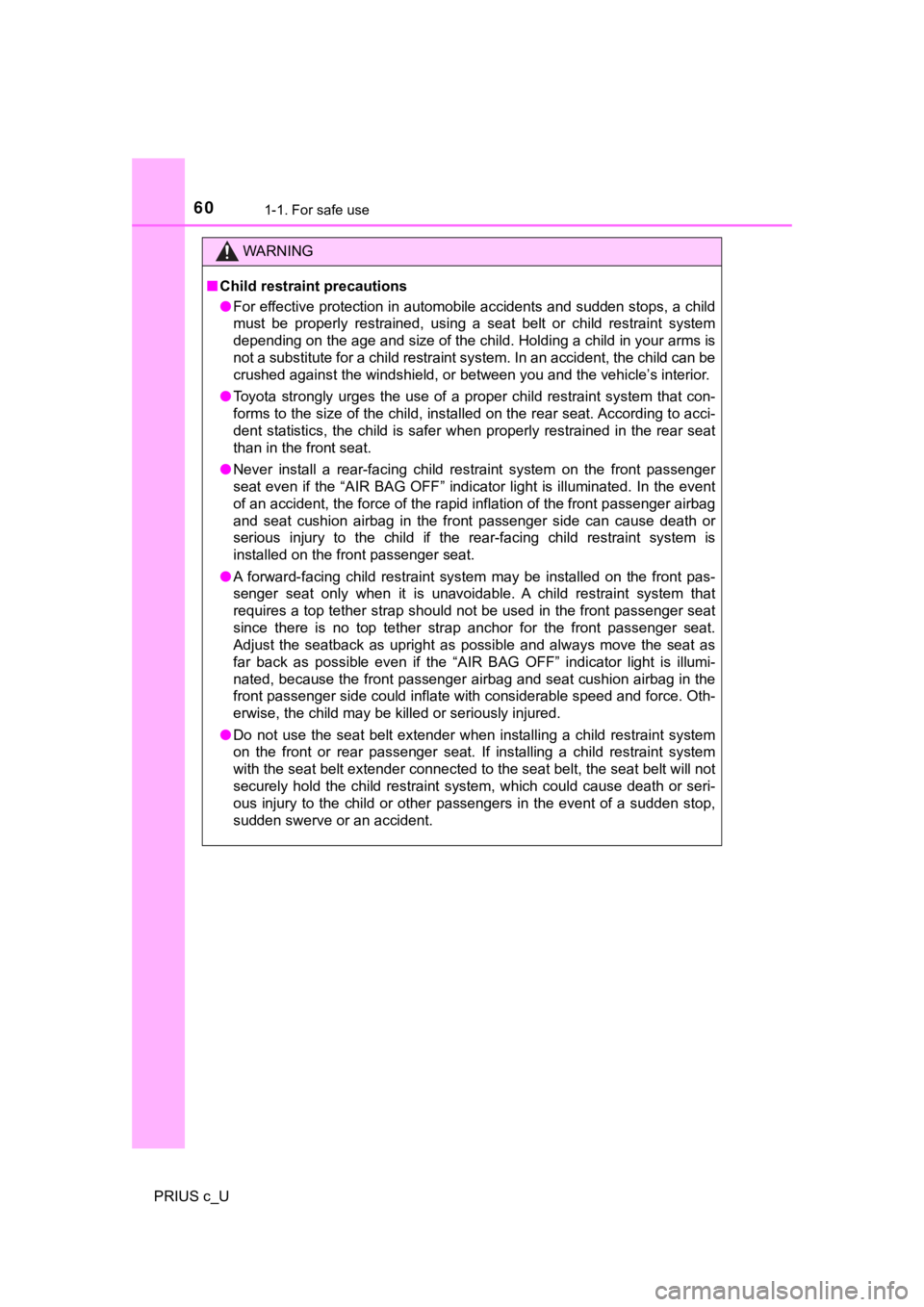
■Child restraint precautions
● For effective protection in automobile accidents and sudden sto ps, a child
must be properly restrained, using a seat belt or child restrai nt system
depending on the age and size of the child. Holding a child in your arms is
not a substitute for a child restraint system. In an accident, the child can be
crushed against the windshield, or between you and the vehicle’ s interior.
● Toyota strongly urges the use of a proper child restraint syste m that con-
forms to the size of the child, installed on the rear seat. According to acci-
dent statistics, the child is safer when properly restrained in the rear seat
than in the front seat.
● Never install a rear-facing child restraint system on the front passenger
seat even if the “AIR BAG OFF” indicator light is illuminated. In the event
of an accident, the force of the rapid inflation of the front p assenger airbag
and seat cushion airbag in the front passenger side can cause d eath or
serious injury to the child if the rear-facing child restraint system is
installed on the front passenger seat.
● A forward-facing child restraint system may be installed on the front pas-
senger seat only when it is unavoidable. A child restraint syst em that
requires a top tether strap should not be used in the front passenger seat
since there is no top tether strap anchor for the front passeng er seat.
Adjust the seatback as upright as possible and always move the seat as
far back as possible even if the “AIR BAG OFF” indicator light is illumi-
nated, because the front passenger airbag and seat cushion airb ag in the
front passenger side could inflate with considerable speed and force. Oth-
erwise, the child may be killed or seriously injured.
● Do not use the seat belt extender when installing a child restr aint system
on the front or rear passenger seat. If installing a child rest raint system
with the seat belt extender connected to the seat belt, the seat belt will not
securely hold the child restraint system, which could cause dea th or seri-
ous injury to the child or other passengers in the event of a s udden stop,
sudden swerve or an accident.
Page 63 of 596
631-1. For safe use
1
For safety and security
PRIUS c_U
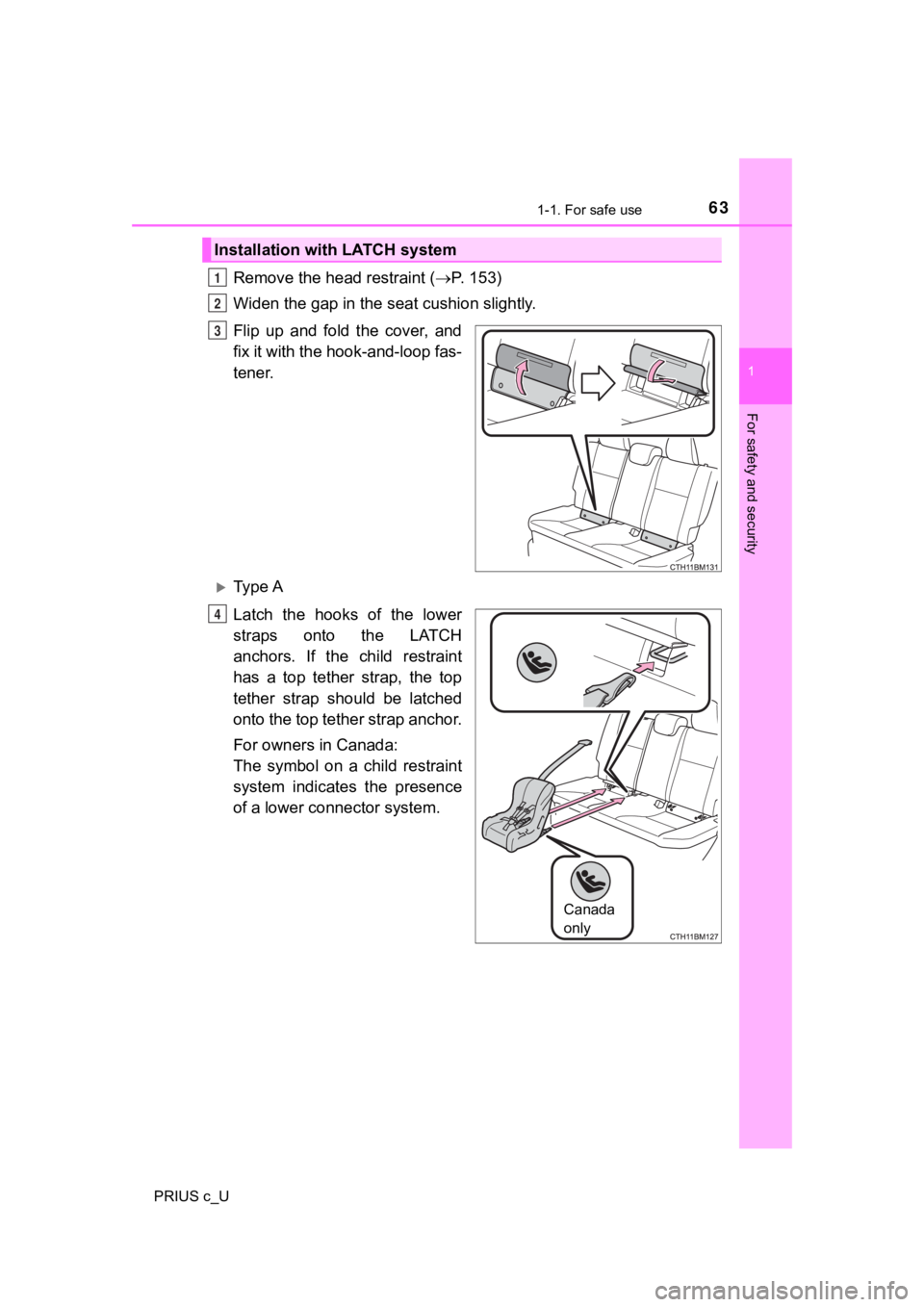
Remove the head restraint (P. 1 5 3 )
Widen the gap in the seat cushion slightly.
Flip up and fold the cover, and
fix it with the hook-and-loop fas-
tener.
Ty p e A
Latch the hooks of the lower
straps onto the LATCH
anchors. If the child restraint
has a top tether strap, the top
tether strap should be latched
onto the top tether strap anchor.
For owners in Canada:
The symbol on a child restraint
system indicates the presence
of a lower connector system.
Installation with LATCH system
1
2
3
Canada
only
Q
Page 71 of 596
711-1. For safe use
1
For safety and security
PRIUS c_U
WARNING
■When installing a booster seat
To prevent the belt from going into ALR lock mode, do not fully extend the
shoulder belt. ALR mode causes the belt to tighten only. This c ould cause
injury or discomfort to the child. ( P. 34)
■ When installing a child restraint system
Follow the directions given in the child restraint system insta llation manual
and fix the child restraint system securely in place.
If the child restraint system is not correctly fixed in place, the child or other
passengers may be seriously injured or even killed in the event of sudden
braking, sudden swerving or an accident.
● When a booster seat is installed, always ensure that the should er belt is
positioned across the center of the child’s shoulder. The belt should be
kept away from the child’s neck, but not so that it could fall off the child’s
shoulder. Failure to do so may r esult in death or serious injury in the event
of sudden braking, sudden swerving or an accident.
● Ensure that the belt and plate are securely locked and the seat belt is not
twisted.
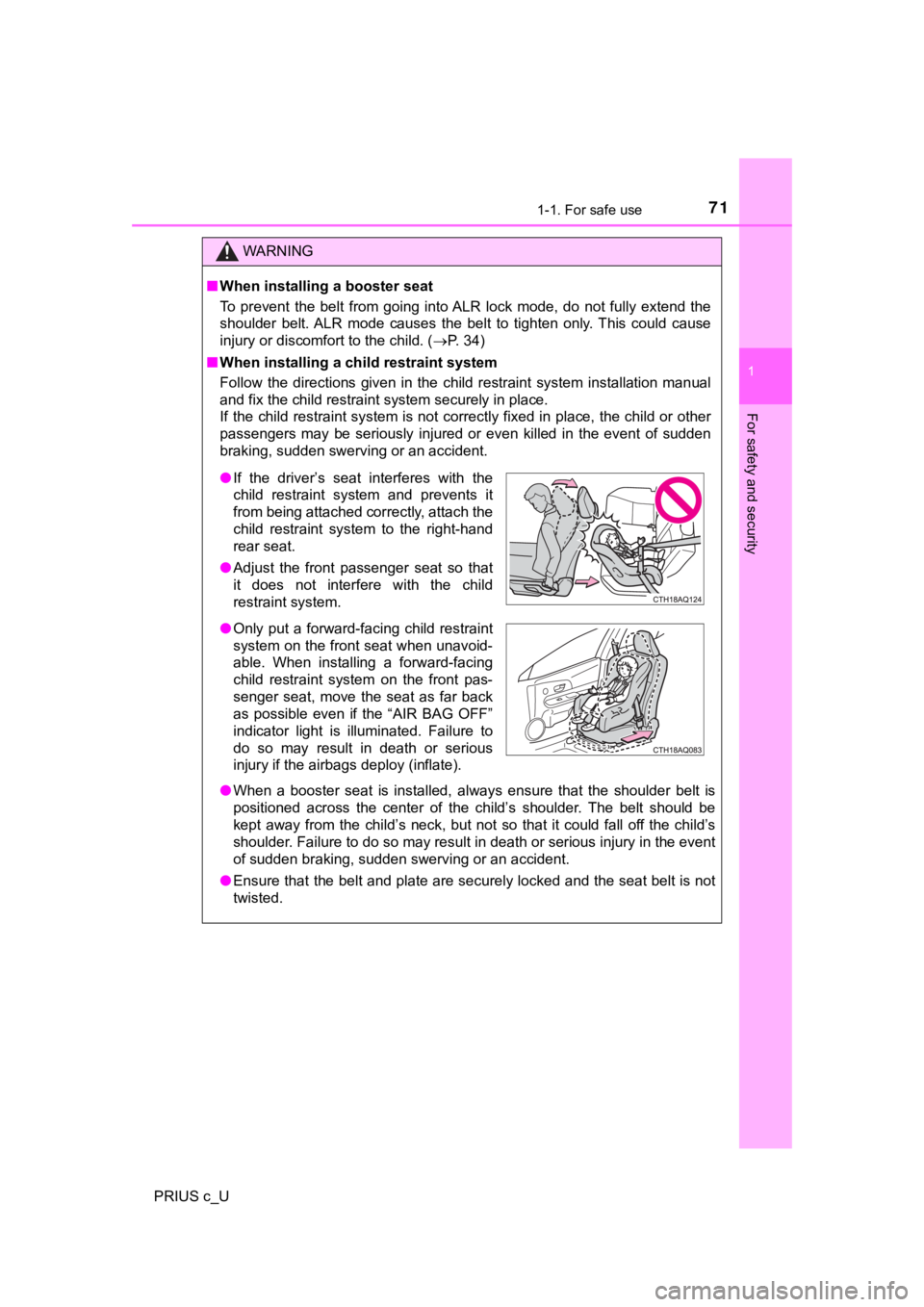
● If the driver’s seat interferes with the
child restraint system and prevents it
from being attached correctly, attach the
child restraint system to the right-hand
rear seat.
● Adjust the front passenger seat so that
it does not interfere with the child
restraint system.
● Only put a forward-facing child restraint
system on the front seat when unavoid-
able. When installing a forward-facing
child restraint system on the front pas-
senger seat, move the seat as far back
as possible even if the “AIR BAG OFF”
indicator light is illuminated. Failure to
do so may result in death or serious
injury if the airbags deploy (inflate).
Page 73 of 596
731-1. For safe use
1
For safety and security
PRIUS c_U
Exhaust gas precautions
Harmful substance to the human body is included in exhaust
gases if inhaled.
WARNING
Exhaust gases include harmful carbon monoxide (CO), which is colorless and
odorless. Observe the following precautions.
Failure to do so may cause exhaust gases enter the vehicle and may lead to
an accident caused by light-headedness, or may lead to death or a serious
health hazard.
■ Important points while driving
● Keep the back door closed.
● If you smell exhaust gases in the vehicle even when the back do or is
closed, open the windows and have the vehicle inspected at your Toyota
dealer as soon as possible.
■ When parking
● If the vehicle is in a poorly ventilated area or a closed area, such as a
garage, stop the hybrid system.
● Do not leave the vehicle with the hybrid system on for a long t ime.
If such a situation cannot be avoided, park the vehicle in an o pen space
and ensure that exhaust fumes do not enter the vehicle interior .
● Do not leave the hybrid system operating in an area with snow build-up, or
where it is snowing. If snowbanks build up around the vehicle w hile the
hybrid system is operating, exhaust gases may collect and enter the vehi-
cle.
■ Exhaust pipe
The exhaust system needs to be checked periodically. If there is a hole or
crack caused by corrosion, damage to a joint or abnormal exhaus t noise, be
sure to have the vehicle inspected and repaired by your Toyota dealer.
Page 81 of 596
811-2. Hybrid system
1
For safety and security
PRIUS c_U
■If a warning light comes on, a warning message is displayed, or the 12-
volt battery has been disconnected
The hybrid system may not start. In this case, try to start the system again. If
the “READY” indicator does not come on, contact your Toyota dea ler.
■ Running out of fuel
When the vehicle has run out of fuel and the hybrid system cann ot be started,
refuel the vehicle with at least enough gasoline to make the lo w fuel level
warning light ( P. 479) go off. If there is only a small amount of fuel, the
hybrid system may not be able to start. (The standard amount of fuel is about
1.3 gal. [5.0 L, 1.1 Imp. gal.] when the vehicle is on a level surface. This value
may vary when the vehicle is on a slope. Add extra fuel when th e vehicle is
inclined.)
■ Electromagnetic waves
●High voltage parts and cables on hybrid vehicles incorporate el ectromag-
netic shielding, and therefore emit approximately the same amount of elec-
tromagnetic waves as conventional gasoline powered vehicles or home
electronic appliances.
● Your vehicle may cause sound interference in some third party-p roduced
radio parts.
■ Hybrid battery ( traction battery)
The hybrid battery (traction battery) has a limited service life. The lifespan of
the hybrid battery (traction battery) can change in accordance with driving
style and driving conditions.
Page 86 of 596
86
PRIUS c_U
1-3. Theft deterrent system
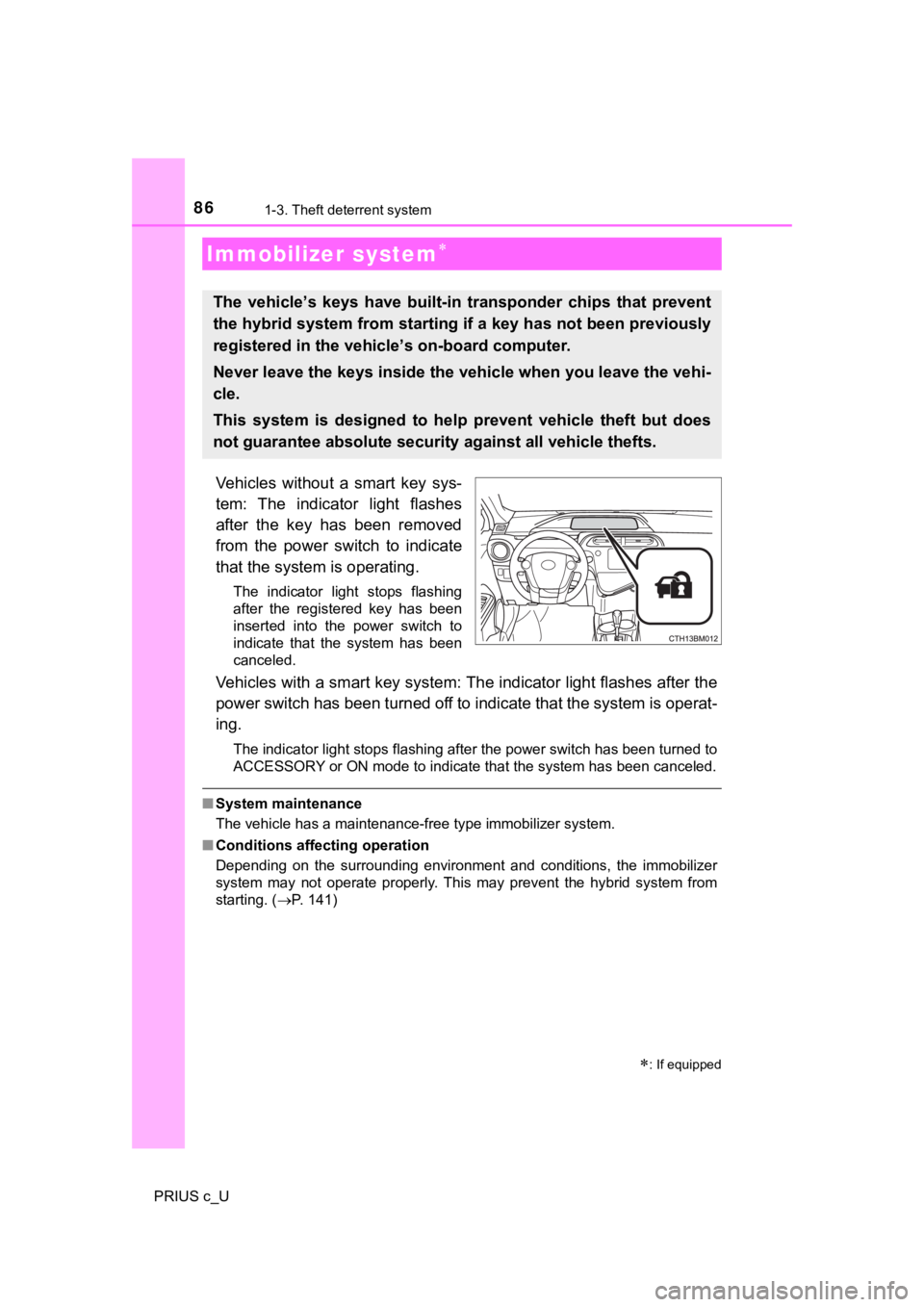
Vehicles without a smart key sys-
tem: The indicator light flashes
after the key has been removed
from the power switch to indicate
that the system is operating.
The indicator light stops flashing
after the registered key has been
inserted into the power switch to
indicate that the system has been
canceled.
Vehicles with a smart key system: The indicator light flashes after the
power switch has been turned off to indicate that the system is operat-
ing.
The indicator light stops flashing after the power switch has b een turned to
ACCESSORY or ON mode to indicate that the system has been canceled.
■ System maintenance
The vehicle has a maintenance-free type immobilizer system.
■ Conditions affecting operation
Depending on the surrounding environment and conditions, the im mobilizer
system may not operate properly. This may prevent the hybrid sy stem from
starting. ( P. 141)
Immobilizer system
The vehicle’s keys ha ve built-in transponder chips that prevent
the hybrid system from starting if a key has not been previousl y
registered in the vehic le’s on-board computer.
Never leave the keys inside the vehicle when you leave the vehi-
cle.
This system is designed to help prevent vehicle theft but does
not guarantee absolute security against all vehicle thefts.
: If equipped
Page 91 of 596
91
Instrument cluster2
PRIUS c_U2.
Instrument cluster
Warning lights and indicators ................... 92
Gauges and meters ............ 97
Multi-information display............................. 101
Energy monitor/ consumption screen ........ 110