ECU TOYOTA PRIUS PLUG-IN 2012 Workshop Manual
[x] Cancel search | Manufacturer: TOYOTA, Model Year: 2012, Model line: PRIUS PLUG-IN, Model: TOYOTA PRIUS PLUG-IN 2012Pages: 704, PDF Size: 19.59 MB
Page 545 of 704
521
4-3. Do-it-yourself maintenance
PRIUS PHV_OM_OM47818U_(U)
4
Maintenance and care
CAUTION
■Replacing light bulbs
●Be sure to stop the hybrid system and turn off the lights. Do not attempt to
replace the bulb immediately after turning off the lights.
The bulbs become very hot and may cause burns.
●Do not touch the glass portion of the light bulb with bare hands. Hold the
bulb by the plastic or metal portion.
If the bulb is scratched or dropped, it may blow out or crack.
●Fully install light bulbs and any parts used to secure them. Failure to do so
may result in heat damage, fire, or water entering the headlight unit. This
may damage the headlights or cause condensation to build up on the lens.
■To p r e v e n t d a m a g e o r f i r e
Make sure bulbs are fully seated and locked.
Page 549 of 704
526
5-1. Essential information
PRIUS PHV_OM_OM47818U_(U)
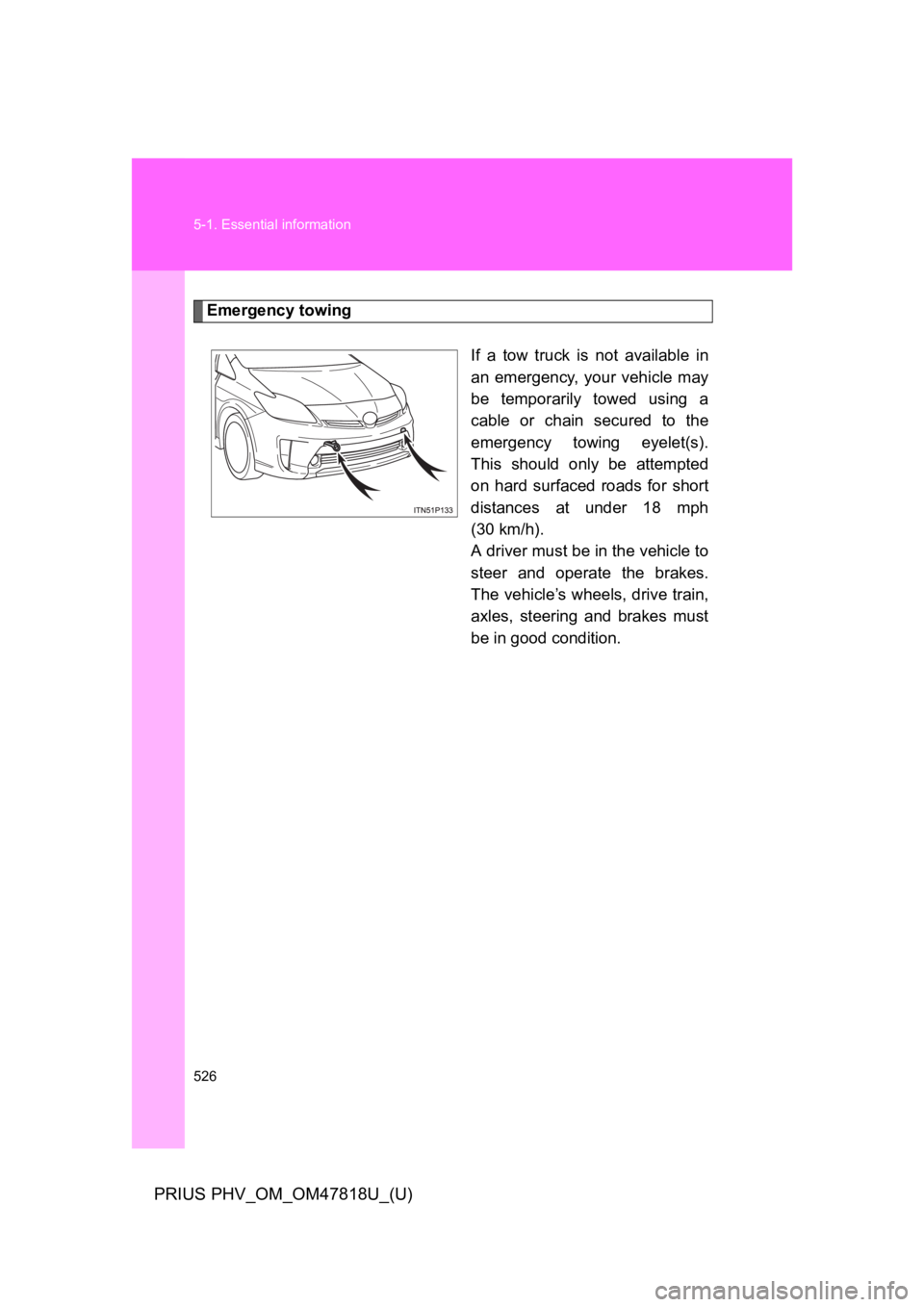
Emergency towing
If a tow truck is not available in
an emergency, your vehicle may
be temporarily towed using a
cable or chain secured to the
emergency towing eyelet(s).
This should only be attempted
on hard surfaced roads for short
distances at under 18 mph
(30 km/h).
A driver must be in the vehicle to
steer and operate the brakes.
The vehicle’s wheels, drive train,
axles, steering and brakes must
be in good condition.
Page 550 of 704
5
When trouble arises
527
5-1. Essential information
PRIUS PHV_OM_OM47818U_(U)
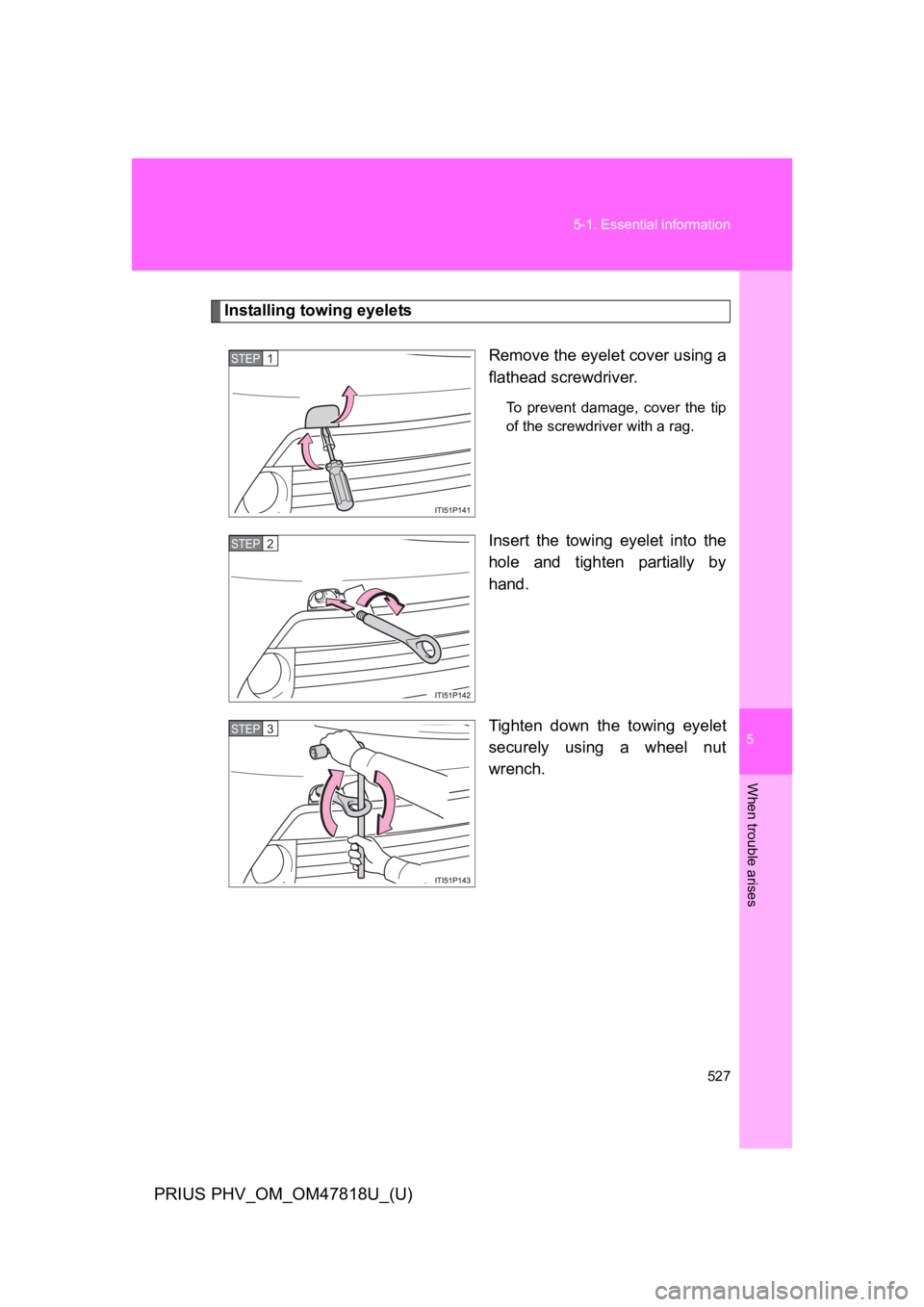
Installing towing eyelets
Remove the eyelet cover using a
flathead screwdriver.
To p r e v e n t d a m a g e , c o v e r t h e t i p
of the screwdriver with a rag.
Insert the towing eyelet into the
hole and tighten partially by
hand.
Tighten down the towing eyelet
securely using a wheel nut
wrench.
STEP 1
STEP 2
STEP 3
Page 553 of 704
530
5-1. Essential information
PRIUS PHV_OM_OM47818U_(U)
CAUTION
■Caution while towing
●Use extreme caution when towing the vehicle.
Avoid sudden starts or erratic driving maneuvers which place excessive
stress on the emergency towing eyelets and the cables or chains. Always
be cautious of the surroundings and other vehicles while towing.
●Do not turn the “POWER” switch off.
This may lead to an accident as the front wheels will be locked by the
parking lock.
●If the hybrid system is off, the power assist for the brakes and steering will
not function, making steering and braking more difficult.
■Installing towing eyelets to the vehicle
Make sure that towing eyelets are installed securely.
If not securely installed, towing eyelets may come loose during towing. This
may lead to accidents that cause serious injury or even death.
Page 562 of 704
5
When trouble arises
539
5-2. Steps to take in an emergency
PRIUS PHV_OM_OM47818U_(U)
*1:Open door warning buzzer:
The open door warning buzzer sounds to alert one or more of the doors is
not fully closed (with the vehicle having reached a speed of 3 mph [5 km/h]).
*2:Seat belt warning buzzer:
The driver’s and front passenger’s seat belts reminder sounds to alert the
driver and front passenger that his or her seat belt is not fastened. The
buzzer sounds intermittently for 10 seconds after the vehicle has reached a
speed of at least 12 mph (20 km/h). Then, if the seat belt is still unfastened,
the buzzer will sound in a different tone for 20 more seconds.
■SRS warning light
This warning light system monitors the airbag sensor assembly, front impact
sensors, side impact sensors (front), side impact sensors (rear), driver’s seat
position sensor, driver’s seat belt buckle switch, front passenger occupant
classification system (ECU and sensors), “AIR BAG ON” indicator light, “AIR
BAG OFF” indicator light, front passenger’s seat belt buckle switch, seat belt
pretensioner assemblies, airbags, interconnecting wiring and power
sources. (→P. 1 8 4 )
■Front passenger occupant classification system (ECU and sensors),
seat belt reminder and warning buzzer
●If luggage is placed on the front passenger seat, the front passenger
occupant classification system (ECU and sensors) may cause the warn-
ing light to flash and the warning buzzer to sound even if a passenger is
not sitting in the seat.
●If a cushion is placed on the seat, the front passenger occupant classifi-
cation system (ECU and sensors) may not detect a passenger, and the
warning light may not operate properly.
Page 563 of 704

540
5-2. Steps to take in an emergency
PRIUS PHV_OM_OM47818U_(U)
■Electric power steering system warning light
When the 12-volt battery charge becomes insufficient or the voltage tempo-
rarily drops, the electric power steering system warning light may come on.
■If the malfunction indicator lamp comes on while driving
First check the following:
●Is the fuel tank cap loose?
If it is, tighten it securely.
The malfunction indicator lamp will go off after several driving trips.
If the malfunction indicator lamp does not go off even after several trips, con-
tact your Toyota dealer as soon as possible.
■When the tire pressure warning light comes on
Check the tire inflation pressure and adjust to the appropriate level.
Pushing the tire pressure warning reset switch will not turn off the tire
pressure warning light.
■The tire pressure warning light may come on due to natural causes
The tire pressure warning light may come on due to natural causes such
as natural air leaks and tire inflation pressure changes caused by tem-
perature. In this case, adjusting the tire inflation pressure will turn off the
warning light (after a few minutes).
Page 571 of 704
548
5-2. Steps to take in an emergency
PRIUS PHV_OM_OM47818U_(U)
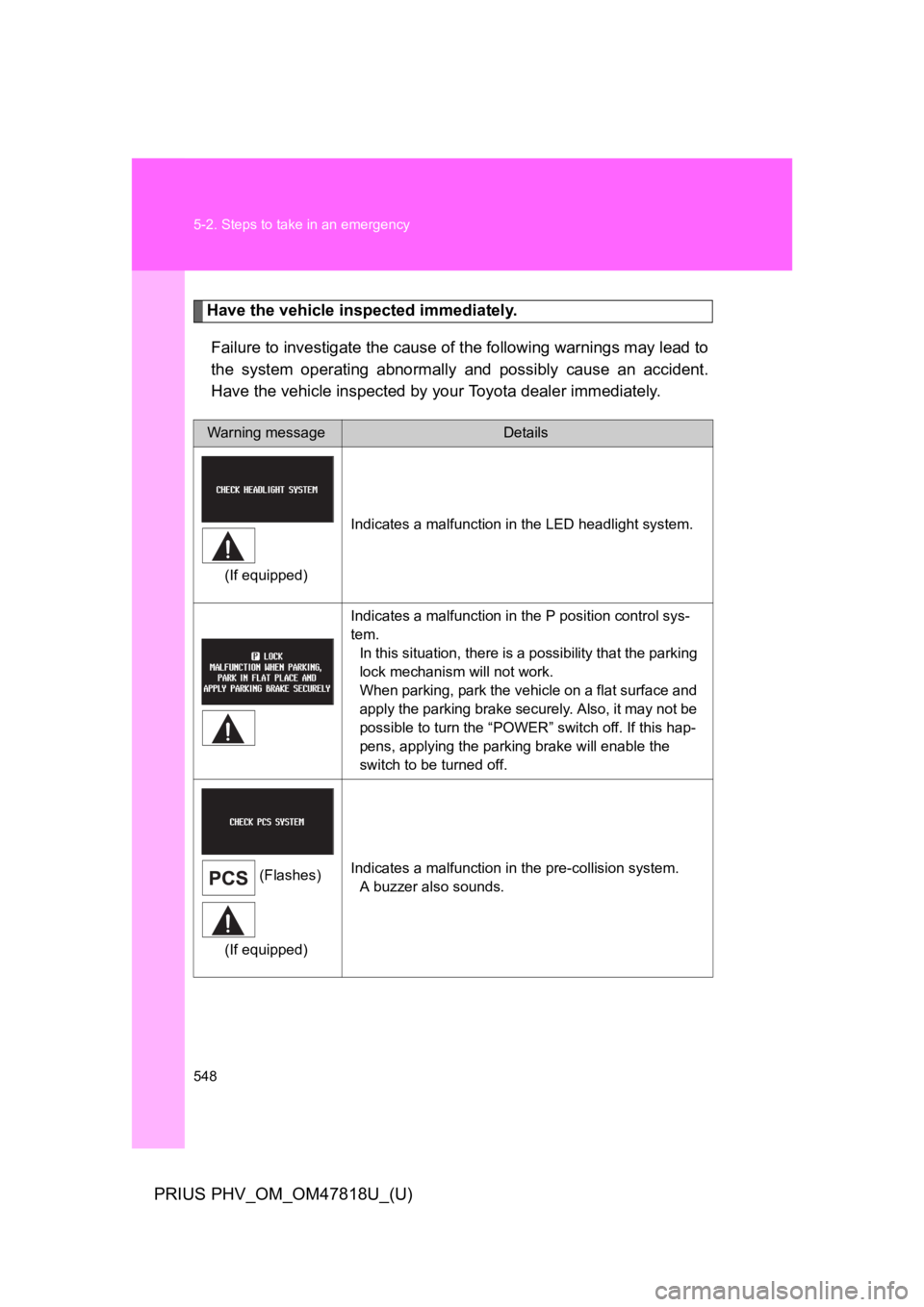
Have the vehicle inspected immediately.
Failure to investigate the cause of the following warnings may lead to
the system operating abnormally and possibly cause an accident.
Have the vehicle inspected by your Toyota dealer immediately.
Warning messageDetails
(If equipped)
Indicates a malfunction in the LED headlight system.
Indicates a malfunction in the P position control sys-
tem.
In this situation, there is a possibility that the parking
lock mechanism will not work.
When parking, park the vehicle on a flat surface and
apply the parking brake securely. Also, it may not be
possible to turn the “POWER” switch off. If this hap-
pens, applying the parking brake will enable the
switch to be turned off.
(Flashes)
(If equipped)
Indicates a malfunction in the pre-collision system.
A buzzer also sounds.
Page 608 of 704
5
When trouble arises
585
5-2. Steps to take in an emergency
PRIUS PHV_OM_OM47818U_(U)
CAUTION
■When fixing the flat tire
●Stop your vehicle in a safe and flat area.
●Do not touch the wheels or the area around the brakes immediately
after the vehicle has been driven.
After the vehicle has been driven, the wheels and the area around the
brakes may be extremely hot. Touching these areas with hands, feet or
other body parts may result in burns.
●Connect the valve and hose securely with the tire installed on the vehi-
cle. If the hose is not properly connected to the valve, air leakage may
occur as sealant may be sprayed out.
●If the hose comes off the valve while inflating the tire, there is a risk
that the hose will move abruptly due to air pressure.
●After inflation of the tire has completed, the sealant may splatter when
the hose is disconnected or some air is let out of the tire.
●Follow the operation procedure to repair the tire. If the procedures not
followed, the sealant may spray out.
●Keep back from the tire while it is being repaired, as there is a chance
of it bursting while the repair operation is being performed. If you
notice any cracks or deformation of the tire, turn off the compressor
switch and stop the repair operation immediately.
Page 630 of 704
5
When trouble arises
607
5-2. Steps to take in an emergency
PRIUS PHV_OM_OM47818U_(U)
If your vehicle has to be stopped in an emergency
Only in an emergency, such as if it becomes impossible to stop the
vehicle in the normal way, stop the vehicle using the following pro-
cedure:
St eadily step on the bra ke peda l with bo th fe et and firmly
depress it.
Do not pump the brake pedal repeatedly as this will increase the
effort required to slow the vehicle.
Shift the shift position to N.
If the shift position is shifted to N
After slowing down, stop the vehicle in a safe place by the
road.
St op th e hyb rid system.
If the shift position cannot be shifted to N
Keep depressing the brake pedal with both feet to reduce
vehicle speed as much as possible.
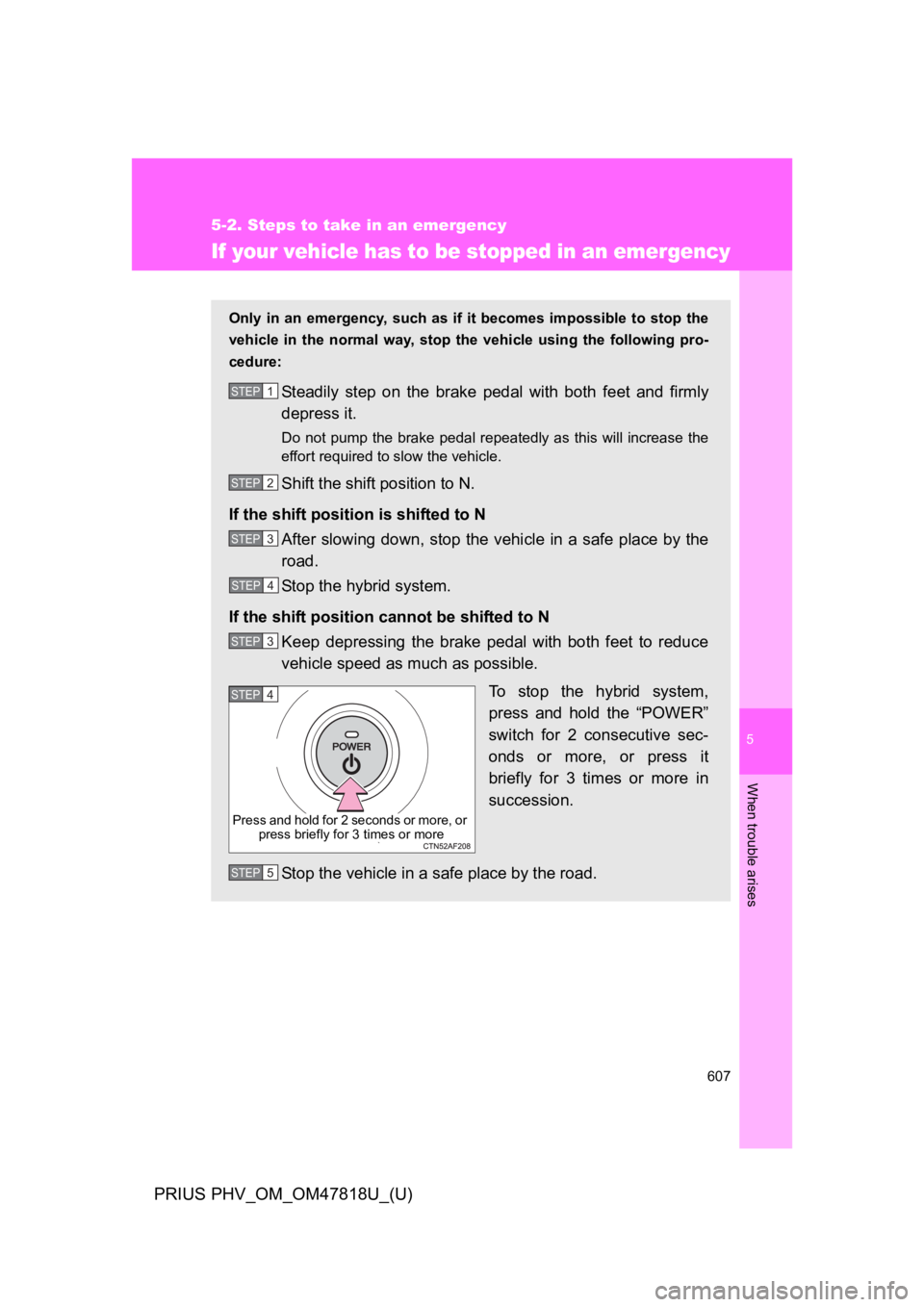
To s t o p t h e h y b r i d s y s t e m ,
press and hold the “POWER”
switch for 2 consecutive sec-
onds or more, or press it
briefly for 3 times or more in
succession.
St op th e veh i cle in a safe place by the ro ad.
STEP 1
STEP 2
STEP 3
STEP 4
STEP 3
STEP 4
Press and hold for 2 seconds or more, or press briefly for 3 times or more
STEP 5
Page 660 of 704
638
6-1. Specifications
PRIUS PHV_OM_OM47818U_(U)
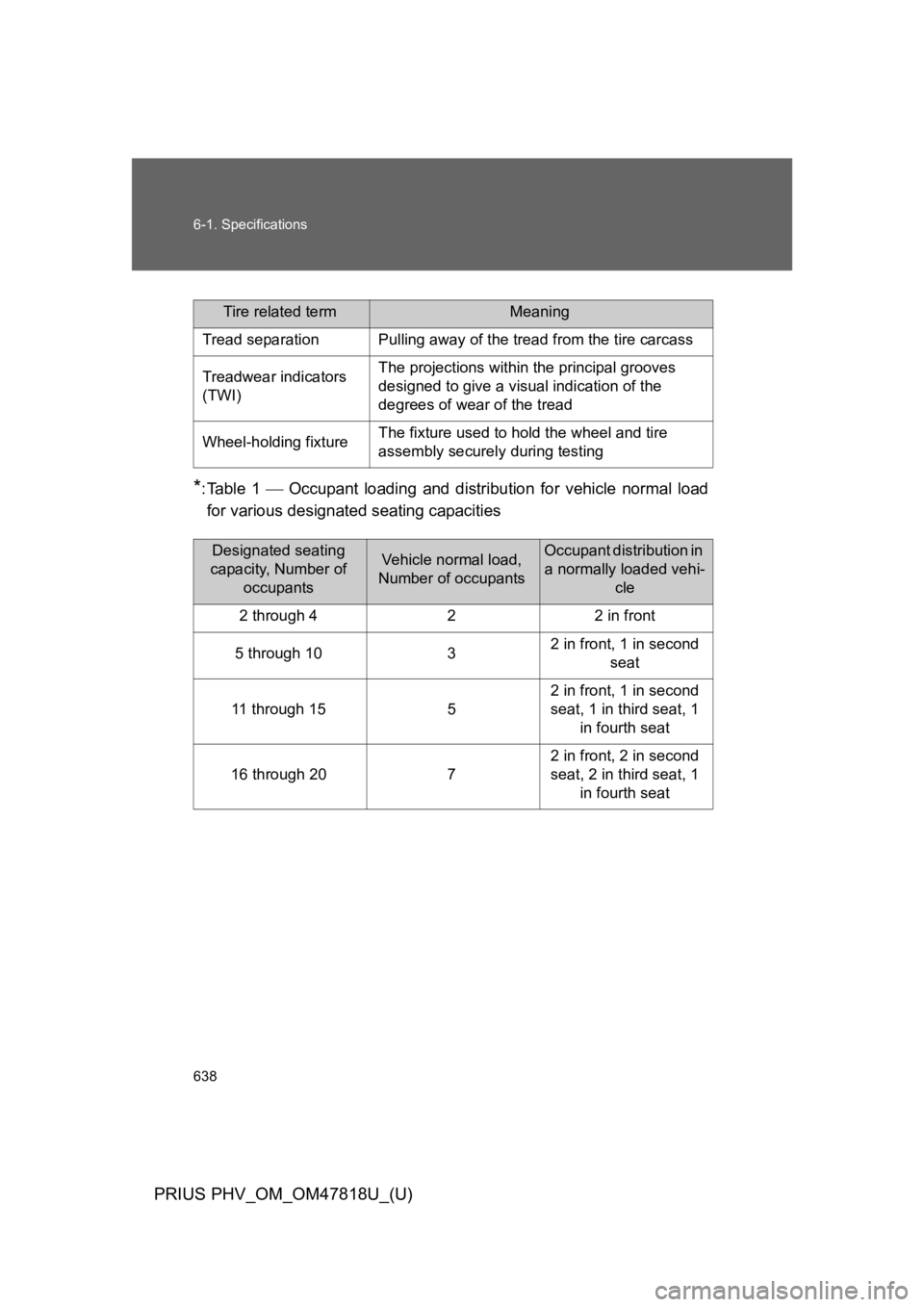
*:Table 1 ⎯ Occupant loading and distribution for vehicle normal load
for various designated seating capacities
Tire related termMeaning
Tread separation Pulling away of the tread from the tire carcass
Treadwear indicators
(TWI)
The projections within the principal grooves
designed to give a visual indication of the
degrees of wear of the tread
Wheel-holding fixtureThe fixture used to hold the wheel and tire
assembly securely during testing
Designated seating
capacity, Number of
occupants
Ve h i c l e n o r m a l l o a d ,
Number of occupants
Occupant distribution in
a normally loaded vehi-
cle
2 through 4 2 2 in front
5 through 10 32 in front, 1 in second
seat
11 t h r o u g h 1 5 5
2 in front, 1 in second
seat, 1 in third seat, 1
in fourth seat
16 through 20 7
2 in front, 2 in second
seat, 2 in third seat, 1
in fourth seat