battery TOYOTA PRIUS PLUG-IN HYBRID 2018 Owner's Guide
[x] Cancel search | Manufacturer: TOYOTA, Model Year: 2018, Model line: PRIUS PLUG-IN HYBRID, Model: TOYOTA PRIUS PLUG-IN HYBRID 2018Pages: 772, PDF Size: 107.88 MB
Page 147 of 772
147
2
2-2. Charging
Plug-in hybrid system
PRIUS PHV_OM_OM47C99E_(EE)
Charging methods
◆Charging from an external power source (P. 160)
This is a charging method used when charging from an AC socket
(220 V-240 V) with the charging cable equipped to the vehicle or
charging at a public charging station.
The charging start time (or departure time) and day can be set to carry
out charging using the timer at the desired date and time. (P. 171)
◆Using the hybrid battery (traction battery) charge mode
(P. 101)
The plug-in hybrid system can be switched to hybrid battery (trac-
tion battery) charge mode to charge the hybrid battery (traction bat-
tery) using electricity generated by gasoline engine operation.
The maximum charge amount in the hybrid battery (traction battery)
charge mode is approximately 80% of the fully charged capacity for the
charging from an external power source.
◆Solar charging system (if equipped) (P. 183)
In certain conditions, when the vehicle is parked, the hybrid battery
(traction battery) can be charged by using electricity generated by
the solar panel equipped to the roof of the vehicle.
The maximum charge amount of the solar charging system is approxi-
mately 90% of the fully charged capacity for the charging from an exter-
nal power source. (This does not mean the battery can be fully charged
in one day.)
The following methods can be used to charge the hybrid battery
(traction battery).
Page 148 of 772
1482-2. Charging
PRIUS PHV_OM_OM47C99E_(EE)
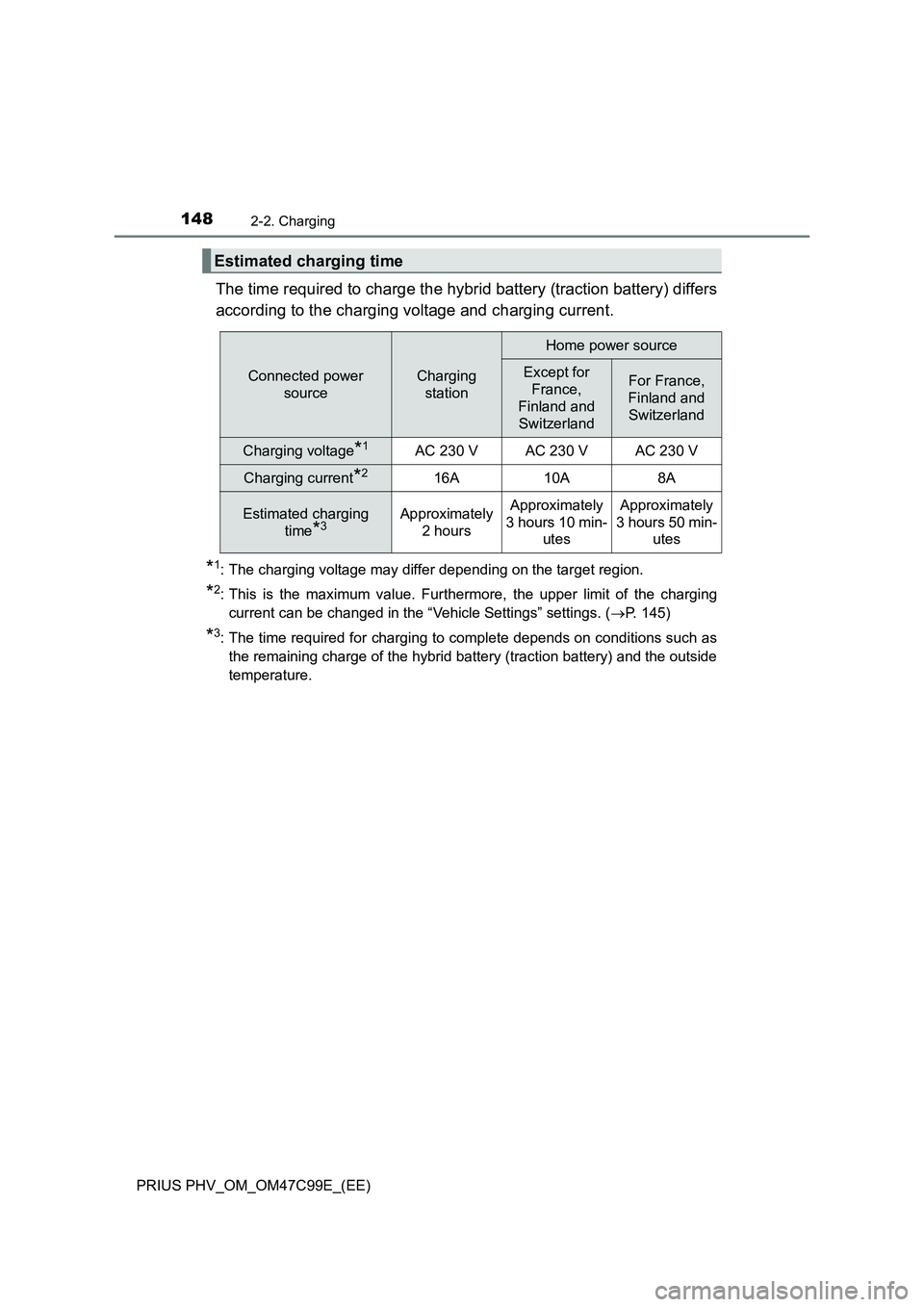
The time required to charge the hybrid battery (traction battery) differs
according to the charging voltage and charging current.
*1: The charging voltage may differ depending on the target region.
*2: This is the maximum value. Furthermore, the upper limit of the charging
current can be changed in the “Vehicle Settings” settings. (P. 145)
*3: The time required for charging to complete depends on conditions such as
the remaining charge of the hybrid battery (traction battery) and the outside
temperature.
Estimated charging time
Connected power
sourceCharging
station
Home power source
Except for
France,
Finland and
SwitzerlandFor France,
Finland and
Switzerland
Charging voltage*1AC 230 VAC 230 VAC 230 V
Charging current*216A10A8A
Estimated charging
time
*3Approximately
2 hoursApproximately
3 hours 10 min-
utesApproximately
3 hours 50 min-
utes
Page 149 of 772
1492-2. Charging
2
Plug-in hybrid system
PRIUS PHV_OM_OM47C99E_(EE)
■Charging time may increase
In the following situations, charging time may become longer than normal:
●In very hot or very cold temperatures.
●The vehicle is consuming a lot of electricity, for example, when the head
light switch is on etc.
●There is a power outage during charging.
●There is an interruption in the electrical supply.
●There is a drop in the voltage of external power source.
●The charge in the 12-volt battery is low, for example due to the vehicle being
left unused for a long period of time.
●The maximum charging current is set to 8A through the “Vehicle Settings”
settings. (P. 145)
●When the “Traction Battery Heater” operates.
●When the “Traction Battery Cooler” is operated before charging. (if
equipped) (P. 150)
■Using a DC Charger
DC Chargers cannot be used with this vehicle.
This vehicle is equipped with several functions that are linked with
charging.
■“Traction Battery Heater”
When the outside temperature is low and the charging cable is con-
nected to the vehicle, this function automatically warms the hybrid
battery (traction battery) until it reaches or exceeds a certain tem-
perature.
●When the charging cable is removed from the vehicle or remains
connected to the vehicle for approximately 3 days, the system
automatically stops.
●When the charging timer is used (P. 171), this function will
operate according to the timer settings.
Charging-linked functions
Page 150 of 772
1502-2. Charging
PRIUS PHV_OM_OM47C99E_(EE)■
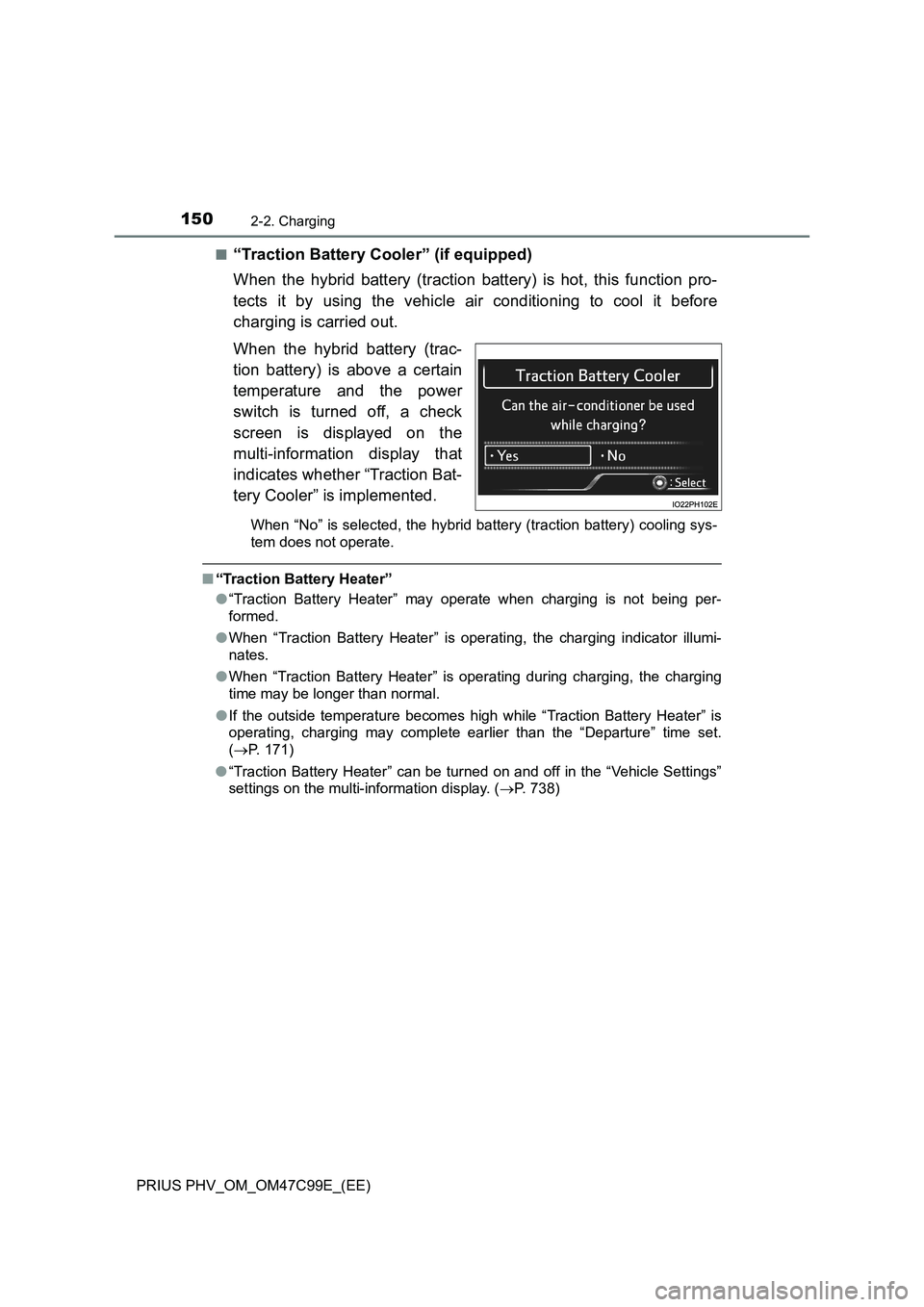
“Traction Battery Cooler” (if equipped)
When the hybrid battery (traction battery) is hot, this function pro-
tects it by using the vehicle air conditioning to cool it before
charging is carried out.
When the hybrid battery (trac-
tion battery) is above a certain
temperature and the power
switch is turned off, a check
screen is displayed on the
multi-information display that
indicates whether “Traction Bat-
tery Cooler” is implemented.
When “No” is selected, the hybrid battery (traction battery) cooling sys-
tem does not operate.
■“Traction Battery Heater”
●“Traction Battery Heater” may operate when charging is not being per-
formed.
●When “Traction Battery Heater” is operating, the charging indicator illumi-
nates.
●When “Traction Battery Heater” is operating during charging, the charging
time may be longer than normal.
●If the outside temperature becomes high while “Traction Battery Heater” is
operating, charging may complete earlier than the “Departure” time set.
(P. 171)
●“Traction Battery Heater” can be turned on and off in the “Vehicle Settings”
settings on the multi-information display. (P. 738)
Page 151 of 772
1512-2. Charging
2
Plug-in hybrid system
PRIUS PHV_OM_OM47C99E_(EE)■“Traction Battery Cooler” (if equipped)
●When the hybrid battery (traction battery) is above a certain temperature
and the power switch is turned off, a check screen is displayed on the multi-
information display that indicates whether “Traction Battery Cooler” is imple-
mented. Approximately 5 minutes after selecting “Yes” on this screen, sys-
tem operation becomes possible.
●When charging starts, “Traction Battery Cooler” only operates if the hybrid
battery (traction battery) temperature is hot.
●The charging indicator is illuminated while “Traction Battery Cooler” is on
standby or operating.
●“Traction Battery Cooler” is implemented for a maximum of approximately
30 minutes. However, when the “Departure” time is set (P. 171) and there
is not sufficient time between the current time and the time that charging will
complete, “Traction Battery Cooler” operation time may become shorter.
●When there is a small amount of remaining charge in the hybrid battery
(traction battery), even if the hybrid battery (traction battery) is hot, “Traction
Battery Cooler” may not be implemented.
●When the following operations are performed while “Traction Battery Cooler”
is operating, the hybrid battery (traction battery) cooling operation stops.
• A door is opened
• The hood is opened
• The power switch is turned to any mode other than off
• The alarm operates (if equipped) (P. 8 8 )
• The shift position is changed to any position other than P
• The Remote Air Conditioning System is operated (P. 542)
• “Charge Now” is implemented (P. 179)
• The amount of remaining charge in the hybrid battery (traction battery) is
below a certain amount
●When the power switch is turned off, a check screen is displayed on the
multi-information display that indicates whether “Traction Battery Cooler” is
implemented. This check screen can be turned on and off in the “Meter Cus-
tomize” settings on the multi-information display (P. 253). However, when
the check screen is set to “Off”, “Traction Battery Cooler” is no longer oper-
ates.
●“Traction Battery Cooler” uses the power of the hybrid battery (traction bat-
tery) and external power source.
• While “Traction Battery Cooler” is operating, the amount of the remaining
charge of the hybrid battery (traction battery) increases and decreases in
a certain range, and does not increase as in normal charging.
• The operation of “Traction Battery Cooler” is recognized as charging by a
charging equipment. The charging equipment that calculates the fee
according to charging time causes a charging fee.
Page 152 of 772
1522-2. Charging
PRIUS PHV_OM_OM47C99E_(EE)
Charging tips
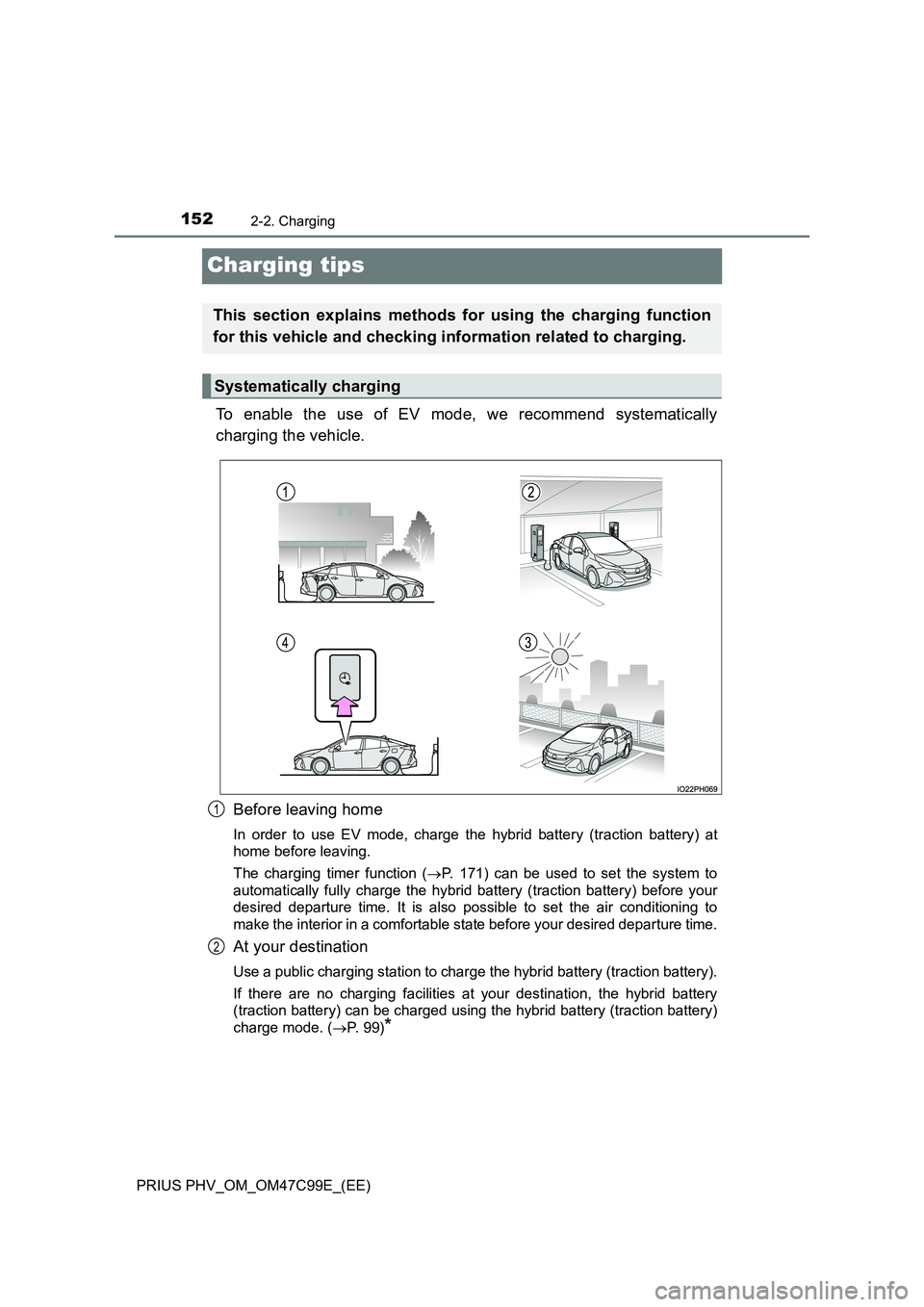
To enable the use of EV mode, we recommend systematically
charging the vehicle.
Before leaving home
In order to use EV mode, charge the hybrid battery (traction battery) at
home before leaving.
The charging timer function ( P. 171) can be used to set the system to
automatically fully charge the hybrid battery (traction battery) before your
desired departure time. It is also pos sible to set the air conditioning to
make the interior in a comfortable state before your desired departure time.
At your destination
Use a public charging station to charge the hybrid battery (traction battery).
If there are no charging facilities at your destination, the hybrid battery
(traction battery) can be charged using the hybrid battery (traction battery)
charge mode. ( P. 9 9 )*
This section explains methods for using the charging function
for this vehicle and checking information related to charging.
Systematically charging
1
2
Page 153 of 772
1532-2. Charging
2
Plug-in hybrid system
PRIUS PHV_OM_OM47C99E_(EE)
While parking
For vehicles with a solar charging system, solar charging is performed to
charge the hybrid battery (traction battery) when the necessary conditions
such as parking are met. (P. 183)
After returning home
In order to drive the next time, charge the hybrid battery (traction battery).
Settings the charge schedule allows you to charge the hybrid battery (trac-
tion battery) at the desired time such as late at night or early in the morn-
ing. Furthermore, the charging timer can be set to automatically charge the
hybrid battery (traction battery) every day or at the same time on certain
days. (P. 171)
Vehicles with a solar charging system:
When the hybrid battery (traction battery) is fully charged, charging the
battery via the solar charging system is not performed. If you are not plan-
ning on driving the vehicle for a few days, refraining from charging the
vehicle until right before you plan on using it will allow the solar charging
system to be used effectively.
*: When using the hybrid battery (traction battery) charge mode while parked,
make sure that no flammable objects are near the vehicle and the vehicle is
parked in a well-ventilated area. (P. 108)
3
4
Page 155 of 772
155
2
2-2. Charging
Plug-in hybrid system
PRIUS PHV_OM_OM47C99E_(EE)
Things to know before charging
This vehicle has been designed to allow charging from an external
power source using a charging cable for exclusive use with standard
household AC sockets.
However, the vehicle differs greatly from standard household electri-
cal goods in the following ways, and incorrect usage could cause fire
or electric shock, possibly leading to death or serious injury.
●The charging operation is designed to operate at 10A continuously
for the charge duration (up to 3 hours 10 minutes). (P. 148)
●Charging can be conducted outdoors.
To charge properly, follow the procedure after reading the explanation
below. Charging is intended to be carried out by licensed drivers only
who properly understand the charging procedure.
●Charging should not be carried out by children.
●When charging with a charging equipment, follow the procedures
for using each equipment.
●When charging using a public charging facility, check the setting of
the charging timer function.
• When the charge schedule is registered, temporarily turn off the
function or turn “Charge Now” on. (P. 177, 179)
• When the charge schedule is set to ON, charging will not start
even if the charging cable is connected. Also, charging fee may
occur due to connection of the charging cable.
Make sure to read the following precautions before connecting
the charging cable to the vehicle and charging the hybrid battery
(traction battery).
Charging precautions
Page 157 of 772
1572-2. Charging
2
Plug-in hybrid system
PRIUS PHV_OM_OM47C99E_(EE)■Capacity reduction of the hybrid battery (traction battery)
The capacity of the hybrid battery (traction battery) will decline gradually
when the hybrid battery (traction battery) is in use. The rate at which it
declines will differ in accordance with environmental conditions and the way
in which the vehicle is used. Observing the following can help suppress bat-
tery capacity decline.
●Avoid parking the vehicle in areas with a high temperature under direct sun-
light when the hybrid battery (traction battery) is fully charged.
●Avoid accelerating and decelerating frequently and suddenly when EV driv-
ing.
●Avoid frequent driving near the top speed for EV driving. (P. 1 0 6 )
●Leave a low level of charge in the hybrid battery (traction battery) when
leaving the vehicle undriven for a long period of time.
After confirming that EV mode has switched to HV mode, turn the power
switch off.
●Use the charging timer function as much as possible in order to fully charge
the hybrid battery (traction battery) immediately before starting off.
(P. 171)
Also, if the hybrid battery (traction battery) capacity reduces, the distance that
can be driven in EV mode decreases. However, vehicle performance does
not significantly become worse.
■When the remaining charge of the hybrid battery (traction battery) is low
after charging
In the following situations, the remaining charge of the hybrid battery (traction
battery) after charging completes may be less than normal in order to protect
the system (the EV driving range after the battery is fully charged may be
shorter).
*
●Charging is carried out when the outside temperature is low or high
●Charging is carried out immediately after high-load driving or in extreme
heat
When none of the above situations apply and there is a drastic drop in the
remaining charge of the hybrid battery (traction battery) after charging com-
pletes, have the vehicle inspected by any authorized Toyota retailer or Toyota
authorized repairer, or any reliable repairer.
*: When this occurs, even if the remaining charge display of the hybrid battery
(traction battery) shows that it is fully charged, the remaining charge rapidly
decreases faster than normal.
Page 159 of 772
1592-2. Charging
2
Plug-in hybrid system
PRIUS PHV_OM_OM47C99E_(EE)
NOTICE
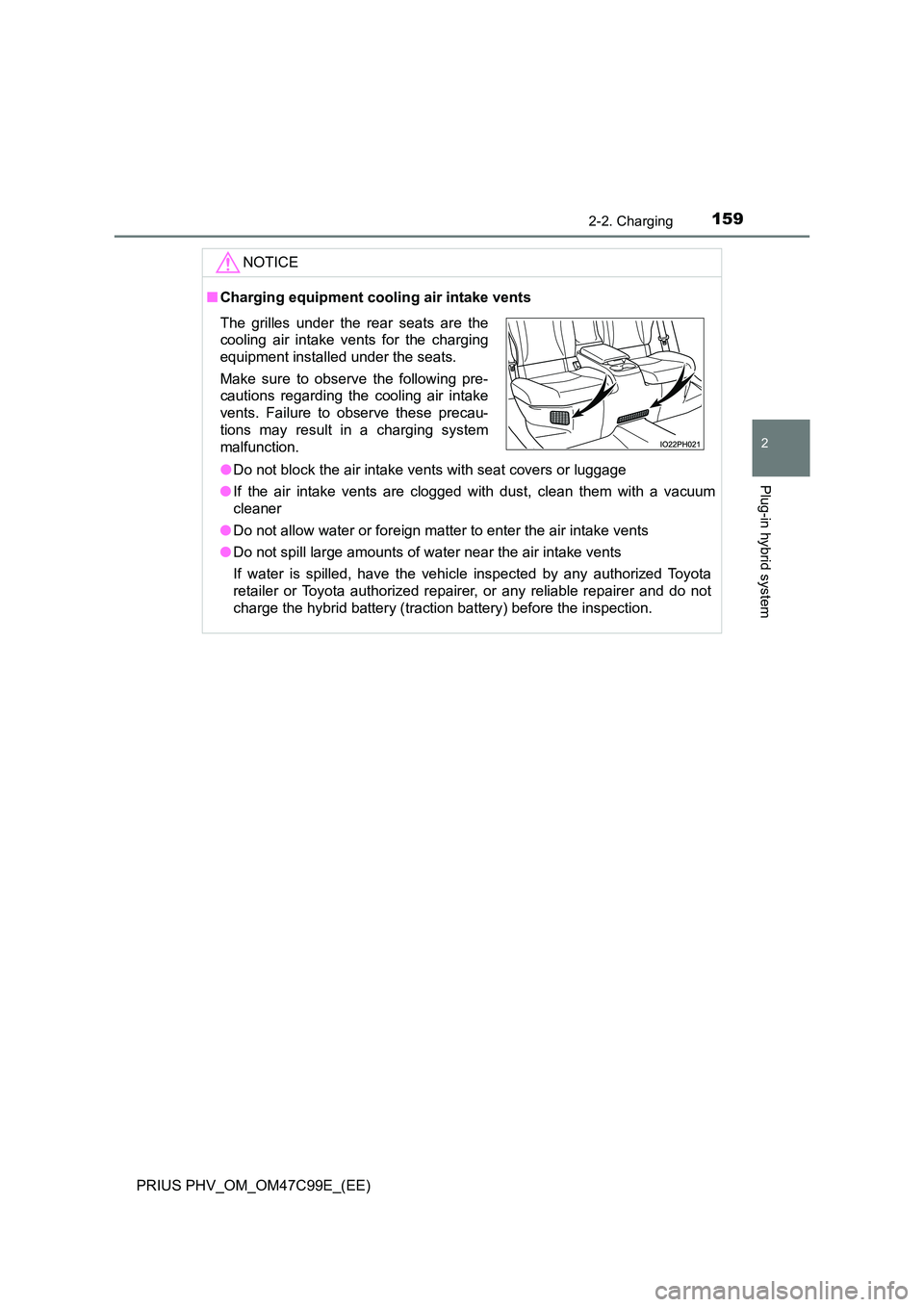
■Charging equipment cooling air intake vents
● Do not block the air intake vents with seat covers or luggage
● If the air intake vents are clogged with dust, clean them with a vacuum
cleaner
● Do not allow water or foreign matter to enter the air intake vents
● Do not spill large amounts of water near the air intake vents
If water is spilled, have the vehicle inspected by any authorized Toyota
retailer or Toyota authorized repairer, or any reliable repairer and do not
charge the hybrid battery (traction battery) before the inspection.
The grilles under the rear seats are the
cooling air intake vents for the charging
equipment installed under the seats.
Make sure to observe the following pre-
cautions regarding the cooling air intake
vents. Failure to observe these precau-
tions may result in a charging system
malfunction.