spec TOYOTA PRIUS PLUS 2019 Manual PDF
[x] Cancel search | Manufacturer: TOYOTA, Model Year: 2019, Model line: PRIUS PLUS, Model: TOYOTA PRIUS PLUS 2019Pages: 568, PDF Size: 73.58 MB
Page 485 of 568
4857-2. Steps to take in an emergency
PRIUS +_OM_OM47D30E_(EE)
7
When trouble arises
WARNING
■Replacing a flat tire
● Do not touch the disc wheels or the area around the brakes immediately
after the vehicle has been driven.
After the vehicle has been driven the disc wheels and the area around the
brakes will be extremely hot. Touching these areas with hands, feet or
other body parts while changing a tire, etc. may result in burns.
● Failure to follow these precautions could cause the wheel nuts to loosen
and the tire to fall off, resulting in death or serious injury.
• Have the wheel nuts tightened with a torque wrench to 103 N•m
(10.5 kgf•m, 76 ft•lbf) as soon as possible after changing wheels.
• When installing a tire, only use wheel nuts that have been specifically
designed for that wheel.
• If there are any cracks or deformations in the bolt screws, nut threads or
bolt holes of the wheel, have the vehicle inspected by any authorized
Toyota retailer or Toyota authoriz ed repairer, or any reliable repairer.
• When installing the wheel nuts, be sure to install the wheel nuts with the
tapered ends facing inward. ( P. 412)
Page 490 of 568
4907-2. Steps to take in an emergency
PRIUS +_OM_OM47D30E_(EE)
WARNING
■When using the compact spare tire
● Remember that the spare tire provided is specifically designed for use with
your vehicle. Do not use your spare tire on another vehicle.
● Do not use more than one compact spare tire simultaneously.
● Replace the spare tire with a standard tire as soon as possible.
● Avoid sudden acceleration, abrupt steering, sudden braking and shifting
operations that cause sudden engine braking.
■ When the compact spare tire is attached
The vehicle speed may not be correctly detected, and the following systems
may not operate correctly:
■ Speed limit when using the compact spare tire
Do not drive at speeds in excess of 80 km/h (50 mph) when a compact
spare tire is installed on the vehicle.
The compact spare tire is not designed for driving at high speeds. Failure to
observe this precaution may lead to an accident causing death or serious
injury.
■ After using the tools and jack
Before driving, make sure all the tools and jack are securely in place in their
storage location to reduce the possibility of personal injury during a collision
or sudden braking.
• ABS & Brake assist
• VSC
•TRC
•Cruise control*
• Dynamic radar cruise control*
• PCS (Pre-Crash Safety system)*
• EPS
*: If equipped
• Rear view monitor system*
• IPA (Intelligent Parking Assist)*
• LDA (Lane Departure Alert with
steering control)*
• Navigation system*
• Automatic High beam*
Page 497 of 568
4977-2. Steps to take in an emergency
PRIUS +_OM_OM47D30E_(EE)
7
When trouble arises
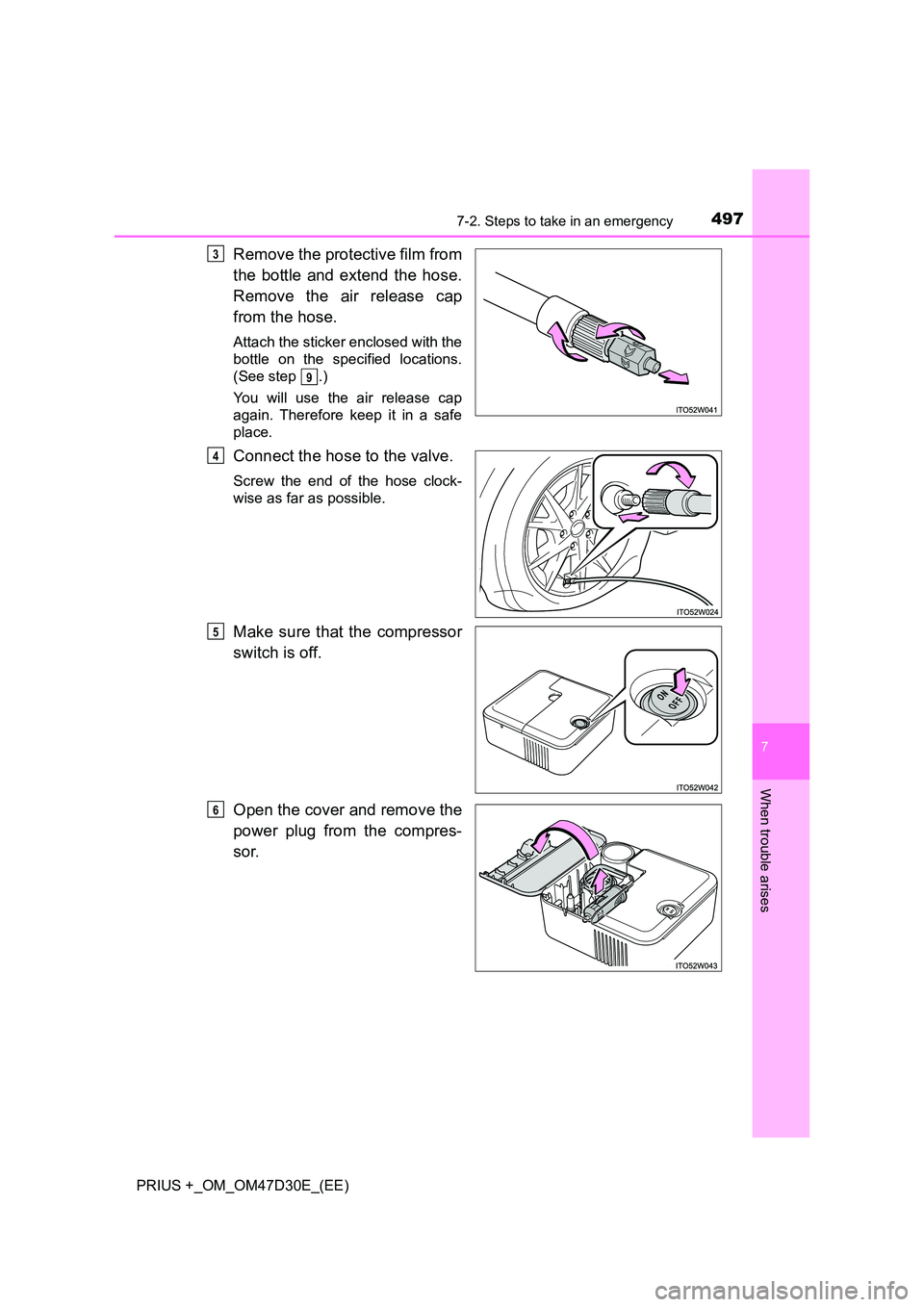
Remove the protective film from
the bottle and extend the hose.
Remove the air release cap
from the hose.
Attach the sticker enclosed with the
bottle on the specified locations.
(See step .)
You will use the air release cap
again. Therefore keep it in a safe
place.
Connect the hose to the valve.
Screw the end of the hose clock-
wise as far as possible.
Make sure that the compressor
switch is off.
Open the cover and remove the
power plug from the compres-
sor.
3
9
4
5
6
Page 499 of 568
4997-2. Steps to take in an emergency
PRIUS +_OM_OM47D30E_(EE)
7
When trouble arises
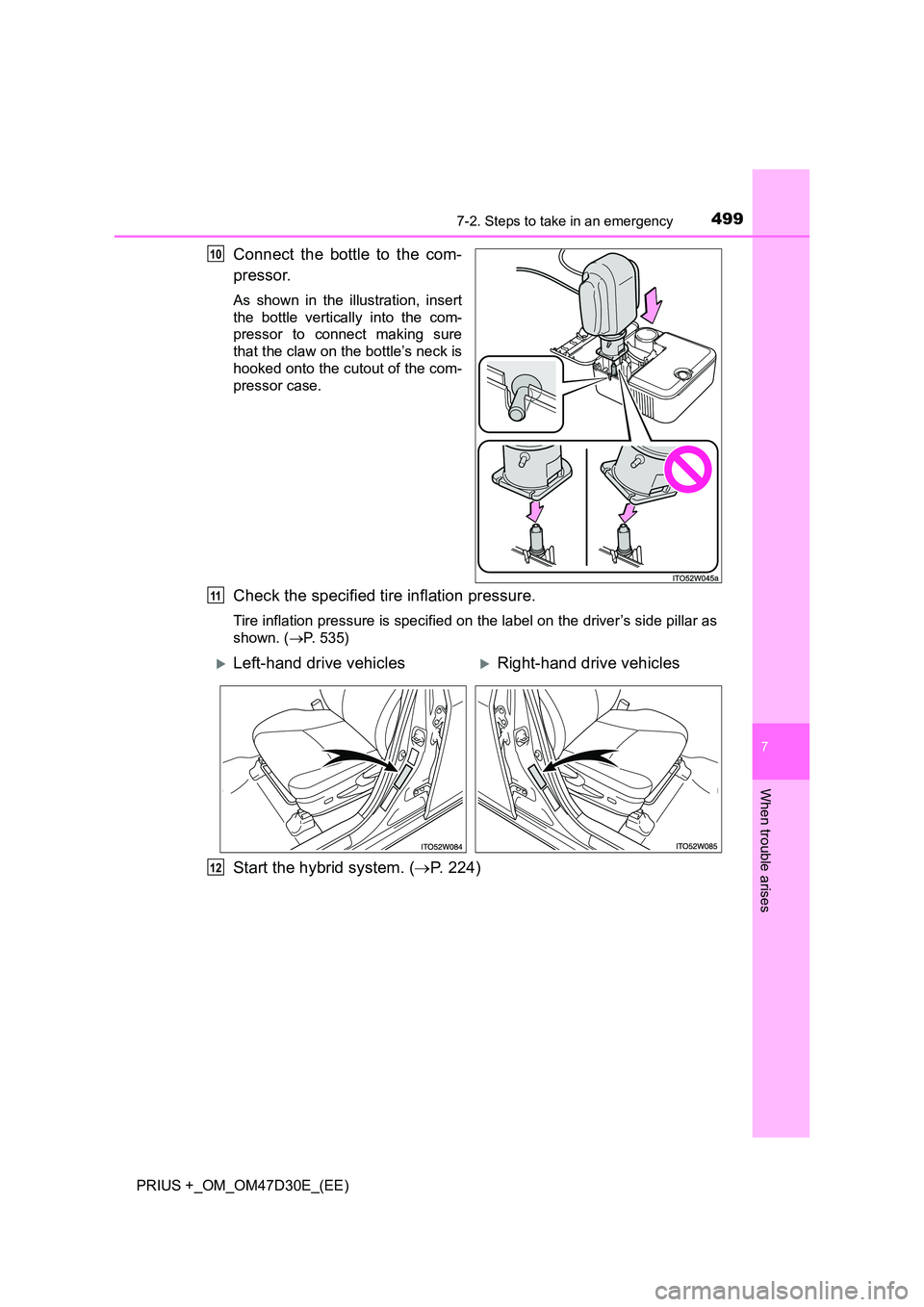
Connect the bottle to the com-
pressor.
As shown in the illustration, insert
the bottle vertically into the com-
pressor to connect making sure
that the claw on the bottle’s neck is
hooked onto the cutout of the com-
pressor case.
Check the specified tire inflation pressure.
Tire inflation pressure is specified on the label on the driver’s side pillar as
shown. ( P. 535)
Start the hybrid system. (P. 224)
10
11
Left-hand drive vehiclesRight-hand drive vehicles
12
Page 500 of 568
5007-2. Steps to take in an emergency
PRIUS +_OM_OM47D30E_(EE)
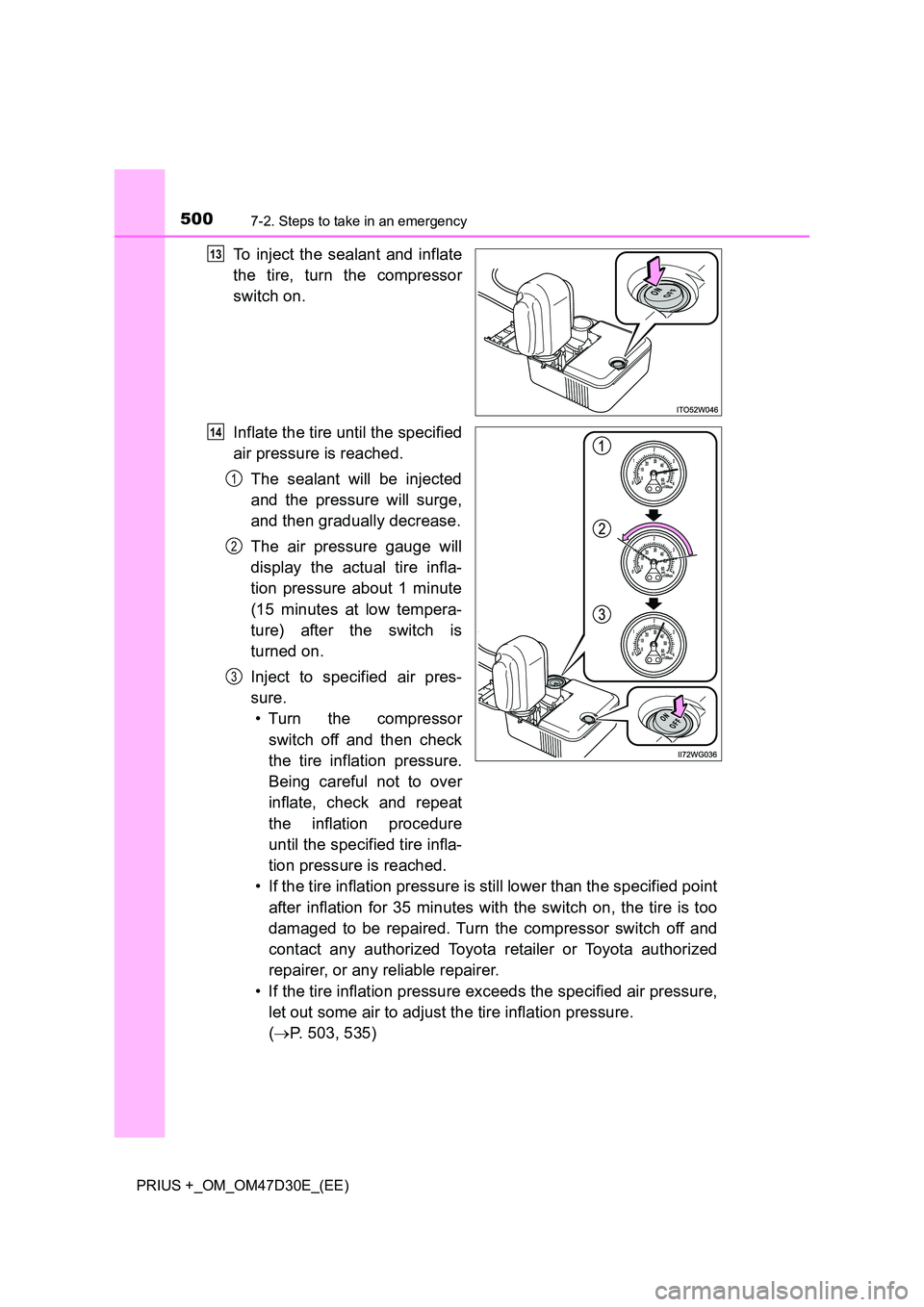
To inject the sealant and inflate
the tire, turn the compressor
switch on.
Inflate the tire until the specified
air pressure is reached.
The sealant will be injected
and the pressure will surge,
and then gradually decrease.
The air pressure gauge will
display the actual tire infla-
tion pressure about 1 minute
(15 minutes at low tempera-
ture) after the switch is
turned on.
Inject to specified air pres-
sure.
• Turn the compressor
switch off and then check
the tire inflation pressure.
Being careful not to over
inflate, check and repeat
the inflation procedure
until the specified tire infla-
tion pressure is reached.
• If the tire inflation pressure is still lower than the specified point
after inflation for 35 minutes with the switch on, the tire is too
damaged to be repaired. Turn the compressor switch off and
contact any authorized Toyota retailer or Toyota authorized
repairer, or any reliable repairer.
• If the tire inflation pressure exceeds the specified air pressure,
let out some air to adjust the tire inflation pressure.
( P. 503, 535)
13
14
1
2
3
Page 502 of 568
5027-2. Steps to take in an emergency
PRIUS +_OM_OM47D30E_(EE)
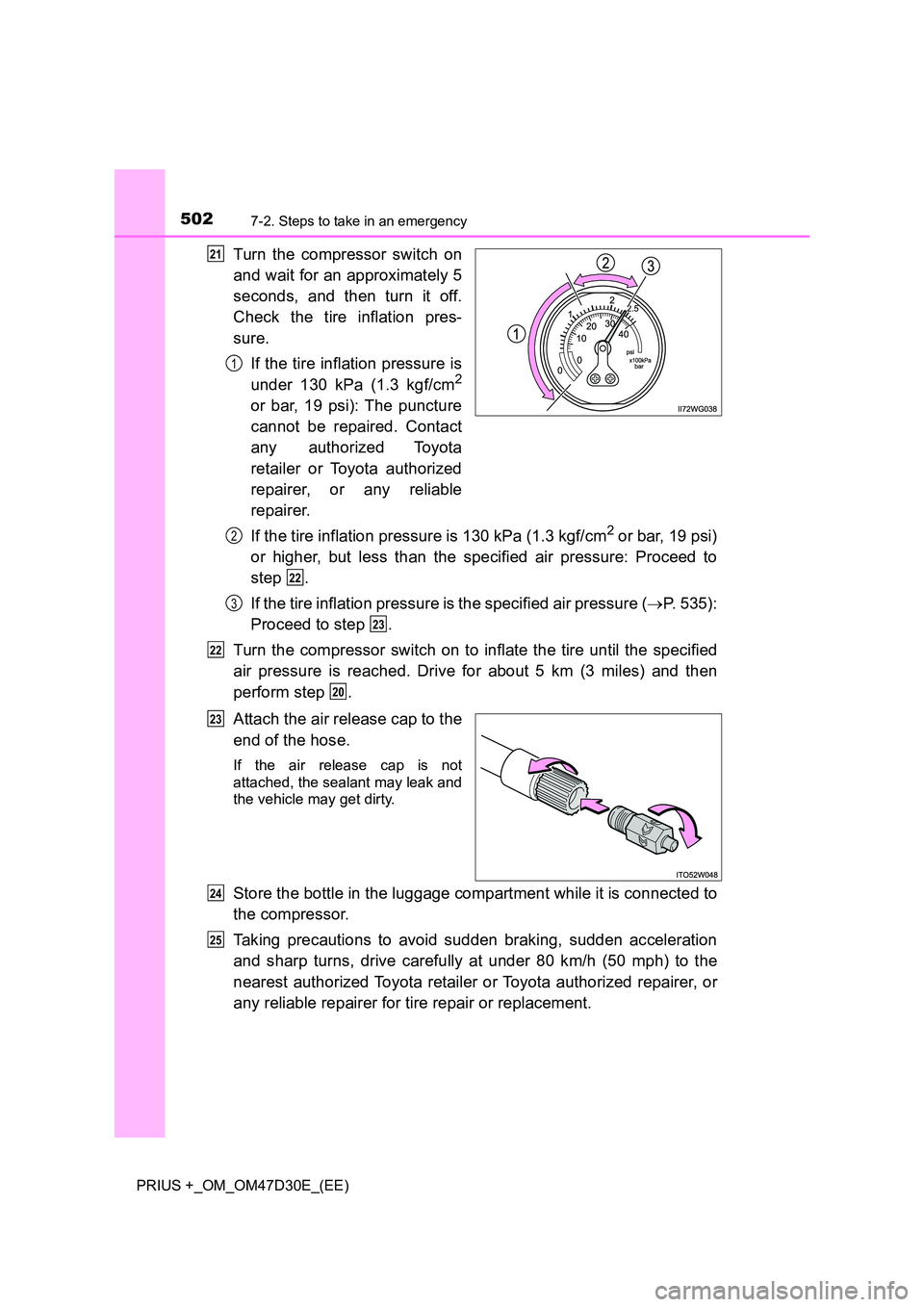
Turn the compressor switch on
and wait for an approximately 5
seconds, and then turn it off.
Check the tire inflation pres-
sure.
If the tire inflation pressure is
under 130 kPa (1.3 kgf/cm2
or bar, 19 psi): The puncture
cannot be repaired. Contact
any authorized Toyota
retailer or Toyota authorized
repairer, or any reliable
repairer.
If the tire inflation pressure is 130 kPa (1.3 kgf/cm2 or bar, 19 psi)
or higher, but less than the specified air pressure: Proceed to
step .
If the tire inflation pressure is the specified air pressure ( P. 535):
Proceed to step .
Turn the compressor switch on to inflate the tire until the specified
air pressure is reached. Drive for about 5 km (3 miles) and then
perform step .
Attach the air release cap to the
end of the hose.
If the air release cap is not
attached, the sealant may leak and
the vehicle may get dirty.
Store the bottle in the luggage compartment while it is connected to
the compressor.
Taking precautions to avoid sudden braking, sudden acceleration
and sharp turns, drive carefully at under 80 km/h (50 mph) to the
nearest authorized Toyota retailer or Toyota authorized repairer, or
any reliable repairer for tire repair or replacement.
21
1
2
22
3
23
22
20
23
24
25
Page 503 of 568
5037-2. Steps to take in an emergency
PRIUS +_OM_OM47D30E_(EE)
7
When trouble arises
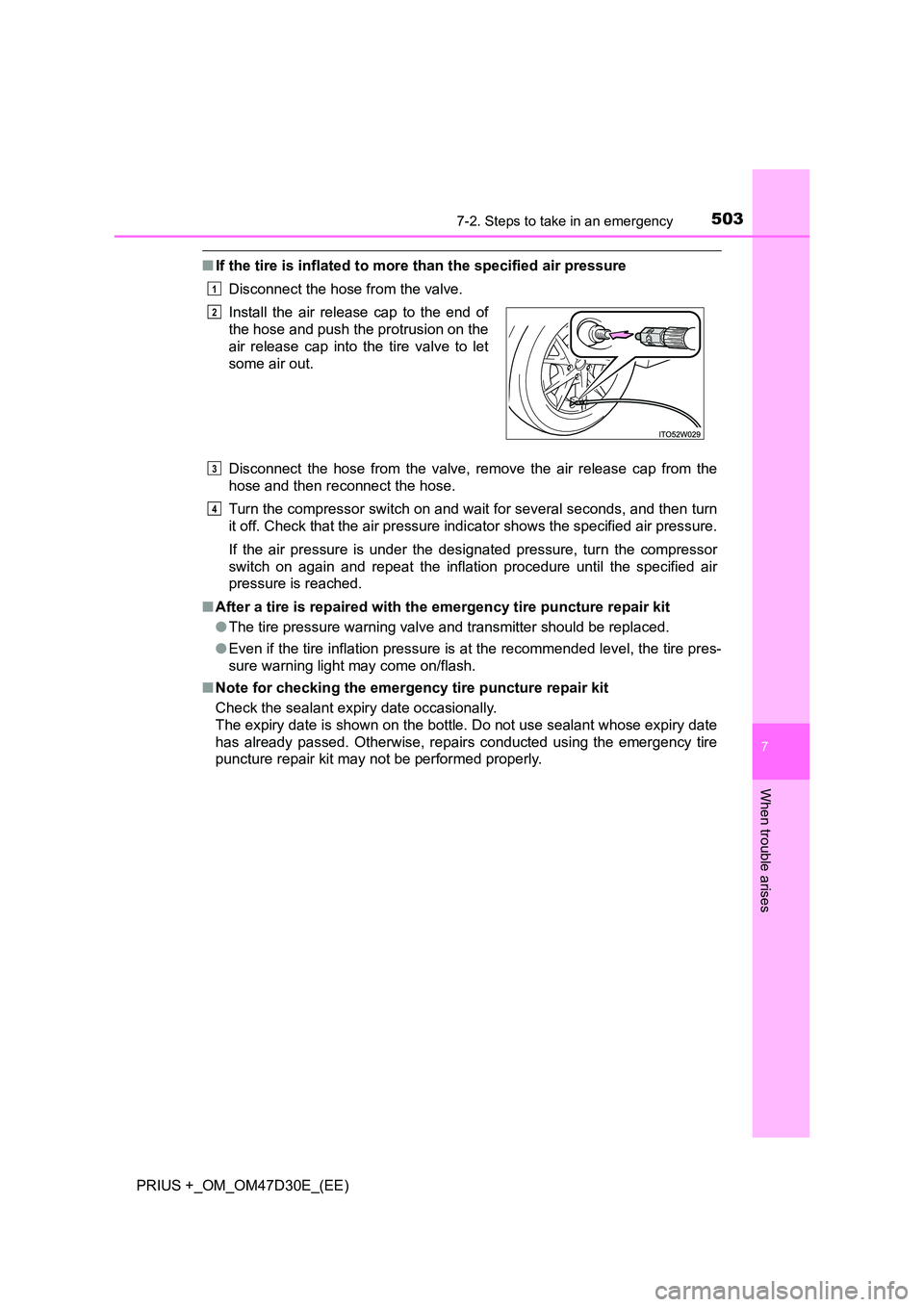
■If the tire is inflated to more than the specified air pressure
Disconnect the hose from the valve.
Disconnect the hose from the valve, remove the air release cap from the
hose and then reconnect the hose.
Turn the compressor switch on and wait for several seconds, and then turn
it off. Check that the air pressure indicator shows the specified air pressure.
If the air pressure is under the designated pressure, turn the compressor
switch on again and repeat the inflation procedure until the specified air
pressure is reached.
■ After a tire is repaired with the emergency tire puncture repair kit
● The tire pressure warning valve and transmitter should be replaced.
● Even if the tire inflation pressure is at the recommended level, the tire pres-
sure warning light may come on/flash.
■ Note for checking the emergency tire puncture repair kit
Check the sealant expiry date occasionally.
The expiry date is shown on the bottle. Do not use sealant whose expiry date
has already passed. Otherwise, repairs conducted using the emergency tire
puncture repair kit may not be performed properly.
Install the air release cap to the end of
the hose and push the protrusion on the
air release cap into the tire valve to let
some air out.
1
2
3
4
Page 507 of 568
5077-2. Steps to take in an emergency
PRIUS +_OM_OM47D30E_(EE)
7
When trouble arises
WARNING
■Driving to spread the liquid sealant evenly
Observe the following precautions to reduce the risk of accidents.
Failing to do so may result in a loss of vehicle control and cause death or
serious injury.
● Drive the vehicle carefully at a low speed. Be especially careful when turn-
ing and cornering.
● If the vehicle does not drive straight or you feel a pull through the steering
wheel, stop the vehicle and check the following.
• Tire condition. The tire may have separated from the wheel.
• Tire inflation pressure. If the tire inflation pressure is 130 kPa (1.3 kgf/
cm2 or bar, 19 psi) or less, the tire may be severely damaged.
Page 510 of 568
5107-2. Steps to take in an emergency
PRIUS +_OM_OM47D30E_(EE)
One of the following may be the cause of the problem:
● The 12-volt battery may be discharged. (P. 513)
● One or both of the 12-volt battery terminals may be disconnected.
( P. 389)
Contact any authorized Toyota retailer or Toyota authorized repairer,
or any reliable repairer if the problem cannot be repaired, or if repair
procedures are unknown.
When the hybrid system does not start, the following steps can be
used as an interim measure to start the hybrid system if the power
switch is functioning normally.
Do not use this starting procedure except in cases of emergency.
Set the parking brake.
Turn the power switch to ACCESSORY mode.
Press and hold the power switch for about 15 seconds while
depressing the brake pedal firmly.
Even if the hybrid system can be started using the above steps, the
system may be malfunctioning. Have the vehicle inspected by any
authorized Toyota retailer or Toyota authorized repairer, or any reliable
repairer.
The interior lights and headlights do not turn on, or the horn
does not sound.
Emergency start function
1
2
3
Page 515 of 568
5157-2. Steps to take in an emergency
PRIUS +_OM_OM47D30E_(EE)
7
When trouble arises
Start the engine of the second vehicle. Increase the engine speed
slightly and maintain at that level for approximately 5 minutes to
recharge the 12-volt battery of your vehicle.
Maintain the engine speed of the second vehicle and start the
hybrid system of your vehicle by turning the power switch to ON
mode.
Make sure the “READY” indicator comes on. If the indicator light
does not come on, contact any authorized Toyota retailer or Toyota
authorized repairer, or any reliable repairer.
Once the hybrid system has started, remove the jumper cables in
the exact reverse order from which they were connected.
Close the exclusive jump starting terminal cover, and reinstall the
fuse box cover to its original position.
When installing, first hook the fuse box cover onto the two rear tabs.
Once the hybrid system starts, have the vehicle inspected at any
authorized Toyota retailer or Toyota authorized repairer, or any reliable
repairer as soon as possible.
■ Starting the hybrid system when the 12-volt battery is discharged
The hybrid system cannot be started by push-starting.
■ To prevent 12-volt battery discharge
● Turn off the headlights and the audio system while the hybrid system is off.
● Turn off any unnecessary electrical components when the vehicle is running
at a low speed for an extended period, such as in heavy traffic.
■ When the 12-volt battery is removed or discharged
● In some cases, it may not be possible to unlock the doors using the smart
entry & start system when the 12-volt battery is discharged. Use the wire-
less remote control or the mechanical key to lock or unlock the doors.
● The hybrid system may not start on the first attempt after the 12-volt battery
has recharged but will start normally after the second attempt. This is not a
malfunction.
● The power switch mode is memorized by the vehicle. When the 12-volt bat-
tery is reconnected, the system will return to the mode it was in before the
12-volt battery was discharged. Before disconnecting the 12-volt battery,
turn the power switch off. If you are unsure what mode the power switch was
in before the 12-volt battery discharged, be especially careful when recon-
necting the 12-volt battery.
5
6
7
8
9