traction control TOYOTA PRIUS PRIME 2021 Owners Manual (in English)
[x] Cancel search | Manufacturer: TOYOTA, Model Year: 2021, Model line: PRIUS PRIME, Model: TOYOTA PRIUS PRIME 2021Pages: 808, PDF Size: 74.05 MB
Page 12 of 808

12
PRIUS PRIME_OM_OM47D71U_(U)The SRS airbag and seat belt pretensioner devices in your Toyota contain
explosive chemicals. If the vehicle is scrapped with the airbags and seat belt
pretensioners left as they are, this may cause an accident such as fire. Be
sure to have the systems of the SRS airbag and seat belt pretensioner
removed and disposed of by a qualified service shop or by your Toyota dealer
before you scrap your vehicle.
Special handling may apply,
See www.dtsc.ca.gov/hazardouswaste/perchlorate.
Your vehicle has components that may contain perchlorate. These compo-
nents may include airbag, seat belt pretensioners, and wireless remote con-
trol batteries.
Scrapping of your Toyota
Perchlorate Material
WARNING
■General precautions while driving
Driving under the influence: Never drive your vehicle when under the influ-
ence of alcohol or drugs that have impaired your ability to operate your vehi-
cle. Alcohol and certain drugs delay reaction time, impair judgment and
reduce coordination, which could lead to an accident that could result in
death or serious injury.
Defensive driving: Always drive defensively. Anticipate mistakes that other
drivers or pedestrians might make and be ready to avoid accidents.
Driver distraction: Always give your full attention to driving. Anything that
distracts the driver, such as adjusting controls, talking on a cellular phone or
reading can result in a collision with resulting death or serious injury to you,
your occupants or others.
■General precaution regarding children’s safety
Never leave children unattended in the vehicle, and never allow children to
have or use the key.
Children may be able to start the vehicle or shift the vehicle into neutral.
There is also a danger that children may injure themselves by playing with
the windows, or other features of the vehicle. In addition, heat build-up or
<0048005b00570055004800500048004f005c000300460052004f004700030057004800500053004800550044005700580055004800560003004c00510056004c0047004800030057004b0048000300590048004b004c0046004f0048000300460044005100
030045004800030049004400570044004f0003005700520003[children.
Page 86 of 808
86
PRIUS PRIME_OM_OM47D71U_(U)
2-1. Plug-in hybrid system
Plug-in hybrid system features
The illustration is an example for explanation and may differ from the
actual item.
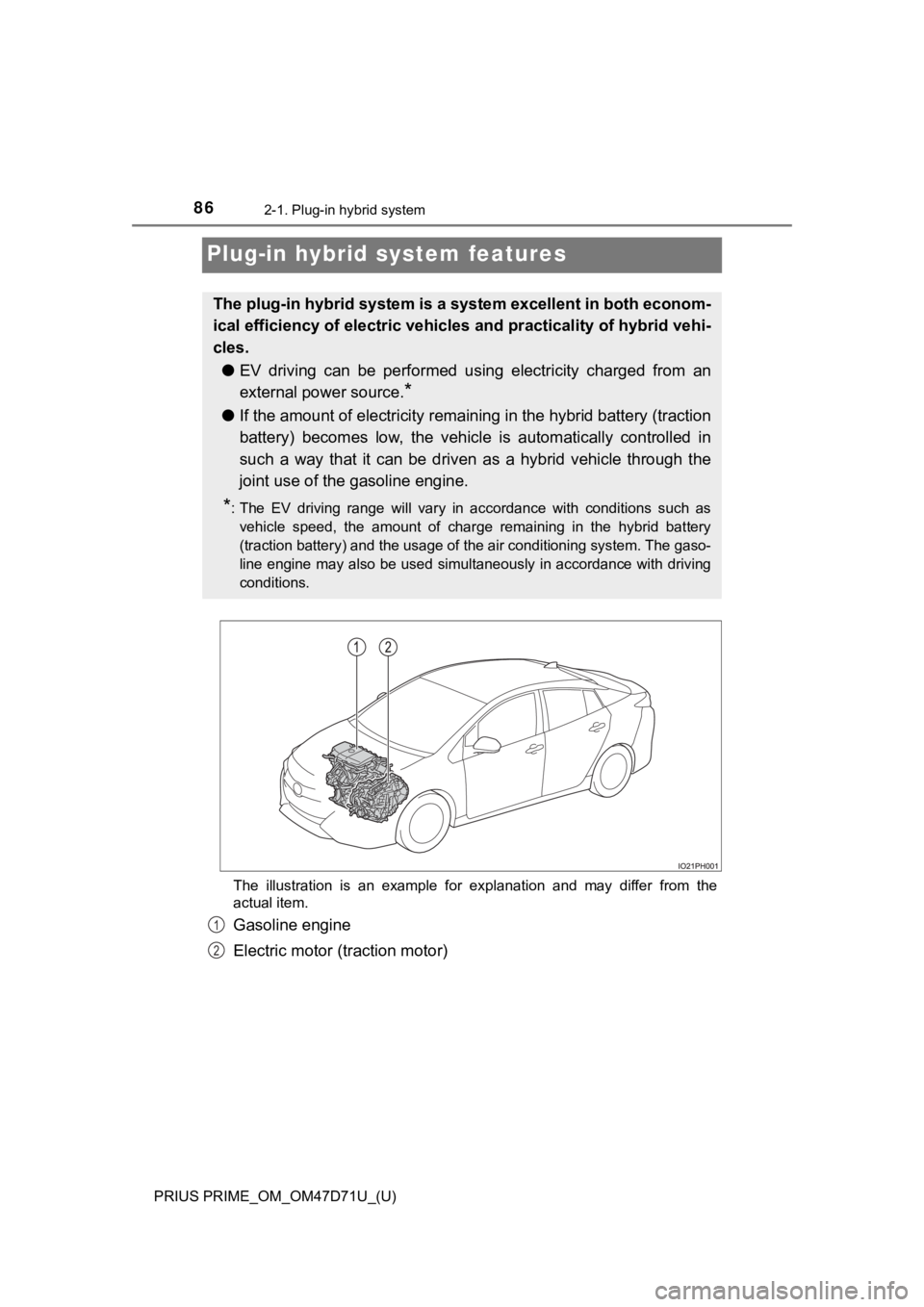
Gasoline engine
Electric motor (traction motor)
The plug-in hybrid system is a system excellent in both econom-
ical efficiency of electric vehicles and practicality of hybrid vehi-
cles.
●EV driving can be performed using electricity charged from an
external power source.
*
●If the amount of electricity remaining in the hybrid battery (traction
battery) becomes low, the vehicle is automatically controlled in
such a way that it can be driven as a hybrid vehicle through the
joint use of the gasoline engine.
*: The EV driving range will vary in accordance with conditions such as
vehicle speed, the amount of charge remaining in the hybrid battery
(traction battery) and the usage of the air conditioning system. The gaso-
line engine may also be used simultaneously in accordance with driving
conditions.
1
2
Page 92 of 808
92
PRIUS PRIME_OM_OM47D71U_(U)
2-1. Plug-in hybrid system
■When in EV/EV auto mode
In EV/EV auto mode, EV driving (driving using only the electric
motor)
* is possible. However, depending on the situation, EV driv-
ing may be canceled and both gasoline engine and electric motor
are used (P. 95). Also, if a little electricity is remaining in the
hybrid battery (traction battery), HV mode is automatically selected.
To drive in EV/EV auto mode long, observe the followings.
●Avoid sudden acceleration and sudden deceleration, and be sure
to drive smoothly.
If you repeatedly accelerate, the hybrid battery (traction battery)
charge will deplete quickly. Also, EV driving may be canceled by
rapid acceleration or vehicle speed.
●Restrain your speed as much as possible. The distance that can
be driven in EV/EV auto mode will reduce considerably at high
speeds.
*: The EV driving range can be checked using the multi-information dis-
play etc. (P. 214, 230, 237, 254)
■
When in HV mode
The vehicle can be used in the same way as a standard hybrid
vehicle.
In HV mode, controls are primarily carried out as follows in accor-
dance with the driving conditions.
●The gasoline engine stops
* when the vehicle is stopped.
●During start off, the electric motor (traction motor) drives the vehi-
cle.
●During normal driving, the gasoline engine and electric motor
(traction motor) are controlled effectively, and the vehicle is
driven with optimum fuel efficiency. Also, when necessary, the
electric motor (traction motor) operates as an electrical generator
to charge the hybrid battery (traction battery).
●When the accelerator pedal is depressed heavily, drive force
from both the gasoline engine and the electric motor (traction
motor) is used to accelerate.
*: When the hybrid battery (traction battery) requires charging or the
engine is warming up, etc., the gasoline engine will not automatically
stop. (P. 95)
Control when driving in each mode
Page 96 of 808

96
PRIUS PRIME_OM_OM47D71U_(U)
2-1. Plug-in hybrid system
■If the vehicle is not used for a long time
●The 12-volt battery may discharge. In this event, charge the 12-volt battery.
(P. 607)
In order to prevent the hybrid battery (traction battery) from becoming
extremely low in charge, charge the hybrid battery (traction battery) from
external power source or start the hybrid system at least once every 2 or 3
months, and turn the power switch off after the gasoline engine has
stopped automatically. (If the gasoline engine does not start up even after
approximately 10 seconds have passed since the “READY” indicator came
on, the power switch can be turned to off without any further action.)
●When the vehicle is left with the charging cable connected, the electricity
consumption amount of the 12-volt battery increases due to controls, such
as the system checking, operating. When the charging cable is not needed,
immediately remove it from the vehicle.
■Sounds and vibrations specific to a hybrid vehicle
There may be no engine sound or vibration even though the vehicle is able to
move with the “READY” indicator is illuminated. For safety, apply the parking
brake and make sure to shift the shift position to P when parked.
The following sounds or vibrations may occur when the hybrid system is
operating and are not a malfunction.
●Motor sounds may be heard from the engine compartment.
●Sounds may be heard from the hybrid battery (traction battery) when the
hybrid system starts or stops.
●Relay operating sounds such as a snap or soft clank will be emitted from the
hybrid battery (traction battery), behind the rear seats, when the hybrid sys-
tem is started or stopped.
●Sounds from the hybrid system may be heard when the back door is open.
●Sounds may be heard from the transmission when the gasoline engine
starts or stops, when driving at low speeds, or during idling.
●Engine sounds may be heard when accelerating sharply.
●Sounds may be heard due to regenerative braking when the brake pedal is
depressed or as the accelerator pedal is released.
●Vibration may be felt when the gasoline engine starts or stops.
●Cooling fan sounds may be heard from the air intake vents. (P. 99)
■Vehicle proximity notification system
In the following cases, the vehicle proximity notification system may be diffi-
cult for surrounding people to hear.
●In very noisy areas
●In the wind or the rain
Also, as the vehicle proximity notification system is installed on the front of
the vehicle, it may be more difficult to hear from the rear of the vehicle com-
pared to the front.
Page 98 of 808

98
PRIUS PRIME_OM_OM47D71U_(U)
2-1. Plug-in hybrid system
Plug-in hybrid system precautions
The illustration is an example for explanation and may differ from the
actual item.
Take care when handling the hybrid system, as it contains a high
voltage system (about 600V at maximum) as well as parts that
become extremely hot when the hybrid system is operating.
Obey the caution labels attached to the vehicle.
Caution label
Charging inlet
Service plug
Air conditioning compressor
Power control unit and DC/DC
converterElectric motor (traction motor)
High voltage cables (orange)
Onboard traction battery char-
ger
Hybrid battery (traction bat-
tery)1
2
3
4
5
6
7
8
9
Page 106 of 808

106
PRIUS PRIME_OM_OM47D71U_(U)
2-1. Plug-in hybrid system
◆Accelerator pedal/brake pedal operation
●Drive your vehicle smoothly. Avoid abrupt acceleration and
deceleration. Gradual acceleration and deceleration will make
more effective use of the electric motor (traction motor) without
having to use gasoline engine power.
●Avoid repeated acceleration. Repeated acceleration consumes
hybrid battery (traction battery) power, resulting in poor fuel con-
sumption. Battery power can be restored by driving with the
accelerator pedal slightly released.
◆When braking
Make sure to operate the brakes gently and a timely manner. A
greater amount of electrical energy can be regenerated when slow-
ing down.
◆Delays
Repeated acceleration and deceleration, as well as long waits at
traffic lights, will lead to high fuel and electricity consumption.
Check traffic reports before leaving and avoid delays as much as
possible. When driving in a traffic jam, gently release the brake
pedal to allow the vehicle to move forward slightly while avoiding
overuse of the accelerator pedal. Doing so can help control exces-
sive electricity and fuel consumption.
◆Highway driving
●Control and maintain the vehicle at a constant speed. Before
stopping at a toll booth or similar, allow plenty of time to release
the accelerator and gently apply the brakes. A greater amount of
electrical energy can be regenerated when slowing down.
●Electricity consumption will increase significantly when driving at
high speeds in EV mode. If there will be a long distance to the
next external charging point after leaving a freeway, it is recom-
mended to drive in HV mode while on the freeway and change to
EV mode after leaving the freeway.
Page 112 of 808
112
PRIUS PRIME_OM_OM47D71U_(U)
2-2. Charging
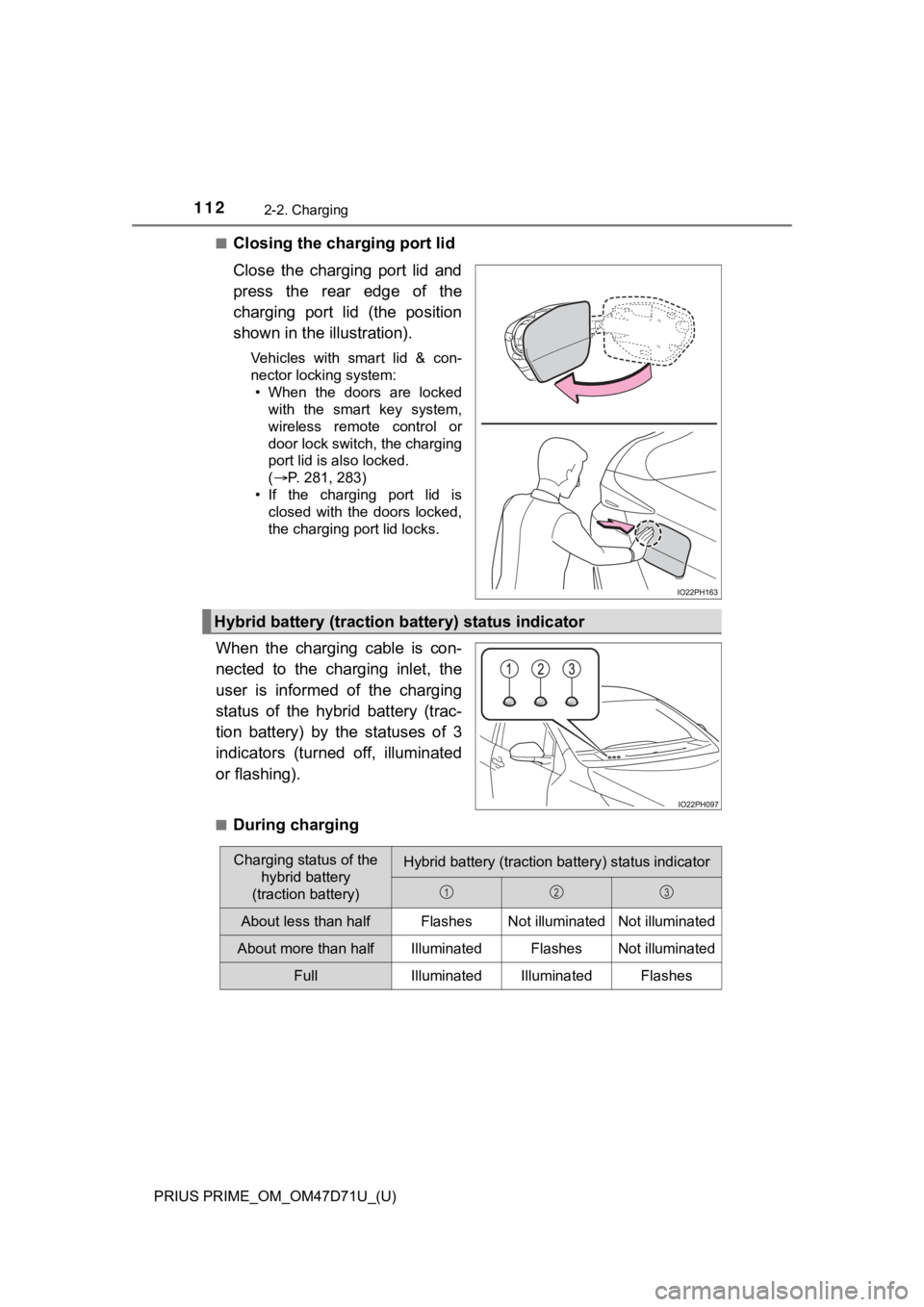
■Closing the charging port lid
Close the charging port lid and
press the rear edge of the
charging port lid (the position
shown in the illustration).
Vehicles with smart lid & con-
nector locking system:
• When the doors are locked
with the smart key system,
wireless remote control or
door lock switch, the charging
port lid is also locked.
(P. 281, 283)
• If the charging port lid is
closed with the doors locked,
the charging port lid locks.
When the charging cable is con-
nected to the charging inlet, the
user is informed of the charging
status of the hybrid battery (trac-
tion battery) by the statuses of 3
indicators (turned off, illuminated
or flashing).
■During charging
Hybrid battery (traction battery) status indicator
Charging status of the
hybrid battery
(traction battery)Hybrid battery (traction battery) status indicator
About less than halfFlashesNot illuminatedNot illuminated
About more than halfIlluminatedFlashesNot illuminated
FullIlluminatedIlluminatedFlashes
123
Page 136 of 808
136
PRIUS PRIME_OM_OM47D71U_(U)
2-2. Charging
■Hybrid battery (traction battery) warming control (Alaska and
Canada only)
This control operates after the charging cable remains connected to
the vehicle for 3 days and “Traction Battery Heater” automatically
stops. It automatically insulates the hybrid battery (traction battery)
in extremely low temperatures.
●This control stops 31 days after the charging cable is connected,
even if it is still connected to the vehicle.
●When this control operates, charging schedule settings are
ignored and charging starts.
■“Traction Battery Cooler”
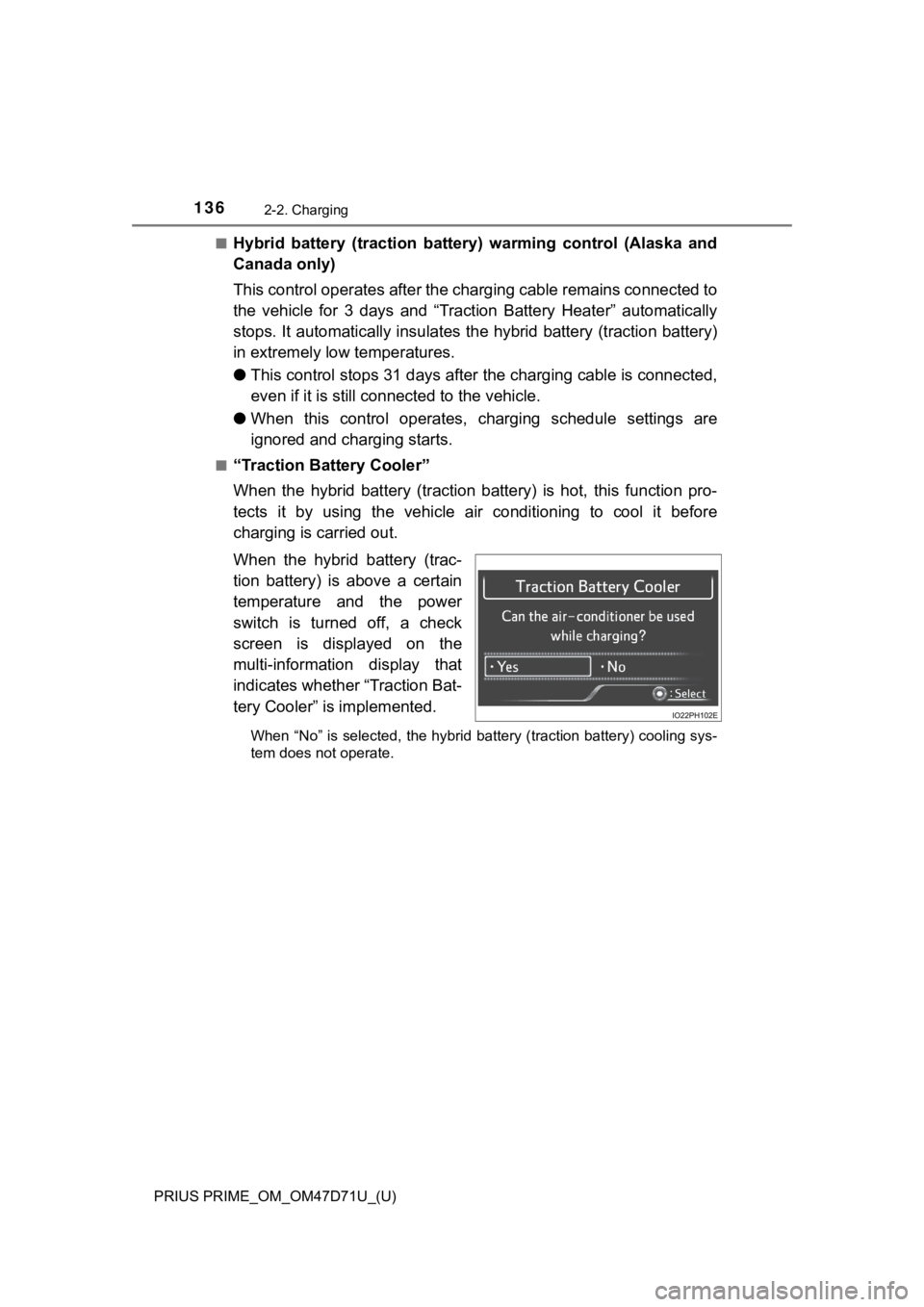
When the hybrid battery (traction battery) is hot, this function pro-
tects it by using the vehicle air conditioning to cool it before
charging is carried out.
When the hybrid battery (trac-
tion battery) is above a certain
temperature and the power
switch is turned off, a check
screen is displayed on the
multi-information display that
indicates whether “Traction Bat-
tery Cooler” is implemented.
When “No” is selected, the hybrid battery (traction battery) cooling sys-
tem does not operate.
Page 183 of 808
PRIUS PRIME_OM_OM47D71U_(U)
1832-2. Charging
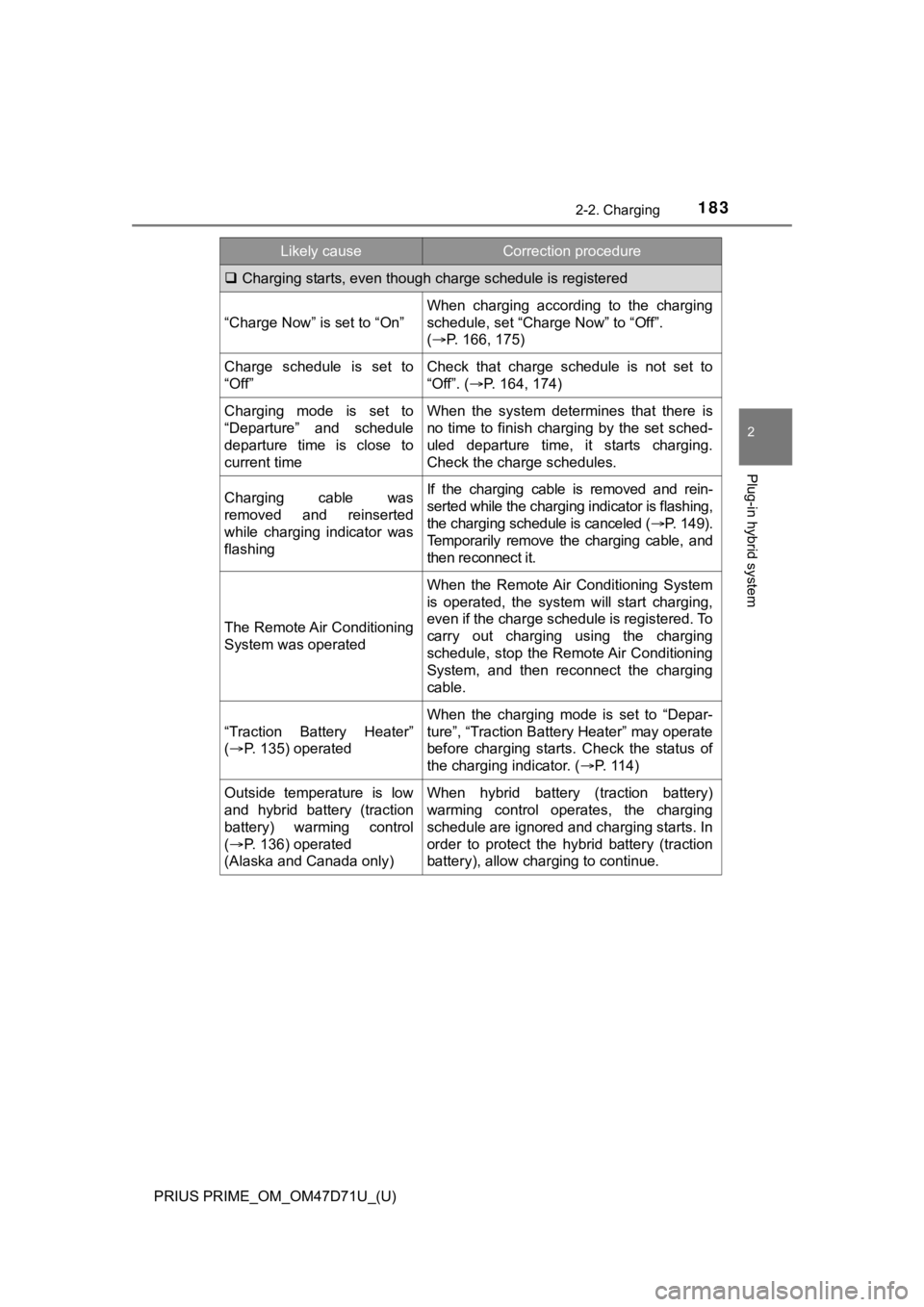
2
Plug-in hybrid system
Charging starts, even though charge schedule is registered
“Charge Now” is set to “On”
When charging according to the charging
schedule, set “Charge Now” to “Off”.
(P. 166, 175)
Charge schedule is set to
“Off”Check that charge schedule is not set to
“Off”. (P. 164, 174)
Charging mode is set to
“Departure” and schedule
departure time is close to
current timeWhen the system determines that there is
no time to finish charging by the set sched-
uled departure time, it starts charging.
Check the charge schedules.
Charging cable was
removed and reinserted
while charging indicator was
flashingIf the charging cable is removed and rein-
serted while the charging indicator is flashing,
the charging schedule is canceled (P. 149).
Temporarily remove the charging cable, and
then reconnect it.
The Remote Air Conditioning
System was operated
When the Remote Air Conditioning System
is operated, the system will start charging,
even if the charge schedule is registered. To
carry out charging using the charging
schedule, stop the Remote Air Conditioning
System, and then reconnect the charging
cable.
“Traction Battery Heater”
(P. 135) operated
When the charging mode is set to “Depar-
ture”, “Traction Battery Heater” may operate
before charging starts. Check the status of
the charging indicator. (P. 114)
Outside temperature is low
and hybrid battery (traction
battery) warming control
(P. 136) operated
(Alaska and Canada only)When hybrid battery (traction battery)
warming control operates, the charging
schedule are ignored and charging starts. In
order to protect the hybrid battery (traction
battery), allow charging to continue.
Likely causeCorrection procedure
Page 189 of 808
PRIUS PRIME_OM_OM47D71U_(U)
1892-2. Charging
2
Plug-in hybrid system
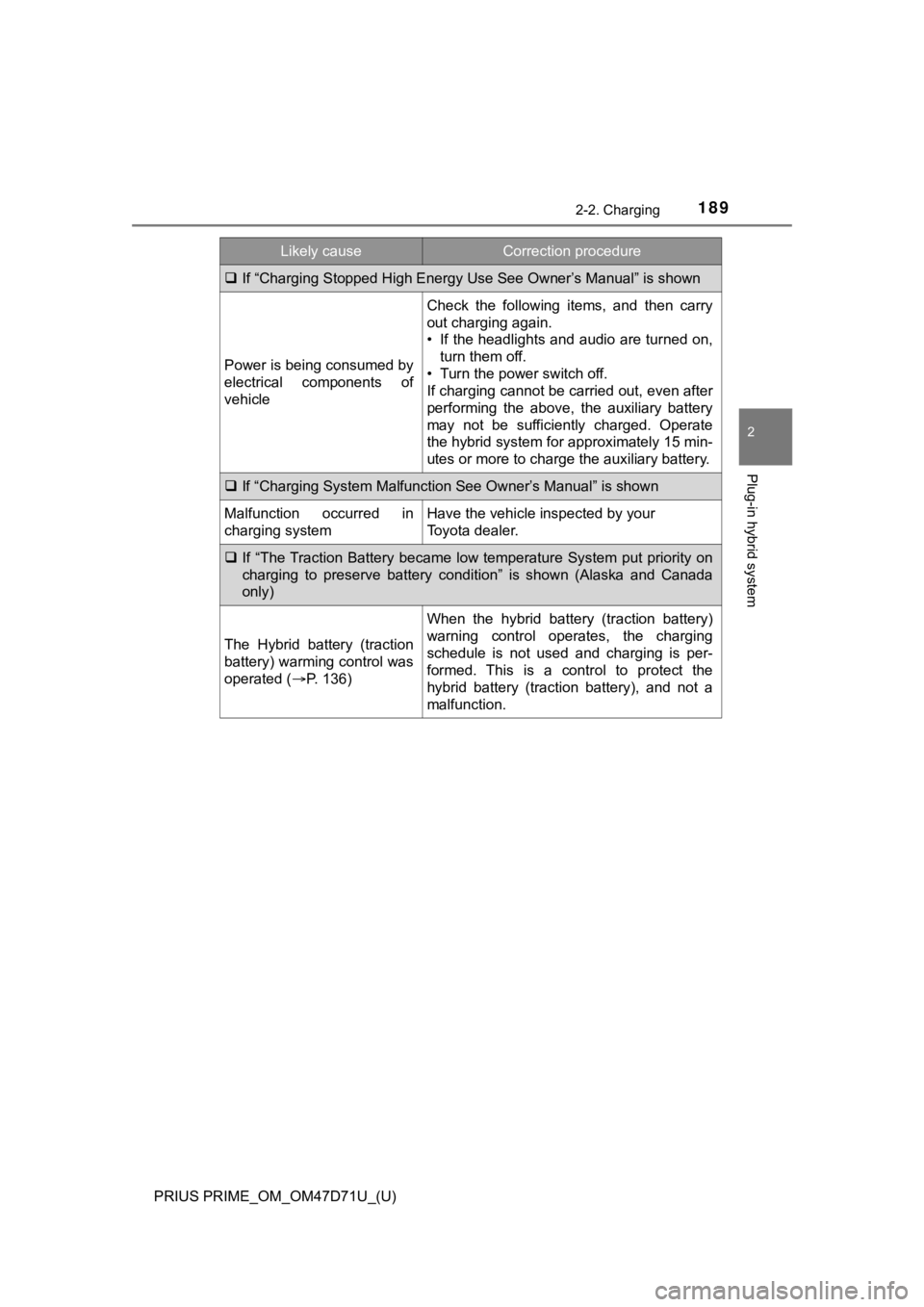
If “Charging Stopped High Energy Use See Owner’s Manual” is shown
Power is being consumed by
electrical components of
vehicle
Check the following items, and then carry
out charging again.
• If the headlights and audio are turned on,
turn them off.
• Turn the power switch off.
If charging cannot be carried out, even after
performing the above, the auxiliary battery
may not be sufficiently charged. Operate
the hybrid system for approximately 15 min-
utes or more to charge the auxiliary battery.
If “Charging System Malfunction See Owner’s Manual” is shown
Malfunction occurred in
charging systemHave the vehicle inspected by your
Toyota dealer.
If “The Traction Battery became low temperature System put priority on
charging to preserve battery condition” is shown (Alaska and Canada
only)
The Hybrid battery (traction
battery) warming control was
operated (P. 136)
When the hybrid battery (traction battery)
warning control operates, the charging
schedule is not used and charging is per-
formed. This is a control to protect the
hybrid battery (traction battery), and not a
malfunction.
Likely causeCorrection procedure