fuel pressure TOYOTA PRIUS PRIME 2022 Owners Manual
[x] Cancel search | Manufacturer: TOYOTA, Model Year: 2022, Model line: PRIUS PRIME, Model: TOYOTA PRIUS PRIME 2022Pages: 808, PDF Size: 14.72 MB
Page 17 of 808
17Pictorial index
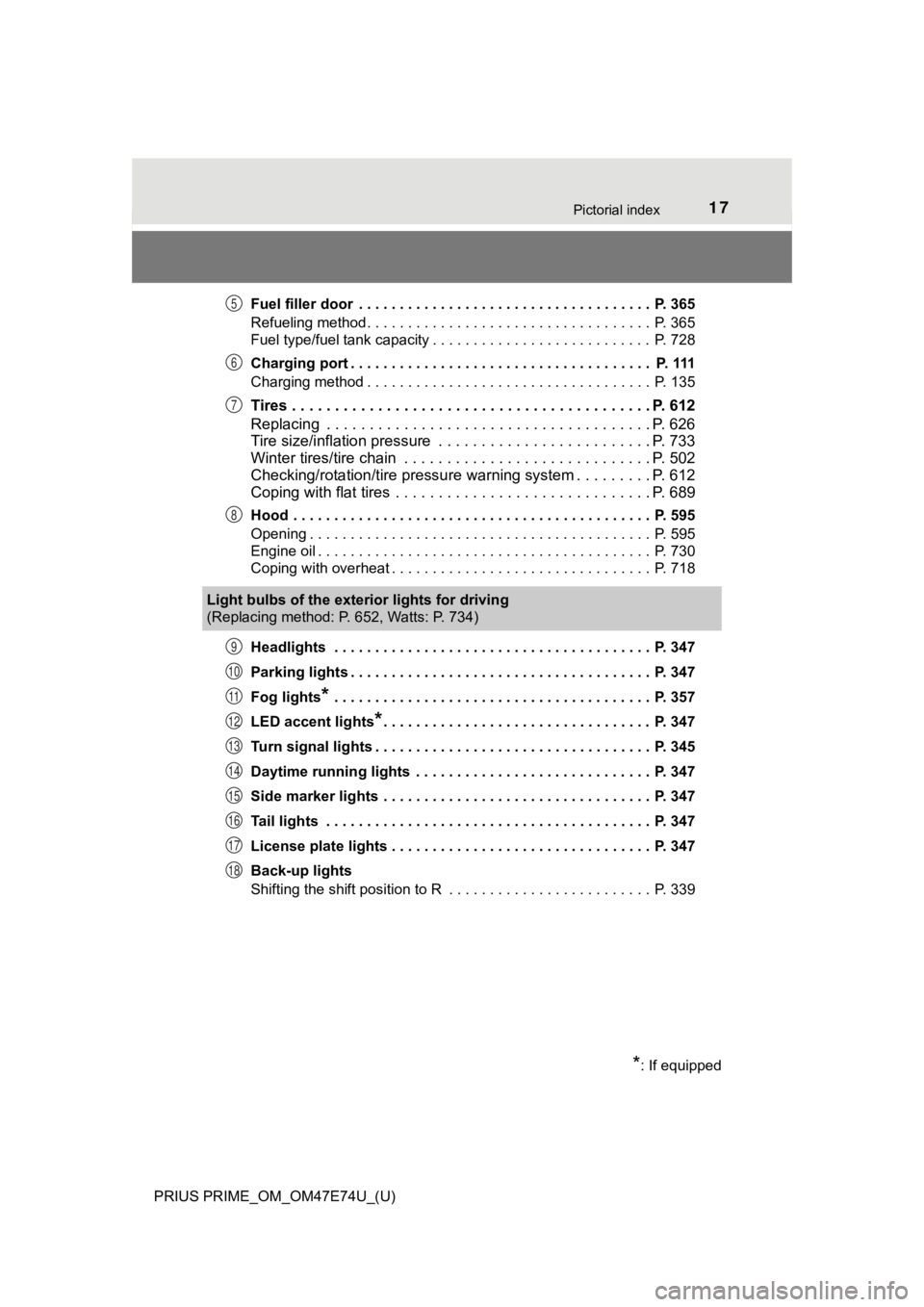
PRIUS PRIME_OM_OM47E74U_(U)Fuel filler door . . . . . . . . . . . . . . . . . . . . . . . . . . . . . . . . . . . . P. 365
Refueling method . . . . . . . . . . . . . . . . . . . . . . . . . . . . . . . . . . . P. 365
Fuel type/fuel tank capacity . . . . . . . . . . . . . . . . . . . . . . . . . . . P. 728
Charging port . . . . . . . . . . . . . . . . . . . . . . . . . . . . . . . . . . . . . P. 111
Charging method . . . . . . . . . . . . . . . . . . . . . . . . . . . . . . . . . . . P. 135
Tires . . . . . . . . . . . . . . . . . . . . . . . . . . . . .
. . . . . . . . . . . . . P. 612
Replacing . . . . . . . . . . . . . . . . . . . . . . . . . . . . . . . . . . . . . . P. 626
Tire size/inflation pressure . . . . . . . . . . . . . . . . . . . . . . . . . P. 733
Winter tires/tire chain . . . . . . . . . . . . . . . . . . . . . . . . . . . . . P. 502
Checking/rotation/tire pressur e warning system . . . . . . . . .P. 612
Coping with flat tires . . . . . . . . . . . . . . . . . . . . . . . . . . . . . . P. 689
Hood . . . . . . . . . . . . . . . . . . . . . . . . . . . . . . . . . . . . . . . . . . . . P. 595
Opening . . . . . . . . . . . . . . . . . . . . . . . . . . . . . . . . . . . . . . . . . . P. 595
Engine oil . . . . . . . . . . . . . . . . . . . . . . . . . . . . . . . . . . . . . . . . . P. 730
Coping with overheat . . . . . . . . . . . . . . . . . . . . . . . . . . . . . . . . P. 718
Headlights . . . . . . . . . . . . . . . . . . . . . . . . . . . . . . . . . . . . . . . P. 347
Parking lights . . . . . . . . . . . . . . . . . . . . . . . . . . . . . . . . . . . . . P. 347
Fog lights
* . . . . . . . . . . . . . . . . . . . . . . . . . . . . . . . . . . . . . . . P. 357
LED accent lights
*. . . . . . . . . . . . . . . . . . . . . . . . . . . . . . . . . P. 347
Turn signal lights . . . . . . . . . . . . . . . . . . . . . . . . . . . . . . . . . . P. 345
Daytime running lights . . . . . . . . . . . . . . . . . . . . . . . . . . . . . P. 347
Side marker lights . . . . . . . . . . . . . . . . . . . . . . . . . . . . . . . . . P. 347
Tail lights . . . . . . . . . . . . . . . . . . . . . . . . . . . . . . . . . . . . . . . . P. 347
License plate lights . . . . . . . . . . . . . . . . . . . . . . . . . . . . . . . . P. 347
Back-up lights
Shifting the shift position to R . . . . . . . . . . . . . . . . . . . . . . . . . P. 339
5
6
7
8
Light bulbs of the exterior lights for driving
(Replacing method: P. 652, Watts: P. 734)
*: If equipped
9
10
11
12
13
14
15
16
17
18
Page 108 of 808
108
PRIUS PRIME_OM_OM47E74U_(U)
2-1. Plug-in hybrid system
◆Air conditioning
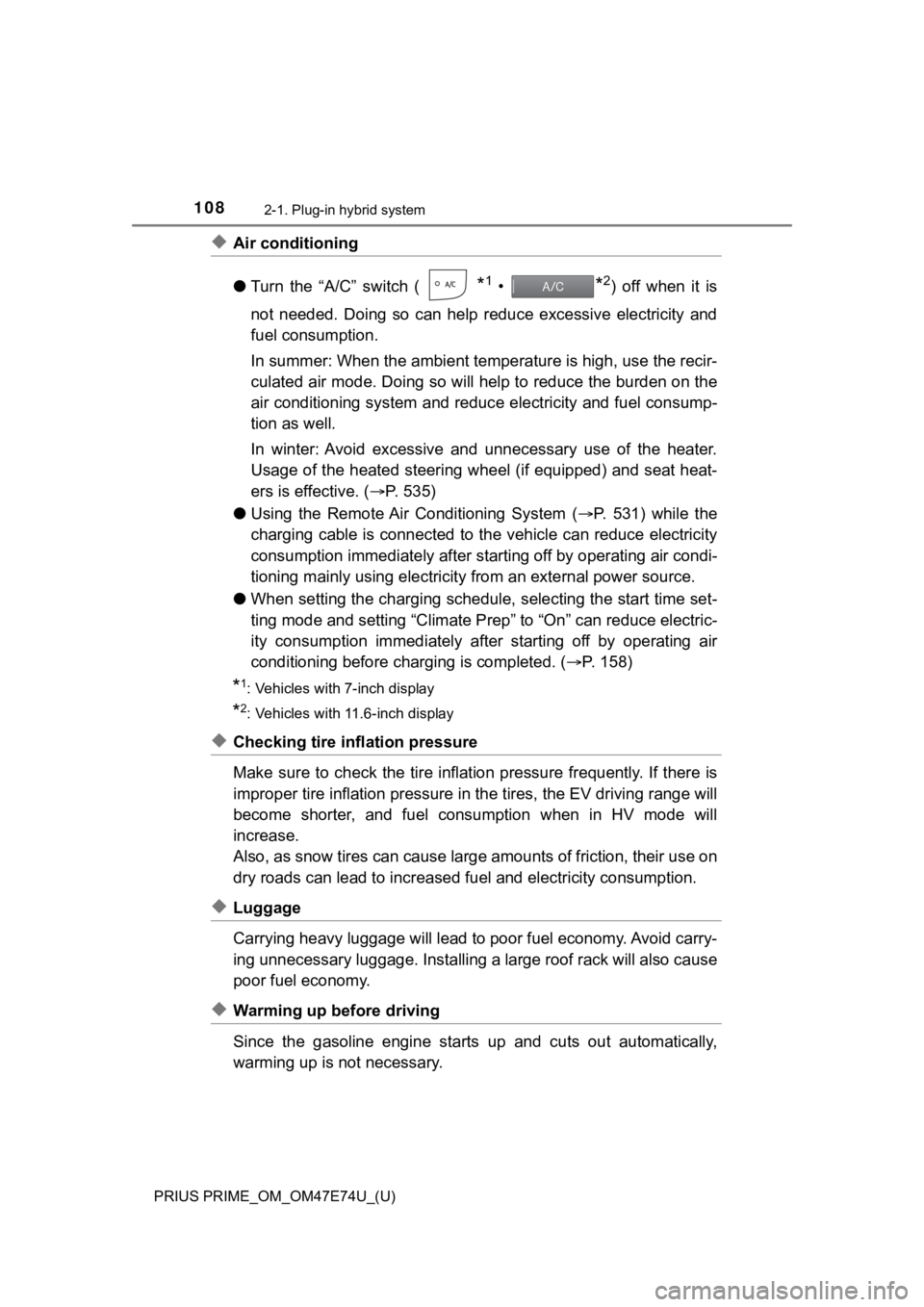
●Turn the “A/C” switch (
*1 • *2) off when it is
not needed. Doing so can help reduce excessive electricity and
fuel consumption.
In summer: When the ambient temperature is high, use the recir-
culated air mode. Doing so will help to reduce the burden on th e
air conditioning system and reduc e electricity and fuel consump-
tion as well.
In winter: Avoid excessive and unnecessary use of the heater.
Usage of the heated steering w heel (if equipped) and seat heat-
ers is effective. ( P. 5 3 5 )
● Using the Remote Air Conditioning System ( P. 531) while the
charging cable is connected to the vehicle can reduce electrici ty
consumption immediately after st arting off by operating air condi-
tioning mainly using electricity from an external power source.
● When setting the charging schedule, selecting the start time se t-
ting mode and setting “Climate Prep” to “On” can reduce electric-
ity consumption immedi ately after starting off by operating air
conditioning before c harging is completed. ( P. 158)
*1: Vehicles with 7-inch display
*2: Vehicles with 11.6-inch display
◆Checking tire inflation pressure
Make sure to check the tire inflation pressure frequently. If t here is
improper tire inflation pressur e in the tires, the EV driving range will
become shorter, and fuel consumption when in HV mode will
increase.
Also, as snow tires can cause large amounts of friction, their use on
dry roads can lead t o increased fuel and electricity consumptio n.
◆Luggage
Carrying heavy luggage will lead to poor fuel economy. Avoid carry-
ing unnecessary luggage. Installing a large roof rack will also cause
poor fuel economy.
◆Warming up before driving
Since the gasoline engine starts up and cuts out automatically,
warming up is not necessary.
Page 203 of 808
PRIUS PRIME_OM_OM47E74U_(U)
2033. Instrument cluster
3
Instrument cluster
*1: These lights turn on when the power switch is turned to ON mode to indi-
cate that a system check is being performed. They will turn off after the
hybrid system is on, or after a few seconds. There may be a malfunction in
a system if a light does not come on, or turn off. Have the veh icle
inspected by your Toyota dealer.
*2: The light flashes or illuminates to indicate a malfunction.
*3: The light flashes to indicate a malfunction.
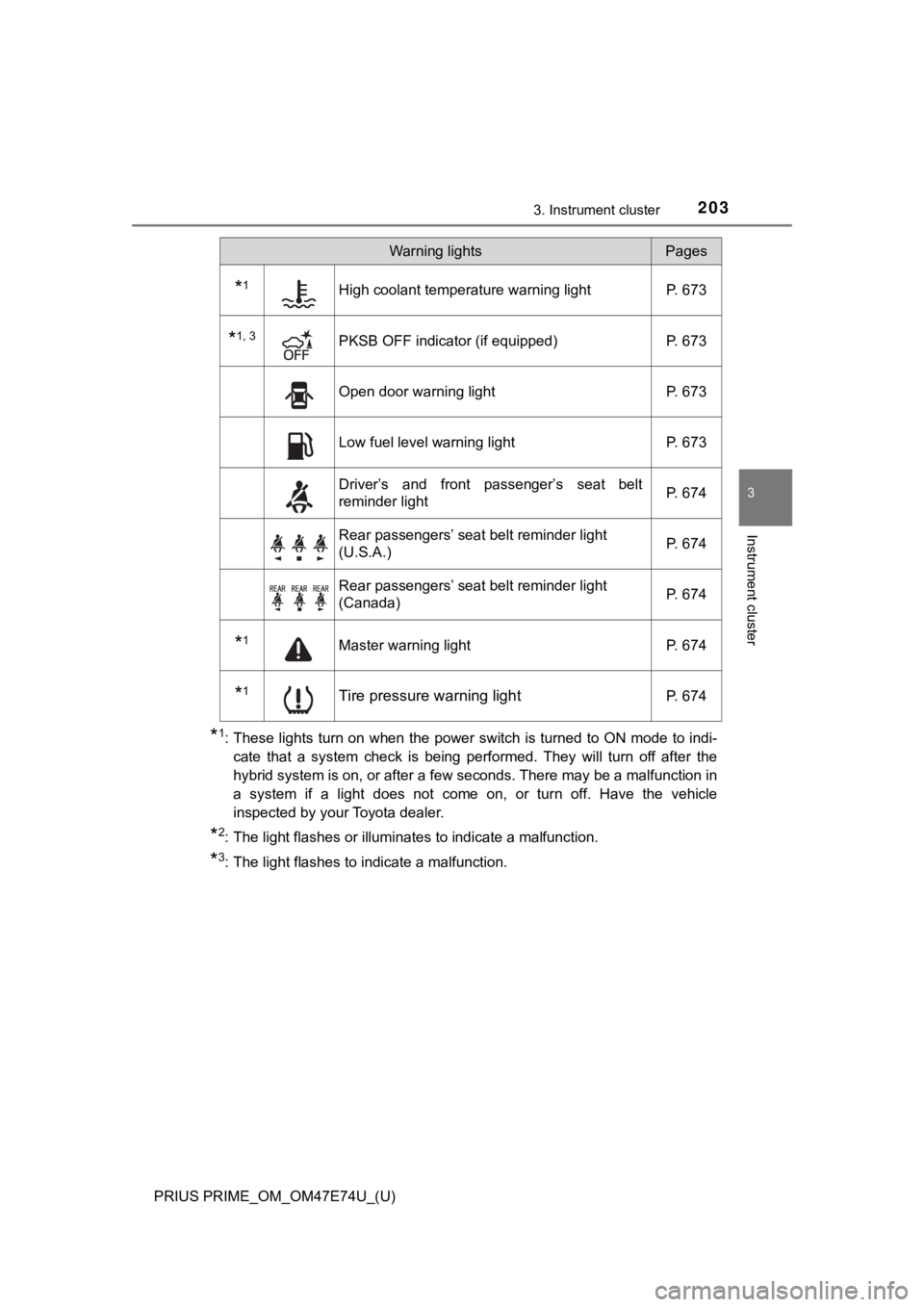
*1High coolant temperature warning light P. 673
*1, 3PKSB OFF indicator (if equipped)P. 673
Open door warning light P. 673
Low fuel level warning lightP. 673
Driver’s and front passenger’s seat belt
reminder light P. 674
Rear passengers’ seat belt reminder light
(U.S.A.)P. 674
Rear passengers’ seat belt reminder light
(Canada)P. 674
*1Master warning light
P. 674
*1Tire pressure warning lightP. 674
Warning lightsPages
Page 365 of 808

365
PRIUS PRIME_OM_OM47E74U_(U)
5-4. Refueling
5
Driving
Opening the fuel tank cap
●Turn the power switch off and ensure that all the doors and win -
dows are closed.
● Confirm the type of fuel.
■Fuel types
P. 735
■ Fuel tank opening for unleaded gasoline
To help prevent incorrect fueling, your vehicle has a fuel tank opening that
only accommodates the special nozzle on unleaded fuel pumps.
The fuel tank of your vehicle h as a special structure, which
requires a reduction in fuel tank pressure before refueling. After
the opener switch has been pressed, it will take several second s
until the vehicle is r eady for refueling.
Before refueling the vehicle
Page 368 of 808

368
PRIUS PRIME_OM_OM47E74U_(U)
5-4. Refueling
■When the fuel filler door cannot be opened by pressing the inside switch
Using the lever to open the fuel filler door may not allow for an adequate
reduction in fuel tank pressure before refueling. To prevent fu el from spilling
out, turn the cap slowly when removing it.
During refueling, fuel may spill out from the filler opening due to air being dis-
charged from inside the fuel tank. Therefore, fill the fuel tan k carefully and
slowly. Open the back door and remove the
cover underneath the luggage compart-
ment light.
Pull the lever backward and check that
the fuel lid opens.
NOTICE
■
When refueling
1
2
When refueling your vehicle, make sure
that the fuel filler door lock is not pushed
by the fuel nozzle boot, etc., as this may
cause a valve to close, possibly resulting
in a fuel spill.
If the fuel filler door lock has been
pushed, operate the fuel filler door
opener switch in the vehicle before con-
tinuing to refuel.
Page 504 of 808

504
PRIUS PRIME_OM_OM47E74U_(U)
5-6. Driving tips
■Tire chain installation
Observe the following precautions when installing and removing chains:
● Install and remove tire chains in a safe location.
● Install tire chains on the front tires only. Do not install tir e chains on the rear
tires.
● Install tire chains on front tires as tightly as possible. Retighten chains after
driving 1/4 - 1/2 mile (0.5 - 1.0 km).
● Install tire chains following the instructions provided with the tire chains.
■ Consumption of fuel and electricity
In cold temperatures, resistance of the parts of a vehicle (transmission, tires,
etc.) generally increases, resulting in increase of energy consumption. As a
result, fuel economy is likely to decrease.
Consumption of fuel and electricity of this vehicle is also likely to become
worse in cold temperatures.
WARNING
■Driving with snow tires
Observe the following precautions to reduce the risk of accidents.
Failure to do so may result in a loss of vehicle control and ca use death or
serious injury.
● Use tires of the specified size.
● Maintain the recommended level of air pressure.
● Do not drive in excess of 75 mph (120 km/h), regardless of the type of
snow tires being used.
● Use snow tires on all, not just some wheels.
■ Driving with tire chains
Observe the following precautions to reduce the risk of accidents.
Failure to do so may result in the vehicle being unable to be d riven safely,
and may cause death or serious injury.
● Do not drive in excess of the speed limit specified for the tir e chains being
used, or 30 mph (50 km/h), whichever is lower.
● Avoid driving on bumpy road surfaces or over potholes.
● Avoid sudden acceleration, abrupt steering, sudden braking and shifting
operations that cause sudden engine braking.
● Slow down sufficiently before entering a curve to ensure that vehicle con-
trol is maintained.
● Do not use LTA (Lane Tracing Assist).
■ When parking the vehicle
When parking the vehicle without applying the parking brake, ma ke sure to
chock the wheels. If you do not chock the wheels, the vehicle m ay move
unexpectedly, possibly resulting in an accident.
Page 574 of 808

574
PRIUS PRIME_OM_OM47E74U_(U)
7-1. Maintenance and care
Cleaning and protecting the vehicle exterior
●Working from top to bottom, liberally apply water to the vehicl e
body, wheel wells and underside of the vehicle to remove any di rt
and dust.
● Wash the vehicle body using a sponge or soft cloth, such as a
chamois.
● For hard-to-remove marks, use car wash soap and rinse thoroughl y
with water.
● Wipe away any water.
● Wax the vehicle when the wate rproof coating deteriorates.
If water does not bead on a clean surface, apply wax when the vehicle
body is cool.
■Before car washes
Check that the fuel filler door and charging port lid on your v ehicle are closed
properly.
■ Automatic car washes
●Fold the mirrors before washing the vehicle. Start washing from the front of
the vehicle. Make sure to extend the mirrors before driving.
● Brushes used in automatic car washes may scratch the vehicle su rface,
parts (wheel, etc.) and harm your vehicle’s paint.
● Rear spoiler may not be washable in some automatic car washes. There
may also be an increased risk of damage to vehicle.
■ High pressure car washes
As water may enter the cabin, do not bring the nozzle tip near the gaps
around the doors or perimeter of the windows, or spray these ar eas continu-
ously.
Perform the following to protect the vehicle and maintain it in
prime condition:
Page 593 of 808
PRIUS PRIME_OM_OM47E74U_(U)
5937-3. Do-it-yourself maintenance
7
Maintenance and care
Tire inflation
pressure
( P. 620)• Tire pressure gauge
• Compressed air source
Washer fluid
( P. 610)• Water or washer fluid containing antifreeze (for win-
ter use)
• Funnel (used only for adding water or washer fluid)
WARNING
The engine compartment contains many mechanisms and fluids that may
move suddenly, become hot, or become electrically energized. To avoid death
or serious injury, observe the following precautions.
■ When working on the engine compartment
● Make sure that the “Accessory”, “Ignition ON” or mileage display
(P. 210) on the main display and the “READY” indicator are both off.
● Keep hands, clothing and tools away from the moving fan.
● Be careful not to touch the engine, power control unit, radiato r, exhaust
manifold, etc. right after driving as they may be hot. Oil and other fluids
may also be hot.
● Do not leave anything that may burn easily, such as paper and r ags, in the
engine compartment.
● Do not smoke, cause sparks or expose an open flame to fuel. Fuel fumes
are flammable.
● Be extremely cautious when working on the 12-volt battery. It contains poi-
sonous and corrosive sulfuric acid.
■ When working near the electric cooling fans or radiator grille
Be sure the power switch is off.
With the power switch in ON mode, the electric cooling fans may automati-
cally start to run if the air conditioning is on and/or the coolant temperature
is high. (P. 604)
■ Safety glasses
Wear safety glasses to prevent flying or falling material, fluid spray, etc.
from getting in your eyes.
ItemsParts and tools
Page 621 of 808

PRIUS PRIME_OM_OM47E74U_(U)
6217-3. Do-it-yourself maintenance
7
Maintenance and care
Tire valve
Tire pressure gauge
Remove the tire valve cap.
Press the tip of the tire pressure gauge onto the tire valve.
Read the pressure using the gauge gradations.
If the tire inflation pressure is not at the recommended level, adjust
the pressure.
If you add too much air, press the center of the valve to defla te.
After completing the tire inflation pressure measurement and
adjustment, apply soapy water to the valve and check for leakage.
Put the tire valve cap back on.
■Tire inflation pressure check interval
You should check tire inflation p ressure every two weeks, or at least once
a month.
Do not forget to check the spare.
■Effects of incorrect tire inflation pressure
Driving with incorrec t tire inflation pressure may result in th e following:
●Reduced fuel economy
●Reduced driving comfort and poor handling
●Reduced tire life due to wear
●Reduced safety
●Damage to the drive train
If a tire needs frequent inflating , have it checked by your Toyota dealer.
Inspection and adjustment procedure
1
2
1
2
3
4
5
6
Page 677 of 808

6778-2. Steps to take in an emergency
PRIUS PRIME_OM_OM47E74U_(U)
8
When trouble arises
■SRS warning light
This warning light system monitors the airbag sensor assembly, front impact
sensors, side impact sensors (front door), side impact sensors (front), side
impact sensors (rear), driver’s seat belt buckle switch, front passenger occu-
pant classification system (ECU and sensors), “AIR BAG ON” indi cator light,
“AIR BAG OFF” indicator light, front passenger’s seat belt buck le switch, seat
belt pretensioners, airbags, interconnecting wiring and power s ources.
( P. 36)
■ Front passenger detection sensor, seat belt reminder and warnin g
buzzer
● If luggage is placed on the front passenger seat, the front pas senger detec-
tion sensor may cause the warning light to flash and the warnin g buzzer to
sound even if a passenger is not sitting in the seat.
● If a cushion is placed on the seat, the sensor may not detect a passenger,
and the warning light may not operate properly.
■ Electric power steering system wa rning light (warning buzzer)
When the 12-volt battery charge becomes insufficient or the vol tage tempo-
rarily drops, the electric power steering system warning light may come on
and the warning buzzer may sound.
■ If the malfunction indicator lamp comes on while driving
First check the following:
●Is the fuel tank empty?
If it is, fill the fuel tank immediately.
● Is the fuel tank cap loose?
If it is, tighten it securely.
The malfunction indicator lamp will go off after several drivin g trips.
If the malfunction indicator lamp does not go off even after several trips, con-
tact your Toyota dealer as soon as possible.
■
When the tire pressure warning light comes on
Inspect the appearance of the ti re to check that the tire is not punctured.
If the tire is punctured: P. 689
If the tire is not punctured:
Check the tire inflation pressure and adjust to the appropriate level. Initial-
izing the tire pressure warning system will not turn off the tire pressure
warning light.
■The tire pressure warning light may come on due to natural caus es
The tire pressure warning light may come on due to natural caus es such
as natural air leaks and tire inflation pressure changes caused by tem-
perature. In this case, adjusting the tire inflation pressure w ill turn off the
warning light (afte r a few minutes).
■Conditions that the tire pressure warning system may not functi on
properly
P. 6 1 7