ECU TOYOTA PRIUS PRIME 2023 User Guide
[x] Cancel search | Manufacturer: TOYOTA, Model Year: 2023, Model line: PRIUS PRIME, Model: TOYOTA PRIUS PRIME 2023Pages: 680, PDF Size: 14.97 MB
Page 37 of 680
371-1. For safe use
1
For safety and security
bag sensor assembly (ECU) controls airbag deployment based on
information obtained from the sensors, etc., shown in the system
components diagram above. This information includes crash sever-
ity and occupant information. As the airbags deploy, a chemical
reaction in the inflators quickly fills the airbags with non-toxic gas to
help restrain the motion of the occupants.
■If the SRS airbags deploy
(inflate)
●Slight abrasions, burns, bruising,
etc., may be sustained from SRS
airbags, due to the extremely high
speed of deployment (inflation) by
hot gases.
●A loud noise and white powder will
be emitted.
●Parts of the airbag module (steer-
ing wheel hub, airbag cover and
inflator) as well as the parts
around the airbags may be hot for
several minutes. The airbag itself
may also be hot.
●The windshield may crack.
●The hybrid system will be stopped
and fuel supply to the engine will
be stopped. (P.87)
●The brakes and st op lights will be
controlled automatically.
( P.425)
●The interior lights will turn on auto-
matically. ( P.446)
●The emergency flashers will turn
on automatically. ( P.546)
●For Safety Connect subscribers, if
any of the following situations
occur, the system is designed to
send an emergency call to the
response center, notifying them of
the vehicle’s location (without
needing to push the “SOS” button)
and an agent will a ttempt to speak
with the occupants to ascertain
the level of emergency and assis-
tance required. If the occupants
are unable to communicate, the
agent automatically treats the call
as an emergency and helps to dis-
patch the necessary emergency services. (
P.65)
• When an SRS airbag has been deployed
• When a seat belt pretensioner has
operated
• When the vehicle has been involved in a severe rear-end colli-
sion
■The SRS airbags deploy in a
frontal impact when
●The following SRS airbags will
deploy in the event of an impact
that exceeds a threshold level
(level of force corresponding to an
approximately 12 - 18 mph [20 -
30 km/h] frontal collision with a
fixed wall that does not move or
deform):
• SRS front airbags
●The threshold level at which the
SRS airbags will deploy will be
higher than normal in the in the
following situations:
• When the vehicle collides with an
object, such as a parked vehicle
or sign pole, which moves or
deforms on impact
• If the vehicle is involved in an underride collision, such as a colli-
sion in which the front of the vehi-
cle underrides, or goes under, the
bed of a truck
●Depending on the type of collision,
only the following may deploy:
• Seat belt pretensioners
●The SRS airbags for the front pas-
senger’s seat will not deploy if
there is no passenger in the front
passenger seat. However, the
SRS airbags for the front passen-
ger’s seat may deploy, even if the
seat is unoccupied, if luggage is
put on the seat.
Page 39 of 680
391-1. For safe use
1
For safety and security
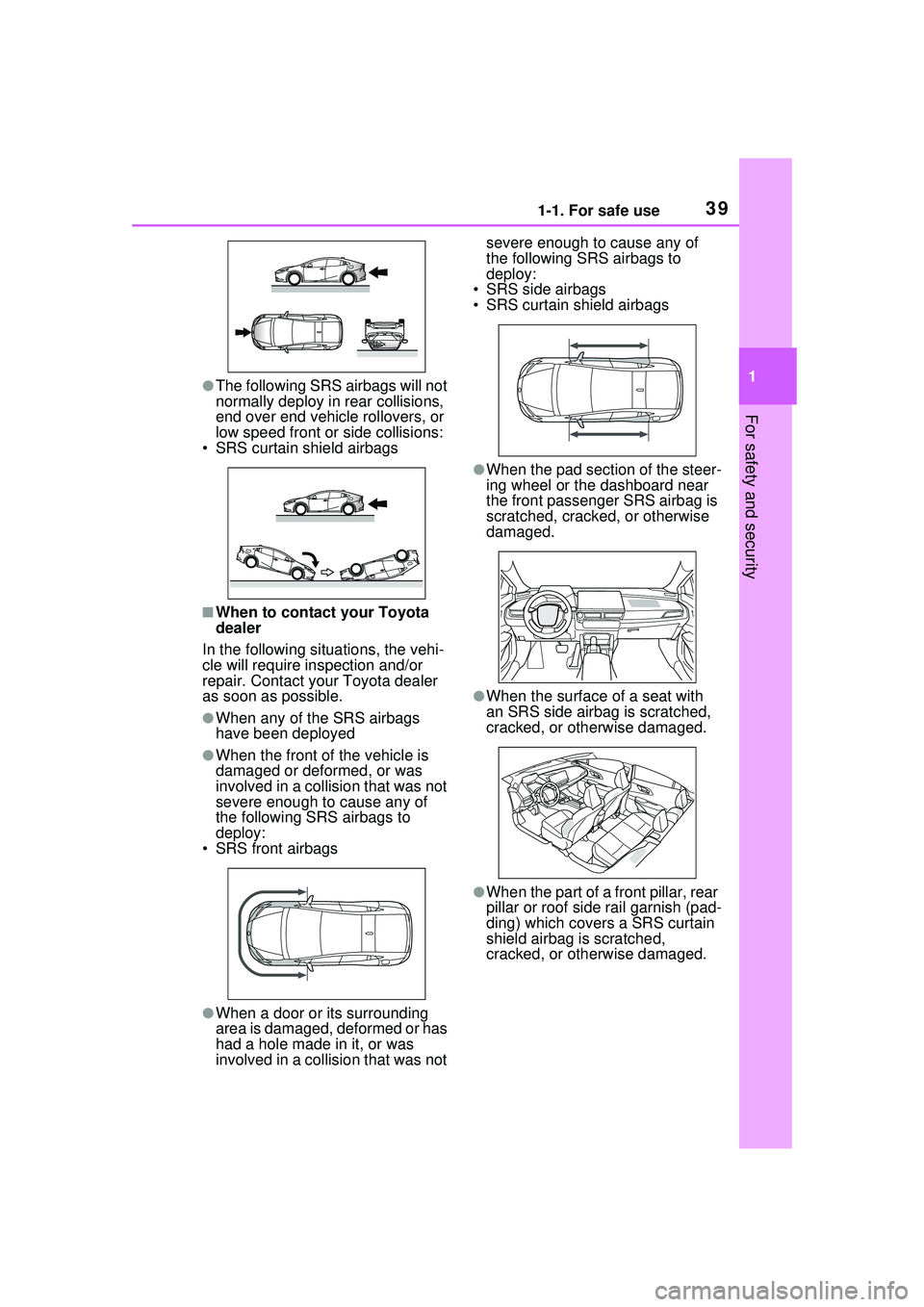
●The following SRS airbags will not
normally deploy in rear collisions,
end over end vehicle rollovers, or
low speed front or side collisions:
• SRS curtain shield airbags
■When to contact your Toyota
dealer
In the following situations, the vehi-
cle will require inspection and/or
repair. Contact your Toyota dealer
as soon as possible.
●When any of the SRS airbags
have been deployed
●When the front of the vehicle is
damaged or deformed, or was
involved in a collision that was not
severe enough to cause any of
the following SRS airbags to
deploy:
• SRS front airbags
●When a door or its surrounding
area is damaged, deformed or has
had a hole made in it, or was
involved in a collision that was not severe enough to cause any of
the following SRS airbags to
deploy:
• SRS side airbags
• SRS curtain shield airbags
●When the pad section of the steer-
ing wheel or the dashboard near
the front passenger SRS airbag is
scratched, cracked, or otherwise
damaged.
●When the surface of a seat with
an SRS side airbag is scratched,
cracked, or otherwise damaged.
●When the part of a front pillar, rear
pillar or roof side rail garnish (pad-
ding) which covers a SRS curtain
shield airbag is scratched,
cracked, or otherwise damaged.
Page 41 of 680
411-1. For safe use
1
For safety and security
WARNING
●The SRS front passenger air-
bag deploys with considerable
force, and can cause death or
serious injury, especially if the
front passenger is very close to
the airbag. The front passenger
seat should be positioned as far
possible from the airbag with
the seatback adjusted so that
the passenger is sat upright.
●Improperly seated and/or
restrained infants and children
can be killed or seriously injured
by a deploying airbag. An infant
or child who is too small to use
a seat belt should be properly
secured using a child restraint
system. Toyota strongly recom-
mends that all infants and chil-
dren be placed in the rear seats
of the vehicle and properly
restrained. The rear seats are
safer for infants and children
than the front passenger seat.
( P.51)
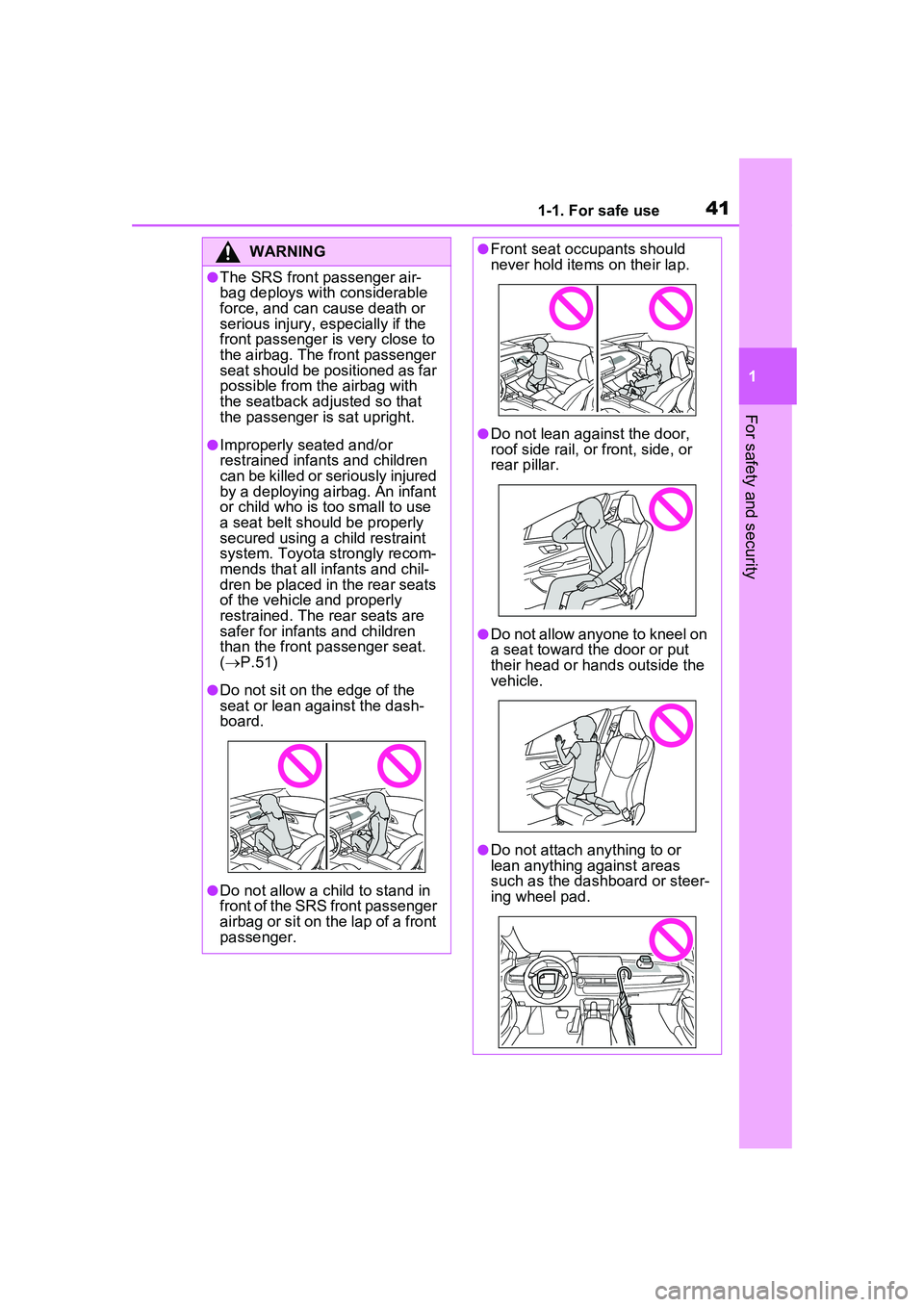
●Do not sit on the edge of the
seat or lean against the dash-
board.
●Do not allow a child to stand in
front of the SRS front passenger
airbag or sit on the lap of a front
passenger.
●Front seat occupants should
never hold items on their lap.
●Do not lean against the door,
roof side rail, or front, side, or
rear pillar.
●Do not allow anyone to kneel on
a seat toward the door or put
their head or hands outside the
vehicle.
●Do not attach anything to or
lean anything against areas
such as the dashboard or steer-
ing wheel pad.
Page 43 of 680
431-1. For safe use
1
For safety and security
WARNING
• Front door trim
• Front door speakers
●Modifications to the front door
panels (such as making holes in
them)
●Repair or modification of the fol-
lowing parts or their surrounding
• Front fender
• Front bumper
• Sides of the vehicle interior
●Installation of the following parts
or accessories
• Bull bars or kangaroo bars
• Snow plows
• Winches
• Roof luggage carriers
●Modifications to the vehicle’s
suspension
●Installation of electronic devices
such as mobile two-way radios
(RF-transmitter) and CD players
●Modifications to your vehicle for
a person with a physical disabil-
ity
Page 45 of 680
451-1. For safe use
1
For safety and security
WARNING
●Make sure the “PASSENGER
AIR BAG OFF” indicator light is
not illuminated when using the
seat belt extender for the front
passenger seat. If the “PAS-
SENGER AIR BAG OFF” indi-
cator light is illuminated,
disconnect the extender tongue
from the seat belt buckle, and
reconnect the seat belt. Recon-
nect the seat belt extender after
making sure the “PASSENGER
AIR BAG ON” indicator light is
illuminated. If you use the seat
belt extender while the “PAS-
SENGER AIR BAG OFF” indi-
cator light is illuminated, the
SRS airbags for the front pas-
senger will not activate, which
could cause death or serious
injury in the event of a collision.
●Do not apply a heavy load to the
front passenger seat or equip-
ment (e.g. se atback pocket).
●Do not put weight on the front
passenger seat by putting your
hands or feet on the front pas-
senger seat seatback from the
rear passenger seat.
●Do not let a rear passenger lift
the front passenger seat with
their feet or press on the seat-
back with their legs.
●Do not put objects under the
front passenger seat.
●Do not recline the front passen-
ger seatback so far that it
touches a rear seat. This may
cause the “PASSENGER AIR
BAG OFF” indicator light to be
illuminated, which indicates that
the SRS airbags for the front
passenger will not activate in
the event of a severe accident.
If the seatback touches the rear
seat, return th e seatback to a
position where it does not touch
the rear seat. Keep the front
passenger seatback as upright
as possible when the vehicle is
moving. Reclining the seatback
excessively may lessen the
effectiveness of the seat belt
system.
●If an adult sits in the front pas-
senger seat, the “PASSENGER
AIR BAG ON” indicator light is
illuminated. If the “PASSEN-
GER AIR BAG OFF” indicator is
illuminated, ask the passenger
to sit up straight, well back in
the seat, feet on the floor, and
with the seat belt worn correctly.
If the “PASSENGER AIR BAG
OFF” indicator still remains illu-
minated, either ask the passen-
ger to move to the rear seat, or
if that is not possible, move the
front passenger seat fully rear-
ward.
●When it is unavoidable to install
a forward-facing child restraint
system on the front passenger
seat, install the child restraint
system on the front passenger
seat in the proper order.
( P.53)
●Do not modify or remove the
front seats.
Page 47 of 680

471-1. For safe use
1
For safety and security
■Child*4
■Child restraint system with infant*5
■Unoccupied
Indicators/warn-ing lights
“PASSENGER AIR BAG ON” and
“PASSENGER AIR BAG OFF” indica- tor lights“PASSENGER
AIR BAG OFF” or “PASSENGER
AIR BAG ON”
*4
SRS warning lightOff
Driver’s and front passenger’s seat belt reminder lightOff*2 or flashing*3
DevicesFront passenger airbagDeactivated or
activated
*4
Indicators/warn- ing lights
“PASSENGER AIR BAG ON” and
“PASSENGER AIR BAG OFF” indica- tor lights“PASSENGER
AIR BAG OFF”
*6
SRS warning lightOff
Driver’s and front passenger’s seat belt reminder lightOff*2 or flashing*3
DevicesFront passenger airbagDeactivated
Indicators/warn-ing lights
“PASSENGER AIR BAG ON” and
“PASSENGER AIR BAG OFF” indica- tor lights“PASSENGER
AIR BAG OFF”
SRS warning light
OffDriver’s and front passenger’s seat belt reminder light
DevicesFront passenger airbagDeactivated
Page 49 of 680
491-1. For safe use
1
For safety and security
Exhaust gas precau-
tions
Harmful substance to the
human body is included in
exhaust gases if inhaled.
WARNING
Exhaust gases contain harmful
carbon monoxide (CO), which is
colorless and odorless. Observe
the following precautions.
Failure to do so may cause
exhaust gases to enter the vehicle
and may lead to an accident
caused by light-headedness, or
may lead to death or a serious
health hazard.
■Important points while driving
●Keep the back door closed.
●If you smell exhaust gases in
the vehicle even when the back
door is closed, open the side
windows and have the vehicle
inspected at your Toyota dealer
as soon as possible.
■When parking
●If the vehicle is in a poorly venti-
lated area or a closed area,
such as a garage, stop the
hybrid system.
●Do not leave the vehicle with
the hybrid system operating for
a long time.
If such a situation cannot be
avoided, park the vehicle in an
open space and ensure that
exhaust fumes do not enter the
vehicle interior.
●Do not leave the hybrid system
operating in an area with snow
build-up, or where it is snowing.
If snowbanks build up around
the vehicle while the hybrid sys-
tem operating, exhaust gases
may collect and enter the vehi-
cle.
■Exhaust pipe
The exhaust system needs to be
checked periodically. If there is a
hole or crack caused by corro-
sion, damage to a joint or abnor-
mal exhaust noise, be sure to
have the vehicle inspected and
repaired by your Toyota dealer.
Page 51 of 680
511-2. Child safety
1
For safety and security
Points to remember: P.51
Child restraint system: P.53
When using a child restraint sys-
tem: P.54
Child restraint system installa-
tion method
• Fixed with a seat belt: P.55
• Fixed with a child restraint LATCH anchor: P.60
• Using an anchor bracket (for top tether strap): P.62 The laws of all 50 states of the
U.S.A. as well as Canada now
require the use of child restraint
systems.
Prioritize and observe the
warnings, as well as the laws
and regulations for child
restraint systems.
Use a child restraint system
until the child becomes large
enough to properly wear the
vehicle’s seat belt.
Choose a child restraint sys-
tem that suits your vehicle
and is appropriate to the age
and size of the child.
Child restraint sys-
tems
Before installing a child
restraint system in the vehi-
cle, there are precautions
that need to be observed,
different types of child
restraint systems, as well as
installation methods, etc.,
written in this manual.
Use a child restraint system
when riding with a small child
that cannot properly use a
seat belt. For the child’s
safety, install the child
restraint system to a rear seat.
Be sure to follow the installa-
tion method that is in the oper-
ation manual enclosed with
the restraint system.
Table of contents
Points to remember
WARNING
■When a child is riding
Observe the following precau-
tions.
Failure to do so may result in
death or serious injury.
●For effective protection in auto-
mobile accidents and sudden
stops, a child must be properly
restrained, using a seat belt or
child restraint system which is
correctly installe d. For installa-
tion details, refer to the opera-
tion manual enclosed with the
child restraint system. General
installation inst ructions are pro-
vided in this manual.
Page 52 of 680
521-2. Child safety
WARNING
●Toyota strongly urges the use of
a proper child restraint system
that conforms to the weight and
size of the child, installed on the
rear seat. According to accident
statistics, the child is safer when
properly restrained in the rear
seat than in the front seat.
●Holding a child in your or some-
one else’s arms is not a substi-
tute for a child restraint system.
In an accident, the child can be
crushed against the windshield
or between the holder and the
interior of the vehicle.
■Handling the child restraint
system
If the child restrain t system is not
properly fixed in place, the child or
other passengers may be seri-
ously injured or even killed in the
event of sudden braking, sudden
swerving, or an accident.
●If the vehicle were to receive a
strong impact from an accident,
etc., it is possible that the child
restraint system has damage
that is not readily visible. In
such cases, do not reuse the
restraint system.
●Make sure you have complied
with all installation instructions
provided with the child restraint
system manufacturer and that
the system is properly secured.
●Keep the child restraint system
properly secured on the seat
even if it is not in use. Do not
store the child restraint system
unsecured in the passenger
compartment.
●If it is necessary to detach the
child restraint system, remove it
from the vehicle or store it
securely in the luggage com-
partment.
Page 53 of 680
531-2. Child safety
1
For safety and security
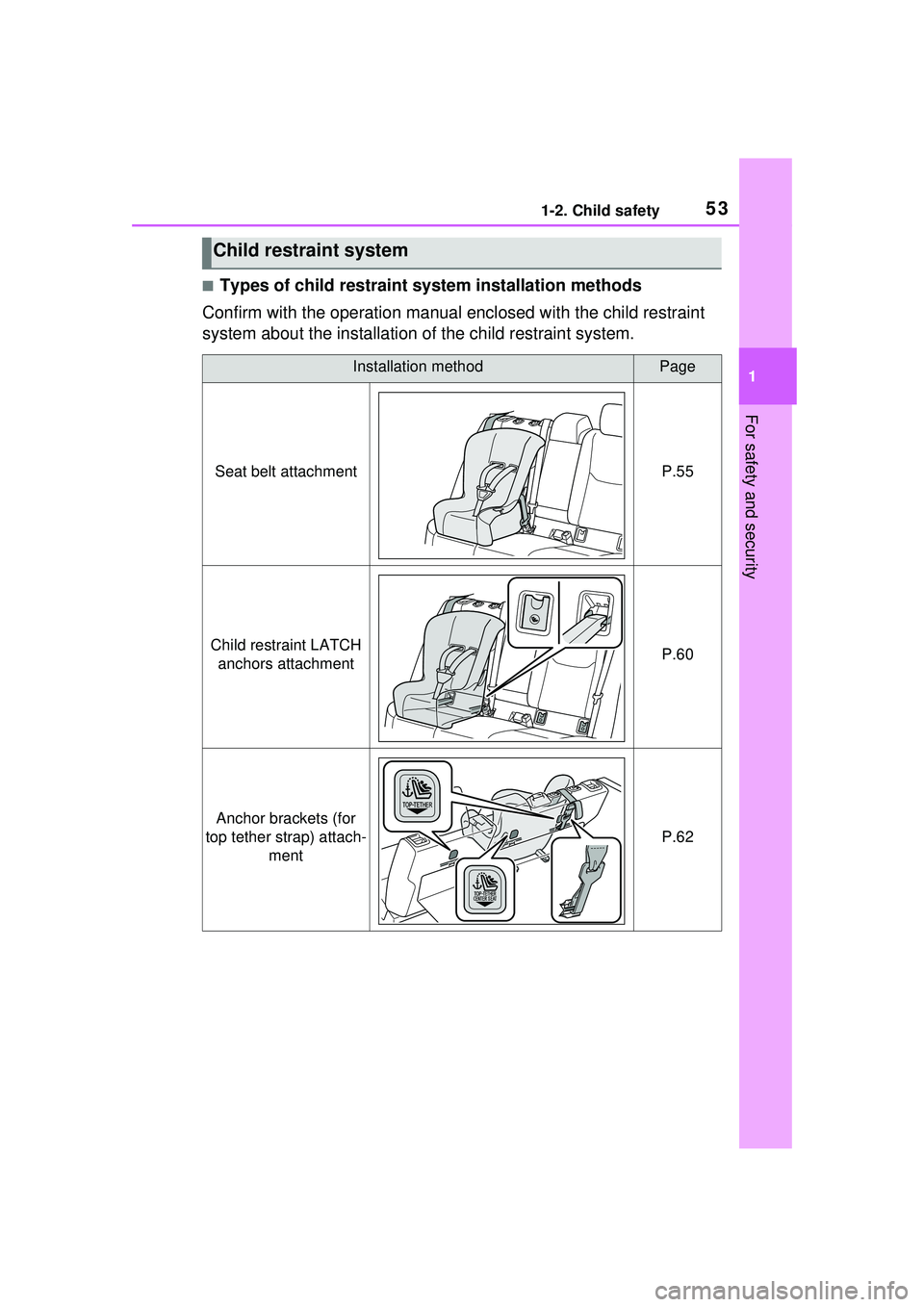
■Types of child restraint system installation methods
Confirm with the operation manual enclosed with the child restraint
system about the installation of the child restraint system.
Child restraint system
Installation methodPage
Seat belt attachmentP.55
Child restraint LATCH anchors attachmentP.60
Anchor brackets (for
top tether strap) attach- ment
P.62